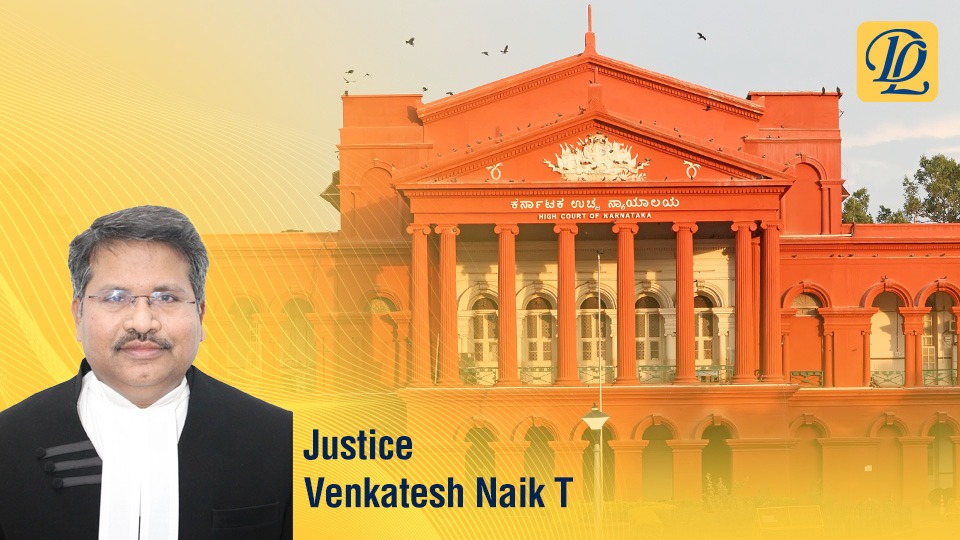
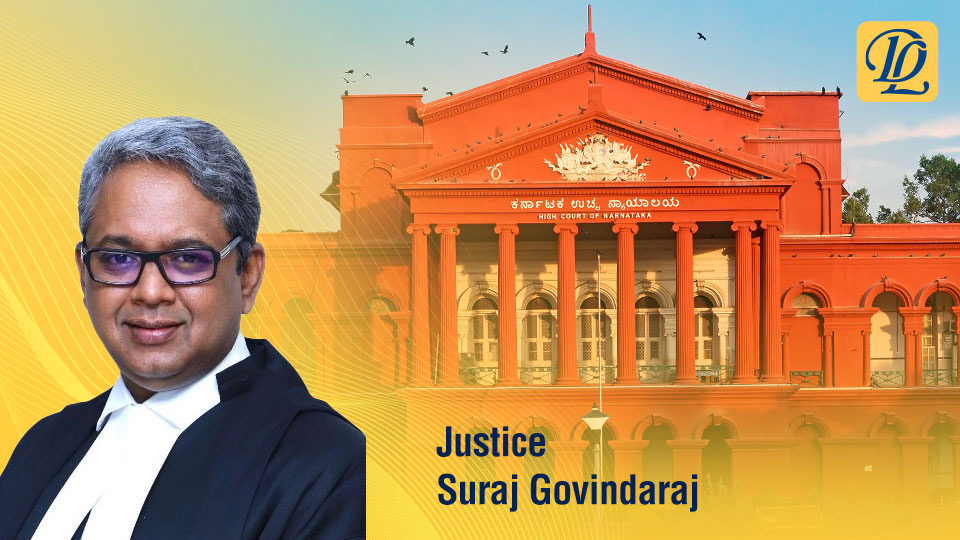
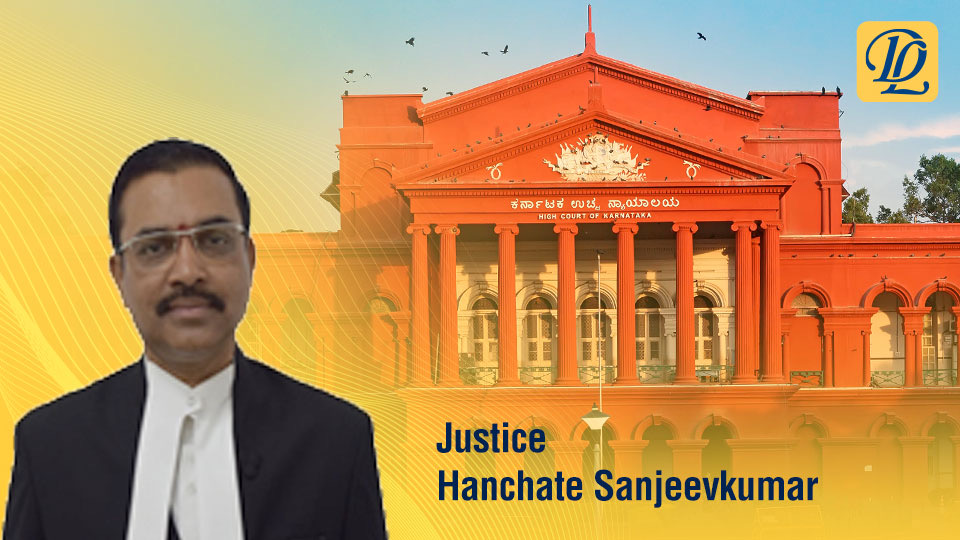
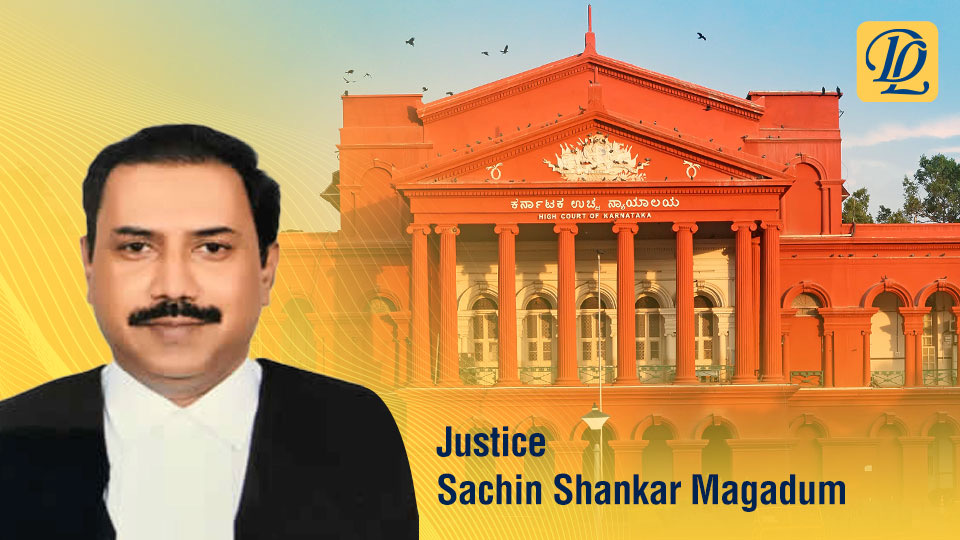
Hon’ble Mr. Justice Venkatesh Naik T celebrates his 51st birthday today.
Hon’ble Mr. Justice Venkatesh Naik Thavaryanaik: Born on 01.06.1975. Native of Chitradurga. Completed B.A.L., L.L.B., from SJM Law College, Chitradurga and secured 3rd Rank. Obtained L.L.M. from Kuvempu University, Shivamogga. Enrolled as Advocate and practiced at Chitradurga. Appointed as District Judge on 02.01.2012. Served as Registrar (Administration) at High Court. Worked at Prl. Secretary to Government, Law Department. Worked as Prl. District & Sessions Judge, Udupi & Bengaluru Rural District.
Sworn-in as Additional Judge of the High Court of Karnataka on 24.01.2023.
Important Judgments delivered by Hon’ble Mr. Justice Venkatesh Naik.
“Speedy trial in NIA cases guarantees the fundamental right under Article 21”. Karnataka High Court directs establishment of three more Special to ensure speedy trial and disposal of the NIA cases.
Karnataka High Court directs amendment of Section 377 IPC to include Necrophilia on the lines of laws prevalent in UK, Canada, NZ etc. Guidelines issued to install CCTVs in mortuaries and to maintain Mortuary hygiene.
Mere act of insulting a person would not satisfy the ingredients of Section 504, IPC. There must be intentional insult with intent to provoke breach of the peace. Karnataka High Court.
Abetment to commit suicide. Merely because a person has been so named in the suicide note, one cannot immediately jump to the conclusion that he is an offender under Section 306 of IPC. Karnataka High Court.
Additional accused can be added under Section 319 Cr.P.C. before the conviction and sentence is pronounced as otherwise the Court gets divested of its power. Karnataka High Court.
Suit for specific performance. When the defendant neither pleads nor leads evidence on hardship, Court shall decree the suit especially when the plaintiff proves readiness & willingness. Karnataka High Court.
Mere expression of words without any intention to cause alarm or cause to do any act which he is not legally bound to do, or to omit to do does not constitute criminal intimidation under Section 506 IPC. Karnataka High Court.
Mere use of words ‘Investigating Officer is directed to conduct the investigation’ without applying the judicious mind, does not amount to permission by the Magistrate to take up the investigation for a non-cognizable offence. Karnataka High Court.
Advocates must practice Seven Lamps of Advocacy. Making false allegations against the Presiding Officer cannot be countenanced for transfer of case under Section 407 of Cr.P.C. Karnataka High Court.
Mere act of insulting a person would not satisfy the ingredients of Section 504, IPC. There must be intentional insult with intent to provoke breach of the peace. Karnataka High Court.
Abetment to commit suicide. Merely because a person has been so named in the suicide note, one cannot immediately jump to the conclusion that he is an offender under Section 306 of IPC. Karnataka High Court.
Additional accused can be added under Section 319 Cr.P.C. before the conviction and sentence is pronounced as otherwise the Court gets divested of its power. Karnataka High Court.
Land acquisition. Deletion of certain lands from the acquisition based on objective, rational considerations, including areas that had already been converted for non-agricultural use, extensively developed localities, nurseries, religious institutions, and lands already acquired for other Government projects etc cannot be a ground to challenge the acquisition proceedings. Karnataka High Court.
Land acquisition. Failure to include land in the preliminary notification and denial of the right to file objections vitiates the entire acquisition proceedings. Arbitrary exclusion or inclusion of lands in the acquisition process is discriminatory and unlawful. Karnataka High Court.
A General Power of Attorney duly executed and notarized carries a presumption of validity under Section 85 of the Indian Evidence Act. Mere execution of a cancellation deed and its registration under Book IV of the Registration Act does not amount to constructive notice to third parties. Karnataka High Court.
Service Law. A suspension order cannot be sustained if it is based solely on a criminal case that has been quashed. Continued suspension, in the absence of periodic review is illegal. Karnataka High Court.
Judgment on admission. A suit can be dismissed on the basis of admissions if they are unequivocal and leave no further dispute regarding the material facts in the case. Admissions regarding the validity of a family settlement in a compromise petition falls within the ambit of Order XII Rule 6 CPC. Karnataka High Court.
”Even if disobedience of a court order is undisputed, the court may consider a defence of impossibility to comply and refrain from initiating contempt proceedings if enforcement is deemed impossible”. Karnataka High Court accepts substantial compliance regarding restoration of forest lands in the revenue records.
Constructive Resjudicata. To invoke Order II Rule 2 CPC and to reject the plaint, there should be intentional relinquishment of claim in the earlier suit. Karnataka High Court.
“No breaking of link’’. In a criminal trial based entirely on circumstantial evidence, the Court cannot sustain a conviction for murder based on inadmissible statements and weak circumstantial links that do not exclude the hypothesis of innocence. Karnataka High Court.
‘Uninformed legitimization of trivialities would make a mockery of administration of criminal justice.’ Where the testimony of the primary witness reveals a pre-planned attempt to falsely implicate the accused in coordination with the Police, the evidence loses its credibility, and the accused is entitled to an acquittal. Karnataka High Court.
Dowry death. A conviction cannot rest solely on medical evidence of homicidal death without a credible link showing cruelty soon before death. Where interested witnesses give materially contradictory statements unsupported by independent evidence, statutory presumptions cannot be invoked. If dowry allegations are vague and the prosecution fails to prove guilt beyond reasonable doubt, the accused is entitled to the benefit of doubt. Karnataka High Court.
Companies Act 1956. The Court will not interfere with a Scheme of Arrangement approved by an overwhelming majority unless it is patently illegal, fraudulent, or based on a perverse valuation; pending misfeasance proceedings or minority share disputes do not bar sanction of an otherwise viable scheme. Karnataka High Court.
“Nandi Infrastructure Corridor Enterprise Limited is sitting on a huge land bank without much progress’’. Karnataka High Court directs the State Government to bring fresh planning by discarding the Framework Agreement at the earliest.
The development of townships adjacent to a major infrastructure corridor is considered an integral and inseparable part of the ‘public purpose’ of the project. Once the overarching validity of an infrastructure project and its land requirements have been upheld by the Supreme Court, individual challenges to specific land parcels on the same grounds are barred by the principles of finality of litigation. Karnataka High Court.
Trademarks Act. A company in liquidation loses its proprietary rights and goodwill over a trade mark when it has been continuously out of use for a long period. Its non-use is not covered by ‘special circumstances’ under Section 47(3). Karnataka High Court.
A lease renewal or extension clause is not absolute and cannot be specifically enforced where it expressly makes renewal subject to the lessor’s consent. If the landlord refuses consent after the original term expires, the tenancy lawfully ends and the tenant’s continued possession becomes unlawful. Karnataka High Court.
Karnataka Lokayukta Act. Chairman of a government company is a ‘public servant’ under the Act. The collective nature of board decisions does not absolve the Chairman of responsibility for ensuring adherence to statutory rules. Karnataka High Court.
Prevention of Money Laundering Act. A transaction concerning a corporate asset that is already under liquidation, executed by a promoter or director without lawful title or authority, and undertaken in circumstances demonstrating absence of good faith, is liable to be declared void. Karnataka High Court.
A Court Order obtained by misleading the court cannot be the basis for initiating contempt proceedings for its non-compliance. Such order cannot be given effect to and no contempt can be said to have been committed by its non-compliance. Karnataka High Court.
Properties mortgaged to a Bank as collateral security, and acquired prior to the alleged offenses, do not constitute ‘proceeds of crime’ under the PMLA. The attachment of such properties undermines the Bank’s rights as a secured creditor to recover public money under the SARFAESI Act, especially if the Bank was not issued notice under Section 8 of the PMLA. Karnataka High Court.
Prevention of Money Laundering Act. The Appellate Tribunal does not possess the inherent power to remand a case back to the Adjudicating Authority. The Appellate Tribunal is a creature of Statute with limited, specifically conferred powers, and the Act does not explicitly vest the power of remand in the Appellate Tribunal. Karnataka High Court.
A land grant made by the Government for a specific purpose with right of resumption does not constitute a full alienation or sale of the land. Neither a mortgage of these limited rights nor the winding-up of the grantee company extinguishes the Government’s power of resumption. Karnataka High Court.
Land acquisition. Deletion of certain lands from the acquisition based on objective, rational considerations, including areas that had already been converted for non-agricultural use, extensively developed localities, nurseries, religious institutions, and lands already acquired for other Government projects etc cannot be a ground to challenge the acquisition proceedings. Karnataka High Court.
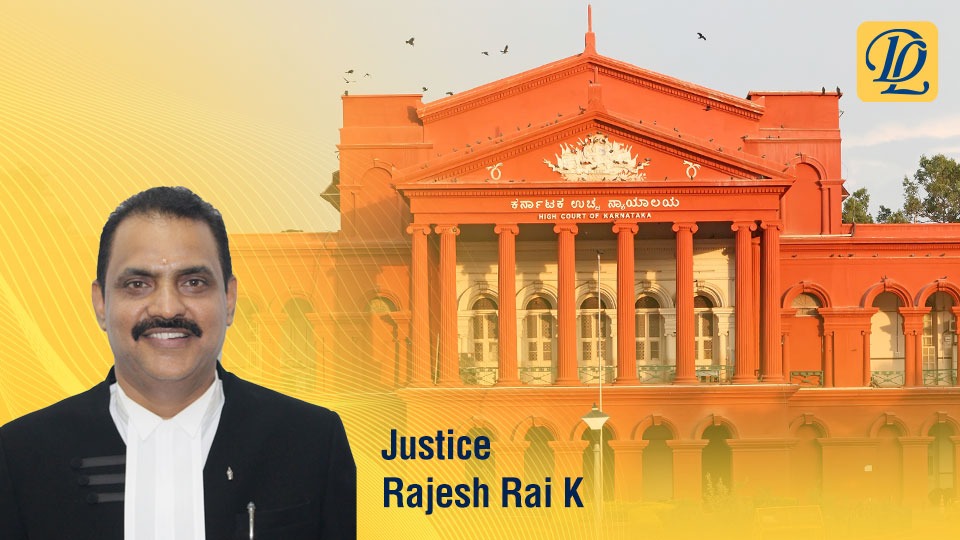
Hon’ble Mr. Justice Rajesh Rai K celebrates his 52nd birthday today.
Hon’ble Mr. Justice Rajesh Rai Kallangala: Born on 01.06.1974. Completed primary education at Kepu & secondary education & PUC at Vitla. Completed Degree from St. Philomina’s College. Completed LL.B., from Vivekananda Law College, Puttur. Enrolled as Advocate in 1999 and practiced in the office of Sri G. Balakrishna Shastri and Sri Younus Ali Khan. Later joined the office of Hon’ble shri Justice John Michael D’Cunha. Worked as Government Pleader for 2 years. Served as Central Government Senior Panel Counsel for 6 years. Functioned as Special Public Prosecutor for Enforcement Directorate, and Narcotics Control Bureau. Served as Panel Advocate for BDA. Practiced mainly on criminal side.
Sworn-in as Additional Judge of the High Court of Karnataka on 09.02.2023.
Important Judgments delivered by Hon’ble Mr. Justice Rajesh Rai.
IPC. Section 306. To constitute the offence under Section 306, IPC, the accused must have played an active role by act of instigation or doing certain act to facilitate the commission of suicide. Karnataka High Court.
Application under Order 41 Rule 27 CPC can be considered only at the time of hearing of appeal on merits so as to find out whether the additional evidence has any relevance/bearing on the issues involved. Karnataka High Court.
Criminal trial. Denying cross-examination violates a person’s life and liberty which are not only fundamental rights but also basic human rights. Karnataka High Court.
Service law. In the absence of clear proof based on the evidence of witnesses in the enquiry, an adverse presumption cannot be drawn on the guilt of the accused. Karnataka High Court sets aside compulsory retirement on corruption charges.
Standalone distilleries established for manufacturing ethanol are not governed by the provisions of the Sugarcane Control Order, 1966. Karnataka High Court.
”Purpose of acquisition is relevant factor in determining the compensation’’. Karnataka High Court enhances compensation from Rs. 750 to Rs. 2000 for the land acquired for Court complex.
Conviction for the offence under Section 366A Procuration of minor girl for illicit sexual intercourse must be fortified by sufficient evidence and reasons when the offence of rape not proved. Karnataka High Court.
When the prosecution fails to prove its case, benefit of the acquittal can be extended by the appellate court even to the accused who has not preferred appeal challenging the order of conviction. Karnataka High Court.
Criminal Law. Though due to passage of time and memory loss, witnesses deviate from their Police Statements, but when such discrepancies make the foundation of the prosecution case shaky, the Court has to take strict note thereof. Karnataka High Court.
If deposition of the child witness inspires confidence in the mind of the Court and there is no improvement or tutoring, the Court may rely upon the same. Karnataka High Court.
In determining culpable homicide under Section 299 of IPC, mentality of the accused, nature of the act and its effect upon the victim have to be analysed. Karnataka High Court.
When accused are acquitted for the offences under Sections 498A, 304B IPC and Sections 3 and 4 of the Dowry Prohibition Act, conviction for the murder cannot be sustained. Karnataka High Court.
Lack of intention on the part of the accused and commission of the act in the heat of passion upon sudden quarrel are the mitigating circumstances. Karnataka High Court reduces sentence from Section 302 IPC to Section 304.
Criminal Law. When trial Court misreads the evidence and arrives at a conclusion erroneously to convict the accused, the appellate Court must intervene to prevent miscarriage of justice. Karnataka High Court.
Reference Court while awarding compensation in respect of the sub-soil/minerals underneath the soil of the acquired properties shall take into consideration the provisions of the Karnataka Minor Minerals Concession Rules. Karnataka High Court.
Freedom fighters’ pension. The proof required must be as provided in the pension scheme itself. As long as such proof was not available, the benefit cannot be granted. Karnataka High Court, while following the Supreme Court Judgment.
Criminal law. To impose the extreme punishment, all the three tests; Crime test, Criminal test and Rarest rare test must be satisfied. Karnataka High Court converts imprisonment till last breath of life to life imprisonment.
Criminal Law. Subsequent voluntary statement of the accused cannot be admissible in evidence and recovery to that effect amounts to “rediscovery of a fact already disclosed and capable of discovery.” Karnataka High Court.
Cheque issued by vendor to purchaser of property as security towards pending litigation on the property is not ‘legally enforceable debt’. Karnataka High Court.
Presumption of innocence is a human right. Mere recovery of the tainted money, dehorse the circumstances under which it was found, is not sufficient for conviction under the PC Act when the substantive evidence is not proved. Karnataka High Court.
Preventive detention under the Goonda Act. Failure to furnish translated copies of the documents to the detenue renders the detention unsustainable. Karnataka High Court.
MVC Act. Contributory negligence cannot be attributed to victim riding vehicle simply because he did not have driving license and insurance, especially when he was riding on the correct side of the road. Karnataka High Court.
MVC Act,1988. Tribunal or Court should not apply the split multiplier in routine course and multiplier should be applied. An injured or the legal representatives of the deceased should not be deprived from getting a just compensation. Karnataka High Court.
MVC Act. Tribble riding on a two-wheeler itself is not a ground to avoid insurance liability unless it is established that the tribble riding was the cause for the accident to attribute contributory negligence. Karnataka High Court.
Service Law. Court cannot sit on perceptivity of the State Government in posting a person to a particular post except considering the eligibility of the person to occupy the post. Karnataka High Court.
Failure to furnish legible and translated copies of the documents supporting the preventive detention to the detune vitiates the detention order. Karnataka High Court.
Income Tax Act. Proceedings regarding escaped assessment and notices under Section 153C solely based on loose sheets and documents which are termed as ‘diaries’ found during the search are unsustainable. Karnataka High Court.
It is not always mandatory for the State Government to script the reasons for transfer of public servant when the reasonings are reflected in the records for obtaining prior-approval from the Chief Minister. Karnataka High Court.
A suit seeking a declaration regarding matrimonial status, whether affirmative or negative, falls within the exclusive jurisdiction of the Family Court under Section 7(1)(b) of the Family Courts Act, 1984. The nature of relief sought does not affect maintainability, and Civil Courts are barred from entertaining such suits. Karnataka High Court.
Criminal Law. A conviction under Section 302 IPC can be upheld without an independent eyewitness if res gestae witnesses, forensic evidence, and motive prove guilt beyond a reasonable doubt. Testimony from the deceased’s family cannot be dismissed for bias, and minor contradictions or hostile witnesses do not weaken a well-supported prosecution case. Karnataka High Court.
State Financial Corporation Act. In proceedings under Sections 31 and 32, where the enforcement of a surety’s liability is sought, the court’s investigation is primarily limited to determining the validity of the financial corporation’s claim. Karnataka High Court.
A suit for specific performance cannot be decreed if the plaintiff acknowledges the contract’s termination by the defendant, unless the plaintiff also seeks and proves that the termination was invalid. Karnataka High Court.
POCSO Act. DNA evidence alone, though having evidentiary value under Section 45 of the Evidence Act, cannot establish guilt beyond reasonable doubt without corroborative testimony, especially when the prosecutrix denies the incident. Karnataka High Court.
Hindu Law. A son born after a father receives ancestral property in a partition is entitled to a share in that property as his birth reconstitutes the coparcenary, unless the property was alienated before his birth. Karnataka High Court.
Karnataka Land Revenue Act. A suit against the State or its officers regarding entries in revenue records is expressly barred by Section 135. Such a suit is liable to be rejected at the threshold under Order VII Rule 11 of the Civil Procedure Code for not disclosing cause of action. Karnataka High Court.
Karnataka Civil Services (Classification, Control and Appeal) Rules. Natural justice requires that a delinquent officer be given notice and an opportunity to represent before the Disciplinary Authority records its final findings and imposes a penalty. No such hearing is required at the stage of merely recording disagreement with the Inquiry Officer’s findings. Karnataka High Court.
Karnataka Civil Services (Classification, Control and Appeal) Rules. Departmental proceedings initiated against a retired government servant more than four years after the date of the event are void and barred by limitation. Karnataka High Court.
Hindu Law. Devolution of a deceased Hindu male’s separate self-acquired property must be governed by the general rules of succession under Section 8 of the Hindu Succession Act which mandates that the widow and all children, being Class I heirs, are entitled to equal shares in the property. Coparcenary principles under Section 6 of the Act do not apply to such separate property. Karnataka High Court.
Karnataka Lokayukta Act 1984. The Lokayukta has no authority under the Act to adjudicate questions of right, title, or interest in property; such issues can be determined only in appropriate civil proceedings. Karnataka High Court.
Electricity Act 2003. Inter-State transmission of electricity under Section 11 can be regulated not only by the Central Government but also by the State Government in an extraordinary circumstance, arising in the public interest. Karnataka High Court.
“Even the most solemn proceedings stand vitiated if they are actuated by fraud.’’ Karnataka High Court imposes exemplary costs on a litigant for pursuing fraudulent claims and dragging the dispute on for more than a decade.
Karnataka Land Revenue Act. Assistant Commissioner cannot cancel a land grant if the validity of the grant has already been adjudicated and upheld by a Tribunal. Administrative or quasi-judicial authorities cannot exercise statutory powers to override the finality of orders passed by a superior forum. Karnataka High Court.
Suit for declaration and injunction. Failure of the plaintiff to establish absolute title does not automatically result in the dismissal of the suit for injunction. If the plaintiff proves ‘settled possession’ through continuous revenue entries and long-standing occupation, he is entitled to an injunction. Karnataka High Court.
Scheduled Castes and the Scheduled Tribes (Prevention of Atrocities) Act. There is no bar to entertain an appeal even after expiry of 180 days. Karnataka High Court.
Bharatiya Nagarik Suraksha Sanhita. A victim cannot file second appeal against the order of acquittal either under Section 413 or by seeking special leave under Section 419 since affirming order of acquittal by the Appellate Court is final and not subject to review. Karnataka High Court.
Pre-conception and Pre-natal Diagnostic Techniques (Prohibition of Sex Selection) Act. Failure to maintain required documentation and operating prohibited machine cannot be termed as mere procedural lapse. Such violation of basic fundamental requisite amounts to dishonest, fraudulent and can be termed intentional. Karnataka High Court refuses to quash criminal proceedings under the Act.
Karnataka Police Act. For non-cognizable offences, the police cannot initiate an investigation or file a charge-sheet without strict adherence to Section 155(1) and 155(2). The informant must be referred to the Magistrate, and the Magistrate must pass a reasoned, explicit order permitting the investigation, rather than a mere endorsement, otherwise, the entire proceedings are invalid and must be quashed. Karnataka High Court.
‘Rashness and negligence are multi-faceted concepts which cannot be comprehended and interpreted in isolation’. Mere driving of vehicle in high speed neither amounts to negligence nor rashness in itself. Karnataka High Court.
“Digital arrest has shaken the country’s economic system, causing substantial financial loss to both educated and illiterate people. Such offences require greater care and caution in the interest of society at large”. Karnataka High Court rejects the plea for anticipatory bail of the accused.
Karnataka Land Reforms Act. Claim over land by adverse possession and also as a tenant under the Act are mutually destructive pleas which disentitles the person from the grant of occupancy rights under the Act. Karnataka High Court.
When a married women willingly engages in a longterm sexual relationship with another man, fully aware of its nature and without any cogent evidence to show that such relationship was induced by misconception of facts or false promise of marriage made in bad faith from the inception, the man cannot be held guilty of rape under Section 376 of IPC. Karnataka High Court.
Hon’ble Mrs. Justice Anu Sivaraman celebrates her 60th birthday today.
Hon’ble Mrs. Justice Anu Sivaraman: Born on 25.5.1966 at Ernakulam. Educated at St.Teresa`s Convent Girls High School and St. Teresa`s College and later at Maharaja`s College, Ernakulam. Graduated in English Literature in 1986 and completed Diploma in Journalism from Kerala Press Academy in 1987. Obtained Law Degree from Government Law College, Ernakulam. Enrolled as an Advocate on 09.03.1991. Served as Standing Counsel for the Corporation of Cochin from 2001 to 2010, Senior Government Pleader from January 2007 and Special Government Pleader (Co-operation) during 2010-2011. Sworn in as Additional Judge of the High Court of Kerala on 10.04.2015. Appointed as Permanent Judge of the High Court of Kerala with effect from 05-04-2017.
Her Ladyship was transferred as a Judge of Karnataka High Court and assumed office on 21.03.2024.
State Financial Corporation Act. In proceedings under Sections 31 and 32, where the enforcement of a surety’s liability is sought, the court’s investigation is primarily limited to determining the validity of the financial corporation’s claim. Karnataka High Court.
When an alternate site is allotted due to the fault of the BDA, interest on differential sital value is chargeable only from the date of legal challenge, not from the original allotment. Karnataka High Court.
Indian Succession Act. Sole legatee, by necessary implication can act as an executor of a Will and can apply for grant probate of Will. Karnataka High Court.
Land Acquisition Act, 1894. If an award is not passed within two years under Section 11A, the acquisition lapses. Pendency of litigation does not extend the period unless a stay order is in effect. A lapsed acquisition creates a fresh cause of action for legal challenge. Karnataka High Court.fvg
Intra-court writ appeals are maintainable when challenging administrative or statutory orders, even if the party invokes Article 227 of the Constitution of India. The power exercised in such cases falls under Article 226. Karnataka High Court.
Indian Telegraph Act. Mere laying of high-tension power transmission lines over private land does not amount to land acquisition but constitutes a statutory right of user. Disputes over sufficiency of compensation must be adjudicated under Section 16(3) by the District Judge, not through writ jurisdiction. Karnataka High Court.
Karnataka Land Reforms Act. Land Tribunal has power to rectify and correct the extent of land in an order passed by it after causing actual measurement and after giving an opportunity of being heard to the concerned parties. Karnataka High Court.
Disposal of corner sites. ‘Power of the BDA to accept or reject auction bid without explanation is traceable to a Rule which is not under challenge.’ Karnataka High Court upholds rejection of the auction bid.
An order refusing or granting ex-parte interim measure on an application under Section 9 of the Arbitration and Conciliation Act falling under ‘Commercial Arbitration Dispute’ is appealable order under Section 37 of the Act. Karnataka High Court.
Limitation to make a reference under Section 18 of the Land Acquisition Act 1894. Cause of action arises only after the conclusion of the proceedings under Section 30 of the Act. Karnataka High Court.
‘’Mubarat’’ is a form of divorce by mutual consent recognized by Muslim Personal Law. Family courts are duty-bound to accept the Mubarat agreement between the parties to dissolve the marriage. Karnataka High Court.
Arbitration and Conciliation Act. In commercial arbitration matters, delay in filing appeals under Section 37 can be condoned only by way of exception and not as a rule. ‘Sufficient cause’ is not flexible so as to cover long delays, which are beyond the period provided for in the appeal. Karnataka High Court.
Arbitration and Conciliation Act. Interpretation of a contract is a matter for an Arbitrator to determine. Even if such interpretation gives rise to an erroneous application of law, the Courts will generally not interfere, unless the error is palpably perverse or illegal and goes to the root of the matter. (Ref). Karnataka High Court.
Hindu Law. Devolution of a deceased Hindu male’s separate self-acquired property must be governed by the general rules of succession under Section 8 of the Hindu Succession Act which mandates that the widow and all children, being Class I heirs, are entitled to equal shares in the property. Coparcenary principles under Section 6 of the Act do not apply to such separate property. Karnataka High Court.
Land acquisition. If the Land Acquisition Officer fails to justify the award or prove the relied-upon sale statistics, the court must reassess the market value on the basis of the claimant’s evidence, including non-agricultural potential. Where comparable sales are prior or subsequent to the preliminary notification, escalation or de-escalation may be applied to arrive at a fair value, particularly for land with high development potential. Karnataka High Court.
Indian Partnership Act. The bar on suits by an unregistered firm under Section 69(2) does not apply to a suit seeking a permanent injunction against passing off or misuse of a trade name, as this right arises from common law/tort and not from the contract of partnership. A plaint seeking such an injunction cannot be rejected on the ground of the firm’s non-registration. Karnataka High Court.
Electricity Act 2003. Inter-State transmission of electricity under Section 11 can be regulated not only by the Central Government but also by the State Government in an extraordinary circumstance, arising in the public interest. Karnataka High Court.
Challenge to land acquisition. Writ jurisdiction cannot be exercised to resolve complex disputes regarding title or allegations of fraud in previous settlements, as such matters involve disputed questions of fact that must be adjudicated in a properly instituted civil suit. Claims brought after an inordinate delay are liable to be rejected on the grounds of delay and laches. Karnataka High Court.
The commercial nature of the transaction such as leasing premises for a retail store takes precedence over the general classification of the matter as a landlord-tenant dispute. Such suits must be adjudicated exclusively by Commercial Courts to fulfill the legislative intent of providing a specialized and time-bound mechanism for resolving business-related litigations. Karnataka High Court.
Habeas Corpus. Custody of child with father cannot be termed as illegal detention since the issue can be considered by a competent Family Court. Karnataka High Court.
Preventive detention. Failure to specifically state the grounds of detention in the Detention Order vitiates the exercise of preventive detention. Preventive detention cannot be invoked merely on the existence of pending criminal cases, particularly when the allegations are capable of being effectively addressed under the ordinary criminal law. Karnataka High Court.
Preventive detention is advised to assert/afford protection to society. Courts cannot sit as an Appellate Court on the subjective satisfaction of the detaining authority. Karnataka High Court.
Indian Succession Act. A sole beneficiary of a Will can be considered an executor by necessary implication. His application for probate is maintainable even if he is not explicitly named as the executor in the Will. Karnataka High Court.
In a partition suit involving a Christian family, succession must be determined under the Indian Succession Act, and the coparcenary principles under the Hindu Succession Act have no application. Where an intestate dies leaving only children, the property is to be divided equally among all surviving children. Karnataka High Court.
Bangalore Development Authority (Allotment of Sites) Rules. An allottee of a site forfeits his right to the allotment if he fails to deposit the full sital value within the period stipulated. The Court cannot direct the BDA to accept such payment and execute the sale deed years after the stipulated period has expired. Karnataka High Court.
Karnataka Protection of Interest of Depositors in Financial Establishments Act. ‘Deposit’ under Section 2(2) is widely inclusive, covering any money received by a financial establishment to be returned with benefit, unless it is proven to fall within the Act’s seven specific exceptions. Karnataka High Court.
Arbitration and Conciliation Act. An order passed by an Arbitral Tribunal that merely resolves an incidental factual or procedural issue such as the validity of an authorization to sign an agreement without conclusively determining a substantive claim or a jurisdictional challenge, does not constitute an ‘interim award’. Such an order cannot be challenged under Section 34 of the Act. Karnataka High Court.
When a non-executant seeks declaration that the sale deed is null or void and does not bind on him, he has to merely pay court fee on the value of the reliefs sought and not ad valorem court-fee on the sale consideration mentioned in the sale deeds. Karnataka High Court.
Specific Relief Act. Where the executant of a deed wants it to be annulled, he has to seek cancellation of the deed. But if a non-executant seeks annulment of a deed, he has to seek a declaration that the deed is invalid, or non est, or illegal or that it is not binding on him. (Referred) Karnataka High Court.
Karnataka Stamp Act. The time limit of two years to initiate proceedings for undervaluation cannot be defeated by a technical contention that the exercise of calling for the document had been done by the District Registrar within two years. Karnataka High Court.
Land acquisition. When the market value is determined based on sale deeds that were executed prior to the issuance of the preliminary notification, the principle of ‘annual escalation’ must be applied to account for the appreciation in land value during the intervening period. Guidance value cannot always be the basis. Karnataka High Court.
Indian Succession Act. A probate court cannot act as a court of title and reject an application for Letters of Administration on the ground that the applicant failed to produce ‘proof of title’ or exhaustive details regarding the ownership of the properties. Karnataka High Court.
Rejection of plaint. A plaintiff cannot selectively challenge a recent transaction while ignoring the foundational registered sale deeds executed by the predecessors-in-title decades earlier; failure to challenge the root of the title within the prescribed period renders any subsequent challenge to the derivative title barred by limitation. Karnataka High Court.
A suit for partition coupled with a prayer for cancellation of a sale deed is required to be instituted within the period of three years under Articles 58 and 59 of the Limitation Act. Where the suit is instituted beyond the period of limitation, the plaint is liable to be rejected as being barred by law. Karnataka High Court.
When an alternate site is allotted due to the fault of the BDA, interest on differential sital value is chargeable only from the date of legal challenge, not from the original allotment. Karnataka High Court.
Hon’ble Mr. Justice Mohammad Nawaz celebrates his 61st birthday today.
Hon’ble Mr. Justice Mohammad Nawaz: Born on 22nd May 1965. Completed primary education at St. Francis Xavier’s Primary School, Puttur, Dakshina Kannada, High School at St. Philomena’s High School, Puttur, Dakshina Kannada, Bachelor’s Degree in Science at St. Philomena’s College, Puttur, Dakshina Kannada and LL.B. at Sri Jagadguru Renukacharya Law College, Bengaluru.
Enrolled as Advocate on 20.04.1990. Appointed as Government Pleader in the year 2003. Appointed as Special Prosecutor for Lokayukta in the year 2007. Appointed as Addl. State Public Prosecutor and worked from 2008-2012.
Appointed as State Public Prosecutor in June, 2015. Represented the Mangalore City Corporation and Karnataka State Road Transport Corporation.
Appointed as Addl. Judge, High Court of Karnataka on 02.06.2018 and permanent Judge on 26.02.2020.
Important judgments delivered by Hon’ble Mr. Justice Mohammed Nawaz.
Sections 407 & 408 Cr.P.C. Case and counter case have to be tried together by the same court irrespective of the nature of offences involved to avoid conflicting judgments over the same incident. Karnataka High Court.
IPC. Section 498A. General and omnibus allegations cannot manifest in a situation where the relatives of the complainant’s husband are forced to undergo trial. Karnataka High Court.
Owner/driver of private vehicle from which ganja was seized cannot plead absence of ”conscious possession” since the standard of ‘conscious possession’ is different in case of private vehicle with few persons known to one another. Karnataka High Court.
Criminal Law. At the stage of considering discharge application, Court cannot hold mini trial or go deep into probative value of material on record. Karnataka High Court.
Cr.P.C. Section 482. Quashing of non-compoundable cases. Guiding factor is as to whether the ends of justice would justify such exercise of power, both the ultimate consequences may be acquittal or dismissal of indictment. Karnataka High Court.
Arbitrary freezing of bank account by the authorities, unless there is a strong suspicion against the account holder, adversely affects the right to life under Article 21 of the Constitution of India. Karnataka High Court.
Cr.P.C. Section 200. Magistrate can not refer complaint for investigation to Police under Section 156, after taking cognizance of the offence. After taking cognizance, he can not revert back. Karnataka High Court.
Criminal Procedure Code. Acceptance of B report can NOT be done mechanically without adverting to the material on the basis of which the said report is filed. Karnataka High Court.
Bail in NDPS cases. Though mere delay in obtaining Forensic Science Lab report is not a ground to grant bail-Prosecution shall secure the report at the earliest to prevent detention of accused for an indefinite period. Karnataka High Court.
Criminal Trial. Expert handwriting opinion can be relied only when it is supported by internal and external evidence. Law on the point discussed. Karnataka High Court.
Preventive detention under the Goonda Act. Failure to furnish translated copies of the documents to the detenue renders the detention unsustainable. Karnataka High Court.
MVC Act. Contributory negligence cannot be attributed to victim riding vehicle simply because he did not have driving license and insurance, especially when he was riding on the correct side of the road. Karnataka High Court.
MVC Act,1988. Tribunal or Court should not apply the split multiplier in routine course and multiplier should be applied. An injured or the legal representatives of the deceased should not be deprived from getting a just compensation. Karnataka High Court.
MVC Act. Tribble riding on a two-wheeler itself is not a ground to avoid insurance liability unless it is established that the tribble riding was the cause for the accident to attribute contributory negligence. Karnataka High Court.
Where the materials on record prima facie disclose specific, detailed, and consistent allegations of sexual assault and other offenses like physical assault and criminal intimidation, supported by a pattern of coercion, digital blackmail, and threats, the defense of a ‘consensual relationship’ or disputes over facts must be determined during a full trial, and not at the preliminary stage of quashing. Karnataka High Court.
In cases involving cyber economic crimes and corporate espionage, courts must exercise caution in granting anticipatory bail, especially when national security interests are implicated. The risk of evidence tampering and destruction justifies the denial of anticipatory bail. Karnataka High Court.
Initiation of proceedings under Section 138 of the Negotiable Instruments Act do not bar initiation of proceedings for the offense of cheating. Karnataka High Court.
Karnataka Civil Services (Appointment on Compassionate Grounds) Rules. The one-year limit for compassionate appointments should not be strictly applied if authorities fail to act on a timely, although informal, application from an illiterate widow, as their inaction deprives eligible dependents of a fair chance to apply. Karnataka High Court.
A plaint cannot be rejected merely because the plaintiff disputes her signature on the vakalat, as this is not a ground under Order 7 Rule 11. Such a procedural defect should be allowed to be cured and cannot defeat the party’s substantive rights. Karnataka High Court.
Civil Procedure Code. Rejection of plaint under Order VII Rule 11 constitutes a decree under Section 2 (2) and is appealable under Section 96. Karnataka High Court.
Hindu Succession Act. A daughter’s right to a share in ancestral coparcenary property is a birthright that remains unaffected by revenue-based mutation entries and sale based on such entries. Any denial of a coparcenary share based on the presence or absence of revenue entries is legally unsustainable, as title must be adjudicated based on the source of acquisition and the nature of the property rather than administrative record-keeping. Karnataka High Court.
POCSO Act and Section 376 of the IPC. Enemity between the families of the accused and the victim coupled with negative DNA report are factors to be taken note of. Where the victim’s testimony is inconsistent, the medical evidence is inconclusive, and there is an unexplained, inordinate delay in filing the FIR, the accused is entitled to the benefit of the doubt. Karnataka High Court.
Kartha of a Hindu Joint Family possesses the legal authority to alienate ancestral property without the consent of other coparceners, provided the alienation is for ‘legal necessity’ or for the ‘benefit of the estate’—such as meeting the expenses for a daughter’s marriage or family maintenance. Once such necessity is proved, the sale is binding on all members of the joint family. Karnataka High Court.
A second wife, during the subsistence of her husband’s first marriage, is not a legal heir of her deceased husband. She is not entitled to a share in his property, and her right is limited only to maintenance. Karnataka High Court.
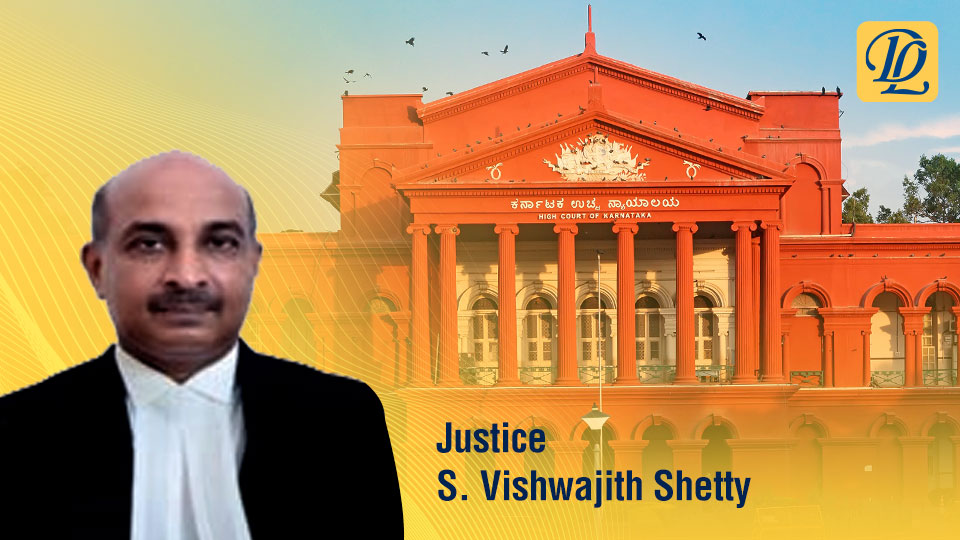
Hon’ble Mr. Justice S. Vishwajith Shetty celebrates his 59th birthday today.
Hon’ble Mr. Justice Savanur Vishwajith Shetty: Born on 19.05.1967. Appointed as Additional Judge of the High Court of Karnataka and taken oath on 28.04.2020 and Permanent Judge on 25.09.2021.
Important Judgements delivered by Hon’ble Mr. Justice S Vishwajith Shetty.
Karnataka Police Act. Mere apprehension of the police is not enough to pass an order of externment. There must be grounds and adequate materials to show that there is danger based upon credible materials. Karnataka High Court.
Wife demanding separate residence does not always amount to cruelty for grant of divorce. There must be determination to put an end to marital relation and cohabitation. Karnataka High Court.
Karnataka Excise Act. Compliance of Sections 53 and 54 i.e. securing search warrant or to record the grounds to dispense with the search warrant is mandatory. Non-compliance of the same would vitiate the conviction order. Karnataka High Court.
Judgment of acquittal passed in a complaint case can be challenged before the High Court under Section 378(4) Cr.PC and an appeal under Section 378(2) Cr.PC before the Sessions Court is not maintainable. Karnataka High Court.
Rash and negligent driving resulting in death. Leniency can be shown on the sentence that is imposed on the accused in the event if the family members of the deceased receive the compensation from the accused. Karnataka High Court.
When Juvenile Justice Board decides to try the juvenile as an adult, the accused can, apart from appealing against the order, seek bail under Section 12 of the Juvenile Justice (Care and Protection of Children) Act, 2015. Karnataka High Court.
Arms Act. When the gun seized from the accused was unloaded and no ammunition was found in possession of the accused, the gun cannot be said to have been used for hunting purposes. Karnataka High Court sets aside conviction.
Karnataka SC/ST (PTCL) Act. Application for restoration filed 25 years after the sale cannot be entertained by the authorities since it is beyond reasonable time. Karnataka High Court.
Judicial estoppel. Person participating in the proceedings despite knowledge of the defect in the jurisdiction of an Authority without any objection is disentitled from questioning the jurisdiction in subsequent proceeding. Karnataka High Court.
“Child cannot be allowed to remain in unhealthy atmosphere”. Karnataka High Court orders custody of the minor child to the father having found the wife to be in immoral relationship.
Order XXIII Rule 1(3)(b) of CPC applies even to writ proceedings. Withdrawal of writ petition with liberty to file fresh petition on the same cause of action does not act as resjudicata. Karnataka High Court.
Order XVIII Rule 3 of CPC. Rebuttal evidence is permissible only in respect of issues casting onus on the other side and the said opportunity cannot be utilized to fill up the lacuna in the evidence of the party leading evidence first. Karnataka High Court.
Writ jurisdiction cannot be invoked challenging issuance of caste certificate since alternate remedy of appeal is provided under the Karnataka SC/ST & OBC (Reservation of Appointments, etc.,) Act. Karnataka High Court.
“State has no power to direct reservation in employment in favour of SC, ST and OBCs in Private Schools under the Karnataka Education Act.” Landmark Judgement from the Karnataka High Court.
Withdrawal of exemption under the Employees Provident Funds and Miscellaneous Provisions Act on the ground of financial loss of an establishment for three consecutive years is not unconstitutional. Karnataka High Court.
When urgency clause in invoked under Land Acquisition Act, 1894, the State must act with quite promptitude failing which the acquisition proceedings are liable to be quashed. Karnataka High Court.
Writ Court cannot direct the Government to frame scheme under Article 162 of the Constitution especially when the parties have alternative remedy for the redressal of their grievances. Karnataka High Court.
When correction of arbitration award is sought, limitation to challenge award commences from the date on which request for correction of award has been disposed of by arbitrator and not from the date of the original award. Karnataka High Court.
”Every order or transaction pursuant to fraudulent act is void ab initio and the same cannot be allowed to stand”. Karnataka High Court, while ordering restoration of khata which was fraudulently changed.
Change of entries in property register by playing fraud. Such fraudulent entry can be set aside in a Writ Petition under Article 226 of the Constitution of India. Karnataka High Court.
Nominated members have no right to cast their votes in the election to President and Vice President under the Karnataka Municipalities Act. Karnataka High Court.
Tahsildar has jurisdiction under Section 140(2) of the Karnataka Land Reforms Act to carry out survey work and fix boundaries even in respect lands falling within the limits of Corporation. Karnataka High Court.
Transport vehicle and omnibus, when gross weight does not exceed 7500 kg would be a light motor vehicle. Holder of LMV driving licence is competent to drive such transport vehicle only when the weight does not exceed the limit. Karnataka High Court.
Customs Brokers Licensing Regulations. Time limit of 90 days for passing the order in original under Regulation 17 is directory and not mandatory. Karnataka High Court.
Family pension. Order of priority under the pension Rules prevail over order of priority under the Hindu Succession Act. When wife is alive, no other legal/illegitimate heir can claim family pension. Karnataka High Court.
Karnataka SC-ST (PTCL) Act, 1978. Application for resumption and restoration of granted land filed 10 years after the sale can be rejected on the ground of delay and laches. Karnataka High Court.
Karnataka SC-ST (PTCL) Act, 1978. Delay of 16 years from the date of sale in filing application for resumption and restoration of granted land. Karnataka High Court quashes the entire proceedings.
Service Law. Minimum qualifications for appointments prescribed under the UGC guidelines are for the purpose of maintaining excellence in the higher standards of education. Universities have no power to relax them. Karnataka High Court.
‘Corruption hurts everyone. Corruption erodes trust of a common man in the system. Anti corruption law shall be invoked against persons, who by virtue of their office are discharging public duty’. Karnataka High Court.
Prevention of Corruption Act, 1988. Employee of Society, registered under the Societies Registration Act, which receives funds from Government, is a ‘public servant’ and liable for prosecution under the Act. Karnataka High Court.
Default bail under the Unlawful Activities Prevention Act. Order extending time to complete investigation without notifying or producing the accused is bad in law. Accused are entitled to default bail in such eventuality. Karnataka High Court.
Cenvat Credit Rules, 2004. Industry having outdoor catering services for factory canteen cannot claim Cenvit credit post 2011. Court, while dealing with taxing statute, cannot include what is specifically excluded. Karnataka High Court.
Code of Civil Procedure, 1908. Order XXIX Rule 1. Director of company can NOT institute a suit without board resolution or ratification. Temporary injunction can be refused on the ground of maintainability of the suit. Karnataka High Court.
Right to Fair Compensation and Transparency in Land Acquisition, Rehabilitation and Resettlement Act, 2013 does not apply to acquisitions under the Bangalore Development Authority Act. Karnataka High Court reiterates.
Bangalore Development Authority Act, 1976. Section 38-B. Karnataka High Court declares bulk allotment of acquired land by BDA in favour of BDA Employees’ Welfare Association as illegal. Dismisses PIL for non-joinder of allottes of the sites.
Environment. Declaring forest as non-forest under the Karnataka Forest Act without the prior approval of the Central Government is illegal. Take action against erring officials – Karnataka High Court.
Criminal Procedure Code. Power under Section 311 to summon material witness or examine person present can be invoked by the court suo motu and even at a stage when the case is posted for judgment. Karnataka High Court.
Criminal Procedure Code. Non-recording or delayed recording or improper recording of statement under Section 161-3 is a serious irregularity which is incurable. Conviction under NDPS Act set aside on this ground. Karnataka High Court.
Criminal Procedure Code. Section 319. Power to proceed against other persons appearing to be guilty of offence cannot be exercised in a casual manner on the basis of a stray statement of the complainant. Karnataka High Court.
Aarogya Setu App. Informed consent of users of the app is must for sharing user data by the Government of India and National Informatics Centre. Karnataka High Court.
Properties purchased by husband in the name of his wife are the absolute properties of the wife in view of Section 14 of the Hindu Succession Act. Karnataka High Court.
Daughters born prior to coming into force of the Hindu Succession Act, 1956 are also entitled for coparcenary property under the amended Section 6. Karnataka High Court.
Special statutes prevail over the Limitation Act. Appellate Authority has no power to entertain an appeal beyond the period of one month as stipulated under Section 107(4) of the Karnataka Goods and Services Tax Act, 2017. Karnataka High Court.
Bombay Tenancy and Agricultural Lands Act, 1948. In a case of surrender of land by tenant, procedure of taking possession under Section 29 of the Act does not apply. Karnataka High Court.
Karnataka Land Reforms Act. Trustee is the owner and custodian of Trust property and cannot claim occupancy rights under Section 45 of the Act in respect of the Trust property. Karnataka High Court.
Karnataka SC/ST (PTCL) Act. Any action taken by the authorities under the Act beyond a reasonable period cannot be sustained. Karnataka High Court quashes resumption order.
Karnataka Land Reforms Act. Sub-tenants are entitled to be registered as occupants of the land, only when the sub-tenancy was created prior to 2 October 1965. Karnataka High Court.
High Court under Article 226 cannot interfere with the order of the fact-finding authority like the Land Tribunal especially when the order is based on appreciation of the oral and documentary evidence on record. Karnataka High Court.
Karnataka Land Revenue Act. Deputy Commissioner has no jurisdiction to reject the application for conversion of land after the expiry of four months when the deeming clause under Section 95 (5) applies. Karnataka High Court.
Blocking Input Tax Credit available in Electronic Credit Ledger under Rule 86A of the Central Goods and Services Tax Rules, 2017. Post-decisional or remedial hearing shall be granted to the person/assessee affected. Karnataka High Court.
Tenancy rights can be adjudicated only before the Land Tribunal. Tahsildar has no right to enter the name of the Government in RTC assuming vesting of the land. Karnataka High Court.
”It is the duty of the Court and the Prosecution to protect the right of informant/victim to oppose bail application of the accused for the rape offence under IPC or under POCSO Act.” Karnataka High Court issues exhaustive guidelines.
Bail application of an accused for the offences punishable under Section 376(3), 376-AB, 376DA or 376-DB of IPC or under POCSO Act cannot be heard without giving opportunity of being heard to the informant/victim. Karnataka High Court.
POCSO Act being later prevails over the SC/ST Atrocities Act. Where accused is charged with both SC/ST Atrocities Act and POCSO Act, petition for bail under Section 439 Cr.P.C can be filed before High Court. Karnataka High Court.
There is no need for the Court order appointing guardian in respect of minor’s undivided interest in joint family. Parents can sell undivided interest of minor in joint family property. Karnataka High Court.
Bombay Paragana and Kulkarni Watans (Abolition) Act. Re-grant in favour of the Watandar/Inamadar would enure to the benefit of the purchaser if the sale was made prior to the last date of filing an application for re-grant. Karnataka High Court.
Prosecution has no right to apply for modification of the chargesheet under Section 216 and 217 of the Cr.P.C. Only the trial Court can suo motu exercise power to alter the chargesheet. Karnataka High Court.
When a document which is required to be stamped is not sufficiently stamped, even the copy of such document is not admissible as secondary evidence. Karnataka High Court.
Recovery of Government dues. ‘’The practice of bringing the entire extent of land for sale for recovery of dues which would be otherwise recovered by selling a portion of the property is highly deplorable’’. Karnataka High Court.
Karnataka Control of Organised Crime Act. Service of grounds of arrest on the accused immediately after his arrest would be sufficient compliance under Section 50(1) of Cr.PC and Article 22(1) of the Constitution of India. Karnataka High Court.
Willful failure to submit income tax returns. There is a presumption of a culpable mental state on the part of the accused. The accused has to rebut this presumption in accordance with the law. Karnataka High Court.
Retailers or showroom owners cannot be prosecuted under the Insecticides Act, 1968, for selling a substandard product unless it is proven that they had knowledge of its defective nature or were responsible for its manufacture or quality control. Criminal liability under the Act requires mens rea, and prosecution should be limited to persons directly responsible for the product’s quality and distribution. Karnataka High Court.
Magistrate’s Court has no jurisdiction to try offences under Section 27(b)(ii) of the Drugs and Cosmetics Act, 1940, as per Section 32(2) of the Act. Such cases must be committed to the Sessions Court, and failure to do so renders the entire trial and conviction void. Karnataka High Court.
The right to default bail is a fundamental right when the charge sheet is not filed within the prescribed period. Courts must ensure judicial scrutiny before permitting mechanical addition of stringent charges. Karnataka High Court.
Criminal proceedings under Sections 498A, 494 IPC are liable to be quashed if filed beyond the limitation period under Section 468 Cr.P.C. Mere allegations without concrete proof of a second marriage or direct involvement of accused relatives amount to an abuse of process, warranting relief under Section 482 Cr.P.C. Karnataka High Court.
In matrimonial disputes, criminal proceedings under Section 498A IPC cannot be sustained based on vague, omnibus allegations, particularly against aged in-laws living separately. Unexplained delay in filing an FIR casts doubt on the credibility of allegations. Karnataka High Court.
Partition Act, 1893. Where a property is found to be indivisible and if multiple shareholders seek to exercise their right to buy out other shares, the Court must facilitate a competitive process and is legally mandated to sell the shares to the shareholder who offers the highest price above the court’s valuation. Karnataka High Court.
Karnataka Court Fees and Suits Valuation Act. In a suit for declaration and possession involving agricultural land, the market value for the purpose of calculating Court fees must be determined solely as 25 times the annual land revenue as prescribed by the deeming provision in Section 7(2) of the Act. Karnataka High Court.
Karnataka Stamp Act. If possession was already held by the purchaser prior to the agreement of sale or if possession is not delivered under the agreement, the document is only liable to be stamped under the lower duty. Karnataka High Court.
When a jurisdictional issue is raised belatedly, after substantial evidence has already been led on the original issues, the Trial Court cannot exercise discretion to treat it as a preliminary issue. In such circumstances, the mandate under Order XIV Rule 2(1) to decide all issues together must prevail. Karnataka High Court.
Indian Succession Act. A person who claims a right to the testator’s property adverse to the testator’s title and who is not an heir under succession or inheritance, does not have a ‘caveatable interest’ and cannot be impleaded as an objector in a petition for the grant of probate. Karnataka High Court.
Order XVIII Rule 1 and 3 CPC. Trial Court has no power to compel a defendant to lead evidence first, especially on issues where the burden of proof lies on the plaintiffs. The plaintiff must first lead evidence on all issues where the burden of proof rests on him. Karnataka High Court.
An accused already in custody for one offense requires formal arrest and remand in the second offense for their custody in the latter case to be legal. In such an eventuality, fresh bail application can be filed before the Trial Court, even if previously granted bail and released in the initial offense. Karnataka High Court.
The right to default bail is a fundamental right when the charge sheet is not filed within the prescribed period. Courts must ensure judicial scrutiny before permitting mechanical addition of stringent charges. Karnataka High Court.
SARFAESI Act. When a security interest is duly registered, it creates a first charge that overrides any subsequent attachment order issued by tax authorities under State legislations like the KVAT Act. The ‘prior in time’ interest of a secured creditor must be honored, and the State cannot claim a superior charge over assets that have already been legally sold to satisfy a registered security interest. Karnataka High Court.
Arbitration and Conciliation Act. Enforcement of a foreign award can be refused only on specific statutory grounds. ‘Patent illegality’ ground is not available in respect of foreign awards. A party who voluntarily chooses not to participate in arbitration despite due notice cannot later claim they were ‘unable to present their case’ to resist enforcement. Karnataka High Court.
Suit for specific performance. A subsequent agreement holder or purchaser is not a necessary or proper party to be impleaded in the suit since such transactions are governed by the principle of lis pendens. Karnataka High Court.
Payment of Gratuity Act is a special, self-contained code. The Appellate Authority has no jurisdiction to entertain an appeal or condone delay once a total period of 120 days from the date of receipt of the order has expired, and it has no power to extend this period further. Karnataka High Court.
Commercial Courts Act: An order passed by a Commercial Court rejecting a plaint amounts to a “decree” under Section 2(2) of the CPC. The aggrieved party must prefer a commercial appeal under Section 13(1A) of the Act. A writ petition under Article 227 of the Constitution is not maintainable when such an alternative and efficacious statutory remedy of appeal exists. Karnataka High Court.
Arbitration and Conciliation Act. A party who disputes the very existence or execution of the agreement cannot maintain an application for referral to arbitration under Section 8, as the existence of a valid and admitted agreement is the jurisdictional bedrock for such an order. A Trial Court exceeds its jurisdiction if it refers parties to arbitration when the underlying agreement is denied by the applicant themselves. Karnataka High Court.
Karnataka Court Fees and Suits Valuation Act. When a plaintiff seeks a declaration that a document is void, without claiming the consequential reliefs of possession or injunction related to that declaration, the court fee is to be computed on the value assigned by the plaintiff in the plaint, and not on the market value of the property. Karnataka High Court.
Order XXXVII CPC. In summary suits, ten days period prescribed under Rule 3(5) for the defendant to apply for leave to defend, counted from the date of service of the summons for judgment is merely the outer limit. An application for leave to defend filed by the defendant after entering appearance but before the service of the summons for judgment is not premature and is legally maintainable. Karnataka High Court.
The Executing Court should permit an amendment to the execution petition and its schedule when the decreed property has undergone physical changes after the decree. Refusing such an amendment solely on the ground that the Court cannot travel beyond the decree amounts to ignoring relevant subsequent events and would unjustly deprive the decree-holder of the fruits of the decree on a mere technicality. Karnataka High Court.
Order XXIII Rule 3A. When an application questioning the compromise raises a substantial legal question concerning a purported attempt to deprive a daughter of her statutory right to an equal share in coparcenary property, the trial court cannot summarily dismiss the application without issuing notice to the parties or considering its merits. Karnataka High Court.
Stamp Act. Court has the statutory power to impound any document that is insufficiently stamped at any stage of the proceedings even after the disposal of the suit and to direct the payment of deficit stamp duty and penalty. Karnataka High Court.
Karnataka Stamp Act. Refundable security deposit stipulated in a lease deed does not constitute ‘money advanced in addition to the rent reserved’. Stamp duty on the lease deed must be calculated solely on the basis of the rent reserved, excluding the refundable security deposit. Karnataka High Court.
Suit for partition. Joint family property inadvertently omitted from the plaint and the consequent preliminary decree can be included during the final decree proceedings. Karnataka High Court.
Drugs and Cosmetics Act. An Inspector appointed under Section 21(1) retains competency upon being transferred to a new area without requiring a fresh Gazette Notification. The bar on trial by a Court inferior to the Court of Session under Section 32(2) does not preclude a Magistrate from taking cognizance of the complaint and committing the case to the Sessions Court for trial. Karnataka High Court.
Abetment to commit suicide. There must be a direct and proximate link between the accused’s actions and the deceased’s death. A clear mens rea (guilty mind) and an active, direct act intended to push the person to commit suicide are required. General allegations of torture in a death note, or words uttered in the heat of a moment, are not sufficient to prove abetment.
Protection of Women from Domestic Violence Act. Female relatives of the husband/male partner can be included as ‘respondents’. However, the quantum of interim maintenance is determined by the proven income of the respondent, and courts are justified in reducing it if the applicant fails to provide evidence of higher income. Karnataka High Court.
Hon’ble Mr. Justice R Devdas celebrates his 57th birthday today.
Hon’ble Mr. Justice R Devdas: Born on 15th May 1969. Studied in Sri Ramakrishna Vidyashala, Mysore. Pre-University Education and Bachelor of Arts at St.Joseph’s Arts and Science College, Bangalore and Bachelor of Law at Sri Jagadguru Renukacharya College of Law, Bangalore.
Started practice in the year 1994 in the office of M/s. Jayaram & Jayaram, Advocates, Bangalore.
Appointed as Addl. Government Advocate for State of Karnataka on 6th June 2008.
Appointed as Principal Government Advocate on 10th July 2014.
Appointed as an Additional Judge of the High Court of Karnataka on 14th February 2018.
Appointed as Permanent Judge of the High Court of Karnataka on 7th January 2020.
Important Judgments delivered by Hon’ble Mr. Justice R. Devdas
Service Law. Person who questions a Government order in Court and accepts another Government order without demure loses right to challenge the first order. Karnataka High Court.
Income Tax Act. Section 147. Mere change of opinion on consideration of the same material is not a ground to reopen the assessment. Full Bench Karnataka High Court.
Karnataka SC-ST PTCL Act. Application for resumption of land after sale with prior permission NOT maintainable. Alternative appeal remedy not a bar for Writ Petition against illegal order of Assistant Commissioner. Karnataka High Court.
Hindu Law. Separated son has NO right in ancestral property left by kartha. He can claim share as Class-I heir after death of Kartha in notional partition. Karnataka High Court.
Unlike access to justice, forum convenience is not a fundamental right. Only the Chief Justice of High Court has power to allocate work to puisne judges of respective benches of High Court. Karnataka High Court clarifies.
Air India Limited is not a ‘State’ within the meaning of Article 12 of the Constitution of India after disinvestment and hence Writ against it is not maintainable. Karnataka High Court.
Karnataka High Court condones the delay of 20 years in seeking resumption of granted and later tenanted lands under the Karnataka Scheduled Castes and Scheduled Tribes (Prohibition of Transfer of Certain Lands) Act, 1978.
When sole plaintiff dies and application is filed by persons claiming to be legal representatives, it is the duty of the Court to consider whether the right to sue survives. Karnataka High Court.
https://www.dakshalegal.com/judgements/actionView/BTnGA03wYX2oD6qRmngdeBORw Plaint in a suit for a primary relief of partition and separate possession cannot be rejected on the ground of limitation though the secondary prayer is barred by time especially when both the prayers are interconnected. Karnataka High Court.
Occupancy rights cannot be claimed or granted under the Karnataka Land Reforms Act in respect of garden land (bagayat land). Karnataka High Court reiterates.
Conversion of granted land for non-agricultural purposes and construction of residential building in industrial zone cannot be a ground to cancel the grant. Karnataka High Court.
Purchasers of inam lands after vesting of the lands in the State cannot claim occupancy rights under Section 9 of the Mysore (Personal and Miscellaneous) Inams Abolition Act, 1958. Karnataka High Court.
Karnataka SC-ST PTCL Act. Conversion of land for non-agricultural purposes will operate as prior permission to sell only if the land is converted by the original grantee and not by the purchaser. Karnataka High Court.
Creation/claim of tenancy under the KLR Act in respect of granted lands also amounts to ‘transfer’ under the SC/ST (PTCL) Act, 1978 and hence the same is void though the Tribunal order has become final. Karnataka High Court.
Karnataka SC-ST PTCL Act, 1978. Application for prior permission to alienate granted land filed by power of attorney of the grantee can NOT be considered. Only grantee or his legal heirs can apply for prior permission. Karnataka High Court.
“Purpose of acquisition is relevant factor in determining the compensation’’. Karnataka High Court enhances compensation from Rs. 750/- to Rs. 2000/- for the land acquired for Court complex.
Service law. In the absence of clear proof based on the evidence of witnesses in the enquiry, an adverse presumption cannot be drawn on the guilt of the accused. Karnataka High Court sets aside compulsory retirement on corruption charges.
Standalone distilleries established for manufacturing ethanol are not governed by the provisions of the Sugarcane Control Order, 1966. Karnataka High Court.
Planning Authority cannot seek relinquishment of Buffer Zone or the building line where construction cannot take place, free of cost, to the Planning Authority while sanctioning the development plan. Karnataka High Court.
Reference Court while awarding compensation in respect of the sub-soil/minerals underneath the soil of the acquired properties shall take into consideration the provisions of the Karnataka Minor Minerals Concession Rules. Karnataka High Court.
Freedom fighters’ pension. The proof required must be as provided in the pension scheme itself. As long as such proof was not available, the benefit cannot be granted. Karnataka High Court, while following the Supreme Court Judgment.
Appointment of arbitrator. Question of limitation can be gone into only in the very limited category of cases where there is not even a vestige of doubt that the claim is ex facie time barred. Karnataka High Court.
Grant of lands under the Karnataka Land Revenue Act. There is no restriction that the land shall not be granted to more than one member of the same family. Karnataka High Court.
Inamdar or his successors have no right to alienate lands already vested under the Mysore (Personal and Miscellaneous) Inams Abolition Act, 1954. Subsequent purchasers cannot seek grant of occupancy rights. Karnataka High Court.
Writ Court can give directions to compel the performance in a proper and lawful manner and itself can pass orders which the Government or the public authority should have passed had it properly and lawfully exercised its discretion. Karnataka High Court.
Second Writ Petition for mandamus is maintainable when the earlier direction was not complied. Writ Court can give directions to compel the performance in a proper and lawful manner. Karnataka High Court.
Conducting land survey and marking boundaries under the Karnataka Land Revenue Act cannot be resorted to claim title over the property instead of approaching the civil Court. Karnataka High Court.
Karnataka Land Revenue Act. There is no restriction for grant of land to more than one member of the same family under Section 94-A. Karnataka High Court.
Tahsildar cannot order removal of name from the land records unilaterally asserting the land to be government land and without following the procedure under the Karnataka Land Revenue Act. Karnataka High Court.
Assistant Commissioner has no power to initiate suo motu proceedings under Section 136(2) of the Karnataka Land Revenue Act in respect of the entries made in the land records. Karnataka High Court.
Land grants obtained allegedly by playing fraud can be cancelled only by initiating appropriate proceedings within reasonable time. Karnataka High Court.
Karnataka SC/ST (PTCL) Act. Gift of granted land by grantee in favour of his/her son/daughter without prior permission also attracts the provisions of the Act. Karnataka High Court.
Violation of Sections 79A & 79B of the Karnataka Land Reforms Act cannot be alleged in respect of sale of agricultural properties which took place prior to 1 March 1974. Karnataka High Court.
Karnataka SC/ST (PTCL) Act. Plea of Adverse possession by the purchaser of granted land can be taken only if there is uninterrupted and continuous possession without animus to constitute hostile rights and possession. Karnataka High Court.
The advantage of omission of Sections 79A and 79B of the Karnataka Land Reforms Act is available even to pending review petition before the Appellate Tribunal. Karnataka High Court.
Karnataka Land Reforms Act. Period of non-alienation for tenanted lands commences from the final order of the Land Tribunal and not from the date of issuance of Form-10. Karnataka High Court.
When tenancy is governed under the Karnataka Rent Act, Civil Court has no jurisdiction to pass a decree for possession of the tenanted property. Karnataka High Court.
Urban Land (Ceiling and Regulations) Act. Even after exemption granted under the Act, Deputy Commissioner has the authority to proceed if owners of land violate the order of exemption passed by the State Government. Karnataka High Court.
Undervaluation of transaction. Deputy Commissioner must, after giving the parties an opportunity of being heard, shall hold an enquiry to assess proper market value before levying the duty. Karnataka High Court.
Application for amendment of pleadings after commencement of trial can be permitted only if the applicant demonstrates that, notwithstanding the exercise of due diligence, the application could not have been filed at an earlier stage. Karnataka High Court.
Election to cooperative society. If rejection of nomination paper is per se illegal, Writ Court can entertain the petition under Article 226 without relegating the parties to the election petition. Karnataka High Court.
Where a person is a party to the document and seeks relief regarding the said document, he must pay court fee on the value of the subject-matter. Clever drafting cannot be used to avoid court fee. Karnataka High Court.
A person who has taken advantage or benefit of a provision of law, can not be permitted to raise a challenge to the very same provision under which the benefit was taken. Karnataka High Court.
Planning Authority has no power to impose penalty for delayed development of the layout project, beyond the time granted for completion of the project, in the absence of legislative sanction. Karnataka High Court.
Constitution of India. In the absence of legislative sanction, the State Government, in exercise of its executive powers under Article 162, cannot levy and collect penalty, merely by issuing a notification. Karnataka High Court.
Family Courts Act. Suit for declaration regarding marital status between two ladies claiming to be the legally wedded wife of a certain person falls within the jurisdiction of the family court and not the civil court. Karnataka High Court.
Usage of a portion of residential building for non-residential activities cannot be a reason to cancel allotment of house site especially when the site falls within municipal corporation area. Karnataka High Court.
When the scheme formulated under the Karnataka Urban Development Authorities Act to form residential layout is lapsed, the Authority cannot refuse sanction of residential layout plan submitted by the landowners. Karnataka High Court.
Karnataka Village Offices Abolition Act. Though regrant of land enures to the benefit of the purchaser, notice to the original grantee is mandatory before regularising the alienation. Karnataka High Court.
Rejection of Plaint. Adjudication of the plea of resjudicata requires consideration of the pleadings, issues and decisions in the previous suit. Plaint cannot be rejected under such circumstances. Karnataka High Court.
A compromise decree in an ejectment suit, where the tenant agrees to vacate upon breach of conditions, is directly executable without requiring a fresh suit. Once a compromise is recorded by the court, it becomes enforceable as a decree. Karnataka High Court.
Acquisition by BDA. When adjacent lands are not acquired or deleted from the acquisition, small islands of acquired land cannot be used as a standalone park or playground in regard to a layout formed in a different unconnected lands. Karnataka High Court.
Maintenance and Welfare of Parents and Senior Citizens Act. Gift deed involving a senior citizen cannot be cancelled unless it contains a specific covenant that the transferee will provide basic amenities and basic physical needs to the donor. Karnataka High Court.
Planning authority cannot reject an application for a development plan on the sole premise of a mere proposal for future development or acquisition, unless a formal notification for acquisition has been issued. Karnataka High Court.
Hindu Succession Act. A suit for partition by a deceased Hindu male’s sister’s daughters is liable for rejection under Order VII Rule 11(a) CPC, as, in the absence of Class I heirs, the deceased’s brothers inherit the property to the exclusion of the sister’s daughters. Karnataka High Court.
Cause of action would mean and include the very right to sue. If the plaint does not disclose the right to sue, it must be rejected in order to weed out unnecessary, frivolous litigation, and save precious judicial time for deserving cases. Karnataka High Court.
A daughter-in-law cannot be compelled to pay maintenance to her mother-in-law under the Maintenance and Welfare of Parents and Senior Citizens Act. Karnataka High Court.
Karnataka Land Reforms Act. Proceedings under Sections 79A and 79B cannot be initiated in respect of the transactions occurred prior to the enactment of the sections. Karnataka High Court.
A plaint can be rejected at the threshold if, upon a meaningful reading, it is clear that the suit is barred by limitation, even when the question of limitation is generally considered a mixed question of law and fact. Karnataka High Court.
Karnataka Land Revenue Act. Tahsildar cannot refuse to enter the purchaser’s name in the revenue records on the ground that the sale violates the Karnataka SC/ST (PTCL) Act. Unless and until the competent authority declares the sale void and sets it aside, the Tahsildar has no authority to deny such mutation. Karnataka High Court.
Karnataka Land Grant Rules. State cannot pass an order regarding payment for standing trees on granted land without first obtaining a formal valuation from the competent authority. Any administrative order issued without such a technical valuation report is procedurally flawed and liable to be quashed. Karnataka High Court.
Karnataka Land Revenue Act. Deputy Commissioner cannot reject an application for conversion of land on the ground that the land transaction violates the Karnataka SC/ST (PTCL) Act. Though the Deputy Commissioner can initiate ‘suo-motu’ proceedings through the Assistant Commissioner to investigate PTCL violations, he must consider the conversion application independently. Karnataka High Court.
Rejection of plaint. A suit for partition, filed several years after the original transaction solely to harass a subsequent purchaser, amounts to bogus litigation and must be nipped in the bud, even if clever drafting creates an illusion of cause of action to overcome the law of limitation. Karnataka High Court.
Res Judicata. A subsequent suit for partition and separate possession is barred if a previous suit seeking the identical relief between the same parties or their predecessors-in-interest has already been dismissed by a competent Court. The fact that the earlier suit was dismissed without recording evidence or a detailed adjudication on merits does not prevent the bar of res judicata from operating. Karnataka High Court.
Authorities under the Karnataka Land Revenue Act and the Karnataka Sakala Services Act must process mutation and revenue entry applications within the prescribed timelines. Unexplained delay in updating records based on a registered sale deed amounts to a breach of public duty. Karnataka High Court imposes personal costs on the erring official.
Civil Procedure Code. Section 24. A transfer application falls within the ambit of ‘other proceedings,’ and an order passed on such an application constitutes a ‘case decided,’ as it finally disposes of the matter before the District Judge. Consequently, a Civil Revision Petition is maintainable against such an order. Karnataka High Court.
Karnataka Land Revenue Act. Mere proposal for acquisition of land by Government cannot be a ground to reject conversion of the land. Karnataka High Court.
Irrevocable General Power of Attorney along with an Agreement of Sale and affidavit executed by the lease-cum-sale allottee prior to the judgment in Suraj Lamps can be relied on for the purpose of executing sale deed by the Development Authority in favour of the GPA holder. Karnataka High Court.
Land acquisition proceedings are liable to be quashed when the acquired land remains an undeveloped ‘island’ surrounded by private developments, making the formation of a self-contained layout impossible, and such challenges are not barred by prior dismissals or delay, as the non-implementation of the scheme provides a fresh cause of action. Karnataka High Court.
Municipal authority cannot adjudicate on the validity of registered gift deeds or civil court judgments while considering a khata transfer application. If there are existing khatas registered in other individuals’ names, those parties must be given an opportunity to be heard before any orders affecting their rights are passed. Karnataka High Court.
A plaint is liable to be rejected if the suit seeks to re-adjudicate issues that have already been conclusively decided in prior litigation between the same parties or their privies. A probate, when granted by a competent court, is conclusive as to the validity and due execution of the Will, and a subsequent suit challenging the same on grounds already litigated is not maintainable. Karnataka High Court.
The buffer zone requirement under the Revised Master Plan 2015 does not apply to layouts approved before its finalisation. Where a layout was sanctioned prior to RMP-2015, authorities cannot refuse a building plan solely on the ground of buffer zone compliance. Karnataka High Court.
Under the amended Karnataka Land Revenue Rules, revenue authorities are bound to entertain applications seeking cancellation of land forfeiture, even when the forfeiture is followed by sale of the property for recovery of government dues. Upon repayment of the arrears, the authorities must delete ‘Sarkari Pada’ entry from the revenue records. Karnataka High Court.
Karnataka Land Revenue Act. Deputy Commissioner’s authority under Section 136 (3) is limited to correcting revenue entries and does not extend to annulling previous land grants, determining the validity of transactions, or ordering the resumption of land. The suo motu power cannot be exercised decades after the original grant, especially when third-party interests have been established. Karnataka High Court.
The eligibility of land for regularization of unauthorized occupation, in relation to the prescribed prohibited distance from a local authority’s boundary, must be determined with reference to the geographical boundary and legal status as they existed on the date of filing the original application, and not as on the date of its consideration. Karnataka High Court.
Karnataka Land Grant Rules Grantee of land must be afforded an opportunity to pay the assessed value of the standing trees within the time prescribed by the granting authority. Any cancellation of the grant without adhering to this procedure is unsustainable and liable to be set aside. Karnataka High Court.
Karnataka Land Revenue Act. A revenue grant of land in a manner known to law cannot be unilaterally nullified or deleted from the Record of Rights by the Tahsildar on the mere claim that the land is a ‘Sarkari Gunduthopu,’ as ‘gunduthopu’ land is not statutorily prohibited from being granted. Karnataka High Court.
Section 148 CPC. Civil Court’s power to extend time for payment of deficit court fee is limited to a maximum of thirty days. If the plaintiff fails to pay within this period, the suit remains still-born and cannot be registered. Acceptance of deficit court fee after undue delay, without a timely extension application, is without jurisdiction and defeats the mandatory intent of the Court Fees Act. Karnataka High Court.
A land owner’s right to seek conversion of land from agricultural to non-agricultural use cannot be denied by the Deputy Commissioner solely on the ground that there is a proposal or a preliminary notification for future land acquisition by the State. Until the land is formally vested in the State through a final award and possession, the owner retains the right to put the land to better use, and authorities are obligated to process conversion application. Karnataka High Court.
Karnataka Land Reforms Act. When the lands stand in the name of a private individual as the kathedar, the Deputy Commissioner cannot record the same as ‘unrecorded habitations’ under Section 38A. Karnataka High Court.
Karnataka Land Grant Rules. The gainful employment of the applicant’s family members is not a disqualification for the grant of land. Cancellation of the grant after a prolonged lapse of time is illegal. Karnataka High Court.
The Revenue authorities cannot initiate proceedings to cancel land grants or delete entries from the Record of Rights after an inordinate and unexplained delay. Failure of the State to maintain its own records cannot be used as a ground to penalize bona fide holders of the land. Karnataka High Court.
Karnataka SC/ST (PTCL) Act. Agreement of sale, without any condition that the transaction would be proceeded after obtaining prior permission from the Government, amounts to ‘transfer’ and hence void. Consequently, suit for specific performance of such an agreement is not maintainable. Karnataka High Court.
Karnataka Public Premises (Eviction of Unauthorised Occupiers) Act. When a dispute of title is raised against a show-cause notice issued under the Act, the Estate Officer does not have the jurisdiction to decide such disputed questions of title; such disputes can only be adjudicated by a competent Civil Court. Karnataka High Court.
Karnataka Land Revenue Rules. In proceedings for the regularization of unauthorized cultivation of government land under Chapter XIII-A, an application cannot be rejected solely on the ground that the remaining land would be insufficient for free pasturage since the statutory proviso to the Rules explicitly exempts regularization cases from the requirement of maintaining a minimum pasturage limit and from the necessity of obtaining prior permission from the Deputy Commissioner for such reduction. Karnataka High Court.
Karnataka Land Revenue Act and Rules. Tahsildar has no jurisdiction to reject an application for regularization of unauthorized occupation of government land without placing such applications before the ‘Committee for Regularisation of Unauthorised Occupation’ for its consideration. Karnataka High Court.
Hon’ble Mr. Justice Suraj Govindaraj celebrates his 53rd birthday today.
Hon’ble Mr. Justice Suraj Govindaraj: Born on the 14th of May, 1973, Justice Suraj is an alumnus of the distinguished National Law School of India University, Bengaluru. He enrolled as an Advocate on 23rd June 1995 and built a formidable practice over more than two decades, specialising in civil and commercial law. During his years at the Bar, he appeared before the Hon’ble Supreme Court of India, most of the High Courts in the country, district courts and national tribunals across the country, earning a reputation for clarity, precision, and depth in advocacy.
His elevation to the Bench as an Additional Judge of the High Court of Karnataka on 23rd September 2019, and as a Permanent Judge on 1st March 2021, marked the continuation of a career defined by intellectual rigour, discipline, and integrity.
On the Bench, Justice Suraj has engaged with a wide and complex range of matters—commercial disputes, writ jurisdiction under Article 226, land acquisition law, Labour Law, Criminal Law, insolvency jurisprudence, election law etc., etc., . His judgments are characterised by structured reasoning, procedural discipline. They reflect a judicial approach that is both principled and pragmatic, combining doctrinal clarity with an acute awareness of practical consequences.
What particularly distinguishes Justice Suraj is his deep and sustained engagement with institutional reform and the modernisation of the justice delivery system. He is a member of several important committees constituted under the aegis of the Hon’ble Chief Justice of India, including those relating to the Phase III implementation of the e-Courts project and the standardisation of neutral citations, a significant step towards ensuring uniform, court-authenticated referencing of judgments across jurisdictions in India.
He is also a member of the Artificial Intelligence Committee of the Supreme Court of India, chaired by Hon’ble Mr. Justice P. S. Narasimha. This Committee has been entrusted with the critical mandate of guiding and overseeing the adoption, development, and deployment of artificial intelligence tools across the judiciary, with the objective of enhancing efficiency, accessibility, and transparency in the justice delivery system, while ensuring alignment with constitutional values and procedural fairness.
In addition, Justice Suraj continues to be a member of the AI Assisted Legal Translation Advisory Committee, commonly known as the SUVAS Committee. This initiative leverages artificial intelligence to translate judicial decisions, particularly e-SCR judgments, into multiple Indian languages, with a robust framework of human validation to ensure both linguistic accuracy and legal fidelity. Through this work, he contributes to a transformative effort aimed at making the law more accessible, inclusive, and intelligible to citizens across linguistic backgrounds.
Together, these initiatives place him at the forefront of the judiciary’s engagement with technology, data, and artificial intelligence, not merely as tools of efficiency, but as instruments for deepening access to justice.
Within the State of Karnataka, his contributions to judicial administration have been both innovative and far-reaching. From establishing a widely accessed Telegram channel of the High Court, to revamping its digital infrastructure, integrating postal systems, and developing real-time dashboards for advocates and government departments, Court Case Management System—his initiatives have significantly enhanced transparency, accessibility, and efficiency. His work in promoting virtual mediation and contributing to procedural reform reflects a consistent commitment to improving both access to justice and the quality of dispute resolution.
Beyond the courtroom, Justice Suraj is a regular invitee at the National Judicial Academy, Bhopal, as well as at regional judicial conferences and leading academic institutions. His lectures—often on judicial reform, procedural law, and the intersection of law and technology—are widely appreciated for their clarity, depth, and practical relevance.
In Justice Suraj , we see a rare convergence of roles, a careful and disciplined techno-jurist, a forward-looking reformer, and an institution builder. He represents a judicial philosophy that extends beyond adjudication to the continuous evolution of the justice delivery system, particularly at the intersection of law, technology, and artificial intelligence, ensuring that justice remains not only fair and efficient, but also accessible and inclusive.
Practiced in the field of Civil, Commercial Litigation, Contracts, Property Law, Arbitration, Company Law, Intellectual Property Rights, Constitution Matters, Debt Recovery, Environmental Law, Revenue Matters under local land laws, Consumer Law, RERA etc.
Important judgments delivered by Hon’ble Mr. Justice Suraj Govindaraj.
Labour Law. Dismissal of workman on the ground of loss of confidence of the employer in the workman would not prevent the Labour Court from passing an order of reinstatement. Karnataka High Court.
KT & CP Act. When designation of land in the Master Plan as park is lapsed due to non-acquisition within five years, the landowner is entitled for conversion of the land as per the new classification of the land under the Master Plan. Karnataka High Court
Industrial Disputes Act. An order refusing permission under Section 33(2)(b) can be challenged by way of a Writ Petition in appropriate cases. Karnataka High Court.
Labour Law. Once a domestic enquiry is held to be fair and proper, the labour Court cannot hold the contents of the enquiry report to be perverse and set aside the order on that basis. Karnataka High Court.
Karnataka Societies Registration Act. Erstwhile office members cannot process election to the Society after the appointment of an administrator merely because the administrator has not taken charge. Karnataka High Court.
Karnataka Cooperative Societies Act. Special Officer cannot be appointed on the ground of resignation of directors without waiting for 15 days period prescribed under Section 29(B) to withdraw the resignations. Karnataka High Court.
Change of land use is not required under the KTCP Act to run educational institution once the land is converted under the KLR Act for non-agricultural/educational purposes. Karnataka High Court.
Repair work of the building demolished for road widening, to make it usable, does not amount to re-construction. No action can be initiated under the Karnataka Municipal Corporations Act. Karnataka High Court.
Property derived by a female Hindu post the amendment to Section 6 of the Hindu Succession Act would become her absolute property and a coparcenary or joint family cannot be created by or under her. Karnataka High Court. (DB)
Karnataka Land Reforms Act, 1961. Proceedings under Sections 79A and 79B can NOT be initiated after the agricultural land is converted to non-agricultural purpose. Karnataka High Court.
If possession of property is handed over before or subsequent to execution of document, stamp duty under Article 5(e)(i) of the Karnataka Stamp can NOT be levied. Karnataka High Court.
Land acquisition notification after 19 December 2013, the date on which the 2013 Act was notified to come into force on 1 January 2014, could be issued only under the 2013 Act and not under the 1894 Act. Karnataka High Court.
If possession of property is handed over before or subsequent to execution of document, stamp duty under Article 5(e)(i) of the Karnataka Stamp can NOT be levied. Karnataka High Court.
Workman cannot be dismissed without taking the approval of the Industrial Tribunal in terms of Section 33(2)(b) of the Industrial Disputes Act when proceedings are pending. Karnataka High Court.
Land acquisition. If compensation of some landowners is enhanced, other landowners under same notification are automatically entitled to enhanced Compensation. Duty of the State to notify all other landowners about the enhancement. Karnataka High Court.
Trust registered under the Trust Act is entitled to get liquor license under the amended Karnataka Excise (Sale of Indian & Foreign Liquors) Rules, 1968. Karnataka High Court disposes Writ Petition challenging non-inclusion of Trusts.
Contract Labour (Regulation & Abolition) Act, 1970 & Rules 1971. Notification under Section 10(1) is not a pre-requisite for the Tribunal to decide matters relating to reinstatement or regularization of services of contract labour. Karnataka High Court.
Proceedings under Section 79(A) & (B) of the Karnataka Land Reforms Act can NOT be initiated against purchaser of converted agricultural property. Karnataka High Court.
Change of partners in a partnership concern holding excise license amounts to transfer of excise license. Authorities can cancel license for violation of condition against transfer of license. Karnataka High Court.
Suit for partition. Registration of a sale deed in respect of joint family property would amount to constructive notice to all members of the joint family SCST and the period of limitation would commence from the date of such registration. Karnataka High Court.
Labour Law. Dispute regarding termination can be raised before the Labour Court within whose jurisdiction the employee worked last and received the termination letter and not from the place of origin of termination letter. Karnataka High Court.
Cr.P.C. Sections 82 and 83. Even an agreement holder can challenge the attachment on the ground that he has an interest in the property provided the agreement is bonafide and not fraudulent. Karnataka High Court.
In a suit for partition filed by woman against her father/brother based on amended Section 6 Hindu Succession Act, joint family properties given to her husband as dowry can also be included. Karnataka High Court.
Labour Law. When workman files statutory appeal as also claim petition under section 10(4-A)of ID Act, in the event of either one of them being disposed, the other proceeding would become infructuous and required to be dismissed as such. Karnataka High Court
Claim made by a workmen for payment of minimum wages is not a dispute covered under Section 70 of Karnataka Co-operative Societies Act, 1959. Karnataka High Court.
Motor Vehicle Act. Insurance company not limiting insurance policy till fitness certificate period can not escape liability on the ground that vehicle’s fitness certificate lapsed on the date of accident. Karnataka High Court.
Plaint in a suit for partition based on amended Section 6 of the Hindu Succession Act is liable to be rejected if there is clear admission in the plaint about registered partition of ancestral properties prior to the amendment. Karnataka High Court.
Once the Disabilities Act comes into force, Circulars cannot be relied on to downgrade the cadre as also to fix the pay-scale as per the downgraded cadre. Karnataka High Court.
Forcible, unauthorised, Illegal encroachment of private property by BDA. Karnataka High Court orders allotment of equivalent developed land to the owner. Imposes cost of 5 lakhs to be recovered from the officers at default.
Valuation of Suit. Suit for specific performance. Only value of the property shown in the agreement has to be considered for the purpose of jurisdiction. Karnataka High Court.
Corporation carrying out perennial works through contractor employing Pourakarmikas. Karnataka High Court orders regularisation against sanctioned vacant posts.
In case of termination of an individual employee/workman by a individual notice, a dispute can be raised by such individual workman in terms of Section 10(4-A) of the ID Act. Karnataka High Court.
POCSO Act. Increasing cases of minor girls above the age of 16 years having love/sexual relationship resulting in criminal prosecutions. Karnataka High Court asks Law Commission of India to rethink on the age criteria.
Digitalize the criminal investigation by videographing dying declaration and recording statements electronically with digital signatures. Karnataka High Court issues guidelines.
Mischief by killing or maiming animals. Mens rea, animus or intention is required to be established to constitute offences under Section 428 or Section 429 of IPC. Karnataka High Court.
Legal Metrology (Packed Commodities) Rules, 2011. Compounding of an offence by one accused will not prevent the other accused from seeking quashment of the proceedings. Karnataka High Court.
Mines And Minerals (Development And Regulation) Act, 1957. Geologist can initiate criminal proceedings under Mines and Minerals for the offences under the Act.
When a document is fabricated before the Sub-Registrar, bar under Section 195(1)(a)(i) Cr.P.C applies only to proceedings under Section 177 and not under Sections 419, 420, 468 and 471, IPC. Karnataka High Court.
Arbitration and Conciliation Centre being run under the aegis of the High Court of Karnataka can appoint an Arbitrator if any of the parties individually or both the parties jointly were to approach the centre for such appointment. Karnataka High Court.
Legal Metrology (Packed Commodities) Rules, 2011. When liquid item is sold, the declaration in terms of weight/measures can be done either by weight or volume. Karnataka high Court.
Refusal to pay cost of the arbitration by a party cannot be a ground not to appoint arbitrator if the other party is ready to pay entire arbitration cost. Karnataka High Court.
Even an employee on a contractual basis is entitled to provident fund. There is no requirement of a master-servant relationship with the master exercising supervision and control over the employee. Karnataka High Court.
evenac is not entitled for default bail under Section 167 (2) Cr.P.C. in the event of charge sheet having already been filed before his arrest. Karnataka High Court.
Gratuity is paid to safeguard financial security of a person at the time of retirement. Bank cannot adjust gratuity amount payable to its employee towards outstanding loan account. Karnataka High Court.
Merely because a client does not succeed in the matter and favourable orders were not passed in his favour, the client cannot make out a case that fraud and offence under Sections 406 and 420 of IPC has been committed by his Advocate. Karnataka High Court
Factories Act. Manufacture being per se hazardous does not make the establishment hazardous. The process of manufacture being hazardous for workmen of a particular age group is the relevant test. Karnataka High Court.
If a document has been fabricated for the purposes of usage in a Court and thereafter used in a Court, Section 195 of Cr.P.C. would come into play and only the Court can initiate the proceedings against the offender. Karnataka High Court.
Hindu Succession Act 1956. Karnataka amendment to Section 6 is applicable between 30:7:1994 to 8.9.2005. The Central amendment is applicable from 9:9:2005. Karnataka High Court.
Hindu Succession Act 1956. Section 14 does NOT apply when there is admission by the woman and evidence on record that the property was purchased in her name from out of joint family funds. Karnataka High Court.
Information Technology Act. An intermediary or its directors and officers are not liable for any action or inaction on part of seller making use of facilities provided by the intermediary in terms of a website or market place. Karnataka High Court.
Bhoodan and Vidyadan Scheme. Owner cannot seek return of land once gifted. He can only seek direction for proper utilization of the land. Karnataka High Court.
Companies Act 2013. Except the Registrar Shareholder and Official Liquidator no other person can initiate any criminal proceedings against a company for the offences under the Act. Karnataka High Court.
Director appointed by a Venture Capital Company can be prosecuted as regards criminal offences alleged against the company where investment is made. Karnataka High Court.
Income Tax Act. All the Directors of the Company cannot be automatically prosecuted for any violation of the Income Tax Act. There has to be specific allegations made against each of the Directors who is intended to be prosecuted. Karnataka High Court.
Educational Institutions. Property tax exemption would also apply to persons who have leased the property for educational purposes. Karnataka High Court.
Educational Institutions. Property tax exemption is available even to any land or building used for the purpose of educational institution or incidental thereto such as bank canteen and staff quarters. Karnataka High Court.
Prevention of Money Laundering Act 2002. Investigating-arresting Officer must inform and provide copy of arrest order and grounds of arrest to the person being arrested. Mere oral information would not be sufficient. Karnataka High Court.
SC/ST Prevention of Atrocities Act, 1989. High Court can NOT entertain bail petition under Section 438 & 439 Cr.P.C. Remedy against grant or refusal of bail by the Special Court is appeal to High Court under Section 14A. Karnataka High Court.
Local bodies. Consequences of conversion of Town Municipal Area into a City Municipal Area and absorbion of Panchayat into newly constituted City Municipal Council explained. Karnataka High Court.
Income Tax Act, 1961. Section 80JJAA. Deduction in respect of employment of new workmen. Calendar year and not financial year is to be considered to compute completion of 300 days by the workmen. Karnataka High Court.
Land acquisition. Determination and enhancement of compensation by reference court being a judicial exercise, benefit of the same should be made available even to those who did not approach the Court. Karnataka High Court.
‘Total non application of mind’. Karnataka High Court quashes consent for establishment issued by Karnataka State Pollution Control Board for Karwar Port Expansion Project. Orders fresh exercise.(DB)
‘No instrumentality of the State or any litigant has a right to say that the order of the Court will not be complied with only because an ordinary copy of the order is supplied or that a certified copy is not supplied.’ Karnataka High Court.
Buildings used for the purpose of running educational institution and/or incidental activity are exempted from payment of property tax under the Karnataka Municipalities Act even without making application seeking exemption. Karnataka High Court.
Challenge to an award passed in an International Commercial Arbitration can be made before Commercial Division of a Single Judge Bench of the High Court. Karnataka High Court. (DB)
POCSO Act. Investigation Officer shall inform victim’s parents and legal counsel about bail application or any other application by the accused or the prosecution in the proceedings. Karnataka High Court. (DB)
Defendant whose written statement taken as not filed and on dismissal of his application under Section 8(1) of the Arbitration and Conciliation Act can not seek permission to file written statement. Karnataka High Court.
Court can record compromise among parties even after auction of subject property is completed since successful auction purchaser has no vested right till sale certificate is issued in his favour. Karnataka High Court.
”Store information in electronic form and furnish upon receipt of application under the RTI Act at the earliest”. Karnataka High Court directs Government of Karnataka.
Mere presentation of plaint without court fee does not amount to ‘filing of suit’. By the time court fee is paid, if limitation runs out, suit is liable to be dismissed. Karnataka High Court.
Police can NOT conduct preliminary enquiry when information disclosing commission of cognizable offence is received. Police can initiate such enquiry only after registering FIR. Karnataka High Court.
Defendant can seek injunction against plaintiff only under Order 39 Rule 1(a). He has no right to seek such injunction under Order 39 Rule (b) and (c). Karnataka High Court reiterates.
If roster is not followed for the post of Mayor and Deputy Mayor of a local body in an election, persons belonging to that category must be accommodated in the next election. Karnataka High Court.
Impounding of entire sale agreement in a suit for specific performance for non payment of stamp duty is mandatory even though the suit is confined only one of several properties. Karnataka High Court.
When a compromise is filed before the Court, only that Court must record the compromise. The matter cannot be referred to the Lok- Adalat. Karnataka High Court.
Plaintiff in a suit cannot array defendant as represented by GPA holder with address of the said GPA holder without showing address of the defendant. Karnataka High Court.
Appellate Court cannot decide criminal appeal before it by taking into account evidence recorded in another case even though it might be a cross-case or a counter case. Karnataka High Court issues exhaustive guidelines.
Electricity companies must insure power lines and equipments against any act of nature and claims arising out of electrocution of persons or destruction of crops. Karnataka High Court.
One of the parties to a contract cannot delay appointment of Arbitrator by adopting multi-layered methodology to be gone through by the other party before invocation of Arbitration clause. Karnataka High Court.
Grant of compensation towards loss due to erection of towers and drawing electricity lines based on sale price of adjacent land is correct. Law Commission must suggest payment of suitable compensation. Karnataka High Court.
Allottee of a civic amenity site is not barred from seeking allotment of adjacent civic amenity site for expansion. Authority must consider the applications transparently. Karnataka High Court.
”Train the Officers exercising quasi-judicial powers to write proper orders instead of adopting copy and paste method”. Karnataka High Court directs the State Government.
”Upload and update contact details of persons in-charge of litigation in the local bodies on the official websites for the effective service of court notices’’. Karnataka High Court directs the Principal Secretary to Govt.
Even if the plaintiff has not sought a relief of possession in a suit for specific performance, the Execution Court can issue a delivery warrant directing the Judgment debtor to handover possession of the property. Karnataka High Court.
‘’Only under extreme circumstances handcuffing of an accused can be resorted to.’’ Karnataka High Court orders compensation of Rs. 2 lakhs to law student who was illegally handcuffed by the Police.
Labour Law. Dispute regarding termination can be raised before the Labour Court within whose jurisdiction the employee worked last and received the termination letter and not from the place of origin of termination letter. Karnataka High Court.
Public duty is cast on the Municipal authorities to safeguard the citizens from attack of street dogs. Karnataka High Court issues exhaustive directions/guidelines. Orders Rs. 10 lakhs compensation to the father of the child killed by street dogs.
Land acquisition compensation must be paid in the event of any enhancement granted to another land looser under the same notification. Karnataka High Court deprecates delay in considering applications of landowners.
Set up e-office system and information technology tools to monitor applications/representations and to dispose them at the earliest. Karnataka High Court directs BDA.
Demarcation of land in the Master Plan for road widening would not vest the land with the State/BDA. State/BDA cannot seek relinquishment of such land as a pre-condition for plan sanction without paying compensation. Karnataka High Court.
Lapse of scheme under the BDA Act. Dismissal of earlier writ petition for want of particulars does not preclude fresh writ petition with additional material/grounds. Karnataka High Court.
Compensation and resettlement methodology as determinable under the land acquisition Act of 2013 is applicable to the acquisition made under National Highways Act. Karnataka High Court.
Lapse of Scheme under the Bangalore Development Authority Act would invalidate designation of property as a civic amenity and all further actions taken in connection thereto. Karnataka High Court.
Acquisition under the BDA Act. Land loser can choose compensation in the form of land or site instead of cash anytime before he actually withdraws the cash compensation. Karnataka High Court.
Winding up proceedings can continue even after payment of principal amount if contractual, crystallized and admitted interest on the principal amount is not paid. Karnataka High Court.
Foreign award in respect of parties situated outside India can be executed in India if property of the award debtor is situated within India Karnataka High Court. (DB)
RERA Act prevails over the Arbitration and Conciliation Act. When proceedings are already initiated before the RERA Authority, application for appointment of Arbitrator to decide the same dispute cannot be entertained. Karnataka High Court.
Though there is no bar for appointment of former employee as an arbitrator, if there are justifiable doubts regarding his impartiality, Court can refuse to appoint him as arbitrator. Karnataka High Court.
When an arbitration agreement binds only one of the several persons who are parties to a dispute, the cause of action cannot be split. Arbitrator cannot be appointed in such circumstances. Karnataka High Court.
When grievance is against Company for dishonest misappropriation of property, it is necessary to make the Company accused in the criminal proceedings under Section 403 IPC. Karnataka High Court.
Payment of land acquisition compensation cannot be delayed on the ground that there is a dispute pending between the acquiring body and the Income Tax Department. Karnataka High Court.
Amount deducted under Section 194-LA of the Income Tax Act from and out of land acquisition compensation also forms part of compensation payable to owner. Karnataka High Court.
“Conduct of party in participating in arbitral proceedings and then blaming the arbitrator is against the basic notion of justice”. Karnataka High Court imposes cost of Rs. 5 lakhs on ITI Limited.
Mere pendency of writ petition or writ appeal or SLP will not extend time to pass award under the Land Acquisition Act unless interim orders prevented passing of the award. Karnataka High Court.
A proprietary concern is not required to be arrayed as a separate party in a proceeding under Section 138 of the Negotiable Instruments Act. Karnataka High Court.
Accused is not entitled for default bail under Section 167 (2) Cr.P.C. in the event of charge sheet having already been filed before his arrest. Karnataka High Court.
Once the Disabilities Act comes into force, Circulars cannot be relied on to downgrade the cadre as also to fix the pay-scale as per the downgraded cadre. Karnataka High Court.
Cr.P.C. Sections 82 and 83. Even an agreement holder can challenge the attachment on the ground that he has an interest in the property provided the agreement is bonafide and not fraudulent. Karnataka High Court.
Prohibition of transfer under the Karnataka SC/ST PTCL Act do not apply to auction sale of property by Banks including Co-operative Society and Cooperative Bank towards loan recovery. Karnataka High Court.
Planning Authority insisting for surrender of land free of cost for national highway at the time of plan sanction amounts to extortion and cannot be sustained. Karnataka High Court.
Urban Planning. BBMP cannot refuse to maintain passage/street on the ground that the said passage/street has not been handed over to the BBMP under a relinquishment deed. Karnataka High Court.
Tenants of Municipal Corporation cannot claim equity on the basis of long standing usage of the premises so as to be allotted shops in newly constructed building without going to the process of auction. Karnataka High Court.
Labour Law. Under Section 33(c)(2) of the Industrial Dispute Act, Labour Court can determine employer and employee relationship, amounts due to workman and direct the payment thereof. Karnataka High Court.
Electricity Act, 2003. Karnataka High Court directs e-filing, e-appearance and other e-services to be made available by all national tribunals within 6 months.
State Electricity Regulation Commission has no power to regulate inter-State power transmission since it falls only within the domain of the Central Electricity Regulation Commission. Karnataka High Court.
Property Tax. Residential property used for running Advocate’s office cannot be assessed as commercial property if it falls within the exemption under Section 3 (1) (e) of Karnataka Shops and Establishments Act. Karnataka High Court.
”Award of death sentence must be preceded by psychological and physiological evaluation, examination of early and present family background, history of violence and criminal antecedent of the accused”. Karnataka High Court lays down guidelines. (DB)
Deemed conversion of land under Section 95(2) of the Karnataka Land Revenue Act, 1964 shall be strictly adhered to by the officers when the objections raised are complied with. Karnataka High Court.
Ancestral property fallen to the share of father in a family partition among his father and brothers cannot be claimed by his son since the property so allocated to his share becomes his exclusive property. Karnataka High Court.
Karnataka Private Educational Institutions (Discipline and Control) Rules 1978 continue to be in force even after coming into force of the Karnataka Education Act, 1983 and govern the disciplinary proceedings initiated. Karnataka High Court.
A party seeking to lead evidence through a general or special power of attorney need not make a separate application seeking permission to lead such evidence in the matter. Karnataka High Court.
Labour Law. Once domestic enquiry is held to be not proper or fair, employer can lead further evidence to establish the delinquency of the workman unless such evidence has already been led before the Labour Court. Karnataka High Court.
Karnataka Societies Registration Act. Merely because third party were to submit complaint, the Registrar cannot initiate an enquiry under Section 25 without application of his mind. Karnataka High Court.
All lands, agricultural and non-agricultural, acquired under the land acquisition Act of 2013 are exempted from payment of Income Tax. Karnataka High Court.
Suit for partition. Once a Plaintiff contends that he has separated from the joint family, properties bought subsequent to the said separation cannot be included in the suit for partition filed subsequently. Karnataka High Court.
Failure to declare assets and liabilities. Defaulting member of a Gram Panchayat need not to be issued a show cause notice or be heard before removal from the office. Karnataka High Court.
When complaint and counter complaint are filed making identical allegations, accused in one complaint cannot seek quashment of the complaint on the ground that the allegations are civil in nature. Karnataka High Court.
Public charitable trust need not obtain permission from the jurisdictional District Court in order to file suit against a third party. Karnataka High Court.
Reservation of posts in excess of 50% to SC and ST category under the Karnataka Gram Swaraj and Panchayat Raj Act is not ultravires the Act. Karnataka High Court.
Karnataka Gram Swaraj and Panchayat Raj Act. Period of 30 months for Adhyaksha/Upadhyakshah has to be calculated from the date of result of the election. The delay in holding the first meeting would not add any period to their term. Karnataka High Court.
Karnataka Gram Swaraj and Panchayath Raj Act. Holding contractor’s licence under the GESCOM/KPTCL amounts to an ‘office of profit’. Such person is disqualified from contesting election. Karnataka High Court.
Suit for partition. Appointment of court commissioner during the proceedings to find out the existence of building etc would be unnecessary since such an exercise can be undertaken at the time of final decree proceedings. Karnataka High Court.
Workmen’s Compensation Act. Mere deposit of award amount with interest before the appellate court while challenging the award will not absolve the appellant from paying interest till the realisation of the award. Karnataka High Court.
Anti-Corruption Law & Service Rules. Borrowing authority can entrust an enquiry to the Lokayukta without obtaining prior permission/ approval of the lending authority. Karnataka High Court.
Registration of FIRs. Karnataka High Court directs DGP to issue Circular to all Station House Officers to follow directions issued in Lalita Kumari’s case. Circular to indicate disciplinary proceedings in case of lapse.
Karnataka High Court directs integration of Police IT with Road Accident Data Base, Forensic Laboratory Management System, Insurance Companies and Transport Department for the effective redressal of motor vehicle accident victims.
Election Petition without arraigning all the candidates to an election in an election petition where a declaration of the petitioner to be a returned candidate is sought for is liable to be dismissed. Karnataka High Court.
Election Law. Non-disclosure or suppression of the assets of the candidate or his his/her spouse in his nomination amounts to corrupt practice. Karnataka High Court.
Road Transport Corporation. Section 33 (2) (b) of the Industrial Disputes Act is required to be complied with only if punishment of discharge or dismissal is made and not in respect of other punishments. Karnataka High Court.
Mere demarcation of land in the Master Plan for road widening would not amount to acquisition. State can either acquire the land by paying compensation or return it to owner. Karnataka High Court.
“Living person cannot be deprived of a benefit of a death certificate of a person who is dead”. Karnataka High Courts directs BBMP to issue death certificate of employee washed away in heavy rain while working in a stormwater drain.
Karnataka Land Revenue Rules. Once a sale deed is registered Sub-Registrar shall forward details within thirty days to Tahsildar and Tahsildar is bound to make entries in Mutation Register. Parties need not do anything in this regard. Karnataka High Court.
Urban Land Ceiling (Repeal) Act, 1999. Merely on the basis of deemed vesting the State cannot take over land when the proceedings under ULC Act for vesting of land has not been completed by taking actual possession of the land. Karnataka High Court.
Child on attaining majority can seek his/her name to be incorporated in the Birth Certificate. The Corporation cannot reject such plea on the ground of delay. Karnataka High Court.
Karnataka Municipal Corporations Act, 1976. Without the issuance of a notice under Section 321 (1) a Confirmatory Order cannot be passed under Section 321 (3) based only on the notice under Section 308. Karnataka High Court.
Except on sufficient grounds, Commercial Court cannot permit a party to lead fresh evidence after the matter is posted for arguments and when the witness was not named in the list of witnesses and affidavit was not filed. Karnataka High Court.
Karnataka State Dispute Resolution Policy, 2021. Inter-departmental disputes can be adjudicated before the Interdepartmental Dispute Redressal Committee even after the dispute has arisen. Karnataka High Court.
Arbitration clause in a Government contract or civil remedy is not a bar for the High Court to exercise jurisdiction if the payment is arbitrarily withheld. Karnataka High Court.
Property classified as ‘commercial axes’ can be used for commercial purposes though the property is situated in a residential layout. Karnataka High Court.
Person elected from General Category to a Gram Panchayath as a Member can at a later point of time contest for the post of Adhyaksha and Upadhyaksha in a reserved category so long as he belongs to such reserved category. Karnataka High Court.
MUDA. Successive applications made for site though of different measurements shall be taken into consideration for determining the seniority for the purpose of allotment of site. Karnataka High Court.
Karnataka Land Reforms Act. Proceedings under Section 79(A) & (B) cannot be initiated against a person who has purchased converted property after following necessary procedure under Section 95. Karnataka High Court.
New document cannot be produced in a Final Decree Proceedings which would have the effect of re-deciding the rights between the parties already decided in a preliminary decree. Karnataka High Court.
Civil Court has no power to modify or rectify the details of the property granted under the Karnataka Inams Abolition Act by the Special Deputy Commissioner. Karnataka High Court.
Gram Panchayat. Protection against no-confidence motion against president/VP who assume office after resignation, disqualification or death of the first elected President/VP would not go beyond earlier incumbents’ period. Karnataka High Court.
BBMP has no power to enquire into an allegation of encroachment simpliciter unless the encroachment is in violation of sanctioned plan. Karnataka High Court.
Statutory body cannot deny processing of bills submitted by a contractor on the ground that the documents have been seized by the Lokayukta and/or in the custody of a Court. Karnataka High Court.
Layout owners are entitled for TDR in respect of land used for widening of the existing CDP road laying outside or in the periphery of the layout. Compensation is not payable only in respect of internal roads. Karnataka High Court.
When a portion of private property is earmarked for road widening in the Master Plan under the Karnataka Town and Country Planning Act, the landowner is entitled for compensation. Karnataka High Court.
Cantonment Act. Prior permission is required to be obtained for sale/purchase of a property in a cantonment which is entered in the General Land Register. Karnataka High Court.
Finance Act. Statutory body availing services of an agency to render computer education to persons belonging to economically weaker section, by making payments to the agency, is liable to pay service tax. Karnataka High Court.
Order under the Karnataka Land Revenue Act to resume lands from the alleged encroachers must be preceded by drawing up of mahazar, preparation of survey sketch and application of mind. Karnataka High Court.
KT&CP Act. Land earmarked in the Master Plan for parks etc must be acquired by paying compensation else the earmarking will lapse after five years enabling the landowner to use the land. Karnataka High Court.
Agricultural land coming within the jurisdiction of Municipal Council/Corporation does not require conversion under the Karnataka Land Revenue Act. There is deemed conversion of such land for non-agricultural purposes. Karnataka High Court.
Area earmarked for road widening in a Master Plan under Section 12 (1) (b) of the Karnataka Town and Country Planning Act cannot be taken over by the Planning Authority without paying compensation to the owner. Karnataka High Court.
Karnataka Sakala Services 2011. Application for transfer of khatha must be processed within 30 days from the date of the application either accepting or rejecting the same. Rejection shall be by way of a reasoned order. Karnataka High Court.
Name of Wakf Board in respect of land already standing in the name of a person cannot be entered on mere request by the Board without following the procedure under the Karnataka Land Revenue Act and the Wakf Act. Karnataka High Court.
If Zonal Regulations do not prescribe Buffer Zone, Corporation or Urban Development Authority cannot unilaterally fix a Buffer Zone and direct a private citizen to maintain it in his property. Karnataka High Court.
Provisional Order under Section 321 (1) of the Karnataka Municipal Corporations Act cannot be passed merely stating that the construction is illegal without detailing the illegality. Karnataka High Court.
Karnataka Gram Swaraj and Panchayath Raj Act. Nomination form by candidate must disclose all criminal proceedings against him even when the proceedings are quashed or he is acquitted. Karnataka High Court.
Karnataka Land Revenue Act. Deemed conversion of land under Section 95(5) would apply not only to regular agricultural land, but also to the lands purchased after obtaining permission under Section 109. Karnataka High Court.
Entry in encumbrance certificate. Unless the registered document is set aside or cancelled, entry in the encumbrance certificate cannot be cancelled or deleted by the Sub Registrar. Karnataka High Court.
Registration Act. There is no requirement for the Sub-Registrar to ascertain identity of the person presenting the document going beyond the identity card and/or the persons identifying the executant. Karnataka High Court.
Property allotted in a family partition does not come within the purview of Maintenance and Welfare of Parents and Senior Citizens Act, 2007. Karnataka High Court.
Lands granted to persons belonging to SC/ST under the Karnataka Land Grant Rules do not come within the purview of Karnataka SC/ST (Prohibition of Transfer of Certain Lands) Act. Karnataka High Court.
On the expiry of a lease/license executed by the Corporation/Municipality, the tenants/licensees cannot be forcibly evicted from the shops/commercial property without due process of law. Karnataka High Court.
Arbitration and Conciliation Act. Benefit of extended limitation to challenge award is available only if the application filed under Section 33 falls within the parameters of the Section. Karnataka High Court.
Religious Mutt or temple attached to or managed by the Mutt is outside the purview of Karnataka Hindu Religious Institutions and Charitable Endowments Act. Assistant Commissioner has no power to conduct enquiry. Karnataka High Court.
“Officers of the Corporation acted in malafide and illegal manner in demolishing the property’’. Karnataka High Court orders enquiry against the officers while awarding compensation to the owner of the demolished property.
Karnataka Co-operative Societies Act. Delegation once made by a co-operative society for the purposes of election of a union/federal society, can be changed subsequently on a board resolution being passed. Karnataka High Court.
An officer of the State being required to abide by the orders of Courts and Tribunals, if there is an order of such Court and Tribunal restraining the officer from performing any particular action, the non-performance thereof cannot be said to be a dereliction of duty. Karnataka High Court.
Enquiry into the constitution, working and financial condition of a co-operative society. Registrar continues to have supervisory power over the enquiry officer appointed by him as also have the right to reject the report submitted and direct fresh enquiry. Karnataka High Court.
A Government entity, like the Road Transport Corporation, cannot take two contradictory stands as a model litigant. Contending that a driver was driving properly while simultaneously initiating proceedings for rash and negligent driving alleging misconduct is not permissible. Karnataka High Court.
Test. Eligibility under Clause 5 of the Order of 1992 is a prerequisite for granting priority under Clause 6 of the Order. Priority for granting authorization can only be considered after the eligibility criteria under Clause 5 are satisfied. In areas where there are no zoning regulations, a residential premise can be considered a suitable business premise for the purpose of granting authorization to run a Fair Price Depot. Karnataka High Court.
Test. Eligibility under Clause 5 of the Order of 1992 is a prerequisite for granting priority under Clause 6 of the Order. Priority for granting authorization can only be considered after the eligibility criteria under Clause 5 are satisfied. In areas where there are no zoning regulations, a residential premise can be considered a suitable business premise for the purpose of granting authorization to run a Fair Price Depot. Karnataka High Court.
A person born in a caste which is not notified as a SC or ST in one State cannot claim the benefit, upon migration to another State, wherein that caste or community is notified as SC or ST. Karnataka High Court.
Caste verification. Appellate Authority can be regarded as ‘Functus Officio’ only after an order on merits is passed. If no order on merits is passed and the appeal is withdrawn, it cannot be said that the Appellate Authority is rendered ‘Functus Officio’. Karnataka High Court.
Bombay Tenancy and Agriculture Lands Act. A subsequent purchaser cannot set up a claim of surrender of tenancy to the landlord in terms of Subsection (3) of Section 5. It is for the landlord to have set up such a surrender and established the same. Karnataka High Court.
Companies Act. Sale of property by Company in liquidation, post the commencement of the winding up proceedings, is statutorily void and the same cannot be validated by the Company Court. Karnataka High Court.
When conciliation process fails, Micro and Small Enterprises Facilitation Council cannot straightaway pass an award without referring the matter to arbitration. Karnataka High Court.
Karnataka Land Reforms Act. A declaration of private land as government property under Section 38A is invalid if issued without serving notice to landowners and verifying revenue records. If the government requires land for public use, it must follow proper acquisition procedures and compensate landowners. Karnataka High Court.
Karnataka Land Revenue Act. There is no minimum land extent for conversion from agricultural to non-agricultural use. Any such restriction imposed by revenue authorities is arbitrary and unlawful. Karnataka High Court.
Karnataka Cooperative Societies Act. A re-audit under Section 63(10) does not preclude an inquiry under Section 64, as they serve different purposes. The Registrar’s statutory power to initiate an inquiry into the constitution, working, and financial condition of a cooperative society cannot be interdicted unless there is a clear case of procedural irregularity or mala fide intent. Karnataka High Court.
When agricultural land is converted for non-agricultural purposes, no encumbrance certificate is issued in respect of the said converted land post such conversion. The fact of conversion shall be made in the revenue records. Karnataka High Court.
Karnataka Municipalities (President & Vice-President) Election Rules. The requirement of seven days’ prior notice for elections does not mandate exclusion of the first and last days under the General Clauses Act. Karnataka High Court.
Karnataka Stamp Act. Recovery of unpaid or short-paid stamp duty must be initiated within five years from the date of document registration. In cases of fraud, collusion, or willful misstatement, the period extends to ten years. Any proceedings initiated beyond these limitation periods are barred by law and cannot be enforced. Karnataka High Court.
Resjudicata. A change in law on account of subsequent judgment of a constitutional court will override an earlier order passed thereby making the principles of resjudicata inapplicable. Karnataka High Court.
Karnataka Panchayat Raj Act. Members of the Grama Panchayat can move a motion for no-confidence against either the Adhyaksha or Upadhyaksha or both of them by a single requisition notice. Karnataka High Court.
A registered owner cannot be restrained from dealing with his property. The doctrine of lis pendens under Section 52 of the Transfer of Property Act applies to protect the plaintiffs’ interest, making an injunction against alienation unnecessary. Karnataka High Court.
Hindu Succession Act. A registered partition executed and acted upon prior to coming into force of the amendment to Section 6 of the Hindu Succession Act, 1956 would be saved requiring the plaint in a suit for partition rejected under Order VII Rule 11 of CPC. Karnataka High Court.
Indian Succession Act. In probate revocation proceedings, transposition of necessary parties is permissible. Limitation in such cases is a mixed question of law and fact and must be determined at the stage of final adjudication rather than during transposition. Karnataka High Court.
Caste verification committees are the final fact-finding authorities, and judicial review is limited to cases of procedural irregularity or manifest error. Karnataka High Court.
Caste Certificate. A third party challenging a caste certificate must demonstrate direct legal injury or impact. Once issued, a caste certificate enjoys a presumption of validity, and the burden of proof lies on the challenger to provide substantial evidence. Karnataka High Court.
Trial court has the discretion under Order XXVI Rule 9 CPC to appoint a Court Commissioner suo moto if it deems local investigation necessary for better appreciation of evidence. Such an appointment, even after reserving judgment, is not illegal and does not amount to reopening the case. Karnataka High Court.
Karnataka Gram Swaraj and Panchayat Raj Act. No confidence motion against Adhyaksha or Upadhyaksha. Notice to them can be issued even before the expiry of 10 days from the date of receipt of the requisition. However, the 15-day notice period for convening the meeting is mandatory. Karnataka High Court.
Karnataka Municipalities Act. The Deputy Commissioner does not have appellate jurisdiction to cancel Katha entries made by a Municipality. The power under Section 306 is limited to suspending municipal resolutions in emergent situations and cannot be invoked for private disputes over property records. Karnataka High Court.
The District Caster Verification Committee has jurisdiction to verify caste certificates even for certificates issued before the enactment of 1992 Rules. Further, the Central Government employees are not exempted if their caste certificate was issued by a State authority. Karnataka High Court.
Prior notice under Section 64 of the Karnataka Urban Development Authorities Act is not an absolute necessity and can be exempted in cases where the actions of the Urban Development Authority are not in compliance with the provisions of the Act or its regulations. Karnataka High Court.
Entry of a court injunction in revenue records is legally permissible and does not require a specific direction from the court. The provisions of Karnataka Land Revenue Act, 1961, do not override the doctrine of Lis Pendens, and the integration of judicial and revenue systems ensures transparency in land transactions. Karnataka High Court.
A legatee under a Will is not required to prove authenticity of the Will, if the testator has already admitted the execution of the Will in proceedings before the Court. Karnataka High Court.
Burden of proof. A party to suit cannot be asked to prove the negative. In a suit challenging a registered gift deed on grounds of undue influence, the plaintiff bears the burden of proving that undue influence was exercised. The Trial Court cannot transfer this burden to the defendants, requiring them to prove that they did not exercise undue influence. Karnataka High Court.
Panchayat Raj. A notice for a motion of no confidence against the Adhyaksha of a Gram Panchayat cannot be issued suo moto by the Assistant Commissioner. It must be preceded by a valid requisition signed by the requisite number of members. Karnataka High Court.
Conversion of land under the Karnataka Land Revenue Act. If a government authority fails to act within the prescribed statutory timeline, the deeming fiction under Section 95(2) of the Karnataka Land Revenue Act, 1964 comes into effect, granting automatic approval. Karnataka High Court.
Government cannot retain private land without lawful acquisition. If the State enters into an agreement for land acquisition but later fails to initiate acquisition, it cannot retain possession indefinitely. Karnataka High Court directs removal of railway track if the acquisition is not initiated and completed.
Karnataka Gram Swaraj and Panchayat Raj (Motion of No-Confidence against Adhyaksha and Upadhyaksha of Grama Panchayat) Rules, 1994. It is not mandatory that a proposed motion of no-confidence is required to be enclosed along with the requisition notice. Karnataka High Court.
An email from the provider invoking the bank guarantee shall be deemed to be a written invocation as contemplated under the terms of the guarantee. Upon such invocation, the Bank is obligated to make payment of the guaranteed amount. Karnataka High Court.
Karnataka Gram Swaraj and Panchayat Raj (Motion of No-Confidence against Adhyaksha and Upadhyaksha of Grama Panchayat) Rules. Assistant Commissioner cannot take note of the requisition submitted to Panchayat Development Officer. Karnataka High Court.
Evidence led by one of the parties need not be binding on all other parties. Court can consider the veracity of the deposition if challenged by a party on tenable grounds. Karnataka High Court.
Karnataka Gram Swaraj and Panchayat Raj Act. While calculating ten days’ time to withdraw resignation to the office of Adhyaksha and Upadhyaksha, the date of submission of the resignation has to be excluded. Karnataka High Court.
Evidence led by one of the parties need not be binding on all other parties. Court can consider the veracity of the deposition if challenged by a party on tenable grounds. Karnataka High Court.
Land acquisition. A third party claiming a right to the compensation amount awarded in acquisition proceedings cannot seek impleadment in the Reference Court. Instead, he must approach the Deputy Commissioner for appropriate relief. Karnataka High Court.
A person who has not filed an election petition but is arrayed as a respondent cannot seek transposing as the election petitioner alleging collusion between the election petitioner and the successful candidate. Karnataka High Court.
Tender. The power of judicial review vested with Constitutional Courts in contractual matters is not one of an appeal but is only to excise power to ascertain if there is no wrongdoing by the executive. Karnataka High Court.
Karnataka Land Revenue Act. Undivided interest of an applicant in the family holding shall also be taken into consideration for determining regularisation of unauthorised occupation under 94A. Karnataka High Court.
Changing the name of the allottee does not constitute a breach of the Lease-cum Sale agreement for land allotted to establish an industry. A government entity’s contrary view would be deemed unreasonable. Karnataka High Court.
Land acquisition under the national Highways Act. Description of the land must include details of the owner and the extent of his land. Mere mentioning of the survey number without the details is not sufficient compliance with Section 3(A) of the Act. Karnataka High Court.
Karnataka Co-operative Societies Act. Amendments to the byelaws of a Co-operative society cannot be done bypassing democratic process, wherein a meeting is convened to allow members to deliberate and vote on the proposed amendments. Karnataka High Court.
Caveat filed in the Original Suit in the original jurisdiction shall be put up and considered in the Commercial Suit between the parties. Karnataka High Court.
Order 21 Rule 99 CPC. Detailed enquiry into the inter-se rights of the third party and the decree holder is necessary only when the third party has a subsisting right title or interest in the subject matter of the execution proceedings. Karnataka High Court.
Statutory performance of obligation by the Corporation under the BBMP Act cannot be questioned in a civil suit since it is only the writ court which can exercise jurisdiction in those matters. Karnataka High Court.
Persons in identical situations with the same statutory rights can seek relief from the statutory authority, regardless of whether they have approached the constitutional courts for directions along with others. Karnataka High Court.
Tahsildar has no power to take action in case of violation of the building plan or sanction since the power is vested only with the authorities under the Karnataka Municipalities Act. Karnataka High Court.
Prolonged and illegal delay of 17 years in executing sale deed in favour of auction purchaser. Karnataka High Court directs Urban Development Authority to pay ground rent towards deprivation of usage of the property.
Power of attorney coupled with interest would not come to an end on the death of the person who has executed the power of attorney. Karnataka High Court.
Specific Relief Act. Relief for possession need not be sought for in a suit for specific performance since in terms of Section 22, the relief of possession would be part of the relief of specific performance. Karnataka High Court.
Compensation for usage of land without acquisition. Inter-se dispute among the Government departments cannot be a reason to deny the compensation to the landloser. Karnataka High Court.
When purchaser files a suit for recovery of the advance sale consideration instead of specific performance, the limitation commences from the date of refusal and not from the date of the agreement. Karnataka High Court.
Criminal Breach of Trust. Deducting employees provident fund and not paying the same to the Fund. Offence under Section 405 arises only if the amount is deducted in the first place. Karnataka High Court.
Valuation of property for Court fee. Where sale deed shows market value and sale consideration differently, Court fee has to be paid on the higher value thereof. Karnataka High Court.
Execution Court can determine dispute between the existing parties to the proceedings relating to the Will left by a party who dies during the execution proceedings. Karnataka High Court.
Lands allotted to family members in partition cannot be included in the declarant’s account for the purpose of deciding excess land under the Karnataka Land Reforms Act. Karnataka High Court.
Suit cannot be dismissed for non-payment of Court fee. Proper course is to calculate deficit court fee and call upon the plaintiff to pay failing which to reject the plaint under Order 7 Rule 11(b) CPC. Karnataka High Court.
Property tax exemption to educational institutions. There is no need to file application seeking exemption unless the Corporation disputes usage of property exclusively for educational purposes. Karnataka High Court.
Upon repeal of the Bombay Public Trust Act, the organization which was registered under the said Act can be registered under the Karnataka Societies Registration Act to establish educational institutions. Karnataka High Court.
Karnataka Municipal Corporation Act. Inaction on the part of the Corporation to consider building plan within the timeframe results in deemed sanction to put up construction in accordance with building bye-laws. Karnataka High Court.
Karnataka Municipalities Act. An elected Councillor can be removed for ‘disgraceful conduct’ if they engage in actions that obstruct the statutory duties of the Council or the democratic rights of other members. Removal of such Councillor can be sustained based on proved misconduct even in the absence of a criminal conviction. Karnataka High Court.
“Lingayat” and “Ganiga” are not mutually exclusive identities. A candidate belonging to the broader Lingayat fold can claim the benefits reserved for the ‘Ganiga’ caste under category 2A if consistent documentary evidence, particularly school and revenue records of previous generations created before the commencement of the dispute, establishes such sub-caste affiliation. Karnataka High Court.
Employment Visa. A foreign national on a contractual visa obtained through misrepresentation, does not enjoy the same degree of procedural protection as a citizen or a long-term resident seeking citizenship. Leave India Notice is not vitiated for violation of principles of natural justice. Karnataka High Court.
Foreigners Act. Issuance of a ‘Leave India Notice’ during the subsistence of a visa does not amount to an impermissible indirect cancellation of the visa. It is a lawful, independent exercise of the power under Section 3(2)(c) which overrides the permission granted by the visa. Karnataka High Court.
A secured creditor cannot claim immunity from criminal investigation solely on the ground that the loan was advanced against pledged property. Where the accused had no lawful title to the gold, the pledge so created cannot defeat the rights of the true owner, nor can it impede or restrict a lawful criminal investigation under Section 94 of the BNSS. Karnataka High Court.
Maintenance and Welfare of Parents and Senior Citizens Act. A gift deed is liable to be declared void regardless of whether the condition for maintenance was express or implied. Even without an express recital in the gift deed obligating the donees to maintain the senior citizen, the obligation to maintain can be inferred from the surrounding circumstances and conduct of the parties. Karnataka High Court.
A tender-inviting authority is entitled to reject a bid as non-responsive where the bidder fails to comply with the mandatory requirements of the tender document, particularly when the tender conditions are not under challenge and the decision-making process is not proved to be arbitrary, perverse or illegal. Karnataka High Court.
The five-year term of a Municipality prescribed under Article 243U(1) of the Constitution of India is an absolute and fixed duration that commences from the date of the first meeting and cannot be extended for any reason. Any period during which an Administrator is appointed, delay in fixing reservations, or administrative exigencies cannot be excluded from this term. Karnataka High Court.
BBMP has no power to enquire into an allegation of encroachment simpliciter unless the encroachment is in violation of sanctioned plan. Karnataka High Court.
Karnataka Co-operative Societies Act. Even a registered sale deed can be cancelled by the Additional Registrar of Corporative Societies in a dispute under Section 70 if the allotment is made improperly or illegally. Karnataka High Court.
Karnataka Land Reforms Act. The ceiling limits prescribed under Section 63 apply exclusively to agricultural land. Land not capable of being used for agricultural purposes is excluded from the operation and cannot be considered for determining excess holding. Karnataka High Court.
Karnataka Stamp Act. When a sale deed is executed in furtherance of decree for specific performance after contest, the stamp duty liable to be paid would be the value of the property as shown in the agreement and not the value as on the date on which the document was presented for registration. Karnataka High Court.
Writ Court can intervene and correct the rejection of a nomination in an election process, even for an association, if the rejection is found to be incorrect or arbitrary. The Court’s writ jurisdiction extends to the examination of the validity of nomination rejections in such elections. Karnataka High Court.
Election Law. Disqualification of a candidate is required to be considered as on the date on which the scrutiny of the nomination is made and not on the date of filing of the nomination. On the date of scrutiny, the defect would have to be cured before the nomination papers are taken up for scrutiny. Karnataka High Court.
Karnataka Police Act. In all externment proceedings, the Assistant Commissioner need not record whether witnesses are willing or unwilling to testify if the person remains within the jurisdiction. Karnataka High Court.
Karnataka Police Act. In externment proceedings, full police record and copies of the documents need not be provided. It is sufficient to provide the proposed externee with a written summary of the material allegations. Karnataka High Court.
Karnataka Co-operative Societies Act. Voluntary refusal or unwillingness of an initially nominated delegate of a Co-operative Society to act as such delegate for an election is a ‘substantial reason’ justifying the substitution of the delegate by a subsequent resolution of the board of directors. Karnataka High Court.
Karnataka Private Medical Establishment Act. When an application for registration of a clinic under Section 7(1) is complete in all respects, and the Registration and Grievance Redressal Authority fails to either grant or reject the application within the stipulated ninety-day period, the registration is ‘deemed to have been granted’ in favour of the applicant by virtue of the proviso to Section 7(1). Karnataka High Court.
Right to Information Act. Personal information pertaining to an accused person, such as a copy of the passport or LOC details, is exempt from mandatory disclosure under the Act since it would violate the individual’s right to privacy and could endanger the life or physical safety. The proper remedy for a litigant seeking such documents for court use is to apply to the Trial Court for summoning. Karnataka High Court.
Prohibition of Benami Property Transactions Act. Issuance of notice to the beneficial owner under Section 24 is mandatory when the Initiating Officer is aware of their identity. Failure to provide the beneficial owner an opportunity of hearing vitiates the subsequent attachment and adjudication orders. Karnataka High Court.
A compromise decree in a suit for specific performance, which merely records an agreement to transfer property, does not convey title. A purchaser cannot claim ownership or demand mutation in revenue records solely on the basis of such a compromise without first having the sale deed executed and registered through appropriate execution proceedings. Karnataka High Court.
Pendency of a criminal appeal or the option to apply for suspension of sentence or bail is not a bar to consider an application for parole, which is a separate, time-bound relief granted in exigent circumstances. An authority rejecting parole must issue a reasoned order clearly applying the relevant sections of the Karnataka Prison Manual. Karnataka High Court.
Karnataka Government Servants (Medical Attendance) Rules. A medical reimbursement claim cannot be denied merely because a recognized hospital has changed its name, provided it remains the same legal entity. Authorities are responsible for updating their records, and their inaction cannot be used to deprive an employee of reimbursement. Karnataka High Court.
Karnataka Co-operative Societies Act. On the expiry of the term of office of the Board of Directors, a Joint Registrar cannot automatically assume the role of an administrator and function as the Board of Management without the requirement of any particular separate/formal order. Karnataka High Court.
Karnataka Prisons Act. Remission can be granted to a prisoner even if the sentence is for a specified term unless the sentence awarded makes it clear that the detune shall not be entitled for premature release or remission or parole. Karnataka High Court.
Waqf Act. The Chief Executive Officer can hold an inquiry under Section 54 to decide whether a property is Waqf property and if it has been encroached upon. However, he cannot order eviction since that authority lies exclusively with the Tribunal. Karnataka High Court.
Civil Procedure Code. A defendant who has merely adopted a written statement filed by another defendant cannot file an application to amend that written statement. The right to seek an amendment of a pleading lies with the person who originally filed it. Karnataka High Court.
Mysore Forest Act. Once land is notified as forest under Section 17, the notification applies in perpetuity, unless denotified under Section 30 or covered by exceptions under Section 20, which must be strictly proved by the claimant. Karnataka High Court.
Karnataka Land Revenue Act. Tahsildar is only a receiving officer as regards any application for regularization of land to be placed before the Committee. He has no power to reject the application. Karnataka High Court.
Karnataka Panchayat Raj Act. A no-confidence motion remains valid despite a court-ordered stay. Once the stay is lifted, the Assistant Commissioner may issue a fresh notice, and the meeting must be held within 30 days, excluding the stay period, with at least 15 clear days’ notice to members. Karnataka High Court.
When separate suits regarding the same property are decided by a common judgment, a single appeal challenging that common judgment is legally permissible. Karnataka High Court.
Maintenance and Welfare of Parents and Senior Citizens Act, 2007. Confining appeal remedy only to senior citizen and depriving the same to son, daughter or a third party. Karnataka High Court requests the Law Commission of India to look into the issue.
Maintenance and Welfare of Parents and Senior Citizens Act, 2007. Gift deed executed before coming into force of the Act cannot be challenged under the Act. Proper remedy is to file appropriate suit before the Civil Court. Karnataka High Court.
Khatha transfer. Role of the Revenue authorities is limited to giving effect to recorded ownership for fiscal purposes, not adjudicating complex title disputes which fall within the exclusive purview of civil courts. Karnataka High Court.
Revenue authorities cannot refuse mutation general objection or a pending civil suit that does not directly challenge the validity of the registered deed or the specific property conveyed by it. Karnataka High Court.
Acquisition under the BDA Act. Land loser can choose compensation in the form of land or site instead of cash anytime before he actually withdraws the cash compensation. Karnataka High Court.
Though a matter cannot be referred to Lok Adalalt without hearing all the parties, the defect is curable if all the parties were to be present before the Lok Adalat and agree for a settlement in writing. Karnataka High Court.
Karnataka Land Revenue Act & Karnataka Forest Act. Trees standing on the land as on the date of grant regularising the unauthorised occupation is the property of the government. Karnataka High Court.
Karnataka Forest Act. There is a statutory presumption that forest produce belongs to the State government, which can be rebutted by the person against whom the offence is alleged, requiring them to provide evidence to establish their claim or right to the produce. Karnataka High Court.
Karnataka Forest Act. Sanction of the appropriate authority under Section 114-A of the Act is not necessary before initiating a civil suit seeking for declaratory reliefs and/or compensation as regards a land claimed to be the private property. Karnataka High Court.
An electricity distribution company cannot disconnect supply merely at the request of a municipal authority to penalize or coerce an owner for alleged unauthorized construction. Being an essential service, electricity cannot be cut off as a substitute for the statutory notice and demolition procedures under municipal law. Karnataka High Court.
A municipal authority cannot reject an application for a building plan sanction solely on the basis of a proposed road widening or development project contained in a Master Plan. ‘’Reservation’’ of land does not amount to ‘’acquisition’’. Karnataka High Court.
State Financial Corporation cannot ignore the guidance value fixed by the Government for assessing loan eligibility of an applicant. The Corporation cannot adopt private or ‘presumptive’ valuation methodologies that result in a lower property value than the official guidance value established by the State’s Revenue Department. Karnataka High Court.
Karnataka Sakaala Services Act. Thirty days period for issuance/rejection of Khatha, from the date of the application, includes consideration of any objections filed for issuance of khatha. Karnataka High Court.
A government circular imposing ban on sale of sites formed in a layout without obtaining a release from the Planning Authority cannot be applied retrospectively to divest a property owner of rights acquired through a registered sale deed executed prior to the date of the circular. Karnataka High Court.
A Deputy Commissioner or municipal authority does not possess the inherent or statutory jurisdiction to summarily cancel a long-standing Khata without a clear finding of fraud or a decree from a competent Civil Court. While the State can initiate action against illegal encroachments, it cannot use administrative proceedings to adjudicate complex disputes of title; the proper remedy remains with the Civil Court. Karnataka High Court.
Arbitration and Conciliation Act. Doctrine of separability. Arbitration agreement survives the termination of the underlying contract and continues to subsist, notwithstanding the approval of the Resolution Plan under Section 31(1) of the Insolvency and Bankruptcy Code. Karnataka High Court.
Security for keeping peace. Show-cause notice under Section 126 of the BNSS must be accompanied by an order under Section 130. No show-cause notice can be issued by the Executive Magistrate without the order in writing setting forth the substance of the information received, the amount of the bond to be executed, the term for which it is to be in force and number of sureties. Karnataka High Court.
Inclusion of a professional’s name in a centralized ‘Caution List’ or blacklist by bodies such as the Indian Banks’ Association has serious civil consequences and affects the fundamental right to practice a profession. Such action must comply with principles of natural justice, including a prior show-cause notice and fair hearing. Blacklisting without a speaking order or hearing is arbitrary, violates Article 14 of the Constitution of India. Karnataka High Court.
Children born from live-in relations cannot be stigmatised or deprived of legal protection since there is a constitutional commitment to protect children, irrespective of the parents’ marital status. Where such a relationship ends, the legal system must address the consequences in a manner that prioritises the welfare of the child. Karnataka High Court.
Jamma Malai lands in the Kodagu region represent a specific, privileged hereditary tenure for cardamom cultivation that is distinct from the State’s forest domain. Once the status of such land and the proprietary rights of the holders have been adjudicated and affirmed by a competent Civil Court in a suit involving the State, the revenue and forest authorities cannot re-classify the land as Reserved or Protected Forest. Karnataka High Court.
Hon’ble Mr. Justice Hanchate Sanjeevkumar celebrates his 55th birthday today.
Hon’ble Mr. Justice Hanchate Sanjeevkumar: Born on 13.05.1971. Appointed as Additional Judge of the High Court of Karnataka and taken oath on 04.05.2020 and Permanent Judge on 25.09.2021.
Important Judgments delivered by Hon’ble Mr. Justice Hanchate Sanjeev Kumar.
Wife getting lumpsum maintenance under Section 125 Cr.P.C as full settlement is NOT precluded from claiming maintenance under Section 18 of the Hindu Adoption and Maintenance Act. Karnataka High Court.
MVC Act. The principle of “pay and recover” applies even when owner of vehicle had contested claim petition before the Tribunal or filed appeal against the award. Karnataka High Court.
Holder of Light Motor Vehicle driving license driving Transport Vehicle does not amount to fundamental breach of the insurance policy so as to avoid the liability of the insurance company. Karnataka High Court.
Hindu Adoptions and Maintenance Act, 1956. Adoption of a person above the age of 15 years is permissible only if there is custom or usage applicable to the parties which permits such adoption. Karnataka High Court.
Education. ‘Punishment imposed on student for malpractice shall be commensurate with the gravity of the misconduct’. Karnataka High Court invokes doctrine of proportionality to reduce punishment imposed on a student.
Karnataka Lokayukta Act, 1984. Employees of statutory bodies and government companies are not ‘government servants’ though they are ‘public servants’. Government cannot entrust inquiry against them to Lokayukta under CCA Rules. Karnataka High Court.
‘No child is born in this world without a father and mother. A child has no role to play in his-her birth’. Karnataka High Court orders compassionate appointment to children born out of void or voidable marriage.
Preventive detention. Consideration of representation even after confirmation of preventive detention order is part of Article 21 of the Constitution. Karnataka High Court.
Caste Certificate. Only aggrieved person, such as employer or person deprived of caste certificate or post in Govt or public service or seat educational institution on account of fraudulent caste certificate can question.
Insolvency and Bankruptcy Code, 2016. Demand for customs duty which is not part of resolution plan approved by the adjudicating authority stands extinguished permanently. Karnataka High Court.
Customs Act, 1962. Notification enhancing custom duty would NOT become enforceable if it is simply issued and sent for publication. It is enforceable only when such a notification is published and also offered for sale. Karnataka High Court.
Motor Vehicles Act. Under ‘Act Policy or Statutory Policy’ occupants of the vehicle cannot be considered as third parties. Insurance company is liable for the occupants only if the policy is comprehensive. Karnataka High Court.
Motor Vehicle Act. Vehicle insured but without valid fitness certificate. Insurer is not liable. However ‘pay and recover’ is applicable. Karnataka High Court.
Motor Vehicles Act. Transport Corporation is not entitled for compensation under the head, loss of revenue/idling charges when a bus meets with accident and spare bus is assigned on the scheduled route. Karnataka High Court.
Scribe of a Will can also be considered as attesting witness apart from the status as scribe thus fulfilling the requirement of Section 63 of the Indian Succession Act. Karnataka High Court.
Court cannot take into consideration artificial deductions by husband showing lesser take-home salary to avoid maintenance payable to wife and children. Karnataka High Court.
Hindu Law. ‘’Husband and Wife are one person. Physically divided yet united by Soul’’. Wife cannot seek partition of coparcenary or self-acquired properties during the lifetime of her husband. Karnataka High Court.
Wife getting lumpsum maintenance under Section 125 Cr.P.C as full settlement is NOT precluded from claiming maintenance under Section 18 of the Hindu Adoption and Maintenance Act. Karnataka High Court.
Land Acquisition. Compensation is payable even in respect of Pot/Phut Kharab with statutory benefits unless RTC shows it as canal, nala, road, tank, stream, burial/cremation ground, footpath or reserved for any public purpose. Karnataka High Court.
Insurance company is not liable to pay compensation when the owner gives his vehicle to a minor to drive eventually resulting in the accident. Karnataka High Court.
While dismissing suit for injunction, Court cannot grant decree for possession of the suit property in favour of the defendant in the absence of pleadings or counter claim. Karnataka High Court.
Married daughters are also entitled for partition in the tenanted lands granted under the Karnataka Land Reforms Act, where it is proved that the land granted is enuring to the benefit of joint family. Karnataka High Court.
Civil Court has jurisdiction to decide the inheritance and partition of the tenanted lands granted under the Karnataka Land Reforms Act, among the coparceners. Karnataka High Court.
When a sale deed mentions wrong boundary, the Court can rely on Survey Sketch and Revenue Map, which have presumptive value under the Evidence Act, to identify the property and decide the real issue involved. Karnataka High Court.
Motor Vehicles Act. In case of comprehensive insurance policy, personal accident coverage is applicable even to the borrower of the vehicle. Karnataka High Court.
Rejection of plaint in partition suit. Mere assertion in the written statement about prior partition cannot be a ground to reject the plaint without recording evidence to ascertain the prior partition. Karnataka High Court.
“No women in Bharatha would leave voluntarily matrimonial home of husband’’. Non-compliance of decree of restitution of conjugal rights cannot be a ground for not granting maintenance under section 125(4) of Cr.P.C. Karnataka High Court.
Mere compliance with legal formalities does not necessarily prove the valid execution of a Will. The propounder must also dispel any suspicious circumstances surrounding the Will. Karnataka High Court.
Executant of the Will having been admitted to ICU and dying within short span of time. Mere certificate of the doctor cannot prove the physical and mental competence of the executant. Karnataka High Court.
Evidence Act. Although an expert report is merely an opinion, courts should consider that experts base their conclusions on scientific examination. While courts are not bound to accept expert reports, they also cannot be lightly rejected without careful consideration. Karnataka High Court.
A construction area is a public place as per Section 2(34) of the Motor Vehicles Act. Consequently, an insurance company is liable to pay compensation to victims of accidents, including those occurring within the construction area at night. Karnataka High Court.
A nominee under an insurance policy is merely a recipient of the amount for the convenience of the insurer and does not become the absolute owner of the policy proceeds. The rightful entitlement of policy amount is determined by the applicable law of succession and legal heirs have a superior claim over the nominee. Karnataka High Court.
A person traveling on the mudguard of a tractor is not an authorized passenger under the Motor Vehicles Act. Such risk is not covered under the statutory insurance policy. The insurance company is not liable to pay compensation. Karnataka High Court.
Compensation in motor vehicles accident cases. Grant of family pension cannot be a ground to deny compensation to wife for loss of dependency since the pension is a deferred wage earned through the deceased’s service. Karnataka High Court.
Motor vehicles cases. Absence of a post-mortem does not automatically negate medical evidence proving the cause of death. Expert medical opinions can establish the link between injuries sustained in an accident and subsequent death. Karnataka High Court.
A civil court has jurisdiction to entertain a suit for caste declaration when the plaintiff is not claiming reservation benefits. Karnataka High Court.
A third party affected by a compromise decree has the right to challenge its validity in a separate suit. A compromise decree before the Lok Adalat obtained by fraud or misrepresentation is not binding and can be set aside in a separate suit. Karnataka High Court.
Arbitration and Conciliation Act. A neutral venue mutually agreed upon by the parties does not need to have jurisdiction in the traditional sense. Even if no part of the cause of action arises at the chosen venue, arbitration proceedings may still be held there, and the courts at that venue will have jurisdiction over matters related to the arbitral award. Karnataka High Court.
A second wife is entitled to maintenance under Section 125 of Cr.P.C. when the husband married her without disclosing his subsisting first marriage. Karnataka High Court.
Properties acquired during the marriage of a deceased person are to be considered jointly acquired, even if registered in the name of one spouse. Karnataka High Court.
All women are equal but for the personal laws which treat them differently. Uniform Civil Code and its enforcement give justice to women and achieve equality of status and opportunity. Karnataka High Court.
Even if a wife is granted monetary relief under the PWDV Act, it does not prevent her from claiming maintenance under Section 125 of the Cr.P.C. When determining the quantum of maintenance, the court should consider the maintenance awarded in any previously instituted proceeding to avoid overlapping and conflicting orders. Karnataka High Court.
Suit for injunction. Unregistered sale agreements or MOUs, even if they involve payment of consideration and handing over of original title deeds, do not convey title since in disputes over vacant land, possession is presumed to follow title. Karnataka High Court.
Unregistered MOU does not convey title to immovable property even if original documents are handed over to the intending purchaser and full sale consideration is received by the owner. Karnataka High Court.
Negotiable Instruments Act. Endorsement made by the bank while returning the cheque as ‘’account is closed’’ is akin to ‘’insufficient funds’’ attracting the penal provision under Section 138. Karnataka High Court.
Property purchased by wife in her husband’s name using her own funds is her self-acquired property, exempt from benami prohibitions, as the statutory exception for a husband purchasing in his wife’s name is reciprocally applied. Karnataka High Court.
Karnataka Land Reforms Act. Right to inherit tenancy in tenanted lands is exclusively limited to individuals falling within the statutory definition of ‘family’. Married daughter is expressly excluded from this definition and possesses no inheritable right to her father’s tenanted land. Karnataka High Court.
Motor Vehicle insurance Cover notes are mere proposals valid for 60 days. Without premium payment and policy issuance, the insurance company is not liable. The claimant or vehicle owner must prove the policy’s existence if the insurer disputes liability. Karnataka High Court.
A suit for a permanent injunction solely based on an unregistered agreement to sell without seeking substantive relief of specific performance is not maintainable. Karnataka High Court.
Karnataka Gram Swaraj and Panchayat Raj Act. A suit to recover payment for work performed for the Panchayat is not barred under Section 295, as the restriction applies only to money lawfully collected by the authority. Karnataka High Court.
Employees Compensation Act. Petition for compensation filed by a major brother of the deceased is not maintainable since he is not a ‘dependant’ under Section 2(d) of the Act. Karnataka High Court.
In a partition suit, an absolute injunction restraining alienation over the entire property is incorrect when the plaintiffs only claim a fractional share. The injunction can be granted to restrain alienation or encumbrance on the reserved portion equivalent to the share claimed. Karnataka High Court.
A challenge to a Will must be instituted within three years from the date on which the cause of action first arises, namely, the date on which the plaintiffs first acquire knowledge of the said Will. A suit instituted decades after the execution of the Will to question its validity is manifestly barred by limitation. Karnataka High Court.
In a suit for specific performance, the trial court need not grant an injunction restraining the owner from alienating the property, as any transfer made during the pendency of the proceedings remains subject to the final decree by virtue of the doctrine of lis pendens under Section 52 of the Transfer of Property Act. Karnataka High Court.
Land acquisition. A suit for permanent injunction against a land acquiring authority is not maintainable in a Civil Court under Section 9 CPC if the land has already been subject to completed acquisition proceedings. Land Acquisition Act is a complete code, and the Civil Court’s jurisdiction is barred from interfering with such proceedings. Karnataka High Court.
A Muslim woman who marries a Hindu man becomes an integral member of her husband’s family. This holds true even where the relationship, though not a formal marriage, is in the nature of marriage. Consequently, succession to her estate upon her death is governed by the Hindu Succession Act. Karnataka High Court.
In a suit for specific performance, interests of justice are best served not by an absolute injunction, but by permitting development of the property subject to a formal undertaking that the construction shall be at the defendants’ own risk and subject to the final adjudication of the suit. Karnataka High Court.
Partition. The principle that there cannot be a partial partition is not an absolute one. Partial partition is permissible by exercising power under Section 151 of the CPC. Karnataka High Court.
Hindu Law. Where an oral family arrangement effecting partition by metes and bounds is reported to the revenue authorities and reflected in the records, it constitutes a valid partition and is exempt from registration. Partition is not a transfer but a mutual arrangement, and revenue entries, if supported by cogent evidence, can establish a valid partition. Karnataka High Court.
An agreement of sale executed during a prohibitory or non-alienation period is barred by law and contrary to public policy, thereby attracting the bar under Section 23 of the Indian Contract Act. Consequently, a plaint filed to enforce such an agreement is liable to be rejected. Karnataka High Court.
Hon’ble Mr. Justice S.R. Krishna Kumar celebrates his 56th birthday today.
Hon’ble Mr. Justice S.R. Krishna Kumar: Born on 07.05.1970. Graduated LL.B. at University Law College, Bangalore. Enrolled as an Advocate on 29.08.1992.
From 1992 to till date – Practiced as an Advocate in the High Court of Karnataka as well as Civil Courts, Criminal Courts and Tribunals.
Practiced on all types of Civil Cases, Criminal Cases, Writ Petitions/Appeals, Arbitration Cases, Company Cases, Motor Vehicle Cases, Matrimonial Cases and Consumer Disputes.
Appointed as Additional Judge of the High Court of Karnataka and taken oath on 23.09.2019 and Permanent Judge on 01.03.2021.
Important Judgments delivered by Hon’ble Mr. Justice S R Krishna Kumar.
Right of Persons with Disabilities Act. Visually impaired person cannot be driven to common law remedy when the offence committed against him attracts the RPD Act. Karnataka High Court.
Stay of execution pending suit between decree holder and judgement debtor. Order 21 Rule 29 CPC will not apply to suits which are instituted subsequent to institution of the execution proceedings. Karnataka High Court.
Property of grandfather directly inherited by grandson, when his father had predeceased the grandfather, becomes the self-acquired property of the grandson. Karnataka High Court.
Trademarks of Company in liquidation are custodia legis of the Company Court. Only the Company Court can determine the ownership of the mark and declare any disposition as void. Karnataka High Court.
Order under section 148A(d) of the Income Tax Act, 1961 is invalid if the same is issued after three years of relevant assessment year and the amount escaped from tax is below Rs. 50 lakhs. Karnataka High Court.
Social impact assessment prior to issuance of preliminary notification under the 2013 land acquisition Act must be by mandatory publication of the notification in the official gazette. Else the acquisition proceedings becomes illegal. Karnataka High Court.
Land-owners whose lands were acquired for KIADB after 1 January 2014 are entitled to compensation under the Right to Fair Compensation and Resettlement Act, 2013. Karnataka High Court.
No income tax can be levied or deductible on compensation for acquiring lands under the Karnataka Industrial Areas Development Act in view of 2013 land acquisition Act. Karnataka High Court.
Determining CET rankings of 2021-22 batch students by taking only CET marks is illegal. Karnataka High Court orders fresh ranking for admission to Engineering and Technology courses for the academic year 2022-23 by taking both PUC and CET marks.
Provisional release of perishable goods under the Customs Act is permissible even during pendency of appeal and not confined to proceedings pending before the adjudicating officer. Karnataka High Court.
Production of additional evidence under Order 41 Rule 27, CPC cannot be as a matter of right. Party must explain why evidence could not be produced in trial court despite due diligence. Karnataka High Court.
Post-acquisition allottee has no locus standi to challenge de-notification of lands under acquisition relying on the doctrine of promissory estoppel. Karnataka High Court.
Interpretation of statutes. Proviso to a provision cannot control the main provision nor be interpreted in a manner which renders the main provision nugatory or otiose. Karnataka High Court.
“Right to nutritious food is a fundamental right of pregnant woman, lactating mothers and children’’. Karnataka High Court directs the State Govt to implement ICDS without further delay and to submit compliance report.
No party should suffer due to the act of court. Right accrued as on the date of writ petition cannot be taken away by amendment inserted during the pendency of the petition. Karnataka High Court.
Arbitration & Conciliation Act. Even when limitation period to challenge arbitral award under Section 34 expired during closure/vacation of Courts, provisions of Section 4 of the Limitation Act cannot be invoked by the applicant. Karnataka High Court.
Non-impleadment of particular Department in Writ Petition is not a ground for the State Government not to comply with Court order. Karnataka High Court suggests appointment of Nodal Coordinating Officer.
”Honour power purchase agreements and make prompt, regular and timely payments to power generators without any delay”. Karnataka High Court directs ESCOMs while holding writ petitions maintainable to enforce PPAs.
”Urban planning is a valuable force to achieve sustainable development.”. Karnataka High Court upholds land acquisition for Dr.K.Shivaram Karanth Layout.
”Purchase of land by Karnataka Housing body without mandatory prior approval of State Government is void”. Karnataka High Court cancels sale deed and restores land to the owner.
Child custody. Non-custodial parent is entitled to equal number of days as with the custodial parent during holidays, festivals, birthdays and other important family functions. Karnataka High Court issues guidelines.
Registration of sale deed in the State of Karnataka. Sub-registrars can NOT insist on production of ’11E’ sketch for registration. Govt website to be updated accordingly. Karnataka High Court.
Civil Procedure Code. Order 39 Rules 1 and 2. Trial court has to apply its mind while granting ex-parte injunction. Passing cryptic, bald, laconic, unreasoned and non-speaking order is impermissible. Karnataka High Court.
Arbitration and Conciliation Act. Waiver of ineligibility of arbitrator under Section 12. In the absence of an express agreement between parties claim cannot be barred by principles of waiver acquiescence and estoppel. Karnataka High Court.
Creating posts having trappings of the Ministers to overcome the upper ceiling limit under Article 164 1-A is ultra vires the constitutional mandate. Karnataka High Court.
Non-impleadment of particular Department in Writ Petition is not a ground for the State Government not to comply with Court order. Karnataka High Court suggests appointment of Nodal Coordinating Officer.
Karnataka High Court applies the test of ‘manifest arbitrariness’ to strike down the Rule which whittled down GST refund of input taxes paid in the course of zero-rated supply and export.
Rule 6 of Cenvat Credit Rules 2004 does not disallow common credit taken for manufacture of sugar even after 2015 amendment as bagasse is not a manufactured product. Karnataka High Court.
Post-acquisition allottee has no locus standi to challenge de-notification of lands under acquisition relying on the doctrine of promissory estoppel. Karnataka High Court.
Land-owners whose lands were acquired for KIADB after 1 January 2014 are entitled to compensation under the Right to Fair Compensation and Resettlement Act, 2013. Karnataka High Court.
Social impact assessment prior to issuance of preliminary notification under the 2013 land acquisition Act must be by mandatory publication of the notification in the official gazette. Else the acquisition proceedings becomes illegal. Karnataka High Court.
Trademarks of Company in liquidation are custodia legis of the Company Court. Only the Company Court can determine the ownership of the mark and declare any disposition as void. Karnataka High Court.
Karnataka Court Fees and Suits Valuation Act. Suit for cancellation of sale deed. No need to pay ad-valorem court fee on the market value if the property is agricultural land. Karnataka High Court.
Application under Order 21 Rule 29 CPC seeking stay of execution proceedings on the ground that the suit is instituted by the Judgment Debtor is maintainable only if the suit was instituted prior to filing of the execution petition. Karnataka High Court.
Expenditure incurred by assessee towards construction of houses for flood victims as per of the Government directions is liable for deduction under Section 37(1) of the Income Tax Act. Karnataka High Court.
When the portion left in the layout plan for Ring Road, National Highway or Peripheral Road is not utilised for the said purpose and is diverted for other purpose, the landowner is entitled for TDR compensation. Karnataka High Court.
Karnataka Education Act. Mere change in the composition of the Governing Council or its members from time to time would not tantamount to change in the Governing Council. Karnataka High Court.
When educational institution is run on a property designated for educational purposes under the Master Plan and the zoning regulations, there is no requirement for conversion of the property specifically for educational purposes. Karnataka High Court.
Planning Authority cannot refuse ‘No Objection Certificate’ for establishing petrol bunk on the ground that the land is not converted for non-agricultural purposes. Karnataka High Court.
Execution proceedings. Amendment of pleadings under Order VI Rule 17 CPC applies to objector/obstructor application under Order XXI Rule 97 CPC. Karnataka High Court.
Indian Succession Act. Jurisdiction of the trial Court in relation to grant of Succession Certificate is in relation to place where the deceased ordinarily resided at the time of his death or where his movable properties are situated. Karnataka High Court.
Commercial Court is bound to order refund of the entire court fee when the matter is settled out of Court before recording evidence on the merits of the claim. Karnataka High Court.
When there is no recital in sale agreement that possession of property is handed over to purchaser, Court cannot direct the party to pay stamp duty and penalty as per conveyance. Karnataka High Court.
Property of grandfather directly inherited by grandson, when his father had predeceased the grandfather, becomes the self-acquired property of the grandson. Karnataka High Court.
Karnataka Municipalities Act. Advance notice to Municipality is not required in a suit for permanent injunction if the very object of filing the suit is defeated by delay. Karnataka High Court.
Principle of ‘’Boundaries prevail over Measurements’’ would not apply when the measurement/extent given in the document is clear, definite, specific, unambiguous and certain. Karnataka High Court.
Contract Act. Section 65. Vendor cannot refuse to refund advance amount to the purchaser on the ground that the sale agreement itself was void or illegal. Karnataka High Court.
Suit for injunction without disclosing identity of the property as required under Order 7 Rule 3 of the Civil Procedure Code is not maintainable. Karnataka High Court.
Suit for ejection. Once the defendants admit landlord-tenant relationship vis-à-vis the plaintiff, they cannot question title of the plaintiff over the tenanted property. Karnataka High Court.
Co-operative banks can recover money either under the Karnataka Co-operative Societies Act, or under the SARFAESI Act. Their remedy cannot be restricted to SARFAESI Act. Karnataka High Court.
Karnataka Stamp Act. Stamp duty classification must be based on the express terms of the document and not on assumptions. A document cannot be classified as a ‘’sale agreement’’ unless it meets statutory requirements. Karnataka High Court.
A compromise decree operates as a contract between parties superimposed with judicial approval and can only be set aside if fraud, misrepresentation, or undue influence is proven. Further, a separate suit challenging a compromise decree is not maintainable under Order 23 Rule 3A CPC. The only remedy available is to approach the court that recorded the compromise decree. Karnataka High Court.
Non-payment of the entire sale consideration does not render a registered sale deed invalid, as title transfers upon execution and registration. The appropriate remedy in such cases is to seek recovery of the unpaid amount rather than cancellation of the sale deed. Karnataka High Court.
A registered sale deed cannot be declared null and void merely on allegations of fraud and coercion unless cogent evidence is presented. The burden of proof lies on the party asserting fraud. Karnataka High Court.
Development authority cannot refuse to implement resolutions dropping land acquisition if possession wasn’t taken. Section 48 of Land Acquisition Act and Section 21 of General Clauses Act allow withdrawal/rescission of acquisition if original owners retain possession. Karnataka High Court.
Hindu Law. Partition can take place only among persons having pre-existing right over property. Third party claiming right under an unregistered power of attorney cannot be allotted a share in a suit for partition. Karnataka High Court.
Salary of a legal heir appointed on compassionate grounds does not form part of the deceased’s estate and cannot be attached for recovering debts incurred by the deceased. Liability for such debts is limited to the property inherited, and coercive recovery from the legal heir’s independent earnings is impermissible under Rule 37(1) of the Karnataka Co-operative Societies Rules, 1960. Karnataka High Court.
A co-owner cannot enter into a sale agreement for the entire property without the consent of other co-owners. An agreement executed by a co-sharer without full ownership rights is not enforceable under Section 17 of the Specific Relief Act, 1963. Karnataka High Court.
Criminal Procedure Code. Police notices under Section 41(A) cannot be served through WhatsApp, as it does not ensure proper legal service. Karnataka High Court.
Plaint cannot be rejected by relying on the defendant’s plea of res judicata or by considering contentions beyond the averments made in the plaint itself. The existence of a factual dispute necessitates a full trial for proper adjudication, rather than a summary dismissal at the initial stage. Karnataka High Court.
Land Acquisition Act, 1894. Acquisition proceedings are rendered void if there is a failure to strictly adhere to statutory timelines and procedural safeguards, such as proper notification, effective hearing of objections, and timely award pronouncement with due approvals, thereby ensuring the protection of property rights against arbitrary state action. Karnataka High Court.
Hindu Law. Where a member of a Hindu Joint Family alienates joint family property without establishing ‘kartha’ status, legal necessity, or benefit of the estate, such alienation is valid only to the extent of his undivided share, and not against the shares of other co-parceners or subsequent bona fide purchasers of those shares. Karnataka High Court.
Post-acquisition allottee has no locus standi to challenge de-notification of lands under acquisition relying on the doctrine of promissory estoppel. Karnataka High Court.
Karnataka Police Act. Mere possession of substantial cash without supporting documents is not an offence under Section 98 unless there is reasonable suspicion or evidence that it was stolen or obtained by fraud. Criminal proceedings based solely on such possession are untenable, especially when the seizure occurred outside the Election Code of Conduct period. Karnataka High Court.
Change of Khata cannot be refused only on the basis of third party objections when the applicant claims title under a registered sale deed/title deed. Karnataka High Court.
Prevention of Corruption Act. Section 7A applies even to non-public servants who attempt to obtain an undue advantage by influencing public servants. A preliminary inquiry is not mandatory before registering a FIR for a corruption case, especially when the initial complaint or report clearly discloses the commission of a cognizable offence. Karnataka High Court.
Hindu Succession Act. Property inherited by a female from her mother becomes her absolute, separate property under Section 14(1). Daughter has no right by birth to challenge the disposition of the property by her mother. Karnataka High Court.
The utilization of private land by the State for a public purpose without following due process of acquisition constitutes a violation of the landowner’s constitutional right to property guaranteed under Article 300-A of the Constitution. In such circumstances, the Court is duty-bound to direct the State to initiate compulsory acquisition proceedings in accordance with law and ensure payment of just and fair compensation for the land so appropriated. Karnataka High Court.
Once an order of regrant under the Karnataka Certain Inams Abolition Act attains finality, the Civil Court’s jurisdiction to review or revisit it is impliedly barred. The Court retains jurisdiction to grant reliefs such as declaration or injunction based on the finalized regrant order. Karnataka High Court.
Karnataka Town and Country Planning Act. Requirement of obtaining approval for a single plot layout under Section 17 is prospective and does not apply to lands developed and established prior to declaration of the area as Local Planning Area. Karnataka High Court.
Order VII Rule 11 CPC. A plaint is liable to rejection when the suit is ex facie barred by limitation and the plaintiff fails to disclose a definite right or clear cause of action owing to vague, inconsistent, and contradictory pleadings or documents concerning the alleged title or relationship with the property. The ancillary relief of partition, being contingent upon the time-barred relief of declaration, is equally unsustainable. Karnataka High Court.
Banning of Unregulated Deposit Schemes Act. When the complaint and FIR reveal cognizable offences like cheating, proceedings cannot be quashed merely because the matter also has a civil aspect, as civil and criminal remedies may coexist. Karnataka High Court.
A suit for recovery of possession simpliciter for possessin property based on encroachment without a prayer for declaration of title is maintainable if the defendant’s pleadings and evidence do not cast a cloud upon the plaintiff’s title. Karnataka High Court.
No income tax can be levied or deductible on compensation for acquiring lands under the Karnataka Industrial Areas Development Act in view of 2013 land acquisition Act. Karnataka High Court.
CGST/KGST Act 2017. A single show cause notice, especially when the transactions in question traverse beyond and span across several/multiple financial years/tax periods. is inherently illegal, as it bypasses mandatory jurisdictional constraints and violates the principles of natural justice by depriving the assessee of the opportunity to provide year-wise explanations and reconciliations. Karnataka High Court.
Administrative Law. A show cause notice issued without proper jurisdiction is legally void/non-est and can be challenged especially if it involves a fundamental flaw of lacking legal basis or if an authority wrongly assumes jurisdiction. Karnataka High Court.
Karnataka Court Fees and Suits Valuation Act. Suit for cancellation of sale deed. No need to pay ad-valorem court fee on the market value if the property is agricultural land. Karnataka High Court.
Insolvency and Bankruptcy Code. An approved Resolution Plan operates as a final settlement of all claims against the Corporate Debtor. All statutory dues, including tax liabilities, that do not form part of the resolution plan stand permanently extinguished. Any assessment orders or demand notices issued by the Income Tax Department for periods prior to the approval of the plan are void ab initio and without jurisdiction. Karnataka High Court.
Magistrate has no power to order issuance of Red Corner Notice or consequential open-dated warrant either under Cr.P.C., BNSS or any other law. Karnataka High Court.
Hon’ble Mr. Justice Sachin Shankar Magadum celebrates his 54th birthday today.
Hon’ble Mr. Justice Sachin Shankar Magadum: Born on 05.05.1972. Graduated LL.B. at R.L. Law College, Belagavi. Enrolled as an Advocate on 31.10.1998. Practiced at Chikodi from 1998 to 2001.
From 03/07/2001 to June 2008 practiced at High Court of Karnataka, Bengaluru, in the field of Civil, Criminal and Constitutional Matters. After establishment of Circuit Bench at Dharwad shifted practice to High Court of Karnataka, Bench at Dharwad. Appeared before the Karnataka Appellate Tribunal and other Tribunals, and also before Karnataka State Consumer Disputes Redressal Commission and stood as Standing Counsel for National Highways Authority of India and Karnataka Institute of Medical Sciences, Hubbali.
Appointed as Additional Judge of the High Court of Karnataka and taken oath on 23.09.2019 and Permanent Judge on 01.03.2021.
Important Judgements delivered by Hon’ble Mr. Justice Sachin Shankar Magadum.
Karnataka Police Act. Failure to provide reasonable opportunity to the person sought to be removed from the local limits of his jurisdiction renders the order illegal. Karnataka High Court.
Karnataka Urban Development Authorities Act. Failure to implement the scheme substantially within five years and shifting of the scheme to other land results in lapsing of the acquisition proceedings. Karnataka High Court.
Educational qualification cannot be insisted for transfer of authorization of licence on compassionate ground Karnataka Essential Commodities (Public Distribution System) Control Order. Karnataka High Court.
Landowner is entitled to additional interest on the compensation when dispossessed from the property before the initiation of the acquisition proceedings. Karnataka High Court.
Karnataka SC-ST (PTCL) Act, 1978. In an appeal under Section 5A of the Act by the grantee, Deputy Commissioner can NOT stay mutation entry in the name of subsequent purchaser. Remedy is only under the Karnataka Land Revenue Act. Karnataka High Court.
C.P.C. Execution. Person who claims under a Will and seeks declaration of title and possession can NOT maintain application under Order 21 Rule 97 as obstructer. He has to file separate suit for declaration and possession. Karnataka High Court.
Suit for possession based on title without seeking declaration of ownership is maintainable when the defendant does not assert the title to himself. Karnataka High Court.
Suit against public trust. Court cannot entertain application seeking appointment of receiver by deferring the application seeking leave to prosecute the suit under Section 92 of CPC. Karnataka High Court.
Acceptance of lesser share by father in ancestral properties in family partition will not prevent his son from claiming actual/correct share in the properties. Karnataka High Court.
Decree holder can decide in which of the several modes mentioned in Section 51 of the Civil Procedure Code, he will execute his decree. The judgment debtor cannot invoke the Section. Karnataka High Court.
Mere amendment to plaint adding properties describing them as joint family properties will not cause hardship since the nature of the properties need to be substantiated during the trial. Karnataka High Court.
Where property is sold under the Partition Act 1893, provisions of Order 21 Rules 84 & 85 CPC regarding mandatory deposit of entire balance sale price within 15 days do not apply. Court can extend time for such payment. Karnataka High Court.
When a cross objection is not maintainable independently, then there is no question of maintaining two separate order sheets as per Rule 155 of the Civil Rules of Practice. Karnataka High Court.
In a suit for partition, defendant can seek direction to plaintiff to include certain properties in the plaint schedule and seek partition of the same. Karnataka High Court.
Non-binding arbitration agreement with an option to litigate further if the parties do not resolve the disputes pursuant to such non-binding arbitration cannot be termed an arbitration agreement. Karnataka High Court.
Advocate representing a party has a right to be physically present in a Remote Point when the evidence of his client is being recorded. Karnataka High Court.
Question of violation of building bye-laws or plan etc are within the exclusive jurisdiction of the planning authorities. Civil Court cannot try these aspects in a civil suit. Karnataka High Court.
SARFAESI Act. Even person other than principal borrower, like tenant, can challenge the order passed under Section 14 only before the competent Tribunal. Writ petition is not maintainable. Karnataka High Court.
”Courts are under an obligation to follow religious text and old practices in religious disputes so long as they do not violate constitutional rights of an individual”. Karnataka High Court while approving Bala Sanyasa.
”On account of expansion of public interest litigation, we are witnessing frivolous litigations and increasing instances of abuse of public interest litigation.” Karnataka High Court.
Privatisation of Airports. Policy decision of the executive are best left to it and a Court should not interfere with the policy decision unless the decision of the authority is mala fide, arbitrary, irrational or unreasonable. Karnataka High Court.
Karnataka SC-ST (PTCL) Act, 1978. If the grantee converts the granted land for non agricultural purposes, it is no more a ‘granted land under the Act’ and hence prior permission to sell is NOT necessary. Karnataka High Court.
Karnataka SC-ST (Prohibition of Transfer of Certain Lands) Act, 1978 is NOT applicable if the granted land is converted by the grantee to non-agricultural purposes under the Karnataka Land Revenue Act, 1964. Karnataka High Court.
Evidence Act and Karnataka Stamp Act. Even a photocopy-xerox copy of the original document can be impounded and deficit stamp duty can be collected by the Court if the same is produced after laying proper foundation. Karnataka High Court.
Land acquisition. Kharab lands falling under category ‘A’ of the Karnataka Land Revenue Rules belong to landowners and not to Government. Landowners are entitled to compensation. Karnataka High Court reiterates.
C.P.C. Order 39 Rules 1 and 2. Grant of temporary injunction restraining usage of confidential information of plaintiff by defendant. Principles summarised. Karnataka High Court.
Mareva Injunction. Court can grant mareva injunction where recovery of amounts outstanding is a long drawn process and transfer of assets by defendant defeats the claim of the plaintiff. Karnataka High Court.
Arbitration and Conciliation Act. Award rejecting claim if found to be illegal fresh award cannot be made by Court under Section 34. Only option is to set aside award and leave parties to resume Arbitration once again. Karnataka High Court.
Arbitration and Conciliation Act. Application under Section 9 is maintainable even after conclusion of arbitral proceedings and during Section 34 proceedings only in so far as the claim granted by the arbitrator. Karnataka High Court.
CPC. Attachment before judgment is a drastic power which should NOT be exercised mechanically to convert unsecured debt into a secured debt. Prima facie case and the chance of suit being decreed are relevant. Karnataka High Court.
Hindu Succession Act. Amended Section 6. Plea of prior partition. Mere partition decree will not sever joint family status. Until final decree is passed and allottees of shares are put in possession – there is no partition. Karnataka High Court.
Contempt of Courts Act. High Court has no power to take cognizance of contempt of Appellate Tribunal since the Tribunal is not court subordinate to High Court. Karnataka High Court.
Specific Relief Act. Bar under Section 22 against grant prayer not sought for does not curtail power of the appellate Order XLI Rule 33 CPC. Court can refund of sale consideration even in the absence of prayer. Karnataka High Court.
Income Tax Act. Section 147. Mere change of opinion on consideration of the same material is not a ground to reopen the assessment. Full Bench Karnataka High Court.
A member of the Bar is expected to act first as an Officer of the Court and thereafter as the mouthpiece of his client. Karnataka High Court censures lawyer for filing contemptuous petition.
CPC. Attachment before judgment is a drastic power which should NOT be exercised mechanically to convert unsecured debt into a secured debt. Prima facie case and the chance of suit being decreed are relevant. Karnataka High Court.
C.P.C. Order 39 Rules 1 and 2. Grant of temporary injunction restraining usage of confidential information of plaintiff by defendant. Principles summarised. Karnataka High Court.
Land acquisition for Urban Development Authorities. Prolonged delay in issuing final notification after preliminary notification amounts to abandonment of acquisition. Landowner can utilize the lands in accordance with law. Karnataka High Court.
Karnataka Scheduled Castes and Scheduled Tribes (Prohibition of Transfer of Certain Lands) Act 1978. ‘Granted land’ (original grant to SC-ST persons) includes house sites or non-agricultural land also. Karnataka High Court.
Karnataka SC-ST (Prohibition of Transfer of Certain Lands) Act, 1978 is NOT applicable if the granted land is converted by the grantee to non-agricultural purposes under the Karnataka Land Revenue Act, 1964. Karnataka High Court.
Karnataka SC-ST (PTCL) Act, 1978. If the grantee converts the granted land for non agricultural purposes, it is no more a ‘granted land under the Act’ and hence prior permission to sell is NOT necessary. Karnataka High Court.
Second wife whose marriage was valid before coming into operation of the Hindu Succession Act, 1956 is entitled to inherit the properties of her husband in terms of Section 10. Karnataka High Court.
Resjudicata applies even to wrong decisions. Judgment which has attained finality intra-parties cannot be re-opened simply because the legal position is altered in another subsequent judgment. Karnataka High Court.
An arbitral award cannot be really treated as an instrument under the Stamp Act. Executing Court cannot impound the decree or levy penalty. Karnataka High Court.
Married daughters constitute independent unit for the purpose of determining excess land under Section 63(4) of the Karnataka Land Reforms Act. Karnataka High Court.
Land Acquisition Act. If an application is filed to refer dispute to civil court, the authority concerned cannot refuse to make a reference under Section 30. Karnataka High Court.
When there is a doubt as to whether an unregistered document is partition deed or relinquishment deed, it can be adjudicated only during the trial. Trial Court cannot refuse to accept it in evidence by conducting a mini trial. Karnataka High Court.
A registered partition acts as complete disruption of the joint family status. Son born subsequent to the partition cannot seek reopening of the partition unless the partition was within his own family. Karnataka High Court.
Hindu Adoption and Maintenance Act. Parties governed by the Bombay School of law though residing in Karnataka can adopt a person who has attained the age of majority. Karnataka High Court.
Right of a daughter under Section 8 of Hindu Succession Act is not affected by alienation after death of father and before amendment to Section 6 of Hindu Succession Act. Karnataka High Court.
Suit for specific performance in respect of Inam land. Non-alienation clause in the grant order is not a relevant question while examining the controversy between the parties. Karnataka High Court.
Suit for specific performance. Even when possession was delivered prior to agreement of sale, the agreement shall be treated as the one coupled with possession and the stamp duty shall be paid accordingly. Karnataka High Court.
”We must import a little commonsense into notices of this kind.” Statutory notice akin to Section 80 CPC is not mandatory to make counter claim in a civil suit filed by the statutory body. Karnataka High Court.
Registered general power of attorney coupled with interest cannot be cancelled by registration of another document titled ‘’Cancellation of GPA’’. The remedy is only under the Specific Relief Act. Karnataka High Court.
Mere speculation about hidden artifacts or historical monuments is not a ground to acquire land without following the procedure under the Ancient Monuments and Archaeological Sites and Remains Act. Karnataka High Court.
Award passed by the Lok Adalath cannot be questioned by a separate suit though termed as suit for partition in view of the bar under the Legal Services Authority Act. Karnataka High Court.
Adopted son becomes a coparcener of in the family to which he is adopted. Karta has no right to bequeath ancestral property by Will after adopting the son. Karnataka High Court.
High Tension electricity lines over agricultural lands will not completely deprive landowners of utilizing their lands to carry out agricultural operations. Diminutive value of the land at 30% is just and reasonable. Karnataka High Court.
Madras School of Hindu Law. Mother or widow of a propositus cannot independently claim share in the coparceneary properties and are entitled only to notional share after his death. Karnataka High Court.
Third party applicant approaching execution court under Order 97 Rule XXI of CPC should possess an independent title which is superior to that of the decree holders. Karnataka High Court.
Execution proceedings in suit for partition. Person claiming under joint family member who suffered decree cannot maintain application Order 21 Rule 97 of CPC. Karnataka High Court.
Karnataka Land Reforms Act. Vesting in the State Government of land leased contrary to the Act. Tahsildar can exercise power under Section 58 only if the lease is created after coming into force of the Act. Karnataka High Court.
Karnataka Land Revenue Act. Deputy Commissioner cannot hold roving enquiry and nullify the registered documents in the guise of exercising suo motu revisional jurisdiction under Section 136(3). Karnataka High Court.
Daughters cannot maintain suit for partition in respect of joint family properties when the succession had opened prior to the commencement of the Hindu Succession Act, 1956. Karnataka High Court.
Karnataka Town and Country Planning Act. Planning Authority cannot reject modification of layout plan unless the modification contravenes any provisions of the Act. Karnataka High Court.
Municipal Corporation is bound to manage, control and protect Civic Amenity sites vested in it on execution of release deed by the layout owner. Karnataka High Court.
https://www.dakshalegal.com/judgements/actionView/OAKslY6sfNyUfJfnoNmxOytRX CGST Act. Appeal under Section 107. When the entire tax liability is disputed, there is no requirement of depositing admitted amount of tax, interest, fine, fee and penalty arising from the impugned order. Karnataka High Court.
Amended Section 6 of the Hindu Succession Act. If daughter is not alive when 2005 amendment to Hindu Succession Act was passed, her legal heirs can seek her share in the ancestral property. Karnataka High Court.
Land Acquisition. Pot Kharab is not a government land and it belongs to the ownership of the landowner under the Karnataka Land Revenue Rules. Compensation is payable even in respect of such land. Karnataka High Court.
Change of land use from residential to commercial can be granted under Section 14 of the Karnataka Town and Country Planning Act. Authorities are bound to consider the representation from the owner. Karnataka High Court.
Application for conversion of lands for non-agricultural purposes cannot be rejected on the ground that there is proposal to include the lands in the Master Plan. Karnataka High Court.
Court cannot straightaway dismiss a suit for non-joinder of necessary party to the suit. Proper course of action is to adjourn the suit and direct the plaintiff to add the necessary party. Karnataka High Court.
Children cannot seek partition of properties received by their father from the grandfather under Section 8 of the Hindu Succession Act during his lifetime. Karnataka High Court.
Civil Procedure Code. Disputed questions cannot be taken into consideration or decided while considering an application under Order 7 Rule 11. Karnataka High Court.
Scheme formed by Bank denying compassionate appointment to married daughter of a deceased employee cannot be termed as discriminatory or violative of Article 15 of the Constitution. Karnataka High Court.
Service Law. Husband undergoing vasectomy as a condition for availing maternity leave by wife applies even in cases where the husband undergoes tubectomy. Karnataka High Court.
A litigant cannot assert title based on entries in the revenue records and mere entry in the revenue records will not constitute an act of adverse possession. Karnataka High Court.
Though Civil Court has no jurisdiction to declare caste of a person, it has jurisdiction to direct correction of entry in school records as per the Caste Certificate. Karnataka High Court.
Governing Council of a University cannot make recommendation to the Disciplinary Authority/Registrar in the matter of imposition of penalty to the employees. Karnataka High Court.
Criminal Law. When a case relies heavily on a dying declaration, the court must meticulously examine its veracity, consistency, and the surrounding circumstances. If the dying declaration is inconsistent, appears doubtful, or is not adequately corroborated by other reliable evidence, and if the prosecution’s case is marred by significant inconsistencies and procedural lapses, the accused is entitled to acquittal. Karnataka High Court.
Test. When a case relies heavily on a dying declaration, the court must meticulously examine its veracity, consistency, and the surrounding circumstances. If the dying declaration is inconsistent, appears doubtful, or is not adequately corroborated by other reliable evidence, and if the prosecution’s case is marred by significant inconsistencies and procedural lapses, the accused is entitled to acquittal. Karnataka High Court.
In a suit for partition of joint Hindu family property, the wife and children of a coparcener have an independent right to challenge a compromise decree that adversely affects their pre-existing rights in the ancestral property. Order VII Rule 11(d) of the CPC should not be used to reject a plaint in a partition suit at a preliminary stage when there are substantive rights of the parties that need to be adjudicated through a full trial. Karnataka High Court.
A subsequent purchaser of a property is bound by the arbitration clause in the original agreement, even if they were not a signatory, provided his vendor was a party to that agreement. Karnataka High Court.
When a person’s name has been lawfully entered in the Record of Rights on the basis of a registered sale deed, and is subsequently removed due to fraudulent misrepresentation, the revenue authorities are duty-bound to correct the records and reinstate the rightful entry. Karnataka High Court.
Once a valid title is acquired through a registered sale deed, revenue authorities are obligated to change the khata as per the deed. Revenue officials cannot question the validity of the sale deed or GPA since such matters are under the purview of a civil court. Karnataka High Court.
Karnataka Land Revenue Act. When a landowner’s name is removed from the RTC due to alleged non-payment of revenue, the Tahasildar has a legal obligation to consider the landowner’s representation for restoration of their name. Forfeiture of land should be proportional to the unpaid revenue. Karnataka High Court.
Karnataka Land Reforms Act. Landless persons are entitled for grant of surplus land vested in the Government under Sections 79A, section 79B or under any other provision of the Act. High Court can issue mandamus directing the Deputy Commissioner to consider the representation in accordance with the law. Karnataka High Court.
Karnataka Land Revenue Act. A landowner who owns ‘A’ kharab land is entitled to seek assessment of that land if he can substantiate that the land is cultivable. The revenue authorities cannot arbitrarily reject such requests but must consider them in accordance with the relevant legal provisions. Karnataka High Court.
Grant of Land. The distance between the land and the BBMP boundary will be calculated based on the date of the application submission, not the current date. The 18 km restriction from the BBMP boundary imposed by notification will not be applied retrospectively to applications submitted before the notification date. Karnataka High Court.
In disputes involving family partitions and boundary demarcation, the Court may direct the relevant authorities to conduct a fresh survey strictly in accordance with the terms of the registered Partition Deed to ensure fairness and accuracy and to avoid claims beyond what was allotted. Karnataka High Court.
Karnataka Land Revenue Act. Kumki land is intrinsically attached to the warg land. Re-purchase of warg land automatically restores kumki privileges to the owner. Kumki land alone cannot be granted under the regularisation of unauthorised occupancy scheme. Karnataka High Court.
Karnataka Land Revenue Act. Tahsildar has no authority to conduct an inquiry into the genuineness of a saguvali chit. The inherent powers under Section 25 cannot be used to circumvent the specific procedural framework established under the Rules. Karnataka High Court.
Once there is a registered document, the revenue authorities are bound to take cognizance of transfer of immovable property and act accordingly. An agreement holder cannot object to mutation proceedings. Karnataka High Court.
Appeal under Section 372 of Code of Criminal Procedure against acquittal. The appellate court should not disturb a trial court’s acquittal unless the trial court’s appreciation of evidence is capricious or its conclusions are without evidence. Karnataka High Court.
Karnataka Land Revenue Act. When there is a dispute over phodi and durasthi of land, and a civil suit is already pending to determine the rights and claims of the parties, the Deputy Commissioner lacks the authority to interfere in those matters. Karnataka High Court.
When an appellate authority sets aside an order nullifying sale deeds, the revenue authorities are duty-bound to restore the vendor’s name in RTC records. A validly executed sale deed entitles the purchaser to seek mutation, and unnecessary delays by revenue officials constitute inaction warranting judicial intervention through a writ of mandamus. Karnataka High Court.
Karnataka Land Revenue Act. A private land cannot be declared as an unrecorded habitation without verifying ownership and following due process. The landowner must be given a fair hearing before such classification, and merely showing settlements on a Google Map does not justify reclassification. Karnataka High Court.
A premature filing under Section 11(5) of the Arbitration and Conciliation Act, 1996 does not render the petition invalid if the statutory period of 30 days has elapsed before adjudication. The purpose of this provision is to afford reasonable time to the opposing party, and if that time has passed without compliance, the court is empowered to appoint an arbitrator. Karnataka High Court.
Revenue authorities are legally bound to reflect civil court injunction orders in the ‘other rights’ column of land records under Section 127(1)(b) of the Karnataka Land Revenue Act. The refusal to do so on the ground that State is not a party to the suit is untenable and contrary to judicial principles. Karnataka High Court.
Karnataka Land Revenue Act. There is no requirement of obtaining prior permission under the Karnataka SC/ST (PTCL) Act for conversion of lands granted to persons belong to SC/ST. Karnataka High Court.
When change of land use from the Outline Development Plan is granted under the Karnataka Town and Country Planning Act, the Deputy Commissioner cannot reject conversion of land under the Karnataka Land Revenue Act. Karnataka High Court.
Reclassification of kharab land from ‘A’ to ‘B’ must be based on an enquiry and prior notice to affected landowners. Any unilateral action by revenue authorities without affording a hearing violates the principles of natural justice and is legally unsustainable. Karnataka High Court.
Amendment of pleadings. When a defendant has acquired a right due to the limitation period, this right cannot be taken away through an amendment of the plaint. When the status of a party is disputed, steps must be taken at the earliest to amend the pleadings. Karnataka High Court.
Rejection of conversion of tenanted lands during the non-alienation period fixed under the Karnataka Land Reforms Act is valid since the purpose of non-alienation clause is retention of such lands for agricultural purposes. Karnataka High Court.
Karnataka Agricultural Produce Marketing (Regulation) Act. Purchase of food grains exclusively for personal use in the poultry farm, not for trade, does not require license under the Act.
A statutory authority cannot forfeit deposit or part of the deposit made by the intending buyer due to failure to pay the full amount within the stipulated time, unless explicitly authorized by statute. Karnataka High Court.
Appeals under the Karnataka Land Revenue Act seeking correction of entries cannot be kept pending for prolonged periods. Karnataka High Court directs speedy disposal of appeals.
Karnataka Land Revenue Act. When forfeited land is restored after payment of land revenue, it does not amount to fresh grant. It only reverts back to original position. Karnataka High Court.
Karnataka Land Revenue Act. Change of name in revenue documents pursuant to sale deed cannot be delayed/refused quoting technical problem in Bhoomi software. Karnataka High Court.
Karnataka Land Reforms Act. Proceedings under Sections 79A & 79B cannot be initiated when the land was already converted for non-agricultural purposes on the date of the purchase. Karnataka High Court.
Karnataka Land Revenue Act. Land cannot be notified as ‘sarkari pada’ for non-payment of land revenue without forfeiture order under Section 163 of the Act. Karnataka High Court.
Once resumption order under Karnataka SC/ST (PTCL) Act is set aside, purchaser has a right to get his name resumed/mutated in revenue records. Karnataka High Court imposes cost on the Tahsildar for unlawful refusal.
Karnataka Land Revenue Rules. Subsequent extension of corporation boundaries cannot be the basis to reject the application for regularisation of unauthorised occupation, where the application was filed prior to such extension. Karnataka High Court.
Prior permission under the Karnataka SC/ST (PTCL) Act is not required for conversion of land under the Karnataka Land Revenue Act. Karnataka High Court.
Karnataka Land Revenue Act. Mere possibility of a future land acquisition, based on a prospective notification, cannot be a ground to refuse conversion. Karnataka High Court.
Unless the voidable/fraudulent sale transactions affecting plaintiff’s title are questioned as not binding, suit for declaration of title and possession is not maintainable. Karnataka High Court.
State’s supervisory role over local bodies in the matter of appointments to senior positions does not affect local governance autonomy. Karnataka High Court.
Presumption in favour of the constitutionality of legislation extends even to the subordinate legislation unless there is a clear violation of the parent statute or the rule-making authority has acted beyond its powers. Karnataka High Court.
Suit for partition dismissed for default does not bar a subsequent suit for partition since the right to enforce a partition is a continuous right. Karnataka High Court.
Land Acquisition Act. A landowner can maintain second application under Section 28A of the Act seeking redetermination of market value of his land in the event of further enhancement by the appellate court in respect of other lands. Karnataka High Court.
Adopted son is also entitled to seek transfer of fair price shop and he cannot be excluded from the purview of son referred to in clause 13 of the Karnataka Essential Commodities (Public Distribution System) Control Order. Karnataka High Court.
Limitation Act. Suit for possession based on title can be non-suited only if defendant establishes adverse possession. When adverse possession is not proved, suit cannot be dismissed on the ground of limitation. Karnataka High Court.
Mere amendment to plaint adding properties describing them as joint family properties will not cause hardship since the nature of the properties need to be substantiated during the trial. Karnataka High Court.
Cause of action for the purpose of Writ jurisdiction is to be construed liberally and pragmatically, and where a chain of events forms a continuous transaction spanning multiple States, each component constitutes a material part of the cause of action. Karnataka High Court.
Government officers of a State are duty-bound to implement orders passed by a High Court of another State, as Article 226(2) confers wide territorial jurisdiction on High Courts wherever any part of the cause of action arises, which is to be construed liberally across interconnected events. Karnataka High Court.
Proceedings under the Karnataka Protection of Interest of Depositors in Financial Establishments are not ‘suits’ as defined under the Code of Civil Procedure. Provisions of Order VII Rule 11 of the CPC cannot be invoked to dismiss an application or petition filed under the Act. Karnataka High Court.
Constitution of India. Article 226(2) confers wide territorial jurisdiction on High Courts wherever any part of the cause of action arises, to be construed liberally across interconnected events. Orders passed in such jurisdiction have extra-territorial effect and bind all authorities, who are duty-bound to comply irrespective of location; any non-compliance constitutes a breach of constitutional obligation and is amenable to correction by writ of mandamus. Karnataka High Court.
A suit for injunction cannot be summarily dismissed as ‘abated’ solely due to the death of a defendant if the right to sue survives against the legal representatives. Karnataka High Court.
Specific Relief Act. A contract of personal service with a private entity is not specifically enforceable. A suit filed by a private employee seeking a mandatory injunction for reinstatement or the quashing of a termination notice is ex-facie barred by law. Karnataka High Court.
Rights of a stranger purchaser in a partition suit are extremely limited. A purchaser of an undivided share has no independent right to participate in the partition proceedings or to resist the claim of a coparcener, unless a specific plea of collusiveness or fraud is raised and substantiated. Karnataka High Court.
Hindu Succession Act. Property inherited by a son under Section 8 of the Act, after the death of his father, does not retain the character of joint family or coparcenary property vis-à-vis his own children. A daughter cannot claim partition during the lifetime of such person. Karnataka High Court.
A void transaction remains void, unaffected by subsequent legislative repeal. The repeal of the Hyderabad Tenancy and Agricultural Lands Act, 1950 does not have the effect of reviving or validating transactions that stood void under the said Act during its subsistence. Karnataka High Court.
Contract Act. Offer and acceptance. Absence of a formal or express communication of acceptance does not invalidate a contract, especially when the proposer has not insisted on a specific mode of acceptance within a reasonable time or alleged any breach of the stipulated conditions. Karnataka High Court.
Bigamy. Section 494 IPC. A Magistrate has no jurisdiction to take cognizance of an offence of bigamy based on a police report filed under Section 190(1)(b). A police report cannot be elevated to the status of a ‘complaint’ for offences falling under Chapter XX of the IPC. Karnataka High Court.
Execution proceedings in suit for partition. Person claiming under joint family member who suffered decree cannot maintain application Order 21 Rule 97 of CPC. Karnataka High Court.
Video Conferencing Rules. High Court may relax the mandatory requirement of recording a complainant’s evidence through an Indian Embassy or Consulate with a Coordinator in a criminal trial if he demonstrates substantial practical hardship and furnishes a binding undertaking ensuring the integrity and continuity of cross-examination and safeguarding the accused’s right to a fair trial. Karnataka High Court.
Dismissal of a complaint for default or non-compliance after the accused’s appearance amounts to an acquittal under Section 255 Cr.P.C., for which the only proper recourse is an appeal against acquittal under Section 378(4) Cr.P.C., rendering a revision petition non-maintainable. Karnataka High Court.
A convict who breaches conditions of parole by failing to surrender on the stipulated date is guilty of the offence under Section 58 of the Karnataka Prisons (Amendment) Act, 2022, particularly where the convict fails to produce credible evidence to support any plea of involuntary non-compliance. Karnataka High Court issues guidelines to the Superintendents of Central and District Prisons across the State.
Where the employer’s service rules mandate equal distribution of family pension among multiple wives, the second wife is entitled to her share under those rules, even if a will in her favor is declared invalid. Karnataka High Court.
Criminal Law. A contractual dispute cannot be converted into a criminal case unless there is clear evidence of fraudulent intent or criminality at the very outset of the transaction. Where a significant part of the contract has already been performed, it cannot be said that the agreement was entered into with the dishonest intention required to constitute the offence of cheating. Karnataka High Court.
Hindu Succession Act. Section 8. The estate of a Hindu male dying intestate must be divided equally among all Class-I heirs individually. In case of second void marriage, wives are not treated as ‘branches’, and children from both valid and void marriages are entitled to ‘equal individual’ shares. Karnataka High Court.
A registered sale deed cannot be unilaterally cancelled by a government authority, even on the plea of fraud. The proper course of action for the aggrieved party is to challenge the deed in a competent Civil Court. Karnataka High Court.
Amendment by substitution to restore property tax exemption has retrospective effect and no demand can be raised for the interregnum period. Karnataka High Court.
The Registration of Births and Deaths Act is a special statute that prescribes a specific and effective remedy for such matters. When a special law designates a competent authority and lays down a prescribed procedure, the jurisdiction of civil courts is impliedly barred. Karnataka High Court.
On the death of a Hindu male after the commencement of the Hindu Succession Act, 1956, his property devolves by succession under Section 8 and not by survivorship. Such property ceases to retain its coparcenary character, and a son born after 1956 does not acquire any birthright in it and the property vests in the heirs as their individual property. Karnataka High Court.
Karnataka SC/ST (Prohibition of Transfer of Certain Lands) Act. Land grant by way of regularization of unauthorized occupation does not fall within the purview of ‘granted land’. Non-alienation condition imposed on such a grant, or the requirement to obtain permission under Section 4(1) of the PTCL Act for its alienation, is legally unsustainable and without jurisdiction. Karnataka High Court.
Indian Telegraph Act. A petition for compensation is an application before a civil court and is subject to the three-year limitation period commencing from the date of commissioning of the high-tension power line. Claims filed beyond this period are time-barred, and a District Judge lacks jurisdiction to entertain such petitions. Karnataka High Court.
Acceptance of lesser share by father in ancestral properties in family partition will not prevent his son from claiming actual/correct share in the properties. Karnataka High Court.
A purchaser of property during ongoing litigation should be allowed to join the suit, ensuring all affected parties are heard, preventing potential collusion, and enabling the court to make a comprehensive and final decision, subject to the suit’s outcome. Karnataka High Court.
Hindu Marriage Act. The legal fiction of legitimacy under Section 16 is available only to children of Hindu parents whose marriage, though void or voidable, is recognized under the Hindu Marriage Act. Children born out of wedlock between a Hindu and Muslim cannot claim the benefit under the Section. Karnataka High Court.
Cancellation of a land grant due to the grantee’s failure to deposit the value of standing trees is unsustainable if the action is not preceded by valuation of the standing trees made at the hands of the competent authority and the demand to pay the same. Karnataka High Court.
Payment of advance under agreement to sell creates statutory charge upon the property. Limitation to recover the advance amount is twelve years as per Article 62 of the Limitation Act running from the date when the money sued for becomes due. Karnataka High Court.
Criminal Law. When a case relies heavily on a dying declaration, the court must meticulously examine its veracity, consistency, and the surrounding circumstances. If the prosecution’s case is marred by significant inconsistencies and procedural lapses, the accused is entitled to acquittal. Karnataka High Court.