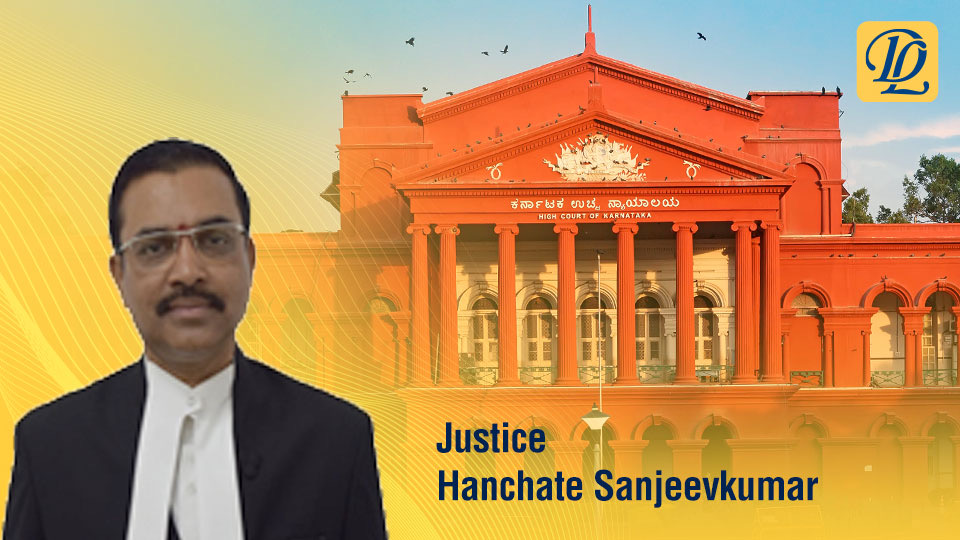
Hon’ble Mr. Justice Hanchate Sanjeevkumar celebrates his 55th birthday today.
Hon’ble Mr. Justice Hanchate Sanjeevkumar: Born on 13.05.1971. Appointed as Additional Judge of the High Court of Karnataka and taken oath on 04.05.2020 and Permanent Judge on 25.09.2021.
Important Judgments delivered by Hon’ble Mr. Justice Hanchate Sanjeev Kumar.
Wife getting lumpsum maintenance under Section 125 Cr.P.C as full settlement is NOT precluded from claiming maintenance under Section 18 of the Hindu Adoption and Maintenance Act. Karnataka High Court.
MVC Act. The principle of “pay and recover” applies even when owner of vehicle had contested claim petition before the Tribunal or filed appeal against the award. Karnataka High Court.
Holder of Light Motor Vehicle driving license driving Transport Vehicle does not amount to fundamental breach of the insurance policy so as to avoid the liability of the insurance company. Karnataka High Court.
Hindu Adoptions and Maintenance Act, 1956. Adoption of a person above the age of 15 years is permissible only if there is custom or usage applicable to the parties which permits such adoption. Karnataka High Court.
Education. ‘Punishment imposed on student for malpractice shall be commensurate with the gravity of the misconduct’. Karnataka High Court invokes doctrine of proportionality to reduce punishment imposed on a student.
Karnataka Lokayukta Act, 1984. Employees of statutory bodies and government companies are not ‘government servants’ though they are ‘public servants’. Government cannot entrust inquiry against them to Lokayukta under CCA Rules. Karnataka High Court.
‘No child is born in this world without a father and mother. A child has no role to play in his-her birth’. Karnataka High Court orders compassionate appointment to children born out of void or voidable marriage.
Preventive detention. Consideration of representation even after confirmation of preventive detention order is part of Article 21 of the Constitution. Karnataka High Court.
Caste Certificate. Only aggrieved person, such as employer or person deprived of caste certificate or post in Govt or public service or seat educational institution on account of fraudulent caste certificate can question.
Insolvency and Bankruptcy Code, 2016. Demand for customs duty which is not part of resolution plan approved by the adjudicating authority stands extinguished permanently. Karnataka High Court.
Customs Act, 1962. Notification enhancing custom duty would NOT become enforceable if it is simply issued and sent for publication. It is enforceable only when such a notification is published and also offered for sale. Karnataka High Court.
Motor Vehicles Act. Under ‘Act Policy or Statutory Policy’ occupants of the vehicle cannot be considered as third parties. Insurance company is liable for the occupants only if the policy is comprehensive. Karnataka High Court.
Place of inquiry and trial in case of continuing matrimonial offence.
Motor Vehicle Act. Vehicle insured but without valid fitness certificate. Insurer is not liable. However ‘pay and recover’ is applicable. Karnataka High Court.
Motor Vehicle Act Insurance policy commences from the time of making payment and not from issuance of policy.
Motor Vehicles Act. Transport Corporation is not entitled for compensation under the head, loss of revenue/idling charges when a bus meets with accident and spare bus is assigned on the scheduled route. Karnataka High Court.
Scribe of a Will can also be considered as attesting witness apart from the status as scribe thus fulfilling the requirement of Section 63 of the Indian Succession Act. Karnataka High Court.
Court cannot take into consideration artificial deductions by husband showing lesser take-home salary to avoid maintenance payable to wife and children. Karnataka High Court.
Hindu Law. ‘’Husband and Wife are one person. Physically divided yet united by Soul’’. Wife cannot seek partition of coparcenary or self-acquired properties during the lifetime of her husband. Karnataka High Court.
Wife getting lumpsum maintenance under Section 125 Cr.P.C as full settlement is NOT precluded from claiming maintenance under Section 18 of the Hindu Adoption and Maintenance Act. Karnataka High Court.
Land Acquisition. Compensation is payable even in respect of Pot/Phut Kharab with statutory benefits unless RTC shows it as canal, nala, road, tank, stream, burial/cremation ground, footpath or reserved for any public purpose. Karnataka High Court.
Insurance company is not liable to pay compensation when the owner gives his vehicle to a minor to drive eventually resulting in the accident. Karnataka High Court.
While dismissing suit for injunction, Court cannot grant decree for possession of the suit property in favour of the defendant in the absence of pleadings or counter claim. Karnataka High Court.
Married daughters are also entitled for partition in the tenanted lands granted under the Karnataka Land Reforms Act, where it is proved that the land granted is enuring to the benefit of joint family. Karnataka High Court.
Civil Court has jurisdiction to decide the inheritance and partition of the tenanted lands granted under the Karnataka Land Reforms Act, among the coparceners. Karnataka High Court.
When a sale deed mentions wrong boundary, the Court can rely on Survey Sketch and Revenue Map, which have presumptive value under the Evidence Act, to identify the property and decide the real issue involved. Karnataka High Court.
Motor Vehicles Act. In case of comprehensive insurance policy, personal accident coverage is applicable even to the borrower of the vehicle. Karnataka High Court.
Rejection of plaint in partition suit. Mere assertion in the written statement about prior partition cannot be a ground to reject the plaint without recording evidence to ascertain the prior partition. Karnataka High Court.
“No women in Bharatha would leave voluntarily matrimonial home of husband’’. Non-compliance of decree of restitution of conjugal rights cannot be a ground for not granting maintenance under section 125(4) of Cr.P.C. Karnataka High Court.
Mere compliance with legal formalities does not necessarily prove the valid execution of a Will. The propounder must also dispel any suspicious circumstances surrounding the Will. Karnataka High Court.
Executant of the Will having been admitted to ICU and dying within short span of time. Mere certificate of the doctor cannot prove the physical and mental competence of the executant. Karnataka High Court.
Evidence Act. Although an expert report is merely an opinion, courts should consider that experts base their conclusions on scientific examination. While courts are not bound to accept expert reports, they also cannot be lightly rejected without careful consideration. Karnataka High Court.
A construction area is a public place as per Section 2(34) of the Motor Vehicles Act. Consequently, an insurance company is liable to pay compensation to victims of accidents, including those occurring within the construction area at night. Karnataka High Court.
Road roller and double drum roller is motor vehicle under Section 2(21) and 2(28) of the Motor Vehicles Act. Karnataka High Court.
A nominee under an insurance policy is merely a recipient of the amount for the convenience of the insurer and does not become the absolute owner of the policy proceeds. The rightful entitlement of policy amount is determined by the applicable law of succession and legal heirs have a superior claim over the nominee. Karnataka High Court.
A person traveling on the mudguard of a tractor is not an authorized passenger under the Motor Vehicles Act. Such risk is not covered under the statutory insurance policy. The insurance company is not liable to pay compensation. Karnataka High Court.
Compensation in motor vehicles accident cases. Grant of family pension cannot be a ground to deny compensation to wife for loss of dependency since the pension is a deferred wage earned through the deceased’s service. Karnataka High Court.
Motor vehicles cases. Absence of a post-mortem does not automatically negate medical evidence proving the cause of death. Expert medical opinions can establish the link between injuries sustained in an accident and subsequent death. Karnataka High Court.
A civil court has jurisdiction to entertain a suit for caste declaration when the plaintiff is not claiming reservation benefits. Karnataka High Court.
A third party affected by a compromise decree has the right to challenge its validity in a separate suit. A compromise decree before the Lok Adalat obtained by fraud or misrepresentation is not binding and can be set aside in a separate suit. Karnataka High Court.
Arbitration and Conciliation Act. A neutral venue mutually agreed upon by the parties does not need to have jurisdiction in the traditional sense. Even if no part of the cause of action arises at the chosen venue, arbitration proceedings may still be held there, and the courts at that venue will have jurisdiction over matters related to the arbitral award. Karnataka High Court.
A second wife is entitled to maintenance under Section 125 of Cr.P.C. when the husband married her without disclosing his subsisting first marriage. Karnataka High Court.
Properties acquired during the marriage of a deceased person are to be considered jointly acquired, even if registered in the name of one spouse. Karnataka High Court.
All women are equal but for the personal laws which treat them differently. Uniform Civil Code and its enforcement give justice to women and achieve equality of status and opportunity. Karnataka High Court.
Even if a wife is granted monetary relief under the PWDV Act, it does not prevent her from claiming maintenance under Section 125 of the Cr.P.C. When determining the quantum of maintenance, the court should consider the maintenance awarded in any previously instituted proceeding to avoid overlapping and conflicting orders. Karnataka High Court.
Suit for injunction. Unregistered sale agreements or MOUs, even if they involve payment of consideration and handing over of original title deeds, do not convey title since in disputes over vacant land, possession is presumed to follow title. Karnataka High Court.
Unregistered MOU does not convey title to immovable property even if original documents are handed over to the intending purchaser and full sale consideration is received by the owner. Karnataka High Court.
Negotiable Instruments Act. Endorsement made by the bank while returning the cheque as ‘’account is closed’’ is akin to ‘’insufficient funds’’ attracting the penal provision under Section 138. Karnataka High Court.
Property purchased by wife in her husband’s name using her own funds is her self-acquired property, exempt from benami prohibitions, as the statutory exception for a husband purchasing in his wife’s name is reciprocally applied. Karnataka High Court.
Karnataka Land Reforms Act. Right to inherit tenancy in tenanted lands is exclusively limited to individuals falling within the statutory definition of ‘family’. Married daughter is expressly excluded from this definition and possesses no inheritable right to her father’s tenanted land. Karnataka High Court.
Motor Vehicle insurance Cover notes are mere proposals valid for 60 days. Without premium payment and policy issuance, the insurance company is not liable. The claimant or vehicle owner must prove the policy’s existence if the insurer disputes liability. Karnataka High Court.
A suit for a permanent injunction solely based on an unregistered agreement to sell without seeking substantive relief of specific performance is not maintainable. Karnataka High Court.
Karnataka Gram Swaraj and Panchayat Raj Act. A suit to recover payment for work performed for the Panchayat is not barred under Section 295, as the restriction applies only to money lawfully collected by the authority. Karnataka High Court.
Employees Compensation Act. Petition for compensation filed by a major brother of the deceased is not maintainable since he is not a ‘dependant’ under Section 2(d) of the Act. Karnataka High Court.
In a partition suit, an absolute injunction restraining alienation over the entire property is incorrect when the plaintiffs only claim a fractional share. The injunction can be granted to restrain alienation or encumbrance on the reserved portion equivalent to the share claimed. Karnataka High Court.
A challenge to a Will must be instituted within three years from the date on which the cause of action first arises, namely, the date on which the plaintiffs first acquire knowledge of the said Will. A suit instituted decades after the execution of the Will to question its validity is manifestly barred by limitation. Karnataka High Court.
In a suit for specific performance, the trial court need not grant an injunction restraining the owner from alienating the property, as any transfer made during the pendency of the proceedings remains subject to the final decree by virtue of the doctrine of lis pendens under Section 52 of the Transfer of Property Act. Karnataka High Court.
Land acquisition. A suit for permanent injunction against a land acquiring authority is not maintainable in a Civil Court under Section 9 CPC if the land has already been subject to completed acquisition proceedings. Land Acquisition Act is a complete code, and the Civil Court’s jurisdiction is barred from interfering with such proceedings. Karnataka High Court.
A Muslim woman who marries a Hindu man becomes an integral member of her husband’s family. This holds true even where the relationship, though not a formal marriage, is in the nature of marriage. Consequently, succession to her estate upon her death is governed by the Hindu Succession Act. Karnataka High Court.
In a suit for specific performance, interests of justice are best served not by an absolute injunction, but by permitting development of the property subject to a formal undertaking that the construction shall be at the defendants’ own risk and subject to the final adjudication of the suit. Karnataka High Court.
Partition. The principle that there cannot be a partial partition is not an absolute one. Partial partition is permissible by exercising power under Section 151 of the CPC. Karnataka High Court.
Hindu Law. Where an oral family arrangement effecting partition by metes and bounds is reported to the revenue authorities and reflected in the records, it constitutes a valid partition and is exempt from registration. Partition is not a transfer but a mutual arrangement, and revenue entries, if supported by cogent evidence, can establish a valid partition. Karnataka High Court.
An agreement of sale executed during a prohibitory or non-alienation period is barred by law and contrary to public policy, thereby attracting the bar under Section 23 of the Indian Contract Act. Consequently, a plaint filed to enforce such an agreement is liable to be rejected. Karnataka High Court.

