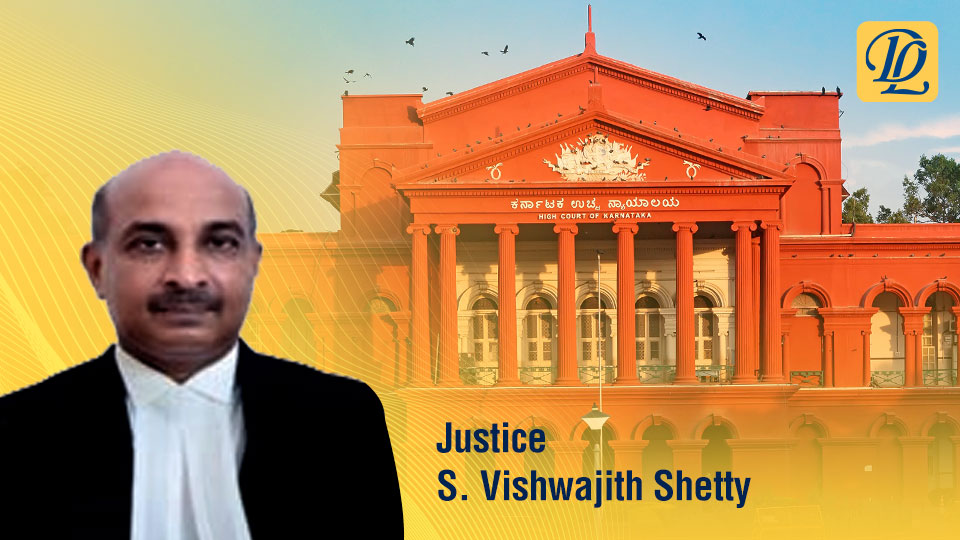
Hon’ble Mr. Justice S. Vishwajith Shetty celebrates his 59th birthday today.
Hon’ble Mr. Justice Savanur Vishwajith Shetty: Born on 19.05.1967. Appointed as Additional Judge of the High Court of Karnataka and taken oath on 28.04.2020 and Permanent Judge on 25.09.2021.
Important Judgements delivered by Hon’ble Mr. Justice S Vishwajith Shetty.
Karnataka Police Act. Mere apprehension of the police is not enough to pass an order of externment. There must be grounds and adequate materials to show that there is danger based upon credible materials. Karnataka High Court.
https://dakshalegal.com/judgements/actionView/RoyFyKpPp7rcOKBWYaz8MwnTj
Indian Penal Code. When accused is acquitted for the offence under Section 392 (Robbery), he cannot be convicted for the offence under Section 411 (Dishonestly receiving stolen property). Karnataka High Court.
Wife demanding separate residence does not always amount to cruelty for grant of divorce. There must be determination to put an end to marital relation and cohabitation. Karnataka High Court.
Karnataka Excise Act. Compliance of Sections 53 and 54 i.e. securing search warrant or to record the grounds to dispense with the search warrant is mandatory. Non-compliance of the same would vitiate the conviction order. Karnataka High Court.
Judgment of acquittal passed in a complaint case can be challenged before the High Court under Section 378(4) Cr.PC and an appeal under Section 378(2) Cr.PC before the Sessions Court is not maintainable. Karnataka High Court.
Rash and negligent driving resulting in death. Leniency can be shown on the sentence that is imposed on the accused in the event if the family members of the deceased receive the compensation from the accused. Karnataka High Court.
When Juvenile Justice Board decides to try the juvenile as an adult, the accused can, apart from appealing against the order, seek bail under Section 12 of the Juvenile Justice (Care and Protection of Children) Act, 2015. Karnataka High Court.
Arms Act. When the gun seized from the accused was unloaded and no ammunition was found in possession of the accused, the gun cannot be said to have been used for hunting purposes. Karnataka High Court sets aside conviction.
Karnataka SC/ST (PTCL) Act. Application for restoration filed 25 years after the sale cannot be entertained by the authorities since it is beyond reasonable time. Karnataka High Court.
Judicial estoppel. Person participating in the proceedings despite knowledge of the defect in the jurisdiction of an Authority without any objection is disentitled from questioning the jurisdiction in subsequent proceeding. Karnataka High Court.
“Child cannot be allowed to remain in unhealthy atmosphere”. Karnataka High Court orders custody of the minor child to the father having found the wife to be in immoral relationship.
Order XXIII Rule 1(3)(b) of CPC applies even to writ proceedings. Withdrawal of writ petition with liberty to file fresh petition on the same cause of action does not act as resjudicata. Karnataka High Court.
Order XVIII Rule 3 of CPC. Rebuttal evidence is permissible only in respect of issues casting onus on the other side and the said opportunity cannot be utilized to fill up the lacuna in the evidence of the party leading evidence first. Karnataka High Court.
Writ jurisdiction cannot be invoked challenging issuance of caste certificate since alternate remedy of appeal is provided under the Karnataka SC/ST & OBC (Reservation of Appointments, etc.,) Act. Karnataka High Court.
“State has no power to direct reservation in employment in favour of SC, ST and OBCs in Private Schools under the Karnataka Education Act.” Landmark Judgement from the Karnataka High Court.
“State has no power to regulate fee structure in Private Schools under the Karnataka Education Act”. Landmark Judgement from the Karnataka High Court.
Withdrawal of exemption under the Employees Provident Funds and Miscellaneous Provisions Act on the ground of financial loss of an establishment for three consecutive years is not unconstitutional. Karnataka High Court.
Prospective beneficiary has no right to question deletion of the land from the acquisition proceedings. Karnataka High Court.
When urgency clause in invoked under Land Acquisition Act, 1894, the State must act with quite promptitude failing which the acquisition proceedings are liable to be quashed. Karnataka High Court.
Writ Court cannot direct the Government to frame scheme under Article 162 of the Constitution especially when the parties have alternative remedy for the redressal of their grievances. Karnataka High Court.
When correction of arbitration award is sought, limitation to challenge award commences from the date on which request for correction of award has been disposed of by arbitrator and not from the date of the original award. Karnataka High Court.
”Every order or transaction pursuant to fraudulent act is void ab initio and the same cannot be allowed to stand”. Karnataka High Court, while ordering restoration of khata which was fraudulently changed.
Change of entries in property register by playing fraud. Such fraudulent entry can be set aside in a Writ Petition under Article 226 of the Constitution of India. Karnataka High Court.
Arbitration award. The date for quantifying the stamp duty payable on the award is the date on which the award was signed. Karnataka High Court.
Nominated members have no right to cast their votes in the election to President and Vice President under the Karnataka Municipalities Act. Karnataka High Court.
Tahsildar has jurisdiction under Section 140(2) of the Karnataka Land Reforms Act to carry out survey work and fix boundaries even in respect lands falling within the limits of Corporation. Karnataka High Court.
Transport vehicle and omnibus, when gross weight does not exceed 7500 kg would be a light motor vehicle. Holder of LMV driving licence is competent to drive such transport vehicle only when the weight does not exceed the limit. Karnataka High Court.
Customs Brokers Licensing Regulations. Time limit of 90 days for passing the order in original under Regulation 17 is directory and not mandatory. Karnataka High Court.
Family pension. Order of priority under the pension Rules prevail over order of priority under the Hindu Succession Act. When wife is alive, no other legal/illegitimate heir can claim family pension. Karnataka High Court.
Karnataka SC-ST (PTCL) Act, 1978. Application for resumption and restoration of granted land filed 10 years after the sale can be rejected on the ground of delay and laches. Karnataka High Court.
Karnataka SC-ST (PTCL) Act, 1978 is NOT applicable in cases of mere agreements of sale without delivery of possession. Karnataka High Court.
Karnataka SC-ST (PTCL) Act, 1978. Delay of 16 years from the date of sale in filing application for resumption and restoration of granted land. Karnataka High Court quashes the entire proceedings.
Service Law. Minimum qualifications for appointments prescribed under the UGC guidelines are for the purpose of maintaining excellence in the higher standards of education. Universities have no power to relax them. Karnataka High Court.
‘Corruption hurts everyone. Corruption erodes trust of a common man in the system. Anti corruption law shall be invoked against persons, who by virtue of their office are discharging public duty’. Karnataka High Court.
Prevention of Corruption Act, 1988. Employee of Society, registered under the Societies Registration Act, which receives funds from Government, is a ‘public servant’ and liable for prosecution under the Act. Karnataka High Court.
Default bail under the Unlawful Activities Prevention Act. Order extending time to complete investigation without notifying or producing the accused is bad in law. Accused are entitled to default bail in such eventuality. Karnataka High Court.
Cenvat Credit Rules, 2004. Industry having outdoor catering services for factory canteen cannot claim Cenvit credit post 2011. Court, while dealing with taxing statute, cannot include what is specifically excluded. Karnataka High Court.
Code of Civil Procedure, 1908. Order XXIX Rule 1. Director of company can NOT institute a suit without board resolution or ratification. Temporary injunction can be refused on the ground of maintainability of the suit. Karnataka High Court.
Right to Fair Compensation and Transparency in Land Acquisition, Rehabilitation and Resettlement Act, 2013 does not apply to acquisitions under the Bangalore Development Authority Act. Karnataka High Court reiterates.
Bangalore Development Authority Act, 1976. Section 38-B. Karnataka High Court declares bulk allotment of acquired land by BDA in favour of BDA Employees’ Welfare Association as illegal. Dismisses PIL for non-joinder of allottes of the sites.
Environment. Declaring forest as non-forest under the Karnataka Forest Act without the prior approval of the Central Government is illegal. Take action against erring officials – Karnataka High Court.
Criminal Procedure Code. Power under Section 311 to summon material witness or examine person present can be invoked by the court suo motu and even at a stage when the case is posted for judgment. Karnataka High Court.
Suo Motu action regarding functioning of the Juvenile Justice Boards in the State. Karnataka High Court issues interim directions.
Criminal Procedure Code. Non-recording or delayed recording or improper recording of statement under Section 161-3 is a serious irregularity which is incurable. Conviction under NDPS Act set aside on this ground. Karnataka High Court.
Criminal Procedure Code. Section 319. Power to proceed against other persons appearing to be guilty of offence cannot be exercised in a casual manner on the basis of a stray statement of the complainant. Karnataka High Court.
Aarogya Setu App. Informed consent of users of the app is must for sharing user data by the Government of India and National Informatics Centre. Karnataka High Court.
Karnataka High Court strikes down rule enabling collection of fee from transporter of minor minerals from other States into State of Karnataka.
Arbitration and Conciliation Act 1996. Additional award under Section 33 forms part of the arbitral award. Remedy appeal and not Writ.
Karnataka High Court directs State Election Commission to hold elections for 198 Wards of BBMP at the earliest.
Properties purchased by husband in the name of his wife are the absolute properties of the wife in view of Section 14 of the Hindu Succession Act. Karnataka High Court.
Daughters born prior to coming into force of the Hindu Succession Act, 1956 are also entitled for coparcenary property under the amended Section 6. Karnataka High Court.
Special statutes prevail over the Limitation Act. Appellate Authority has no power to entertain an appeal beyond the period of one month as stipulated under Section 107(4) of the Karnataka Goods and Services Tax Act, 2017. Karnataka High Court.
Bombay Tenancy and Agricultural Lands Act, 1948. In a case of surrender of land by tenant, procedure of taking possession under Section 29 of the Act does not apply. Karnataka High Court.
Karnataka Land Reforms Act. Trustee is the owner and custodian of Trust property and cannot claim occupancy rights under Section 45 of the Act in respect of the Trust property. Karnataka High Court.
Karnataka SC/ST (PTCL) Act. Any action taken by the authorities under the Act beyond a reasonable period cannot be sustained. Karnataka High Court quashes resumption order.
Karnataka Land Reforms Act. Sub-tenants are entitled to be registered as occupants of the land, only when the sub-tenancy was created prior to 2 October 1965. Karnataka High Court.
High Court under Article 226 cannot interfere with the order of the fact-finding authority like the Land Tribunal especially when the order is based on appreciation of the oral and documentary evidence on record. Karnataka High Court.
Karnataka Land Revenue Act. Deputy Commissioner has no jurisdiction to reject the application for conversion of land after the expiry of four months when the deeming clause under Section 95 (5) applies. Karnataka High Court.
Blocking Input Tax Credit available in Electronic Credit Ledger under Rule 86A of the Central Goods and Services Tax Rules, 2017. Post-decisional or remedial hearing shall be granted to the person/assessee affected. Karnataka High Court.
Tenancy rights can be adjudicated only before the Land Tribunal. Tahsildar has no right to enter the name of the Government in RTC assuming vesting of the land. Karnataka High Court.
”It is the duty of the Court and the Prosecution to protect the right of informant/victim to oppose bail application of the accused for the rape offence under IPC or under POCSO Act.” Karnataka High Court issues exhaustive guidelines.
Bail application of an accused for the offences punishable under Section 376(3), 376-AB, 376DA or 376-DB of IPC or under POCSO Act cannot be heard without giving opportunity of being heard to the informant/victim. Karnataka High Court.
POCSO Act being later prevails over the SC/ST Atrocities Act. Where accused is charged with both SC/ST Atrocities Act and POCSO Act, petition for bail under Section 439 Cr.P.C can be filed before High Court. Karnataka High Court.
There is no need for the Court order appointing guardian in respect of minor’s undivided interest in joint family. Parents can sell undivided interest of minor in joint family property. Karnataka High Court.
Bombay Paragana and Kulkarni Watans (Abolition) Act. Re-grant in favour of the Watandar/Inamadar would enure to the benefit of the purchaser if the sale was made prior to the last date of filing an application for re-grant. Karnataka High Court.
Prosecution has no right to apply for modification of the chargesheet under Section 216 and 217 of the Cr.P.C. Only the trial Court can suo motu exercise power to alter the chargesheet. Karnataka High Court.
When a document which is required to be stamped is not sufficiently stamped, even the copy of such document is not admissible as secondary evidence. Karnataka High Court.
Recovery of Government dues. ‘’The practice of bringing the entire extent of land for sale for recovery of dues which would be otherwise recovered by selling a portion of the property is highly deplorable’’. Karnataka High Court.
Karnataka Control of Organised Crime Act. Service of grounds of arrest on the accused immediately after his arrest would be sufficient compliance under Section 50(1) of Cr.PC and Article 22(1) of the Constitution of India. Karnataka High Court.
Willful failure to submit income tax returns. There is a presumption of a culpable mental state on the part of the accused. The accused has to rebut this presumption in accordance with the law. Karnataka High Court.
Retailers or showroom owners cannot be prosecuted under the Insecticides Act, 1968, for selling a substandard product unless it is proven that they had knowledge of its defective nature or were responsible for its manufacture or quality control. Criminal liability under the Act requires mens rea, and prosecution should be limited to persons directly responsible for the product’s quality and distribution. Karnataka High Court.
Magistrate’s Court has no jurisdiction to try offences under Section 27(b)(ii) of the Drugs and Cosmetics Act, 1940, as per Section 32(2) of the Act. Such cases must be committed to the Sessions Court, and failure to do so renders the entire trial and conviction void. Karnataka High Court.
The right to default bail is a fundamental right when the charge sheet is not filed within the prescribed period. Courts must ensure judicial scrutiny before permitting mechanical addition of stringent charges. Karnataka High Court.
Criminal proceedings under Sections 498A, 494 IPC are liable to be quashed if filed beyond the limitation period under Section 468 Cr.P.C. Mere allegations without concrete proof of a second marriage or direct involvement of accused relatives amount to an abuse of process, warranting relief under Section 482 Cr.P.C. Karnataka High Court.
In matrimonial disputes, criminal proceedings under Section 498A IPC cannot be sustained based on vague, omnibus allegations, particularly against aged in-laws living separately. Unexplained delay in filing an FIR casts doubt on the credibility of allegations. Karnataka High Court.
Partition Act, 1893. Where a property is found to be indivisible and if multiple shareholders seek to exercise their right to buy out other shares, the Court must facilitate a competitive process and is legally mandated to sell the shares to the shareholder who offers the highest price above the court’s valuation. Karnataka High Court.
Karnataka Court Fees and Suits Valuation Act. In a suit for declaration and possession involving agricultural land, the market value for the purpose of calculating Court fees must be determined solely as 25 times the annual land revenue as prescribed by the deeming provision in Section 7(2) of the Act. Karnataka High Court.
Karnataka Stamp Act. If possession was already held by the purchaser prior to the agreement of sale or if possession is not delivered under the agreement, the document is only liable to be stamped under the lower duty. Karnataka High Court.
When a jurisdictional issue is raised belatedly, after substantial evidence has already been led on the original issues, the Trial Court cannot exercise discretion to treat it as a preliminary issue. In such circumstances, the mandate under Order XIV Rule 2(1) to decide all issues together must prevail. Karnataka High Court.
Indian Succession Act. A person who claims a right to the testator’s property adverse to the testator’s title and who is not an heir under succession or inheritance, does not have a ‘caveatable interest’ and cannot be impleaded as an objector in a petition for the grant of probate. Karnataka High Court.
Order XVIII Rule 1 and 3 CPC. Trial Court has no power to compel a defendant to lead evidence first, especially on issues where the burden of proof lies on the plaintiffs. The plaintiff must first lead evidence on all issues where the burden of proof rests on him. Karnataka High Court.
An accused already in custody for one offense requires formal arrest and remand in the second offense for their custody in the latter case to be legal. In such an eventuality, fresh bail application can be filed before the Trial Court, even if previously granted bail and released in the initial offense. Karnataka High Court.
The right to default bail is a fundamental right when the charge sheet is not filed within the prescribed period. Courts must ensure judicial scrutiny before permitting mechanical addition of stringent charges. Karnataka High Court.
SARFAESI Act. When a security interest is duly registered, it creates a first charge that overrides any subsequent attachment order issued by tax authorities under State legislations like the KVAT Act. The ‘prior in time’ interest of a secured creditor must be honored, and the State cannot claim a superior charge over assets that have already been legally sold to satisfy a registered security interest. Karnataka High Court.
Arbitration and Conciliation Act. Enforcement of a foreign award can be refused only on specific statutory grounds. ‘Patent illegality’ ground is not available in respect of foreign awards. A party who voluntarily chooses not to participate in arbitration despite due notice cannot later claim they were ‘unable to present their case’ to resist enforcement. Karnataka High Court.
Suit for specific performance. A subsequent agreement holder or purchaser is not a necessary or proper party to be impleaded in the suit since such transactions are governed by the principle of lis pendens. Karnataka High Court.
Payment of Gratuity Act is a special, self-contained code. The Appellate Authority has no jurisdiction to entertain an appeal or condone delay once a total period of 120 days from the date of receipt of the order has expired, and it has no power to extend this period further. Karnataka High Court.
Commercial Courts Act: An order passed by a Commercial Court rejecting a plaint amounts to a “decree” under Section 2(2) of the CPC. The aggrieved party must prefer a commercial appeal under Section 13(1A) of the Act. A writ petition under Article 227 of the Constitution is not maintainable when such an alternative and efficacious statutory remedy of appeal exists. Karnataka High Court.
Arbitration and Conciliation Act. A party who disputes the very existence or execution of the agreement cannot maintain an application for referral to arbitration under Section 8, as the existence of a valid and admitted agreement is the jurisdictional bedrock for such an order. A Trial Court exceeds its jurisdiction if it refers parties to arbitration when the underlying agreement is denied by the applicant themselves. Karnataka High Court.
Karnataka Court Fees and Suits Valuation Act. When a plaintiff seeks a declaration that a document is void, without claiming the consequential reliefs of possession or injunction related to that declaration, the court fee is to be computed on the value assigned by the plaintiff in the plaint, and not on the market value of the property. Karnataka High Court.
Order XXXVII CPC. In summary suits, ten days period prescribed under Rule 3(5) for the defendant to apply for leave to defend, counted from the date of service of the summons for judgment is merely the outer limit. An application for leave to defend filed by the defendant after entering appearance but before the service of the summons for judgment is not premature and is legally maintainable. Karnataka High Court.
The Executing Court should permit an amendment to the execution petition and its schedule when the decreed property has undergone physical changes after the decree. Refusing such an amendment solely on the ground that the Court cannot travel beyond the decree amounts to ignoring relevant subsequent events and would unjustly deprive the decree-holder of the fruits of the decree on a mere technicality. Karnataka High Court.
Order XXIII Rule 3A. When an application questioning the compromise raises a substantial legal question concerning a purported attempt to deprive a daughter of her statutory right to an equal share in coparcenary property, the trial court cannot summarily dismiss the application without issuing notice to the parties or considering its merits. Karnataka High Court.
http://dakshalegal.com/judgements/actionView/d9045cca4a57515057e07d9e
Stamp Act. Court has the statutory power to impound any document that is insufficiently stamped at any stage of the proceedings even after the disposal of the suit and to direct the payment of deficit stamp duty and penalty. Karnataka High Court.
Karnataka Stamp Act. Refundable security deposit stipulated in a lease deed does not constitute ‘money advanced in addition to the rent reserved’. Stamp duty on the lease deed must be calculated solely on the basis of the rent reserved, excluding the refundable security deposit. Karnataka High Court.
Suit for partition. Joint family property inadvertently omitted from the plaint and the consequent preliminary decree can be included during the final decree proceedings. Karnataka High Court.
Drugs and Cosmetics Act. An Inspector appointed under Section 21(1) retains competency upon being transferred to a new area without requiring a fresh Gazette Notification. The bar on trial by a Court inferior to the Court of Session under Section 32(2) does not preclude a Magistrate from taking cognizance of the complaint and committing the case to the Sessions Court for trial. Karnataka High Court.
Abetment to commit suicide. There must be a direct and proximate link between the accused’s actions and the deceased’s death. A clear mens rea (guilty mind) and an active, direct act intended to push the person to commit suicide are required. General allegations of torture in a death note, or words uttered in the heat of a moment, are not sufficient to prove abetment.
Protection of Women from Domestic Violence Act. Female relatives of the husband/male partner can be included as ‘respondents’. However, the quantum of interim maintenance is determined by the proven income of the respondent, and courts are justified in reducing it if the applicant fails to provide evidence of higher income. Karnataka High Court.

