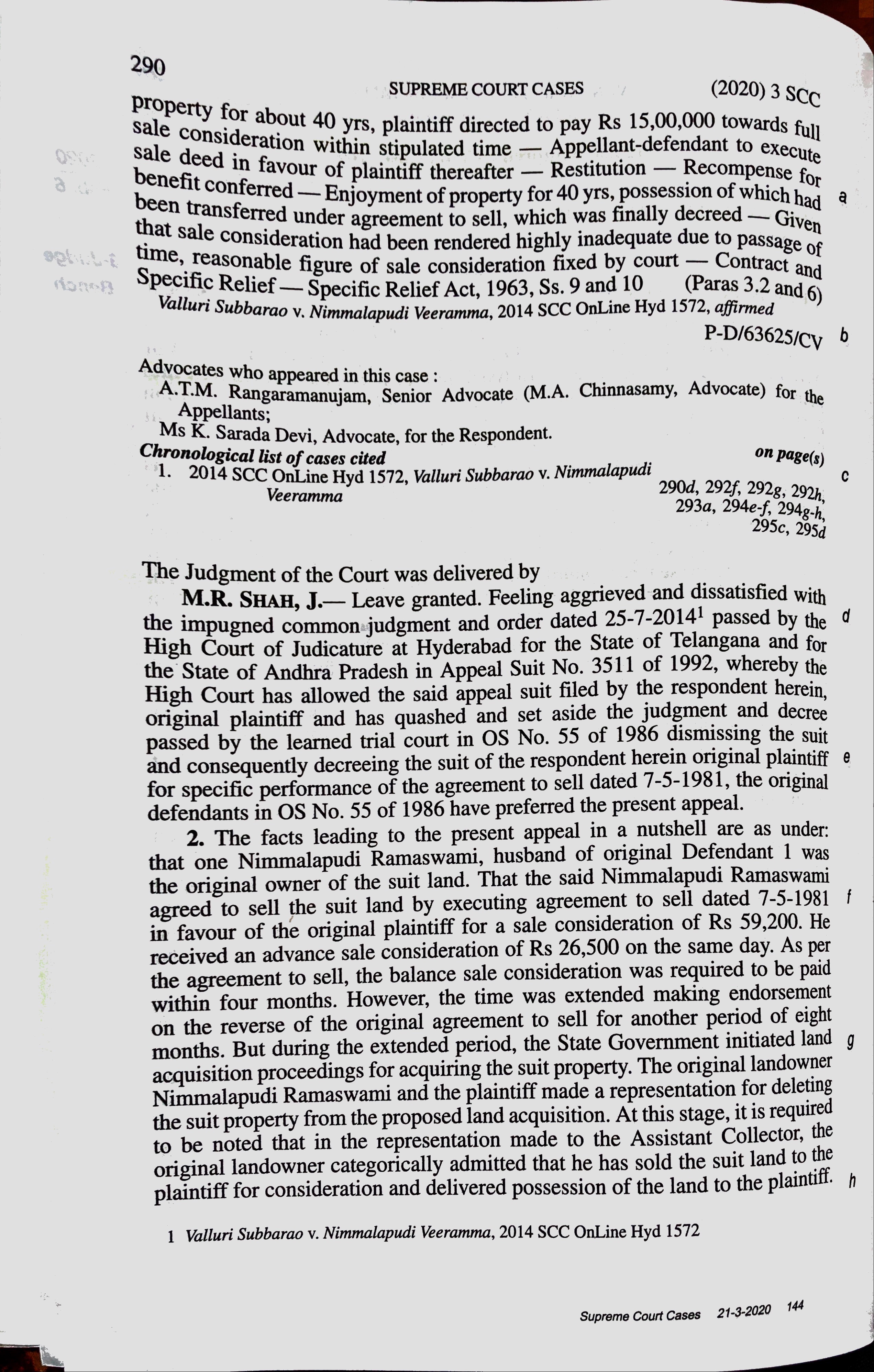
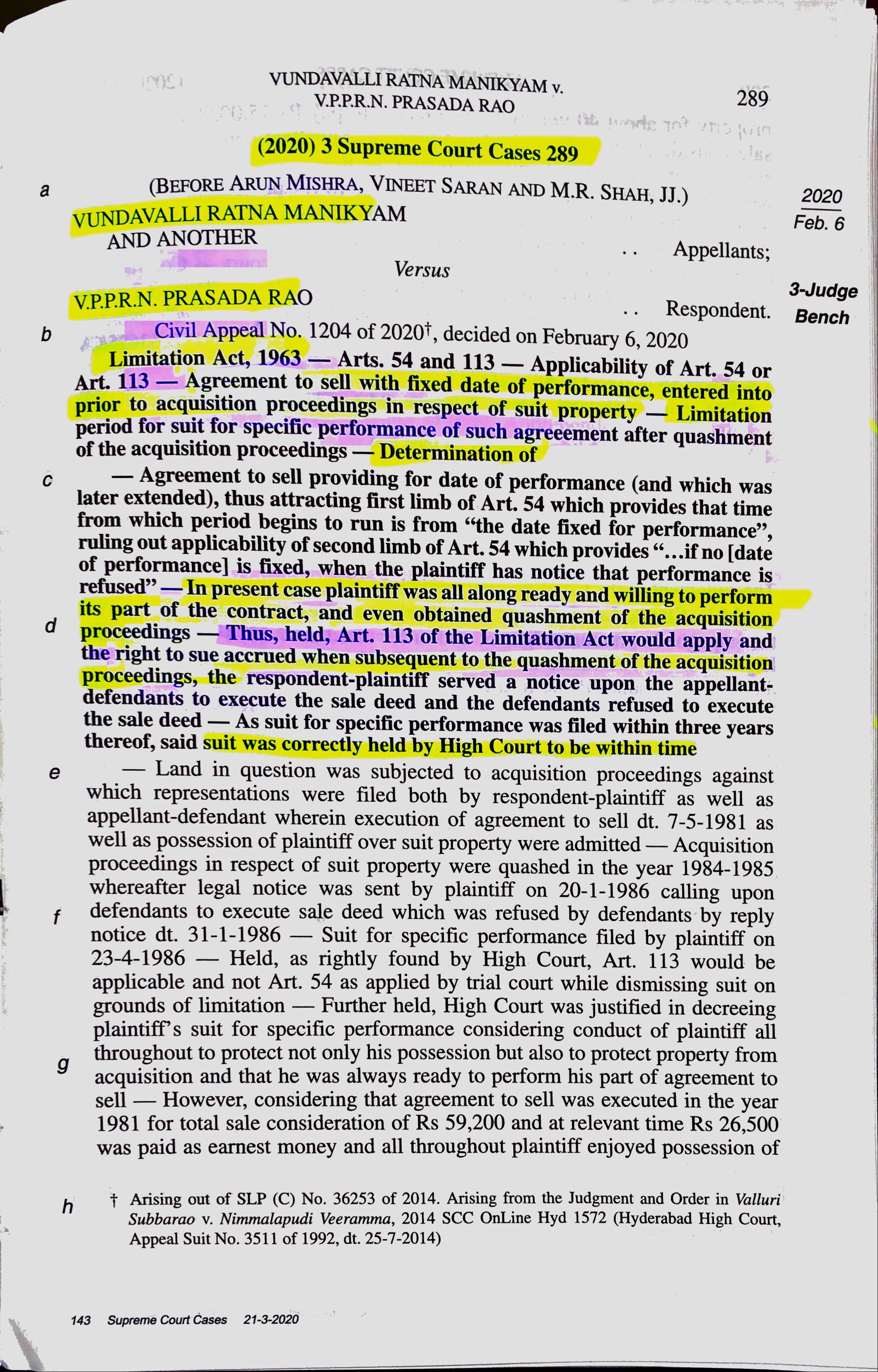
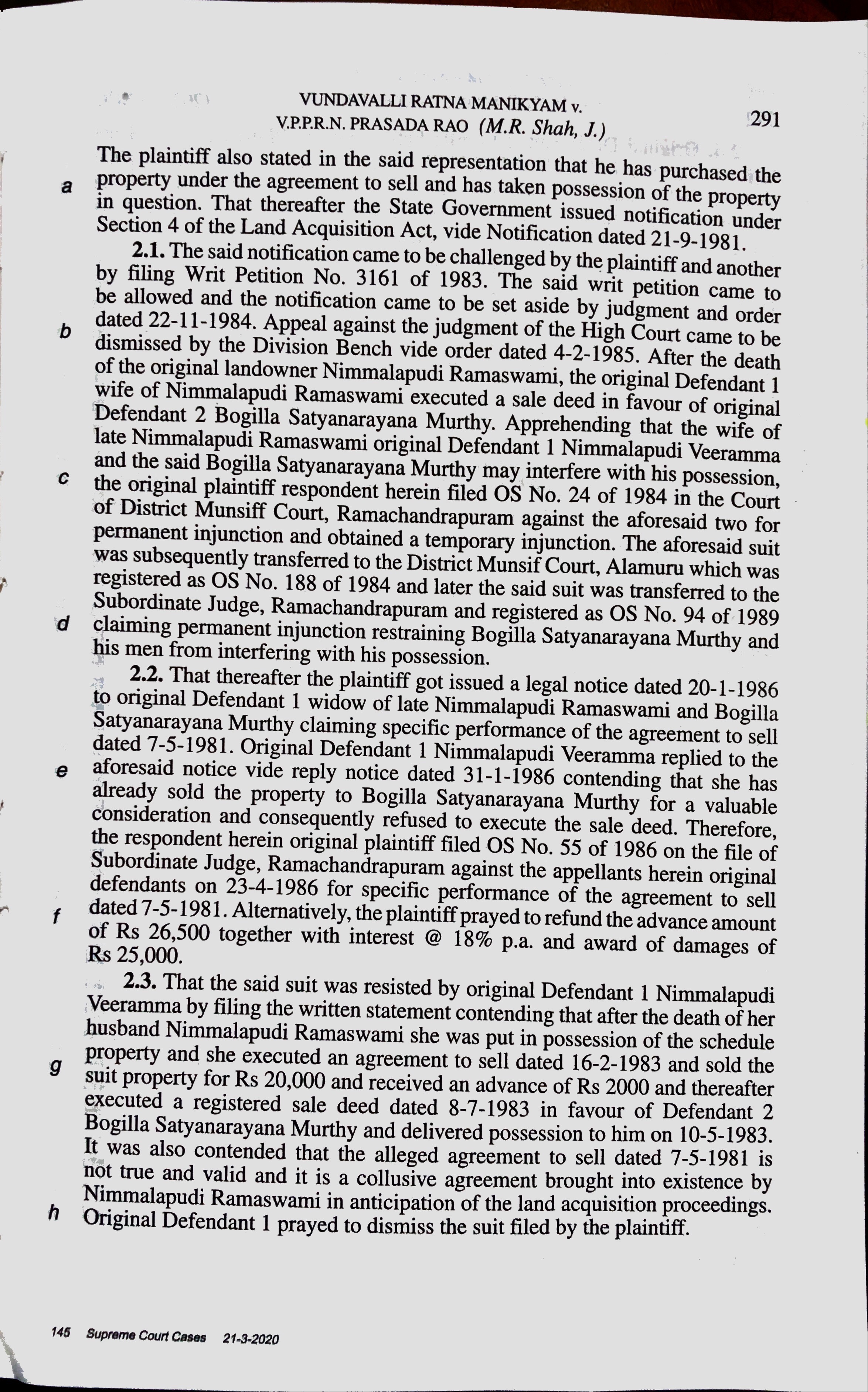
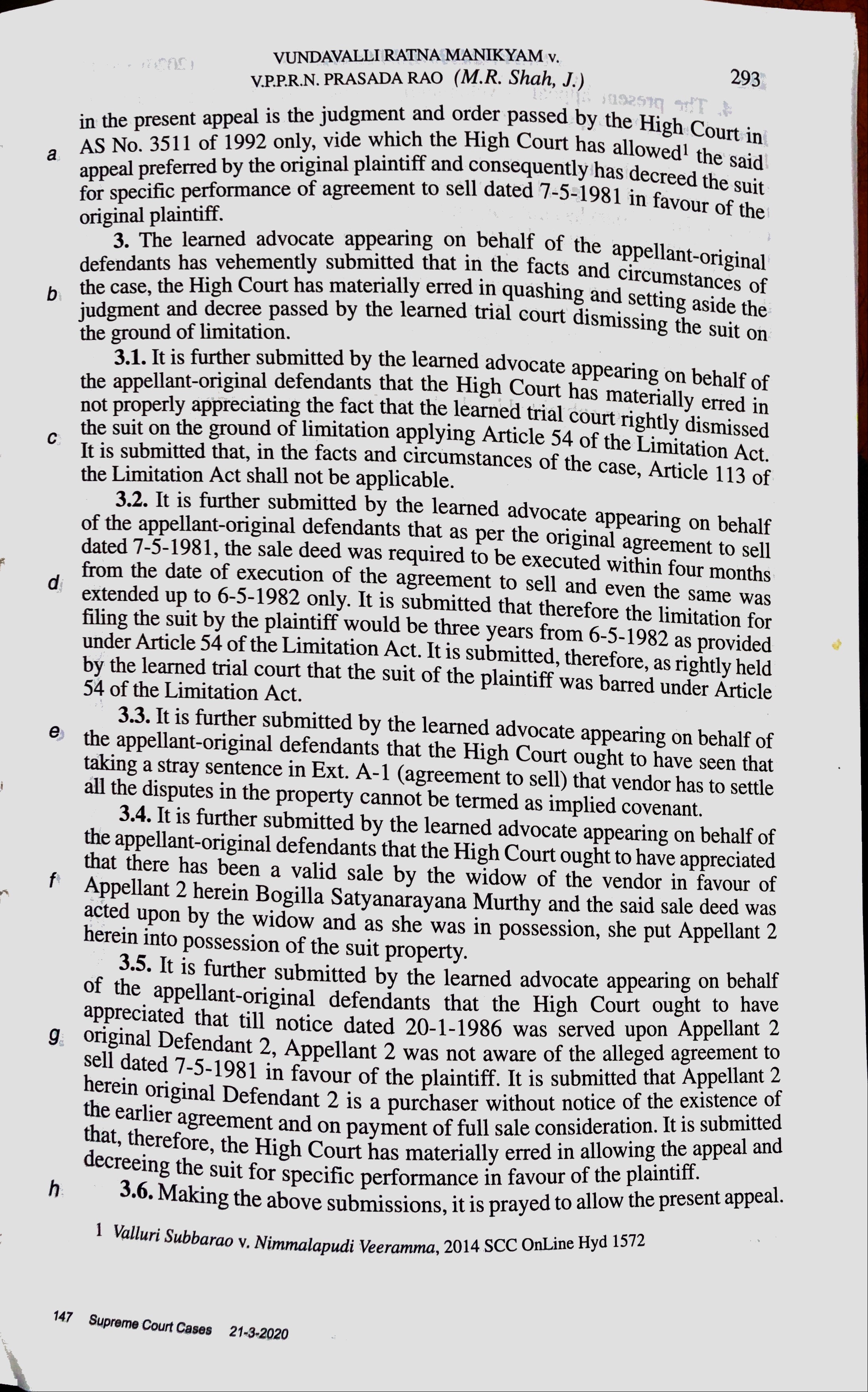
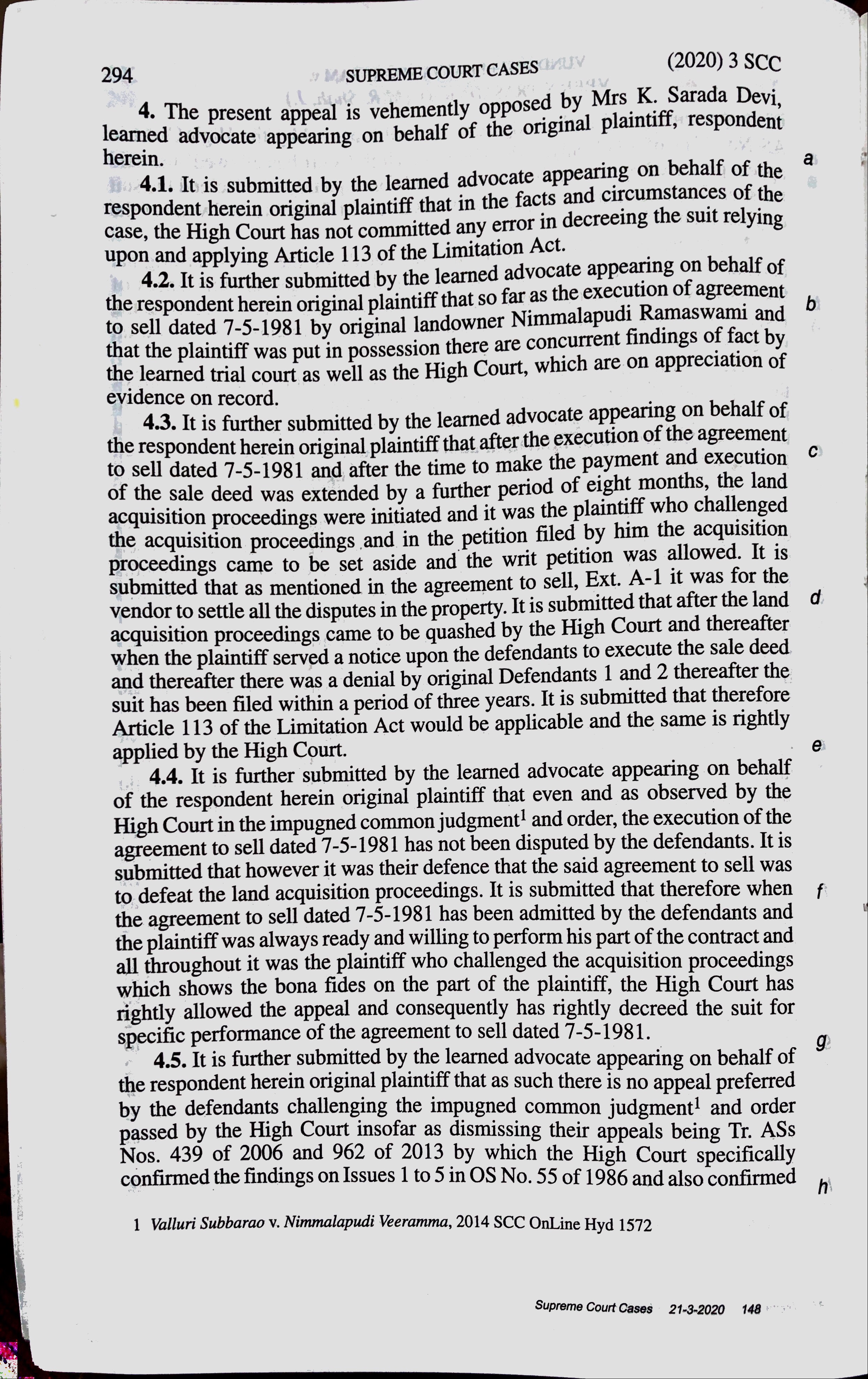
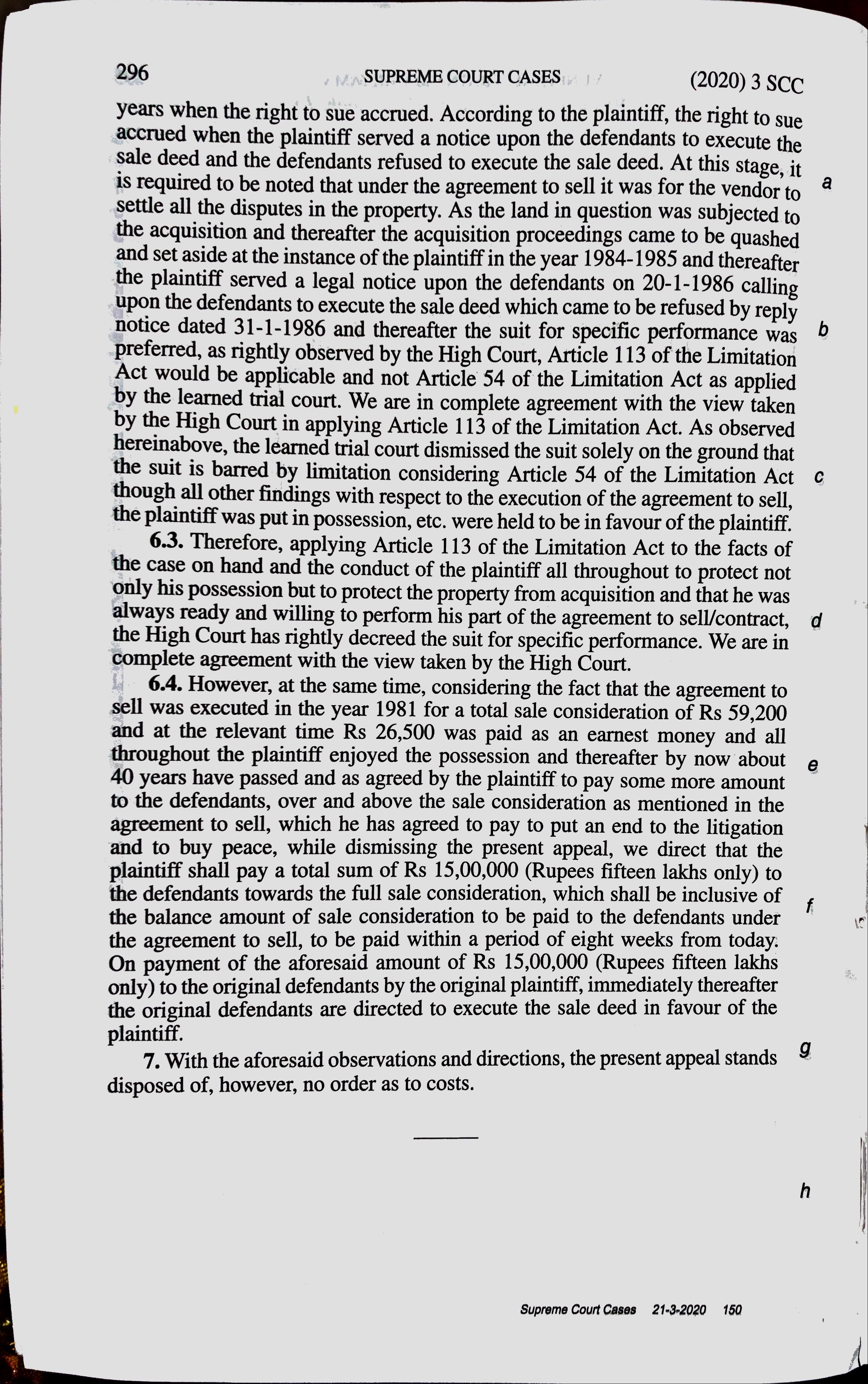
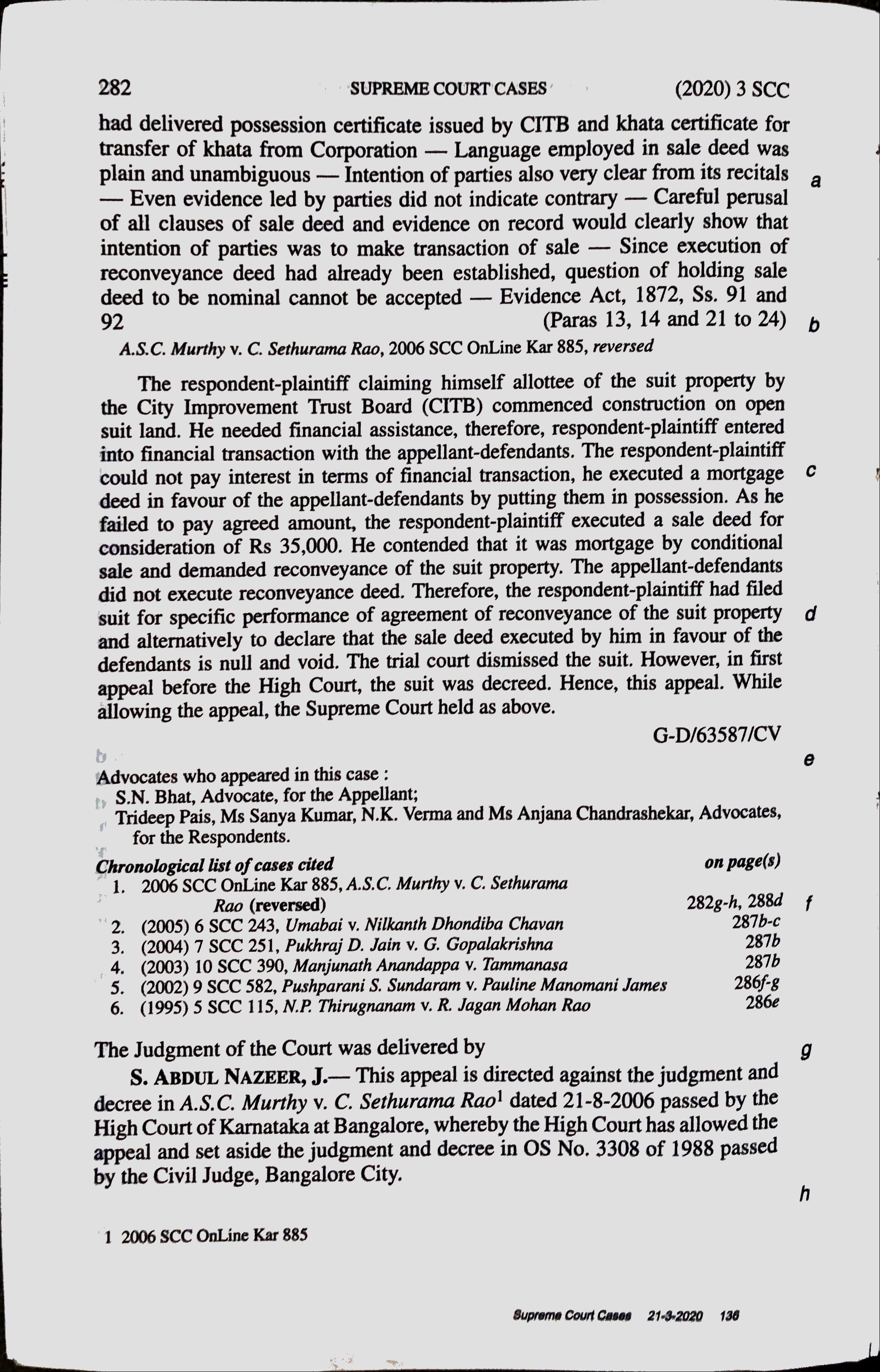
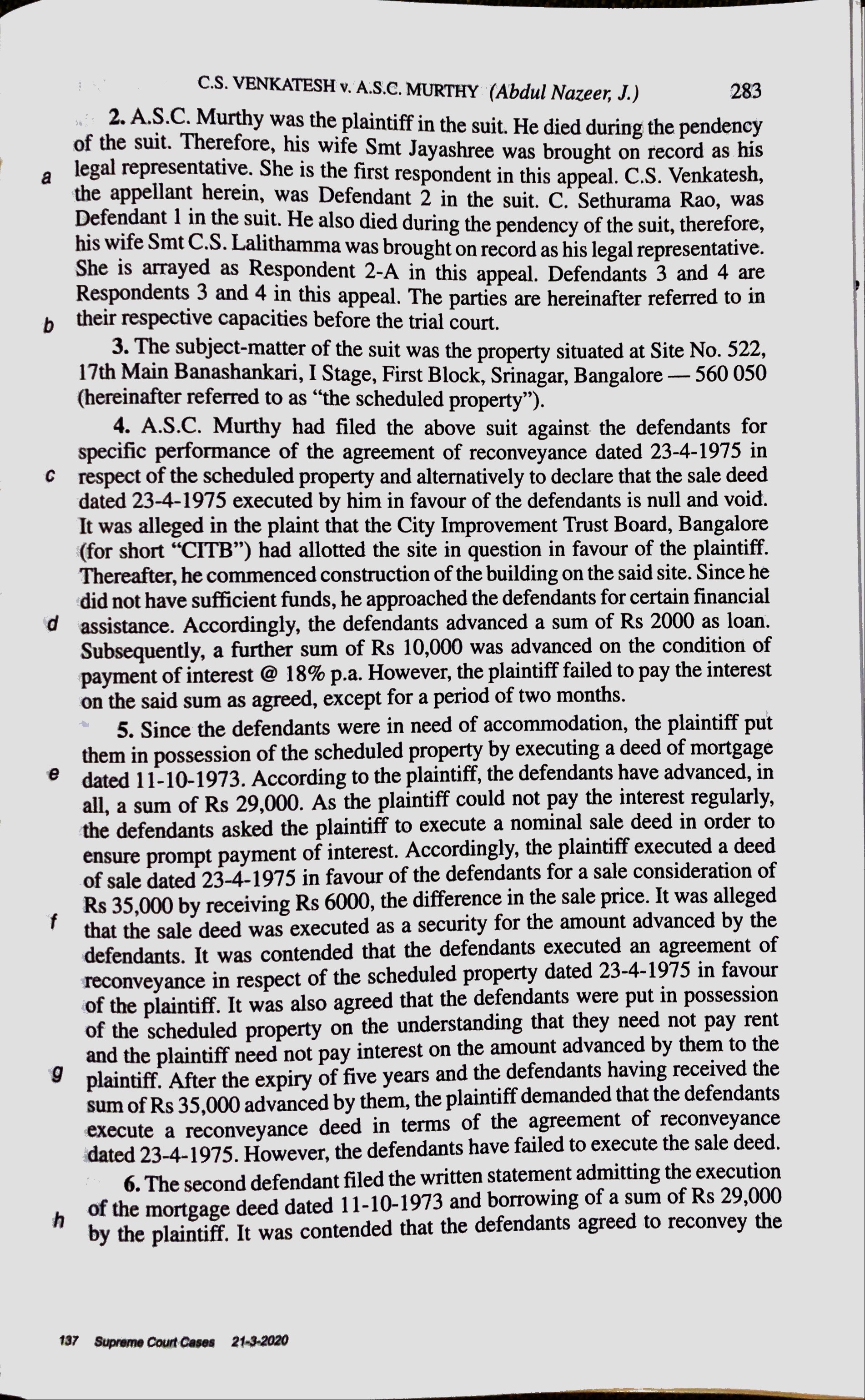
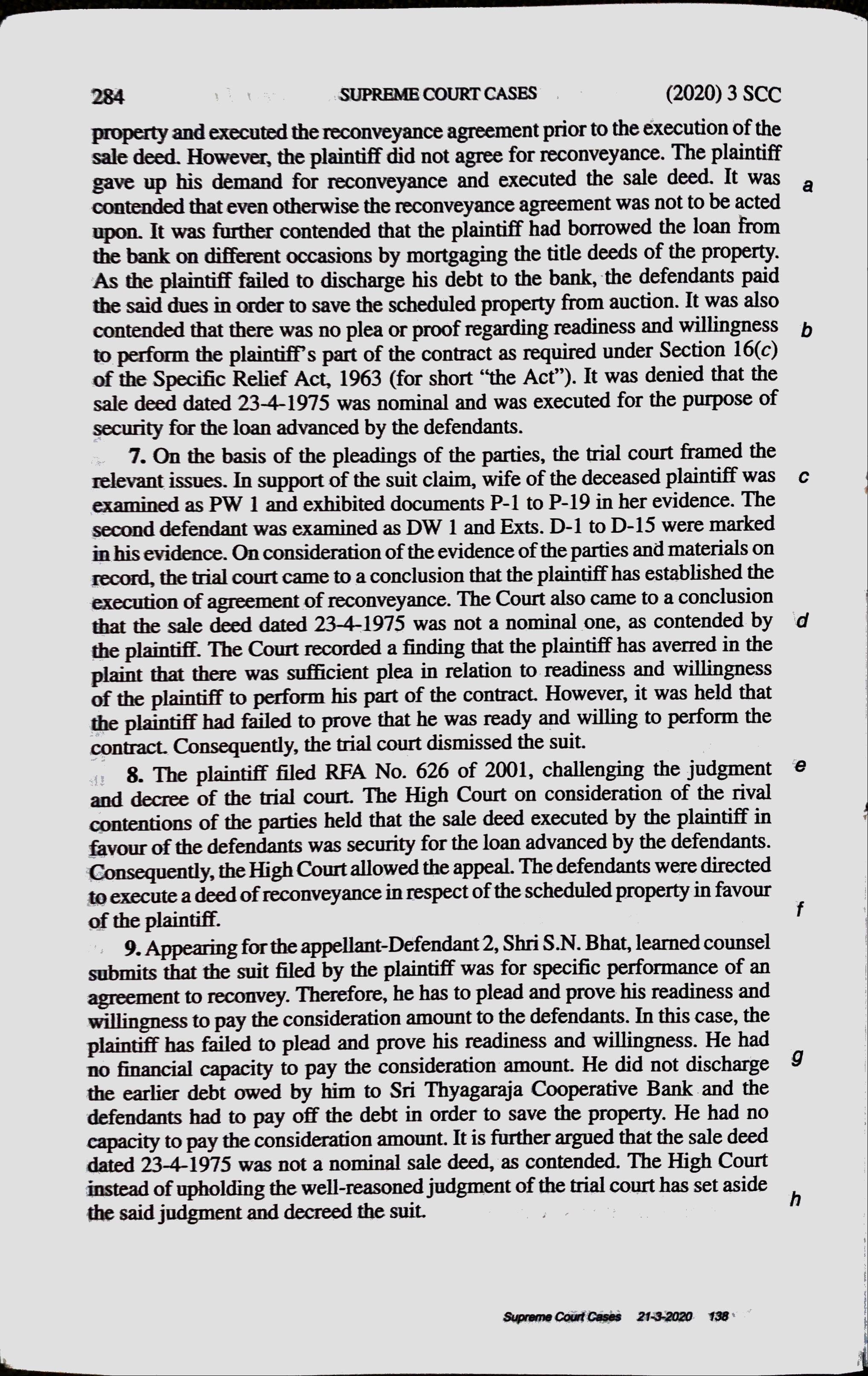
ನಿರ್ದಿಷ್ಟ ಕಾರ್ಯಕ್ಷಮತೆಗಾಗಿ ದಾವೆ. ಸೂಟ್ ಫ಼ಾರ್ ಸ್ಪೆಸಿಫ಼ಿಕ್ ಪರ್ಫ಼ಾರ್ಮೆನ್ಸ್. ಕಾಲಮಿತಿ. ಖರೀದಿಗೆ ಒಪ್ಪ೦ದವಾದ ಜಮೀನು ಒಪ್ಪ೦ದದ ನ೦ತರ ಭೂಸ್ವಾದೀನಕ್ಕೆ ಒಳಪಡುತ್ತದೆ. ಖರೀದಿದಾರನು ಜಮೀನನ್ನು ಭೂಸ್ವಾದೀನದಿ೦ದ ಹೊರತರಲು ದಾವೆ ಹೂಡಿ ಜಯಗಳಿಸುತ್ತಾನೆ. ಆದರೆ ನ೦ತರ ಮಾರಾಟಗಾರನು ಜಮೀನನ್ನು ಮಾರಾಟ ಮಾಡಲು ನಿರಾಕರಿಸುತ್ತಾನೆ. ಇ೦ತ ಸನ್ನಿವೇಶದಲ್ಲಿ, ನಿರ್ದಿಷ್ಟ ಕಾರ್ಯಕ್ಷಮತೆಗಾಗಿ ದಾವೆ ಹೂಡಲು ಕಾಲಮಿತಿಯು, ಜಮೀನು ಭೂಸ್ವಾದೀನದಿ೦ದ ಹೊರಬ೦ದ ನ೦ತರವೇ ಉ೦ಟಾಗುತ್ತದೆ. ಆದ್ದರಿ೦ದ ವಾದಿಯು ಹೂಡಿದ ದಾವೆಯು ಕಾಲಮಿತಿಯ ಒಳಗಿದೆ. ಹಾಗೂ ವಾದಿಯು ಯಾವತ್ತೂ ಜಮೀನು ಕೊಳ್ಳಲು ತಯಾರಿದ್ದಾನೆ. ದಾವೆಯನ್ನು ಉಚ್ಚನ್ಯಾಯಾಯಲವು ಪುರಸ್ಕರಿಸಿರುವುದು ಸರಿ ಇದೆ. ಆದರೆ ವಿಳ೦ಬದ ಕಾರಣ ಮಾರಾಟದ ದರವನ್ನು ರೂ. 59,200 ರಿ೦ದ ರೂ. 15,00,000 ಕ್ಕೆ ಏರಿಸಲಾಗಿದೆ. ಉ೦ಡವಲ್ಲಿ ರತ್ನ ಮಾಣಿಕ್ಯ೦ ವ್ಸ್ ವಿ.ಪಿ.ಪಿ.ಆರ್.ಎನ್. ಪ್ರಸಾದ ರಾವ್ (2020) 3 ಎಸ್. ಸಿ. ಸಿ. 289
Agreement to purchase. Acquisition proceedings initiated after the agreement. Acquisition proceedings were quashed at the instance of the purchaser. Time to sue for specific performance commences after quashing of the acquisition proceedings. The plaintiff has always been ready and willing to perform his part of the contract.
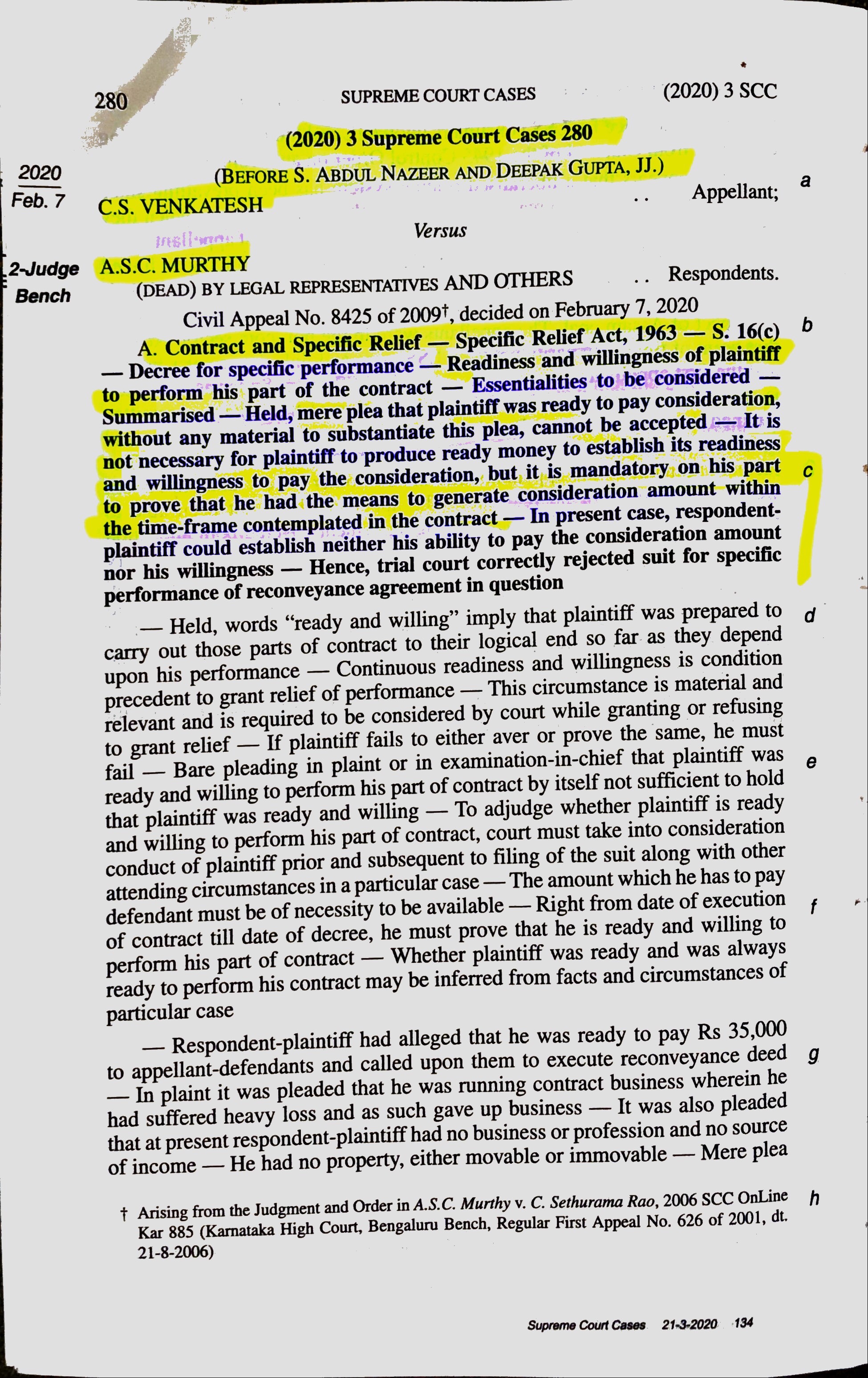
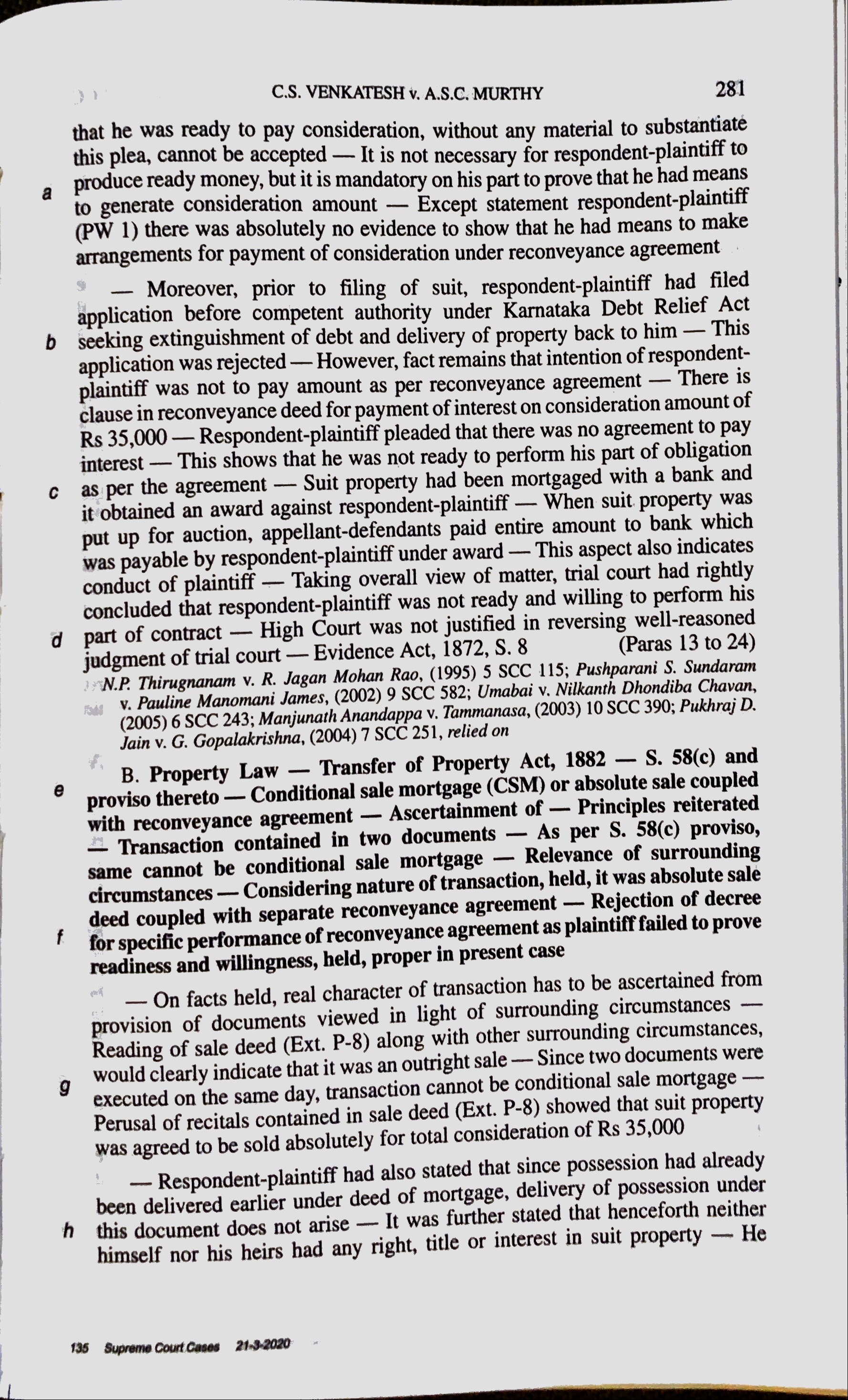
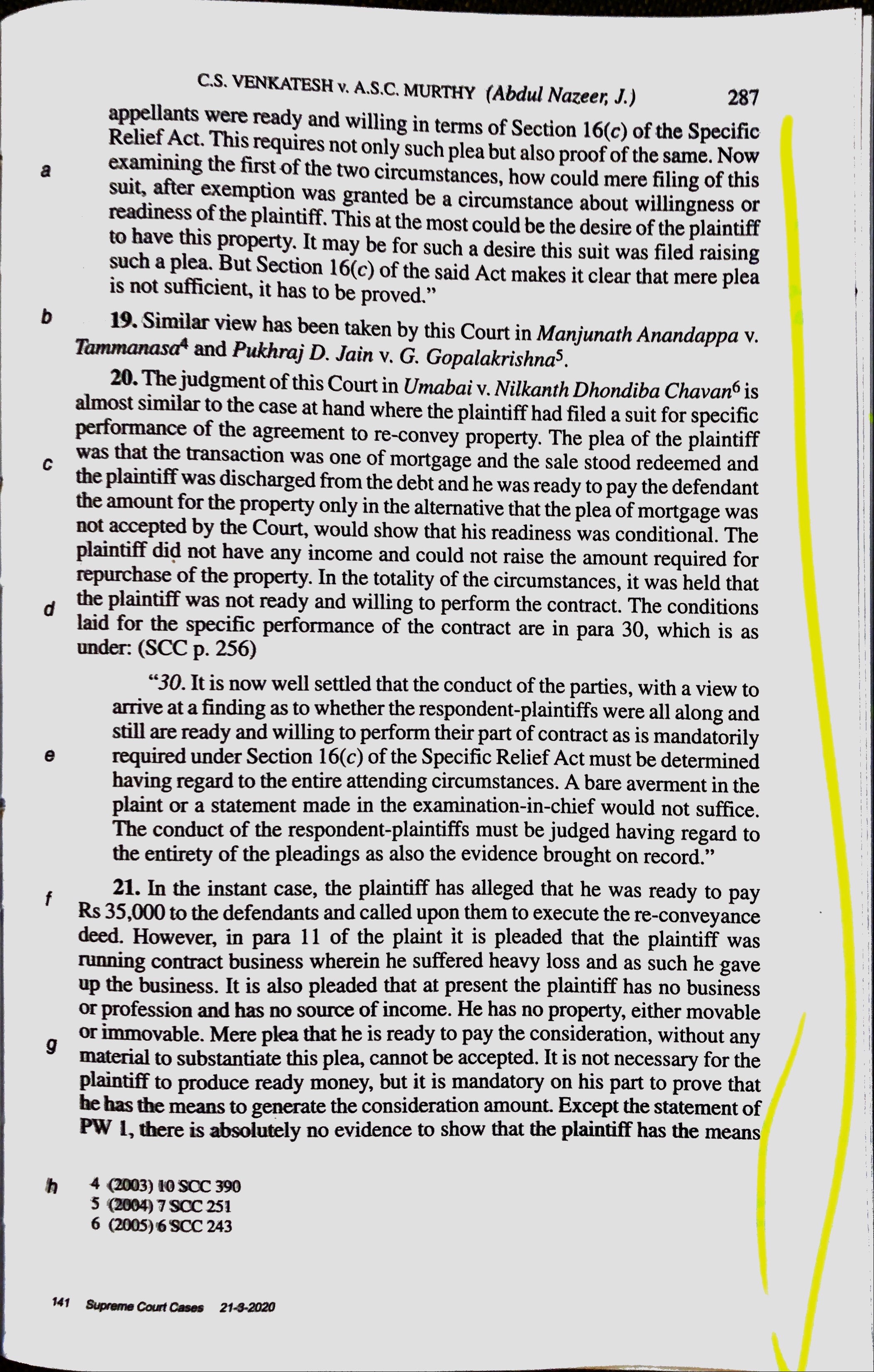
ನಿರ್ದಿಷ್ಟ ಕಾರ್ಯಕ್ಷಮತೆಗೆ ವ್ಯಾಜ್ಯ. (ಸೂಟ್ ಫ಼ಾರ್ ಸ್ಪೆಸಿಫ಼ಿಕ್ ಪರ್ಮಾರ್ಮೆನ್ಸ್.) ಸಿದ್ಧತೆ ಮತ್ತು ಇಚ್ಚೆ (ರೆಡಿನೆಸ್ ಅನ್ಡ್ ವಿಲ್ಲಿ೦ಗ್ ನೆಸ್) ಹಾಗೂ ಹಣಕಾಸಿನ ಬಲ ಇವನ್ನು ಬರಿಯ ವ್ಯಾಜ್ಯ ಪತ್ರದ ಬರವಣಿಗೆಯಿ೦ದ ಮಾತ್ರ ಸಾಬೀತು ಪಡಿಸಲು ಸಾದ್ಯವಿಲ್ಲ. ಸಿದ್ಧ ಹಣವನ್ನು ನ್ಯಾಯಾಲಯಕ್ಕೆ ತೋರಿಸುವ ಅಗತ್ಯವಿಲ್ಲದಿದ್ದರೂ, ಒಪ್ಪಂದದಲ್ಲಿ ಆಲೋಚಿಸಿದಕಾಲಾವಧಿಯಲ್ಲಿ ಪರಿಗಣನೆಯಮೊತ್ತವನ್ನು ಉತ್ಪಾದಿಸುವ ಶಕ್ತಿ ಅವನಿಗೆ ಇದೆ ಎಂದುಸಾಬೀತುಪಡಿಸುವುದುಕಡ್ಡಾಯವಾಗಿದೆ. ಪ್ಯಾರಾಗಳು13 ರಿಂದ 24. (ತೀರ್ಪುಲಗತ್ತಿಸಿದೆ).
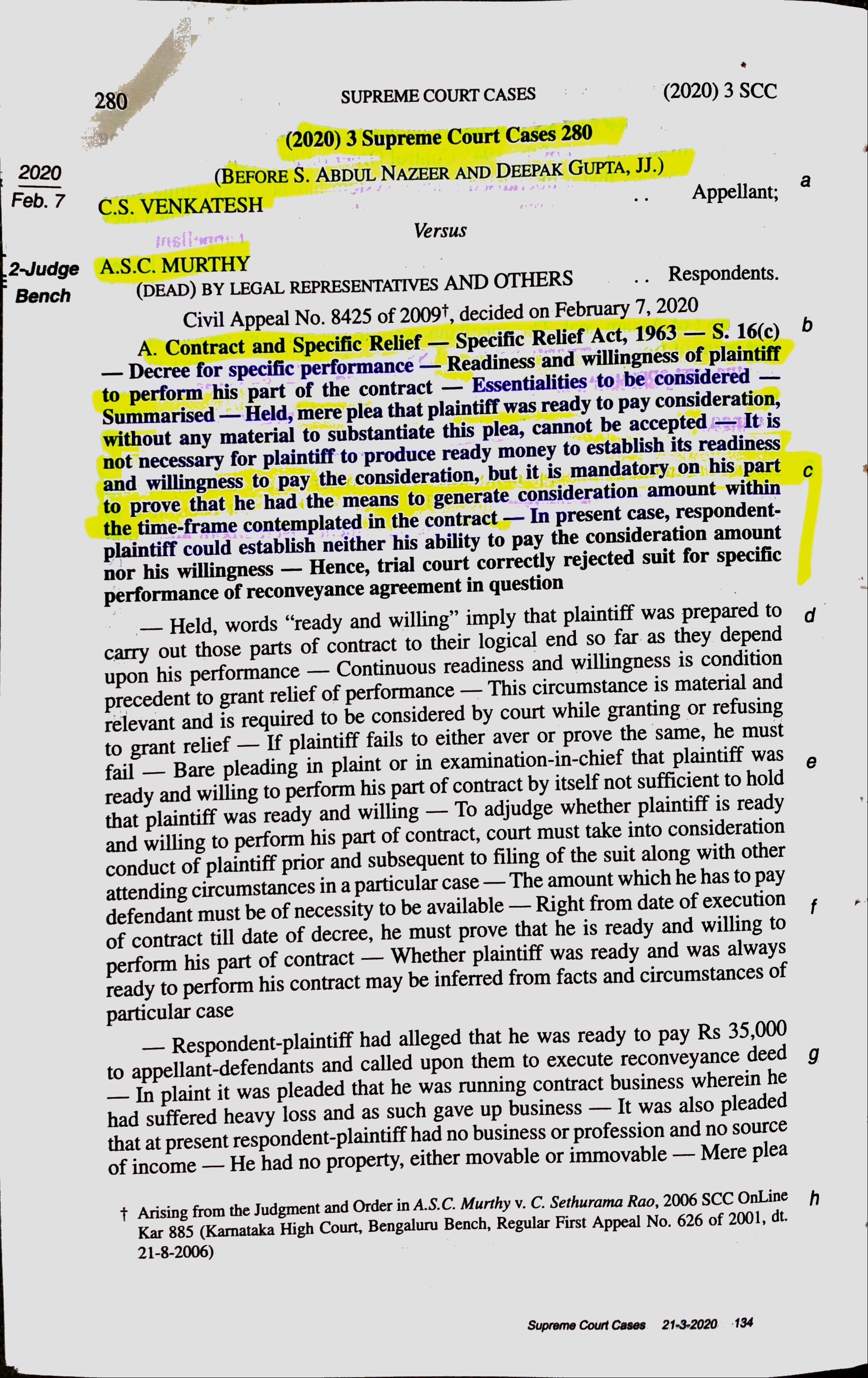
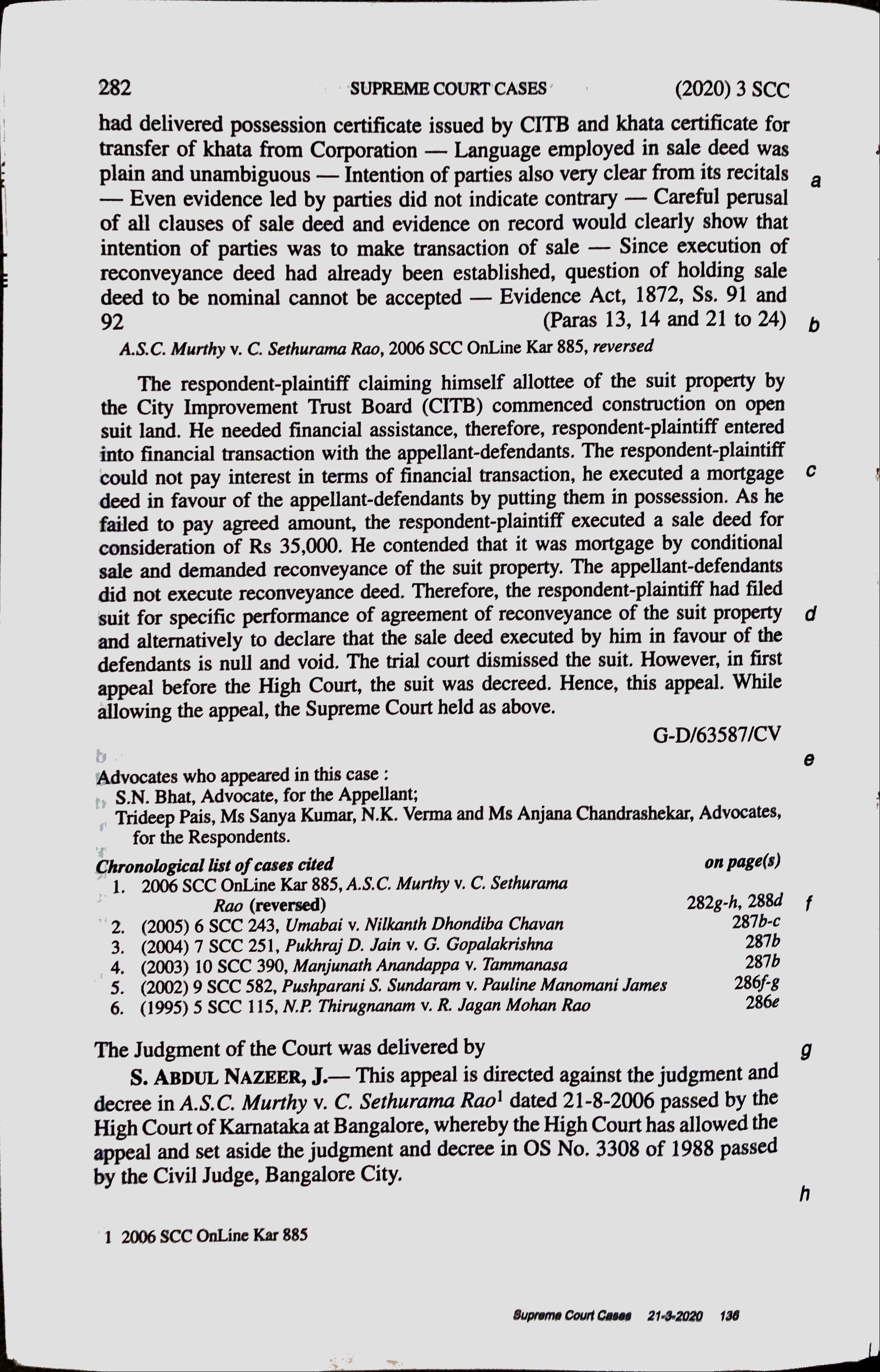
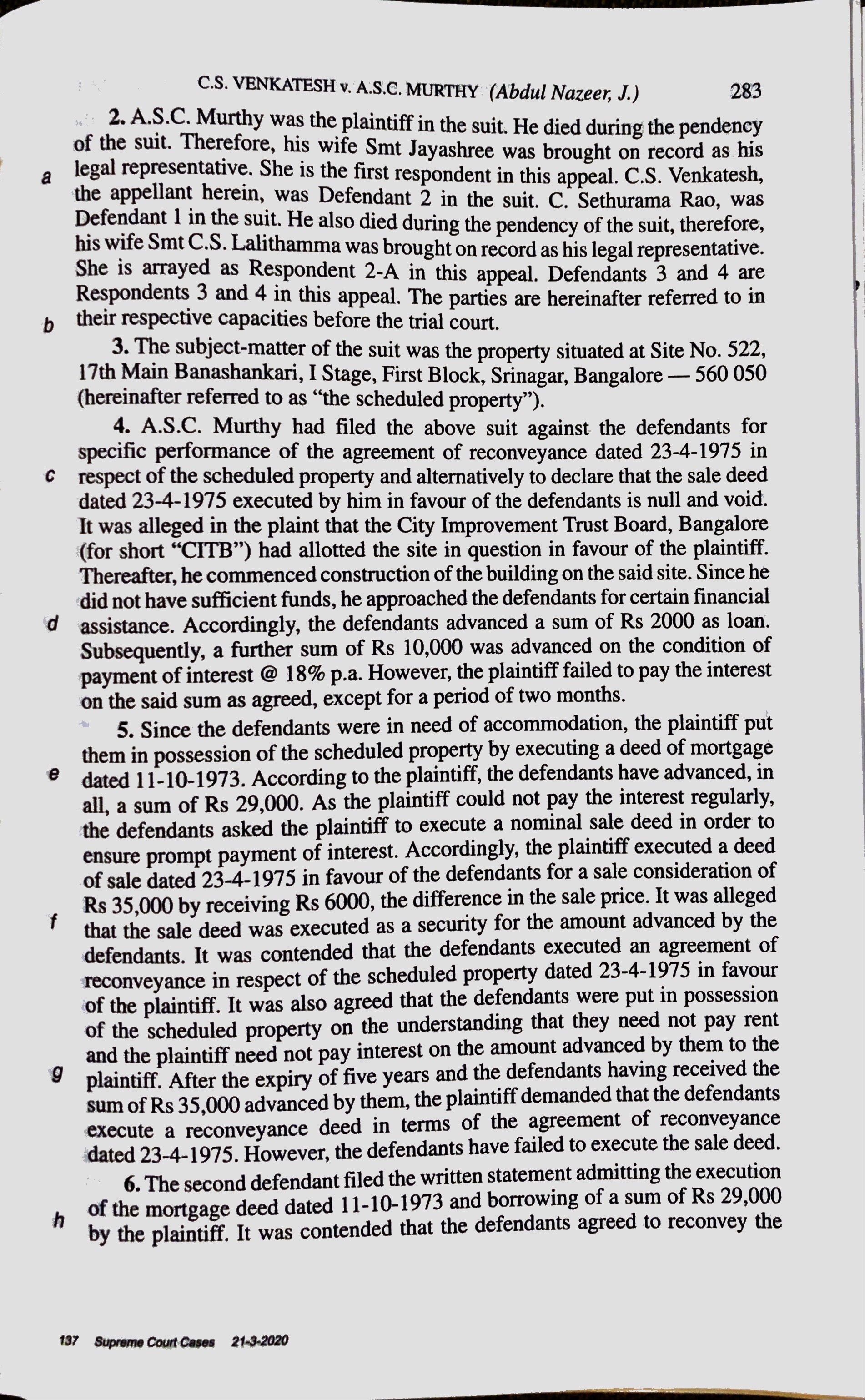
Suit for specific performance. Readiness and willingness. Mere plea that the plaintiff was ready to pay consideration without any material to substantiate cannot be accepted. Though it is not necessary to produce ready money, it is mandatory to prove that he had the means to generate consideration amount within the timeframe contemplated in the contract. Paragraphs 13 to 24. C.S Venkatesh vs A.S.C Murthy (2020) 3 SCC 280
ಸಿವಿಲ್ ಪ್ರೊಸೀಜರ್ ಕೋಡ್. ಆದೇಶ 7 ನಿಯಮ 11. ಪೂರ್ಣ ಮಾರಾಟದ ಹಣ ಪಾವತಿಸಲಾಗದ ಕಾರಣಕ್ಕೆ ಮಾರಾಟ ಪತ್ರವನ್ನು ರದ್ದುಗೊಳಿಸುವ ದಾವೆಯನ್ನು ಮಾರಾಟಗಾರನು ಹೂಡಲು ಬರುವುದಿಲ್ಲ. ಈ ರೀತಿಯ ದಾವೆಗಳು ಆದೇಶ 7 ನಿಯಮ 11 (ಎ) ಅಡಿಯಲ್ಲಿ ತಿರಸ್ಕರಿಸಬೇಕಾಗುತ್ತವೆ. ಮಾರಾಟಗಾರನು ಹಣ ವಸೂಲಾತಿಗಾಗಿ ಪ್ರತ್ಯೇಕ ದಾವೆ ಹೂಡಬಹುದು. ಸುಪ್ರೀಂ ಕೋರ್ಟ್ 9 ಜುಲೈ 2020.
ಪ್ಯಾರ: 15.3 ವಾದಿಯು ಮಾರಾಟದ ಹಣ ಒಂದು ಭಾಗವನ್ನು ಪಾವತಿಸದ ಆರೋಪದ ಮೇಲೆ ಪ್ರಕರಣವನ್ನು ಮಾಡಿದ್ದಾರೆ ಮತ್ತು ಈ ನೆಲೆಯಲ್ಲಿ ಮಾರಾಟ ಪತ್ರವನ್ನು ರದ್ದುಗೊಳಿಸುವ ಪರಿಹಾರಕ್ಕಾಗಿ ಪ್ರಾರ್ಥಿಸಿದ್ದಾರೆ. ಆಸ್ತಿ ವರ್ಗಾವಣೆ ಕಾಯ್ದೆ, 1882 ರ ಸೆಕ್ಷನ್ 54 ಈ ಕೆಳಗಿನಂತೆ ಹೇಳುತ್ತದೆ:
“54. ‘ಮಾರಾಟ’ ಎಂದು ವ್ಯಾಖ್ಯಾನಿಸಲಾಗಿದೆ .— ‘ಮಾರಾಟ’ ಎನ್ನುವುದು ಪಾವತಿಸಿದ ಅಥವಾ ಭರವಸೆ ನೀಡಿದ ಅಥವಾ ಭಾಗಶಃ ಪಾವತಿಸಿದ ಮತ್ತು ಭಾಗಶಃ ಬೆಲೆಗೆ ಬದಲಾಗಿ ಮಾಲೀಕತ್ವದ ವರ್ಗಾವಣೆಯಾಗಿದೆ. ”
“ಮಾರಾಟ” ದ ವ್ಯಾಖ್ಯಾನವು ಒಬ್ಬ ವ್ಯಕ್ತಿಯಿಂದ ಇನ್ನೊಬ್ಬರಿಗೆ ಮಾಲೀಕತ್ವದ ವರ್ಗಾವಣೆಯಾಗಬೇಕು ಎಂದು ಸೂಚಿಸುತ್ತದೆ, ಅಂದರೆ ಆಸ್ತಿಯ ಎಲ್ಲಾ ಹಕ್ಕುಗಳು ಮತ್ತು ಆಸಕ್ತಿಯ ವರ್ಗಾವಣೆ. ವರ್ಗಾವಣೆದಾರನು ಯಾವುದೇ ಭಾಗವನ್ನು ಅಥವಾ ಆಸ್ತಿಯಲ್ಲಿ ಹಕ್ಕನ್ನು ಉಳಿಸಿಕೊಳ್ಳಲು ಸಾಧ್ಯವಿಲ್ಲ, ಇಲ್ಲದಿದ್ದರೆ ಅದು ಮಾರಾಟವಾಗುವುದಿಲ್ಲ. ಮಾಲೀಕತ್ವದ ವರ್ಗಾವಣೆಯನ್ನು “ಪಾವತಿಸಿದ ಅಥವಾ ಭರವಸೆ ನೀಡಿದ ಅಥವಾ ಭಾಗ ಪಾವತಿಸಿದ ಮತ್ತು ಭಾಗದ ಭರವಸೆ” ಗಾಗಿ ಮಾಡಬೇಕಾಗಿದೆ ಎಂದು ವ್ಯಾಖ್ಯಾನವು ಮತ್ತಷ್ಟು ಸೂಚಿಸುತ್ತದೆ. ಬೆಲೆ ಹೀಗೆ ಮಾರಾಟದ ವಹಿವಾಟಿನ ಅತ್ಯಗತ್ಯ ಅಂಶವಾಗಿದೆ.
ವಿದ್ಯಾಧರ್ ವರ್ಸಸ್ ಮಾಣಿಕರಾವ್ ಮತ್ತು ಇತರರು (1999) 3 ಎಸ್ ಸಿ. ಸಿ 573 – ಮಾರಾಟ ಪೂರ್ಣಗೊಳಿಸಲು”ಬೆಲೆ ಪಾವತಿಸಿದ ಅಥವಾ ಭರವಸೆ ನೀಡಿದ ಅಥವಾ ಭಾಗ ಪಾವತಿಸಿದ ಮತ್ತು ಭಾಗದ ಭರವಸೆ” ಎಂಬ ಪದಗಳು ಮಾರಾಟ ಪತ್ರವನ್ನು ಕಾರ್ಯಗತಗೊಳಿಸುವ ಸಮಯದಲ್ಲಿ ಸಂಪೂರ್ಣ ಬೆಲೆಯ ನಿಜವಾದ ಪಾವತಿಯು ಸೈನ್ ಕ್ವಾ ಅಲ್ಲ ಎಂದು ಸೂಚಿಸುತ್ತದೆ . ಸಂಪೂರ್ಣ ಬೆಲೆಯನ್ನು ಪಾವತಿಸದಿದ್ದರೂ, ಆದರೆ ಮಾರಾಟ ಪತ್ರವನ್ನು ಕಾರ್ಯಗತಗೊಳಿಸಲಾಗುತ್ತದೆ, ಮತ್ತು ನೋಂದಾಯಿಸಿದರೆ, ಮಾರಾಟವು ಪೂರ್ಣಗೊಳ್ಳುತ್ತದೆ, ಮತ್ತು ಆಸ್ತಿಯು ವಹಿವಾಟಿನ ಅಡಿಯಲ್ಲಿ ವರ್ಗಾವಣೆದಾರರಿಗೆ ತಲುಪುತ್ತದೆ. ಮಾರಾಟದ ಬೆಲೆಯ ಒಂದು ಭಾಗವನ್ನು ಪಾವತಿಸದಿರುವುದು ಮಾರಾಟದ ಸಿಂಧುತ್ವಕ್ಕೆ ಪರಿಣಾಮ ಬೀರುವುದಿಲ್ಲ. ಆಸ್ತಿಯಲ್ಲಿನ ಶೀರ್ಷಿಕೆ ಈಗಾಗಲೇ ಹಾದುಹೋದ ನಂತರ, ಬಾಕಿ ಮಾರಾಟದ ಪರಿಗಣನೆಯನ್ನು ಪಾವತಿಸದಿದ್ದರೂ ಸಹ, ಈ ನೆಲೆಯಲ್ಲಿ ಮಾರಾಟವನ್ನು ಅಮಾನ್ಯಗೊಳಿಸಲಾಗುವುದಿಲ್ಲ. “ಮಾರಾಟ” ವನ್ನು ರೂಪಿಸಲು, ಪಕ್ಷಗಳು ಆಸ್ತಿಯ ಮಾಲೀಕತ್ವವನ್ನು ವರ್ಗಾಯಿಸುವ ಉದ್ದೇಶವನ್ನು ಹೊಂದಿರಬೇಕು.
ಬಾಕಿ ಹಣವನ್ನು ಮರುಪಡೆಯಲು ಫಿರ್ಯಾದಿಗಳು ಕಾನೂನಿನಲ್ಲಿ ಇತರ ಪರಿಹಾರಗಳನ್ನು ಹೊಂದಿರಬಹುದು, ಆದರೆ ನೋಂದಾಯಿತ ಮಾರಾಟ ಪತ್ರವನ್ನು ರದ್ದುಗೊಳಿಸುವ ಪರಿಹಾರವನ್ನು ನೀಡಲಾಗುವುದಿಲ್ಲ.
ಫಿರ್ಯಾದಿಗಳು ಸಲ್ಲಿಸಿದ ಮೊಕದ್ದಮೆಗೆ ಅರ್ಹತೆಯಿಲ್ಲ. ಆರ್ಡರ್ ೭ ರೂಲ್ ೧೧ (ಎ) ಅಡಿಯಲ್ಲಿ ವಾದವನ್ನು ತಿರಸ್ಕರಿಸಲಾಗುವುದು.
8 July 2020 – The Division Bench headed by the Chief Justice of Karnataka took strong exception to a discourteous email sent by an Advocate to Karnataka High Court Registry when a matter was sought to be listed before the Court. The Court summoned the Advocate to convey the displeasure. “We called you here to convey our compliments. Atleast you have the courage to tell that the Chief Justice of Karnataka High Court does not understand the emails sent earlier”, the Chief Justice said. The advocate promptly apologized for the mistake.
It is a matter of fact that the Registry, Judges and Lawyers are all working under extreme pressure. Many judicial officers and staff are affected by Covid-19. Listing of matters in High Court is preceded by permission to file. There is no automatic filing and listing of cases. It is advisable that all act with patience till normalcy is restored. Finding fault with registry for non-listing is certainly not the way, the court said. Many are addressing emails directly to Chief Justice on all types of issues. There must be restraint in this regard, the court expressed.
Karnataka High Court holds that Government Orders banning Online Coaching to children prima facie violative of Article 21 and 21A of the Constitution of India. Voluntary online coaching without additional fee permitted. (Interim Order)
Karnataka High Court 8 July 2020
Anumitha Sharma and others vs State of Karnataka and another. Writ Petition (PIL) WP 8168/2020 & connected matters. Chief Justice Abhay Shreeniwas Oka and Justice Nataraj Rangaswamy. 8 July 2020 (Interim Order).
Held: Prima facie we are of the view that both the orders of the Government imposing ban on Online classes encroach upon the fundamental rights under Article 21 and 21A of the Constitution of Indiasays the division bench.
The Karnataka High Court says though it is not for the Court to decide in matter online education has to be imparted, it is clear that both the Government Orders do not stand the legal tests. The High Court also says that the Government shall take steps to provide online education even in rural areas.
Interim Order Government Orders banning Online Coaching stayed subject to the condition that Online Coaching is voluntary and no additional fee is charged.
Last week, a lawyer from Bangalore was thrown out of a television news channel debate when he questioned the “constitutionality” of Indian soldiers shouting “Bholo Bharat Maata Ki Jai” during the Prime Minister’s visit to Ladakh. I made some research on this. Hence this write-up.
Article 1 of the Constitution of India which deals with ‘Name and territory of the Union’ reads as under:
“India, that is Bharat, shall be a Union of States.”
Perhaps the first reference to Bharata is found in Vishnu Purana (400-300 BC). A Sanskrit shloka reads thus;
उत्तरंयत्समुद्रस्यहिमाद्रेश्चैवदक्षिणम्।
वर्षंतद्भारतंनामभारतीयत्रसंततिः।।
This shloka means: “The country (Varsam) that lies north of the ocean and south of the snowy mountains is called Bharatam; there dwell the descendants of Bharata.
The Bharat Empire i.e.Bharatvarsha originally included the present day of Pakistan, Afghanistan, China, Iran, Tajikistan, Uzbekistan, Kyrgyzstan, Russia, Turkmenistan, North-West Tibet, Nepal and Bangladesh.
In ‘The Discovery of India’, a book that he composed in the Ahmednagar Fort during his years of captivity (1942-1946) and published in 1946, Pandit Jawaharlal Nehru (1946: 38-39) wrote:
“Often, as I wandered from meeting to meeting, I spoke to my audiences of this India of ours, of Hindustan and of Bharata, the old Sanskrit name derived from the mythical founders of the race.”
When ‘The Discovery of India’ was published, these names, Hindustan, Bharat (also Bharata), India, coexisted in the subcontinent. The constant usage also was ‘Jai Hind’ by Nehru and several other political leaders who liked to proclaim “Jai Hind” at the end of speeches.
Historians believe it was during Moghul rule rather than during British rule, when India was called Hindustan. This led to political and cultural unity of Bhārata, allowing Indians to develop a complete sense of belonging together, irrespective of their religions.
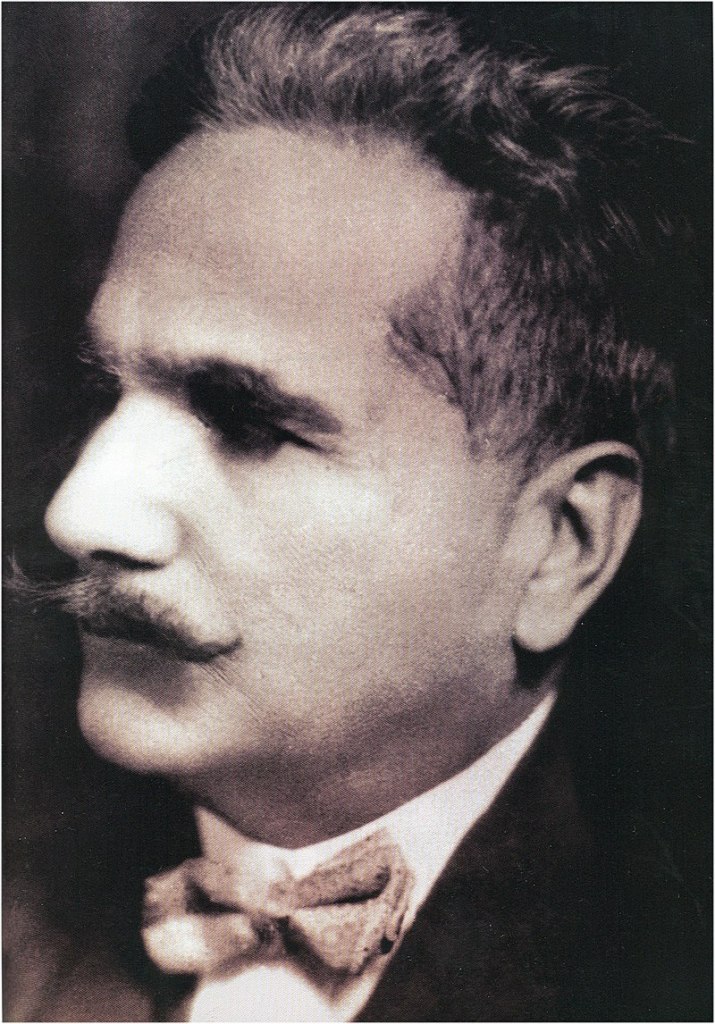
The name Hindustan got its proudest moment when in 1904 Sir Allama Muhammad Iqbalpenned his famous patriotic poem “Sāre jahāṉ se acchā, Hindositāṉ hamārā”. Sir Allama Muhammad Iqbal was a poet, philosopher, theorist, and barrister in British India. He is held as the national poet of Pakistan.
Sir. Allama Muhammad Iqbal (1877-1938)
The Constituent Assembly on 29 August 1947 constituted the Constitution Drafting Committee under the Chairmanship of Dr. B.R. Ambedkar. From February 1948 to November 1949, the members of the Constituent Assembly examined the draft, moving and discussing in the process almost 2,500 amendments.
On 26 November 1949, we finally adopted the Constitution of India and signed it on 24 January 1950. On 26 January 1950, the Constitution of India officially came into force, and the Constituent Assembly became the Provisional Parliament of India until the first general elections of 1952. It was Dr. Ambedkar who favoured the name Bharat and wanted Constituent Assembly to adopt Article 1 without much debate. However the name was approved after prolonged debates among the members of the Constituent Assembly.
So, four years after the publication of Nehru’s Discovery of India, the drafters of the Constitution decided to write “India, that is Bharat, shall be a Union of States”. The alternative Article “Hind, or, in the English language, India, shall be a Union of States” was not accepted.
The last speech ofShri Hargovind Pant on this issue is memorable. Let me extract it in full.
“Mr. President, during the early sittings of the Assembly I had moved an amendment to the effect that for the name of the country, we should have the word “Bharat” or “Bharat Varsha” in place of ‘India’. I am gratified to see that some change in the name has at last been accepted. I, however, fail to understand why the word ‘Bharat Varsha’ is not acceptable to the House when the importance and glory of this word is being admitted by all here. I do not want to repeat what the other Members have said in regard to the acceptance of this glorious word, but I would make only a few observations in respect of this word.
‘The word “Bharat” or “Bharat Varsha” is used by us in our daily religious duties while reciting the Sankalpa. Even at the time of taking our bath we say in Sanskrit:
It means that I so and so, of Aryavart in Bharat Khand, etc………..
The most celebrated and word-famous poet Kalidasa has used this word in his immortal work depicting the story of his two great characters-King Dushyanta and his queen Shakuntala. The son born of them was named ‘Bharat’ and his Kingdom was known as “Bharat”. There are many fascinating descriptions of the heroism of Bharat in our ancient books. It is said that in his childhood he used to play with lion cubs and overpowered them. We are well acquainted with the story of Bharat. I fail to understand, in view of all this, why we are reluctant to accept, from the core of our heart the word ‘Bharat Varsha’ as the name of our country,
So far as the word ‘India’ is concerned, the Members seem to have, and really I fail to understand why, some attachment for it. We must know that this name was given to our country by foreigners who having heard of the riches of this land were tempted towards it and had robbed us of our freedom in order to acquire the wealth of our country. If we, even then, cling to the word ‘India’, it would only show that we are not ashamed of having this insulting word which has been imposed on us by alien rulers. Really, I do not understand why we are accepting this word.
‘Bharat’ or ‘Bharat Varsha’ is and has been the name of our country for ages according to our ancient history and tradition and in fact this word inspires enthusiasm and courage in its; I would, therefore, submit that we should have no hesitation at all in accepting this word. It will be a matter of great shame for us if we do not accept this word and have some other word for the name of our country. I represent the people of the Northern part of India where sacred places like Shri Badrinath, Shri Kedarnath, Shri Bageshwar and Manasarovar are situated. I am placing before you the wishes of the people of this part. I may be permitted to state, Sir, that the people of this area want that the name of our country should be ‘Bharat Varsha’ and nothing else.”
Shri. Hargovind Pant 1855-1957
Mahatma Gandhi preferred Vande Mataram, which is part of Bankim Chandra’s novel Anandmath published in 1882.
Bharath Matha: It is interesting to note that almost all countries call their Homeland as ‘Motherland’. Only Nazis called their land as ‘Fatherland’. Russians refer to Mother Russia as a personification of the Russian nation. Within the British Empire, many natives in the colonies came to think of Britain as the mother country of one, large nation. India is personified as Bharat Mata i.e. Mother India. The French commonly refer to France as “la mère patrie”. Hispanic Americans and 19th century-upper-class-Filipinos, commonly referred to Spain as “la Madre Patria”. Romans and the subjects of Rome saw Italy as the motherland. “Fatherland” was mostly featured in news reports associated with Nazi Germany.
The word “Bharat” has a primary place in the foundational document of this nation i.e. the Constitution of India, in the very first article. The insertion was after much debate and discussion by some of the greatest legal/constitutional minds.
Indians calling their homeland as motherland has naturally made the slogan “Bharath Matha Ki Jai” a patriotic gesticulation.
Proclaiming “Bharath Matha Ki Jai” by citizens and soldiers is part of our constitutional spirit. Nothing can inspire a solider in the frontline than proudly shouting this slogan.
The controversy over this issue is the result of half-baked knowledge of lawyers participating in serious debates. This needs to be avoided and curbed.
S.Basavaraj, Advocate, Daksha Legal, Member, Karnataka State Bar Council, 9845065416
B.V.Acharya, Senior Advocate & former Advocate General for Karnataka.
Constitution of India is hailed as one of the best federal Constitutions in the World. It has adopted parliamentary system of Government based on British model. It provides for three organs of the State viz., Legislature, Executive and Judiciary. It recognize separation of powers, though not with all rigidity. The Constitution has specified the powers, duties and responsibilities of each of the organs. Though each of the organs is equal; by its very nature, functions and power, the judiciary occupies a pre-eminent position. It has the responsibility to see that the other two organs function within the sphere earmarked to them under the Constitution. It has the power to invalidate any legislative or executive action if the same is unauthorized. However, if the judiciary and in particular the Supreme Court acts in excess of authority, there is no remedy available.
Since the Constitution has been in force for the last 70 years, it may be worthwhile to consider the relative status and powers of these organs as it existed at the commencement of the Constitution and as on today.
Legislature Let us first consider the position of the Legislature. By legislature, I mean the parliament, as there is not much of a change so far as State legislatives are concerned. Under the Constitution, the Parliament is empowered to legislate on subjects earmarked in List-I (Central List) and List-III (concurrent List). There has been no noticeable change in the power of the parliament in this regard.
However, in addition to the power to legislate as stated above, the parliament is also authorized to amend the Constitution as provided by Article 368 of the Constitution. Soon after the coming into force of the Constitution the parliament and State legislatures had enacted certain legislations by way of Land Reforms as also providing for reservation in service and admission to educational institutions for schedule castes and tribes and other backward classes. As these enactments were invalidated by the judiciary as unconstitutional being violative of fundamental rights, the parliament with a view to validate them, brought about constitutional amendments. These amendments to the Constitution were unsuccessfully challenged as the Supreme Court upheld the power of the parliament to amend the Constitution without any limitation on such power.
This position continued till about the year 1967 when, for the first time Supreme Court in the case of Golaknath ruled that the parliament had no power to amend Part-III of the Constitution which provided for Fundamental Rights. In the year 1973, in the case of Keshavananda Bharathi Vs State of Kerala (1973 (4) SCC 225) 13 Judge Bench of the Supreme Court considered the question of validity of the Kerala Land Reforms Act as also certain Constitutional Amendments effected by the parliament. The correctness or otherwise of the decision of the Court in Golaknath’s case also came up for consideration. The controversy in the case centered round the power of the parliament to amend the Constitution. For the petitioners it was contended that the power of the parliament to amend the constitution was not unlimited and that there were implied limitations on such power. The plea forcefully put forth was that the power does not include authority to amend the constitution which alters the basic structure / framework of the Constitution. Respondents strongly refutedthis contention and urged that the power to amend conferred by Article 368 is without any limitation or restriction, and implying any such limitation will be doing violence to the language employed.
The court after hearing the matters for about 68 days delivered a split verdict. Seven out of 13 judges (forming the majority) ruled in favour of the petitioners and held that the power does not empower the parliament to effect such amendment which will alter the basic structure of the constitution. It in fact also struck down latter part of Section 31-C (which precluded judicial review of legislationwhich was enacted in furtherance of any of the directive principles of State Policy) on the ground that it altered the basic structure of the constitution as power of judicial review is part of it. Six of the Judges, however, strongly maintained that the power of the parliament to amend any part of the constitution is without any limitation or restriction and that it is a constituent power vested with the parliament. Naturally majority decision angered the executive so much that soon thereafter the Government deviating from the convention, passed orders appointing Justice A.N.Ray as the Chief Justice of India, superseding 3 judges senior to him viz., Justice J.M.Shelat, Justice K.S.Hegde and Justice A.N.Grover. This decision of the Government evoked strong protest from the public and in particular legal fraternity. The three superseded judges resigned, which had no effect on the firm decision of the Government. After Justice A.N.Ray assumed office of the Chief Justice of India an attempt was made to get the majority decision in Keshavananda Bharati case reviewed and a 13 judge was constituted for the said purpose. However, the attempt proved futile on account of strong objection by team of Advocates led by late Sri N.A.Palkhivala and on the second day, as hearing of the review was in progress, the Chief Justice of India simply dissolved the Bench without any formal order. Thus the majority view in Keshavananda’s case became law of the land and continues to be so even now. Yet another attempt to curtail Supreme Court’s power of judicial review was thwarted by the judgment in Minerva Mills case. The net result is, the power of parliament to amend the constitution stood restricted and subsequently few amendments also stood invalidated on the basis of doctrine of basic structure.
Though purely on a point of law the judgment of the Supreme Court in the case of Keshavananda was considered erroneous by a section of the legal experts, the public in general welcomed the decision as it was felt that such a check on the power of the parliament to amend the constitution was quite necessary and imperative. It is widely believed that, but for this decision, by now the parliament would have amended the constitution many times and to such an extent that to-day we would not have had this constitution. In fact this decision virtually saved the constitution and in-turn the country. To-day we have this constitution only because of the decision in Keshavananda Bharati.
For the purpose of this articles, suffice it to say that w.e.f. 1973 parliament was deprived of its very important power of amendment of the constitution without any limitation on account of the decision in Keshavananda Bharati. This is a case of loss of power of parliament and gain for the judiciary as will be explained later.
Few years ago, a Police Officer told me how Police add “alias” against names of few troublemaking petty criminals just to project them as anti-social elements hoping that bail would be refused by courts. It is also a fact that using alias by accused themselves enhances notoriety. However, law enforcing agencies deliberately using alias in first information reports would certainly add notoriety to the accused. Flipside of the coin is violation of fundamental right to reputation which is considered in this write-up
Usage of alias in FIR is often not supported by any documentary evidence such as change of name etc. Many a times, alias name is added to an ordinary person just to make him look notorious. The Karnataka High Court has recently called upon the Police to explain how and under what circumstances ‘alias’ was used against accused in a criminal case.
Wharton’s Law Lexicon 15th Edition defines ‘alias’ as a “second name applied to a person where he has been styled or has styled himself by more names than one”. Concise Oxford English Dictionary, 11th edition defends ‘alias’ as a “a false or assumed identity.”
‘Alias’ in crime world. Criminals use aliases,fictitious business names and dummy corporations (corporate shells) to hide their identity, or to impersonate other persons or entities in order to commit fraud. Aliases and fictitious business names used for dummy corporations have become extremely complex. However, usage of alias by persons involved in criminal activities undoubtedly enhances their notoriety. Many who became famous/notorious in Bangalore underworld had weird alias names which served their purpose for decades. Few were Krishnamurthy alias Korangu, Vijay Kumar alias Kavala, Soma alias Deadly Soma (names as shown in FIRs – persons already dead).
The above maybe cases where accused themselves used alias or did not object to usage of alias by their henchmen or Police. However, affixing alias by Police in FIRs without there being any justifiable reasons i.e. accused himself using alias or other documentary evidence such as change of name document, passport etc would be highly objectionable. Branding accused with prefix alias would seriously affect his reputation.
Right to reputation – Fundamental right. The right to one’s reputation is a fundamental right traceable to Article 21 of the Constitution of India. In Subramanian Swamy v. Union of India, (2016) 7 SCC 221, at para 144 the Hon’ble Supreme Court reaffirmed the legal position that reputation is an inextricable aspect of right to life under Article 21 of the Constitution and that the right to reputation is a constituent of Article 21 of the Constitution. The Supreme Court relied on the its earlier judgment in Charu Khurana v. Union of India (2015) 1 SCC 192 which held that dignity is the quintessential quality of a personality since it is a highly cherished value and that right to honour, dignity and reputation are the basic constituents of right under Article 21. The Hon’ble Supreme Court in Subramanian Swamy v. Union of India relied on several judgments, the reference to which is unnecessary here. Suffice it to say individual reputation is part of Article 21 of the Constitution of India.
There are more than 800 judgments of the Supreme Court where accused name contain alias. It is not clear as to whether these accused really had alias or names added by Police. Few reported judgments are; Pratap Singh alias Pikki v. State of Uttarakhand, (2019) 7 SCC 424. Mohmed Riyaz alias Goru (Criminal Appeal No. 144 of 2012) Tabrez Khan alias Guddu v. State of U.P., (2019) 4 SCC 615. State of H.P. v. Vijay Kumar alias Pappu (2019) 5 SCC 373. Kishan Singh alias Actor v. State of Uttaranchal, (2019) 11 SCC 807. Manish Solanki alias Bansi v. State of Rajasthan, (2019) 4 SCC 340. Mohd. Akhtar alias Kari v. State of Bihar, (2019) 2 SCC 513. Thangela Narendra alias Chinnu v. State of Karnataka (2019) 14 SCC 709. Jitendra alias Kalla v. State (NCT of Delhi), (2019) 13 SCC 691. State of U.P. v. Anil Kumar alias Badka (2018) 9 SCC 492. State of Maharashtra v. Bandu alias Daulat(2018) 11 SCC 163. Harpal Singh alias Chhota v. State of Punjab, (2017) 1 SCC 734. Harpal Singh alias Deputy v. State of Punjab (2017) 1 SCC 734
All these are cases involving heinous crimes. Branding accused with alias appears to be well-established rule for the Police/prosecution.
Conclusion: Examined from this angle andhaving regard to the notoriety it has gained in crime world, prefixing ‘alias’ to accused by Police in FIRs certainly tarnish reputation. This is so especially when accused has no such recorded pseudo name. In their eagerness to brand accused as a notorious criminal or anti-social element, if the Police were to prefix, it would destroy reputation of the accused for all time to come since FIRs are public documents. Even if the case foisted on accused ends in acquittal or quashed by higher courts, the damage done is irreversible. It is absolutely necessary for the Police to verify antecedents of accused before affixing alias. Even if the accused discloses his name with alias, Police must verify veracity of such a claim since few want to gain notoriety by proclaiming to have alias names. Self-branding is equally dangerous. Hence the courts at the very first instance, when accused is produced, must call upon the Police to explain reason/need for usage of alias. This will prevent violation of accused’s fundamental right to reputation protected under Article 21 of the Constitution of India.
S.Basavaraj, Advocate, Daksha Legal, Bangalore. Member, Karnataka State Bar Council. raj@dakshalegal.com