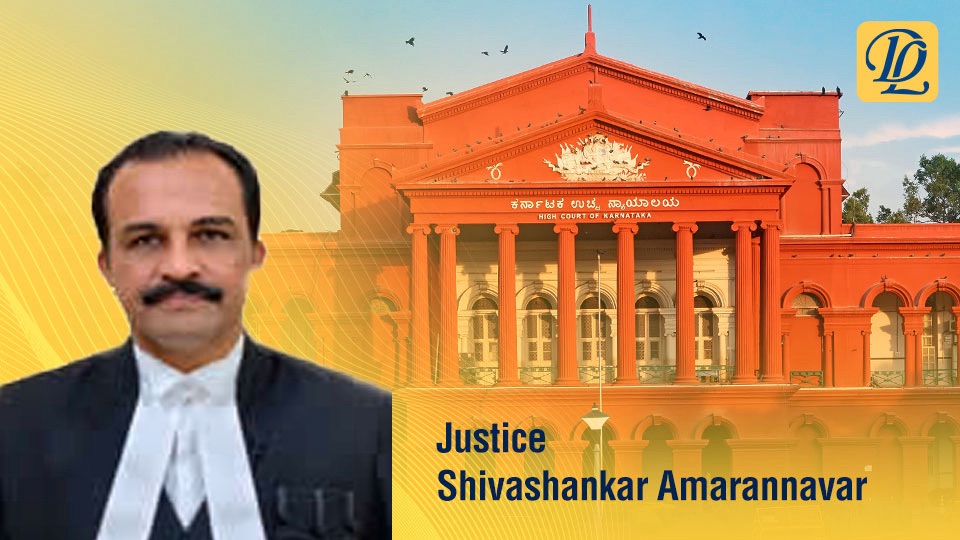
Hon’ble Mr. Justice Shivashankar Amarannavar celebrates his 54th birthday today.
Hon’ble Mr. Justice Shivashankar Amarannavar:
Born on 20.07.1970. Did B.Com., LL.M. (Karnataka University, Dharwad). Enrolled as an Advocate on 24th June, 1994. Started practicing in Dharwad District Court in the chambers of his father- Mr. B.M. Amarannavar. Worked as Special Public Prosecutor, Fast Track Court, Dharwad. Worked as part-time faculty member in University College of Law, Dharwad. Directly appointed as District and Sessions Judge on 25th February 2008 and served as Additional City Civil and Sessions Judge, Bengaluru, Principal District and Sessions Judge, Bagalkot and Udupi. Served as Registrar (Vigilance), High Court of Karnataka and also served as Principal City Civil and Sessions Judge, Bengaluru. Appointed as an Additional Judge of High Court of Karnataka, Bengaluru on 04-05-2020 and Permanent Judge on 25.09.2021.
Important Judgments delivered by Justice Shivashankar Amarannavar.
Cr.P.C. Section 41A. When police issues notice under Section 41A, the apprehension of arrest is not completely ruled out. Hence petition for anticipatory bail is maintainable. Karnataka High Court.
Service law. A public servant cannot be left without a post. Transfer of a public servant without him being posted elsewhere amounts to a legal malafide. Karnataka High Court. (DB)
Suit for partition by daughters based on the amended Section 6 of the Hindu Succession Act. Properties sold prior to 20 December 2004 are not available for partition. Karnataka High Court.
Plea of adverse possession in the written statement and the plea of ownership based on grant in the oral evidence run contrary to each other thus disproving both the claims. Karnataka High Court.
Proof of Will. When the attestor of a Will turns/declared hostile, other evidence showing proper execution of the Will can be relied upon. Karnataka High Court.
Principle of Feeding the Grant by Estoppel would enure to the benefit of purchasers of Inam lands upon the re-grant under the Karnataka (Religious and Charitable) Inam Abolition Act, 1955. Karnataka High Court.
Adoption of child precedes proper ceremonies being performed. Mere adoption deed without proof of required ceremonies does not prove adoption. Karnataka High Court.
While granting permission to the Police to investigate non-cognizable offence, the Magistrate cannot simply issue police intimation without passing any order on the requisition. Karnataka High Court.
Proof of Will. When the attestor of a Will turns/declared hostile, other evidence showing proper execution of the Will can be relied upon. Karnataka High Court.
Hon’ble Mr. Justice K V Aravind celebrates his 47th birthday today.
Hon’ble Mr. Justice K V Aravind: Born on 12.07.1977. Native of Dodda Kurubarahally, Kolar Taluk and District. Graduated in law from University Law College, Bengaluru. Enrolled as an Advocate on 04.08.2000. Served as Jr. Standing Counsel for Income Tax Department from 2004 to 2012 and as Senior Standing Counsel from 2012 till elevation, Served as Senior Standing Counsel for Central Excise, Customs and Central GST from 2016 to 2020.
Appointed as an Additional Judge of the High Court of Karnataka on 25.10.2023.
Important Judgments delivered by Hon’ble Mr. Justice K V Aravind.
Karnataka Bank is not “State” within the meaning of Article 12 of the Constitution of India. Writ under Article 226 cannot be issued against the private bank. High court of Karnataka.
Security Interest (Enforcement) Rules. Forfeiture of deposit upon failure to make payment of balance amount is a statutory action. Courts cannot interfere on grounds of financial hardship or health issues of the bidder. Karnataka High Court.
Commissioner cannot declare an institution as ‘declared institution’ under the Karnataka Hindu Religious Institutions and Charitable Endowments Act merely on the recommendation of the Tahsildar. Karnataka High Court.
Mere acceptance of the returns by the Registrar under Section 13 of the Karnataka Societies Registration Act will not create any right and the same cannot be challenged in a Writ Petition by persons claiming right over the management. Karnataka High Court.
Insurance Ombudsman Rules. Employer who makes contribution to the policies, has right to be heard by the Insurance Ombudsman while adjudicating the disputes. Karnataka High Court.
N. Ravindranath Kamath, Senior Advocate, Bengaluru.
The independence of India was declared by the erstwhile British Government on 15.08.1947. Thereafter the new Constitution of India came into force on 26.01.1950. Thus India became a Republic. The Indian democracy is one of the largest democracies in the world. The very first Article 1 of the Part I of the Constitution of India envisages: – [1] India, that is Bharat shall be a union of states; [2] The state and territories thereof shall be as specified in the First Schedule; [inserted by the 7th amendment, 1956] [3] The territory of India shall comprise: [a] The territory of the state [b] The union territories specified in the first schedule [inserted by way of amendment in 1956] [c] Such other territories as may be acquired.
Thus when the parliament enacts a new law, it must take the whole of Bharat [India] into consideration. A healthy discussion among the legal fraternity and the public in general, ought to have been made by the lawmakers, as many of the enactments of the British Government Continued to be followed in the independent India since 15.08.1947 and necessary amendments as required over time to time have been carried out for which many objections have not come at the relevant point of time.
After the independence of India, the Code of Criminal Procedure, 1878 was in force for nearly 25 years. The same was repealed and the new code of criminal procedure in 1973 was introduced, after nearly 50 years now Bharatiya Nagarika Suraksha Sanhita, 2023 has replaced the 1973 Cr.P.C. Similarly, the Indian penal code, 1860 is replaced by Bharatiya Nyaya Sanhita, 2023 which will have only 358 sections as opposed to 511 sections in IPC, 1860. The Indian Evidence Act is replaced by Bhartiya Sakshya Adhiniyam, 2023. Much importance is given in the Bharatiya Sakshaya Adhiniyam, 2023 for electronic delivery of oral testimony. This allows witnesses, accused individuals, and victims to provide testimony electronically, enhancing accessibility and efficiency in the legal proceedings. There are provisions in the Sakshya Adhiniyam for the inclusion of information stored in semiconductor memory of communication devices such as smartphones and laptops, broadening the range of admissible evidence to include e-mails, server lockslocational proof, and voice mails. The said Act also broadens the definition of secondary evidence to include oral and written admissions, as well as the testimony of an expert who has studied the document. The whole reading of Bharatiya Sakshya Adhiniyam, 2023 does not find a place for a Narco analysis/brain mapping test which is barred after Selvi’s case [2010 (7) SCC 263] by the apex court which is very much necessary in the present state of affairs. Though many things are said about such test, a careful analysis, research and discussion was required on brain mapping test, particularly in the context of terrorism, rape, murder, fraud related cases. 4.On the whole, a careful reading of the above 3 enactments looks, like it is an ‘OLD WINE IN NEW BOTTLE’ many feel it is a case of imposing Hindi on general public. The following are the sum of the provisions which are enacted in the new Act, are the replica of the old Act. It is nothing but repetition. The following are some of the repetitions which I can mention.
Section311 OF Cr.P.C envisages: Power to summon material witness, or examine person present.—Any Court may, at any stage of any inquiry, trial or other proceeding under this Code, summon any person as a witness, or examine any person in attendance, though not summoned as a witness, or recall and re-examine any person already examined; and the Court shall summon and examine or recall and re-examine any such person if his evidence appears to it to be essential to the just decision of the case. The corresponding new Section in BNSS for old Section 311 of Cr.P.C is 348 of the BNSS section which envisages: Power to summon material witness, or examine person present: “Any Courtmay, at any stage of any inquiry, trial or other proceeding under this Sanhita, summon any person as a witness, or examine any person in attendance, though not summoned as a witness, or recall and re-examine any person already examined; and the Court shall summon and examine or recall and re-examine any such person if his evidence appears to it to be essential to the just decision of the case.”
Section 309 of Cr.P.C envisages: Power to postpone or adjourn proceedings: [(1) “In every inquiry or trial the proceedings shall be continued from day-to-day until all the witnesses in attendance have been examined unless the Court finds the adjournment of the same beyond the following day to be necessary for reasons to be recorded: Provided that when the inquiry or trial relates to an offence under section 376, section 376A, section 376AB, section 376B, section 376C or section 376D, section 376DA, section 376DB of the Indian Penal Code, the inquiry or trial shall be completed within a period of two months from the date of filing of the charge sheet.]
(2) If the Court after taking cognizance of an offence, or commencement of trial, finds it necessary or advisable to postpone the commencement of, or adjourn, any inquiry or trial, it may, from time to time, for reasons to be recorded, postpone or adjourn the same on such terms as it thinks fit, for such time as it considers reasonable, and may by a warrant remand the accused if in custody:
Provided that no Magistrate shall remand an accused person to custody under this section for a term exceeding fifteen days at a time:
Provided further that when witnesses are in attendance no adjournment or postponement shall be granted, without examining them, except for special reasons to be recorded in writing:
[Provided also that no adjournment shall be granted for the purpose only of enabling the accused person to show cause against the sentence proposed to be imposed on him.]
[Provided also that –
no adjournment shall be granted at the request of a party, except where the circumstances are beyond the control of that party;
the fact that the pleader of a party is engaged in another Court, shall not be a ground for adjournment;
where a witness is present in Court but a party or his pleader is not present or the party or his pleader though present in Court, is not ready to examine or cross-examine the witness, the Court may, if thinks fit, record the statement of the witness and pass such orders as it thinks fit dispensing with the examination-in-chief or cross-examination of the witness, as the case may be.] The corresponding new Section in BNSS for old Section 309 of Cr.P.C is 346 of the BNSS section which envisages:
Power to postpone or adjourn proceedings: [(1) “In every inquiry or trial the proceedings shall be continued from day-to-day until all the witnesses in attendance have been examined unless the Court finds the adjournment of the same beyond the following day to be necessary for reasons to be recorded: Provided that when the inquiry or trial relates to an offence under section 64, section 65, section 66, section 67, section 68, section 70 or section 71, of the Bharatiya Nyaya Sanhita, 2023, the inquiry or trial shall be completed within a period of two months from the date of filing of the charge sheet.]
(2) If the Court after taking cognizance of an offence, or commencement of trial, finds it necessary or advisable to postpone the commencement of, or adjourn, any inquiry or trial, it may, from time to time, for reasons to be recorded, postpone or adjourn the same on such terms as it thinks fit, for such time as it considers reasonable, and may by a warrant remand the accused if in custody:
Provided that no Magistrate shall remand an accused person to custody under this section for a term exceeding fifteen days at a time:
Provided further that when witnesses are in attendance no adjournment or postponement shall be granted, without examining them, except for special reasons to be recorded in writing:
[Provided also that no adjournment shall be granted for the purpose only of enabling the accused person to show cause against the sentence proposed to be imposed on him.]
[Provided also that –
no adjournment shall be granted at the request of a party, except where the circumstances are beyond the control of that party;
the fact that the pleader of a party is engaged in another Court, shall not be a ground for adjournment;
where a witness is present in Court but a party or his pleader is not present or the party or his pleader though present in Court, is not ready to examine or cross-examine the witness, the Court may, if thinks fit, record the statement of the witness and pass such orders as it thinks fit dispensing with the examination-in-chief or cross-examination of the witness, as the case may be.]
Section 145 OF CrPC envisages: Procedure where dispute concerning land or water is likely to cause breach of peace. — (1) Whenever an Executive Magistrate is satisfied from a report of a police officer or upon other information that a dispute likely to cause a breach of the peace exists concerning any land or water or the boundaries thereof, within his local jurisdiction, he shall make an order in writing, stating the grounds of his being so satisfied, and requiring the parties concerned in such dispute to attend his Court in person or by pleader, on a specified date and time, and to put in written statements of their respective claims as respects the fact of actual possession of the subject of dispute. (2) For the purposes of this section, the expression “land or water” includes buildings, markets, fisheries, crops or other produce of land, and the rents or profits of any such property. (3) A copy of the order shall be served in the manner provided by this Code for the service of a summons upon such person or persons as the Magistrate may direct, and at least one copy shall be published by being affixed to some conspicuous place at or near the subject of dispute. (4) The Magistrate shall then, without reference to the merits or the claims of any of the parties to a right to possess the subject of dispute, persue the statements so put in, hear the parties, receive all such evidence as may be produced by them, take such further evidence, if any, as he thinks necessary, and, if possible, decide whether any and which of the parties was, at the date of the order made by him under sub-section (1), in possession of the subject of dispute: Provided that if it appears to the Magistrate that any party has been forcibly and wrongfully dispossessed within two months next before the date on which the report of a police officer or other information was received by the Magistrate, or after that date and before the date of his order under sub-section (1), he may treat the party so dispossessed as if that party had been in possession on the date of his order under sub-section (1). (5) Nothing in this section shall preclude any party so required to attend, or any other person interested, from showing that no such dispute as aforesaid exists or has existed; and in such case the Magistrate shall cancel his said order, and all further proceedings thereon shall be stayed, but, subject to such cancellation, the order of the Magistrate under sub-section (1) shall be final. (6) (a) If the Magistrate decides that one of the parties was, or should under the proviso to sub- section (4) be treated as being, in such possession of the said subject, he shall issue an order declaring such party to be entitled to possession thereof until evicted therefrom in due course of law, and forbidding all disturbance of such possession until such eviction; and when he proceeds under the proviso to sub-section (4), may restore to possession the party forcibly and wrongfully dispossessed. (b) The order made under this sub-section shall be served and published in the manner laid down in sub-section (3). (7) When any party to any such proceeding dies, the Magistrate may cause the legal representative of the deceased party to be made a party to the proceeding and shall thereupon continue the inquiry, and if any question arises as to who the legal representative of a deceased party for the purposes of such proceeding is, all persons claiming to be representatives of the deceased party shall be made parties thereto. (8) If the Magistrate is of opinion that any crop or other produce of the property, the subject of dispute in a proceeding under this section pending before him, is subject to speedy and natural decay, he may make an order for the proper custody or sale of such property, and, upon the completion of the inquiry, shall make such order for the disposal of such property, or the sale-proceeds thereof, as he thinks fit. (9) The Magistrate may, if he thinks fit, at any stage of the proceedings under this section, on the application of either party, issue a summons to any witness directing him to attend or to produce any document or thing. (10) Nothing in this section shall be deemed to be in derogation of powers of the Magistrate to proceed under section 107.
The corresponding new Section in BNSS for old Section 145 of Cr.P.C is 164 of the BNSS section which envisages:
Procedure where dispute concerning land or water is likely to cause breach of peace .— (1) Whenever an Executive Magistrate is satisfied from a report of a police officer or upon other information that a dispute likely to cause a breach of the peace exists concerning any land or water or the boundaries thereof, within his local jurisdiction, he shall make an order in writing, stating the grounds of his being so satisfied, and requiring the parties concerned in such dispute to attend his Court in person or by pleader, on a specified date and time, and to put in written statements of their respective claims as respects the fact of actual possession of the subject of dispute. (2) For the purposes of this section, the expression “land or water” includes buildings, markets, fisheries, crops or other produce of land, and the rents or profits of any such property. (3) A copy of the order shall be served in the manner provided by this Code for the service of a summons upon such person or persons as the Magistrate may direct, and at least one copy shall be published by being affixed to some conspicuous place at or near the subject of dispute. (4) The Magistrate shall then, without reference to the merits or the claims of any of the parties to a right to possess the subject of dispute, persue the statements so put in, hear the parties, receive all such evidence as may be produced by them, take such further evidence, if any, as he thinks necessary, and, if possible, decide whether any and which of the parties was, at the date of the order made by him under sub-section (1), in possession of the subject of dispute: Provided that if it appears to the Magistrate that any party has been forcibly and wrongfully dispossessed within two months next before the date on which the report of a police officer or other information was received by the Magistrate, or after that date and before the date of his order under sub-section (1), he may treat the party so dispossessed as if that party had been in possession on the date of his order under sub-section (1). (5) Nothing in this section shall preclude any party so required to attend, or any other person interested, from showing that no such dispute as aforesaid exists or has existed; and in such case the Magistrate shall cancel his said order, and all further proceedings thereon shall be stayed, but, subject to such cancellation, the order of the Magistrate under sub-section (1) shall be final. (6) (a) If the Magistrate decides that one of the parties was, or should under the proviso to sub- section (4) be treated as being, in such possession of the said subject, he shall issue an order declaring such party to be entitled to possession thereof until evicted therefrom in due course of law, and forbidding all disturbance of such possession until such eviction; and when he proceeds under the proviso to sub-section (4), may restore to possession the party forcibly and wrongfully dispossessed. (b) The order made under this sub-section shall be served and published in the manner laid down in sub-section (3). (7) When any party to any such proceeding dies, the Magistrate may cause the legal representative of the deceased party to be made a party to the proceeding and shall thereupon continue the inquiry, and if any question arises as to who the legal representative of a deceased party for the purposes of such proceeding is, all persons claiming to be representatives of the deceased party shall be made parties thereto. (8) If the Magistrate is of opinion that any crop or other produce of the property, the subject of dispute in a proceeding under this section pending before him, is subject to speedy and natural decay, he may make an order for the proper custody or sale of such property, and, upon the completion of the inquiry, shall make such order for the disposal of such property, or the sale-proceeds thereof, as he thinks fit. (9) The Magistrate may, if he thinks fit, at any stage of the proceedings under this section, on the application of either party, issue a summons to any witness directing him to attend or to produce any document or thing. (10) Nothing in this section shall be deemed to be in derogation of powers of the Magistrate to proceed under section 126.
Section 147 OF CrPC envisages: Dispute concerning right of use of land or water.—(1) Whenever an Executive Magistrate is satisfied from the report of a police officer or upon other information, that a dispute likely to cause a breach of the peace exists regarding any alleged right of user of any land or water within his local jurisdiction, whether such right be claimed as an easement or otherwise, he shall make an order in writing, stating the grounds of his being so satisfied and requiring the parties concerned in such dispute to attend his Court in person or by pleader on a specified date and time and to put in written statements of their respective claims. Explanation. —The expression “land or water” has the meaning given to it in sub-section (2) of section 145. (2) The Magistrate shall then persue the statements so put in, hear the parties, receive all such evidence as may be produced by them respectively, consider the effect of such evidence, take such further evidence, if any, as he thinks necessary and, if possible, decide whether such right exists; and the provisions of section 145 shall, so far as may be, apply in the case of such inquiry. (3) If it appears to such Magistrate that such rights exist, he may make an order prohibiting any interference with the exercise of such right, including, in a proper case, an order for the removal of any obstruction in the exercise of any such right: Provided that no such order shall be made where the right is exercisable at all times of the year, unless such right has been exercised within three months next before the receipt under sub-section (1) of the report of a police officer or other information leading to the institution of the inquiry, or where the right is exercisable only at particular seasons or on particular occasions, unless the right has been exercised during the last of such seasons or on the last of such occasions before such receipt. (4) When in any proceedings commenced under sub-section (1) of section 145 the Magistrate finds that the dispute is as regards an alleged right of user of land or water, he may, after recording his reasons, continue with the proceedings as if they had been commenced under sub-section (1), and when in any proceedings commenced under sub-section (1) the magistrate finds that the dispute should be dealt with under section 145, he may, after recording his reasons, continue with the proceedings as if they had been commenced under sub-section (1) of section 145. The corresponding new Section in BNSS for old Section 147 of Cr.P.C is 166 of the BNSS section which envisages:
Dispute concerning right of use of land or water. (1) Whenever an Executive Magistrate is satisfied from the report of a police officer or upon other information, that a dispute likely to cause a breach of the peace exists regarding any alleged right of user of any land or water within his local jurisdiction, whether such right be claimed as an easement or otherwise, he shall make an order in writing, stating the grounds of his being so satisfied and requiring the parties concerned in such dispute to attend his Court in person or by pleader on a specified date and time and to put in written statements of their respective claims. Explanation. —For the purposes of this sub-section, the expression “land or water” has the meaning given to it in sub-section (2) of section 164. (2) The Magistrate shall peruse the statements so put in, under sub-section (1), hear the parties, receive all such evidence as may be produced by them respectively, consider the effect of such evidence, take such further evidence, if any, as he thinks necessary and, if possible, decide whether such right exists; and the provisions of section 164 shall, so far as may be, apply in the case of such inquiry. (3) If it appears to such Magistrate that such rights exist, he may make an order prohibiting any interference with the exercise of such right, including, in a proper case, an order for the removal of any obstruction in the exercise of any such right: Provided that no such order shall be made where the right is exercisable at all times of the year, unless such right has been exercised within three months next before the receipt under sub-section (1) of the report of a police officer or other information leading to the institution of the inquiry, or where the right is exercisable only at particular season or on particular occasion, unless the right has been exercised during the last of such seasons or on the last of such occasions before such receipt. (4) When in any proceedings commenced under sub-section (1) of section 164 the Magistrate finds that the dispute is as regards an alleged right of user of land or water, he may, after recording his reasons, continue with the proceedings as if they had been commenced under sub-section (1), and when in any proceedings commenced under sub-section (1) the Magistrate finds that the dispute should be dealt with under section 164, he may, after recording his reasons, continue with the proceedings as if they had been commenced under sub-section (1) of section 164.
Having practiced on the trial side for many years. I have found that under the erstwhile criminal procedure code. The power given to executive magistrates in many of the sections ought to have been removed and given to Judicial magistrates in 1991 I had written an article titled “Need for Amendment of Section 145 of CR.P.C”, which was published in Criminal Law Journal 1991- page 160. I opined about the need to give power under sec.145 Crpc to judicial magistrate as it was available under the 1869 Act. The executive magistrate cannot handle property disputes effectively like a Judicial Magistrate, given several executive work vested in him including meeting the ministers, MLAs and MP’s and Advocate and litigants and the general public who appear in the cases are put to several inconveniences and are not comfortable with the proceedings, as the proceedings are not conducted judicially. The said article is herewith reproduced for the benefit of the readers of this article. Published in 1991, Crl.L.J. 160 “NEED FOR AMENDMENT OF SECTION 145 OF Cr.P.C”
By: – N Ravindranath Kamath, Advocate, Virajpet, Kodagu “The object and intent of Section 145 of Cr. P.C. is to prevent the breach of peace arising out of disputes relating to immovable properties by maintaining one or the other of the parties in the possession which the Court finds they had immediately before the dispute. The action which may ultimately be taken is preventive. The jurisdiction of the Court under the section is limited to the extent necessary for preventing any apprehension of breach of the peace. The proceeding under this section is of a summary nature intended to maintain peace till the title of the respective claimants is adjudged by a competent civil Court. The proceedings under the section are quasi-judicial within the meaning of Section 2(1) of Cr. P.C. The jurisdiction under this section is vested with the Executive Magistrate. The magistrate acting under this section need not go into the question of title but has to meet the urgency of the situation by preventing a breach of the peace. The two essentials for taking action are that there should be a dispute likely to cause a breach of the peace and that the disputes should concern immovable property. Though the questions relating to possession over the land are within the exclusive jurisdiction of civil Courts. The magistrate gets that jurisdiction when there is apprehension of a breach of the peace. The power under this section was vested with the Judicial Magistrate under the Code of Criminal Procedure, 1898, which has been replaced by the Code of Criminal Procedure, 1974. Under the old Code, Judicial Magistrate used to exercise powers under this section but now owing to the changes brought about in the new Code the power under this section is vested with the Executive Magistrates. It is generally felt that relief under this section is hardly available for the aggrieved parties owing to the preoccupation of the Executive Magistrates with other executive works. The Executive Magistrate besides attending other Executive work may also be fully occupied during the time of elections, census and other works that he is required to do so also to attend the meetings of ministers or Government secretaries. The Executive Magistrate hardly finds time to hear the parties and dispose of the cases pending before him. The non-availability of the Executive Magistrates during the crucial period of disputes forces the aggrieved party to seek remedy in the civil Courts. Prior to the changes brought about in the Cr. P.C. 1974 the Judicial Magistrate who is to act under this section used to discharge his duty judicially. The question of the non-availability of the presiding officer was rare prior to the changes brought into the new Code. The preliminary order was available under this section at the very crucial period of dispute which today has become a wild cry. The intention of the legislature is thereby perhaps frustrated by bringing changes to the Cr. P.C. 1974. Thus it is felt that jurisdictional changes are required to this section. The power under this section should vest with the Judicial Magistrate which will certainly be pragmatic and of a great relief to the parties who seek remedy under this section. Changes as suggested will certainly usher in an atmosphere of change where it is generally felt.”
The new provision that is section 164 of BNSS is nothing but a replica and repetition of Section 145 of CRPC of 1973. This goes to show that the lawmakers have not done much research while enacting the 3 enactments. Much deliberation was required. The idea of enacting 3 new laws replacing the 3 laws ought to have been made public for discussion in public forums, particularly among the Advocate fraternity.
The lawmakers perhaps were in a hurry to enact the law rather than seeing the convenience of the general public. Giving Hindi sentiments ought to have been reconsidered with the non-Hindi title also. Most of the changes ought to have been introduced by way of an amendment rather than enacting a new law. The Union Law Ministers should call for a discussion methodically in each district of Baharat among the legal fraternity and also stakeholders and bring changes to the present new 3 laws, wherein most of the issues are not covered.
Most of the changes are unnecessary even the title could have been changed by way of the amendments and the amended book could have been made available to the public and Advocates instead making all of us to buy new books.
In 2002 many changes were brought to the Civil Procedure Code, 1908 one of the changes was limiting the scope of Sec.115 of CPC mainly to reduce the litigation arising out of sec 115 of CPC in the High Court, but in the place of sec 115 of CPC Article 227 of the Constitution of India is being used in all High Courts by litigants and Advocates. Now the victims are Advocates and the general public because it is becoming expensive for them but the ratio of litigation has not reduced. Similarly, the time limit prescribed for filing the written statements was limited to 90 days but there are no provisions stating a time limit to the framing of the ISSUES in a civil litigation. Therefore, in many cases, issues are framed after a considerable point of time and the written statement is accepted at a nominal cost even after 2 years. There is no one to monitor the actual purpose of the amendments or the reason why any law is enacted. Similar will be the fate of BNSS, BNS and BSA 2023 if the errors and mistakes, are not rectified and the general public and stakeholders are not taken into confidence.
Therefore, I conclude that the Union Law Minister shall constitute a committee or a commission to hold discussions, and meetings to bring the changes. There is no proper clarity in the new enactments and the new enactments cannot be said to be a good piece of legislation, a thorough discussion and rectification are need of the hour; All the Bar Council of state and Bar council of India has to take the role of communicating to the Central Government. This law may continue for another 100 years and it will remain a defective piece of legislation if the above suggestions are not taken into consideration. As of now the new 3 enactments has helped Book publishers and Book printers.
Shri. B V Acharya, Senior Advocate and former Advocate General for Karnataka
Bharathiya Nagarik Suraksha Sanhita 2023 (for short hereinafter referred to as“ Sanhita” ) replaces the Code of Criminal Procedure 1973 ( for short hereinafter referred to the as Code) . There can be no dispute that both Sanhita and Code deal with the procedure relating to criminal matters. The preamble to the Sanhita itself provides as follows “An Act to consolidate and amend the law relating to Criminal Procedure”. While the Code gives the title correctly as Code of Criminal Procedure, the title of Sanhita is entirely different without any reference to the procedure in criminal cases. On the other hand, the title of the Sanhita translated into English reads as follows: “Indian Citizens Protection Code 2023“. As a fact, the Sanhita does not even remotely deal with the protection of the citizens. While the title of the code is in English, the title of Sanhita is in Hindi which non-Hindi speaking people will find it difficult to pronounce, leave alone understand. Some feel it is a case of imposition of Hindi on non-Hindi speaking states.
New Enactment unnecessary – Amendment would have served the purpose
The Code was enacted in 1973, replacing the Code of Criminal Procedure 1898 i.e., more than 25 years after independence. So, it cannot be termed as a colonial legacy. The Sanhita is virtually a reenactment of the Code with some minor changes. These changes could have been conveniently effected by amending the Code itself. The whole exercise of having a new enactment was wholly unnecessary. It is relevant to note that while the Code was drafted after taking the views of expert committee with extensive deliberations and considerations, the Sanhita is drafted in a hurry making some changes without required deliberations and considerations. Even for Lawyers, Judges and Police Officials, it will take a couple of years to become familiar with the new sections which compel them to continuously refer to and rely upon table of old and new sections. Ultimately the beneficiary of new enactment appears to be only the law book publishers and sellers. The Sanhita does not protect the citizens but confuses them.
FIRST INFORMATION REPORT
Section 154 of the Code provides for registration of the first information report (FIR) by the station house officer of the police station on receipt of information of cognizable offences. Section 173 of the Sanhita corresponds to Section 154 of the Code. The Code provides that when information of any cognizable offence is received by the SHO, he must immediately register the FIR. There was conflict of opinion among various High Courts and also some decisions of the Supreme Court as to whether the police have any right to hold preliminary enquiry before registering such FIR. This conflict was resolved by the constitution bench of the Supreme Court in the case of Lalitha Kumari. The constitution bench held that the police have no right to postpone registration of the FIR by holding preliminary enquiry and they are bound to register the FIR immediately on receipt of the information. However, the Supreme Court permitted such preliminary enquiry only in very few categories of cases such as cases under the Prevention of Corruption Act, matrimonial matters etc., The provisions of the Sanhita have now the effect of overruling the judgment of the Supreme Court by providing that in any case where the offence alleged is punishable with imprisonment of more than 3 years and less than 7 years, police have the absolute discretion to hold preliminary enquiry on condition that such preliminary enquiry may be conducted only with the prior permission of an officer of the rank of DSP. It is further provided that the SHO is not bound to register the FIR if he does not find a prima-facie case after such preliminary enquiry. The provision also mandates that such preliminary enquiry has to be concluded within 14 days. One fails to understand the rationale on the basis of which power to hold preliminary enquiry is excluded in respect of cognizable offences punishable with imprisonment for less than 3 years.
It is submitted that the present provision in the Sanhita vesting discretion in the police officer to hold preliminary enquiry or not is undesirable and unwarranted. Such discretion gives scope for misuse by the police, also leading to giving scope for corruption. Rival parties will approach the police officer for favourable decision in their favour on the result of preliminary enquiry.
In case the SHO declines to register the FIR, the complainant can send the complaint to SP by registered post who has to investigate or get it investigated. Similar provision was there under the Code also. However, the Sanhita now provides that in case the complainant does not get relief at the hands of the SP, he has to apply to the Magistrate with affidavit who can then direct investigation as provided under Section 175(3). This is in a way a new provision which enables the informant to approach the Magistrate for a direction for investigation. Under the Code there was no such provision and the remedy under the Code was only to file a private complaint under Section 200 of the Code in which, of course, the Magistrate had a right to order investigation under 156(3) of the Code. The net result is that now if a private complaint is filed, under section 223 of Sanhita, there is no power vested with the magistrate to direct an investigation by the police, as in the Sanhita there is no provision similar to section 156(3) of the Code.
Section 173 of the Sanhita provides for furnishing information regarding cognizable offence by electronic communication. On first blush this appears to be a welcome provision beneficial to the informant. However, in practice this is likely to cause unwarranted and mischievous consequences. Clause 173(1) (b) provides that such electronic communication shall be taken on record by the SHO only on the informant signing the same within 3 days. If the informant does not approach the police within 3 days, no further action is contemplated. It is reasonable to apprehend that this provision may give scope for flooding the police stations with baseless and frivolous complaints forwarded electronically by mischievous elements, disrupting the normal functioning of the police. Instances of hoax telephone calls or messages, scaring the people of bomb explosion are not uncommon. The present provision enabling electronic communication by irresponsible people will cause more harm than good. Afterall the informant could give the information at the nearest police station, irrespective of the area where the offence has taken place. It is settled law that informant need not give the information only to the police within whose jurisdiction offence has been committed and such information could be given to the officer in charge of any police station. This position is now clarified in section 173 (1) by inserting the clause “irrespective of area where the offence is committed”. Therefore, the informant must give the information orally or in writing in a responsible manner with his signature. In the circumstance, provision enabling electronic communication is neither desirable nor warranted and the same will lead to undesirable consequences as explained above.
POLICE REMAND
Section 167 of the Code corresponds to of the 187 of the Sanhita regarding remand of the accused to custody. Though under both the enactments total period of police custody cannot exceed fifteen (15) days, under the Code such police custody could be only during first 15 days after arrest. The provision in Sanhita enables the Magistrate to permit the police custody for intermittent period extending up to 60 or 90 days, with the limitation that the same cannot exceed 15 days on the whole. This is a retrograde step enlarging the power of police remand anytime during the period of investigation (60 days or 90 days), provided total of such period does not exceed 15 days on the whole. The net result is, while under the Code the possibility of the accused being sent to police custody expired on completion of 15 days from the date of arrest, now under the Sanhitha such possibility extends up to the whole period of investigation (60 days or 90 days and in some cases even 180 days). This could lead to harassment by the investigating officer during investigation. The provision thus unnecessarily extends the power of the police and curtails the right of the accused.
FURTHER INVESTIGATION
Section 173 of the Code corresponds to Section 193 of the Sanhita, both dealing with the final report after the investigation. In substance, the provisions are similar. Section 193(9) of the Sanhita provides for further investigation by the Police after the filing of the charge sheet corresponding to Section 173(8) of the Code.
This provision enabling further investigation even after filing charge sheet was originally inserted in the Code to enable investigating agency to submit any clinching material which came to light subsequently in the interest of justice in exceptional circumstances. However, we now find that this is one of the most misused provisions by the investigating officers. In fact, generally no charge sheet is filed without a clause that further investigation will be conducted and supplementary chargesheets will be filed. And in many cases, such further investigation is continued not only months together but also years together and more than even two or three supplemental chargesheets are filed involving more persons as accused and even replacing the accused already charged in the original charge sheet. In some cases, the provision is misused to gather material to help the accused to get an order of acquittal. (In the Jayalalitha’s Case such further investigation was held at the instance of the Government to help the accused and the Karnataka High Court intervened and quashed such further investigation as malafide act).
However, notwithstanding such routine misuse of the provision, Sanhita also has reenacted such provision even without clarifying that such further investigation could be done only in exceptional cases and not as a matter of course in every case.
While the Code conferred unrestricted power to conduct any further investigation for any length of time even while the trial Court is seized of the matter and trail is in progress, the Sanhita has added a proviso which mandates that any such further investigation, when the trial is in progress could be only after obtaining the permission of trial court. This is a welcome step, though it does not go far enough. It would have been better if the proviso mandated permission of the Court for any further investigation after the charge sheet is filed and Court has taken cognizance, instead of confining the same only to period during trial. Trial commences only on framing of charge and recording of the plea of the accused. Thus, as on today, under the Sanhita, no permission of the trial Court is necessary for further investigation even after the trial court has taken cognizance till charges are framed. This could have been avoided if permission of the Court was mandated for any investigation after the Court has taken cognizance.
Section 223 of the Bharathiya Nagarik Suraksha Sanhita 2023 corresponds to Section 200 of the Criminal Procedure Code 1973. The said provision deals with the procedure to be followed when a private complaint is filed before a Magistrate. While Section 200 of the Code contains only one section without any subsections, Section 223 of the Sanhita consists of two clauses (1) & (2).
The present subsection (1) of Section 223 of the Sanhita is almost verbatim identical to S.200 of the Code with addition of a proviso which reads as follows:
“Provided that no cognizance of an offence shall be taken by Magistrate without giving the accused an opportunity of being heard”.
The scheme of the Code as can be seen from S.200 to 204 does not contemplate presence of the accused and hence the accused has no role to play at all till the stage of S.204 which provides that if the Magistrate is of the opinion that there is sufficient ground to proceed, then only he issues process for the attendance of the accused. (This could be either summons or warrant). It is only thereafter the accused appears before the court and takes part in further proceedings as provided in the Code. It is settled law that an accused person has no right to insist on his presence and have any say in the matter, even if he voluntarily appears and seeks to participate in proceedings before reaching the stage of S.204 when process is issued.
Same is the position even under the scheme of Sanhita embodied in S.223 to 227 (Corresponding to S.200 to 204 of the Code). Under the Sanhita also as can be seen from S.227 for the first time provision for issue of process to the accused is contemplated after the Magistrate forms the opinion that there is sufficient ground to proceed.
Thus, when both the Code as well as the Sanhita do not contemplate or permit presence of the accused till he is summoned by the Magistrate. (This is under S.204 of the Code and S.227 of the Sanhita).
However, the provisions of the Sanhita, make important departure from the above settled position by inserting the proviso quoted above, which mandates that the Magistrate cannot take cognizance of an offence “without giving the accused an opportunity of being heard”.
Necessarily the accused has to be present at that stage because it is impossible for the Magistrate to afford such opportunity without his presence. Thus, the procedure under the Sanhita imposes an obligation on the Magistrate to do something impossible i.e., to say before taking cognizance he has to give opportunity to the accused who is not before the court at that stage. There is no provision enabling the Magistrate to summon the accused prior to S.227 stage.
Even if it is assumed that the provision for affording opportunity of hearing empowers the Magistrate to summon him for that purpose, it means that the Magistrate even before forming an opinion contemplated by S.227 has to issue summons to the accused.
The net result is according to the procedure in the Sanhita when the Magistrate takes cognizance of the complaint, he has to secure the presence of the accused by summoning or otherwise even before taking cognizance for affording the accused an opportunity of being heard. This procedure on the face of it looks absurd. How can the accused be given an opportunity even before the complainant and his witnesses are examined on oath, which can be done only after taking cognizance?
According to the procedure contemplated in the Sanhita, the accused will be present at the time of examination of the complainant and his witnesses, as this follows taking cognizance. Can the accused at that stage have an opportunity to cross examine them?
If as explained above, upon filing of complaint, immediately the Magistrate is required to issue summons to all the accused to secure their presence, same will result in chaos. It is opposed to all cannons of justice to provide for presence of the accused, even before the Magistrate has taken cognizance of the offence and the statement of the complainant and his witnesses are recorded.
Hence aforesaid provision providing for giving the accused an opportunity of being heard even before taking cognizance is most unreasonable and totally unworkable. This provision appears to have been inserted even without elementary consideration of its futility and disastrous consequences.
SUGGESTION
The object behind insertion of the aforesaid proviso providing for giving the accused an opportunity of being heard appears to be based on principles of natural justice. The idea appears to be to prevent abuse of law by the complainant and avoid unnecessary harassment of the accused in frivolous or vexatious complaints. It is true that an accused in private complaint should not be subjected to harassment by compelling him to face protracted proceedings till the case ends in discharge/acquittal/conviction. Therefore, it appears reasonable to afford an opportunity to the accused to have his say before the commencement of regular enquiry or trial before the Magistrate. However as explained above giving of such an opportunity even before taking cognizance is absurd and impracticable as explained above.
The question is at what initial stage affording of such an opportunity can be just, reasonable and practicable. In the opinion of the author, such an opportunity should be given before the Magistrate forms an opinion that there is sufficient ground for proceeding as contemplated by section 227 of Sanhita. It is advisable to amend section 227 so as to authorize the Magistrate to issue summons to the accused, to secure his presence and afford him an opportunity of being heard. Formation of such opinion to proceed further or not should be after taking into consideration entire material including the response of the accused. This suggestion will satisfy the object of proviso to section 223 which will now be shifted to section 227 with necessary modification.
Further in a case where the Magistrate directs an investigation or enquiry under section 225 of Sanhita (corresponding to section 202 of the Code), the need for affording an opportunity to the accused even at initial stage can be achieved by specifically providing that in the enquiry or investigation under section 225, the accused should be given an opportunity of being heard. In such an event, affording an opportunity under section 227 could be dispensed with.
SPECIAL PROTECTION TO PUBLIC SERVANTS
Section 223 (2) of the Sanhita provides that in the case of a complaint against public servant alleging offence committed in the course of discharge of his official functions / duties the Magistrate is debarred from taking cognizance unless the following two conditions are satisfied:
The public servant is given an opportunity to have his say in the matter.
A report from an officer superior to such public servant containing facts and circumstances of the incident is received by the Magistrate.
This provision affording this extra protection to the public servants is not only undesirable and unwarranted but it is also impracticable. The provision contemplates this exercise even before taking cognizance and (and not issue of process) so it is unworkable. Further even expecting a report from a superior officer at that stage is also not practicable apart from procedural delay. Who that superior is also not clear. Further it is not proper for the Magistrate to expect such a report from the superior even before cognizance is taken. In effect, an impracticable and unworkable practice is made with the sole object of giving special protection to the public servant. In fact the whole procedure contemplated will make it impossible for anyone to file private complaint against a public servant.
The other result is that a public servant has to be always at the mercy of the superior, whose report will decide the fate of the private complaint against him.
Similar unwanted protection is also provided to a public servant in section 175(3) and (4) of the Sanhita
Conclusion
Large number of decision rendered by the Supreme Court interpreting and explaining the relevant provisions of the Code and making several recommendations to improve the system are totally ignored while enacting the Sanhita. For instance, in section 227(b) corresponding to section 204 of the Code, the Magistrate is empowered to issue warrant at the first instance itself in a warrant case, though the Supreme Court in series of rulings has held that in such cases without exception summons alone should be issued at the first instances. Still retaining the provision enabling the Magistrate to issue warrant is a retrograde step.
Enactment of the Sanhita in a hurry without due application of mind is an exercise in futility. Whatever changes have been made could have been done by amending the Code by deletion or addition. Most of the changes effected were unnecessary and impracticable as explained above and the same has been done, increasing the power of the police to the detriment of the interest of the citizens.
Negotiable Instruments Act. Accused who breaches settlement agreement to pay cheque amount cannot later take the contention that the original complaint was defective for not making company a party. Karnataka High Court.
Accused who breaches settlement agreement in a cheque dishonour case cannot be allowed to go scot-free on hyper-technical grounds without adhering to the conditions of the settlement. Karnataka High Court.
When purchaser files a suit for recovery of the advance sale consideration instead of specific performance, the limitation commences from the date of refusal and not from the date of the agreement. Karnataka High Court.
Suit for partition without including all the joint family properties and without impleading all the co-sharers is not maintainable. Karnataka High Court.




 Daksha Legal