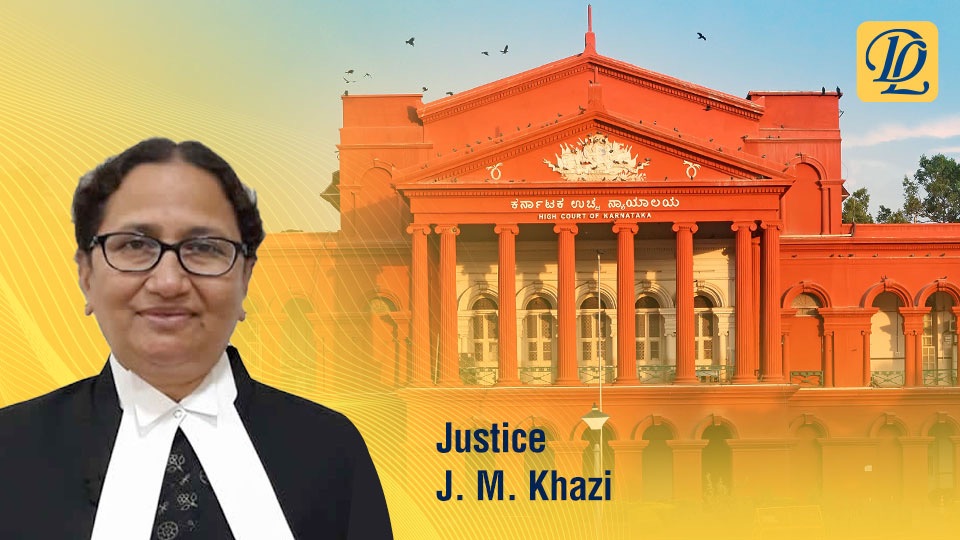
Hon’ble Ms. Justice J. M. Khazi celebrates her 61st birthday today.
Hon’ble Ms. Justice J. M. Khazi:
Born on October 8th 1963, at Indi the then Bijapur (now Vijayapura) District to Late Smt. Rashida Begum & Late Sri. M.A. Kazi as their eldest daughter. She is having an elder brother and 3 younger sisters. Her Father Late Sri. M.A. Kazi served throughout Karnataka and retired as Public Prosecutor. She had her Education upto PUC at Badami, Gadag, Navalgund, Ballari and Mandya. She did her B.Sc. and LL.B at Shivamogga and LL.M. through Kuvempu University (Distance Education).
She started practice at Vijayapura and Bengaluru on both Civil and Criminal side. At Bengaluru practiced in the office of Sri.Ashok R.Kalyanshetty. She was selected as Civil Judge & JMFC during October 1993 and worked at Tumakuru, Somwarpet, Mandya, Bengaluru and Nelamangala. Promoted as Senior Civil Judge during 2003 and worked at Bengaluru and Sagar.
Promoted as District & Sessions Judge during July 2009 and worked as District & Sessions Judge, Bengaluru and Tumakuru, Prl. District and Sessions Judge, Shivamogga, Registrar (Administration) and Secretary to Hon’ble the Chief Justice, High Court of Karnataka, Presiding Officer, Karnataka Wakf Tribunal, Bengaluru, KSTAT, Bengaluru and now working as Registrar (Vigilance), High Court of Karnataka.
Appointed as Additional Judge of the High Court of Karnataka and taken oath on 25.03.2021 and Permanent Judge on 30.09.2022.
Hobbies: Reading, gardening and listening to music.
Important Judgments delivered by Hon’ble Miss. Justice J M Khazi.
Reference and incorporation in a contract. Mere reference to another document in a contract will not incorporate terms of the document into the contract. Karnataka High Court.
Essential Commodities Act. Initiation of criminal proceedings without making company an accused are not maintainable and are liable to be quashed. Karnataka High Court.
Civil dispute being converted into criminal case amounts to abuse of process of law. Karnataka High Court quashes criminal proceedings initiated by apartment owner against the office bearers for disconnecting electricity supply.
Pendency of civil case is not a ground to dismiss criminal proceeding. Criminal case regarding forgery of Will cannot be dismissed on the ground that the finding in criminal case will have a binding effect in pending civil suit. Karnataka High Court.
Re-Compensate forest land taken four decades ago for Harangi Reservoir Project. Karnataka High Court directs the State Government to handover 11,722 hectares of Revenue lands to Forest Department.
Hindu Law. Separated son has No right in ancestral property left by kartha. He can claim share as Class-I heir after death of Kartha in notional partition. Karnataka High Court.
Appellate Court cannot decide criminal appeal before it by taking into account evidence recorded in another case even though it might be a cross-case or a counter case. Karnataka High Court issues exhaustive guidelines.
Grant of benefit by statutory authority inadvertently or by mistake to few persons does not create right to other similarly situated persons to claim such benefit. Karnataka High Court.
Reference and incorporation in a contract. Mere reference to another document in a contract will not incorporate terms of the document into the contract. Karnataka High Court.
Essential Commodities Act. Initiation of criminal proceedings without making company an accused are not maintainable and are liable to be quashed. Karnataka High Court.
Civil dispute being converted into criminal case amounts to abuse of process of law. Karnataka High Court quashes criminal proceedings initiated by apartment owner against the office bearers for disconnecting electricity supply.
Pendency of civil case is not a ground to dismiss criminal proceeding. Criminal case regarding forgery of Will cannot be dismissed on the ground that the finding in criminal case will have a binding effect in pending civil suit. Karnataka High Court.
Karnataka Societies Registration Act. Prosecution for not conducting annual general body meeting cannot launched after six months from the date of the alleged offence. Karnataka High Court.
If land falls within Corporation limits, there is no requirement to obtain permission under Section 95 of the Karnataka Land Revenue Act for diverting agricultural land for non-agricultural purpose. Karnataka High Court.
Criminal Law. Life imprisonment means imprisonment for complete span of life. Consecutive sentences in case of conviction for several offences at one trial does not arise. Application for clarification of sentence is not maintainable. Karnataka High Court.
N.I. Act. Section 138. When cheque is delivered for collection within the territorial jurisdiction of a Court where the payee maintains the account, proceedings cannot be initiated in other place. Karnataka High Court.
When a Company nominates a Director under Section 49(2) of the Legal Meteorology Act, 2009, initiation of penal proceedings against other Directors is not permissible. Karnataka High Court.
Motor Vehicles Act, 1988. Section 147. Person travelling on mud-guard of a tractor is NOT an authorized passenger. Persons working on ploughing/crushing machines attached to tractor are NOT employees. Karnataka High Court.
Customary divorce among PanchamasaliLingayats, though recognised under Section 29-2 of the Hindu Marriage Act, the same is required to be proved strictly in accordance with Section 60 of the Evidence Act. Karnataka High Court.
Attornment of tenancy in favour of purchaser is not required to initiate eviction proceedings under the Karnataka Rent Act, 1999. Karnataka High Court.
Karnataka Land Reforms Act. Tenancy created under registered lease deed by grandfather during minority of grandson. Same is binding unless the lease is challenged within three years after grandson attains majority. Karnataka High Court.
Land Acquisition. Challenge to land acquisition can be rejected by courts on the ground constructive resjudicata and res judicata. Issue regarding fraud already adjudicated binds subsequent proceedings. Karnataka High Court.
Undue influence, unless specifically pleaded in the plaint, cannot be assumed by the court based on evidence during trial. Karnataka High Court reiterates.
RTC entries in revenue records. Deputy Commissioner exercising power under the Karnataka Land Revenue Act cannot sit over the validity of registered title deed. Karnataka High Court.
FIR for the offence under Section 498-A IPC cannot be registered against woman alleged to be in illicit relationship with complainant’s husband unless essential ingredients of the offence are made out. Karnataka High Court.
Defamation. When a class of persons are mentioned to have been defamed and if such a class is indefinite, the complaint cannot be entertained. Karnataka High Court.
Offence by Companies. A person cannot be prosecuted unless he is shown to be in-charge of the Company as Managing director or Director. Karnataka High Court.
Vendor committing breach of agreement to sell his property and returning the advance amount to purchaser does not constitute criminal breach of trust. Karnataka High Court.
SC/ST (Prevention of Atrocities) Act, 1989. ”Pre-existing civil disputes cannot be converted into offences under the Act”. Karnataka High Court while quashing criminal proceedings under the Act.
Negotiable Instruments Act. Directors of a company cannot be held vicariously guilty of the offence punishable under Section 138 when the company is not arrayed as an accused in the complaint. Karnataka High Court reiterates.
Mahazar drawn contrary to Section 100 (4) Cr.P.C. is only irregular. Same cannot be termed as illegal if seizure can be proved upon search conducted. Karnataka High Court.
Person who gifted immovable property to Municipality on the assurance of alternative site is entitled to receive market value compensation if there is no provision for allotment of alternate site. Karnataka High Court.
Obtaining power of attorney from property owner and selling the property to third party does not by itself amount to cheating unless obtaining the power of attorney was with an intention to deceive the owner. Karnataka High Court.
Mere inducement to invest in money doubling scheme in the absence of dishonest intention to cheat the investor from the inception does not constitute either cheating or criminal breach of trust. Karnataka High Court.
FIR lodged during pendency of civil suit between parties giving criminal texture to civil dispute and to wreak vengeance is liable to be quashed. Karnataka High Court.
Bar under Article 363 of the Constitution to enquire into disputes arising out of merger agreement or instrument of accession between Ruler of an Indian State and the Government applies even to Revenue proceedings. Karnataka High Court.
Drugs and Cosmetics Act. Serving Government analyst report on accused after expiration of drug’s shelf life deprives valuable right of the accused to get the drug re-analysed. Criminal proceedings are liable to be quashed Karnataka High.
Range Forest Officer cannot register FIR in respect non-cognizable offences under the Karnataka Forest Act without obtaining prior permission from the Magistrate. Karnataka High Court.
Director of a company who resigned by submitting required Form before the Registrar of Companies cannot be held liable for bouncing of cheque issued after his retirement. Karnataka High Court.
Private complaint in respect of a cognizable offence without complying with Sections 154(1) and 154(3) of Cr.P.C is not maintainable. Karnataka High Court reiterates.
Conscious possession of live cartridges fully knowing the consequences is essential to constitute offence under Sections 3 and 25(1)(a) of the Arms Act. Karnataka High Court.
When there is no clause prescribing minimum quantity of electricity to be purchased by Govt Electricity Company under Power Purchase Agreement, licensee cannot be restrained from injecting power generator into the grid. Karnataka High Court.
To constitute offence under Section 3(1)(j) of the SC & ST (Prevention of Atrocities) Act, the accused must have employed the person for manual scavenging knowing fully well that he belongs to SC & ST community. Karnataka High Court.
Persons who had ceased to be directors of company cannot be arrayed as accused in proceedings under the NI Act in respect of cheque issued by the Company. Karnataka High Court reiterates.
Instigating Police personnel to go on mass leave and to participate in the strike seeking redressal of grievances do not constitute the offence of Sedition. Karnataka High Court.
Employee working under contractor sustaining injuries does not fall under the definition of ‘worker’ as defined under Section 2(l) of the Factory Act. Karnataka High Court.
BBMP Act 2020. Whenever transfer of property comes to the knowledge of the Chief Commissioner through notice under Section 149, he is bound to enter the name of the transferee in the property tax register. Karnataka High Court.
Permission to demolish dilapidated building. Though issuance of notice to adjacent owner is not necessary, it is incumbent to notify when demolition poses threat. Karnataka High Court.
Person who relinquishes land in favour of Corporation is entitled to maximum Transferable Development Rights as per the amendment to KTCP Act. Karnataka High Court.
President of a Gram Panchayat has no power under the Karnataka Gram Swaraj and Panchayat Raj Act, 1993 to cancel khata registered in favour of a person. Karnataka High Court.
BBMP cannot refuse to change khata of property duly purchased under a registered sale deed only on the ground of third-party objection. Karnataka High Court.
Gram Panchayat preventing licensed persons from carrying on business by introducing public auction without authority of law violates fundamental right under Article 19. Karnataka High Court.
Rejection of restoration application under the PTCL Act filed after 32 years. Remand of the proceedings on the ground of procedural irregularity cannot be ordered when fresh consideration is a futile exercise. Karnataka High Court.
Delimitation of wards based on the population is flexible clothing the Government with power to meet difficult situation since scale of representation may not be always uniform. Karnataka High Court.
Karnataka SC-ST – PTCL Act. Delay of seven years in applying for restoration of the granted land without any explanation for the delay. Application is liable to be rejected. Karnataka High Court.
”Elections are the essence of democracy”. Karnataka High Court directs the Govt to provide reservation for women in the wards having greater women population and to hold elections at the earliest.
When a statutory appeal is rejected as not maintainable, the appellate authority cannot make observations on merits touching the rights of the parties. Karnataka High Court.
Even the delay of 25 years cannot be a ground to reject application for restoration of deleted entry in revenue records when the applicant acquired the title by registered sale deed which remains unchallenged. Karnataka High Court.
Limitation to apply for cancellation of khata under Section 114A of the Karnataka Municipal Corporations Act is three years from the date of the order and not from the date of knowledge of the order. Karnataka High Court.
Cheque bounce case. Partnership firm cannot be held liable for dishonour of the cheque issued by a partner in his individual capacity. Karnataka High Court.
Criminal proceedings under the Karnataka Private Medical Establishment Act, 2007 cannot be initiated except on a complaint in writing by the authorized officer. Karnataka High Court.
Essential Commodities Act, 1955. Criminal proceedings cannot be initiated only against manager of company without arraying the company as accused. Karnataka High Court.
Insecticides Act, 1968. Criminal proceedings cannot be initiated only against director of company without arraying the company as accused. Karnataka High Court.
When agricultural land falling within local planning area is designated for residential purpose, the permission shall be deemed to have been granted subject to payment of fine prescribed under the Karnataka Land Revenue Act. Karnataka High Court.
Essential Commodities Act. Manager of a company cannot be prosecuted for substandard goods unless the manufacturer/company is arraigned as an accused. Karnataka High Court.
Post-dated cheque presented beyond the period of three months from the date the cheque bears will not attract the provisions of Section 138 of the N I Act. Karnataka High Court.
Before initiating criminal proceedings under the Factories Act, the authorities should pass an order on the reply submitted by the occupier or the factory manager to the show cause notice. Karnataka High Court.
Persons nominated under Section 352(1)(b) of the Karnataka Municipalities Act, 1964 are not eligible to be included in the electoral roll of the Local Authorities Constituency. Karnataka High Court.
When quality supervisor is appointed by a Company under the Fertilizer (Control Order), director of Company cannot be prosecuted for the offences under the Essential commodities Act. Karnataka High Court.
Criminal prosecution launched under the Insecticides Act against director of company without arraigning the Company as an accused is not maintainable. Karnataka High Court.
When company is alleged to have committed offence under the Karnataka Forest Act, prosecution cannot be launched only against the directors without making the company an accused. Karnataka High Court.
Proceedings under Section 138 N.I. Act cannot be initiated against a person who ceased to be director of a Company as on the date of issuance of the cheque. Karnataka High Court.
Legal Metrology Act. Common complaint in respect of several distinct offences based on different causes of action on different facts and different nature is not maintainable. Karnataka High Court.
Karnataka Prohibition of Charging Exorbitant Interest Act, 2004. Police conducting raid without registering FIR at the first instance is illegal. Karnataka High Court.
While considering the application to engage private Prosecutor under Section 302 Cr.P.C, the Magistrate must form an opinion as to whether cause of justice would be subserved. Karnataka High Court.
Karnataka Excise Act. Police Officer entering and conducting search without search warrant or without recording the reasons for dispensing with obtaining search warrant is impermissible. Karnataka High Court.
Death of employee due to the negligence of the owner/occupier of the factory. Simultaneous prosecution under Section 304-A of IPC and Section 92 of the Factories Act is not permissible. Karnataka High Court.
Karnataka Tax on Entry of Goods Act. Denatured spirit and ethyl alcohol are two different products. Clarification cannot run counter to the Tax Entries to levy entry tax. Karnataka High Court.
Insecticides Act. Prior written consent by the State Government or a person authorized by it is mandatory before initiating the criminal prosecution for an offence under the Act. Karnataka High Court.
Insecticides Act. Criminal prosecution only against employee of Company cannot be launched without arraigning the Company also as an accused. Karnataka High Court.
Prosecution for obtaining false caste certificate can be launched only if the certificate is cancelled by the Competent Authority. Magistrate cannot decide the validity of the Caste certificate. Karnataka High Court.
Registration of the FIR under Sections 30 and 35 of the Arms Act which are non- cognizable cases without the order of a Magistrate is illegal. Karnataka High Court.
Sale of property pursuant to proceedings under the SARFAESI Act for the default committed by the borrower cannot be given the colour of criminal offences. Karnataka High Court.
Failure to pay fashion event organiser does not amount to fraud under Section 420 IPC unless there are clear allegations of intention to defraud from the inception. Karnataka High Court.
Wild Life (Protection) Act, 1972. Cognizance cannot be taken merely on the basis of the final report submitted by the Range Forest Officer. Karnataka High Court.
When the purpose of land acquisition is same and lands are similar, same amount of compensation shall be paid to owners, though the lands are lying in different villages. Karnataka High Court.
Registration of multiple FIR by same person against the same accused based on the same set of facts and the same cause of action is impermissible and violative of Article 21 of the Constitution of India. Karnataka High Court.
Wild Life (Protection) Act. Magistrate cannot take cognizance merely on the basis of final report by the police unless there is a complaint made by a person prescribed under Section 55A of the Act. Karnataka High Court.
Before taking cognizance of offence under Section 138 of N.I. Act against out of station accused, preliminary enquiry must be conducted as contemplated under Section 202 of Cr.P.C. Karnataka High Court.
Removal and transportation of sand after obtaining prior permission of the Government does not attract penal provision of Section 379 of IPC since the Section implies removal of the property belonging to another person without consent. Karnataka High Court.
Investigation of non-cognizable offences. Mere endorsement by the Magistrate ‘permitted’ on the requisition cannot be construed as order under Section 155(2) of Cr.P.C. Karnataka High Court.
Prevention of Corruption Act. Competent authority to grant sanction to prosecute head of the Department is the Cabinet. Minister in-charge has no power to grant such sanction. Karnataka High Court.
No criminal proceedings can be initiated against Notary Public except by an officer authorised by the Central or State Government by general or special order in this behalf. Karnataka High Court.
Tax cannot be levied on telecommunication towers erected by the Bharat Sanchar Nigam Limited (Government of India undertaking) on the immovable property belongs to it, or the Union of India save as the parliament may by law provide. Karnataka High Court.
Suit for partition by woman coparcener is not maintainable if the ancestral property was sold before coming into force of the amended Section 6 of the Hindu Succession Act. Karnataka High Court.
Companies Act, 1956. Offence under Section 217 is not a continuing offence. No criminal prosecution can be launched beyond six months in view of Section 468(2)(a) and (b) of Cr.PC. Karnataka High Court.
Labour Court awarding partial backwagesfor proven unauthorised absence of workman for a long period runs contrary to the principle of ‘no work, no pay’ and cannot be justified under Section 11-A of the I D Act. Karnataka High Court.
“Prohibition of outdoor advertisement on non-residential private properties violates Articles 14 & 19(1)(a) and (g) of the Constitution of India” declares Karnataka High Court. Directions issued to take strict action against unauthorised hoardings.
No estoppel against statute. Landowners cannot be deprived of compensation for the Road Margin Area even though they accepted condition and derived benefit under the approved plan. Karnataka High Court.
Suit for permanent injunction. Pendency of tenancy dispute under Land Reforms before Tribunal does NOT prevent civil court to deal with issue of possession and to grant temporary/permanent injunction. Karnataka High Court.
Industrial Disputes Act. Labour Court must quantify monetary value payable to the Workman before directing the employer to implement the award under Section 33 (2) (c). Karnataka High Court.
Microbreweries also fall under the Karnataka Excise (Brewery) Rules and are entitled for refund/adjustment of unutilised excise duty and additional excise duty. Karnataka High Court.
Offence under Section 78 (3) of the Karnataka Police Act is non-cognizable. Police officer cannot investigate the offence without obtaining orders from the Magistrate. Karnataka High Court.
Word ‘permitted’ is not an order under Section 155 (2) Cr.P.C. Registration of FIR, in the absence of valid order as specified under Section 155 (2) of Cr.P.C. stands vitiated. Karnataka High Court.
Deputy Commissioner need not follow the procedure prescribed in Rule 5 of the Karnataka Excise Licences (General Conditions) Rules, 1967 while renewing the license. Karnataka High Court.
Religious Institution (Prevention of Misuse) Act, 1988. Election campaign in the temple premises by person who is not in-charge of the affair of the Temple does not attract the Act. Karnataka High Court.
Income Tax Act. Magistrate can take cognizance for the offences under Sections 277 and 278 only on the basis of complaint by the authorized officer with prior sanction from the competent Authority. Karnataka High Court.
Karnataka Police Act. Playing ‘’AndharBahar” in private house does not attract Common Gaming-House under the Act. Prosecution cannot launched in such a scenario. Karnataka High Court.
Karnataka Excise Act. Conducting search without obtaining order from the Magistrate and without recording the grounds for its dispensation under Section 54 is illegal. Karnataka High Court.
Mere pendency of litigation, in the absence of any restraint order, cannot be a ground for the Corporation not to enter the name of the purchaser in the khata. Karnataka High Court.
Special Court established under Section 435 of the Companies Act, 2013, cannot take cognizance of an offence committed under the provisions of the Companies Act, 1956. Karnataka High Court.
Transfer of undivided interest by landowner in respect of apartment allotted to developer under Joint Development Agreement. Apartment value cannot be included for stamp duty calculation. Karnataka High Court.
NDPS Act. Importing drugs via consignment. When the ‘Controlled Delivery’ technique fails, proceeding with the criminal prosecution based solely on the voluntary statement amounts to abuse of process of law. Karnataka High Court.
Motor Vehicles Act. Transport schemes depend on various factors and play a pivotal role in ensuring connectivity, mobility and quality of life. Such schemes cannot be interfered with, unless it is arbitrary and discriminatory. Karnataka High Court.
Registered sale deed executed by the Agricultural Produce Marketing Committee cannot be unilaterally cancelled under the Karnataka Agricultural Marketing (Regulation of Allotment of Property in Market yards) Rules 2004. Karnataka High Court.
Criminal prosecution under the Companies Act 2013 cannot be launched for the actions which were valid under the Companies Act 1956. Karnataka High Court.
Sub-division of converted land without obtaining permission under the Karnataka Town and Country Planning Act cannot be a ground to reject transfer of khata by the Municipality. Karnataka High Court.
Planning Authority cannot ask landowner to relinquish land designated for road widening in the Master plan free of cost as a condition precedent for sanctioning the layout plan. Karnataka High Court.
Commissioner of Municipal Corporation cannot give a finding on the title of a person over the property while ordering cancellation of the khata. Karnataka High Court.
Land acquisition. Urgency clause can be invoked only for sufficient reasons to be recorded in writing. Delay on the part of the acquiring body invalidates the proceedings. Karnataka High Court.
Market value for the excess lands utilized for widening of National Highway has to be determined in commensurate with the market value determined in respect of the acquired land. Karnataka High Court.
Doctrine of res judicata cannot be used to reject a plaint, as its determination necessitates an examination of pleadings, issues, and decisions in prior suits. Karnataka High Court.
Urban (Ceiling and Regulation) Act. Revenue Inspector has no power to take possession of excess land. Karnataka High Court restores land to the owners after 30 years.
Criteria for exercising power under Section 482 Cr.P.C to quash FIR is the situs of the authority who has registered the case and not the place of commission of the crime either in full or part. Karnataka High Court.
Obtaining Succession Certificate by producing fabricated relinquishment deed. Cognizance of such offence can be taken only upon a complaint in writing of that Court or by any person authorized as stated under Section 195 of Cr.PC. Karnataka High Court.
Commission earned by payment aggregator, without the knowledge of the criminality, cannot be termed as facilitating illegal money transfer to invoke Section 3 of the Prevention of Money Laundering Act. Karnataka High Court.
Earnest money in sale transaction represents guarantee that purchaser will perform his part of the contract. It can be forfeited only when the transaction fails by reasons of the default or failure of the purchaser and not otherwise. Karnataka High Court.
Negotiable Instruments Act. Power of Courts to order interim compensation under Section 143(A) can be only in respect of the offences committed after the introduction of the Section in the statute book. Karnataka High Court.
Change of use under Section 14A of the Karnataka Town and Country Planning Act is not a condition precedent for conversion of land for non-agricultural purposes under Section 95 of the Karnataka Land Revenue Act. Karnataka High Court.
Plaint can be rejected on the ground of resjudicata if the claim in the subsequent suit is based on the status of a person (adoption) already negatived in the earlier suit. Karnataka High Court.
Accused who is not charged with the predicate offence can still be prosecuted for the offence under the Prevention of Money Laundering Act. Karnataka High Court.
Land Acquisition Act. Delay in issuing preliminary and final notification has material bearing on the question of invocation of urgency power. Karnataka High Court.
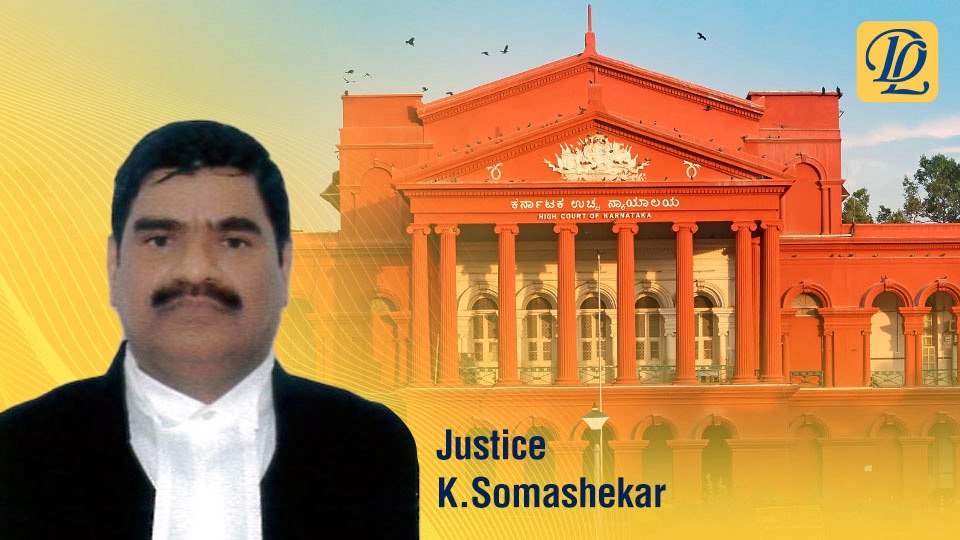
Hon’ble Mr .Justice K. Somashekar celebrates his 61st birthday today.
Hon’ble Mr. Justice K. Somashekar: Born on 15.09.1963. Enrolled as an advocate on 27.01.1990 and practiced in Mysore and Chamarajanagar Districts on both Civil and Criminal sides. Directly appointed as District and Sessions Judge on 17.06.1998 and served as Additional Districts and Sessions Judge at Bijapur(Vijayapura); and City Civil Court, Bangalore and Principal District and Sessions Judge at Uttara Kannada, Karwar District; Hassan; Bangalore Rural District, Chitradurga and Principal City Civil and Sessions Judge, Bangalore and also served as Registrar Judicial and Registrar Vigilance, High Court of Karnataka. Appointed as an Additional Judge of the High Court of Karnataka on 14.11.2016 and Permanent Judge on 03.11.2018.
Important judgments delivered by Justice K. Somashekar.
Criminal Trial. Wife cannot be dragged into criminal case simply because she is signatory to cheques along with her husband who is involved in illegal business transactions. Such practice should be curtailed. Karnataka High Court.
Mere payment of premium amount before occurrence of accident will not cover liability if the insurance policy is issued with effect from the time after the accident. Karnataka High Court.
“Victim compensation is the social philosophy and legislative implication. Failure on the part of the prosecution to secure a conviction is not a ground to deny compensation”. Karnataka High Court orders compensation to minor girl orphaned due to crime.
Presentation of undated cheque after three years from the date of the transaction by adding the date. Proceeding under Section 138 NI Act will be clearly barred by limitation. Karnataka High Court.
Criminal trial. In a case resting on circumstantial evidence, motive plays a crucial role. Motive is a double-edged weapon, which will cut either side of the case. Karnataka High Court.
“Case of the prosecution in entirety is found to be doubtful and is full of inconsistencies”. Karnataka High Court acquits the accused in RTI activist Lingaraju murder case.
An order of acquittal adds up to the presumption of innocence in favour of the accused and hence the Appellate Court has to be relatively slow in reversing the order. Karnataka High Court.
Dowry Prohibition Act 1961. Wife roping in entire family members of husband with ulterior motive of wreaking vengeance. Such proceedings are liable to be quashed. Karnataka High Court.
When the prosecution fails to prove its case, benefit of the acquittal can be extended by the appellate court even to the accused who has not preferred appeal challenging the order of conviction. Karnataka High Court.
Criminal Law. Though due to passage of time and memory loss, witnesses deviate from their Police Statements, but when such discrepancies make the foundation of the prosecution case shaky, the Court has to take strict note thereof. Karnataka High Court.
When proceedings are initiated under the Karnataka SC/ST (PTCL) Act, the authorities are bound to examine whether the grant comes within the purview of the Act. Karnataka High Court.
If deposition of the child witness inspires confidence in the mind of the Court and there is no improvement or tutoring, the Court may rely upon the same. Karnataka High Court.
In determining culpable homicide under Section 299 of IPC, mentality of the accused, nature of the act and its effect upon the victim have to be analysed. Karnataka High Court.
Employees’ Provident Funds and Miscellaneous Provisions Act. Competent authority has discretion to reduce the percentage of damages under Section 14B and the same is justiciable. Karnataka High Court.
When accused are acquitted for the offences under Sections 498A, 304B IPC and Sections 3 and 4 of the Dowry Prohibition Act, conviction for the murder cannot be sustained. Karnataka High Court.
Lack of intention on the part of the accused and commission of the act in the heat of passion upon sudden quarrel are the mitigating circumstances. Karnataka High Court reduces sentence from Section 302 IPC to Section 304.
Criminal Law. When trial Court misreads the evidence and arrives at a conclusion erroneously to convict the accused, the appellate Court must intervene to prevent miscarriage of justice. Karnataka High Court.
Criminal law. To impose the extreme punishment, all the three tests; Crime test, Criminal test and Rarest rare test must be satisfied. Karnataka High Court converts imprisonment till last breath of life to life imprisonment.
Criminal Law. Subsequent voluntary statement of the accused cannot be admissible in evidence and recovery to that effect amounts to “rediscovery of a fact already disclosed and capable of discovery.” Karnataka High Court.
Service Law. Court cannot sit on perceptivity of the State Government in posting a person to a particular post except considering the eligibility of the person to occupy the post. Karnataka High Court.
Failure to furnish legible and translated copies of the documents supporting the preventive detention to the detune vitiates the detention order. Karnataka High Court.
Income Tax Act. Proceedings regarding escaped assessment and notices under Section 153C solely based on loose sheets and documents which are termed as ‘diaries’ found during the search are unsustainable. Karnataka High Court.
It is not always mandatory for the State Government to script the reasons for transfer of public servant when the reasonings are reflected in the records for obtaining prior-approval from the Chief Minister. Karnataka High Court.
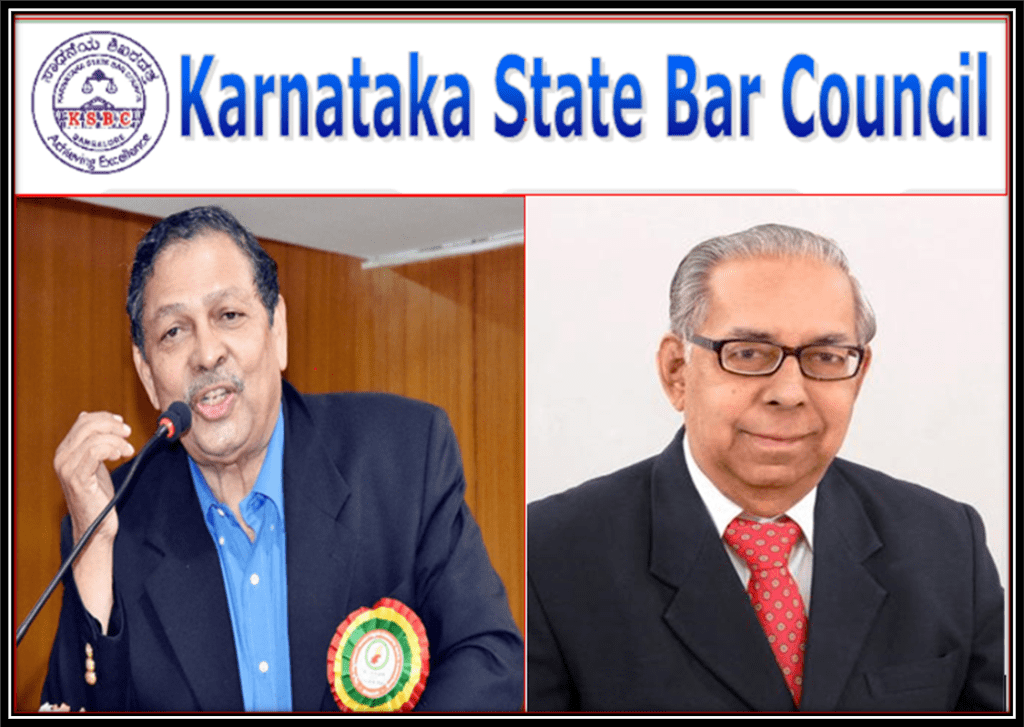
The Karnataka State Bar Council has addressed a letter to the Chief Justice of India, Prime Minister of India and the Law Minister of India demanding inclusion of Judge/s from Karnataka in the Karnataka High Court collegium.
Speaking to S. Basavaraj, Senior Advocate and Member, Karnataka State Bar Council, Justice Santosh Hegde, former judge, Supreme Court of India and Shri. B. V. Acharya, Senior Advocate and former Advocate General for Karnataka have supported the view of the Bar Council.
Justice Santosh Hegde says “the collegium should not only be aware of the good qualities of an Advocate before recommending his name to be a Judge, but it must also be aware of his drawbacks. The critical assessment of a lawyer or a subordinate judge for elevation as High Court judge is possible only if a local judge is part of the collegium when compared to outsiders.”
Shri. B.V. Acharya minced no words when he said “the entire collegium system is a judge made system. I am of the opinion that the collegium at the High Court level should consist of the local judges from the state. If the collegium consist of outside judges, the chief justice of India should recommend senior most judge outside the collegium and consider his views on the recommendation. ”
The letter of the Karnataka State Bar Council reads as follows: The Karnataka State Bar Council, representing the legal fraternity of our State, humbly submits this letter to draw your esteemed attention to a matter of significance concerning the composition of the Collegium of the Hon’ble High Court of Karnataka. Identified as the State of Mysore during the British Raj, our State has been actively part of the administration of the judicial system be it with the appointment of the Board of Commissioners on 21/10/1831, to the appointment of Maharaja of Mysore as Rajpramukh under the Constitution of India to the current judicial set-up. We have seen it all.
The Karnataka High Court (previously called as the High Court of Mysore) has its principal bench at Bengaluru with circuit/additional benches in Dharwad and Kalaburgi. Few notable judges who have been elevated from the High Court of Karnataka to become Chief Justice of India are Hon’ble Mr. Justice E.S. Venkataramaiah, Hon’ble Mr. Justice M. N. Venkatachalaiah, Hon’ble Mr. Justice S. Rajendra Babu and Hon’ble Mr. Justice H.L. Dattu. Drawing ourselves back to the subject under reference, it has come to our notice that the current Collegium of the Honble High Court of Karnataka does not include any judges whose parent High Court is Karnataka. While we hold the highest regard for the distinguished judges serving in our High Court from other States, we respectfully express our concern regarding the absence of representation from judges who have roots and a deep understanding of the legal traditions, customs, and nuances specific to State of Karnataka. Judges whose parent High Court is Karnataka bring with them an intrinsic understanding of the unique legal landscape of the state, informed by years of practice and experience within its jurisdiction. Their insights are invaluable in maintaining the balance between the diverse legal challenges that arise in the State of Karnataka and the broader jurisprudential framework of our nation. This balance is crucial for fostering a judiciary that is not only impartial but also deeply connected with the local populace it serves. Furthermore, the inclusion of such judges in the Collegium would bolster the confidence of the legal community and the public in the judicial process, reinforcing the perception that the High Court is attuned to the specific legal, cultural, and social fabric of State of Karnataka. It also serves as a recognition of the contributions and professional development of judges who have dedicated their careers to the judiciary in Karnataka.
We are aware of the complexities involved in judicial appointments and the multitude of factors that the Collegium considers. However, we respectfully urge that this aspect be given due consideration in the ongoing and future appointments to the High Court of Karnataka. In this regard, we place our trust in your office wisdom and discretion to take steps that would address this concern, ensuring that the High Court of Karnataka continues to reflect both the diversity and unity of our judicial system and consider our request to include the judges in the collegium whose parent High Court is Karnataka since regional Judges know about the deep root of practical issues. We express our profound gratitude for your attention to this matter and remain hopeful that our humble submission will be considered favourably.
Hon’ble Ms.Justice Jyoti Mulimani celebrates her 56th birthday today.
Hon’ble Miss. Justice Jyoti Mulimani: Born on 15.08.1968. Enrolled as an Advocate on 31.07.1992.
Handled all types of Civil Cases. Hindu Law, Probate, Company, Arbitration. Constitutional, Tax & Tariff. Electricity, Education, Service, Motor Vehicles, and Excise matters.
Served as a Mediator and Trainer in Bengaluru Mediation Centre for the past 12 years.
Appointed as Additional Judge of the High Court of Karnataka and taken oath on 11.11.2019 and Permanent Judge on 08.09.2021.
Important judgments delivered by Hon’ble Miss. Justice Jyoti Mulimani.
Civil court cannot enhance compensation under the Indian Telegraph Act towards diminution value if the Deputy Commissioner has already awarded under a particular head. Karnataka High Court.
Tribunal under the Maintenance and Welfare of Parents and Senior Citizens Act can invalidate Gift only if the Gift has condition that the transferee shall provide basic amenities and basic physical needs to the transferor. Karnataka High Court.
Hindu Law. Gift by a coparcener of his undivided interest in the coparcenary property either to a stranger or to his relation without the consent of the other coparcener is void. Comprehensive Judgement of the Karnataka High Court.
Recognition of Trade Union cannot be demanded as a matter of right. Recognition depends on the discretion of the employer which cannot be imposed by invoking Articles 226 of the Constitution of India. Karnataka High Court.
Where title of the plaintiff is disputed by the defendant, mere suit for bare injunction without supporting prayer for declaration is not maintainable. Karnataka High Court.
Transfer of property in violation of law against fragmentation is void and does not confer title. Suit based on such transfer is liable to be dismissed. Karnataka High Court.
When an officer is entrusted with the duty to decide the issue, detailed order and not an official memorandum is required to be passed. Karnataka High Court.
Though mortgage by deposit of title deeds can be created by handing over title deeds to lender, if the parties reduce the contract to writing, the document alone would be the sole evidence of its terms. Karnataka High Court.
Corporation cannot cancel khata without passing a speaking order and without giving an opportunity to person who may adversely be affected. Karnataka High Court.
Prohibition of transfer of land under the Karnataka Land Reforms Act applies even to agreement of sale. Specific performance of such agreement cannot be granted. Karnataka High Court.
KIADB Act. Terms of lease-cum-sale agreement prevail over Regulations governing disposal of lands. Once a lease-cum-sale agreement is executed, the Board cannot revoke the allotment citing the Regulations. Karnataka High Court.
Payment of Gratuity Act. Controlling Authority cannot entertain application claiming gratuity after inordinate delay beyond the period of limitation. Karnataka High Court.
Senior Citizens Act. Petition against non-relatives is not maintainable especially when the gift deed is silent about maintenance. Karnataka High Court.
Hon’ble Mr. Justice Ramachandra D. Huddar celebrates his 61st birthday today.
Hon’ble Mr. Justice Ramachandra D Huddar. [13-08-1963]
Honble Mr. Justice Ramachandra Dattatray Huddar: Born on 13.08.1963. Native of Gokak, Belgaum District. Graduated in Law from R.L. Law College, Belagavi. Enrolled as Advocate and practiced at Gokak. Appointed as Munsiff on 08.02.1995. Appointed as District Judge on 02.07.2009. Served as Registrar (Review & Statistics), Registrar (Administration), Addl. Registrar General, Dharwad Bench, Registrar (Infrastructure & Maintenance) & Registrar (Computers). Served as Prl. District & Sessions Judge, Dharwad, Mysuru. Worked as Director, Karnataka Judicial Academy, Bengaluru. Served also as Prl. City Civil & Sessions Judge, Bengaluru and Sworn-in as Additional Judge of the High Court of Karnataka on 24.01.2023.
Important Judgments delivered by Hon’ble Mr. Justice Ramachandra D Huddar.
Money belonging to a citizen is his property. If that is retained by the State, that amounts to temporary acquisition of property for which compensation has to be paid going by Article 300A of the Constitution of India. Karnataka High Court.
Banking Regulation Act. Bank can discontinue employment of a person who is convicted for an offence involving moral turpitude, whether he is sentenced or not. Karnataka High Court.
‘’Judges cannot act like Mughals of bygone era’’. High Court cannot issue writ in derogation of law or transcend the barriers of law. Karnataka High Court.
Negotiable Instruments Act. When cheque is returned with the endorsement ‘’payment stopped by drawer’’, the penal provisions of the Act are attracted. Karnataka High Court.
Land acquisition. Denotification and rescinding the denotification has to be gazetted so that the stakeholders challenge it; and the unscrupulous landowners would not prey the potential buyers on the basis of Denotification. Karnataka High Court.
UAP Act. Informal body of individuals ‘concerned’ with the terrorist act, though not actually involved in terrorist act, is also covered under the definition of ‘terrorist gang’. Karnataka High Court.
Mere usage of the words ‘Khayam’ or ‘Nirantara’ in a collateral document does not make lease of immovable property a ‘permanent lease’. Karnataka High Court.
When the appellate Court receives additional evidence such as expert opinion which requires to be analysed by the trial Court, the matter can be remanded to the trial Court. Karnataka High Court.
Not every application under Order 21 Rule 97 of CPC requires detailed enquiry. Courts must reject frivolous application at the threshold to enable the decree holder to reap the benefits of the decree. Karnataka High Court.
Hindu Succession Act. Failure on the part of daughters to claim share in house property in a family partition does not amount to abandonment of claim under the unamended Section 23. Karnataka High Court.
Criminal Law. Circumstantial evidence. Proved circumstances must be consistent only with hypothesis of guilt of accused and totally inconsistent with his innocence. Karnataka High Court.
Industry showing payment of overtime wages as conveyance charges to evade the ESI contribution. Karnataka High Court imposes exemplary cost on the appellant industry.
Though earlier suit for injunction does not operate as resjudicata, specific issues framed in the earlier suit and the decision rendered therein would certainly operate as resjudicata. Karnataka High Court.
Plaintiff is bound by law of limitation when he files a fresh suit under Order 23 Rule (1) CPC. If liberty is granted at the appellate stage, the cause action for fresh suit must be different than the earlier one. Karnataka High Court.
Specific performance. Subsequent escalation in market value is not a ground to refuse specific performance of the agreement when all other factors are proved. Karnataka High Court.
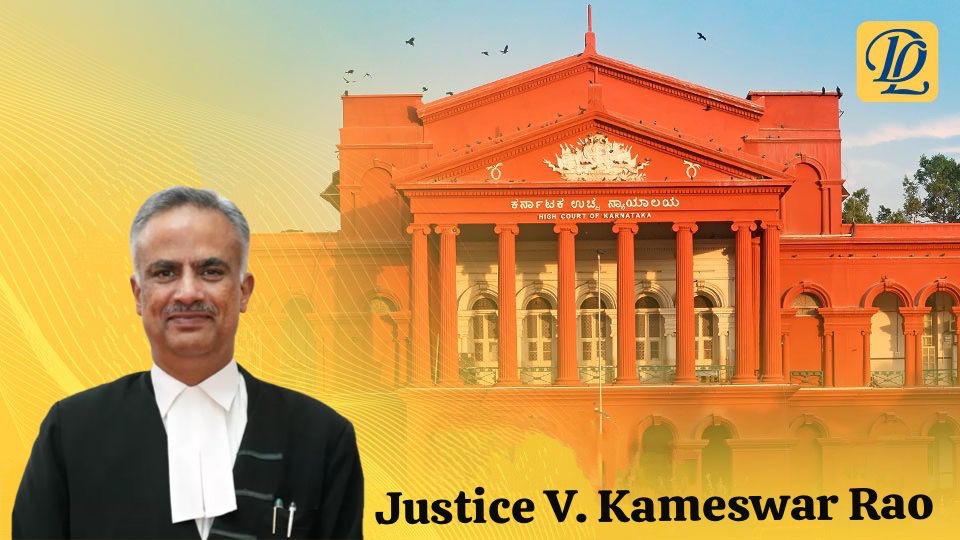
Hon’ble Mr. Justice V. Kameswar Rao celebrates his 59th birthday today. Justice V. Kameswar Rao was born on 7 August 1965. He did his BA (Hons.) Geography and LL.B from Delhi University in the years 1987 and 1990 respectively. Awarded Certificate of Merit for standing second in College in the year 1985-86.
He enrolled as an Advocate in March, 1991 with Bar Council of Delhi. Practiced in the Supreme Court of India, Delhi High Court, Central Administrative Tribunal (Principal Bench), New Delhi. Also appeared in other High Courts like at Madras High Court, Port Blair (Circuit Bench of Calcutta High Court). Conducted cases relating to Service Law, Labour Law, Arbitration, Constitution and Administrative Law. Represented various Public Sector Undertakings, Banks & Autonomous Bodies. Was Member Executive of the Central Administrative Tribunal Bar Association (Principal Bench), New Delhi.
He was designated as Senior Advocate by the Delhi High Court in January, 2010. Justice V Kameswar Rao was elevated as Additional Judge of High Court of Delhi on 17 April, 2013 and as Permanent Judge on 18th March, 2015 (F/N) and was transferred as a Judge of Karnataka High Court and assumed office on 01.06.2024.
Important and latest judgements delivered by Justice V. Kameswar Rao.
Period treated as ‘not spent on duty’ will be counted for the purpose of seniority, and also for all consequential benefits. The period treated as ‘not spent on duty’ must be construed for the purposes of back wages only and not for the purposes of seniority, promotion etc. Vinod Kumar v. State (NCT of Delhi), 2023 SCC OnLine Del 6011. Delhi High Court.
When an employee gets involved in a crime, disabling himself from rendering his services on account of conviction or incarceration, even if he is acquitted subsequently on appeal and re-instated in service, he cannot, as a matter of right, claim back wages for the period when he was not in service. Vinod Kumar v. State (NCT of Delhi), 2023 SCC OnLine Del 6011. Delhi High Court.
Nurses working in hospitals provide a very valuable humanitarian service; their duties are manifold – from assisting doctors in carrying out treatment to taking personal care of patients and even sometimes handling bystanders and relatives of the patients. They attend to the needs of the sick and the ailing in the extremely tense atmosphere of hospitals. It would be a travesty of justice, if such people are denied adequate compensation for their services as they are entitled. Sita Mundu v. All India Institute of Medical Sciences, 2023 SCC OnLine Del 6216. Delhi High Court.
Arbitration and Conciliation Act. High Court while exercising judicial function under Section 11(6) can determine the issue of maintainability of a petition on any ground including on territorial jurisdiction/res judicata, etc. The principle of res judicata shall be applicable to a petition under Section 11. Otherwise, it would mean, despite a petition under Section 11(6) not maintainable, like, on the ground that the High Court lacks the territorial jurisdiction as the seat of arbitration is elsewhere; the petition needs to be entertained. Such cannot be the position in law. This Court can, if a petition is not maintainable, shall be within its right to dismiss the petition at the threshold. Antique Art Export Pvt. Ltd. v. United India Insurance Company Ltd., 2023 SCC OnLine Del 1091. Delhi High Court.
The children room in every District must be kept open on Sundays and second Saturdays also between 10 AM to 5 PM, so that any Court passing an order of visitation can also direct the visitation to be effected in Children Room, Family Court, District Court on every second Saturday and Sunday as well. Necessary directions be issued by the Registrar General of this Court to the District Judge/Principal Judge, Family Courts of every District in that regard. Samrat Singh Rawat v. Poonam Rawat, 2023 SCC OnLine Del 7973. Delhi High Court.
Cause of action in a partition suit is recurring one. Dismissal of earlier suit for partition for default is not a bar for the second suit. Srinivas and others Vs M.C. Narayanaswamy and others.
Hon’ble Mr. Justice S. Sunil Dutt Yadav celebrates his 51st birthday today.
Hon’ble Mr. Justice Siddappa Sunil Dutt Yadav:
Born on 3rd August 1972. Appointed as Additional Judge of the High Court of Karnataka and took oath on 14.02.2018 and Permanent Judge on 07.01.2020.
Important judgments delivered by Hon’ble Mr. Justice Sunil Dutt Yadav.
Compensation towards tortious acts of State entities. Concurrent remedy no bar to exercise writ jurisdiction. Karnataka High Court awards compensation of Rs. 1.19 Crore for death and injury due to electrocution.
Claim to property based on adverse possession. Period starts from the time of giving up the claim based on title. Plea of title and adverse possession are mutually inconsistent. Karnataka High Court.
Unlike access to justice, forum convenience is not a fundamental right. Only the Chief Justice of High Court has power to allocate work to puisne judges of respective benches of High Court. Karnataka High Court clarifies.
Service Law. Stigmatic termination of an employee cannot be done by following termination simplicotor Rule abandoning disciplinary proceedings. Karnataka High Court.
Ineligible candidate cannot plead his innocence in the selection process. Permitting ineligibility to triumph would have the effect of perpetuation of illegality which cannot be allowed. Karnataka High Court.
False allegation of impotency by wife would cause mental disharmony to husband and amounts to mental cruelty, which would enable the husband to seek divorce on the ground of cruelty. Karnataka High Court.
Assessee is entitled for ‘Nil Tax Deduction at Source’ for payments made towards reimbursement of salaries of deputed expatriate employees. Karnataka High Court.
Service Law. Wherever horizontal reservation of eligible candidates are not found, it is the duty of the authorities concerned to then have a vertical reservation. Karnataka High Court.
Service Law. Transfer order, after the period of general transfers without showing place of posting, is not permissible. Place of transfer must be to a vacant post. Karnataka High Court.
Prevention of Corruption Act. Previous sanction is not required before passing an order for investigation under Section 156(3) of Cr.P.C. Authoritative pronouncement of the Karnataka High Court.
Karnataka Grama Swaraj and Panchayat Raj Act. Chief Executive Officer cannot terminate employees of the Grama Panchayat since the competent authority is the Gram Panchayat. Karnataka High Court.
There must be a specific allegation that the action complained of amounts to interference or attempt to interfere with the free exercise of electoral right by undue influence at an election to constitute offence under Section 171C, IPC. Karnataka High Court.
Where driver of vehicle had no valid and effective driving licence, the insurance company shall pay the compensation to the claimant and recover the same from owner of the vehicle. Karnataka High Court reiterates.
MVC Act. Amputation of leg need not always result in 100% disability for the purpose of awarding compensation when the claimant can do the work which is not strenuous in nature. Karnataka High Court.
Borrower of motor vehicle steps into the shoes of the owner of the vehicle and hence the borrower of the vehicle or his legal heirs are not entitled for compensation. Karnataka High Court.
Arbitration and Conciliation Act, 1996. Even non-signatories will be bound by the arbitration agreement, if there is implied consent to be bound and a direct relationship with the signatory. Karnataka High Court.
Election Law. Purchase of Medi Assist Policies by a candidate prior to nomination but distribution of the same after the nomination would amount to bribery in terms of Section 123 of the R.P. Act. Karnataka High Court.
Escaped assessment under the IT Act. ‘Income chargeable to tax’ is income as arising out of the capital gains and not the entire sale consideration. Karnataka High Court.
Service Law. Person ineligible for the post cannot question the appointment of another person to the post since Public Interest Litigation is impermissible in Service matters. Karnataka High Court.
Re-assessment under Section 148A (d) of the Income Tax Act against a Company already merged with another Company is a substantive illegality and without jurisdiction. Karnataka High Court.
Reopening assessment under Section 148 IT Act. Reasons for issuing notice once communicated and objections received, the officer is duty bound to adjudicate upon the same before reassessment order is passed. Karnataka High Court.
“Disputes between the governmental bodies cannot be dragged before the constitutional courts”. Karnataka High Court sets up committee to resolve the dispute between APMC and BMRCL regarding compensation.
Grant of sanction u/s 197 Cr.P.C. is an administrative function and the presumption under Section 114(e) of the Indian Evidence Act that official acts have been performed regularly can be applied. Karnataka High Court.
Grant of NOC from the Ministry of Defence for construction within the vicinity of Defence Establishment can only be as per the provisions of the Works of Defence Act, 1903. Executive instructions cannot be relied on. Karnataka High Court.
Determination of market value under Section 26 of 2013 Land acquisition Act shall be as per the guidelines in Section 26 of 2013 Act and not based on earlier Gazette Notification. Karnataka High Court.
Amendment of pleading cannot be rejected on the ground of delay when the Court exercises power under Section 26 (4) of the Specific Relief Act. Karnataka High Court.
Alternate appellate remedy. If exercise of jurisdiction by a Tribunal ex-facie appears to be an exercise of jurisdiction in futility, it will be permissible for the High Court to interfere in exercise of its writ jurisdiction. Karnataka High Court.
Judicial proceedings initiated by a third party other than the employer cannot be a reason to withhold pension payable to public servant. Karnataka High Court.
Right to privacy of Aadhaar number holder has to be protected. Marriage does not eclipse the right to privacy which is protected by the procedure of hearing under Section 33 of the Aadhaar Act. Karnataka High Court.
Employees Compensation Act. Commissioner is bound to consider the aspect of penalty in accordance with statutory provision when there is delay in payment of even the partial liability. Karnataka High Court.
Re-assessment under the Income Tax Act. Assessee duty to disclose does not extend beyond full and truthful disclosure of all primary facts and does not include inferences. Karnataka High Court.
Whether BBMP can demand full property tax from the Educational Institutions? High Court of Karnataka takes up the issue and grants stay of the demand notice.
Procedure to be followed by BBMP in cases of reopening self-assessment where returns are not filed and in cases of random scrutiny. Karnataka High Court lays down guidelines.
Indian Succession Act. While granting Letters of Administration to the sole legal heir of the deceased, Court has no power to impose condition of non-alienation of the property on the petitioner. Karnataka High Court.
Disqualification to hold Office in local bodies. Work done for the Gram Panchayat at an earlier point of time would not operate as a disqualification. Karnataka High Court.
Karnataka Co-operative Societies Act. Disqualification for not clearing loan due to the Society as on the date of election. Subsequent clearing of dues will not wipe out the disqualification. Karnataka High Court.
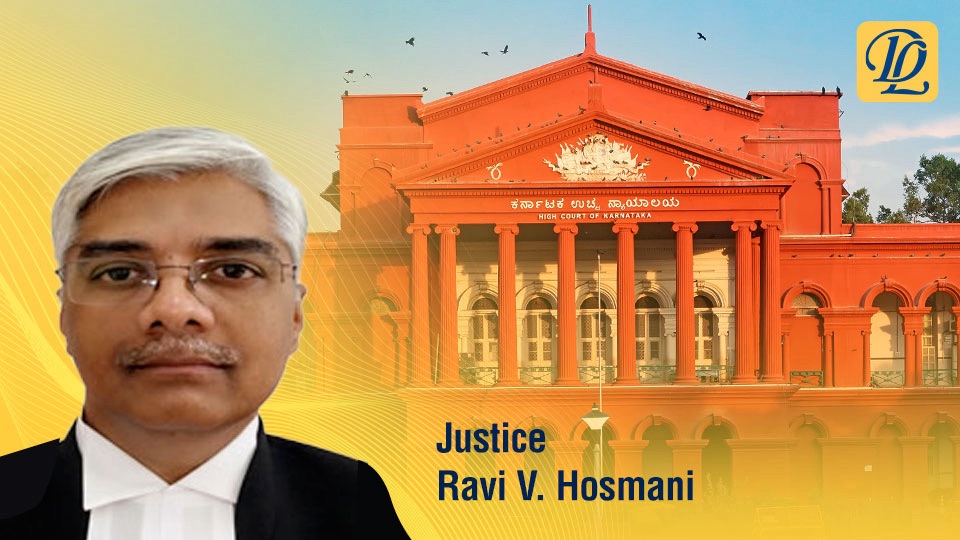
Hon’ble Mr. Justice Ravi V. Hosmani celebrates his 54th birthday today.
Hon’ble Mr. Justice Ravi VenkappaHosmani: Born on 29.07.1971. Enrolled as an Advocate on 07.07.1995 at Bengaluru. Started practice before the High Court of Karnataka at Bangalore both on the Original and Appellate stages in Writ Jurisdiction as well as on the Civil Appellate side. Also appeared before the Trial Courts, Appellate Authorities, Tribunals etc. And from July 2008 practised before the High Court of Karnataka Dharwad Bench. Appointed as Additional Judge of the High Court of Karnataka and taken oath on 07.01.2020 and Permanent Judge on 25.09.2021.
Important judgments delivered by Justice Ravi V Hosamani.
The specified value and suit valuation in IPR suits below Rs. 3 lakhs shall be examined by the Courts to ensure it is not arbitrary or unreasonable and the suit is not undervalued. Karnataka High Court.
Motor Vehicles Act, 1988. Death of employee. Amount received by dependents under group insurance scheme is NOT a pecuniary advantage and can NOT be deducted from the MVC compensation. Karnataka High Court.(DB)
Criminal Law. Testimony of a witness who identified the accused for the first time in Court without knowing him before, and in the absence of any Test Identification Parade, would be valueless and unreliable. Karnataka High Court.
When suit for specific performance is dismissed and in the absence of prayer against dispossession, defendant/owner has a right to get back possession of the property in accordance with law. Karnataka High Court.
Suit for partition. Défense of prior partition becomes weak when revenue entries do not stand separately and exclusively in the name of the family members. Karnataka High Court.
Defendant cannot be placed expartemerely on process server report unless the court is satisfied that each one of the steps contemplated for service of notice is complied with. Karnataka High Court.
A co-owner cannot seek temporary injunction against another co-owner on the ground of adverse possession unless there is a partition of the property by metes and bounds. Karnataka High Court.
Registration Act. When refusal of registration is endorsed on a deed, the only remedy is appeal under Section 72. The refusal cannot be recalled under Section 68(2). Karnataka High Court.
Recently the Karnataka High Court had to deal with a Criminal Petition challenging an FIR registered by the Police against a person who took the held the cat in temporary hostage for creating nuisance. Justice M. Nagaprasanna, Judge, Karnataka High Court while staying the criminal proceedings observed ;
“A Cat by name Daisy owned by the 2nd respondent Complainant goes missing as it jumps from wall to wall of the houses adjacent to it. Therefore, a complaint of criminal intimidation, breach of peace are alleged against the petitioner. The allegation is that the cat was in the house of the petitioner as could be seen from the CCTV. The learned counsel for the petitioner submits that cats get in and cats go out through the windows and that cannot mean an offence under Section 504, 506 and 509 of the IPC. Permitting further proceedings in such frivolous cases will clog the criminal justice system. Therefore there shall be an interim order of stay of all further proceedings”





 Daksha Legal