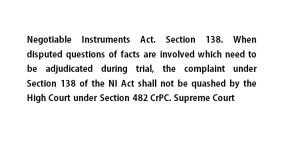
Para 22. When disputed questions of facts are involved which need to be adjudicated after the parties adduce evidence, the complaint under Section 138 of the NI Act ought not to have been quashed by the High Court by taking recourse to Section 482
Full Judgment: Rajeshbhai Muljibhai Patel v. State of Gujarat, (2020) 3 SCC 794
R. BANUMATHI, J.— Leave granted. These appeals arise out of the impugned judgment dated 14-12-20181 passed by the High Court of Gujarat at Ahmedabad dismissing Criminal Miscellaneous Application No. 2735 of 2017 thereby declining to quash the FIR No. I-194/2016. By the same order, the High Court has allowed2 Criminal Miscellaneous Application No. 24588 of 2017 and quashed the criminal case in CC No. 367 of 2016 filed by Appellant 3 Hashmukhbhai Ravjibhai Patel against accused Yogeshbhai Muljibhai Patel under Section 138 of the NI Act.
2. Brief facts which led to the filing of these appeals are as under: Appellant 1 Rajeshbhai Muljibhai Patel is the real brother of Yogeshbhai Muljibhai Patel who is the accused in CC No. 367 of 2016 filed under Section 138 of the NI Act by Appellant 3 Hashmukhbhai Ravjibhai Patel. Both Appellant 1 Rajeshbhai and his brother Yogeshbhai are stated to be residents of United Kingdom. In this appeal, Appellant 1 Rajeshbhai is represented through his power-of-attorney holder Appellant 2 Vipulkumar Hasmukhbhai Patel. Respondent Yogeshbhai is represented through his power-of-attorney holder another respondent Mahendrakumar Javaharbhai Patel.
3. On 8-12-2015, Appellant 3 Hasmukhbhai Ravjibhai Patel filed a criminal case being CC No. 367 of 2016 against accused Yogeshbhai under Section 138 of the NI Act. The father of Appellant 1 Rajeshbhai and Yogeshbhai had agricultural lands bearing Block/Survey Nos. 534, 536/1/A, 536/1/B, 538, 539, 540, 541/1, 542 and 543 situated at Village Fofaliya, Ta. Dabhoi, District Vadodara. In 2010, in order to sell his father’s land, Yogeshbhai called up Appellant 3 who is also the maternal uncle of Yogeshbhai and Rajeshbhai. Since Appellant 3 was also planning of buying some agricultural land from the surplus funds which he had received from the sale of his agricultural land, he accepted the proposal of Yogeshbhai. Yogeshbhai who is residing in United Kingdom showed his intention to come to India for executing the sale deed of his lands in favour of Appellant 3 and asked to pay the money to Respondent 2 Mahendrakumar Javaharbhai Patel.
4. Accordingly, Appellant 3 gave Rs 30,00,000 each on four days viz. 21-8-2010, 22-8-2010, 26-8-2010 and 28-8-2010 as part payment, the total amounting to Rs 1,20,00,000 to Respondent 2 Mahendrakumar, who issued receipts for the said payments of amount for and on behalf of accused Yogeshbhai.
5. In 2015, accused Yogeshbhai came to India and arranged meeting with Appellant 3. In the meeting, Yogeshbhai informed Appellant 3 that he has already executed a registered Sale Deed No. 1229/2013 dated 16-7-2013 in favour of one M/s Brentwood Industries India Pvt. Ltd. thereby, selling the above referred lands to that company which was agreed to be sold to Appellant 3.
6. Knowing all these facts, Appellant 3 demanded his legal outstanding debt from Yogeshbhai immediately i.e. total of Rs 1,20,00,000 and Yogeshbhai promised to refund the amount by issuing four cheques of Rs 30,00,000 each in favour of Appellant 3. Accordingly, accused Yogeshbhai issued cheques bearing Nos. 8108 and 8109 of NRO Account No. 08540107512 on 12-10-2015 and cheque Nos. 20801 and 20802 of NRE Account No. 085401000566 on 30-10-2015. As per Appellant 3, at the time of issuance of cheques, Yogeshbhai gave assurance of the clearance of above cheques.
7. Two cheques bearing Nos. 8108 and 8109 dated 12-10-2015 of NRO Account No. 08540107512 amounting to Rs 30,00,000 each were dishonoured on the same day i.e. on 12-10-2015 on the ground of “Payment stopped by the Drawer”. The third cheque was of NRE Account No. 085401000566 with cheque bearing No. 20801 dated 30-10-2015 amounting to Rs 30,00,000 and the fourth cheque was also of NRE Account No. 085401000566 with cheque bearing No. 20802 dated 30-10-2015 amounting to Rs 30,00,000. When those two cheques drawn on NRE Account No. 085401000566 were presented before the Bank on the same day i.e. on 30-10-2015, those cheques were also returned on the same day with the endorsement “Payment stopped by the Drawer”. Thereafter, Appellant 3 sent a legal notice to Yogeshbhai on 17-11-2015 demanding payment of money which notice was delivered on 23-11-2015.
8. Insofar as dishonour of cheques bearing Nos. 8108 and 8109 dated 12-10-2015 of NRO Account No. 08540107512, they were returned unpaid on 12-10-2015. The complainant issued notice on 17-11-2015 and therefore, claim qua the two Cheques Nos. 8108 and 8109 are barred by limitation under the provisions of the Negotiable Instruments Act. The complaint therefore, pertains only for Cheques Nos. 20801 and 20802 of NRE Account No. 085401000566 which were returned unpaid on 30-10-2015. Complaint under Section 138 of the NI Act against Yogeshbhai was taken on file on 5-2-2016 in CC No. 367 of 2016. On 6-9-2016, the Court of 5th Additional Civil Judge & JMFC, Bharuch issued a bailable warrant for production of accused Yogeshbhai.
9. Appellant 3 Hasmukhbhai has filed Special Summary Suit No. 105 of 2015 before the Additional Chief Judicial Magistrate, Vadodara for recovery of Rs 1,20,00,000 under Order 37 CPC. Summary Suit No. 105 of 2015 filed by Appellant 3 was based on the four receipts issued by Respondent 2 Mahendrakumar. The Court in that case has issued summons for appearance against Yogeshbhai and Mahendrakumar which has been served on 1-11-2015. According to the respondents, they came to know about those four receipts only after they have been served with summons in the said suit.
10. Alleging that the appellants have forged and fabricated the four receipts, Respondent 2 Mahendrakumar has filed the complaint for cheating and forgery against the appellants. Based on the said complaint, FIR No. I-194/2016 was registered against the appellants under Sections 406, 420, 465, 467, 468, 471 and 114 IPC. Respondent 2 Mahendrakumar has alleged that the appellants joined together and prepared fabricated receipts of Rs 1,20,00,000 bearing forged signature of Respondent 2 and produced these forged receipts as true.
11. In the FIR, it was averred that Yogeshbhai, who is residing in United Kingdom had executed a power of attorney dated 14-3-2013 in favour of Mahendrakumar for administration of his lands. On the basis of this power of attorney, Mahendrakumar executed an agreement to sale in favour of one Jigneshbhai Dhanesh Chandra Shah on 16-4-2013. Thereafter, Yogeshbhai came from London and executed a registered Sale Deed No. 1229/2013 dated 16-7-2013 in favour of M/s Brentwood Industries India Pvt. Ltd. for Rs 6,16,44,000. In the sale deed, the agreement to sale holder has signed as confirming party. In consideration of the sale deed, the landowner was to receive Rs 6,16,44,000 and the confirming party-Jigneshbhai was to receive Rs 1,13,94,000. Yogeshbhai is the elder brother of Appellant 1 Rajeshbhai. Appellant 1 had filed a Special Civil Suit No. 284 of 2013 before the Court of Principal Civil Judge, Bharuch claiming his share in the said land sold by Yogeshbhai. In the said suit, Yogeshbhai, his mother Kanchanben, Respondent 2 Mahendrakumar and Jigneshbhai were arraigned as defendants. The said suit was compromised between Appellant 1 and Yogeshbhai in London and Yogeshbhai was to pay Rs 90,00,000 to Rajeshbhai Appellant 1. Appellant 1 agreed to issue NOC and promised that his power-of-attorney holder Appellant 2 Vipulkumar Hasmukhbhai Patel will issue NOC. Accordingly, Yogeshbhai had come from London and his power-of-attorney holder Appellant 2 Vipulkumar had executed NOC letter in presence of Notary H.J. Zala on 23-9-2015. There was various correspondence between the parties and the company M/s Brentwood Industries India Pvt. Ltd. regarding payment of said Rs 90,00,000.
12. Appellants 1 to 3 filed Criminal Miscellaneous Application No. 2735 of 2017 before the High Court under Section 482 CrPC for quashing of FIR No. I-194/2016. Yogeshbhai who is the accused in the criminal case being CC No. 367 of 2016 also filed Criminal Miscellaneous Application No. 24588 of 2017 for quashing of cheque case filed against him under Section 138 of the NI Act. Yogeshbhai claimed that he has given the cheques to Appellant 3 Hasmukhbhai who approached him requesting for help to purchase land. Yogeshbhai alleged that the appellants have forged the receipts issued by Respondent 2 Mahendrakumar. In this regard, Yogeshbhai placed reliance upon the report of the handwriting expert, Directorate of Forensic Science dated 15-12-2016 as per which, the disputed signatures of Mahendrakumar Javaharbhai on the receipts were not written by him i.e. Respondent 2 Mahendrakumar Javaharbhai.
13. Vide the impugned judgment dated 14-12-20181, the High Court dismissed Criminal Miscellaneous Application No. 2735 of 2017 and declined to quash FIR No. I-194/2016. The High Court held that on the basis of four receipts allegedly issued by Mahendrakumar, the third appellant Hasmukhbhai has filed Summary Suit No. 105 of 2015 for recovery of Rs 1,20,00,000. The High Court referred to the handwriting expert’s opinion who has opined that the signatures found in the receipts do not tally with the signature of Respondent 2 Mahendrakumar. The High Court held that looking into the allegations and the facts, prima facie case of forgery and cheating are made out against the appellants and accordingly, declined to quash FIR No. I-194/2016 and dismissed Criminal Miscellaneous Application No. 2735 of 2017.
14. On the basis of the order passed in Rajeshbhai Muljibhai Patel v. State of Gujarat1, Criminal Miscellaneous Application No. 24588 of 2017 filed by Yogeshbhai was allowed2 and the criminal case in CC No. 367 of 2016 filed by Appellant 3 Hasmukhbhai under Section 138 of the NI Act was quashed. The High Court held that based on the alleged forged receipts, criminal case has been filed under Section 138 of the NI Act and the cheque case cannot be proceeded with and accordingly, quashed the criminal case in CC No. 367 of 2016 filed under Section 138 of the NI Act. Being aggrieved, the appellants have filed these appeals.
15. Mr D.N. Parikh, learned counsel for the appellants, has submitted that the High Court has failed to appreciate that the FIR lodged by Respondent 2 Mahendrakumar is false and frivolous as the same subject-matter is pending consideration in Summary Suit No. 105 of 2015. It was submitted that at least two cases viz. Special Summary Suit No. 105 of 2015 and criminal case in CC No. 367 of 2016 filed under Section 138 of the NI Act are pending before the competent court and while so, the criminal case could not have been registered on the four receipts which are the subject-matter of the pending litigations between the parties. It was further submitted that in Summary Suit No. 105 of 2015, Issue 5 framed by the Court is “whether the defendant proved that the plaintiff has fabricated the forged signature illegally and created forged receipts” and the FSL report-report of the handwriting expert is filed in the said suit and the civil court is yet to determine the issue as to the genuineness of the receipts. The learned counsel submitted that the High Court has failed to appreciate that the opinion of the handwriting expert is relevant evidence, but it is not a conclusive evidence and Section 73 of the Evidence Act empowers the Court to compare the admitted and disputed writings for the purpose of forming Court’s opinion. It was contended that when the genuineness of four receipts is an issue in the civil suit and the dispute is of civil nature, the continuation of the criminal case is an abuse of process of the court and FIR No. I-194/2016 is liable to be quashed. It was also contended that the High Court erred in quashing the cheque case filed under Section 138 of the NI Act and the High Court did not keep in view that issuance of cheques by Yogeshbhai from his NRE account has been admitted.
16. Refuting the above contentions, Ms Aishwarya Bhati, learned Senior Counsel for the respondents, has submitted that Appellant 3 Hashmukhbhai is the maternal uncle of Yogeshbhai and relying upon the words of Appellant 3 and his son Appellant 2 Vipulkumar, Yogeshbhai issued two cheques bearing Nos. 8108 and 8109 for Rs 30,00,000 each from his NRO account and after issuing the cheques, Yogeshbhai realised that there were no funds in the said account and he asked Appellant 3 to return the above cheques and collect new cheques of another account. It was submitted that thereafter Yogeshbhai issued new cheques of NRE account bearing Nos. 20801 and 20802 of Rs 30,00,000 each and at that time, Appellant 3 had told that he had not brought the old cheques with him and will return the old cheques in a day or two but never returned the cheques. The learned Senior Counsel submitted that Yogeshbhai got suspicious and on making enquiry, he found that Appellants 2 and 3 were not intending to purchase any lands and thus, he has instructed the Bank to stop payment for all the four cheques. The learned Senior Counsel further submitted that the appellants made four forged receipts of Rs 30,00,000 each by forging the signatures of Respondent 2 Mahendrakumar and the handwriting expert opined that four receipts relied upon by Appellant 3 Hasmukhbhai have not been signed by Respondent 2 Mahendrakumar and on the basis of FSL report, FIR No. I-194/2016 has been registered under Sections 406, 420, 465, 467, 468, 471 and 114 of the Penal Code, 1860. It was submitted that since there is a prima facie case of forgery and cheating made out against the appellants, the High Court rightly declined to quash the FIR and the impugned order warrants no interference.
17. We have carefully considered the submissions and perused the impugned order and other materials on record.
18. The issue relates to the alleged forgery of four receipts dated 21-8-2010, 22-8-2010, 26-8-2010 and 28-8-2010 each for a sum of Rs 30,00,000 totalling to Rs 1,20,00,000 issued by Respondent 2 Mahendrakumar. For the recovery of the amount of Rs 1,20,00,000, Appellant 3 Hasmukhbhai filed Special Summary Suit No. 105 of 2015 in October 2015. After receiving summons in Summary Suit No. 105 of 2015, Respondent 2 Mahendrakumar entered appearance and filed application seeking leave to defend and the said application was allowed on 19-4-2016. On application filed by Appellant 3 Hasmukhbhai in Summary Suit No. 105 of 2015, four receipts were sent to forensic science laboratory for obtaining the opinion of handwriting expert. The handwriting expert’s report was received in the Court on 15-12-2016 to the effect that all the four receipts were not signed by Respondent 2 Mahendrakumar. It was thereafter on the complaint filed by Respondent 2, FIR No. I-194/2016 dated 28-12-2016 was registered against the appellants for the offences punishable under Sections 406, 420, 465, 467, 468, 471 and 114 IPC.
19. In CC No. 367 of 2016, case of Appellant 3 Hasmukhbhai is that Yogeshbhai issued four cheques each for a sum of Rs 30,00,000, details of which are as under:
On presentation, the above cheques were dishonoured on the ground “Payment stopped by the Drawer”. After issuing the legal notice, Appellant 3 Hasmukhbhai filed criminal case in CC No. 367 of 2016 on 8-12-2015 pertaining to two cheques bearing Nos. 20801 and 20802. It was only thereafter, Respondent 2 Mahendrakumar had filed the criminal complaint dated 20-3-2016 and also filed another criminal complaint dated 14-4-2016 against Appellant 1 Rajeshbhai and Appellant 2 Vipulkumar. Since the police had not registered the FIR, Respondent 2 filed SCRAs Nos. 5945 and 6349 of 2016 before the High Court for seeking directions for lodging FIR. The High Court vide orders dated 4-10-20163 and 6-9-20164 disposed of those petitions directing the police to investigate into the matter.
20. Be that as it may, in Summary Suit No. 105 of 2015, leave to defend was granted to Respondent 2 Mahendrakumar on 19-4-2016. On the application filed by Appellant 3 in the said Summary Suit No. 105 of 2015, four receipts filed in the suit were sent to the handwriting expert. The handwriting expert has opined that signatures in all the four receipts did not tally with the sample signatures which were of Respondent 2 Mahendrakumar. It was only thereafter, complaint was filed by Mahendrakumar, based on which, FIR No. I-194/2016 was registered on 28-12-2016 against the appellants for the offences punishable under Sections 406, 420, 465, 467, 468, 471 and 114 IPC. As rightly contended by the learned counsel for the appellants, in Summary Suit No. 105 of 2015, Issue 5 has been framed by the Court “whether the defendant proved that the plaintiff has fabricated the forged signature illegally and created forged receipts”. When the issue as to the genuineness of the receipts is pending consideration in the civil suit, in our view, the FIR ought not to have been allowed to continue as it would prejudice the interest of the parties and the stand taken by them in the civil suit.
21. It is also to be pointed out that in terms of Section 45 of the Evidence Act, the opinion of handwriting expert is a relevant piece of evidence; but it is not a conclusive evidence. It is always open to Appellant 3-plaintiff to adduce appropriate evidence to disprove the opinion of the handwriting expert. That apart, Section 73 of the Evidence Act empowers the court to compare the admitted and disputed writings for the purpose of forming its own opinion. Based on the sole opinion of the handwriting expert, the FIR ought not to have been registered. Continuation of FIR No. I-194/2016, in our view, would amount to abuse of the process of court and the petition filed by the appellants under Section 482 CrPC in Criminal Miscellaneous Application No. 2735 of 2017 to quash FIR No. I-194/2016 is to be allowed.
22. The High Court, in our view, erred in quashing the criminal case in CC No. 367 of 2016 filed by Appellant 3 Hasmukhbhai under Section 138 of the NI Act. As pointed out earlier, Yogeshbhai has admitted the issuance of cheques. When once the issuance of cheque is admitted/established, the presumption would arise under Section 139 of the NI Act in favour of the holder of cheque that is the complainant Appellant 3. The nature of presumptions under Section 139 of the NI Act and Section 118(a) of the Evidence Act are rebuttable. Yogeshbhai has of course, raised the defence that there is no legally enforceable debt and he issued the cheques to help Appellant 3 Hasmukhbhai for purchase of lands. The burden lies upon the accused to rebut the presumption by adducing evidence. The High Court did not keep in view that until the accused discharges his burden, the presumption under Section 139 of the NI Act will continue to remain. It is for Yogeshbhai to adduce evidence to rebut the statutory presumption. When disputed questions of facts are involved which need to be adjudicated after the parties adduce evidence, the complaint under Section 138 of the NI Act ought not to have been quashed by the High Court by taking recourse to Section 482 CrPC. Though, the Court has the power to quash the criminal complaint filed under Section 138 of the NI Act on the legal issues like limitation, etc. criminal complaint filed under Section 138 of the NI Act against Yogeshbhai ought not to have been quashed merely on the ground that there are inter se disputes between Appellant 3 and Respondent 2. Without keeping in view the statutory presumption raised under Section 139 of the NI Act, the High Court, in our view, committed a serious error in quashing the criminal complaint in CC No. 367 of 2016 filed under Section 138 of the NI Act.
23. In the result, the impugned order is set aside and these appeals are allowed. Criminal Miscellaneous Application No. 2735 of 2017 filed by the appellants is allowed and FIR No. I-194/2016 is quashed. Criminal Miscellaneous Application No. 24588 of 2017 filed by Yogeshbhai Muljibhai Patel stands dismissed. Case filed by Appellant 3 Hasmukhbhai Ravjibhai Patel under Section 138 of the NI Act — CC No. 367 of 2016 stands restored. The 5th Additional Civil Judge & JMFC, Bharuch is directed to proceed with the case in CC No. 367 of 2016 filed under Section 138 of the NI Act and afford sufficient opportunity to both the parties and dispose of the same in accordance with law. Summary Suit No. 105 of 2015 shall be proceeded in accordance with law without being influenced by any of the views expressed by the High Court in the impugned order.
Arising out of SLPs (Crl.) Nos. 142-43 of 2019. Arising from the Judgment and Order in Rajeshbhai Muljibhai Patel v. State of Gujarat, 2018 SCC OnLine Guj 4722 (Gujarat High Court, R/Criminal Miscellaneous Application No. 2735 of 2017, dt. 14-12-2018) and Yogeshbhai Muljibhai Patel v. State of Gujarat, 2018 SCC OnLine Guj 4771 (Gujarat High Court, R/Criminal Miscellaneous Application No. 24588 of 2017, dt. 14-12-2018)
1.Rajeshbhai Muljibhai Patel v. State of Gujarat, 2018 SCC OnLine Guj 4722
2.Yogeshbhai Muljibhai Patel v. State of Gujarat, 2018 SCC OnLine Guj 4771
3. Mahendrabhai Jawaharbhai Patel v. State of Gujarat, 2016 SCC OnLine Guj 4802
4. Yogesh Muljibhai Patel v. State of Gujarat, 2016 SCC OnLine Guj 3254
Compiled by S. Basavaraj, Advocate, Daksha Legal