Relevant paragraphs: 8. Condonation of delay is discretion of the Court. Sufficient cause depends on the facts of each case. Sufficient cause means adequate cause. The party who seeks conduction of delay shall demonstrate that there was no negligence, or there was no inactiveness on his part. The reasons for condonation of delay must be bonafide and reasonable. Sufficient case (sufficient cause) is to be given liberal interpretation to ensure that substantial justice is done. An order of dismissal from service will have far reaching civil consequences on the petitioner, as the order of dismissal virtually amounts to deprivation of right to livelihood. In that circumstances, the Tribunal has failed to exercise jurisdiction vested in it.
The Hon’ble Apex Court in the case of M/s. Katiji and others cited supra while considering Section 5 of the Limitation Act has held that “sufficient cause” employed by the legislature is adequately elastic to enable the courts to apply the law in a meaningful manner which subserves the ends of justice. Further the Hon’ble Apex Court has observed that while condoning the delay liberal approach is to be adopted keeping in mind the following principles:-
(1) Ordinarily a litigant does not stand to benefit by lodging an appeal late.
(2) Refusing to condone delay can result in a meritorious matter being thrown out at the very threshold and cause of justice being defeated. Asagainst which when delay is condoned the highest that can happen is that a cause would be decided on merits after hearing the parties.
(3) ‘Every day’s delay must be explained’ does not mean that a pedantic approach should be made. Why not every hour’s delay, every second’s delay? The doctrine must be applied in a rational common sense pragmatic manner.
(4) When substantial justice and technical considerations are pitted against each other, cause of substantial deserves to be preferred for the other side cannot claim to have vested right in injustice being done because of a non-deliberate delay.
(5) There is no presumption that delay is occasioned deliberately, or on account of culpable negligence, or on account of malafides. A litigant does not stand to benefit by resorting to delay. In fact he runs a serious risk.
(6) It must be grasped that judiciary is respected not on account of its power to legalize injustice on technical grounds but because it is capable of removing injustice and is expected to do so.”
Judgments in G.RAMEGOWDAANDOTHERSVs.SPECIALLANDACQUISITIONOFFICER,BANGALORE, reported in (1988)2SCC 142 and N.BALAKRISHNANVs.M.KRISHNAMURTHY reported in (1998) 7 SCC 123 relied on.
10. The cause stated by the petitioner in the facts and circumstances of the case would constitute sufficient cause to condone the delay of 60 days in filing the appeal. The Tribunal failed to exercise its discretion judiciously while considering the application filed under Section 5 of the Limitation Act.
Writ Petition allowed.
Compiled by S. Basavaraj and Sreekriti Taggarse, Daksha Legal.
Relevant Paragraphs: (after thoroughly discussing case laws). 48. In order to ascertain correct position of law relating to interpretation of word “substitution”, it is relevant to consider the law declared by the Hon’ble Supreme Court in the case of VINEETA SHARMA (supra), wherein at paragraph 56 and 57 of the judgment, the Hon’ble Supreme Court, has held thus: “56. The prospective statute operates from the date of its enactment conferring new rights. The retrospective statute operates backward and takes away or impairs vested rights acquired under existing laws. A retroactive statute is the one that does not operate retrospectively. It operates in futuro. However, itsoperation is based upon the character or status that arose earlier. Characteristic or event which happened in the past or requisites which had been drawn from antecedent events. Under the amended section 6, since the right is given by birth, that is an antecedent event, and the provisions operate concerning claiming rights on and from the date of Amendment Act.
49. In view of the law declared by the Hon’ble Supreme Court with regard to ‘substitution’ in the case of VINEETA SHARMA (supra), the observation made by the Hon’ble Supreme Court in the case of SRI VIJAYALAKSHMI RICE MILLS and in the case of BHAGAT RAM (supra) are not applicable to the peculiar circumstances of these cases as the impugned amendment was procedural in nature and not substantive, as contended by the learned Senior Counsel appearing for the petitioners.
52. The above discussion would persuade me to deduce and infer that, the interim of the respondent-State, while amending the impugned Act and Rule was to give effect retrospectively. The respondent-State was conscious of the nature and character of the object of the Act. I have also carefully observed that, the use of word ‘substituted’ in the amended Act and Rules would subserve and support the submission of the learned Counsel appearing for the respondents.
54.After considering the judgments referred to above with regard to interpretation made to word ‘substitution’ and applying the same for the present case, which is procedural in nature, as the ‘vested rights’ or ‘accrued rights’ as contended by the learned counsel appearing for the petitioners, would begin from the date of their assumption of office as Member of the Zilla Panchayat and in that view of the matter, the contentions so advanced that the impugned amendment commences from the date of publication to the Act cannot be considered. In other words, the impugned amendment is retrospective in nature and not prospective.
55. In view of the law declared by the Apex Court referred to above and considering the submissions made by the learned counsel appearing for the parties, as well as looking into the intent of the legislature which amending the Act, to give effect to democratic values enshrined under Constitution of India, I found that, no public interest is involved insofar as the petitioners are concerned and on the other hand, the factum of public interest lies in favour of the members sought for non-confidence motion against the petitioners, as it is trite law that, democratic principles are the basic pillars to the golden lines runs through the provisions of the Constitution of India.
HELD: Ordinance 2 of 2020 dated 31st March, 2020 to Karnataka Grama Swaraj and Panchayat Raj (Amendment) Ordinance, 2020; and Karnataka Grama Swaraj and Panchayat Raj (Motion of No Confidence against Adhyaksha and Upadhyaksha of Zilla Panchayat) Rules, 2020
Relevant paragraph: 4. Order 39 Rule 1(c) provides that temporary injunction may be granted where, in any suit, it is proved by the affidavit or otherwise, that the defendant threatens to dispossess the plaintiff or otherwise cause injury to the plaintiff in relation to any property in dispute in the suit, the court may by order grant a temporary injunction to restrain such act or make such other order for the purpose of staying and preventing … or dispossession of the plaintiff or otherwise causing injury to the plaintiff in relation to any property in dispute in the suit as the court thinks fit until the disposal of the suit or until further orders. Pursuant to the recommendation of the Law Commission clause (c) was brought on statute by Section 86(i)(b) of the Amending Act 104 of 1976 with effect from February 1, 1977. Earlier thereto there was no express power except the inherent power under Section 151 CPC to grant ad interim injunction against dispossession. Rule 1 primarily concerned with the preservation of the property in dispute till legal rights are adjudicated. Injunction is a judicial process by which a party is required to do or to refrain from doing any particular act. It is in the nature of preventive relief to a litigant to prevent future possible injury. In other words, the court, on exercise of the power of granting ad interim injunction, is to preserve the subject matter of the suit in the status quo for the time being. It is settled law that the grant of injunction is a discretionary relief. The exercise thereof is subject to the court satisfying that (1) there is a serious disputed question to be tried in the suit and that an act, on the facts before the court, there is probability of his being entitled to the relief asked for by the plaintiff/defendant; (2) the court’s interference is necessary to protect the party from the species of injury. In other words, irreparable injury or damage would ensue before the legal right would be established at trial; and (3) that the comparative hardship or mischief or inconvenience which is likely to occur from withholding the injunction will be greater than that would be likely to arise from granting it.
RELEVANT PARAGRAPH 13. Even otherwise, under law revocation of agency by the principal immediately terminates the agent’s actual authority to act for the principal unless the agent’s authority is coupled with an interest as envisaged under Section 202 of the Indian Contract Act. When agency is revoked, the agent could claim compensation if his case falls under Section 205 or could exercise a lien on the principal’s property under Section 221. The agent’s lien on principal’s property recognised under Section 221 could be exercised only when there is no agreement inconsistent with the lien. In the present case the terms of the agreement by which the respondent was appointed as agent, expressly authorises the company to occupy the godown upon revocation of agency. Secondly, the lien in any event, in our opinion, cannot be utilised or taken advantage of to interfere with principal’s business activities.
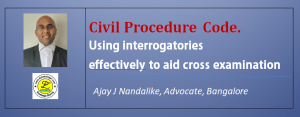
In the aftermath of COVID-19, courts and arbitrations are beginning to adopt virtual hearings as a means of justice dispensation. There is some debate about conducting cross-examination online. A view that is possible is that cross-examination can be conducted online, however, someone from the other side is physically present in the same room as the witness to avoid tutoring. Another view is to have a physical hearing in respect of cross-examination but restrict the scope of cross-examination by encouraging the use of interrogatories. In this background, this article explores how one can use interrogatories effectively to aid cross-examination. The benefits of an effective use of interrogatories include restricting the scope of cross-examination, creating more effective cross-examination, reducing superfluous questions etc.
Instances where an Interrogatories are beneficial
1.Narrowing the scope of controversy:The opponent may not refer to certain facts in the proof affidavit or be silent in respect of some information. It does not mean that the opponent is denying the information. In this situation, the scope of the dispute can be reduced by asking the opponent to admit certain facts by way of interrogatories. These admissions may not harm the case of the opponent but may aid another party’s narrative or may be required for the sake of completeness. This will reduce the necessity of cross-examination on that issue.
2. Reducing the reliance of documentary evidence in relation to certain aspects:The witness may be relying on some voluminous documents or it may contain detailed technical specifications. In order to avoid the court / Arbitral Tribunal to rely on complete document, one can ask interrogatories seeking the witness to state the relevant procedure or provide technical details or as to which page number of the Exhibit where the details are available. This will ensure that the cross-examination will only be restricted to those page numbers of the Exhibits. It may also so happen that a document produced by the witness may not at all be relevant to the matter. In such a situation, one could seek reasons for reliance on a particular document. This will restrict the scope of cross- examination in relation to that document.
3. Excluding aspects which the witness does not have knowledge of:If the Legal Manager of the Company files the proof affidavit on behalf of the Company, it is possible that he is deposing entirely on the basis of records. However, there may be several statements in the affidavit which may not be based on records. These need to be carefully gleaned out and the witness can be asked to identify the source of the statement made in the affidavit. If the witness refers to a document, then if the document is not produced or if the document does not depict the said fact, the fact is not proved. If the witness refers to some information obtained from other company personnel and names such a person, then without that person stepping into the witness box, the fact is not proved. The reference to that fact in the proof affidavit of the witness would be hearsay evidence and cannot be accepted. There would be no need to cross-examine the witness on those facts in the affidavit at all.
4. Identifying the source of the information:The witness may be making certain assertions without stating the supporting facts or producing the supporting documents on the basis of which such statements are made. If questions are asked in cross-examination for the first time regarding the source, the answers may surprise the cross-examiner and one may require more time to prepare to cross-examine further in response to such answers. It may also result in a situation where one is not able to fully cross-examine on that issue because of an unexpected answer. Hence, interrogatories will provide an opportunity to prepare for such surprises.
5. Establishing timelines and dates: It is also possible to utilize the interrogatories to establish a timeline and to organize the information in the affidavit if it has been put in a haphazard manner. If one is required to connect facts stated in the opponent’s affidavit in a manner which is suitable for one’s case, then it is possible to do so. If the affidavit omits a crucial link, it is possible to bring out that information in the timeline by seeking the opponent to confirm that particular fact. Similarly, one can ask the witness to confirm certain dates and events. If the witness intends to deny the timeline, it will help one focus the cross-examination on that specific aspect in the timeline which is denied. This saves considerable time during cross-examination.
6. Getting more information / better particulars relating to technical or procedural aspects:Answer to Interrogatories may be more complete than cross examination. Unlike depositions, interrogatories may inquire not only into the responding party’s present recollection, but also into the collective knowledge available to him or her, including knowledge of his or her agents and attorneys. One may want certain undocumented details or technicalities about some procedure on record. This information requires reference to certain documents which may not be on record or may be just an undocumented business practice of the company, then it is a good idea to ask it in interrogatories. Witness cannot say that he does not have personal knowledge or that he needs to examine records. For instance, one can ask a question regarding the procedure followed internally for clearing an invoice, which departments are involved, who needs to sign off etc. This information will provide a foundation for cross-examination on whether an invoice was improperly cleared, whether there was waiver etc.
7. Evasive Witness:One of the problems that is faced during cross-examination is the witness may not want to reveal certain information despite being aware of the same. So, the witness may say that the he does not have personal knowledge, he will need to refer to document, he did not understand the question etc., or he may not deliver a complete answer. However, in an interrogatory, he cannot say so. He will have the benefit of looking at all relevant documents, seeking information from other persons in the company, seeking advice from counsel, technical persons etc. Although it is possible to give an evasive answer, if care is taken to identify what relevant facts one wants the witness to state, the witness will have to give a yes or no answer.
8. Pinning down the opponent’s case: It is possible that an opponent will have multiple defences which are taken without prejudice to one another or case may be based on multitude of facts. When the opponent is being cross- examined, it would be possible to give contradictory answers or misconstrue the questions or provide caveats in some manner. In construction arbitrations, interpretations of actions of parties revolve around what constitutes general or best engineering / construction practice. If one is able to pin the opponent’s case on any particular issue by eliciting in an interrogatory as to whether they would accept xyz as the best engineering practice and if not, the reasons for the same, one would have a foundation to cross-examination on that issue and elicit appropriate responses. If you are able to rebut the case of the other side with some new information / documents, then interrogatories are an excellent place to pin down the witness. In cross, the witness may want to clarify his statement or say that he misunderstood the question. However, a tightly worded interrogatory requiring an absolute answer will ensure that the opponent is pinned to that position. While cross-examining, one can rebut the case by producing the information / document and create contradictions.
9. Denied document– Before the trial begins, parties exchange statement of admissions and denials of the documents produced by the other party. Typically, one will deny the receipt of the document or deny the contents of the document. If the receipt of the document is denied, the attempt is to either to verify if the document is referred in any other document which is admitted by the opponent or proof of receipt is to be furnished. An interrogatory could focus on referencing some event or action that would have been undertaken pursuant to the denied letter so that portions of the letter can be admitted. If the content of the document is denied, it would be beneficial to identify which portions of the letter are admitted and which portions are denied so that the cross-examination is restricted only to that portion. denial of basis of such denial. If you have received the document, did you reply back to the letter and details of the letter so replied back. You could ask under what circumstances did you decide not to reply back to the letter. Document identification interrogatory is useful if you intend to tie a document to a specific event.
10. Getting information not obtainable from an individual deponent – When conducting discovery against corporations, e.g., in a products liability case, the plaintiff may need to discover information about every other person injured by the same product. Probably no individual employee of the corporation would know the answer, because it would require a search through records. An interrogatory would require the corporation to search its records and conduct a reasonable investigation to gather the information. It’s often useful to have a corporate deponent designate the person who’s most qualified to testify on specified matters.
11. Breaking down the complex claim – In construction arbitrations / claims, there may be complex claims which are bunched together. For instance, idle charges may be bunched together for the entire contract period. It would make sense to seek clarity on the break-up of the claims, basis for the claims, what documents are being relied on for what claim. Additionally, it would be possible to ask questions on mitigation steps. The answers given by a witness can be tested in cross-examination under a more thorough questioning. This will enhance the value of the cross-examination.
12. Create contradictions – One must bear in mind that the interrogatories are drafted with the aid of the opponent’s counsel. Hence it is possible that the counsel’s thoughts and legal correctness may gloss over the facts or assume facts which may not be true. If the same question is asked in another context, the answer may be different in the course of cross-examination. This is extremely risky as the witness may stick to the counsel’s stand. It is also advisable not to ask about incidents which are based on personal knowledge as the counsel may add relevant details, make it complete. Witnesses have imperfect recollections, details of conversations may actually be different, but a counsel can bring a sense of completeness by covering all loopholes.
Effective use of interrogatories will not only aid the cross-examination, but also help the Arbitral Tribunal / Civil Courts to focus on the relevant facts and reign in the cross- examination. Interrogatories form part of the evidence of the parties and would have a greater weightage than cross-examination. If strict time periods are imposed on the cross-examination, then meandering around unnecessary questions can be avoided, a lot of the necessary information can be gleaned out in interrogatories. Typically, there is a need to establish certain background facts during cross and this can be achieved in cross-examination. However, it is not being used effectively due to lack of awareness of its benefits. One hopes that this article will aid practitioners to use interrogatories effectively.
(Ajay J Nandalike is an advocate practicing in Pragati Law Chambers, Bangalore)
Speaking on the occasion of Constitution Day organised by the High Court of Karnataka and Karnataka State Legal Services Authority in association with Karnataka State Bar Council and Advocates’ Association, Bengaluru, Justice B.V. Nagarathna, Judge, High Court of Karnataka through the speech, paid tribute to fifteen outstanding women who shaped the Indian Constitution and homage and honor to the legacy of two important architects of the Indian Republic.
Text of the speech: “We have gathered here today to celebrate the Constitution of India, which was adopted on this day 71 years ago. On this day I extend my greetings to all, as it is a very significant day for us in the legal and judicial fraternity.
At the outset, I wish to pay homage and honor to the legacy of two important architects of the Indian Republic. First, the members of the Constituent Assembly, which included personalities such as Dr B.R. Ambedkar, as the chairman of the drafting committee. Babu Rajendra Prasa, Pandit Jawaharlal Nehru, C. Subramanyam, Alladhi Krishnaswamy Iyer, to name a few and a great many stalwarts.
But today I would like to remember fifteen women architects of the Indian Constitution and secondly, the advisor to the Constituent Assembly, Sir Benegal Narasing Rau and the chairman of the drafting committee, Dr B.R.Ambedkar.
The Constituent Assembly comprised of 299 members had the benefit of their erudition and experience of fifteen outstanding women and I would like to name them to this august gathering. 1. Ammu Swaminathan, 2. Dakshayani Velayudhan, 3. Begum Aizaz Rasul, 4. Durgabai Deshmukh, 5. Hansa Jivraj Mehta, 6. Kamla Chaudhary, 7. Leela Roy, 8. Malati Choudhury, 9. Purnima Banerjee, 10. Rajkumari Amrit Kaur, 11. Renuka Ray, 12. Sarojini Naidu, 13. Sucheta Kriplani 14. Vijalakshami Pandit, 15. Annie Mascarene
Drawn from diverse backgrounds, they were united by their vision for an egalitarian society and polity. Each one of these remarkable women, not only played an active role in public life, but also had several individual achievements to their credit. Their participation in the Constituent Assembly debates and persistence ensured that their vision for an equal, fair and just nation is firmly embodied in our Constitution. The nation owes a deep debt of gratitude, not just to these 15 women, but also my humble tribute to all the members of the Constituent Assembly, who focus their attention to give to our country, our Constitution, which has stood the test of times. despite 103 amendments made to it.
Coming to Sir Benegal Narasing Rau, he was an astute civil servant, and later a judge of the International Court of Justice. Sir B.N. Rau, as he is popularly known was appointed as the constitutional adviser to the Constituent Assembly in formulating the Indian Constitution in the year 1946. He was responsible for the general structure of its democratic framework and prepared the initial draft. The draft prepared by the constitutional advisor was submitted in October 1947. The people of India were given eight months’ time to debate about it. And in light of the criticisms comments and suggestions, a second draft was prepared and it was introduced by Dr B.R. Ambedkar on fourth November 1948 for a first reading of it. Later for one year, clause by clause consideration took place and after three drafts and three readings, the Constitution was declared as passed and adopted on 26th of October 1949. Sir B.N. Rau prepared the draft constitution consisting of 243 articles and the drafting committee worked over it to expand it to 315 Articles. After 2473 amendments, the final form of the Constitution emerged with 395 articles. An important aspect I would like to dwell and to reiterate are the values embodied in our Constitution, which I would like to collectively term as constitutionalism, though there is a great debate as to whether to call it as constitutional morality. But I would not like to go into that aspect today. These values have recognized the judicial recognition by way of the doctrine of basic structure in the famous Keshavananda Bharati case where the defining features of the Constitution, cannot be defied. We need not go any further than the preamble to remind ourselves of the values of the Constitution namely, Justice, Equality, Fraternity and Liberty in India that is sovereign socialist secular democratic republic. These values breathe life into another spirit animating the substantive provisions of the Constitution.
It is not necessary for me to give a very elaborate elaboration of the Constitution to this very learned and erudite audience, but I will be failing in my duty if I do not refer to part three of the Constitution which deals with the fundamental rights and freedoms and part four of the Constitution, which deals with the Directive Principles of the State Policy. In the context of today’s topic, I would like to only highlight Article 47 of the director principles which deals with improvement of public health as a primary duty of the State, which is most relevant in today’s world, and in India, where the pandemic is raging.
Apart from this, from the citizens point of view, the Constitution is significant, not only for the fundamental rights, but the fundamental duties imposed on every citizen, which are essential to lead the nation to greater heights. In today’s context, I would like to only refer to the promotion of harmony and spirit of common brotherhood amongst all the people of India transcending religious linguistic and regional or sectional diversities to renounce practices derogatory to the dignity of women, and to abide by the Constitution and respected ideals and institutions, the national flag, and the national anthem. On this occasion, one cannot forget the role of the Indian judiciary in ensuring that the values embodied in this living document are protected and remain relevant by constantly adapting it to a changing nation with differing needs. I’d like to remember Justice Vivian Bose words, when he said, in State of Bengal vs Anwar Ali Sirkar, and I quote, “The Constitution is not made of dull lifeless words, but living flames intended to give life to a great nation”. I can only say that, bearing in mind this responsibility of judges in the wake of covid 19 pandemic, the courts have made laudable efforts in bringing to life, constitutional values in ensuring access to justice through various innovations. I would like to recall to this august gathering, what I said on last Saturday, about the leadership of our Chief Justice in ensuring that the judicial work is not stopped despite this pandemic. Therefore, it apt that we have in our midst, Chief Justice Kehar to enlighten us on the topic. On this auspicious occasion, I would like to end my address with the following prayer. Loka Samastha Sukino Bhavantu meaning, may all the people be well comfortable and happy.
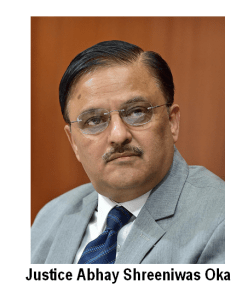
Speaking on the occasion of Constitution Day organised by the High Court of Karnataka and Karnataka State Legal Services Authority in association with Karnataka State Bar Council and Advocates’ Association, Bengaluru, Justice Abhay Shreeniwas Oka, Chief Justice of Karnataka and Patron-in-Chief, Karnataka State Legal Services Authority highlighted the duty of all those who are concerned with the judiciary to ensure that rights conferred on the citizens, under the Constitution of India are upheld.
Full Text of the speechof the Chief Justice: “Today is the day when we must acknowledge the contribution, immense contribution of the framers of our Constitution. The team led by Dr. Babasaheb Ambedkar are architects of modern India. Today, we are celebrating Constitution Day 2020 in the background of pandemic of Covid-19.
The pandemic has adversely affected all the systems, all institutions across the world.
When we have assembled here to commemorate the adoption of the Constitution of India, we must remember that judiciary has to play a pivotal role in evolving the constitution and implementing the constitutional protection guaranteed to the citizens. The Constitution of India confers on all citizens, a fundamental right to access to justice. It is the fundamental duty of the courts to uphold the rights of the citizens. It is the duty of every court and in particular Constitutional Court like High Court to zealously guard the fundamental rights conferred on our citizens by the Constitution of India.
The functioning of the courts got considerably affected due to lockdown and spade of Pandemic Covid-19 that forced us to use the modern technology to keep the course running. How best technology can be used is a subject, which will be addressed by our keynote speaker today.
But, today’s the day when we all the judges must remember that we owe a duty to the litigants to ensure that the courts are conducted in the best possible manner, even during the pandemic. As our doctors and health workers are fighting a battle with Covid-19, those who are part of the institution of judiciary must endeavor to become in a sense Covid-19 warriors by ensuring that the functioning of the courts is affected only to the minimum extent.
In Karnataka, we made best possible effort to ensure that partial functioning of the course continues, and it improves with passage of time. While it is our duty to ensure that the courts are conducted in the pandemic in best possible manner, it is also our duty to ensure that functioning of the courts do not lead to spade of pandemic.
All our institutions in Karnataka, namely the Karnataka Judicial Academy, the Karnataka Legal Service Authority, Computer Committee, all other committees of the High Court, the Arbitration Center, the Mediation Center; they continue to function during the pandemic with of course some limitations.
In fact, we have held E-Lok Adalats and now we are going to hold one more E-Lok Adalat on 19th of December. We were really worried when the pandemic began about the impact of partial functioning of the courts on the litigants whose Liberty was at stake. Therefore we concentrated on disposal of criminal matters. In the High Court we experimented with the idea of final hearing of Criminal Appeals through video conferencing. My esteemed brother judges Justice Arvind Kumar and Justice Veerappa took the lead and they showed that even Criminal Appeals arising out of conviction under Section 302 can be heard through videoconferencing.
As we are talking about upholding the liberty of individuals. It is necessary to refer to some statistics. (statistics given).
As I said, it is the constitutional duty of all those who are concerned with the institution of judiciary, to continue the functioning of the courts in best possible manner because we owe a duty to ensure that nobody is denied access to justice. The Constitution Day acts as a strong reminder to all those who are concerned with the judiciary to ensure that, we make all possible efforts to uphold the rights conferred on the citizens, under the Constitution of India. In fact, every citizen has a role to play in protecting the Constitution.
Thomas Edison once said, “the strength of the constitutional lights in the will of the people to defend it“. I strongly feel that only if we, the members of the judicial fraternity, protect and uphold the fundamental rights of the citizens; will be able to give sufficient strength to our citizens to defend our Constitution.
Today is the day when we should take pledge to abide by the constitutional values. Today is the day when we should take a pledge that whether there is a second wave of pandemic or a third way of pandemic we will continue functioning of our court and will ensure that liberty of each individual is protected.”
HELD: 26. Permission is granted to the second appellant to be represented through her Power of Attorney holder, who is none other than her father on the strength of the Special Power of Attorney executed by her.
Relevant paragraphs: 16. In recent times, we find that the parties who seek for dissolution of their marriage by a decree of divorce by mutual consent do so after long negotiation and discussion, some times they, being located at different parts of the globe, through skype, telephonically or use of other forms of technology, such as whatsapp calls, video conferencing etc. On account of the parties residing in different parts of the country or across the globe and owing to constraints of job or other constraints, such as illness etc., it may not be possible for both parties to sign and verify the pleadings and jointly present the petition for dissolution of their marriage by mutual consent before the Court of Law. This is so in the instant case. In such circumstances, one of the parties to the petition may avail of the facility of appointing a Power of Attorney/agent, in whom the party has full trust and confidence to represent her or him in a proceeding to be filed as in the instant case before the Family Court or any other Court seeking matrimonial or any other relief. Therefore, the provisions of the various enactments must be harmoniously read and interpreted, so as to make it conducive for availing or taking recourse through appointment of a Power of Attorney holder, to represent a party in a proceeding. This is particularly, as in the instant case, where parties are seeking dissolution of their marriage by a decree of divorce by mutual consent. Moreover, in such cases, a party can carefully think over the matter and appoint a person in whom the party would have full trust and confidence to be as her or his Power of Attorney holder. It is on the strength of such a document of Power of Attorney that the Power of Attorney holder would represent a party to jointly file a petition for dissolution of their marriage through mutual consent on behalf of the executor or Power of Attorney. The Family Court may insist on satisfying itself that indeed the parties have an intention that they should seek a decree of divorce by mutual consent and in order to fully satisfy itself, the Court may, apart from examining the Power of Attorney holder representing any party, also through video conferencing, (which is now widely being used on account of the Covid-19 pandemic), examine the parties including the party who is represented through the Power of Attorney holder. That merely because one of the parties would file the petition seeking dissolution of marriage by mutual consent jointly with the other party, through a Power of Attorney, one cannot ignore the fact that the Court must satisfy itself about the genuineness of the petition filed by the parties seeking dissolution of their marriage by a decree of divorce by mutual consent irrespective of whether it is filed through a Power of Attorney. In fact, the filing of such a petition is an exception to what has been stated in Section 23 of the Act. Even so, the Court ought not to be pedantic but must apply a flexible procedure which is in accordance with law and not a procedure, but not one which is incongruent in law.
17. In fact, recently, the Hon’ble Supreme Court in the case of Amardeep Singh vs. Harveen Kaur [(2017) 8 SCC 746] while considering Section 13B(2) of the Act, which stipulates a cooling off period of six months which is also a period of locus poenitentiae, after filing a petition of divorce under Section 13B(1) of the Act, so as to give an opportunity to the parties to rethink over the decision and thereafter, to confirm their decision six months later, has made the said provision less rigid and more pro-litigants by bearing in mind the changed circumstances and peculiarities of the case. Nevertheless, in the said case, it has been observed that the period of six months should be waived owing to the circumstances of the particular case, the exigencies of the situation and bearing in mind the interest of the parties so that justice would be subserved in the matter. In this regard, the Hon’ble Supreme Court has observed that the period mentioned in Section 13B(2) could be construed to be as directory and not mandatory and it would be open to the Court to exercise its discretion in the facts and circumstances of each case, where there are no possibilities of parties to reconcile, cohabit and there are no chances of alternative rehabilitation.
18. A reading of the above would clearly indicate that the Hon’ble Supreme Court has also made it flexible in the context of representation of the parties by their close relatives, partners or siblings or any other person in whom they have complete trust to be appointed as a Power of Attorney holder. In fact, as already noted, the Court can always satisfy itself about the genuineness of the intention of the parties who approach the Court either by themselves or through a Power of Attorney holder by way of video conferencing, so that any doubts about the genuineness of the petition being filed before the Court is removed.
19. On a perusal of the aforesaid observations of the Hon’ble Supreme Court, it is clearly permissible for the parties to be represented by their partners or siblings in a proceeding filed under Section 13B(1) of the Act or any other similar provision in any other enactment, which provides for dissolution of marriage by a decree of divorce by mutual consent.
20… Moreover, for the sake of satisfying and genuineness of the petition, the Family Court could always resort to video conferencing through the medium of which, both the parties could appear apart from the Power of Attorney holder of the second appellant appearing for her, so as to completely satisfy itself about the genuineness of the petition filed by the parties just as presently in this appeal, the appellants have both appeared through video conferencing, first appellant from Bengaluru and the second appellant from Toranto, Canada.
26. Permission is granted to the second appellant to be represented through her Power of Attorney holder, who is none other than her father on the strength of the Special Power of Attorney executed by her.
27. Further, in order to satisfy itself, the Family Court is at liberty to direct the parties especially the second appellant to appear through video conference or skype, before the Court and if such a direction is issued, the second appellant shall comply with the said direction.
Judgments cited/relied on:Komal S. Padukone vs. Principal Judge, Family Court [ILR 1999 KAR 2811], Harshada Bharat Deshmukh vs. Bharat Appasaheb Deshmukh [AIR 2018 Bombay 148], Sudha Ramalingam vs. Registrar General, High Court of Judicature at Madras [AIR 2015 (NOC) 266 (MAD)], Kunhi Purayil Mukundan Naveen vs. Anjalika Dinesh [AIR 2011 (KER) 186], Dasam Vijay Rama Rao vs. M.Sai Sri [ALD-2015-4-757], Amardeep Singh vs. Harveen Kaur [(2017) 8 SCC 746], Komal S. Padukone vs. Principal Judge, Family Court at Bangalore City [ILR 1999 KAR 2811], Harshada Bharat Deshmukh vs. Bharat Appasaheb Deshmukh [AIR 2018 Bombay 148], Sudha Ramalingam vs. Registrar General, High Court of Judicature at Madras [AIR 2015 (NOC) 266 (MAD.)], Dasam Vijay Rama Rao vs. M.Sai Sri [ALD-2015-4-757].
The Karnataka High Court has expressed deep concern and anguish over the increasing cases where insured vehicles are implanted just to get compensation. In many vehicular accidents, the actual vehicle that caused accident lacks insurance policy. Many cases involve ‘hit and run’ accidents. In such cases, the “unscrupulous nexus” stages false scenario in implanting a “proxy” vehicle which is covered by insurance policy. The present case is a classic example of a clear fraud. After 103 days of the accident, brother of the deceased produces his own insured vehicle insinuating its involvement in the accident!
The Court noticed the earlier judgment in Sumangala and others vs Virupakshi and another MFA 30219/2011 decided on 15 June 2011. The fervent plea of the insurance company in the said case, questioning involvement of the insured vehicle as shown in the final report, was brushed aside by observing that ‘if there was any shady material which creates suspicion about the credibility of the final report, the proper course for the insurer should have been to apply to the higher authorities to get the matter investigated or at least should have challenged the final report seeking a writ of mandamus for reinvestigation”. However, the High Court in Mahadev’s case observed as follows; “”
“‘We have, with great respect, perused the entire judgment. From a perusal of the same, we do not find any law laid down in the said judgment of universal application that in all cases where charge sheets werefiled, unless Insurance Company challenges the same and obtains writ of mandamus, MACTs are required to act upon the same and proceed to come to a conclusion that the vehicles named as offending vehicles in the charge sheet, without any further proof, are to be taken as the motor vehicles involved in causing the accident, even in cases where evidence produced points to the contrary.
‘Further, we find that in the said judgment, there is no discussion of the relevant provisions of Code of Criminal Procedure or other cognate provisions of law under which the police authorities would investigate and file charge sheets and on the probative value of the charge sheets vis-a-vis the involvement of a motor vehicle in causing the accident before the Tribunals trying the compensation cases. Experience of the recent past shows that instances of fraudulent/collusive involvement of motor vehicles duly covered by insurancepolicy in accident cases are burgeoning and if the insurance companies are saddled with the burden of challenging the charge sheets filed throughout the country without there being no clear legal mandate to do so, their work would be seriously crippled and they would not be able to do their insurance business without enhancing the premium, thereby further burdening the ever suffering owners of motor vehicles. Even the most liberal reading the provisions of the Motor Vehicles Act, 1988 does not spell out such a requirement.
The question is one of fundamental importance – what is the standard of proof applicable in these proceedings? On whom is the initial burden of proving the accident or, as in this case, involvement of the offending motor vehicle cast? Is not still the standard of proof one of “preponderance of probabilities”? Is a mere charge’ sheet, which in this case is shown to be deficient in truth sufficient to tip the balance only on the premise that insurance company has not dipped deep into its pockets to challenge the charge sheet- what with the toxic nexus between the black sheep among the police, medical professionals and touts of every kind masquerading the field which has become a notorious fact of life. We are afraid, we would be muddling the field further for the already befuddled members of MACT by accepting the arguments of learned counsel for the appellants on this aspect’.
NOTE: Fraud is a ground to question any administrative orders, quasi-judicial and even judicial verdicts. Lord Denning in one of his most celebrated judgments in Lazarus Estates Ltd v Beasley [1956] 1 Q.B. 702; [1956] 2 W.L.R. 502 held “No court in this land will allow a person to keep an advantage which he has obtained by fraud. No judgment of a court, no order of a Minister, can be allowed to stand if it has been obtained by fraud. Fraud unravels everything. The court is careful not to find fraud unless it is distinctly pleaded and proved; but once it is proved, it vitiates judgments, contracts and all transactions whatsoever…”
The decision of the High Court has armed the Tribunals to independently assess involvement of insured vehicles when fraud is alleged and prima facie shown. The Tribunals are no longer shackled by the chargesheets filed in criminal cases.
A path-breaking judgment in the direction of saving insurance companies from succumbing in the web of conspiracy, deceit and fraud.
Compiled and written by S. Basavaraj, Advocate, Daksha Legal.



 Daksha Legal