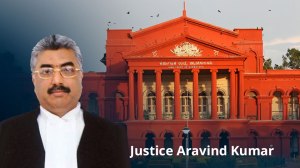
MMDR Act. Offences causing serious ecological imbalance must be met with stringent actions. Mere compounding not enough. Supreme Court.

Jayant Etc. vs The State of Madhya Pradesh. Criminal Appeal 824-825/2020 decided on 3 December 2020.

Judgment Link: https://main.sci.gov.in/supremecourt/2020/12111/12111_2020_34_1502_24918_Judgement_03-Dec-2020.pdf

Relevant Paragraphs: 11. Now so far as the submission on behalf of the private appellants ­violators that in view of the fact that violators were penalty determined by the appropriate authority for
compounding the offences/violations, there cannot be any
further criminal proceedings for the offences under Sections 379
and 414 IPC and Sections 4/21 of the MMDR Act and the
reliance placed on Section 23A of the MMDR Act is concerned, it
is true that in the present case the appropriate authority
determined the penalty under Rule 53 of the 1996 Rules/Rule 18
of the 2006 Rules, which the private appellants ­violators paid
and therefore the bar contained in sub­section 2 of Section 23A
of the MMDR Act will be attracted. Section 23A as it stands
today has been brought on the Statute in the year 1972 on the
recommendations of the Mineral Advisory Board which provides
that any offence punishable under the MMDR Act or any rule
made thereunder may, either before or after the institution of the
prosecution, be compounded by the person authorised under
section 22 to make a complaint to the court with respect to that
offence, on payment to that person, for credit to the Government,
of such sum as that person may specify. Sub­section 2 of
Section 23A further provides that where an offence is
compounded under sub­section (1), no proceeding or further
proceeding, as the case may be, shall be taken against the permitted to compound the violation in exercise of powers under Rule 53 of the 1996 Rules or Rule 18 of the 2006 Rules and the violators accepted the decision and deposited the amount of penalty determined by the appropriate authority for compounding the offences/violations, there cannot be any
further criminal proceedings for the offences under Sections 379
and 414 IPC and Sections 4/21 of the MMDR Act and the
reliance placed on Section 23A of the MMDR Act is concerned, it
is true that in the present case the appropriate authority
determined the penalty under Rule 53 of the 1996 Rules/Rule 18
of the 2006 Rules, which the private appellants­violators paid
and therefore the bar contained in sub­section 2 of Section 23A
of the MMDR Act will be attracted.

However, our above conclusions are considering the
provisions of Section 23A of the MMDR Act, as it stands today. It
might be true that by permitting the violators to compound the
offences under the MMDR Act or the rules made thereunder, the
State may get the revenue and the same shall be on the principle
of person who causes the damage shall have to compensate the
damage and shall have to pay the penalty like the principle of
polluters to pay in case of damage to the environment. However,
in view of the large scale damages being caused to the nature and
as observed and held by this Court in the case of Sanjay (supra),
the policy and object of MMDR Act and Rules are the result of an
increasing awareness of the compelling need to restore the
serious ecological imbalance and to stop the damages being caused to the nature and considering the observations made by
this Court in the aforesaid decision, reproduced hereinabove, and
when the violations like this are increasing and the serious
damage is caused to the nature and the earth and it also affects
the ground water levels etc. and it causes severe damage as
observed by this Court in the case of Sanjay (supra), reproduced
hereinabove, we are of the opinion that the violators cannot be
permitted to go scot free on payment of penalty only. There must
be some stringent provisions which may have deterrent effect so
that the violators may think twice before committing such
offences and before causing damage to the earth and the nature.

It is the duty cast upon the State to restore the ecological
imbalance and to stop damages being caused to the nature. As
observed by this Court in the case of Sanjay (supra), excessive instream sand ­and ­gravel mining from river beds and like resources
causes the degradation of rivers. It is further observed that apart
from threatening bridges, sand mining transforms the riverbeds
into large and deep pits, as a result, the groundwater table drops
leaving the drinking water wells on the embankments of these
rivers dry. Even otherwise, sand/mines is a public property and
the State is the custodian of the said public property and
therefore the State should be more sensitive to protect the
environment and ecological balance and to protect the public
property the State should always be in favour of taking very stern
action against the violators who are creating serious ecological
imbalance and causing damages to the nature in any form. As
the provisions of Section 23A are not under challenge and Section
23A of the MMDR Act so long as it stands, we leave the matter
there and leave it to the wisdom of the legislatures and the
concerned States.

Compiled by S. Basavaraj, Advocate, Daksha Legal, Bengaluru

NDPS Act, 1985. Detention of accused beyond 180 days must satisfy two conditions – reporting progress of investigation and specific reason for detention beyond 180 days. Mere application for extension of time is not enough. Karnataka High Court.

Magoola John vs State of Karnataka. Criminal Petition 5935/2020 decided on 26 November 2020.

Judgment Link: http://judgmenthck.kar.nic.in/judgmentsdsp/bitstream/123456789/350690/1/CRLP5935-20-26-11-2020.pdf

Relevant paragraphs: 11.Be that as it may. Even as could be seen from Section 36(A)(4) proviso indicates that if any person has been charged for the offence under the said Act for the purpose of filing of the charge sheet is 180 days time has been provided. Proviso to the said Section enables the Investigating Agency, if within 180 days if it is not possible to complete the investigation, then it can move the application before the Special Court for extension of  the said period up to one year. But in order to file an  application it has to fulfill two conditions. The first  condition is that the prosecution has to indicate the progress of the investigation made till that date and the second condition is the specific reason for detention of the accused beyond the said period of 180 days. But  on  perusal of the application filed by the learned Public Prosecutor, no such reasons have been assigned except stating that, for the purpose of filing of the charge sheet, FSL report is an important document and when the charge sheet cannot filed and the FSL report has also not come, as such 180 days has to be extended.

12. Be that as it may. Even as could be seen from the records, the said application has been filed  on  4.9.2020 and immediately thereafter the Court has issued the notice to the accused for his reply and the order sheet indicates that he has filed his objections to the said application on 9.9.2020 and even at that time also no order has been passed by the trial Court either extending the time  or  giving any reasons on the application filed under Section 167(2) of Cr.P.C. When the time of 180 days is going to be expired on 6.9.2020, before that or on the same day, the Court could have passed an order either extending of time  or otherwise. When an application has been filed for the purpose of extension of time on 4.9.2020 and the accused was admittedly in judicial custody, the trial Court ought to have taken into consideration the statutory right  available to the accused and it could have been expedited on  or before 6.9.2020. When the Court has not exercised its power on the application filed under Section 36(A)(4) of NDPS Act for extension, then the statutory right which has been there to the accused accrues immediately after 180 days and if an application has been filed by the accused  and if it is pending, then the right will be there to get him released on bail.

Compiled by S. Basavaraj, Advocate, Daksha Legal

Motor Vehicle Act. Insurance policy commences from the time of making payment and not from issuance of policy. In the absence of contract fixing time, policy commences from 00.00 hours midnight (next day). Karnataka High Court.

Sudharshan vs Subash and another. Miscellaneous First Appeal 31894/2012 decided on 2 December 2020.

Judgment Link: http://judgmenthck.kar.nic.in/judgmentsdsp/bitstream/123456789/350758/1/MFA31894-12-02-12-2020.pdf

Relevant Paragraphs: 25. Therefore, as per Section 64VB of the Act above stated, the provision is very clear that soon after the receipt of the payment of premium by the owner and received by the Insurance Company then the contract of insurance begins between them. Issuance of policy is consequent effect after receipt of premium. If there is a specific contract is made between the insurer and the insured that the risk is to be covered from that point of time itself is concerned, then that shall be specifically stated in the Insurance Policy and it is a specific contract between the insurer and insured so far as time of commencement of risk. If there is no specific contract stating to cover the risk from that particular point of time then generally in the Insurance Policy it is stated that the Insurance Policy commences from 00.00 hours by  mentioning  the  next  day  date  commencing  from 00.00 hours (mid night) on next date. Therefore, where there is no specific contract of mentioning time between insurer and insured regarding mentioning of time so as to cover the risk then generally the policy commences from 00.00 hours (mid night) by mentioning the date of the next day. In absence of mentioning specific time of commencement of covering risk, therefore upon considering this and applying the  same in  the  present facts and circumstances and by following the legal provision enshrined under Section 64VB of the Act it can be safely held that from the time of making payment of premium itself covering risk starts.

Cases referred: Yellamma vs.  Bhy Sukhadev Singh  and another [2006 (3)  KCCR 1842], Oriental Insurance Co.Ltd., v. Dharam Chand and others [2011 Kant, M.A.C.138 (SC)], National Insurance Co.Ltd., v. Smt.Bhadramma  and  others [ILR 2009 KAR 3332], Sunita Rati’s case  [AIR  1998  SC  257], New India Insurance Company v. Bhagwati Devi and others [(1998) 6 Supreme Court Cases 534], National Insurance Co. Ltd. v. Jikubkai Nathuji Dabhi, [(1997) 1 SCC 66], National Insurance Co.Ltd., v. Sobina Iakai and others [2007 (3) T.A.C.  19 (S.C)], New India Assurance Co.Ltd., v. Harshadbhai Amrutbhai Modhiya and another [(2006) 5 Supreme Court Cases  192], New India Assurance Co.Ltd., vs. C.M.Jaya and others [AIR 2002 SC 651]

Compiled by S. Basavaraj, Advocate, Daksha Legal.

A take on the (un)constitutionality of the Uttar Pradesh Prohibition of Unlawful Conversion of Religion Ordinance 2020.

Ajay Nandalike, Advocate, Bengaluru

Much ado about conversion for marriage – a take on the (un)constitutionality of the Uttar Pradesh Prohibition of Unlawful Conversion of Religion Ordinance 2020

There has been some debate on the promulgation of the Uttar Pradesh Prohibition of Unlawful Conversion of Religion Ordinance 2020 (‘UP Ordinance’) calling it the Love Jihad Act. Some have called it ‘an assault on personal liberty[1] claiming it places unreasonable restrictions on the right to marriage by questioning conversion for the purposes of marriage and is violative of the right to privacy. Some have argued that it ‘puts the personal dignity and freedom of choice at a backseat’.[2] There is also a comparison of the law to Nazi Germany’s Reich Citizenship laws.[3] These are very serious allegations and it would appear that the law is ex facie unconstitutional. I propose to examine if it is really the case.

Scheme of the UP Ordinance

Let us first examine the heading of the Act and the intention as seen from the preamble of the Ordinance. A plain perusal would indicate that the focus is on anti-conversion and not on prohibition of inter-religious marriages. Let us now examine the provisions of the UP Ordinance.Section 3 prohibits conversion from one religion to another religion by misrepresentation, force, fraud, undue influence, coercion, allurement or marriage. The definition of ‘allurement’, ‘coercion’, ‘force’, ‘fraudulent means’, ‘undue influence’ and ‘unlawful conversion’ are found in Section 2 which deals with definitions.

Section 4 allows any relative who is related by blood, marriage or adoption or any aggrieved person to lodge an FIR if there is violation of Section 3.

Section 5 provides for punishment for contravention of Section 3 which is imprisonment of minimum of 1 year and up to 5 years. But if it is a minor or a woman or a scheduled caste or schedule tribe person, then the minimum imprisonment is 2 years and extends up to ten years. It provides for compensation for such a victim of conversion which may extend to rupees five lakh in addition to any fine.

Section 6 provides that any marriage which was done for the sole purpose of conversion or vice versa shall be declared void by a Family Court at the instance of the applying spouse.

Section 7 makes the offences under the Ordinance to be cognizable and non-bailable.

Section 8 provides for the procedure prior to conversion and to apply for conversion and states that any person who wishes to convert must give a declaration in the prescribed format at least 60 days in advance to the District Magistrate that the conversion is with free consent and without any force, coercion, undue influence or allurement. The religious converter shall also give one month’s notice in the prescribed format before performing such conversion ceremony. The District Magistrate shall get an inquiry conducted through the police to ascertain the real intention, purpose and cause of the proposed religious conversion. Contravention of this provision entails imprisonment as prescribed.

Section 9 provides for declaration post conversion of religion in the prescribed format to be submitted to the District Magistrate who shall exhibit it which shall provide details of the conversion and the converted individual shall appear in person before the District Magistrate within 21 days of sending the declaration to confirm the contents therein. If the provisions of Section 9 are not fulfilled, the conversion is rendered null and void.

Section 10 provides for punishment for institutions or organizations

Section 11 states that the parties to the offence will be every person who has either done the act of conversion, aided or abetted it, counsel or convince or procures any person.

 Section 12 places the burden of proof on the person who has caused the conversion to prove that it was with free consent.

The UP Ordinance provides for a legal mode for recording of any conversion from one religion to another. Sixty days prior to conversion, a notice is required to be given under Section 8 and the District Magistrate will carry out an inquiry to verify that the conversion is truly out of free will. After conversion, the converted person will send a declaration to the District Magistrate and thereafter personally appear to satisfy the District Magistrate that the conversion is valid and proper in terms of Section 9. If the procedure under Section 8 and Section 9 are not followed prior to conversion, then the burden of proof is on the converted person and all other such persons connected with the conversion to show that the conversion was out of free will. If a conversion or attempt at conversion is by use or practice of misrepresentation, fraud, undue influence or by any fraudulent means or by marriage, then it is prohibited under Section 3 and punishable under Section 5.

Comparison with other anti-conversion laws:

The provisions of the UP Ordinance are pari-materia to other anti-conversion laws which are either in force or at some point in time were in force. For ease of convenience, I have charted out the key provisions of these laws which are prevailing in various states. 

Pertinent Details of Acts  M.P.Chhattisgarh C.G.Odisha O.D.Gujarat G.JHimachal Pradesh H.P.Uttarakhand U.K.Jharkhand J.KArunachal Pradesh A.P.Tamil Nadu T.N.Rajasthan R.JUttar Pradesh U.P.
Prohibition on Conversion  YesYesYesYesYesYesYesYesYesYesYes
Pre-Conversion Declaration  NoNoYesYesYesYesYesYes; To Deputy Commissioner of DistrictNoNoYes
Post-Conversion Declaration  NoNoNoYesYesYesYesNoNoNoYes
Inquiry by Magistrate to examine Bonafides of Conversion  NoNoYesNoYesYesYesNoNoNoYes
The converted / associated persons bear the Burden of ProofYes;Yes;Yes;
            

From the above, it is seen that the provisions are more or less similar to other enactments. It may be interesting to note that these provisions have been challenged before Courts and upheld by the Courts. I have prepared a table which will give one a bird’s eye view of such challenges and the current state of the law.

State/ActChallenge to Act (& Brief Status)
Orissa Freedom of Religion Act, 1967   Act & Rules notifiedOrissa HC – Rev. Satya Ranjan Majhi and Ors vs. State of Orissa & Ors. – Upheld the constitutionality of statute and dismissed W.P.   Supreme Court – Satya Ranjan Majhi vs. State of Orissa & Ors. – SC – Upheld the validity of HC judgment and dismissed SLP.   Orissa HC – Yulitha Hyde and Ors. vs. State of Orissa & Ors. – Has been overruled by SC in Rev. Stainislaus   
M.P. Dharma Swatantraya Adhiniyam, 1968   (Chhattisgarh Dharma Swantantraya Adhiniyam, 1968 – Same as MP Act since Chhatisgarh had not been carved out)   Act & Rules notified  Supreme Court – Rev. Stainislaus vs. State of Madhya Pradesh & Ors. The Supreme Court upheld the constitutionality of the said Act and dismissed the Civil Appeals.  
Gujarat Freedom of Religion Act 2003   Act & Rules notifiedGujarat HC – Challenge vide SCA No 1582 of 2009 – Rev. Stanislaus Fernandes, Archbishop of Gandhinagar & Ors. vs. State of Gujarat & Anr. – Petition has been dismissed as withdrawn  
Himachal Pradesh Freedom of Religion Act, 2006 (Repealed) Replaced by the Himachal Pradesh Freedom of Religion Act, 2019   Act & Rules notified  Himachal Pradesh HC – Evangelical Fellowship of India vs. State of Himachal Pradesh – 2006 Act held valid but Petitions allowed to a limited extent   Supreme Court – Matter disposed for not complying conditional order of curing of defects
Uttarakhand Freedom of Religion Act, 2018   Act & Rules notified  No challenge as of now
Jharkhand Freedom of Religion Act, 2017   Act & Rules Notified  – No challenge as of now
Arunachal Pradesh Freedom of Religion Act, 1978   Act Notified; No Rules  – No challenge as of now
Tamil Nadu Prohibition of Forcible Conversion of Religion Act, 2002   Brought in as Ordinance; Act repealed  Revocation of Act by the Government due to widespread protests.
Rajasthan Freedom of Religion Bill, 2006   Pending President’s Assent  – No challenge as of now
Uttar Pradesh Prohibition of Unlawful Religious Conversion Ordinance, 2020   Brought in as Ordinance  – No challenge as of now  

Constitutional validity of anti-conversion laws

With this background, let us examine the legal validity of the anti-conversion laws. The fundamental challenge to all anti-conversion laws has been on the ground of Article 25 (1) of the Constitution apart from legislative competence of States. The argument is that by imposing restrictions on conversion including an inquiry on whether the conversion is valid, going into the issue of whether the conversion is based on free will etc would violate Article 25 (1) of the Constitution. For ease of reference, Article 25 (1)  is extracted hereinbelow. 

“(1) Subject to public order, morality and health and to the other provisions of this Part, all persons are equally entitled to freedom of conscience and the right to freely to profess, practice and propagate religion.”

The Madhya Pradesh and Orissa anti-conversion laws were challenged before the Supreme Court and the Constitution Bench in Rev. Stainislaus vs. State of Madhya Pradesh[4] upheld the same as not violative of Article 25. The Supreme Court held that right to ‘propagate’ does not include the right to ‘convert’ but to transmit or spread one’s religion by an exposition of its tenets. Therefore, there is no fundamental right to ‘convert’.

While interpreting the word ‘propagate’, the Supreme Court held that if a legislation is framed to ensure that there is no forcible conversion, the same would be in furtherance of Article 25 by holding as under:

“We have no doubt that it is in this sense that the word ‘propagate’ has been used in Article 25 (1), for what the Article grants is not the right to convert another person to one’s own religion, but to transmit or spread one’s religion by exposition of its tenets. It has to be remembered that Article 25 (1) guarantees ‘freedom of conscience’ to every citizen, and not merely to the followers one particular religion, and that, in turn, postulates that there is not fundamental right to convert another person as one’s own religion because if a person purposely undertakes the conversion of another person to his religion, as distinguished from his effort to transmit or spread the tenets of his religion, that would impinge on the ‘freedom of conscience’ guaranteed to all citizens of the country alike.”

Another aspect on which the Supreme Court upheld the validity was that while one has the freedom to convert another person, it can be restricted by public order. It held “if an attempt is made to raise communal passions on the ground that someone has been forcibly converted to another religion, it would give rise to an apprehension of breach of public order. Hence, the restriction imposed on conversion by seeking that the same be recorded by way of a declaration before a Magistrate would not fall foul of Article 25.” If one applies this principle, the requirement under the UP Ordinance for recording of the declaration of conversion and inquiry by the Magistrate to ensure that the conversion is free would not fall foul of the Constitution.

This judgment has held the field since then and followed and applied by High Courts across the country. The Division Bench of the Himachal Pradesh High Court examined the constitutionality of the HP Act in Evangelical Fellowship of India vs. State of Himachal Pradesh[5] and upheld the same to the extent that it was covered by the Rev. Stainislaus. The Himachal Pradesh High Court examined the definitions of ‘force’, ‘fraud’ and ‘inducement’ which was argued to be vague and capable of misuse which the Court held was not a legal basis to nullify the enactment. It may be noted that the definitions are almost pari-materia to the UP Ordinance.

There were some rules which were not found in the earlier version of the MP and Orissa laws such as notice before conversion by the convertee, inquiry and registration of case and sanction for prosecution. The Himachal Act sought for notice before conversion and power to inquire into the conversion in the event of any complaint. The argument of privacy was examined as to whether it would be appropriate for such restrictions to be put in place.

The High Court held that a person cannot be asked to disclose his religion and it cannot be ruled out that a person who is changing his religion may face harassment by giving such notice and that such a notice may lead to communal clashes. Holding an inquiry to examine if a conversion is proper or not may be violative of privacy of that individual. Hence only those provisions were held to be unconstitutional.

It may be noted that these provisions are also pari-materia to the UP Ordinance. Therefore, it will be possible to argue that those provisions are unconstitutional applying the dicta of the Himachal High Court. It will be necessary to note that although the judgment was challenged before the Supreme Court, the SLP was dismissed for non-curing of the defects by way of a general procedural order along with several other petitions and cannot be considered as confirmed by the Supreme Court.[6]

Here, it may be necessary to examine a subsequent judgment of the Orissa High Court in Rev. Satya Ranjan Majhi vs. State of Orissa[7], wherein certain amendments of 1999 to the Orissa Rules which provided for an inquiry, declaration before conversion were also challenged saying that it was in excess of the judgment of the Supreme Court in Rev. Stainislaus. The same was dismissed by the Orissa High Court and taken on appeal to the Supreme Court in Satya Ranjan Majhi vs. State of Orissa[8] . The Supreme Court upheld the provisions and dismissed the SLP by a speaking order. Therefore, the judgment of the Supreme Court would apply in the present situation and the UP Ordinance will stand the test of constitutionality on that ground.

By the above analysis, it is clear that the general provisions relating to seeking registration of conversion, prescribing punishment for conversion which is not based on free-will would stand constitutional scrutiny. The only question that remains is the addition of conversion for the purpose of marriage to the law would stand the test or not. 

Let us understand as to how typically these inter-religious marriages are functioning at the present and the problems faced therein and how the UP Ordinance can potentially resolve such issues:Lack of sufficient evidence of such conversion: If one of the spouses fails to fully comply with the religious requirements for conversion or if the conversion is not properly recorded or if one of the spouse does not have any record and the sanctity of the marriage is questioned (ostensibly because the other records of the converting spouse will show his / her previous religion). If the procedure under Section 8 and 9 of the UP Ordinance are followed, then it creates evidence of such conversion which cannot later on be disputed by any party.

Legality of the marriage is questioned: Although it is possible to argue live-in relationship for the purpose of maintenance in the event of desertion by the other spouse, a lengthy and protracted trial will be the consequence as these marriages are not registered and often the converter will not get the election ID card or other identity cards changed to her / his new name. So, there is a possibility that the marriage itself will be disputed which will result in protracted litigation. If the conversion is for the purpose of marriage and later on if someone wants to nullify the marriage, it gives such a party additional ground to question to marriage. The corollary being that such a declaration of conversion will also estop the converter to renege from such marriages.

Inheritance issues: There is also a possibility that succession to spousal property or the grant of legitimacy to the children born out of such inter-religious marriage is disputed and without sufficient proof of conversion, one will get entangled in protracted litigation. Once a person converts to the religion of choice, the benefits of the said religion will automatically follow and cannot be take away.  

 Criminal cases being foisted upon the converter and relatives: Typically cases of kidnapping, coercion, rape and other provisions are foisted on the husband in the event the converter is a girl. By the time the criminal cases are resolved in courts of law, the entire family and the marriage is put under strain. This arises because there are no records that the conversion has been out of free will. If there is compliance under the UP Ordinance and if the spouse comes and makes a statement in Court that she has chosen to marry out of her own free will and without coercion, the criminal cases will automatically fall as was done in the Hadiya case.

Misuse of conversion for the purpose of marriage: As highlighted in Lily Thomas vs. Union of India, some Hindus often convert to Islam merely to sustain bigamous relationships. A proper inquiry as contemplated under the UP Ordinance will ensure that the process of conversion is not misused.

The next question to address is if someone intends to convert for the purpose of marriage, how is it wrong. I will go no further than to cite from the Hon’ble Supreme Court in Lily Thomas vs. Union of India[9]to make my point:

“Religion is a matter of faith stemming from the depth of the heart and mind. Religion is a belief which binds the spiritual nature of man to a supernatural being; it is an object of conscientious devotion, faith and pietism. Devotion in its fullest sense is a consecration and denotes an act of worship. Faith in the strict senses constitutes firm reliance on the truth of religious doctrines in every system of religion. Religion, faith or devotion are not easily interchangeable. If the person feigns to have adopted another religion just for some worldly gain or benefit, it would be religious bigotry. Looked at from this angle, a person who mockingly adopts another religion were plurality of marriage is permitted so as to renounce the previous marriage and desert the wife, cannot be permitted to take advantage of his exploitation as religion is not a commodity to be exploited. The institution of marriage under every personal law is a sacred institution”

Is it seriously violative of freedom of choice of religion to examine that the choice has been exercised freely? The Supreme Court has already answered in Stainislaus that it is not. The law is only seeking a declaration and an inquiry to satisfy that the conversion is based on free will. Is there really a major problem with seeking such a declaration? If a person is choosing to marry someone he or she loves and if he or she or that person’s family puts a condition that the other person must convert for the purpose of marriage, then is such a conversion really out of free will? The Supreme Court in Lily Thomas has already answered in an emphatic no. 

There is another important aspect which has to be considered viz. that the Special Marriages Act, 1954 (‘SM Act’) legalizes any inter-religious marriages. The requirement under the SM Act is that notice requires to be given first and thereafter the marriage would be solemnized without the requirement of any religious ceremony. Therefore, there is no necessity to convert for the purpose of marriage as per existing law.

The SM Act does not bar holding religious ceremonies for solemnization of the marriage but does not give legal sanctity to such ceremonies. In order to overcome the requirements of the SM Act, couples belonging to different religious choose to convert to a common religion and the marriage is solemnized in that common religion.

It is a settled position of law that that a person has a right to marry any person of his or her choice and also has the right to convert his or her religion as per choice.[10] There is no rational need or nexus for converting to the other person’s religion for the purpose of marriage. If a person is allured fraudulently to believe that without conversion the marriage is not possible, then would it be entirely wrong on part of the State to place restrictions to ascertain and satisfy itself that the conversion for the purpose of marriage is not necessary and apprise such a person of the provisions of the SM Act.

The SM Act was put in place for the specific purpose of ensuring that the marriage between inter-religious communities take place and this great nation of India continues to remain a melting pot and an amalgum of cultures. It was only after Akbar married Jodhabai that his perspectives towards religion evolved and became tolerant. He did not insist on his wife to convert to Islam.[11] Two examples from contemporary times are also relevant, Shahrukh Khan’s wife is a practicing Hindu. The families celebrate both Hindu and Muslim cultures. In Karnataka, a Congress politician Mr. Dinesh Gundu Rao’s wife is a practicing Muslim. Neither spouse has restricted the other from practicing their religion. They claim that they have an increased appreciation of the other’s religion because of the inter-religious marriage. I cite them as examples merely to show how love unites in the absence of conversion for the purpose of marriage. As a country we must encourage that and appreciate the same rather than be restricted by religion and insist on conversion for the purpose of marriage.

To conclude, I would say that there is nothing wrong in the UP Ordinance ensuring that the conversion is not for the purpose of marriage and it would not fall foul of the Constitution.

(Ajay J Nandalike is an advocate practicing in the Karnataka High Court. I thank Mr. Harish Jayakumar, Advocate for the research and the tabular representation and Mr. Chandan Kallaiaah Advocate for his valuable inputs. Views are entirely personal)


[1] https://www.livelaw.in/columns/up-ordinance-criminalizing-conversion-for-marriage-is-an-assault-on-personal-liberty-166575

[2] https://www.livelaw.in/top-stories/up-ordinance-against-religious-conversions-by-marriage-justice-m-b-lokur-166600

[3] https://www.thequint.com/news/law/love-jihad-laws-india-nuremberg-law-anti-miscegenation-us-similarities#read-more

[4] (1977) 1 SCC 677

[5] MANU/HP/1259/2012

[6] It is interesting to note that several petitions were dismissed by a general order. The order was passed by a Bench comprising of CJI Gogoi, J Deepak Verma and another judge. J Deepak Verma passed the judgment in the HP High Court. Therefore, in effect J Deepak Verma dismissed the appeal against his own order, albeit by inadvertence and as a procedural order.

[7] MANU/OR/0133/2003

[8] (2003) 7 SCC 439

[9] (2000) 6 SCC 224 at para 38 at p.245

[10] Shafin Jahan vs. Ashokan KN (2018) 16 SCC 368

[11] https://en.wikipedia.org/wiki/Mariam-uz-Zamani t3

Service Law. Employee of a Gram Panchayat cannot be removed on acts of misconduct without enquiry though he is not a civil servant under Article 311 of the Constitution of India. Panchayat, a ‘State’ under Article 12, cannot act arbitrarily. Karnataka High Court.

S.K. Shankarappa vs The Panchayath Development Officer and another. Writ Petition 48068/2018 decided on 21 October 2020.

Judgment Link: http://judgmenthck.kar.nic.in/judgmentsdsp/bitstream/123456789/350766/1/WP48068-18-21-10-2020.pdf

Relevant paragraphs: 8…“Whether a permanent employee of the Panchayat can be removed on acts of misconduct without holding a departmental enquiry?”

12 & 13. Sections 113 (3) of the Karnataka Gram Swaraj and Panchayat Raj Act, 1993 noticed. The afore-extracted provision of law, no doubt empowers the Gram Panchayat to reduce in rank, remove or dismiss any employee appointed by it. But this cannot clothe the Gram Panchayat with the power to remove a permanent employee on grounds of misconduct, without holding an enquiry and giving reasonable opportunity to defend himself as the allegations made would remain allegations until it is substantiated by a process known to law failing which, it would amount to removal of an employee on the basis of suspicion.

14. It is trite law that any amount of suspicion cannot take the place of proof and proof can be arrived at only if a procedure to arrive at is followed. Thus, conduct of a departmental enquiry in the wake of the allegations of misconduct    is    mandatory   and    cannot    be    obviated   or circumvented in any manner.

15. Though the employee of a Gram Panchayat is not a civil servant in its true sense and would not get the protection of Article 311(2) of the Constitution of India nonetheless, a Gram Panchayat being a State under Article 12 of the Constitution of India and is bound by the rigors of Article 14 of the Constitution of India.

16. Therefore, even if a provision bestows power upon the employer to remove an employee for misconduct under any statute without holding an enquiry, natural justice and reasonable opportunity of defence will have to be read into such statutes failing which, the very exercise of such power and the manner of its exercise becomes blatantly arbitrary. More so, when an action under the statute is likely to result in loss of livelihood or cast a stigma on such employee. If the aforesaid interpretation is not given to such statutes, it would be giving absolute, unbridled and unguided power to the employer to dismiss an employee which would not stand the test of Article 14 of the Constitution of India.

17. An instrumentality, agency or any other authority under Article 12 of the Constitution of India must act fairly, justly and reasonably as fair treatment is an essential inbuilt of principles of natural justice. It is apposite to quote the words of the Apex Court “reasonableness and non-arbitrariness pervades the entire constitutional spectrum and is a golden thread which runs through the whole fabric of the Constitution of India”. Therefore, any act of unreasonableness or unfair treatment will fall foul of the rigors of Article 14 of the Constitution of India.

Writ Petition allowed.

Compiled by S. Basavaraj, Advocate, Daksha Legal

Hindu Marriage Act – Section 13- “Cruelty” meaning explained with case laws.

Samar Ghosh v. Jaya Ghosh, (2007) 4 SCC 511, at page 546 :

  1. No uniform standard can ever be laid down for guidance, yet we deem it appropriate to enumerate some instances of human behaviour which may be relevant in dealing with the cases of “mental cruelty”. The instances indicated in the succeeding paragraphs are only illustrative and not exhaustive:
    (i) On consideration of complete matrimonial life of the parties, acute mental pain, agony and suffering as would not make possible for the parties to live with each other could come within the broad parameters of mental cruelty.
    (ii) On comprehensive appraisal of the entire matrimonial life of the parties, it becomes abundantly clear that situation is such that the wronged party cannot reasonably be asked to put up with such conduct and continue to live with other party.
    (iii) Mere coldness or lack of affection cannot amount to cruelty, frequent rudeness of language, petulance of manner, indifference and neglect may reach such a degree that it makes the married life for the other spouse absolutely intolerable.
    (iv) Mental cruelty is a state of mind. The feeling of deep anguish, disappointment, frustration in one spouse caused by the conduct of other for a long time may lead to mental cruelty.
    (v) A sustained course of abusive and humiliating treatment calculated to torture, discommode or render miserable life of the spouse.
    (vi) Sustained unjustifiable conduct and behaviour of one spouse actually affecting physical and mental health of the other spouse. The treatment complained of and the resultant danger or apprehension must be very grave, substantial and weighty.
    (vii) Sustained reprehensible conduct, studied neglect, indifference or total departure from the normal standard of conjugal kindness causing injury to mental health or deriving sadistic pleasure can also amount to mental cruelty.
    (viii) The conduct must be much more than jealousy, selfishness, possessiveness, which causes unhappiness and dissatisfaction and emotional upset may not be a ground for grant of divorce on the ground of mental cruelty.
    (ix) Mere trivial irritations, quarrels, normal wear and tear of the married life which happens in day-to-day life would not be adequate for grant of divorce on the ground of mental cruelty.
    (x) The married life should be reviewed as a whole and a few isolated instances over a period of years will not amount to cruelty. The ill conduct must be persistent for a fairly lengthy period, where the relationship has deteriorated to an extent that because of the acts and behaviour of a spouse, the wronged party finds it extremely difficult to live with the other party any longer, may amount to mental cruelty.
    (xi) If a husband submits himself for an operation of sterilisation without medical reasons and without the consent or knowledge of his wife and similarly, if the wife undergoes vasectomy or abortion without medical reason or without the consent or knowledge of her husband, such an act of the spouse may lead to mental cruelty.
    (xii) Unilateral decision of refusal to have intercourse for considerable period without there being any physical incapacity or valid reason may amount to mental cruelty.
    (xiii) Unilateral decision of either husband or wife after marriage not to have child from the marriage may amount to cruelty.
    (xiv) Where there has been a long period of continuous separation, it may fairly be concluded that the matrimonial bond is beyond repair. The marriage becomes a fiction though supported by a legal tie. By refusing to sever that tie, the law in such cases, does not serve the sanctity of marriage; on the contrary, it shows scant regard for the feelings and emotions of the parties. In such like situations, it may lead to mental cruelty.
    Ramchander v. Ananta, (2015) 11 SCC 539: (2015) 4 SCC (Civ) 791, at page 542 : The expression “cruelty” has not been defined in the Hindu Marriage Act. Cruelty for the purpose of Section 13(1)(i-a) is to be taken as a behaviour by one spouse towards the other, which causes a reasonable apprehension in the mind of the latter that it is not safe for him or her to continue the matrimonial relationship with the other. Cruelty can be physical or mental. In the present case there is no allegation of physical cruelty alleged by the plaintiff. What is alleged is mental cruelty and it is necessarily a matter of inference to be drawn from the facts and circumstances of the case. It is settled law that the instances of cruelty are not to be taken in isolation but to take the cumulative effect of the facts and circumstances emerging from the evidence on record and then draw a fair inference whether the plaintiff has been subjected to mental cruelty due to conduct of the other spouse.

Compiled by S. Basavaraj, Advocate, Daksha Legal.

Specific Relief Act. Section 28. Executing Court can rescind the agreement of sale and anull the decree for specific performance- Karnataka High Court.

Specific Relief Act, 1963 – Section 28(1) – Rescission of Contract – Parameters – Sale Agreement annulled at execution stage.T.L. Rajagopal v. S.N. Shivakumar, 2014 SCC OnLine Kar 10072 : ILR 2014 KAR 4035 : (2014) 3 KCCR 2182 : (2014) 4 AIR Kant R 701 : (2014) 6 Kant LJ 423 : (2014) 4 ICC 275 : AIR 2015 (NOC 433) 160, at page 4052 :

HELD: Decree for specific performance being in the nature of a preliminary decree, the Court after passing of the said decree does not become functus officio. It retains the jurisdiction to conclude the further steps to be taken in the suit. The decree holder chooses to file an execution petition for getting the sale deed registered through the Court when the defendant who suffered the decree fails to obey the same. Though called ‘execution proceedings’, it is nothing but continuation of the original suit. In a suit for partition, after the preliminary decree is passed, to give effect to the preliminary decree, it is necessary to initiate final decree proceedings. But in a suit for specific performance it is called as ‘execution proceedings’. Thus when the Court that passed the decree for specific performance and the Court executing the said decree are one and the same, Section 28 of the Act gives equal opportunity to the parties to the suit. If the plaintiff/decree holder for any reason is unable to deposit the balance sale consideration, he is given a right to apply to the Court that passed the decree seeking extension of time to deposit the money and the Court is vested with the power to grant such extension. At the same time when the plaintiff commits default in making payment, a right is conferred upon the defendant/judgment debtor to approach the Court under Section 28 of the Act seeking rescission of the contract. Here again the Court has the discretion to rescind the contract notwithstanding the fact that the decree has attained finality.

KUMAR, J.:— This writ petition is preferred by the defendant/judgment debtor challenging the order passed by the Executing Court dismissing his application under Section 28(1) of the Specific Relief Act, 1963 (Hereinafter referred to as ‘The Act’ for short).

2. For the purpose of convenience, the parties are referred as per their original rank in the suit.

3. The plaintiff filed a suit for a decree of specific performance of the agreement of sale dated 16.08.1997 against the defendant alleging that the defendant had agreed to sell the schedule property in his favour for Rs. 4,60,000/-. Under the said agreement a sum of Rs. 1,75,000/- was paid as advance by him. The balance sale consideration of Rs. 2,85,000/- had to be paid at the time of registration of the sale deed. He was constrained to file the suit when the defendant failed to execute the sale deed in his favour as agreed. Though duly served with the suit summons, the defendant did not contest the suit and therefore, the decree came to be passed on 26.03.2003 directing the defendant to receive the balance sale consideration from the plaintiff and to execute the registered sale deed failing which he was reserved the liberty of taking steps to get the sale deed executed and registered through the Court Commissioner by depositing the balance sale consideration amount after the appeal time is over.

4. After the decree, the plaintiff issued a notice to the defendant expressing his readiness to pay the balance sale consideration and called upon the defendant to receive the consideration and execute the sale deed. The defendant did not oblige. Therefore, the plaintiff filed Ex. No. 34/2003 to execute the decree.

5. The record shows that the judgment debtor/defendant, to stall the execution proceedings not only filed an application under Order XXI Rule 97 of CPC but also got filed another application under the same provision through his daughter-in-law. However these applications came to be dismissed by the Executing Court. Thereafter, the defendant/judgment Debtor filed I.A. 7 under Section 28 of the Act on 08.03.2011 for rescission of the contract and dismissal of the execution petition.

6. It is the defendant/judgment debtor’s case that the suit came to be decreed exparte on 26.03.2003 and the time to file an appeal against the exparte decree expired on 25.04.2003. The decree is silent as to the outer limit within which the plaintiff should deposit the balance sale consideration from 25.04.2003 and therefore the exparte decree passed in favour of the plaintiff/decree holder is a nullity being contrary to the provisions of Section 28 of the Act. Further the decree holder has not deposited the balance amount till date and therefore, the alleged contract of sale agreement needs to be rescinded and cancelled in the interest of justice and equity. The decree is not executable. The plaintiff/decree holder filed objections to I.A. 7 and sought its dismissal contending that since the defendant/Judgment Debtor failed to comply with the decree, he initiated the execution proceedings well in time and the question of depositing the amount would arise only at the time of the execution of the registered sale deed.

7. The executing Court, after considering the rival contentions and taking note of the decisions relied on by the parties, has dismissed the I.A. holding that no time limit is prescribed in the decree for depositing the balance sale consideration, by the plaintiff. After passing of the decree, the decree holder has filed the execution case only after issuing notice to the judgment debtor stating that he is ready with the balance sale consideration. The defendant did not reply to the notice nor came forward to comply with the decree. Nor has the judgment debtor filed any appeal against the exparte judgment and decree. On the other hand, he got an application filed through his son seeking stay of the further proceedings in the execution petition and another application through one Parvathi under Order XXI Rule 97 of CPC to stall the execution of the proceedings. The Decree holder in fact has deposited the balance sale consideration in the Court on 14.07.2011. The judgment debtor has not come to the Court with clean hands and therefore he is not entitled to the discretionary relief.

8. The present writ petition is filed against the above order passed by the executing Court.

9. Learned Counsel for the defendant/judgment Debtor assailing the impugned order argued that, under the terms of the decree, the plaintiff was expected to deposit the balance sale consideration after expiration of the time prescribed for filing an appeal and therefore, the executing Court could not have held that no time is fixed for payment of the sale consideration. Secondly, it was argued that even after filing of the execution petition, balance sale consideration was not deposited and it was deposited only after the Judgment debtor filed I.A. 7 under Section 28 of the Act. The plaintiff/decree holder had not even filed an application seeking extension of time to deposit the balance sale consideration. The decree is dated 26.03.2003 and the balance sale consideration is deposited nearly 8 years thereafter i.e., on 14.07.2011. In view of these circumstances, it was urged that the agreement entered into by the parties is to be rescinded in terms of Section 28 of the Act and execution petition be dismissed. :

10. Per contra, Learned Counsel for the plaintiff/decree holder arguing in support of the impugned order submitted that, as no time is fixed in the decree, the decree holder, after passing of the decree, issued notice expressing his readiness and willingness to pay the balance sale consideration and obtain the sale deed. When this request was not acceded to, the decree holder was constrained to file the execution petition within five months, which conduct clearly demonstrates that, he was ready to perform his part of the contract. The execution petition was stalled by the judgment debtor by filing applications after applications through his daughter-in-law as well as the son for which the decree holder cannot be blamed. In fact, the decree holder has deposited the amount on 14.07.2011. I.A. 7 is not maintainable on the execution side and it ought to have been filed in the original suit itself as is clear from the provisions of Section 28 of the Act.

11. In the light of the aforesaid facts and rival contentions, the points that arise for my consideration in this writ petition are as under:—

1. Whether an application U/s. 28 of the Act is maintainable on the original side or in the execution proceedings initiated by the decree holder to execute the decree?

2. Whether the Judgment debtor has made out a case for rescission of the contract as provided U/s. 28 of the Act?

12. In order to answer the above questions, it is necessary to have a look at Section 28 of the Act which deals with rescission of contracts for sale or lease of immovable property in certain circumstances when already specific performance has been decreed by the Court. The said provision reads thus:—

“28. Rescission in certain circumstances of contracts for the sale or lease of immovable property, the specific performance of which has been decreed. —

(1) Where in any suit a decree for specific performance of a contract for the sale or lease of immovable property has been made and the purchaser or lessee does not, within the period allowed by the decree or such further period as the court may allow, pay the purchase money or other sum which the court has ordered him to pay, the vendor or lessor may apply in the same suit in which the decree is made, to have the contract rescinded and on such application the court may, by order, rescind the contract either so far as regards the party in default or altogether, as the justice of the case may require.

(2) Where a contract is rescinded under subsection (1), the court:—

(a) shall direct the purchaser or the lessee, if he has obtained possession of the property under the contract, to restore such possession to the vendor or lessor, and

(b) may direct payment to the vendor or lessor of all the rents and profits which have accrued in respect of the property from the date on which possession was so obtained by the purchaser or lessee until restoration of possession to the vendor or lessor, and if the justice of the case so requires, the refund of any sum paid by the vendee or lessee as earnest money or deposit in connection with the contract.

(3) If the purchaser or lessee pays the purchase money or other sum which he is ordered to pay under the decree within the period referred to in sub-section (I), the court may, on application made in the same suit, award the purchaser or lessee such further relief as he may be entitled to, including in appropriate cases all or any of the following reliefs, namely:

(a) the execution of a proper conveyance or lease by the vendor or lessor;

(b) the delivery of possession, or partition and separate possession, of the property on the execution of such conveyance or lease.

(4) No separate suit in respect of any relief which may be claimed under this section shall lie at the instance of a vendor, purchaser, lessor or lessee, as the case may be.

(5) The costs of any proceedings under this section shall be in the discretion of the court.”

13. Therefore, to invoke the above provision, the person who has obtained a decree for specific performance ought to have failed to pay the money or other sum which the Court has ordered him to pay, within the period allowed by the decree or such further period as the Court may allow. In such an event the person who has suffered the decree has a right to apply to the Court in the same suit in which the decree was passed to have the contract rescinded. On such an application being made, the Court may by order rescind the contract either so far as regards the party in default or altogether, as the justice of the case may require. Once such an order for rescission of contract is made, the Court shall direct the purchaser or the lessee, if, he has obtained the possession of the property under the contract, to restore such possession to the vendor or lessor and also may direct payment to the vendor or lessor to pay the rents and profits which have accrued in respect of the property from the date on which the possession was obtained by the purchaser or lessee until restoration of possession to any vendor or lessor, and if the justice of the case so requires, the refund of any sum paid by the vendee or lessee or earnest money or deposit in connection with the contract.

14. The question whether an application under Section 28 of the Act is to be made in the same suit in which the decree is passed, has been the subject matter of interpretation by various High Courts in the country. In view of divergent opinion expressed by various High Courts, the Apex Court had an occasion to consider the same in the case of Ramankutty v. Avara1 where in para 6 it is held as under.“6. The question then emerges is whether it should be on the original side or execution side. Section indicates that it should be “in the same suit”. It would obviously mean in the suit itself and not in the execution proceedings. It is equally settled law that after passing the decree for specific performance, the Court does not cease to have any jurisdiction. The court retains control over the decree even after the decree has been passed. It was open to the court to exercise the power under Section 28(1) of the Act either for extension of time or for rescinding the contract as claimed for. Since the execution application has been filed in the same court in which the original suit was filed, namely, the court of first instance, instead of treating the application on the execution side, it should have as well been numbered as an interlocutory application on the original side and disposed of according to law. In this view, we feel that the Andhra Pradesh High Court is not correct. The High Court, therefore, is not right in dismissing the application treating of transferring it on the original side for dealing with it according to law.”

15. The Apex Court in the case of V.S. Plalanichamy Chettiar Firm v. C. Alagappan2 has reiterated above position of law in para 16 of the judgment:“16. In view of the decision of this Court in Ramankutty Guptan’s case (1994) AIR SCW 1533) when the trial Court and the executing Court are same, executing Court can entertain the application for extension of time though the application is to be treated as one filed in the main suit. On the same analogy, the vendor judgment—holder can also seek rescission of the contract of sale or take up this plea in defence to bar the execution of decree. One of the ground on which the trial Court dismissed the execution application was that the decree holder did not pay the balance of consideration as per the sale agreement and also did not pay within the time stipulated by the Court in the decree.”

16. Again in the case of Chanda (Dead) through LRs. v. Rattni3. at para 10 the Apex Court has held that:“10. The decree for specific performance has been described as a preliminary decree. The power under Section 28 of the Act is discretionary and the Court cannot ordinarily annul the decree once passed by it. Although the power to annul the decree exists yet Section 28 of the Act provides for complete relief to both the parties in terms of the decree. The Court does not cease to have the power to extend the time though the trial Court had earlier directed in the decree that payment of balance price to be made by certain date and on failure suit to stand dismissed. The power exercisable under this Section is discretionary.”

17. In the light of the ratio laid down in the aforementioned judgments, the law on the point can be said to be fairly settled: A decree for specific performance being in the nature of a preliminary decree, the Court after passing of the said decree does not become functus officio. It retains the jurisdiction to conclude the further steps to be taken in the suit. The decree holder chooses to file an execution petition for getting the sale deed registered through the Court when the defendant who suffered the decree fails to obey the same. Though called ‘execution proceedings’, it is nothing but continuation of the original suit. In a suit for partition, after the preliminary decree is passed, to give effect to the preliminary decree, it is necessary to initiate final decree proceedings. But in a suit for specific performance it is called as ‘execution proceedings’. Thus when the Court that passed the decree for specific performance and the Court executing the said decree are one and the same, Section 28 of the Act gives equal opportunity to the parties to the suit. If the plaintiff/decree holder for any reason is unable to deposit the balance sale consideration, he is given a right to apply to the Court that passed the decree seeking extension of time to deposit the money and the Court is vested with the power to grant such extension. At the same time when the plaintiff commits default in making payment, a right is conferred upon the defendant/judgment debtor to approach the Court under Section 28 of the Act seeking rescission of the contract. Here again the Court has the discretion to rescind the contract notwithstanding the fact that the decree has attained finality.

18. Specific performance being a discretionary relief, the Court has ample power to do justice between the parties, if anyone of them were to not act in terms of the decree. As such the contention that an application under Section 28 of the Act ought to be filed in the suit and not in execution proceedings cannot be accepted. I.A. 7 filed under Section 28 of the Act by the defendant/judgment debtor in the execution proceedings seeking rescission of contract therefore is perfectly maintainable and it is to be treated as an interlocutory application filed in the suit for specific performance itself.

19. Admittedly, the defendant/judgment debtor was duly served with the summons in the suit for Specific Performance. He appeared through an Advocate, sought for time but did not file the written statement or participate in the proceedings. Therefore, the suit of the plaintiff/decree holder came to be decreed exparte and the operative portion of judgment of the Trial Court reads as under:—“The suit is decreed with costs.The defendant is directed to receive balance sale consideration of Rs. 2,85,000-00 from the plaintiff and to execute and register the sale deed in favour of the plaintiff at his costs in pursuance of the sale agreement dated 16.08.1997 with respect to suit property.Failure on the part of the defendant to execute the sale deed the plaintiff is at liberty to take steps to get the sale deed executed and registered through the Court Commissioner by depositing the balance sale consideration amount after the appeal time is over.”(Underlining by me)

20. What the plaintiff has to do if the defendant were to not obey the decree passed by the Court is therefore, clearly spelt out in the judgment of the Trial Court. The plaintiff was given the liberty to take steps to get the sale deed executed and registered through the Court by depositing the balance sale consideration after the time prescribed for filing the appeal expired. In other words, the plaintiff had to deposit the balance sale consideration only after expiry of the appeal period.

21. The judgment and decree was delivered on 26.03.2003 and an appeal against the said decree ought to have been filed within 30 days, but the defendant admittedly has not chosen to file any appeal. After expiry of the appeal period, without depositing the balance consideration in Court, the plaintiff issued a legal notice calling upon the defendant to receive the balance sale consideration and execute the sale deed. The defendant did not reply. Then the execution proceedings came to be initiated. The balance consideration was not deposited either before or along with the execution petition.

22. The Judgment debtor/defendant entered appearance, in the execution case. Then he filed I.A. 7 under Section 28(1) of the Act seeking rescission of the contract on the ground of non-deposit of the amount in terms of the decree. Thereafter, the balance sale consideration came to be deposited on 14.07.2011 by the decree holder. The plaintiff/decree holder was expected to file an application under Section 28(1) of the Act seeking extension of time to deposit the amount by showing sufficient cause for the lapse on his part. Till date no such application is filed by the plaintiff/decree holder.

23. If the defendant was at fault, he was not willing to obey the decree, if the plaintiff had deposited the money after the expiry of the appeal period as stipulated in the decree or at least on the day he filed the execution petition, that would have been sufficient to demonstrate his bona fides. The balance sale consideration of Rs. 2,85,000/- had to be deposited on the date of the suit or the date of the decree or at least on the date of filing of the execution petition. But the plaintiff/decree holder appears to have woken up after seeing the averments in I.A. under Section 28 of the Act and made up his mind to deposit the money on 14.07.2011 which is nearly 8 years after the passing of the decree and 14 years from the date of the agreement.

24. The subject matter of the suit is an immovable property situated in Tiptur Town. The value of the immovable properties situated in towns and cities is multiplying every year. The plaintiff/decree holder who had the benefit of the decree also had the benefit of having Rs. 2,85,000/- with him for 14 long years and did not even seek extension of time to deposit the said amount. Today if the Court were to direct the defendant/judgment debtor to execute the sale deed for a consideration which he should have received 14 years ago, it would cause great hardship and irreparable injury, as the said amount would be of no value at all. In that view of the matter, the contract of sale requires to be rescinded and consequently, the decree for specific performance also requires to be annulled.

25. Where a contract is rescinded under sub-Section (1) of Section 28 of the Act, if the justice of the case so requires, the Court can as provided under Section 28 (2)(b) of the Act order for refund of any sum paid by the vendee or lessee as earnest money or deposit in connection with the contract. Similarly Section 65 of the Contract Act, 1872 also casts an obligation on the person who has received an advantage under void agreement or contract that becomes void, to restore it or make compensation for it, to the person from whom he received it. Therefore the defendant/judgment debtor shall refund the advantage/earnest money received from the plaintiff/decree holder under the agreement i.e., a sum for Rs. 1,75,000/- together with interest @ 18% p.a. from the date of receipt of amount till the date of payment, if he wants the rescission of the contract.

26. In the result I pass the following:

ORDERThe writ petition is allowed. The impugned order is hereby set-aside and I.A. filed under Section 28 of the Specific Relief Act is allowed.The agreement of sale dated 16.08.1997 is rescinded and the decree for specific performance dated 26.03.2003 is annulled subject to the condition that the defendant/judgment debtor shall refund earnest money of Rs. 1,75,000/- received under the agreement to the plaintiff/decree holder with interest @ 18% p.a. from the date of receipt of the said amount till the date of payment, within three months from this day.In the event of the defendant/judgment debtor failing to pay the amount to the plaintiff/decree holder or deposit the same in the Court within 3 months from the date of receipt of this order, the order of this Court rescinding the agreement stands vacated and order of the executing Court on I.A. 7 stands restored.———

1. (1994) 2 SCC 642 : AIR 1994 SC 16992. (1999) 4 SCC 702 : AIR 1999 SC 9183. (2007) 14 SCC 26 : AIR 2007 SC 1514

“Orders of appointment and transfers are made by the State Government and the top Executives in utter disregard to reminders of the Courts to act in public interest” – Karnataka High Court.

Siddaraju vs State of Karnataka and others. Writ Petition 11455/2020 decided on 1 December 2020.

Judgment Link: http://judgmenthck.kar.nic.in/judgmentsdsp/bitstream/123456789/350672/1/WP11455-20-01-12-2020.pdf

Relevant paragraphs: The petitioner was appointed as Director of Karnataka Power Transmission Corporation Limited (KPTCL), on 6:12:2019. The petitioner is aggrieved by the order dated 7:10:2020 passed by the respondent-State Government, whereby respondent No.4 was appointed as Director of KPTCL and the petitioner was appointed as Managing Director of Power Company of Karnataka Limited. Subsequently, the State Government  issued  one more notification dated 16.10.2020 appointing the petitioner as Managing Director, Mysore Electrical Industries Limited.

Observations: Paragraph 12. Before parting with this writ petition, this Court deems it necessary to remind the State Government and the top Executives that appointments and transfers are required to be made in “public interest”. Public interest means the interest of the State and the citizens. If the same is followed in letter and spirit, the powers that be would not have to face inconvenient questions and such actions would considerably reduce unwanted litigations. It is sad that though this Court and the Hon’ble Apex Court  have  time and again reminded the powers that be of their constitutional obligation to act in accordance with law, both in letter and spirit, orders of appointment and transfers are made with utter disregard  to  the reminders and have become source of genuinely avoidable litigations. It would be apt to quote the prophetic words of Dr.B.R.Ambedkar, “However good a Constitution may be, if those who are implementing it are not good, it will prove to be bad. However bad a Constitution may be, if those implementing it are good,  it will prove to be good.”

Writ petition stands dismissed. No order as to costs

Compiled by S. Basavaraj, Daksha Legal.

Service Law. Person who questions a Government order in Court and accepts another Government order without demure loses right to challenge the first order. Karnataka High Court.

Siddaraju vs State of Karnataka and others. Writ Petition 11455/2020 decided on 1 December 2020.

Judgment Link: http://judgmenthck.kar.nic.in/judgmentsdsp/bitstream/123456789/350672/1/WP11455-20-01-12-2020.pdf

Relevant paragraphs: The petitioner was appointed as Director of Karnataka Power Transmission Corporation Limited (KPTCL), on 6:12:2019. The petitioner is aggrieved by the order dated 7:10:2020 passed by the respondent-State Government, whereby respondent No.4 was appointed as Director of KPTCL and the petitioner was appointed as Managing Director of Power Company of Karnataka Limited. Subsequently, the State Government  issued  one more notification dated 16.10.2020 appointing the petitioner as Managing Director, Mysore Electrical Industries Limited which he accepted.

8. &10 In the opinion of this Court, the subsequent development in the respondent State Government appointing the petitioner as Director of PCKL by order dated 07.10.2020 and thereafter one more notification dated 16.10.2020 issued by the State Government appointing the petitioner as Managing Director, MEI Ltd., consequent to which the petitioner taking charge  as Managing Director of MEI Ltd., on 16.10.2020, without demure, assumes significance. Normally, when transfer orders are challenged before a court of law or tribunal and during the pendency of such proceedings if another order of transfer is passed and the transferee assumes charge by virtue of the subsequent order of transfer, without protest and without raising  a  challenge to the subsequent orders, the pending proceedings are disposed of  as having become infructuous. The obvious reason behind the disposal of the proceedings as having become infructuous  is  that no useful purpose would be served in proceeding to consider the validity of the previous order of transfer, unless the subsequent order of transfer is also questioned by amending the memorandum of petition, raising grounds of challenge and seeking a specific prayer to set aside the subsequent order of transfer is made, a decision on the previous order of transfer would be rendered useless. It is not a matter of right that by quashing the previous order of transfer that all subsequent orders would axiomatically fall to the ground.…..Therefore, even if this Court were to quash the impugned order, it would not be sufficient to put the petition back in place as Director, KPTCL. The two orders are independent orders issued by the State Government invoking the doctrine of pleasure.

Observations: 12. Before parting with this writ petition, this Court deems it necessary to remind the State Government and the top Executives that appointments and transfers are required to be made in “public interest”. Public interest means the interest of the State and the citizens. If the same is followed in letter and spirit, the powers that be would not have to face inconvenient questions and such actions would considerably reduce unwanted litigations. It is sad that though this Court and the Hon’ble Apex Court  have  time and again reminded the powers that be of their constitutional obligation to act in accordance with law, both in letter and spirit, orders of appointment and transfers are made with utter disregard  to  the reminders and have become source of genuinely avoidable litigations. It would be apt to quote the prophetic words of Dr.B.R.Ambedkar, “However good a Constitution may be, if those who are implementing it are not good, it will prove to be bad. However bad a Constitution may be, if those implementing it are good,  it will prove to be good.”

Writ petition stands dismissed. No order as to costs

Compiled by S. Basavaraj, Daksha Legal.