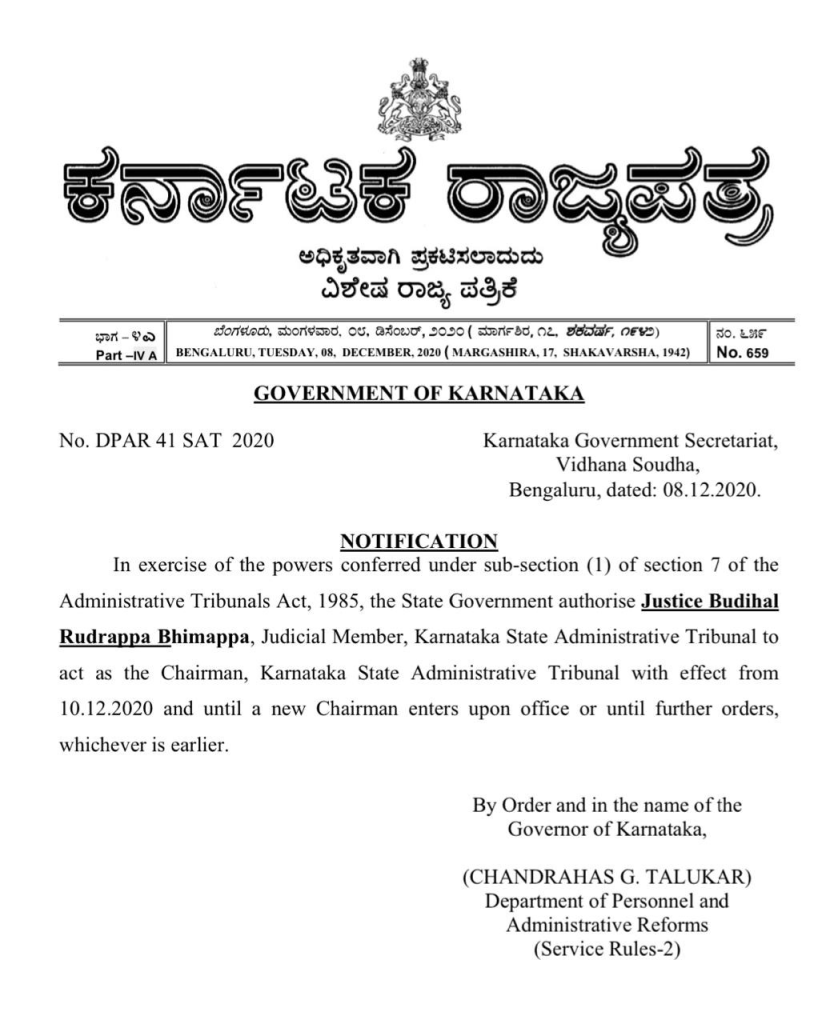
Writ Petition filed online today challenges establishment of Karnataka Veerashaiva Lingayat Development Board.
The contention of the petitioner is that establishment of the Board is unconstitutional apart from destroying the very foundation of the secular philosophy profounded by 12th century social reformist Basava. The Government Order isolates one of the outstanding secular philosophy founded by Basava. The Government order violates secularism which is a basic feature of the Constitution of India. Read the Writ Petition below.
Relevant paragraphs: 8. Complainant claims that it was liasioning between the accused and share broker. Further the transaction according to complainant and accused is not the first one which is one among umpteen number of transactions entered into between the complainant and the accused. It is not disputed that in the past there are instances wherein the shares were sold and made to purchase through mediation of the accused and also payments were made for choice.
9 & 13. The rule of agency is based on two principles (1) whatever a person can do by himself he can do through another. (2) He who does an act through another does it by himself. Certain regular transactions involving a person who is being represented, person representing the former and the third parties may very well be akin to agency when the binding nature of the liability/duty on the person who is so presented by his representative. Thus the person so represented is principal and who represents is agent.
15. Agency may be expressed or implied agency. Expressed agency is one wherein two parties agree for transaction where one will be acting as agent of another and person so acting as agent for valid acts bind the principal. When agent exercises authority or enters into transaction it will be authority by virtue of authority given by principal and benefit or loss principal is entitled to. Infact many of the principles are similar to that of law of partition. As a matter of fact contract of agency is considered as very partnership is concerned as extension of partnership and the implied authority of an agent.
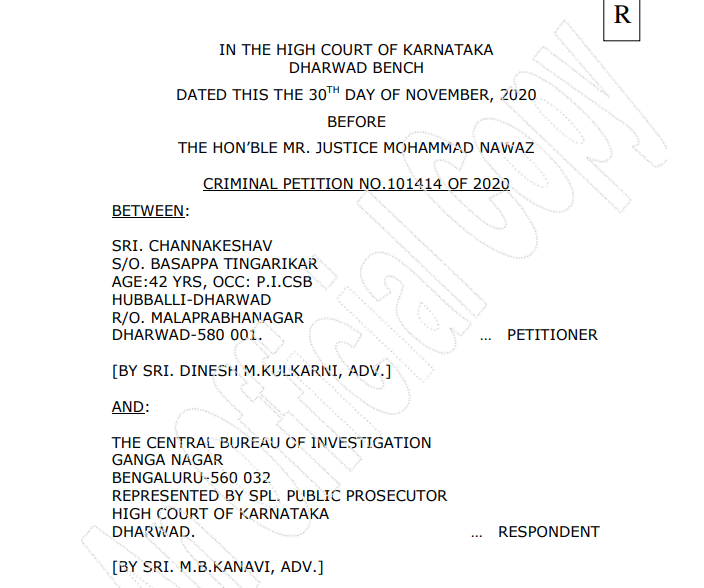
Relevant paragraphs: 4. Admittedly, at the initial stage, this petitioner was granted bail in the present case subject to conditions. It is also admitted that the petitioner has not appeared before the trial Court as directed by the Court while granting bail. It is also admitted that the proclamation under Section 82 of Cr.P.C. is already issued and NBW is pending against the petitioner. Now the question arises as to whether at this stage, the petitioner once again can invoke Section 438 of Cr.P.C. seeking anticipatory bail in this regard. It is relevant to mention the decision of the Hon’ble Apex Court in the case of State of Madhya Pradesh vs. Pradeep Sharma reported in (2014) 2 SCC 171 wherein, the Court referred to its earlier judgment in the case of Lavesh vs. State (NCT of Delhi) reported in (2012) 8 SCC 730 extracted paragraph 12 therein and held as under:
“16. Recently, in Lavesh v. State (NCT of Delhi), this Court (of which both of us were parties) considered the scope of granting relief under Section 438 vis-à-vis a person who was declared as an absconder or proclaimed offender in terms of Section 82 of the Code. In para 12, this Court held as under:
12. From these materials and information, it is clear that the present appellant was not available for interrogation and investigation and was declared as ‘absconder’. Normally, when the accused is ‘absconding’ and declared as a ‘proclaimed offender’, there is no question of granting anticipatory bail. We reiterate that when a person against whom a warrant had been issued and is absconding or concealing himself in order to avoid execution of warrant and declared as a proclaimed offender in terms of Section 82 of the Code he is not entitled to the relief of anticipatory bail.
7. It is clear from the above decision that if anyone is declared as an absconder/proclaimed offender in terms of Section 82 of the Code, he is not entitled to the relief of anticipatory bail.”In view of the above, the position of law is clear on the subject. The petitioner was already granted bail and he had not complied with the conditions imposed in the said order. The petitioner is already proclaimed as an absconding accused and NBW is issued against him. Therefore, the petitioner is not entitled to seek the discretionary relief of anticipatory bail under Section 438 of Cr.P.C. at this stage.
M Shivaraju and another vs The State of Karnataka and another. Writ Petition 10216 OF 2020 (LB-BMP) PIL C/W Writ Petition 11077 OF 2020 (LB-BMP) PIL and Writ Petition 1892 OF 2020 (LB-BMP) PIL decided on 4 December 2020.
ORDER(i) We direct the State Government to publish the final notification of reservations as per clause (c) of sub-section (1) of Section 21 of the said Act of 1976 for 198 Wards as per the delimitation notification dated 23rd June, 2020. We grant time of one month from today to publish the final notification, though, as per the assurance given by the Government, as recorded in the order dated 22nd September 2020, the same was to be published within two weeks from 22nd September 2020;
(ii) We direct the State Election Commission to hold election of BBMP as expeditiously as possible by publishing the election programme within a maximum period of six weeks from the date on which final reservation Notification is published;
(iii) We make it clear that elections shall be held for 198 Wards as per the notification of delimitation of Wards already published on 23rd June, 2020;
(iv) The petitions are allowed on the above terms with no orders as to the costs.
Eight seventy five benches, taken up cases 2,31,365, disposed cases 1,15,938, settlement amount Rs. 357,71,94,758 – all this in a single day via video conferencing. This is the success story of Mega Lok Adalat held on 19 September 2020.
The Legal Services Authorities Act, 1987, is aimed to provide free and competent Legal Services to the weaker sections of the society to ensure that opportunities for securing justice are not denied to any citizen by reason of economic or other disabilities and to organize Lok Adalats to secure that the operation of the legal system promotes justice on a basis equal opportunity; to promote an inclusive legal system in order to ensure fair and meaningful justice to the marginalized and disadvantaged sector; creating legal awareness, legal aid and settlement of disputes through amicable settlement are the main functions of the Authority.
The physical Lok-Adalat was held on 8 February 2020. The total number of benches were 906. Taken up cases 1,86,980. Disposed cases 70,822 and settlement amount was Rs. 256,25,06,636.
However, the real challenge was to arrange a Lok Adalat with equal magnitude during Covid-19 scenario. Hundreds of Judicial Officers, court staff, learned Advocates and Honorable Judges of Karnataka High Court took up the task of holding the Lok Adalat via video conferencing.
The statistics show E-Lok Adalat achieved better results. This is not to in anyway undermine earlier achievements.
Technology coupled with strong determination to achieve speedy justice has made KSLSA’s ‘Success Story of 2020’.
The next Mega E-Lok Adalast is scheduled to be held on 19 December 2020. Details of the event will be shared soon.
Legal awareness programmes are taken up for empowerment of legal knowledge to all the citizens in general and to the weaker sections of the society in particular. Various activities are taken up to reach the vulnerable sections of the society such as SC/ST, Women, Industrial Labourers etc.
The Authority provides legal aid by way of providing the services of able efficient services of Lawyers. Any person, who fulfills the criteria, is entitled for the legal Aid.
Lok Adalats organized by the Authorities and the Taluk Committees help the disputing parties to come to settlement through conciliation and such settlement reached before a Lok Adalat becomes a record having equal status as that of a judgment/decree of the Court.
Karnataka State Legal Services Authority is a Statutory Body constituted under a Central Legislation “Legal Services Authorities Act, 1987”. Hon’ble the Chief Justice of Supreme Court of India is the Patron-in-Chief of National Legal Services Authority. Sr. Judge of the Supreme Court of India is the Executive Chairman of the National Legal Services Authority. Hon’ble the Chief Justice of High Court of Karnataka is the Patron-in-Chief of Karnataka State Legal Services Authority, Bangalore. Sr. Judge of High Court of Karnataka is the Executive Chairman of Karnataka State Legal Services Authority.
The Chief Justice of India is the Patron-in-Chief of National Legal Services Authority. The Chief Justice, High Court of Karnataka, is the Patron-in-Chief of Karnataka State Legal Services Authority, Bengaluru and Senior most Judge, High Court of Karnataka, is the Executive Chairman of Karnataka State Legal Services Authority, Bengaluru. State Legal Services Authority is working through the Member Secretary and monitoring and guiding the District Legal Services Authorities and Taluka Legal Services Committees in the State in achieving the aims and objectives of the Act. There are 30 District Legal Services Authorities in the State of Karnataka. 150 Taluka Legal Services Committees are functioning under District Legal Services Authorities in the State. District Legal Services Authority is headed by Principal District & Sessions Judge as Chairman, Sr. Civil Judge cadre Officer or Principal CJM of the District as the Member Secretary. Taluka Legal Services Committees are headed by the jurisdictional Principal Senior Civil Judge as Chairman and the Principal Civil Judge as the Member Secretary. There are three High Court Legal Services Committees i.e., at Bengaluru, Dharwad and Kalaburagi which are chaired by the sitting Judge of the High Court of Karnataka. Hon’ble Mr. Justice L. Narayana Swamy, Judge, High Court of Karnataka is the Chairman of High Court Legal Services Committee, Bengaluru. The general public who need any legal help / legal aid may contact the concerned Taluka Legal Services Committee / District Legal Services Authority, High Court Legal Services Committees or Karnataka State Legal Services Authority, as the case may be.
Relevant paragraphs: 5. On the basis of the submissions made by Sri.Mrutyunjay Tata Bangi, learned counsel for the petitioner, the questions which would arise for determination are:(1) Whether the Plaintiff is free to value the Suit in any manner it deems fit and just, by making payment of the court fee could such a plaintiff change the jurisdiction of the Court? (2) Whether in a suit for specific performance, it is only the value of the property shown in the said agreement that would have to be considered for the purpose of jurisdiction or would any other item like cost of issuance of legal notice be included so as to increase the valuation. (3) What would be the role of the Court in the event of an artificial increase in the valuation altering the jurisdiction of the Court?
Provisions of Order VII Rule 10 & 10A, 10B, Civil Procedure Code, Section 40 and 50 of the Karnataka Court Fees and Suits Valuation Act are noticed.
9.5 ….a party cannot by artificially inflating the valuation or undervaluing the Suit be allowed to file a particular suit before a Court which would in the absence of such incorrect valuation not have any jurisdiction to try the matter. Merely because the Plaintiff is willing to pay higher court fee by inflating the valuation, he cannot be permitted to do so since the hierarchy of the Court dictates that particular Suit with particular valuation would have to be filed and tried by a particular Court, thus, giving rise to a vested right to the defendant that the Suit of particular nature of particular valuation would be tried by that particular Court only and not by any other Court.
Paragraphs 10.2, 10.3, 10.4 & 10.5 … where the Suit is for a specific performance of contract of sale, the fee shall be computed on the amount of consideration. In the present case, apart from the valuation made as regards the consideration under the agreement of sale, the Plaintiff has added another item, namely the cost of issuance of legal notice to totally value the Suit at Rs.5,01,000/-. It is only by the addition of the relief, in this instance, towards legal notice, namely Rs.1,000/- that the valuation came to be increased in such a manner that the jurisdiction of the Court itself came to be changed. This in my considered opinion is not permissible.
Paragraphs 11.1 & 11.2 The Court would have to carefully examine the mode and methodology of the valuation made by the Plaintiff, more particularly when such a valuation would have the impact of altering the jurisdiction of the Court. The court cannot merely on the basis of the of the Plaintiff being willing to make payment of the court fee permit such a plaintiff to value the Suit at his whims and fancies and make payment of the stamp duty on that basis. The Court while dealing with the same and more so on an application under Order VII Rule 10 of the CPC would have to determine the valuation. The Court would also have to separate the main relief from the ancillary relief in order to ascertain the valuation for the purpose of jurisdiction and that for payment of court fee separately and come to a finding that it is competent to take up the matter and that the Suit has been filed in a proper and competent court.
Relevant paragraphs: 8. The learned counsel for the petitioner next contends that because the challenge is not just to the sale deed but also to the power of attorney executed by the first respondent, it would tantamount seeking cancellation of the power of attorney as well as the sale deed and therefore the suit should be valued under Section 38 of the KCF & SV Act as per the consideration for which the sale deed is executed.
9. The learned counsel for the petitioner elaborates canvassing that the Hon’ble Supreme Court in Satheedevi Vs. Prasanna and Another 2010 AIR SCW 3754 has held that the expression “value of the subject matter of the suit” as found in the provisions of Section 40 of the Kerala Court- Fees and Suits Valuation Act, 1959 (which is pari materia with Section 38 of the KCF & SV Act) should be understood as the ‘value for which the document is executed’. As such, the expression ‘market value’ as found in Section 7(2) of the KCF & SV Act should also, wherever the provisions of Section 38 thereof apply, should be read as “value for which the document is executed” as interpreted by the Hon’ble Supreme Court in the context of Kerala Court-Fees and Suits Valuation Act.
11. The entire controversy as regards the valuation of the suit and the payment of proper court fee will have to be examined from the perspective of the nature of the subject property which is in lis between the petitioner and the respondents.
12.The provisions of Section 7 of the KCF & SV Act stipulate that where the fee payable under this Act depends on the ‘market value’ of any property, such value shall be determined as on the date of presentation of the suit; and insofar as the land which forms part of the estate paying permanently settled annual revenue to the Government, the market value of the land for the different suits mentioned therein shall be twenty-five times the revenue payable. This different mode of determining the market value insofar as the agricultural land under Section 7 of the KCF & SV Act is applicable not only to the reliefs that will have to be valued under Section 24 and other provisions of the KCF & SV Act but also under Section 38 of the KCF & SV Act.
14…..the case on hand before this Court could be distinguished insofar as the applicability of the enunciation by the Hon’ble Supreme Court in the aforesaid decision inasmuch as the significance of a separate mode for valuation in cases of lands which are assessed to annual revenue as provided under Section 7 of the KCF & SV Act was not a subject matter for decision by the Hon’ble Supreme Court.
15. The subject matter in this case is admittedly an agricultural land. The provisions of Section 7(2) of the KCF & SV Act provide for a separate mode for valuation for different suits insofar as agricultural lands which are assessed for annual revenue. This modes applies to even a suit for cancellation as is obvious from the provisions of Section 7 (2) of the KCF & SV Act of sale deed; and the interpretation the expression market value as found in Section 7 of the KCF & SV Act should be read as the valuation for which a document is executed will amount to rendering the provisions of Section 7(2) of the KCF & SV Act, and therefore the entire scheme thereunder, otiose. This would be against the settled canon that an interpretation which renders a statutory provision otiose should be avoided while interpreting a provision of the statute.
Relevant Paragraphs: 11. Now so far as the submission on behalf of the private appellants violators that in view of the fact that violators were penalty determined by the appropriate authority for compounding the offences/violations, there cannot be any further criminal proceedings for the offences under Sections 379 and 414 IPC and Sections 4/21 of the MMDR Act and the reliance placed on Section 23A of the MMDR Act is concerned, it is true that in the present case the appropriate authority determined the penalty under Rule 53 of the 1996 Rules/Rule 18 of the 2006 Rules, which the private appellants violators paid and therefore the bar contained in subsection 2 of Section 23A of the MMDR Act will be attracted. Section 23A as it stands today has been brought on the Statute in the year 1972 on the recommendations of the Mineral Advisory Board which provides that any offence punishable under the MMDR Act or any rule made thereunder may, either before or after the institution of the prosecution, be compounded by the person authorised under section 22 to make a complaint to the court with respect to that offence, on payment to that person, for credit to the Government, of such sum as that person may specify. Subsection 2 of Section 23A further provides that where an offence is compounded under subsection (1), no proceeding or further proceeding, as the case may be, shall be taken against the permitted to compound the violation in exercise of powers under Rule 53 of the 1996 Rules or Rule 18 of the 2006 Rules and the violators accepted the decision and deposited the amount of penalty determined by the appropriate authority for compounding the offences/violations, there cannot be any further criminal proceedings for the offences under Sections 379 and 414 IPC and Sections 4/21 of the MMDR Act and the reliance placed on Section 23A of the MMDR Act is concerned, it is true that in the present case the appropriate authority determined the penalty under Rule 53 of the 1996 Rules/Rule 18 of the 2006 Rules, which the private appellantsviolators paid and therefore the bar contained in subsection 2 of Section 23A of the MMDR Act will be attracted.
However, our above conclusions are considering the provisions of Section 23A of the MMDR Act, as it stands today. It might be true that by permitting the violators to compound the offences under the MMDR Act or the rules made thereunder, the State may get the revenue and the same shall be on the principle of person who causes the damage shall have to compensate the damage and shall have to pay the penalty like the principle of polluters to pay in case of damage to the environment. However, in view of the large scale damages being caused to the nature and as observed and held by this Court in the case of Sanjay (supra), the policy and object of MMDR Act and Rules are the result of an increasing awareness of the compelling need to restore the serious ecological imbalance and to stop the damages being caused to the nature and considering the observations made by this Court in the aforesaid decision, reproduced hereinabove, and when the violations like this are increasing and the serious damage is caused to the nature and the earth and it also affects the ground water levels etc. and it causes severe damage as observed by this Court in the case of Sanjay (supra), reproduced hereinabove, we are of the opinion that the violators cannot be permitted to go scot free on payment of penalty only. There must be some stringent provisions which may have deterrent effect so that the violators may think twice before committing such offences and before causing damage to the earth and the nature.
It is the duty cast upon the State to restore the ecological imbalance and to stop damages being caused to the nature. As observed by this Court in the case of Sanjay (supra), excessive instream sand and gravel mining from river beds and like resources causes the degradation of rivers. It is further observed that apart from threatening bridges, sand mining transforms the riverbeds into large and deep pits, as a result, the groundwater table drops leaving the drinking water wells on the embankments of these rivers dry. Even otherwise, sand/mines is a public property and the State is the custodian of the said public property and therefore the State should be more sensitive to protect the environment and ecological balance and to protect the public property the State should always be in favour of taking very stern action against the violators who are creating serious ecological imbalance and causing damages to the nature in any form. As the provisions of Section 23A are not under challenge and Section 23A of the MMDR Act so long as it stands, we leave the matter there and leave it to the wisdom of the legislatures and the concerned States.
Compiled by S. Basavaraj, Advocate, Daksha Legal, Bengaluru
Relevant paragraphs: 11.Be that as it may. Even as could be seen from Section 36(A)(4) proviso indicates that if any person has been charged for the offence under the said Act for the purpose of filing of the charge sheet is 180 days time has been provided. Proviso to the said Section enables the Investigating Agency, if within 180 days if it is not possible to complete the investigation, then it can move the application before the Special Court for extension of the said period up to one year. But in order to file an application it has to fulfill two conditions. The first condition is that the prosecution has to indicate the progress of the investigation made till that date and the second condition is the specific reason for detention of the accused beyond the said period of 180 days. But on perusal of the application filed by the learned Public Prosecutor, no such reasons have been assigned except stating that, for the purpose of filing of the charge sheet, FSL report is an important document and when the charge sheet cannot filed and the FSL report has also not come, as such 180 days has to be extended.
12. Be that as it may. Even as could be seen from the records, the said application has been filed on 4.9.2020 and immediately thereafter the Court has issued the notice to the accused for his reply and the order sheet indicates that he has filed his objections to the said application on 9.9.2020 and even at that time also no order has been passed by the trial Court either extending the time or giving any reasons on the application filed under Section 167(2) of Cr.P.C. When the time of 180 days is going to be expired on 6.9.2020, before that or on the same day, the Court could have passed an order either extending of time or otherwise. When an application has been filed for the purpose of extension of time on 4.9.2020 and the accused was admittedly in judicial custody, the trial Court ought to have taken into consideration the statutory right available to the accused and it could have been expedited on or before 6.9.2020. When the Court has not exercised its power on the application filed under Section 36(A)(4) of NDPS Act for extension, then the statutory right which has been there to the accused accrues immediately after 180 days and if an application has been filed by the accused and if it is pending, then the right will be there to get him released on bail.