The delay in electing/selecting the Opposition Leader in Karnataka has damaged the institution against corruption in Karnataka. While everyone including BJP political party blamed the Congress Government for destroying the Lokayukta institution by creating Anti Corruption Bureau, the inaction on the part of BJP in electing the Opposition Leader has further weakened the institution of Lokayukta. This is despite the fact that the Karnataka High Court struck down ABC and restored powers to Lokayukta. Section 3 of the Karnataka Lokayukta Act, 1984 deals with appointment of Lokayukta and Upalokayukta. We are presently concerned with appointment of additional Upalokayukta. A person to be appointed as an Upalokayukta shall be a person who has held the office of a judge of a High Court for not less than five years and shall be appointed on the advice tendered by the Chief Minister in consultation with the Chief Justice of the High Court of Karnataka, the Chairman, Karnataka Legislative Council, the Speaker, Karnataka Legislative Assembly, the Leader of the Opposition in the Karnataka Legislative Council and the Leader of the Opposition in the Karnataka Legislative Assembly. Thus consulting the Leader of the Opposition in Karnataka Legislative Assembly and the Leader of the Karnataka Legislative Council is absolutely necessary for the appointment of additional Upalokayukta. The BJP political party lost power and the new Congress Government was formed in May 2023. Even after almost 5 months BJP has not been able to elect the opposition leader in both the Houses. Both the Lokayukta and the Lokayukta handle the works like Departmental enquiries; Public and private grievances with regard to all activities of the government; Enquire into allegations against public servants; Conducting raids, Investigating trap cases; Visiting districts for open hearings; Meeting walk-in complainants on a daily basis; Calling aggrieved persons and concerned officials to discuss issues raised; Examination of 200 files every day; Preparation of final notes under Section 12 (3) of the Act before making recommendations; Advice and preparation if case is challenged before Karnataka State Administrative Tribunal. Tender legal advice on fitness of case for appeal; Monitor vigilance department’s work, police and statistics. It is submitted that as on today there is only one Upalokayukta to assist the Lokayukta in the above duties. While the government was pleased to appoint a Lokayukta and one Upalokayukta, it has not appointed the second Upalokayukta as sanctioned in 1984. Previously there were two Upalokayuktas. After Justice Ananda retired only Justice Phanindra is handling major workload. If the second Upalokayukta, as mandated in 1984, is not appointed, the institution of the Lokayukta will be unable to continue its mandate due to huge pendency thus affecting its usefulness. There is a large increase in complaints over the course of several years and months. Speedy remedy to people’s grievance is required to keep the people’s confidence in the institute of the Ombudsman. There are thirty-one districts in the State of Karnataka. The Upalokayukta has to visit every district at least once a month to give justice to the institution of the Ombudsman. He is required to spend at least three days to open hearings, meet petitioners, complainants, among others. Thus, we can see it is impossible for one person to cover the whole State in one month. Even in the matter of constitutional courts like the High Courts and the Supreme Court of India, the judiciary has lamented at lack of judges to dispose and decide the pending cases. Pendency of cases is the main reason for the institutional failure in rendering speedy justice to the aggrieved persons. The Hon’ble Supreme Court as stressed the need for filling up of the vacancies in the judicial positions from the civil courts level till the Supreme Court of India. The institution of Lokayukta is a unique body to redress the grievances of citizens against mal administration and corruption. It is a matter of fact that the grievances against the governmental machinery is writ large and the reasons are not very difficult to perceive. In this regard an efficient body fully equipped with infrastructure and manpower is absolutely essential. Samaja Parivarthana Samudaya has filed a public interest litigation seeking appointment of additional Upalokayukta and the High court of Karnataka has already issued notice to the State Government. The BJP political party must elect the Leader of the opposition at the earliest to strengthen the institution of Lokayuka. The internal bickering in the BJP has led to crumbling of a citadel and the BJP, which blamed the Congress for weakening the institution of Lokayukta, is answerable to the public at large.
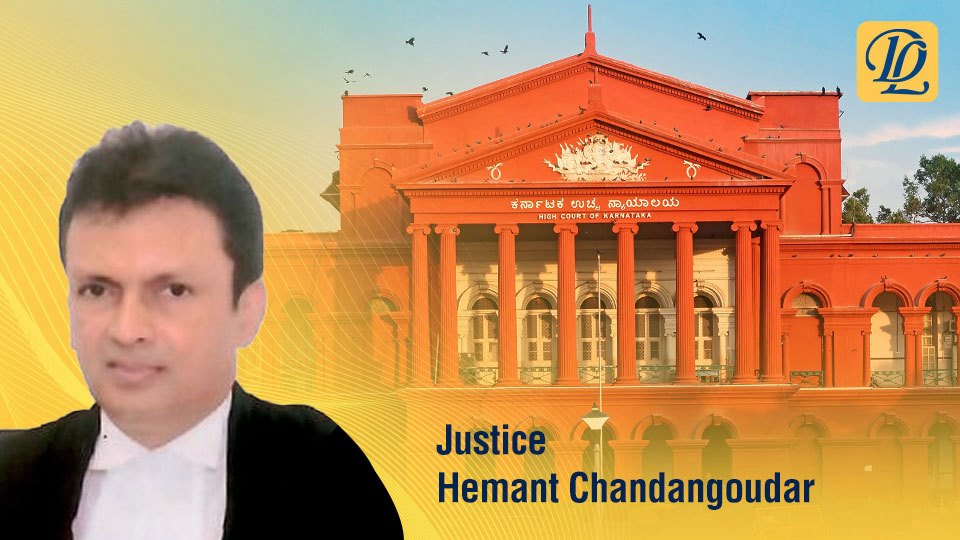
Justice Hemant Chandangoudar is celebrating his 54th birthday today.
Justice Hemant Chandangoudar was born on 28:9:1969. His father Shri. Rajashekar Chandanagoudar was a noted lawyer with vast experience in civil and land reforms laws. Justice Hemant Chandangoudar enrolled as an Advocate on 11:2:1994. He practiced under his father and conducted Civil, Constitutional, Service and Land Reforms mattes.
He was appointed as Additional Judge of the High Court of Karnataka and taken oath on 11:11:2019 and Permanent Judge on 08.09.2021.
Within short span of time, Justice Hemant Chandangoudar has earned the reputation of being one of the finest Judges having great judicial temperament and balanced approach. Justice Hement Chandangoudar is a keen golfer.
If land falls within Corporation limits, there is no requirement to obtain permission under Section 95 of the Karnataka Land Revenue Act for diverting agricultural land for non-agricultural purpose. Karnataka High Court.
Criminal Law. Life imprisonment means imprisonment for complete span of life. Consecutive sentences in case of conviction for several offences at one trial does not arise. Application for clarification of sentence is not maintainable. Karnataka High Court. (DB)
N.I. Act. Section 138. When cheque is delivered for collection within the territorial jurisdiction of a Court where the payee maintains the account, proceedings cannot be initiated in other place. Karnataka High Court.
When a Company nominates a Director under Section 49(2) of the Legal Meteorology Act, 2009, initiation of penal proceedings against other Directors is not permissible. Karnataka High Court.
Motor Vehicles Act, 1988. Section 147. Person travelling on mud-guard of a tractor is NOT an authorized passenger. Persons working on ploughing/crushing machines attached to tractor are NOT employees. Karnataka High Court. (DB)
Customary divorce among Panchamasali Lingayats, though recognised under Section 29-2 of the Hindu Marriage Act, the same is required to be proved strictly in accordance with Section 60 of the Evidence Act. Karnataka High Court.
Karnataka Land Reforms Act. Tenancy created under registered lease deed by grandfather during minority of grandson. Same is binding unless the lease is challenged within three years after grandson attains majority. Karnataka High Court.
Land Acquisition. Challenge to land acquisition can be rejected by courts on the ground constructive resjudicata and res judicata. Issue regarding fraud already adjudicated binds subsequent proceedings. Karnataka High Court. (DB) https://dakshalegal.com/judgements/actionView/d0X2XjoAT0FZy9dBVCr00kYdK
Undue influence, unless specifically pleaded in the plaint, cannot be assumed by the court based on evidence during trial. Karnataka High Court reiterates. (DB)
RTC entries in revenue records. Deputy Commissioner exercising power under the Karnataka Land Revenue Act cannot sit over the validity of registered title deed. Karnataka High Court.
FIR for the offence under Section 498-A IPC cannot be registered against woman alleged to be in illicit relationship with complainant’s husband unless essential ingredients of the offence are made out. Karnataka High Court.
Defamation. When a class of persons are mentioned to have been defamed and if such a class is indefinite, the complaint cannot be entertained. Karnataka High Court.
Offence by Companies. A person cannot be prosecuted unless he is shown to be in-charge of the Company as Managing director or Director. Karnataka High Court.
Mere inducement to invest in money doubling scheme in the absence of dishonest intention to cheat the investor from the inception does not constitute either cheating or criminal breach of trust. Karnataka High Court. https://dakshalegal.com/judgements/actionView/3oMjL1hUwePHrwgQKdCuH291G
Bar under Article 363 of the Constitution to enquire into disputes arising out of merger agreement or instrument of accession between Ruler of an Indian State and the Government applies even to Revenue proceedings. Karnataka High Court. https://dakshalegal.com/judgements/actionView/yZJbLUEItqe8gQKqumFdIspAj
Drugs and Cosmetics Act. Serving Government analyst report on accused after expiration of drug’s shelf life deprives valuable right of the accused to get the drug re-analysed. Criminal proceedings are liable to be quashed Karnataka High.
When there is no clause prescribing minimum quantity of electricity to be purchased by Govt Electricity Company under Power Purchase Agreement, licensee cannot be restrained from injecting power generator into the grid. Karnataka High Court. https://dakshalegal.com/judgements/actionView/9aG4cQkVlyxZi56ReWF8AyKPy To constitute offence under Section 3(1)(j) of the SC & ST (Prevention of Atrocities) Act, the accused must have employed the person for manual scavenging knowing fully well that he belongs to SC & ST community. Karnataka High Court. https://dakshalegal.com/judgements/actionView/mZUpgeGYTeOmehaWrp2Biuydi
In the absence of restraint order, mere pendency of a civil dispute cannot be a ground to refuse sanction of layout plan. Karnataka High Court. https://dakshalegal.com/judgements/actionView/F6HU9nIbvjrPpdW8MODukc77I Karnataka SC-ST – PTCL Act. Delay of seven years in applying for restoration of the granted land without any explanation for the delay. Application is liable to be rejected. Karnataka High Court. https://dakshalegal.com/judgements/actionView/iPmyEjO62jHJSYJMlhDobhicD ”Elections are the essence of democracy”. Karnataka High Court directs the Govt to provide reservation for women in the wards having greater women population and to hold elections at the earliest. https://dakshalegal.com/judgements/actionView/qLfvuiN3dyJsV8kOwPrk4aoGj When a statutory appeal is rejected as not maintainable, the appellate authority cannot make observations on merits touching the rights of the parties. Karnataka High Court.
Tax cannot be levied on telecommunication towers erected by the Bharat Sanchar Nigam Limited (Government of India undertaking) on the immovable property belongs to it, or the Union of India save as the parliament may by law provide. Karnataka High Court. https://dakshalegal.com/judgements/actionView/3Xwq9jTHKJs4U2YhMz9c4TS7e Suit for partition by woman coparcener is not maintainable if the ancestral property was sold before coming into force of the amended Section 6 of the Hindu Succession Act. Karnataka High Court. https://dakshalegal.com/judgements/actionView/P2MxaZz15WlWu4IzMoyjPRtLJ Companies Act, 1956. Offence under Section 217 is not a continuing offence. No criminal prosecution can be launched beyond six months in view of Section 468(2)(a) and (b) of Cr.PC. Karnataka High Court. https://dakshalegal.com/judgements/actionView/jbYeopNntWxR4HGvEeA8QGsuN Suit filed by Bank for recovery of loan amount due from its debtor is not barred under Section 34 of the SARFAESI Act. Karnataka High Court. https://dakshalegal.com/judgements/actionView/EtQAj7uYjnpy37Xz5wrQNCc8G Labour Court awarding partial backwages for proven unauthorised absence of workman for a long period runs contrary to the principle of ‘no work, no pay’ and cannot be justified under Section 11-A of the I D Act. Karnataka High Court. https://dakshalegal.com/judgements/actionView/1Gsp3yu2p9Oki7haHwebZSsBk “Prohibition of outdoor advertisement on non-residential private properties violates Articles 14 & 19(1)(a) and (g) of the Constitution of India” declares Karnataka High Court. Directions issued to take strict action against unauthorised hoardings. https://dakshalegal.com/judgements/actionView/dOi0F3IThoyzWowsPSuvo7ObN
Hon’ble Mr. Justice K. Somashekar celebrates his 60th birthday today
Justice K Somashekar was born on 15:9:1963 in a remote village in Chamarajnagar District. It is interesting to note that he was the first person to become a lawyer from his village. He enrolled as an advocate on 27:1:1990 and practiced in Mysore and Chamarajanagar Districts on both Civil and Criminal sides.
Justice K Somashekar was directly appointed as District and Sessions Judge on 17:6:1998 and served as Additional Districts and Sessions Judge at Bijapur (Vijayapura); City Civil Court, Bangalore and Principal District and Sessions Judge at Uttara Kannada, Karwar District; Hassan; Bangalore Rural District, Chitradurga and Principal City Civil and Sessions Judge, Bangalore and also served as Registrar Judicial and Registrar Vigilance, High Court of Karnataka.
Justice K Smashekar was appointed as an Additional Judge of the High Court of Karnataka on 14.11.2016 and Permanent Judge on 03.11.2018.
Important judgments delivered by Justice K. Somashekar. Criminal Trial. Wife cannot be dragged into criminal case simply because she is signatory to cheques along with her husband who is involved in illegal business transactions. Such practice should be curtailed. Karnataka High Court.
Mere payment of premium amount before occurrence of accident will not cover liability if the insurance policy is issued with effect from the time after the accident. Karnataka High Court. (DB) https://dakshalegal.com/judgements/actionView/WdjePhtI9Mcj3G1HCapAgHfzq “Victim compensation is the social philosophy and legislative implication. Failure on the part of the prosecution to secure a conviction is not a ground to deny compensation”. Karnataka High Court orders compensation to minor girl orphaned due to crime. (DB) https://dakshalegal.com/judgements/actionView/rVLjpm32tgvn6VSRoo9WKlKwL Presentation of undated cheque after three years from the date of the transaction by adding the date. Proceeding under Section 138 NI Act will be clearly barred by limitation. Karnataka High Court. https://dakshalegal.com/judgements/actionView/p92RNehbaj4FcwTvBLmbkS7ee Criminal trial. In a case resting on circumstantial evidence, motive plays a crucial role. Motive is a double-edged weapon, which will cut either side of the case. Karnataka High Court. (DB)
“Case of the prosecution in entirety is found to be doubtful and is full of inconsistencies”. Karnataka High Court acquits the accused in RTI activist Lingaraju murder case. (DB)
Dowry Prohibition Act 1961. Wife roping in entire family members of husband with ulterior motive of wreaking vengeance. Such proceedings are liable to be quashed. Karnataka High Court. https://dakshalegal.com/judgements/actionView/7nibuO3Mhrop4kisSTLTYTvWp When the prosecution fails to prove its case, benefit of the acquittal can be extended by the appellate court even to the accused who has not preferred appeal challenging the order of conviction. Karnataka High Court. (DB) https://dakshalegal.com/judgements/actionView/qosie13nmYln8Tx9PKcErf0xo Criminal Law. Though due to passage of time and memory loss, witnesses deviate from their Police Statements, but when such discrepancies make the foundation of the prosecution case shaky, the Court has to take strict note thereof. Karnataka High Court. (DB) https://dakshalegal.com/judgements/actionView/6hF6iROyju8TkYh7k5DLfVSAY
Criminal law. To impose the extreme punishment, all the three tests; Crime test, Criminal test and Rarest rare test must be satisfied. Karnataka High Court converts imprisonment till last breath of life to life imprisonment. (DB) https://dakshalegal.com/judgements/actionView/D6g80YgX9nWSZCkF8cSdIm4iT Criminal Law. Subsequent voluntary statement of the accused cannot be admissible in evidence and recovery to that effect amounts to “rediscovery of a fact already disclosed and capable of discovery.” Karnataka High Court. (DB) https://dakshalegal.com/judgements/actionView/pJvQkJitCHqzCvwPtaXmOQYzs
Justice Jyoti Mulimani is celebrating her 55th birthday on 15 August 2023.
Hon’ble Miss. Justice Jyoti Mulimani was born on 15.08.1968. She enrolled as an Advocate on 31.07.1992. She handled all types of Civil Cases. Hindu Law, Probate, Company, Arbitration. Constitutional, Tax & Tariff. Electricity, Education, Service, Motor Vehicles, and Excise matters. Justice Jyoti Mulimani served as a Mediator and Trainer in Bengaluru Mediation Centre for the past 12 years. Justice Jyoti Mulimani was appointed as Additional Judge of the High Court of Karnataka and taken oath on 11.11.2019 and Permanent Judge on 08.09.2021.
Important judgments delivered by Miss. Justice Jyoti Mulimani. Civil court cannot enhance compensation under the Indian Telegraph Act towards diminution value if the Deputy Commissioner has already awarded under a particular head. Karnataka High Court.
Tribunal under the Maintenance and Welfare of Parents and Senior Citizens Act can invalidate Gift only if the Gift has condition that the transferee shall provide basic amenities and basic physical needs to the transferor. Karnataka High Court. https://dakshalegal.com/judgements/actionView/chIQKtpYvZ42859RWCLS4ft83 Hindu Law. Gift by a coparcener of his undivided interest in the coparcenary property either to a stranger or to his relation without the consent of the other coparcener is void. Comprehensive Judgement of the Karnataka High Court.
Justice Sunil Dutt Yadav celebrates his 51st birthday today.
Hon’ble Mr. Justice Siddappa Sunil Dutt Yadav was born on 3rd August 1972.
As an Advocate, he conducted many matters involving environmental issues and lake preservation on probono basis. His concern towards preservation of lakes helped saving many lakes in and around the city of Bangalore. He played a major role in preservation of Kappattaguda in Gadag district.
Justice Sunil Dutt Yadav was appointed as Additional Judge of the High Court of Karnataka and took oath on 14.02.2018 and Permanent Judge on 07.01.2020.
Important judgments delivered by Justice Sunil Dutt Yadav. Compensation towards tortious acts of State entities. Concurrent remedy no bar to exercise writ jurisdiction. Karnataka High Court awards compensation of Rs. 1.19 Crore for death and injury due to electrocution. https://dakshalegal.com/judgements/actionView/vPZub6Too0AvAiDc5t8eMkfhO
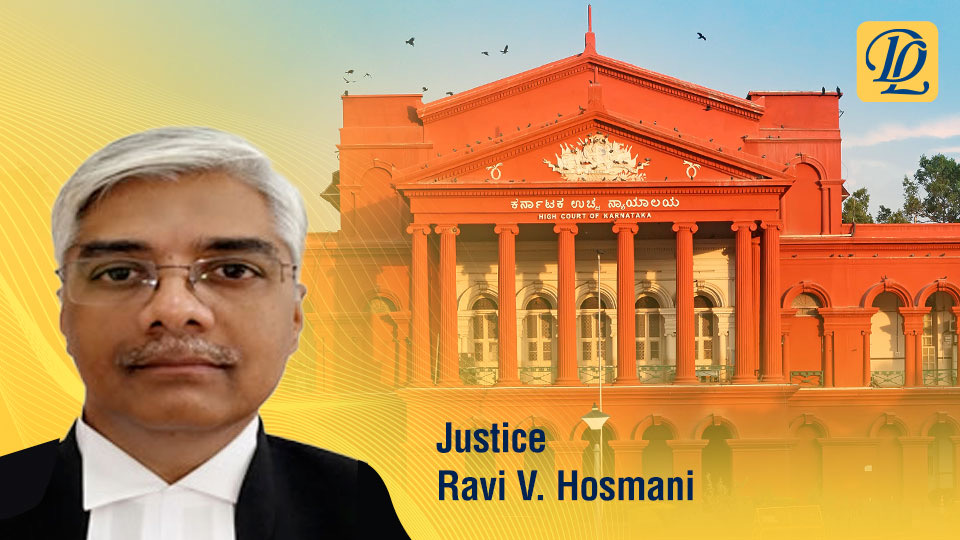
Justice Ravi Hosmani is celebrating his 52nd birthday today.
Justice Ravi Venkappa Hosmani was born on 29.07.1971. Enrolled as an Advocate on 07.07.1995 at Bengaluru. Started practice before the High Court of Karnataka at Bangalore both on the Original and Appellate stages in Writ Jurisdiction as well as on the Civil Appellate side. Also appeared before the Trial Courts, Appellate Authorities, Tribunals etc. And from July 2008 practised before the High Court of Karnataka Dharwad Bench. Appointed as Additional Judge of the High Court of Karnataka and taken oath on 07.01.2020 and Permanent Judge on 25.09.2021.
Important judgments delivered by Justice Ravi V Hosamani.
The specified value and suit valuation in IPR suits below Rs. 3 lakhs shall be examined by the Courts to ensure it is not arbitrary or unreasonable and the suit is not undervalued. Karnataka High Court.
https://dakshalegal.com/judgements/actionView/fq80TkD3zDwKK8sXA2DbB6aiV Motor Vehicles Act, 1988. Death of employee. Amount received by dependents under group insurance scheme is NOT a pecuniary advantage and can NOT be deducted from the MVC compensation. Karnataka High Court. (DB) https://dakshalegal.com/judgements/actionView/rDJ9RaN3TSSjBom75EJF8zhJg Criminal Law. Testimony of a witness who identified the accused for the first time in Court without knowing him before, and in the absence of any Test Identification Parade, would be valueless and unreliable. Karnataka High Court.
When suit for specific performance is dismissed and in the absence of prayer against dispossession, defendant/owner has a right to get back possession of the property in accordance with law. Karnataka High Court.
Suit for partition. Défense of prior partition becomes weak when revenue entries do not stand separately and exclusively in the name of the family members. Karnataka High Court. https://dakshalegal.com/judgements/actionView/Vau54IxDF81BKpQE2MXKSVuBq Defendant cannot be placed exparte merely on process server report unless the court is satisfied that each one of the steps contemplated for service of notice is complied with. Karnataka High Court. https://dakshalegal.com/judgements/actionView/Znlxcx7AtjlQeU4bsqKdw4NyP A co-owner cannot seek temporary injunction against another co-owner on the ground of adverse possession unless there is a partition of the property by metes and bounds. Karnataka High Court.
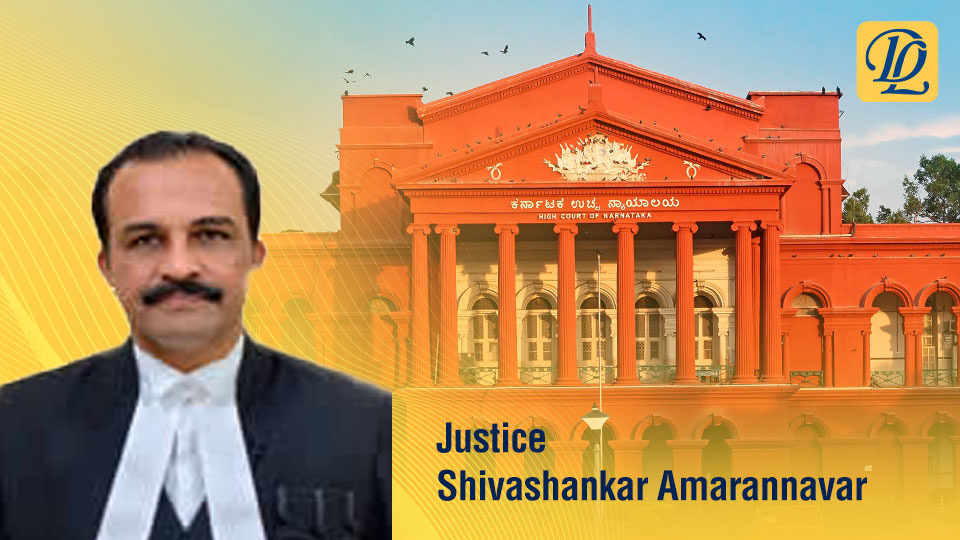
Justice Shivashankar Amarannavar celebrates his 53rd birthday today.
Justice Shivashankar Amarannavar was born on 20.07.1970. He did B.Com., LL.M. (Karnataka University, Dharwad). He enrolled as an Advocate on 24 June, 1994.
Justice Amarannavar started practicing in Dharwad District Court in the chambers of his father- Mr. B.M. Amarannavar. Worked as Special Public Prosecutor, Fast Track Court, Dharwad. Worked as part-time faculty member in University College of Law, Dharwad.
He was directly appointed as District and Sessions Judge on 25 February 2008 and served as Additional City Civil and Sessions Judge, Bengaluru, Principal District and Sessions Judge, Bagalkot and Udupi.
He served as Registrar (Vigilance), High Court of Karnataka and also served as Principal City Civil and Sessions Judge, Bengaluru. Appointed as an Additional Judge of High Court of Karnataka, Bengaluru on 04-05-2020 and Permanent Judge on 25.09.2021. Important Judgments delivered by Justice Shivashankar Amarannavar. Cr.P.C. Section 41A. When police issues notice under Section 41A, the apprehension of arrest is not completely ruled out. Hence petition for anticipatory bail is maintainable. Karnataka High Court. https://dakshalegal.com/judgements/actionView/UvLcCfWt9zz8hqYgMNIp1b57g Service law. A public servant cannot be left without a post. Transfer of a public servant without him being posted elsewhere amounts to a legal malafide. Karnataka High Court. (DB) https://dakshalegal.com/judgements/actionView/Sxs9TQjgLAV4Kxg63TCdcVphR Suit for partition by daughters based on the amended Section 6 of the Hindu Succession Act. Properties sold prior to 20 December 2004 are not available for partition. Karnataka High Court. https://dakshalegal.com/judgements/actionView/0R1Rtm7hRxWDaySPGxTf9Bh2e Plea of adverse possession in the written statement and the plea of ownership based on grant in the oral evidence run contrary to each other thus disproving both the claims. Karnataka High Court. https://dakshalegal.com/judgements/actionView/W9VCtfh2fFoFiwsGSCew2i1KR Proof of Will. When the attestor of a Will turns/declared hostile, other evidence showing proper execution of the Will can be relied upon. Karnataka High Court. https://dakshalegal.com/judgements/actionView/vIxP7km1PBt6udnTaEVxORzzC Principle of Feeding the Grant by Estoppel would enure to the benefit of purchasers of Inam lands upon the re-grant under the Karnataka (Religious and Charitable) Inam Abolition Act, 1955. Karnataka High Court. https://dakshalegal.com/judgements/actionView/90PkZnIHxbeuZPe8Pkz7cgGZW
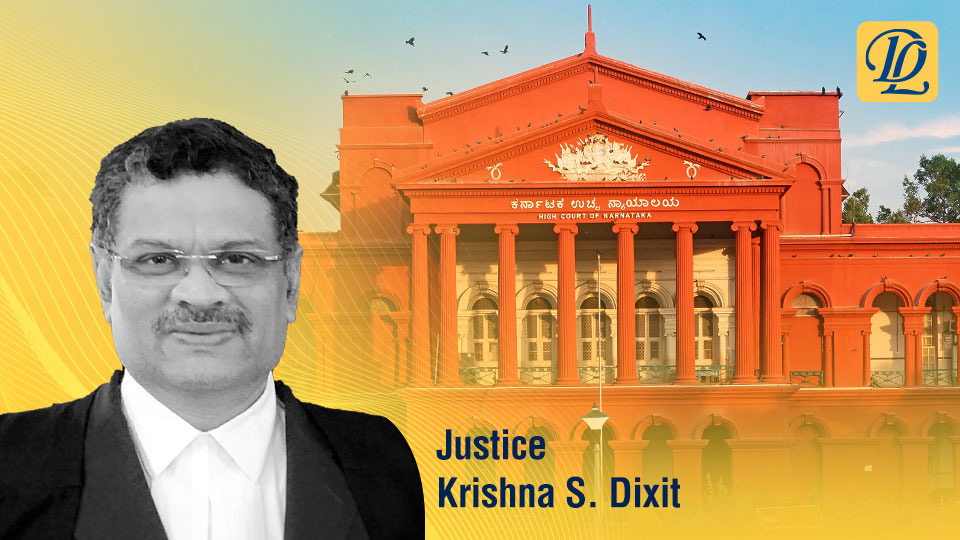
Justice Krishna S. Dixit celebrates his 59th birthday today
Hon’ble Mr. Justice Krishna S. Dixit was born on 20 July 1964. He enrolled as an advocate in July 1989. Since then, he was practicing in the Hon’ble High Court of Karnataka & High Court of Madras, specializing in Law of Writs, Election Laws & Service Laws.
Justice Dixit was appearing in cases before the Service Law Tribunals of several States. He was appointed as the Senior Standing Counsel for the Election Commission of India and also as an Addl. Central Government Standing Counsel since 1999.
He has also served as Standing Counsel for the University Grants Commission, the Competition Commission of India, the Telecom Regulatory Authority of India, Karnataka Veterinary Sciences University, Bhabha Atomic Research Centre, National Institute of Unani Medicines, etc. He was appointed as Amicus Curiae in a few matters before the Hon’ble High Court of Karnataka.
He was Panel Counsel for few Nationalized Banks. He was also a para academician and a part-time lecturer in a Law College in Bengaluru for few years. He was contributing articles to a few Kannada & English Newspapers & magazines. He also participated in several television debates on matters of contemporary relevance.
Having been appointed as the Assistant Solicitor General of India in the year 2014, he was appearing for the Central Government in numerous important cases till his Elevation as a Judge of the High Court of Karnataka on 14th February 2018.
Justice Dixit has delivered many inspirational lectures. Links to few lectures are here:
Important judgments delivered by Justice Krishna S Dixit.
Private Schools. State action should be facilitative and complimentary to the establishment of private schools. “Don’t compare grant of permission to start educational institution with that of a wine shop. Adopt fair standards”. https://dakshalegal.com/judgements/actionView/OKxPDk1BkPUlbM2xHbaAMljnm
Civil Procedure Code. Transposition of Defendant as Plaintiff. Filing of counterclaim by defendant is not a condition for transposition. What is required for transposition is not the Counterclaim but an identity of interest. Karnataka High Court.
STUDENTS FOR FAIR ADMISSIONS, INC. vs PRESIDENT AND FELLOWS OF HARVARD COLLEGE Decided June 29, 2023
Chief Justice John Roberts Justice Clarence Thomas. Justice Samuel Alito. Justice Sonia Sotomayor Justice Elena Kagan Justice Neil Gorsuch Justice Brett Kavanaugh Justice Amy Coney Barrett Justice Ketanji Brown Jackson
Majority view: Justice Roberts, Justice Thomas, Justice Alito, Justice Gorsuch, Justice Kavanaugh, Justice Barrett, Justice Thomas, Justice Gorsuch, Justice Thomas and Justice Kavanaugh Harvard College and the University of North Carolina (UNC) are two of the oldest institutions of higher learning in the United States. Every year, tens of thousands of students apply to each school; many fewer are admitted. Both Harvard and UNC employ a highly selective admissions process to make their decisions. Admission to each school can depend on a student’s grades, recommendation letters, or extracurricular involvement. It can also depend on their race. The question presented is whether the admissions systems used by Harvard College and UNC are lawful under the Equal Protection Clause of the Fourteenth Amendment.
….When the 40-member full admissions committee begins its deliberations, it discusses the relative breakdown of applicants by race. The goal of the process, according to Harvard’s director of admissions, is ensuring there is no “dramatic drop-off” in minority admissions from the prior class….
UNC has a similar admissions process. Every application is re[1]viewed first by an admissions office reader, who assigns a numerical rating to each of several categories. Readers are required to consider the applicant’s race as a factor in their review. Readers then make a written recommendation on each assigned application, and they may provide an applicant a substantial “plus” depending on the applicant’s race. At this stage, most recommendations are provisionally final. A committee of experienced staff members then conducts a “school group review” of every initial decision made by a reader and either approves or rejects the recommendation. In making those decisions, the committee may consider the applicant’s race.
Petitioner, Students for Fair Admissions (SFFA), is a nonprofit or[1]ganization whose stated purpose is “to defend human and civil rights secured by law, including the right of individuals to equal protection under the law.” SFFA filed separate lawsuits against Harvard and UNC, arguing that their race-based admissions programs violate, re[1]spectively, Title VI of the Civil Rights Act of 1964 and the Equal Pro[1]tection Clause of the Fourteenth Amendment. After separate bench trials, both admissions programs were found permissible under the Equal Protection Clause and this Court’s precedents. In the Harvard case, the First Circuit affirmed, and this Court granted certiorari. In the UNC case, this Court granted certiorari before judgment.
Held: Harvard’s and UNC’s admissions programs violate the Equal Protection Clause of the Fourteenth Amendment.
a) Because SFFA complies with the standing requirements for or[1]ganizational plaintiffs articulated by this Court in Hunt v. Washington State Apple Advertising Comm’n, 432 U. S. 333, SFFA’s obligations un[1]der Article III are satisfied, and this Court has jurisdiction to consider the merits of SFFA’s claims. The Court rejects UNC’s argument that SFFA lacks standing be[1]cause it is not a “genuine” membership organization. An organiza[1]tional plaintiff can satisfy Article III jurisdiction in two ways, one of which is to assert “standing solely as the representative of its members,” Warth v. Seldin, 422 U. S. 490, 511, an approach known as rep[1]resentational or organizational standing. To invoke it, an organization must satisfy the three-part test in Hunt. Respondents do not suggest that SFFA fails Hunt’s test for organizational standing. They argue instead that SFFA cannot invoke organizational standing at all be[1]cause SFFA was not a genuine membership organization at the time it filed suit. Respondents maintain that, under Hunt, a group qualifies as a genuine membership organization only if it is controlled and funded by its members. In Hunt, this Court determined that a state agency with no traditional members could still qualify as a genuine membership organization in substance because the agency repre[1]sented the interests of individuals and otherwise satisfied Hunt’s three-part test for organizational standing. See 432 U. S., at 342. Hunt’s “indicia of membership” analysis, however, has no applicability here. As the courts below found, SFFA is indisputably a voluntary membership organization with identifiable members who support its mission and whom SFFA represents in good faith. SFFA is thus enti[1]tled to rely on the organizational standing doctrine as articulated in Hunt.
(b) Proposed by Congress and ratified by the States in the wake of the Civil War, the Fourteenth Amendment provides that no State shall “deny to any person . . . the equal protection of the laws.” Proponents of the Equal Protection Clause described its “foundation[al] principle” as “not permit[ing] any distinctions of law based on race or color.” Any “law which operates upon one man,” they maintained, should “operate equally upon all.” Accordingly, as this Court’s early decisions inter[1]preting the Equal Protection Clause explained, the Fourteenth Amendment guaranteed “that the law in the States shall be the same for the black as for the white; that all persons, whether colored or white, shall stand equal before the laws of the States.”
Despite the early recognition of the broad sweep of the Equal Pro[1]tection Clause, the Court—alongside the country—quickly failed to live up to the Clause’s core commitments. For almost a century after the Civil War, state-mandated segregation was in many parts of the Nation a regrettable norm. This Court played its own role in that ig[1]noble history, allowing in Plessy v. Ferguson the separate but equal regime that would come to deface much of America. 163 U. S. 537.
After Plessy, “American courts . . . labored with the doctrine [of sep[1]arate but equal] for over half a century.” Brown v. Board of Education, 347 U. S. 483, 491. Some cases in this period attempted to curtail the perniciousness of the doctrine by emphasizing that it required States to provide black students educational opportunities equal to—even if formally separate from—those enjoyed by white students. See, e.g., Missouri ex rel. Gaines v. Canada, 305 U. S. 337, 349–350. But the inherent folly of that approach—of trying to derive equality from ine[1]quality—soon became apparent. As the Court subsequently recog[1]nized, even racial distinctions that were argued to have no palpable effect worked to subordinate the afflicted students. See, e.g., McLau[1]rin v. Oklahoma State Regents for Higher Ed., 339 U. S. 637, 640–642. By 1950, the inevitable truth of the Fourteenth Amendment had thus begun to reemerge: Separate cannot be equal.
The culmination of this approach came finally in Brown v. Board of Education, 347 U. S. 483. There, the Court overturned the separate but equal regime established in Plessy and began on the path of inval[1]idating all de jure racial discrimination by the States and Federal Gov[1]ernment. The conclusion reached by the Brown Court was unmistak[1]ably clear: the right to a public education “must be made available to all on equal terms.” 347 U. S., at 493. The Court reiterated that rule just one year later, holding that “full compliance” with Brown required schools to admit students “on a racially nondiscriminatory basis.” Brown v. Board of Education, 349 U. S. 294, 300–301.
In the years that followed, Brown’s “fundamental principle that ra[1]cial discrimination in public education is unconstitutional,” id., at 298, reached other areas of life—for example, state and local laws requiring segregation in busing, Gayle v. Browder, 352 U. S. 903 (per curiam); racial segregation in the enjoyment of public beaches and bathhouses Mayor and City Council of Baltimore v. Dawson, 350 U. S. 877 (per cu[1]riam); and antimiscegenation laws, Loving v. Virginia, 388 U. S. 1. These decisions, and others like them, reflect the “core purpose” of the Equal Protection Clause: “do[ing] away with all governmentally im[1]posed discrimination based on race.” Palmore v. Sidoti, 466 U. S. 429, 432.
Eliminating racial discrimination means eliminating all of it. Ac[1]cordingly, the Court has held that the Equal Protection Clause applies “without regard to any differences of race, of color, or of nationality”— it is “universal in [its] application.” Yick Wo v. Hopkins, 118 U. S. 356, 369. For “[t]he guarantee of equal protection cannot mean one thing when applied to one individual and something else when applied to a person of another color.” Regents of Univ. of Cal. v. Bakke, 438 U. S. 265, 289–290.
Any exceptions to the Equal Protection Clause’s guarantee must survive a daunting two-step examination known as “strict scrutiny,” Adarand Constructors, Inc. v. Peña, 515 U. S. 200, 227, which asks first whether the racial classification is used to “further compelling governmental interests,” Grutter v. Bollinger, 539 U. S. 306, 326, and second whether the government’s use of race is “narrowly tailored,” i.e., “necessary,” to achieve that interest, Fisher v. University of Tex. at Austin, 570 U. S. 297, 311–312. Acceptance of race-based state action is rare for a reason: “[d]istinctions between citizens solely because of their ancestry are by their very nature odious to a free people whose institutions are founded upon the doctrine of equality.”.
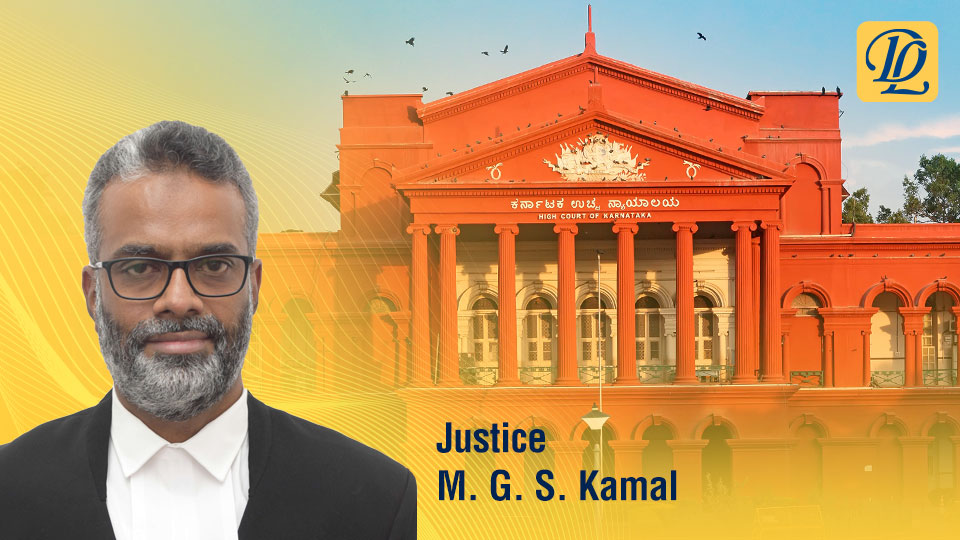
Justice M. G. Shukure Kamal celebrates his 52nd birthday today.
Justice M. G. Shukure Kamal was born on 30 June, 1971 at Kodlipet, Kodagu District. He did his Primary & Secondary education both at Kodlipete and Suntikoppa of Kodagu District. Hr completed his PUC at Govt. Senior College, Madikeri and did his BAL.,LL.B. at Vidyavardhaka Law College, Mysuru.
Justice M. G. Shukure Kamal was enrolled as an Advocate with the Karnataka State Bar Council on 05.08.1994. He appeared before the High Court of Karnataka, City Civil and Sessions Court, Chief Metropolitan Magistrate Courts, Debt Recovery Tribunals at Bengaluru, mainly in Civil, Criminal, Constitutional, Labour, Arbitration, Revenue and Wakf matters.
Justice M. G. Shukure Kamal was appointed as Additional Judge of the High Court of Karnataka and taken oath on 17.03.2021 and Permanent Judge on 30.09.2022.
Few important judgments delivered by Justice M.G. Shukure Kamal.