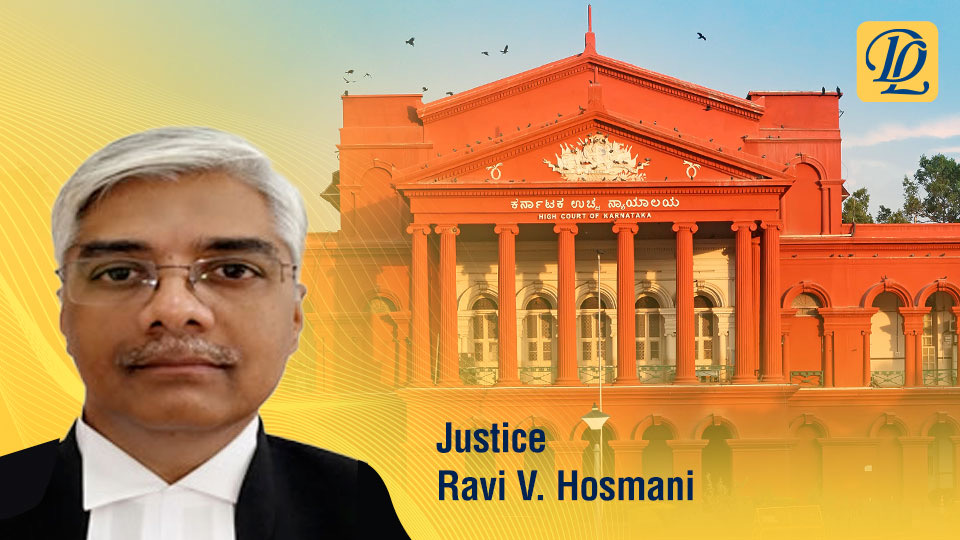
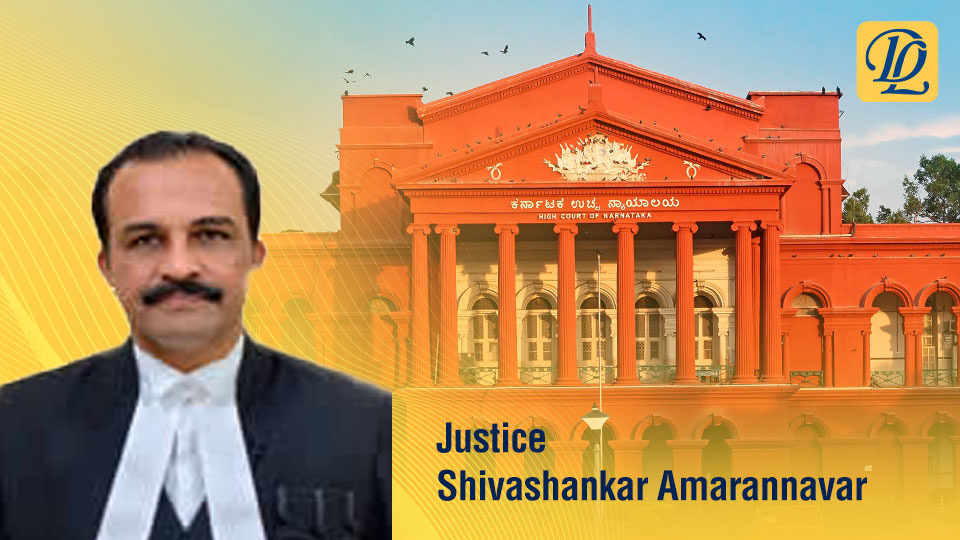
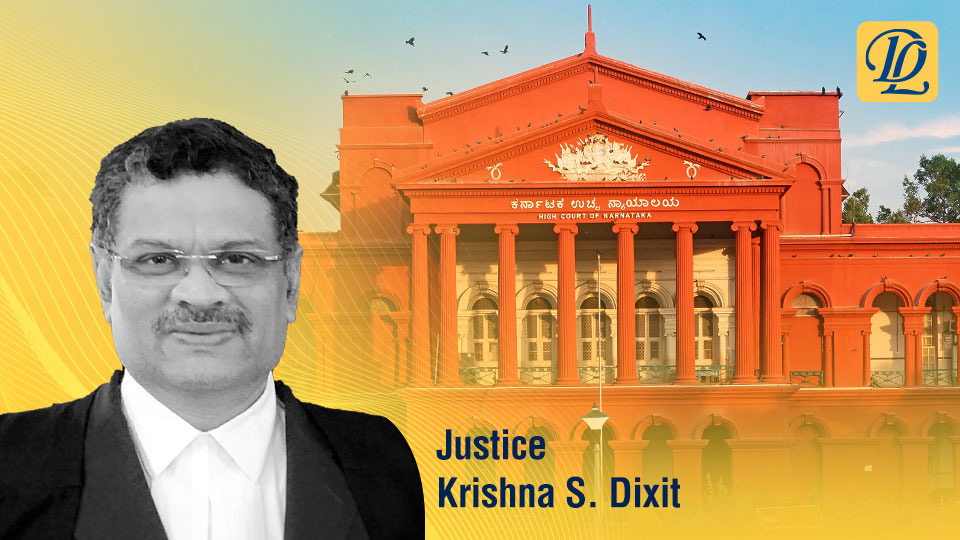
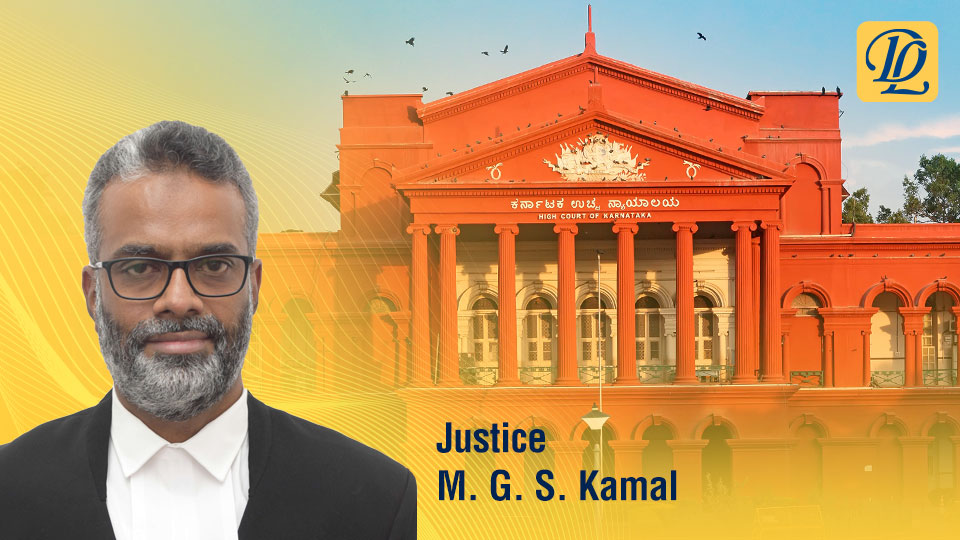
Justice Venkatesh Naik celebrates his 48th birthday today. Justice Venkatesh Naik Thavaryanaik was born on 01.06.1975. Native of Chitradurga. He completed B.A.L., L.L.B., from SJM Law College, Chitradurga and secured 3rd Rank. He obtained L.L.M. from Kuvempu University, Shivamogga.
Justice Venkatesh Naik enrolled as Advocate and practiced at Chitradurga. He was appointed as District Judge on 02.01.2012. He served as Registrar (Administration) at High Court of Karnataka. He worked at Prl. Secretary to Government, Law Department. He worked as Prl. District & Sessions Judge, Udupi & Bengaluru Rural District.
Justice Venkatesh Naik was sworn-in as Additional Judge of the High Court of Karnataka on 24.01.2023.
Important Judgements delivered by Justice Venkatesh Naik T “Speedy trial in NIA cases guarantees the fundamental right under Article 21”. Karnataka High Court directs establishment of three more Special to ensure speedy trial and disposal of the NIA cases. (DB) https://dakshalegal.com/judgements/actionView/OmixS2OMoTfqrljhC59QMaM87 Karnataka High Court directs amendment of Section 377 IPC to include Necrophilia on the lines of laws prevalent in UK, Canada, NZ etc. Guidelines issued to install CCTVs in mortuaries and to maintain Mortuary hygiene. (DB) https://dakshalegal.com/judgments/actionRead/G2tTPI5bHvYyZTiETOTGZQLha
Justice Rajesh Rai celebrates his 49th birthday today.
Justice Rajesh Rai Kallangala was born on 01.06.1974. He completed primary education at Kepu & secondary education & PUC at Vitla. He completed Degree from St. Philomina’s College. Completed LL.B., from Vivekananda Law College, Puttur.
Justice Rajesh Rai enrolled as Advocate in 1999 and practiced in the office of Sri G. Balakrishna Shastri and Sri Younus Ali Khan. Later, he joined the office of Hon’ble shri Justice John Michael D’Cunha.
He worked as Government Pleader for 2 years. Served as Central Government Senior Panel Counsel for 6 years. Functioned as Special Public Prosecutor for Enforcement Directorate, and Narcotics Control Bureau. Served as Panel Advocate for BDA. Practiced mainly on criminal side. Justice Rajesh Rai was sworn-in as Additional Judge of the High Court of Karnataka on 09.02.2023.
Justice H.T. Narendra Prasad celebrates his 57th birthday today.
Justice Harekoppa Thimmana Gowda Narendra Prasad was born on 1 June 1966. He studied B.Sc., from D.V.S.College, Shivamoga in the year 1990 and LL.B., from Vidyavardhaka Law College, Mysuru in the year 1993.
He enrolled as an Advocate in the year 1993. He started practice in the Chambers of Prof.Ravivarma Kumar, former Advocate General of Karnataka.
He initially for a period of two years practiced in Trial Courts, Bengaluru. He practiced in the field of Constitutional Law, Service Law, administrative Law, Public Law, Property Law, Arbitration and Conciliation mattes, Environmental Law, Revenue Matters, Company matters, Banking Laws, Civil and Criminal matters before the High Court of Karnataka, Karnataka State Administrative Tribunal and Central Administrative Tribunal.
He was appointed as High Court Government Pleader in the year 2006 till 2013 and as Additional Government Advocate from 2013 till the date of elevation, i.e., 2018.
H.T. Narendra Prasad was appointed as an Additional Judge, High Court of Karnataka on 02.06.2018 and as Permanent Judge on 26.02.2020.
Justice Rajendra Badamikar celebrates his 61st birthday today. Justice Rajendra Badamikar was born on 01.06.1962 in Hubballi to late Sri. Muralidhar Balavant Rao Badamikar and to late Smt. Vijaya Muralidhar Badamikar of Rabkavi in Bagalkot district.
Justice Badamikar studied primary and secondary education in M.V.Pattan Higher Secondary School, Rabkavi in Bagalkot district. Then, PUC was done in R.L.S. Science College at Belagavi. Completed B.Sc. Degree in Karnataka Science College, Dharwad in 1983 and 1 year studied in M.Sc. (zoology) in Karnataka University, Dharwad. Later on in 1984, joined LL.B (Special) Degree in JSS Sakri Law College, Hubballi and obtained degree in 1987 and also obtained III Rank in II-year LL.B from the Karnataka University, Dharwad.
He enrolled as an Advocate in Karnataka State Bar Council, Bengaluru on 15.07.1987 and joined the Chambers of Sri. Shreekanth T. Patil, Advocate, Dharwad. Practiced both civil and criminal side in Dharwad and Hubballi.
He was appointed as Civil Judge on 18.10.1993 and worked in Chikkodi at Belagavi District; Chittapur at Kalaburagi District and in Belagavi from 29.11.1993 to 03.09.2002. Promoted as Senior Civil Judge on 04.09.2002 and worked as Civil Judge (Sr.Dn.) in Hanagal, Haveri District till May 2006. Then, posted as Deputy Secretary to Karnataka State Legal Services Authority and Member Secretary to the High Court Legal Services Authority and served there till July 2009. Then attended competitive examination conducted by the High Court of Karnataka and promoted as District Judge and served as XII-Additional City Civil and Sessions Judge, Bengaluru, from July 2009 to May 2010. Then, transferred to Belagavi and served there as IV-Additional District and Sessions Judge (Lokayuktha Court), Belagavi District, upto May 2013. Later, he was transferred to Mysuru and served there as V-Additional District and Sessions Judge; III-Additional District and Sessions Judge; and Additional Prl. Family Judge and Prl. Family Judge, Mysuru from May 2013 to February 2015. Then, transferred to Kolar District and served as Prl. District and Sessions Judge, Kolar, from 28.02.2015 till 30.11.2016.
Later he was transferred to Tumakuru as Prl. District and Sessions Judge, Tumakuru District and served there from 05.12.2016 till 13.09.2019. Then, posted as Registrar (Judicial) in High Court of Karnataka, Bengaluru and served there from 16.09.2019 to 09.10.2019. Thereafter, posted as Registrar General and served in the said post from 09.10.2019 till elevation as Judge, High Court of Karnataka, Bengaluru, on 25.03.2021 and Permanent Judge on 30.09.2022.
Some of the important Judgements delivered by Justice Badamikar
Karnataka High Court Act, 1961. Regular First Appeals filed before the 2007 amendment, whose value is less than Rs.15 lakhs, have to be heard by the Division Bench. Amendment applies only to appeals filed after 28 August 2007. (DB) https://dakshalegal.com/judgements/actionView/PXoK3UOnorXI9fFmo3hRJY72F
Justice Veerappa retires today. (Born on 1 June 1961)
It is with great admiration and respect that we reflect upon the remarkable career of this honest, bold, and hardworking individual. Throughout his tenure on the bench, Justice Veerappa has consistently exemplified the virtues of integrity, courage, and diligence, leaving an indelible mark on the judicial system.
First and foremost, Justice Veerappa has been a paragon of honesty. His unwavering commitment to upholding the principles of truth, fairness, and justice has been a guiding light for all who have appeared before them. His ethical conduct and transparent approach to each case have earned him the trust and confidence of the legal community and the public at large.
He has exhibited boldness in his decisions, fearlessly tackling complex legal issues and making tough choices that were in the best interest of justice. With an unyielding dedication to the law and a deep understanding of its nuances, he has demonstrated the courage to stand up for what is right, even in the face of adversity.
Justice Veerappa has also been an epitome of hard work throughout his career. His tireless efforts in meticulously examining the factual and legal position, researching legal precedents, and hearing arguments have ensured that every case received the utmost attention and consideration. His commitment to thoroughness and a fair trial has set a high standard for his colleagues and inspired many aspiring legal professionals.
Beyond his individual qualities, Justice Veerappa has played a pivotal role in promoting the values of honesty, boldness, and hard work within the legal community. His mentorship and guidance have positively influenced countless junior lawyers, encouraging them to uphold the highest ethical standards and strive for excellence in their practice.
As we bid farewell to Justice Veerappa on this momentous occasion, we express our profound gratitude for his invaluable contributions to the judiciary. His legacy of honesty, boldness, and hard work will undoubtedly endure, serving as a testament to his exceptional career and inspiring future generations of legal professionals.
Hon’ble Mr. Justice B.Veerappa: Born on 1st June, 1961. Studied in Primary Education at Government Primary School, Nagadenahalli, Srinivasapura: Secondary Education at Government Higher Primary School, High School and Pre-University Education at Government High School, Composite Junior College, Srinivasapura, Kolar; Degree at Government College, Kolar and LL.B., at Renukacharya Law College, Bengaluru.
He started practice in the High Court of Karnataka in the year 1988 in the office of Prof. M.S.Gopal, Senior Advocate at Bengaluru Appointment as Government pleader on 01.07.1995 and worked upto 15.09.2000 and as Additional Government Advocate on 25.05.2005 and continued as such till 1.1.2015 by conducting various cases. worked as Government Advocate for more than 15 years in all successive Governments.
Ministry of Education & Social Welfare, Government of India has awarded “Three Stars” Merit Certificate for Completion of the National Physical Efficiency Tests (Seniors) COnducted in the year 1979 in the state of Karnataka on 16.06.1979.
He has passed National cadet Corps (N.C.C.) ‘B’ Certificate on 11.5.1985 (CPL) and National Cadet Corps (N.C.C.) ‘C’ Certificate during Feb 1983 (SGT) under the authority of the Ministry of Defence, Government of India.
He has represented the Bengaluru University in Wrestling in the year 1984-85. Won first place in Kabaddi in Inter College Competition during the year 1984-85
Appointed as an Additional Judge of the High Court of Karnataka on 02-01-2015 and Permanent Judge on 30.12.2016.
Some of the Important Judgements delivered by Justice Veerappa.
“Speedy trial in NIA cases guarantees the fundamental right under Article 21”. Karnataka High Court directs establishment of three more Special to ensure speedy trial and disposal of the NIA cases. (DB) https://dakshalegal.com/judgements/actionView/OmixS2OMoTfqrljhC59QMaM87 Maintenance and Welfare of Parents and Senior Citizens Act. Transfer must have been made subject to the condition that the transferee shall provide the basic amenities and basic physical needs to the transferor. Karnataka High Court reiterates. (DB) https://dakshalegal.com/judgements/actionView/aUu8uX7bmkOYVriDpbGom08vE
The petitioner is before this Court calling in question order dated 13-10-2022 passed by the II Additional Principal Judge, Family Court, Bengaluru in G & WC No.288 of 2018 whereby the concerned Court rejects Interlocutory Application No.XX and has further sought for a direction seeking custody of minor child in equal proportion between him and his wife.
3. Facts adumbrated are as follows:
The petitioner is the husband and respondent his wife. The two get married on 19-08-2005. From the wedlock a girl child is born on 04-01-2014. The child is now 9 years old. The relationship between the petitioner and the respondent/wife turns sour and the allegation is that the wife began to live separately along with the minor daughter. Owing to such dispute between the husband and the wife, the husband institutes proceedings before the Family Court in M.C.No.5570 of 2018 seeking judicial separation from the wife. The petitioner also files a petition invoking Section 12 of the Guardians and Wards Act, 1890 (‘the Act’ for short) before the II Additional Principal Judge, Family Court, Bengaluru in G & WC 288 of 2018 seeking an order for appointing him to be the guardian of minor child. The respondent/wife contested the matter by filing her objections in the aforesaid proceedings before the concerned Court in G & WC No.288 of 2018.
9. The afore-narrated facts are not in dispute. The relationship between the couple flounder. The petitioner and the respondent are before the concerned Court in two proceedings – one in M.C.No.5570 of 2018 and the other in G & WC No.288 of 2018. The first of the case filed by the husband was on 15-10-2018. The Family Court granted an ex-parte interim order in favour of the husband restraining the wife from interfering with the peaceful custody of the minor child by the husband reserving liberty in the wife to seek visitation rights. It is then the wife files application I.A.No.VI under Order 39 Rule 4 seeking vacation of the interim order dated 15-10-2018 and I.A.No.VII under Section 12 read with Section 25 of the Act seeking restoration of custody of the minor child to her. This was partly allowed by the concerned Court granting visitation rights to the wife on every alternative Saturday and Sunday with effect from 27-04-2019 and custody on every alternate Saturday and Sunday from 5.00 p.m. to 8.00 p.m.
13. The petitioner has himself appended several photographs to the petition seeking to demonstrate that the girl child/daughter has a good relation with the father to buttress his claim for custody of the child. Those photographs apparently are clicked by a stranger which the wife narrates in detail the manner in which the photographs are taken. It is a fact that there is nobody to take care of the child when the father is not around and the child is handed over to a male stranger by name Vijay who is also alleged to have been sleeping in the same bed while the father and the daughter would sleep only to take photographs. The mother narrates that on several occasions the child had expressed her anguish getting too anxious about a stranger continuously photographing and videographing the child. If these facts are noticed, it becomes unmistakably clear that the father has not created a congenial atmosphere to the girl child, who is now 9 years old, he cannot therefore be heard to contend that he has a right to claim custody of the child, despite the afore-noted glaring facts. The girl child, in her best interest, prefers to be with her mother and psychologically it is presumed that bond between the child and mother is the finest. In cases of this nature, where the parents are wrangling on their egos, wound is inflicted on the child. The Apex Court has cautioned such parents in the case of RAJESWARI CHANDRASEKAR GANESH. It would be apt to quote the paragraphs, which read as follows:-
“120. Before we close this matter, we would like to convey to the parties that their two minor children are watching them very closely. Showing the children that their parents can respect each other and resolve the conflict respectfully will give them a good foundation for the conflict that may, God forbid, arise in their own lives. The parties should try to do their best to remain relaxed and focused. It is critical to maintain boundaries between the adult problems and children. It is of utmost interest to protect the innocence of children and allow them to remain children. They must not be burdened by any adult problem. Minor children do not have the coping skills or the intellectual ability to understand any issues like the financial constraints, adult relationship issues or their parents unhappiness.
121. We find the observations made by the Delhi High Court, in the case of K.G. v. State of Delhi, dated 16.11.2017 in Writ Petition (Criminal) No. 374/2017 and Criminal Miscellaneous Application No. 2007/2017, quite commendable, that the best welfare of the child, normally, would lie in living with both his/her parents in a happy, loving and caring environment, where the parents contribute to the upbringing of the child in all spheres of life, and the child receives emotional, social, physical and material support – to name a few. In a disturbed marriage, unfortunately, there is bound to be impairment of some of the inputs which are, ideally, essential for the best interest of the child.”
The Apex Court observes that the minor children are watching the parents closely. Showing the children that their parents can respect each other and resolve the conflict with respect will give such children, a good foundation. The parties – husband and wife should try to do their best to remain relaxed and focused. It is critical to maintain boundaries between the adult problems and children and it is of utmost interest to protect the innocence of children and allow them to remain children.
14. Even in the case at hand, for the last five years the husband and the wife have been in constant squabble. The minor girl child has been watching parents right from her tender age of 4 years. The minor child does not have the coping skills or the intellectual ability to understand the issues between the adult relationship or the parents unhappiness. The parents have to contribute to the upbringing of the child on all emotions, be it social, physical, mental or material support inter alia. In a disturbed marriage, there is bound to be impairment. Therefore, in the best interest of the girl child, in the case at hand and owing to the facts as narrated hereinabove, I do not find any warrant to interfere with the order passed by the concerned Court in declining to grant custody and permitting grant of visitation rights only.
15. In the result, the petition lacking in merits stands dismissed.
Justice Mohammad Nawaz celebrates his 58th birthday today.
Justice Mohammad Nawaz was born on 22nd May 1965. He completed primary education at St. Francis Xavier’s Primary School, Puttur, Dakshina Kannada; High School at St. Philomena’s High School, Puttur, Bachelor’s Degree in Science at St. Philomena’s College, Puttur, and LL.B. at Sri Jagadguru Renukacharya Law College, Bengaluru.
Justice Mohammad Nawaz enrolled as Advocate on 20.04.1990 and served as; Government Pleader in the year 2003. Special Prosecutor for Lokayukta in the year 2007. Additional. State Public Prosecutor from 2008-2012. State Public Prosecutor in June, 2015.
He represented the Mangalore City Corporation and Karnataka State Road Transport Corporation.
Justice Mohammad Nawaz was appointed as Additional Judge, High Court of Karnataka on 02.06.2018 and permanent Judge on 26.02.2020.
Some of the latest and important judgements delivered by Justice Mohammad Nawaz.
Sections 407 & 408 Cr.P.C. Case and counter case have to be tried together by the same court irrespective of the nature of offences involved to avoid conflicting judgments over the same incident. Karnataka High Court.
Cr.P.C. Section 482. Quashing of non-compoundable cases. Guiding factor is as to whether the ends of justice would justify such exercise of power, both the ultimate consequences may be acquittal or dismissal of indictment. Karnataka High Court. https://dakshalegal.com/judgements/actionView/myJXvAa2CGULJoV3HE6SWU0tQ Arbitrary freezing of bank account by the authorities, unless there is a strong suspicion against the account holder, adversely affects the right to life under Article 21 of the Constitution of India. Karnataka High Court. https://dakshalegal.com/judgements/actionView/aRP34CHXgCX6mQorQVYKVa6uK
Justice S. Vishwajith Shetty celebrates his 56th birthday today.
Appointed as Additional Judge of the High Court of Karnataka and taken oath on 28.04.2020 and Permanent Judge on 25.09.2021.
Mr. Justice Savanur Vishwajith Shetty, was born on 19th May 1967 in an agricultural family. He completed his schooling from St. Victor’s Primary School, Puttur, and High School from St. Philomina High School, Puttur. He obtained law degree from Vaikunta Baliga law college, Udupi.
Justice Vishwajith Shetty enrolled as an advocate in the Karnataka State Bar Council on 3rd of August 1990. After the enrolment on the roles of Karnataka State Bar Council, he joined the chambers of Mr. P. Vishwanath Shetty, who became the Judge of the Karnataka High Court. He practiced in civil, criminal and writ petitions. You started your independence practice in the year 1995.
As lawyer, Justice Vishwajith Shetty served as a panel advocate for Mangalore City Corporation and Davanagere City Corporation.
Karnataka Police Act. Mere apprehension of the police is not enough to pass an order of externment. There must be grounds and adequate materials to show that there is danger based upon credible materials. Karnataka High Court.
Indian Penal Code. When accused is acquitted for the offence under Section 392 (Robbery), he cannot be convicted for the offence under Section 411 (Dishonestly receiving stolen property). Karnataka High Court.
Wife demanding separate residence does not always amount to cruelty for grant of divorce. There must be determination to put an end to marital relation and cohabitation. Karnataka High Court. (DB)
Karnataka Excise Act. Compliance of Sections 53 and 54 i.e. securing search warrant or to record the grounds to dispense with the search warrant is mandatory. Non-compliance of the same would vitiate the conviction order. Karnataka High Court.
Judgment of acquittal passed in a complaint case can be challenged before the High Court under Section 378(4) Cr.PC and an appeal under Section 378(2) Cr.PC before the Sessions Court is not maintainable. Karnataka High Court.
Rash and negligent driving resulting in death. Leniency can be shown on the sentence that is imposed on the accused in the event if the family members of the deceased receive the compensation from the accused. Karnataka High Court.
When Juvenile Justice Board decides to try the juvenile as an adult, the accused can, apart from appealing against the order, seek bail under Section 12 of the Juvenile Justice (Care and Protection of Children) Act, 2015. Karnataka High Court.
Arms Act. When the gun seized from the accused was unloaded and no ammunition was found in possession of the accused, the gun cannot be said to have been used for hunting purposes. Karnataka High Court sets aside conviction.
Karnataka SC/ST (PTCL) Act. Application for restoration filed 25 years after the sale cannot be entertained by the authorities since it is beyond reasonable time. Karnataka High Court. (DB)
Judicial estoppel. Person participating in the proceedings despite knowledge of the defect in the jurisdiction of an Authority without any objection is disentitled from questioning the jurisdiction in subsequent proceeding. Karnataka High Court.(DB)
“Child cannot be allowed to remain in unhealthy atmosphere”. Karnataka High Court orders custody of the minor child to the father having found the wife to be in immoral relationship. (DB)
Order XXIII Rule 1(3)(b) of CPC applies even to writ proceedings. Withdrawal of writ petition with liberty to file fresh petition on the same cause of action does not act as resjudicata. Karnataka High Court. (DB)
Order XVIII Rule 3 of CPC. Rebuttal evidence is permissible only in respect of issues casting onus on the other side and the said opportunity cannot be utilized to fill up the lacuna in the evidence of the party leading evidence first. Karnataka High Court.
Writ jurisdiction cannot be invoked challenging issuance of caste certificate since alternate remedy of appeal is provided under the Karnataka SC/ST & OBC (Reservation of Appointments, etc.,) Act. Karnataka High Court. (DB)
“State has no power to direct reservation in employment in favour of SC, ST and OBCs in Private Schools under the Karnataka Education Act.” Landmark Judgement from the Karnataka High Court. (DB)
“State has no power to regulate fee structure in Private Schools under the Karnataka Education Act”. Landmark Judgement from the Karnataka High Court.(DB)
Withdrawal of exemption under the Employees Provident Funds and Miscellaneous Provisions Act on the ground of financial loss of an establishment for three consecutive years is not unconstitutional. Karnataka High Court.(DB)
When urgency clause in invoked under Land Acquisition Act, 1894, the State must act with quite promptitude failing which the acquisition proceedings are liable to be quashed. Karnataka High Court.(DB)
Writ Court cannot direct the Government to frame scheme under Article 162 of the Constitution especially when the parties have alternative remedy for the redressal of their grievances. Karnataka High Court. (DB)
When correction of arbitration award is sought, limitation to challenge award commences from the date on which request for correction of award has been disposed of by arbitrator and not from the date of the original award. Karnataka High Court.
”Every order or transaction pursuant to fraudulent act is void ab initio and the same cannot be allowed to stand”. Karnataka High Court, while ordering restoration of khata which was fraudulently changed.
Change of entries in property register by playing fraud. Such fraudulent entry can be set aside in a Writ Petition under Article 226 of the Constitution of India. Karnataka High Court.
Nominated members have no right to cast their votes in the election to President and Vice President under the Karnataka Municipalities Act. Karnataka High Court. (DB)
Tahsildar has jurisdiction under Section 140(2) of the Karnataka Land Reforms Act to carry out survey work and fix boundaries even in respect lands falling within the limits of Corporation. Karnataka High Court. (DB)
Transport vehicle and omnibus, when gross weight does not exceed 7500 kg would be a light motor vehicle. Holder of LMV driving licence is competent to drive such transport vehicle only when the weight does not exceed the limit. Karnataka High Court.
Customs Brokers Licensing Regulations. Time limit of 90 days for passing the order in original under Regulation 17 is directory and not mandatory. Karnataka High Court. (DB)
Family pension. Order of priority under the pension Rules prevail over order of priority under the Hindu Succession Act. When wife is alive, no other legal/illegitimate heir can claim family pension. Karnataka High Court.
Karnataka SC-ST (PTCL) Act, 1978. Application for resumption and restoration of granted land filed 10 years after the sale can be rejected on the ground of delay and laches. Karnataka High Court. (DB)
Karnataka SC-ST (PTCL) Act, 1978. Delay of 16 years from the date of sale in filing application for resumption and restoration of granted land. Karnataka High Court quashes the entire proceedings.
Service Law. Minimum qualifications for appointments prescribed under the UGC guidelines are for the purpose of maintaining excellence in the higher standards of education. Universities have no power to relax them. Karnataka High Court.
‘Corruption hurts everyone. Corruption erodes trust of a common man in the system. Anti corruption law shall be invoked against persons, who by virtue of their office are discharging public duty’. Karnataka High Court.
Prevention of Corruption Act, 1988. Employee of Society, registered under the Societies Registration Act, which receives funds from Government, is a ‘public servant’ and liable for prosecution under the Act. Karnataka High Court.
Default bail under the Unlawful Activities Prevention Act. Order extending time to complete investigation without notifying or producing the accused is bad in law. Accused are entitled to default bail in such eventuality. Karnataka High Court.
Cenvat Credit Rules, 2004. Industry having outdoor catering services for factory canteen cannot claim Cenvit credit post 2011. Court, while dealing with taxing statute, cannot include what is specifically excluded. Karnataka High Court. (DB)
Code of Civil Procedure, 1908. Order XXIX Rule 1. Director of company can NOT institute a suit without board resolution or ratification. Temporary injunction can be refused on the ground of maintainability of the suit. Karnataka High Court. (DB)
Right to Fair Compensation and Transparency in Land Acquisition, Rehabilitation and Resettlement Act, 2013 does not apply to acquisitions under the Bangalore Development Authority Act. Karnataka High Court reiterates. (DB)
Bangalore Development Authority Act, 1976. Section 38-B. Karnataka High Court declares bulk allotment of acquired land by BDA in favour of BDA Employees’ Welfare Association as illegal. Dismisses PIL for non-joinder of allottes of the sites. (DB)
Environment. Declaring forest as non-forest under the Karnataka Forest Act without the prior approval of the Central Government is illegal. Take action against erring officials – Karnataka High Court. (DB)
Criminal Procedure Code. Power under Section 311 to summon material witness or examine person present can be invoked by the court suo motu and even at a stage when the case is posted for judgment. Karnataka High Court.
Criminal Procedure Code. Non-recording or delayed recording or improper recording of statement under Section 161-3 is a serious irregularity which is incurable. Conviction under NDPS Act set aside on this ground. Karnataka High Court.
Criminal Procedure Code. Section 319. Power to proceed against other persons appearing to be guilty of offence cannot be exercised in a casual manner on the basis of a stray statement of the complainant. Karnataka High Court.
Aarogya Setu App. Informed consent of users of the app is must for sharing user data by the Government of India and National Informatics Centre. Karnataka High Court. (DB)
Justice R Devdas celebrates his 54th birtyday today
Justice R Devdas was born on 15th May 1969. He studied in Sri Ramakrishna Vidyashala, Mysore. Pre-University Education and Bachelor of Arts at St.Joseph’s Arts and Science College, Bangalore and Bachelor of Law at Sri Jagadguru Renukacharya College of Law, Bangalore.
He started practice in the year 1994 in the office of M/s. Jayaram & Jayaram, Advocates, Bangalore.
He was appointed as Addl. Government Advocate for State of Karnataka on 6th June 2008. Appointed as Principal Government Advocate on 10th July 2014.
Justice R Devdas was appointed as an Additional Judge of the High Court of Karnataka on 14th February 2018 and was appointed as Permanent Judge of the High Court of Karnataka on 7th January 2020.
Some of the latest and important judgements delivered by Justice R. Devdas.
The Representation of People Act, 1951. No person can be added as a party to election petition after expiry of 45 days period of limitation. Non-joinder of necessary party results in dismissal of election petition. Karnataka High Court. https://dakshalegal.com/judgements/actionView/ElsrB7lQoFyqzayPeIxfXtSSf
Justice Suraj Govindaraj celebrates his 50th birthday today.
Justice Suraj Govindaraj graduated LL.B (Hons) at National Law School India University. He enrolled as an Advocate on 23.06.1995. Practiced in the field of Civil, Commercial Litigation, Contracts, Property Law, Arbitration, Company Law, Intellectual Property Rights, Constitution Matters, Debt Recovery, Environmental Law, Revenue Matters under local land laws, Consumer Law, RERA etc., Appeared before the Hon’ble Supreme Court of India, almost all High Courts in the Country, District Courts, Tribunals etc.,
Justice Suraj Govindaraj was appointed as Additional Judge of the High Court of Karnataka and taken oath on 23.09.2019 and Permanent Judge on 01.03.2021.
He is a member of the Phase 3 committee advisory, implementation and monitoring Committee, Neutral Citation Committee and the Ai assisted translation Committee constituted by the Hon’ble Chief Justice of India. He is also a member of the Computer and Technology Committee of the High Court of Karnataka, was instrumental in setting up the Telegram Channel, which is used by most of the lawyers in Karnataka, Revamping of the Website of the High Court of Karnataka to give all information in one place, publication of various reports in the telegram channel which are of assistance to all lawyers and judges, Postal integration at the High Court and District Courts – which gives the status of the service by the postal department. Advocate Registration and Dashboard to give real-time information of their cases etc etc.,
He is also a member of several other committees, including the Mediation Committee.
He is regularly invited by the National Judicial Academy, Bhopal on a regular basis to speak to Bhopal as also at the Regional Judicial Conferences. He is also invited by various colleges in and outside Bangalore to deliver lectures on various subjects.
He has a tremendous interest in sharing knowledge and encouraging lawyers more particularly young lawyers.
Some of the latest and important judgements of Justice Suraj Govindaraj.
KT & CP Act. When designation of land in the Master Plan as park is lapsed due to non-acquisition within five years, the landowner is entitled for conversion of the land as per the new classification of the land under the Master Plan. Karnataka High Court https://dakshalegal.com/judgements/actionView/nm19csYtxwSXa1tdrxwIQh09c
Land acquisition notification after 19 December 2013, the date on which the 2013 Act was notified to come into force on 1 January 2014, could be issued only under the 2013 Act and not under the 1894 Act. Karnataka High Court. https://dakshalegal.com/judgements/actionView/pnNSC5QZ6QfCBJSair4jKSN0j If possession of property is handed over before or subsequent to execution of document, stamp duty under Article 5(e)(i) of the Karnataka Stamp can NOT be levied. Karnataka High Court. https://dakshalegal.com/judgements/actionView/WmYThpM28DJ8YSrSev8msoKrI Land acquisition notification after 19 December 2013, the date on which the 2013 Act was notified to come into force on 1 January 2014, could be issued only under the 2013 Act and not under the 1894 Act. Karnataka High Court. https://dakshalegal.com/judgements/actionView/pnNSC5QZ6QfCBJSair4jKSN0j
If possession of property is handed over before or subsequent to execution of document, stamp duty under Article 5(e)(i) of the Karnataka Stamp can NOT be levied. Karnataka High Court. https://dakshalegal.com/judgements/actionView/WmYThpM28DJ8YSrSev8msoKrI Workman cannot be dismissed without taking the approval of the Industrial Tribunal in terms of Section 33(2)(b) of the Industrial Disputes Act when proceedings are pending. Karnataka High Court. https://dakshalegal.com/judgements/actionView/Zz0Jz9ZQI6qNhl3OOq3kQSdi4 Land acquisition. If compensation of some landowners is enhanced, other landowners under same notification are automatically entitled to enhanced Compensation. Duty of the State to notify all other landowners about the enhancement. Karnataka High Court. https://dakshalegal.com/judgements/actionView/GNGySBcAcVVuNMZq14dtnt4GN Trust registered under the Trust Act is entitled to get liquor license under the amended Karnataka Excise (Sale of Indian & Foreign Liquors) Rules, 1968. Karnataka High Court disposes Writ Petition challenging non-inclusion of Trusts. https://dakshalegal.com/judgements/actionView/5FZ6PKP5R9ybFsVoB5dFDMdRW
Contract Labour (Regulation & Abolition) Act, 1970 & Rules 1971. Notification under Section 10(1) is not a pre-requisite for the Tribunal to decide matters relating to reinstatement or regularization of services of contract labour. Karnataka High Court. https://dakshalegal.com/judgements/actionView/wx1jqT0RqIlc4fHRZNeCR7zrG Proceedings under Section 79(A) & (B) of the Karnataka Land Reforms Act can NOT be initiated against purchaser of converted agricultural property. Karnataka High Court. https://dakshalegal.com/judgements/actionView/FbE5c913Jm3ll7axWRgSvVHbp Change of partners in a partnership concern holding excise license amounts to transfer of excise license. Authorities can cancel license for violation of condition against transfer of license. Karnataka High Court. https://dakshalegal.com/judgements/actionView/55RSxoygMeE8rPPNZk1UaV2Kb Suit for partition. Registration of a sale deed in respect of joint family property would amount to constructive notice to all members of the joint family and the period of limitation would commence from the date of such registration. Karnataka High Court. https://dakshalegal.com/judgements/actionView/5HpsEiKX16RiKmF5peIIqLKpk Labour Law. Dispute regarding termination can be raised before the Labour Court within whose jurisdiction the employee worked last and received the termination letter and not from the place of origin of termination letter. Karnataka High Court. https://dakshalegal.com/judgements/actionView/fXlAzntmj1dAs5hmcc9RgdTt2 Cr.P.C. Sections 82 and 83. Even an agreement holder can challenge the attachment on the ground that he has an interest in the property provided the agreement is bonafide and not fraudulent. Karnataka High Court. https://dakshalegal.com/judgements/actionView/Ul11rUyBi6KzLsSCGm1GVrKA0 In a suit for partition filed by woman against her father/brother based on amended Section 6 Hindu Succession Act, joint family properties given to her husband as dowry can also be included. Karnataka High Court. https://dakshalegal.com/judgements/actionView/yac9TIe4JwB5vLqBYkQQGcIny
Information Technology Act. An intermediary or its directors and officers are not liable for any action or inaction on part of seller making use of facilities provided by the intermediary in terms of a website or market place. Karnataka High Court. https://dakshalegal.com/judgements/actionRead/jEvxF66Q30p05bi3KBRNLPNz5
Labour Law. When workman files statutory appeal as also claim petition under section 10(4-A)of ID Act,in the event of either one of them being disposed,the other proceeding would become infructuous and required to be dismissed as such.Karnataka High Court https://dakshalegal.com/judgements/actionRead/iG2Y2hVKJQ61HLgji3JVea3yU
In a suit for partition filed by woman against her father/brother based on amended Section 6 Hindu Succession Act, joint family properties given to her husband as dowry can also be included. Karnataka High Court. https://dakshalegal.com/judgements/actionRead/yac9TIe4JwB5vLqBYkQQGcIny
Cr.P.C. Sections 82 and 83. Even an agreement holder can challenge the attachment on the ground that he has an interest in the property provided the agreement is bonafide and not fraudulent. Karnataka High Court. https://dakshalegal.com/judgements/actionRead/Ul11rUyBi6KzLsSCGm1GVrKA0
Suit for partition. Registration of a sale deed in respect of joint family property would amount to constructive notice to all members of the joint family and the period of limitation would commence from the date of such registration. Karnataka High Court https://dakshalegal.com/judgements/actionRead/5HpsEiKX16RiKmF5peIIqLKpk
Change of partners in a partnership concern holding excise license amounts to transfer of excise license. Authorities can cancel license for violation of condition against transfer of license. Karnataka High Court. https://dakshalegal.com/judgements/actionRead/55RSxoygMeE8rPPNZk1UaV2Kb
Labour Law. Dispute regarding termination can be raised before the Labour Court within whose jurisdiction the employee worked last and received the termination letter and not from the place of origin of termination letter. Karnataka High Court. https://dakshalegal.com/judgements/actionRead/fXlAzntmj1dAs5hmcc9RgdTt2
Contract Labour (Regulation & Abolition) Act, 1970 & Rules 1971. Notification under Section 10(1) is not a pre-requisite for the Tribunal to decide matters relating to reinstatement or regularization of services of contract labour. Karnataka High Court. https://dakshalegal.com/judgements/actionRead/wx1jqT0RqIlc4fHRZNeCR7zrG
Land acquisition. If compensation of some landowners is enhanced, other landowners under same notification are automatically entitled to enhanced Compensation. Duty of the State to notify all other landowners about the enhancement. Karnataka High Court. https://dakshalegal.com/judgements/actionRead/GNGySBcAcVVuNMZq14dtnt4GN
Trust registered under the Trust Act is entitled to get liquor license under the amended Karnataka Excise (Sale of Indian & Foreign Liquors) Rules, 1968. Karnataka High Court disposes Writ Petition challenging non-inclusion of Trusts. https://dakshalegal.com/judgements/actionRead/5FZ6PKP5R9ybFsVoB5dFDMdRW
Karnataka Cooperative Societies Act. Special Officer cannot be appointed on the ground of resignation of directors without waiting for 15 days period prescribed under Section 29(B) to withdraw the resignations. Karnataka High Court. https://dakshalegal.com/judgements/actionRead/rDzZKvBC2pSsW4n8CtsM8QB0s
Karnataka Societies Registration Act. Erstwhile office members cannot process election to the Society after the appointment of an administrator merely because the administrator has not taken charge. Karnataka High Court. https://dakshalegal.com/judgements/actionRead/wY4lFwKBfwBQLCXexQmFQkkzk
KT & CP Act. When designation of land in the Master Plan as park is lapsed due to non-acquisition within five years, the landowner is entitled for conversion of the land as per the new classification of the land under the Master Plan. Karnataka High Court https://dakshalegal.com/judgements/actionRead/nm19csYtxwSXa1tdrxwIQh09c
Arbitration and Conciliation Centre being run under the aegis of the High Court of Karnataka can appoint an Arbitrator if any of the parties individually or both the parties jointly were to approach the centre for such appointment. Karnataka High Court. https://dakshalegal.com/judgements/actionRead/yJp8xzkv7KRvUcF4ImxebZWvr
POCSO Act. Increasing cases of minor girls above the age of 16 years having love/sexual relationship resulting in criminal prosecutions. Karnataka High Court asks Law Commission of India to rethink on the age criteria. https://dakshalegal.com/judgements/actionRead/ofcIm3beRTfBW25AsdHqszJBB
Income Tax Act. All the Directors of the Company cannot be automatically prosecuted for any violation of the Income Tax Act. There has to be specific allegations made against each of the Directors who is intended to be prosecuted. Karnataka High Court. https://dakshalegal.com/judgements/actionRead/FkYliWXpOPPwh1zBmyJ5xZUbL
Prevention of Money Laundering Act 2002. Investigating-arresting Officer must inform and provide copy of arrest order and grounds of arrest to the person being arrested. Mere oral information would not be sufficient. Karnataka High Court. https://dakshalegal.com/judgements/actionRead/26EhqxuXfwUtQkvfc6sASu3Rs
Educational Institutions. Property tax exemption is available even to any land or building used for the purpose of educational institution or incidental thereto such as bank canteen and staff quarters. Karnataka High Court. https://dakshalegal.com/judgements/actionRead/aneO4s04YSQSYpLCaq9fmllZs
Forcible, unauthorised, Illegal encroachment of private property by BDA. Karnataka High Court orders allotment of equivalent developed land to the owner. Imposes cost of 5 lakhs to be recovered from the officers at default. https://dakshalegal.com/judgements/actionRead/SCjleBmmnga5F5in7edNyDeqJ
Information Technology Act. An intermediary or its directors and officers are not liable for any action or inaction on part of seller making use of facilities provided by the intermediary in terms of a website or market place. Karnataka High Court. https://dakshalegal.com/judgements/actionRead/jEvxF66Q30p05bi3KBRNLPNz5
Plaint in a suit for partition based on amended Section 6 of the Hindu Succession Act is liable to be rejected if there is clear admission in the plaint about registered partition of ancestral properties prior to the amendment. Karnataka High Court. https://dakshalegal.com/judgements/actionRead/AqiH79AYRqh6uAL1goeyPue3D
Labour Law. When workman files statutory appeal as also claim petition under section 10(4-A)of ID Act,in the event of either one of them being disposed,the other proceeding would become infructuous and required to be dismissed as such.Karnataka High Court https://dakshalegal.com/judgements/actionRead/iG2Y2hVKJQ61HLgji3JVea3yU
In a suit for partition filed by woman against her father/brother based on amended Section 6 Hindu Succession Act, joint family properties given to her husband as dowry can also be included. Karnataka High Court. https://dakshalegal.com/judgements/actionRead/yac9TIe4JwB5vLqBYkQQGcIny
ಹಿಂದೂ ಉತ್ತರಾಧಿಕಾರ ತಿದ್ದುಪಡಿ ಕಾಯ್ದೆಯ ಕಲಂ.6 ರ ಅನ್ವಯ, ಮಹಿಳೆಯು ತನ್ನ ತಂದೆ/ಸಹೋದರನ ವಿರುದ್ಧ, ಭಾಗಾಂಶ ಕೋರಿ ದಾಖಲಿಸಿರುವ ದಾವೆಯಲ್ಲಿ, ಆಕೆಯ ಪತಿಗೆ ವರದಕ್ಷಿಣೆಯಾಗಿ ನೀಡಿದ ಅವಿಭಕ್ತ ಕುಟುಂಬದ ಆಸ್ತಿಗಳನ್ನು ಸಹ ಸೇರಿಸಬಹುದು. ಕರ್ನಾಟಕ ಉಚ್ಚ ನ್ಯಾಯಾಲಯ. https://dakshalegal.com/kannada/actionRead/WbyTX1uAQbESng5xidE5t4TPA
Defendant whose written statement taken as not filed and on dismissal of his application under Section 8(1) of the Arbitration and Conciliation Act can not seek permission to file written statement. Karnataka High Court. https://dakshalegal.com/judgements/actionRead/vxsqepFIwum51fwGWMPjGzxsG
Court can record compromise among parties even after auction of subject property is completed since successful auction purchaser has no vested right till sale certificate is issued in his favour. Karnataka High Court. https://dakshalegal.com/judgements/actionRead/lyQiVzAZV3HscHkrWvRvzudyz