“State Government” – Meaning. Chief Minister can be construed as such. Constitution of India.

Justice Krishna S Dixit

Constitution of India. “State Government. In our constitutional scheme, the Chief Minister of the State acts as a limb of the Government. Resignation addressed to Chief Minister is a resignation addressed to the State Government Karnataka High Court 17 July 2020.

Dr. M. Sudheendra Rao vs State of Karnataka and another. Writ Petition 7222 /2020, Decided on 17 July 2020, Justice S Krishna Dixit

Judgment link: http://judgmenthck.kar.nic.in/judgmentsdsp/bitstream/123456789/335497/1/WP7222-20-17-07-2020.pdf

Held: 10 (f) Mr.Ashok Haranahalli is more than justified in contending that, to understand the meaning of “State Government” employed in Section 5(4) of the 1974 Act and its functional aspects, one has to advert to the constitutional scheme arising inter alia from Articles 53, 74, 154, 163 & 361 of the Constitution; our Constitution although deals with the Union and the State Executive separately, the provisions relating thereto follow a common pattern; the Constitution divides the subject under four sub-heads viz., the Chief Executive, the Council of Ministers, the Law Officers and the Conduct of Business; the President is the chief executive of the Union of India and in him vests the executive power of the Union vide Articles 52 & 53; similarly, at the Provincial level, the Governor is the chief executive of the State and it’s executive power is vested in him vide Articles 153 & 154; Article 361 provides absolute immunity to both these high constitutional functionaries, for the exercise and performance of the powers & duties of their offices because neither the President nor the Governor exercises the executive functions individually or personally; the exercise of the executive power is a formally function of the President or the Governor as the case may be; in order to aid & advise the President in the exercise of his function, Article 74(1) provides for a Council of Ministers with the Prime Minister at the head; similarly, at the State level Article 163 provides for a Council of Ministers with the Chief Minister at the head; both these Articles relate to the conduct of  business of the Government; 

(g) It is pertinent to mention that the Executive power of the Union or the State is described by the Apex Court in Ram Jawaya Kapur Vs. State of Punjab, AIR 1955 SC 549, ordinarily as being “the residue of Governmental functions that remain after legislative & judicial functions are taken away” and that they necessarily include the execution of the laws; Mr.H.M. Seervai in his “Constitutional Law of India”, 4th Edition, Volume 2 (Tripathi Publication) at Page 2042 states “…according to Dr.Ambedkar, ………….. the President of India was bound to accept the advice of his Ministers…” At pages 2034 & 2036 of the same Volume, Mr.Seervai has churned out the ratio decidendi of Apex Court decisions (a set of two) in Samsher Singh Vs. State of Punjab, (1974) 2 SCC 831 vociferously pressed into service by Mr.Haranahalli; only the relevant ones to the case in hand are reproduced below:

“(a) Our Constitution generally embodies the Parliamentary or the Cabinet form of Govt. on the British model, both for the Union and the States.

(b) It is a fundamental principle of English constitutional law that the Sovereign does not act on his own responsibility but on the advice of his Ministers who accept responsibility and who command the confidence of the House of Commons.  This principle of English constitutional law is embodied in our Constitution.

(c) It follows from the British form of Parliamentary or Cabinet Govt. that the President and the Governors are the formal or Constitutional heads of the Union and the States and they must act with the aid and advice of the Council of Ministers except where a contrary provision is made by the Constitution.”

(h) Mr.Haranahalli heavily banks upon another recent decision in A.A. Padmanabhan Vs. State of Kerala, (2018) 4 SCC 537 wherein, the highest Court of the country having surveyed the growth of this branch of law has thus observed at para 16: “…Except the discretionary functions of the Governor, he does not exercise any executive functions individually or personally. When a Minister takes an action according to the Rules of Business, it is both in substance and in form the action of the Governor…” Both Mr.Dhyan Chinnappa and Mr.Ashok Haranahalli take the court through the provisions of Karnataka Government (Transaction of Business) Rules, 1977 in support of their contention that the subject matter in question falls within the domain of the Chief Minister; item 15 in II Schedule to these Rules puts into the hands of the Chief Minister, the matters relating to appointment inter alia to the post of “Chairman and Members of any other Commission, Authority, Tribunal or Committees created by Statute”; the text & context of this provision which is generic in nature, the word “appointment” employed therein needs to be understood to include inter alia resignation of the appointee, as well; this apart, Rule 15(1) of 1977 Rules vests prerogative powers in the Chief Minister to take decisions even in respect of matters of business that normally belong to the domain of other Ministers as per the 1977 Rules; the said Rule reads:  

“15. (1) The Chief Minister may call for papers from any Department and express his views and also tender advise on any matter coming within the purview of the business allocated to any Minister.”  

(i)The text & context of the relevant constitutional provisions as interpreted in Samsher Singh supra, coupled with the provisions of the 1977 Rules show the prominent position assigned to the Chief Minister of the State; true it is, that the Chief Minister is not the manifestation of the State unlike the King in England; but he acts as a limb of the Government, is not legally disputable; therefore, the letter of resignation addressed to the “Hon’ble Chief Minister, Government of Karnataka” can be safely construed as the one addressed to the “State Government” in terms of section 5(4) of the 1974 Act; an argument to the contrary falls foul of the constitutional scheme as consistently articulated by the Apex Court in a catena of decisions including Samsher Singh and A.A. Padmanabhan, supra.

Compiled by, S.Basavaraj, Daksha Legal, Bangalore

Has the time come to control Electronic Media sternly.?

S.Basavaraj, Advocate, Bangalore raj@dakshalegal.com

ಎಲೆಕ್ಟ್ರಾನಿಕ್ ಮಾಧ್ಯಮಗಳು ಅತ್ಯ೦ತ ಅಪಾಯಕಾರಿ ಮಟ್ಟಕ್ಕೆ ಇಳಿದಿವಿಯೆ? ಇವನ್ನು ಖಡಾಖ೦ಡಿತವಾಗಿ ನಿಯ೦ತ್ರಿಸುವ ಕಾಲ ಬ೦ದಿದೆಯೇ? ನಿಮ್ಮ ಅಭಿಪ್ರಾಯ ತಿಳಿಸಿ. Has the time come to control Electronic Media sternly.?

At no point of time in history, the electronic media had stooped to the level it has today. The recent news bombarding about Corona, fake claims, panic creation, exaggeration of innocuous events, political lobbying and the alleged extortion rackets have shown that the Electronic Media has reached a dangerous level.

The Press ie. Print Media It is regulated by Press Council of India, a mechanism for the Press to regulate itself. It is created under the Press Council Act, 1978. Section 13 says that the objects of PCI is, inter alia, to build up a code of conduct for newspapers, news agencies and journalists in accordance with high professional standards and to ensure on the part of newspapers, news agencies and journalists, the maintenance of high standards of public taste and foster a due sense of both the rights and responsibilities of citizenship.

Press Council of India has powers to take disciplinary action against journalists as can be seen from Section 14 of the Act. On receipt of a complaint made to it or otherwise, if the Council has reason to believe that a newspaper or news agency has offended against the standards or journalistic ethics or public taste or that an editor or a working journalist has committed any professional misconduct, the Council may, after giving the newspaper, or news agency, the editor or journalist concerned an opportunity of being heard, hold an inquiry in such manner as may be provided by regulations made under this Act and, if it is satisfied that it is necessary so to do, it may, for reasons to be recorded in writing, warn, admonish or censure the newspaper, the news agency, the editor or the journalist or disapprove the conduct of the editor or the journalist, as the case may be.

Press Trust of India Ltd., commonly known as PTI, is the largest news agency in India. PTI is a non- profit cooperative among more than 500 Indian newspapers in India. PTI has inbuilt guidelines.Electronic Media.

The electronic media is the most powerful media both because of its audio-visual impact, and its widest reach covering the section of the society where the print media does not reach.Today, electronic media is neither guided nor regulated in India. The Supreme Court in Cricket Broadcasting Case – Secretary, Ministry of Information and Broadcasting, Government of India v. Cricket Association of Bengal (AIR 1995 SC 1235) has said that there shall be a law controlling the electronic media. The Supreme Court held;
“124 (i)The airwaves or frequencies are a public property. Their use has to be controlled and regulated by a public authority in the interests of the public and to prevent the invasion of their rights. Since the electronic media involves the use of the airwaves, this factor creates an in- built restriction on its use as in the case of any other public property. [iii] The Central Government shall take immediate steps to establish an independent autonomous public authority representative of all sections and interests in the society to control and regulate the use of the airwaves.”

However, no law has been enacted in this regard so far. The Cable and Television Act was meant to regulate television channels when it was on cable. Over time, since we have moved to DTH – the licensee is required to take a permission/license from the Govt of India. While applying for such licence, they undertake to abide by the Cable Act – ie Programme Code and Advertising Code found in Sections 5&6 read with Rules 6 & 7. However there is no statutory mechanism other than this. There is an Inter Ministerial Committee which looks into complaints. However, there is no statutory mechanism.

Electronic media has become the most powerful tool of news assimilation. At the same time, there is total lack of accountability, transparency and responsibility. To achieve higher Television Rating Point TRP, Most notorious often fake headlines are being flashed throughout the day and night. There are allegations of extortion, political lobbying and character assassination for a price. Unless these Television channels, most of them private owned, are controlled and regulated, the unleashing of fake Armageddon will not stop.

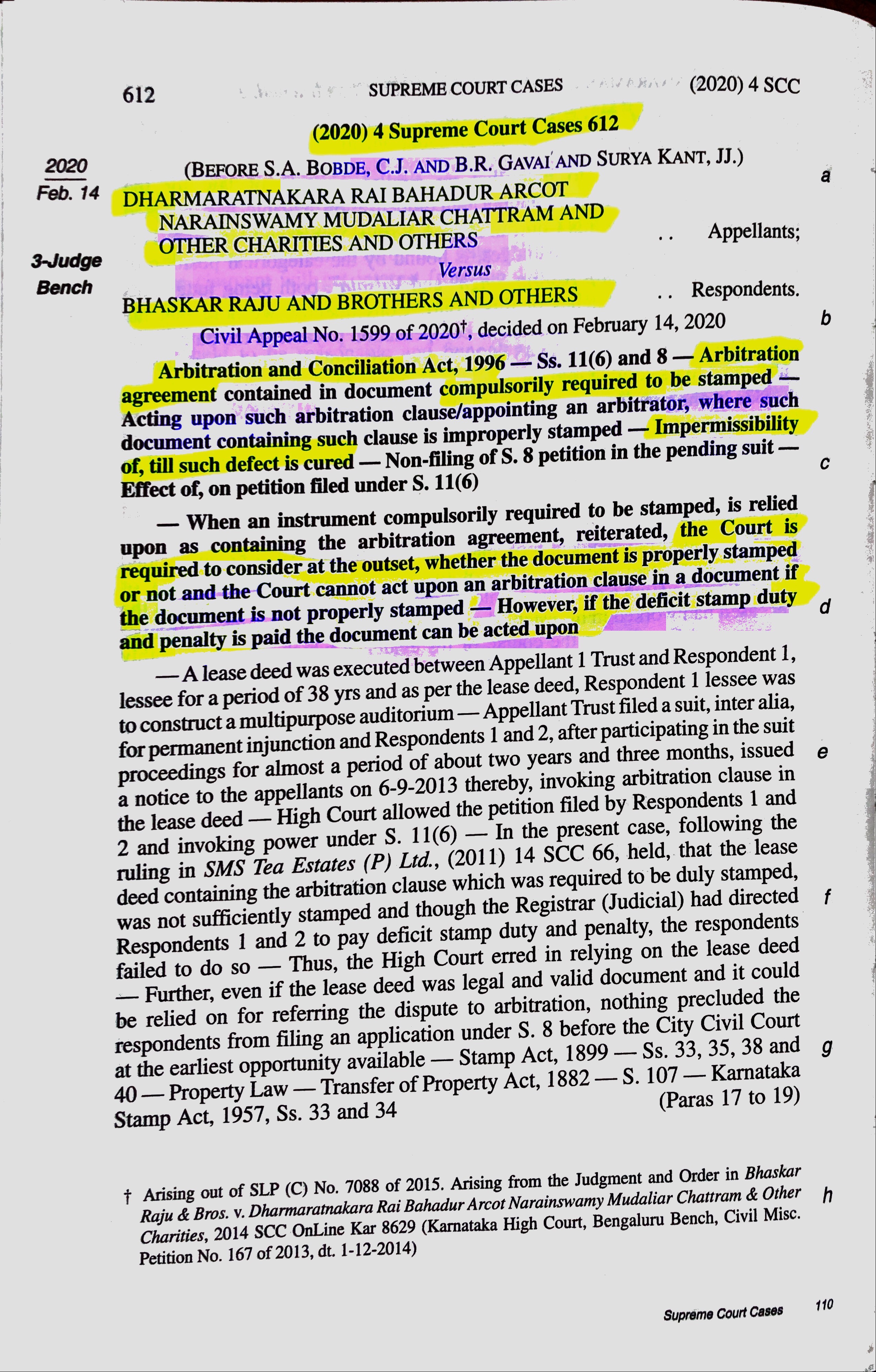
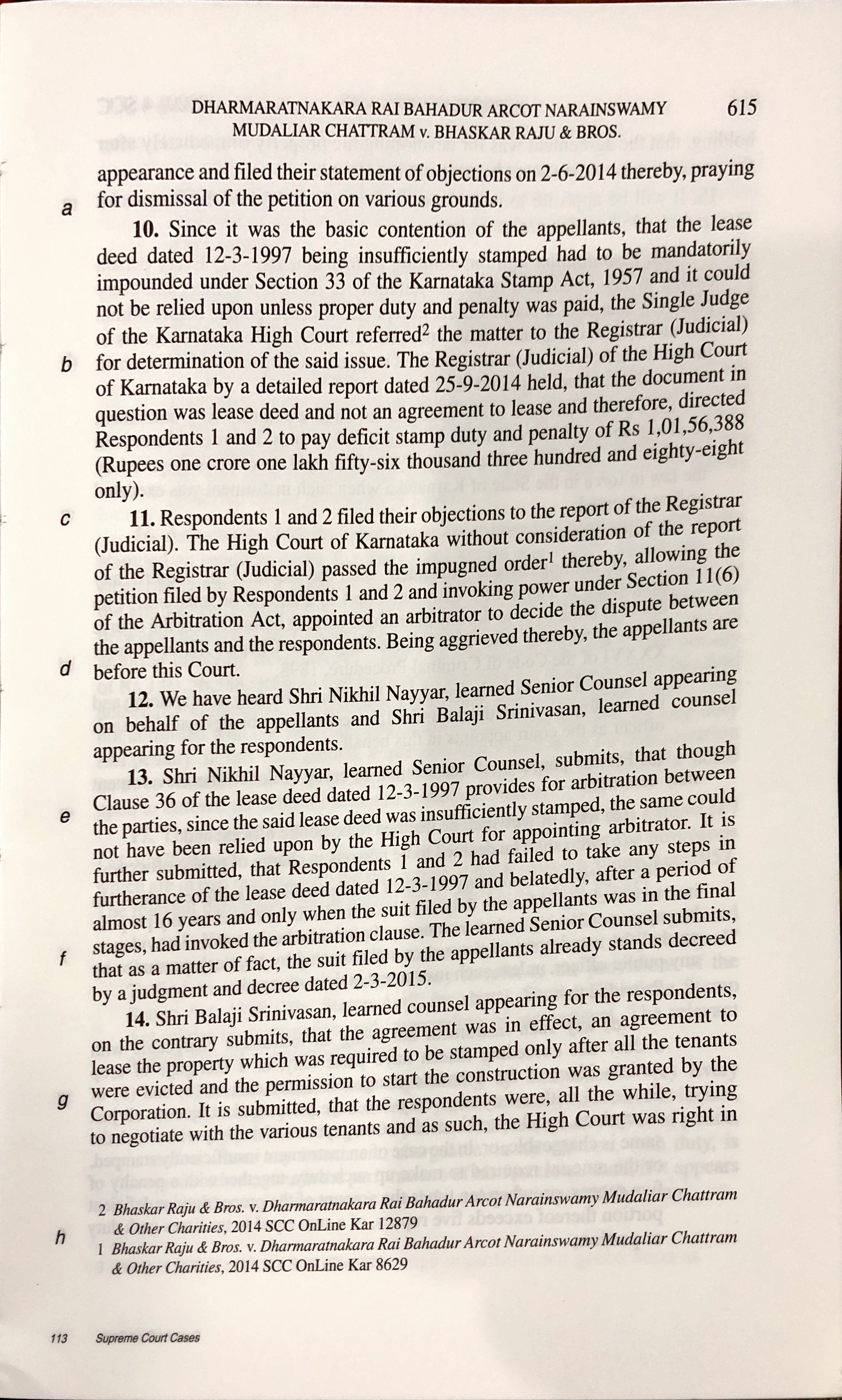
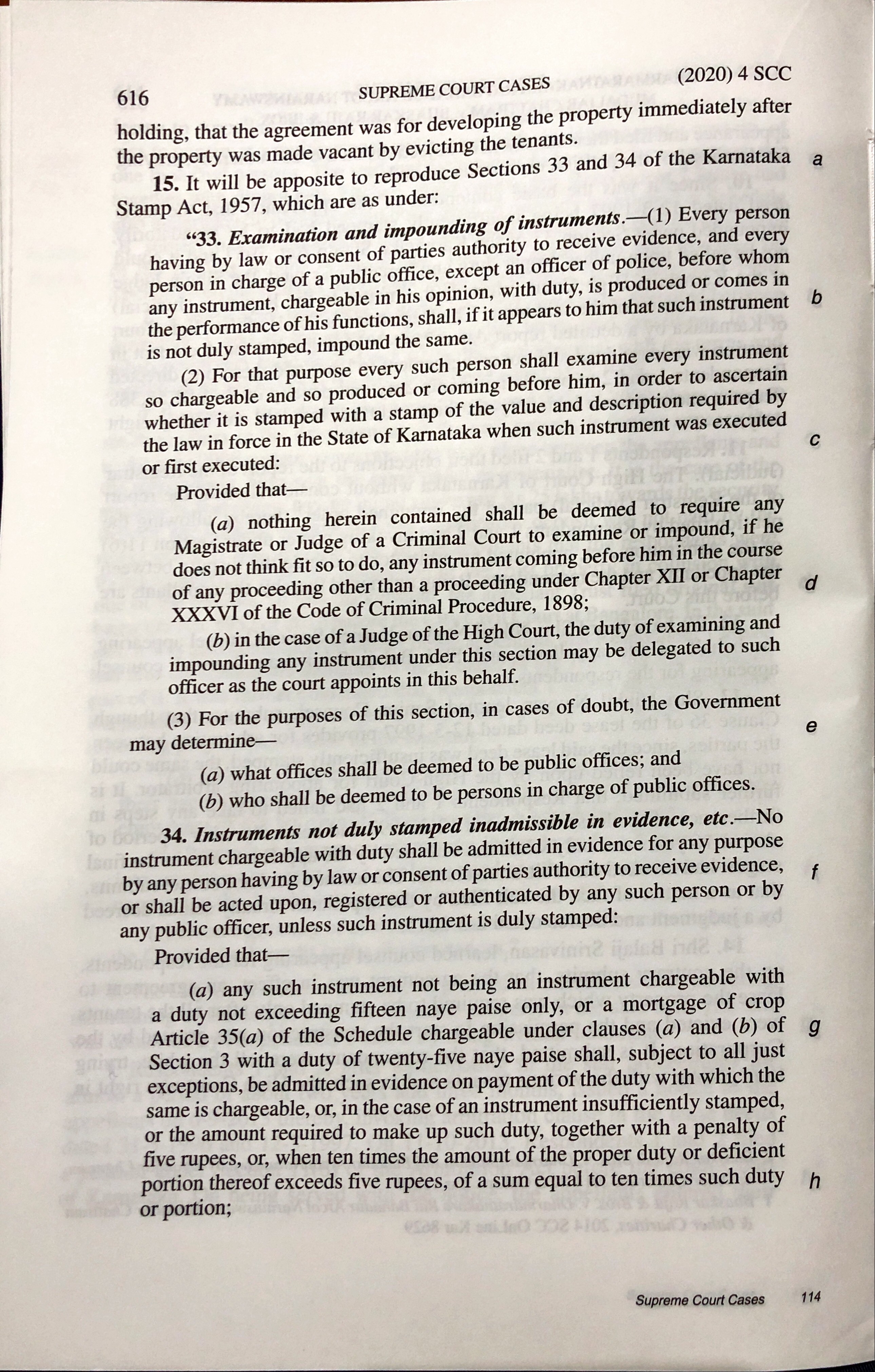
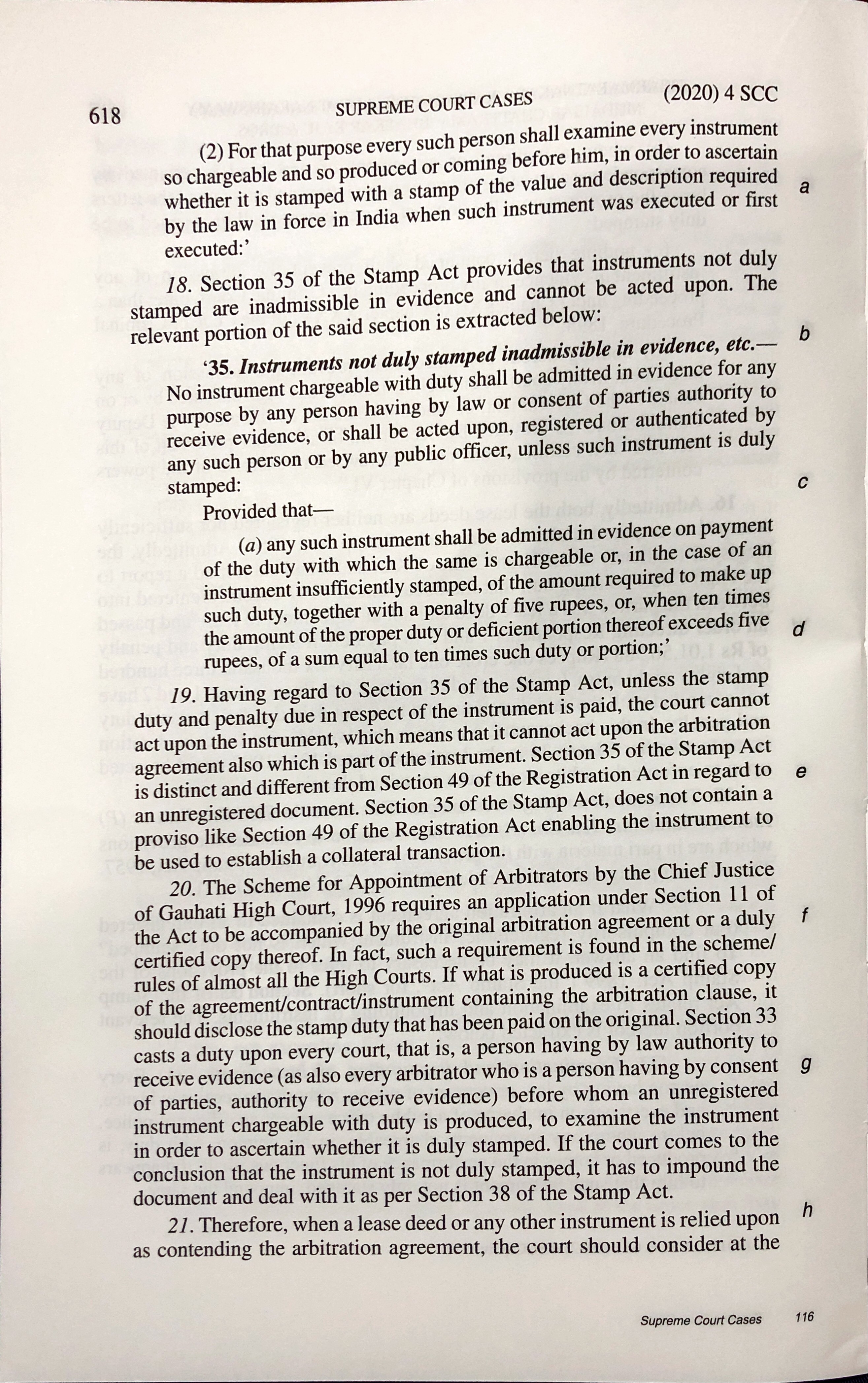
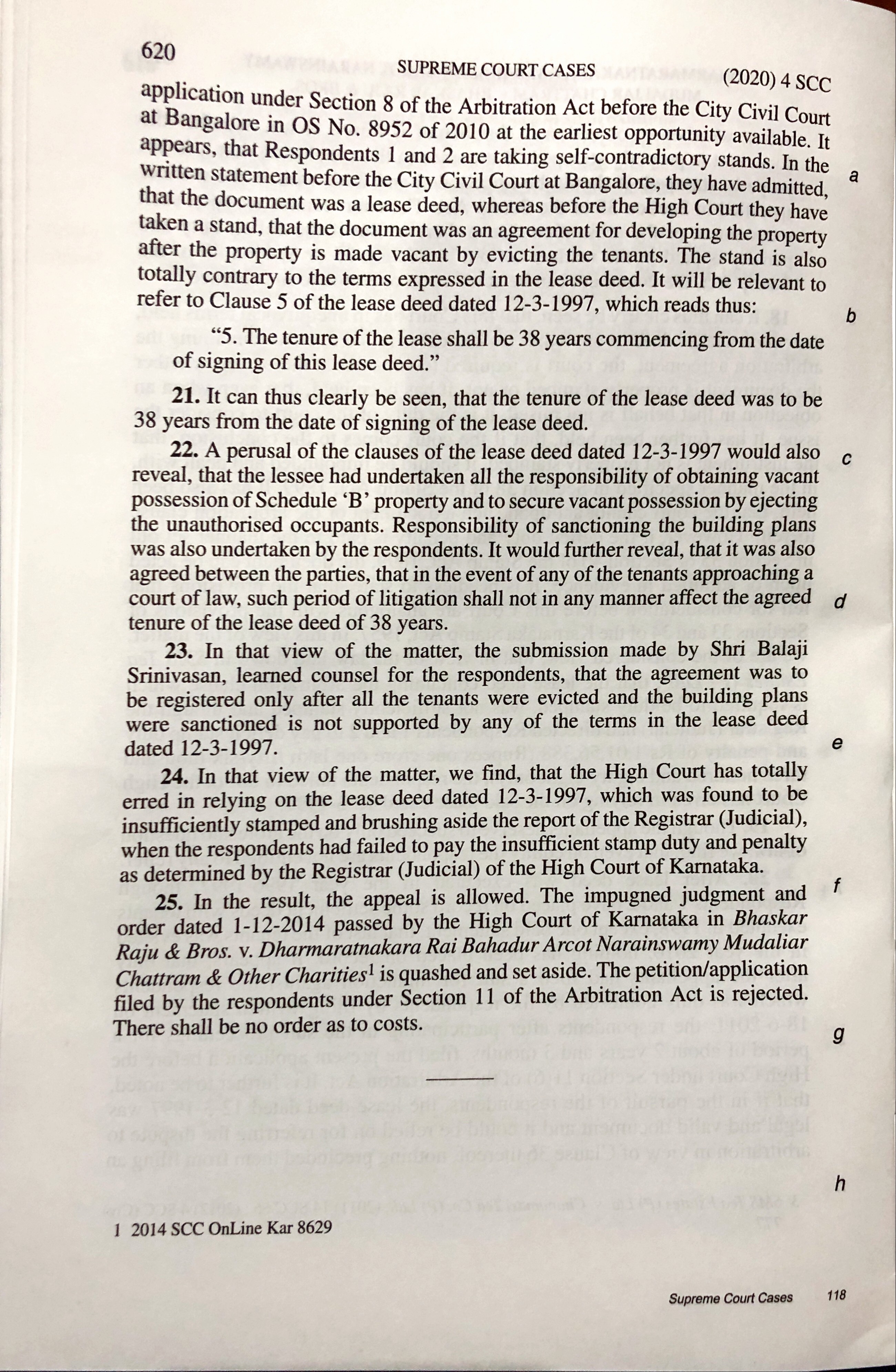
Arbitration agreement. Court has no power to act on it if the document is not stamped.(2020) 4 SCC 612 (judgment enclosed)

Arbitration agreement. Un-stamped or under-stamped document which contains arbitration clause. When the agreement is compulsorily required to be stamped, the court cannot act on such a document. Court can act upon the document only if the deficit stamp duty and penalty is paid.

Dharmadhikara Rai Bahadur Arcot Narrainswamy Mudaliar Chatram and other charities and others. (2020) 4 SCC 612

Daksha Legal seminar on Sri. Padmanabha Swamy temple issue.

Daksha Legal seminar on “Sri. Padmanabha Swamy temple issue”. Today 7 pm. 17 July 2020 on Jio Meet
Key Speaker Sai Deepak J, Advocate, Supreme Court of India and arguing counsel in the matter.
Moderator. S. Basavaraj, Advocate and Founder, Daksha Legal.
Time – 7 pm today 17 July 2020


Link to join https://jiomeetpro.jio.com/shortener?hash=CtjydrYrCao8313dbdb53831594964779408 or enter below Meeting ID to join meeting by entering the Password.
Meeting ID: 024-888-7722
Password: 7m7Mu

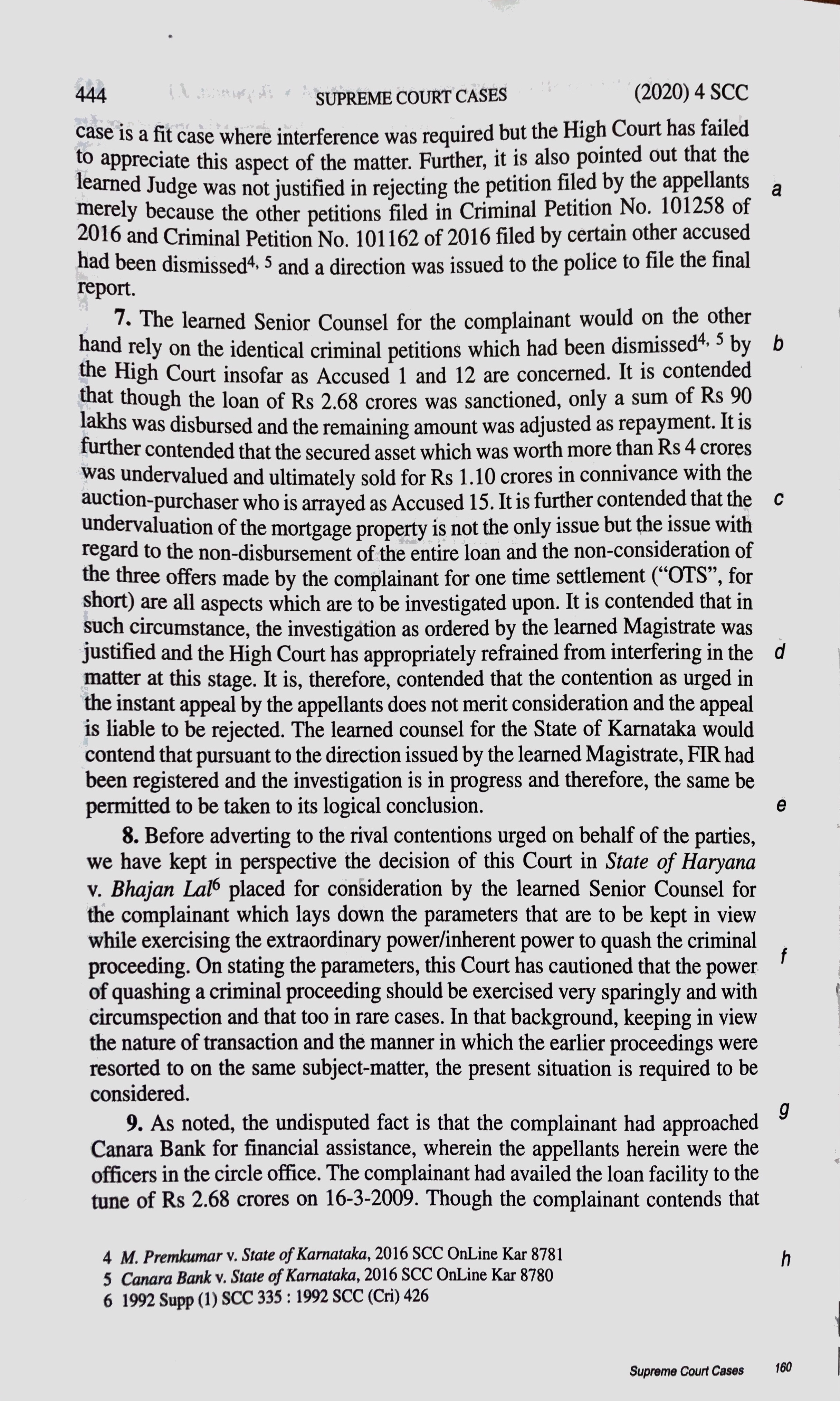
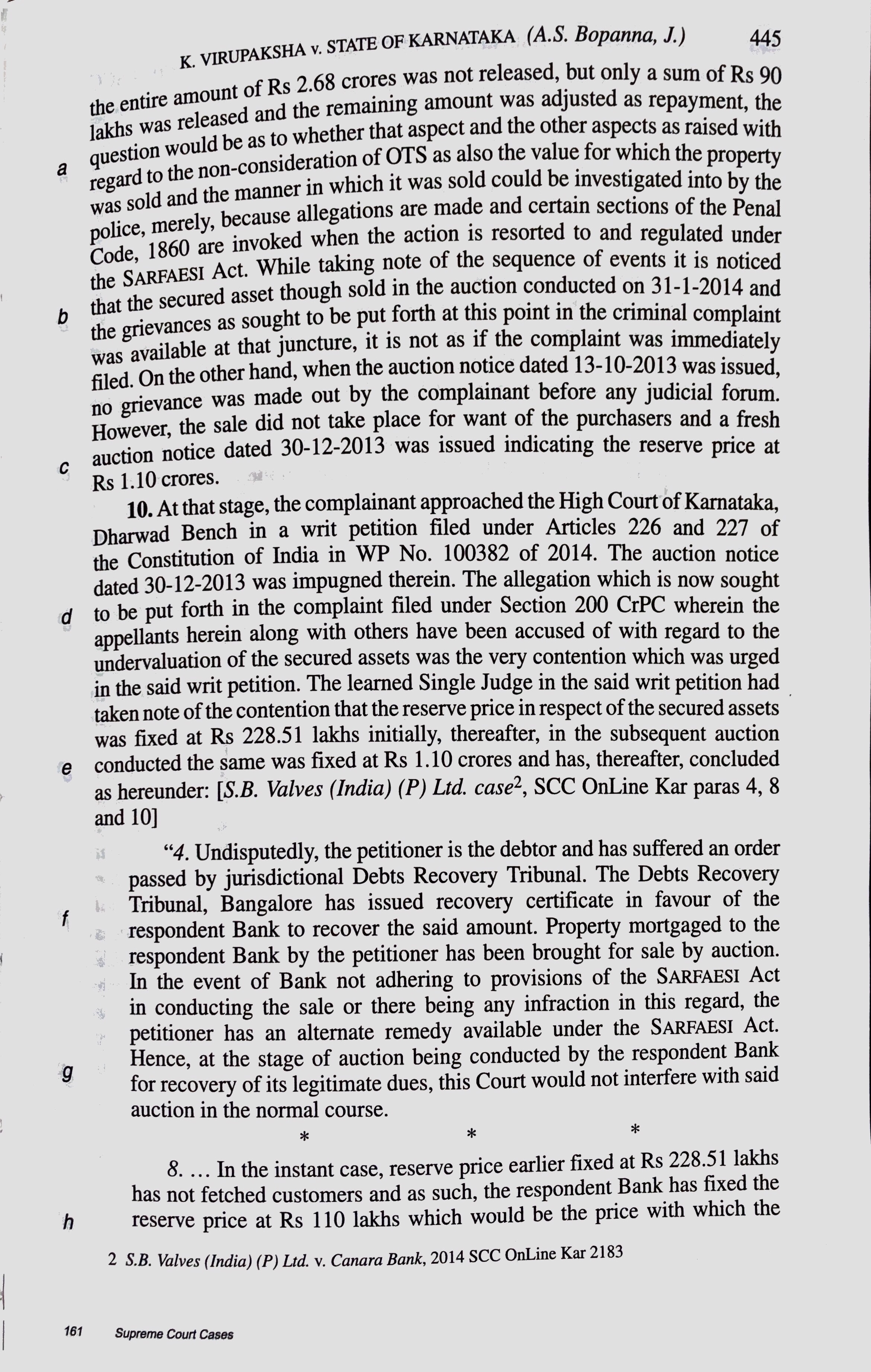
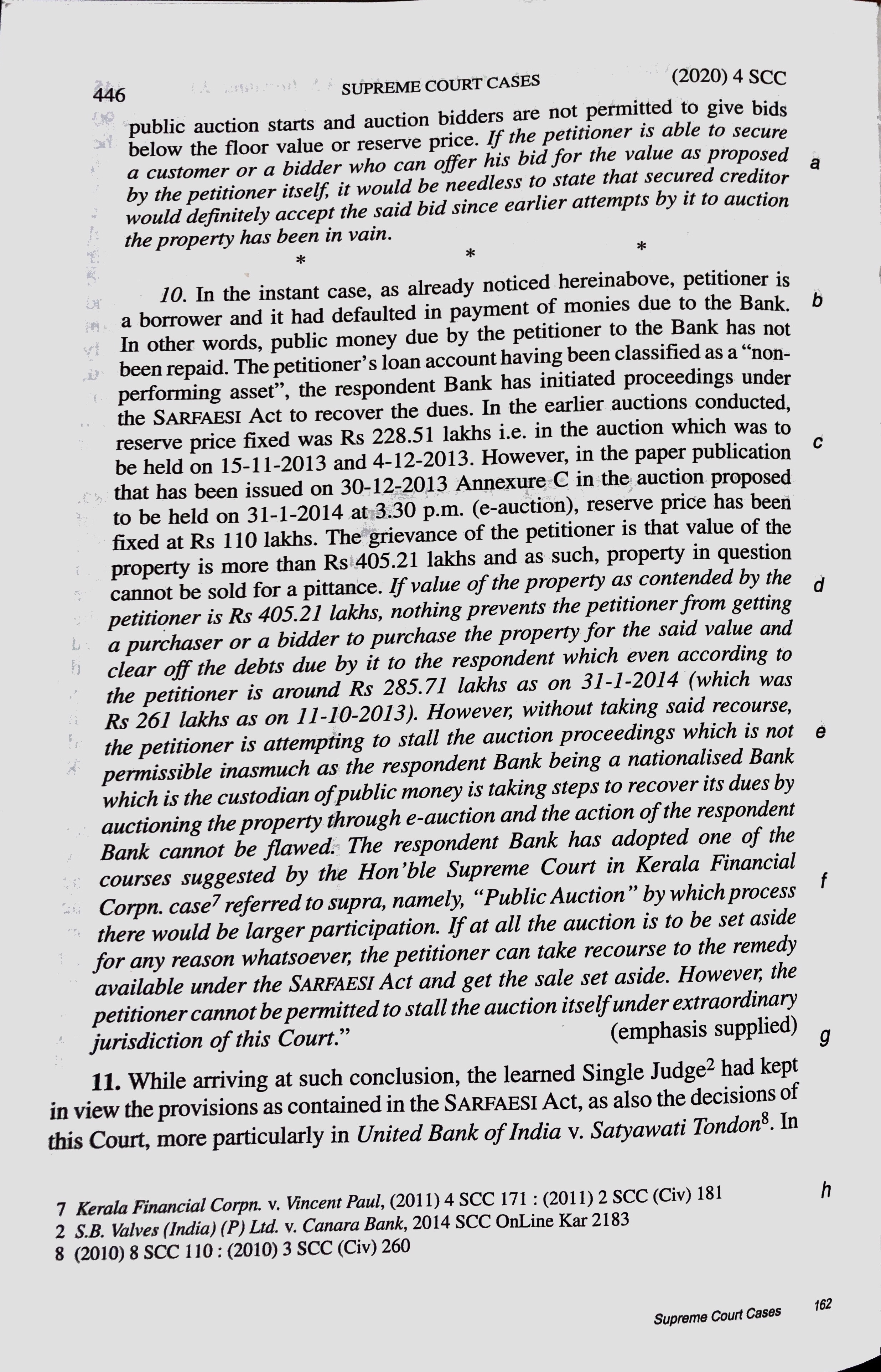
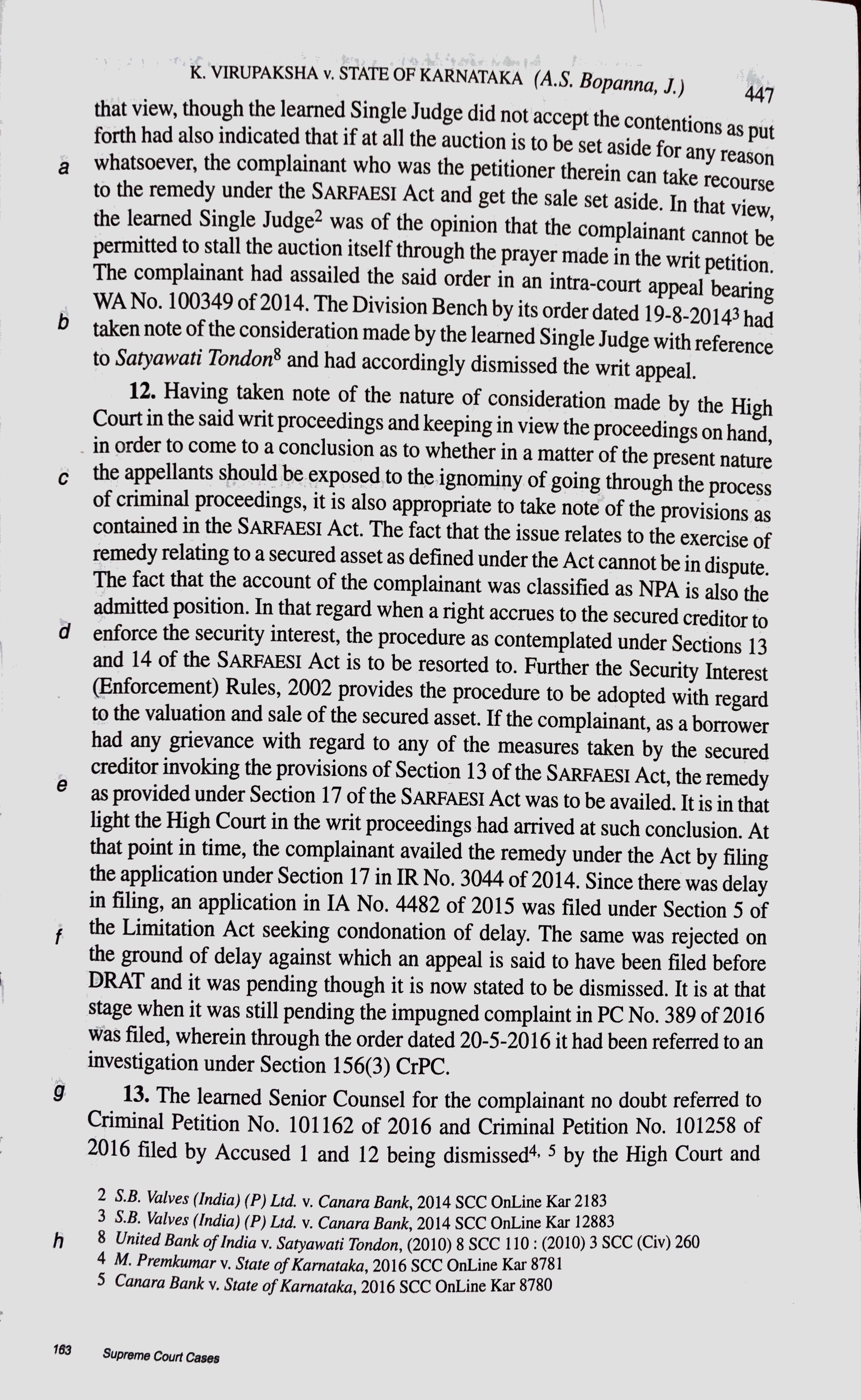
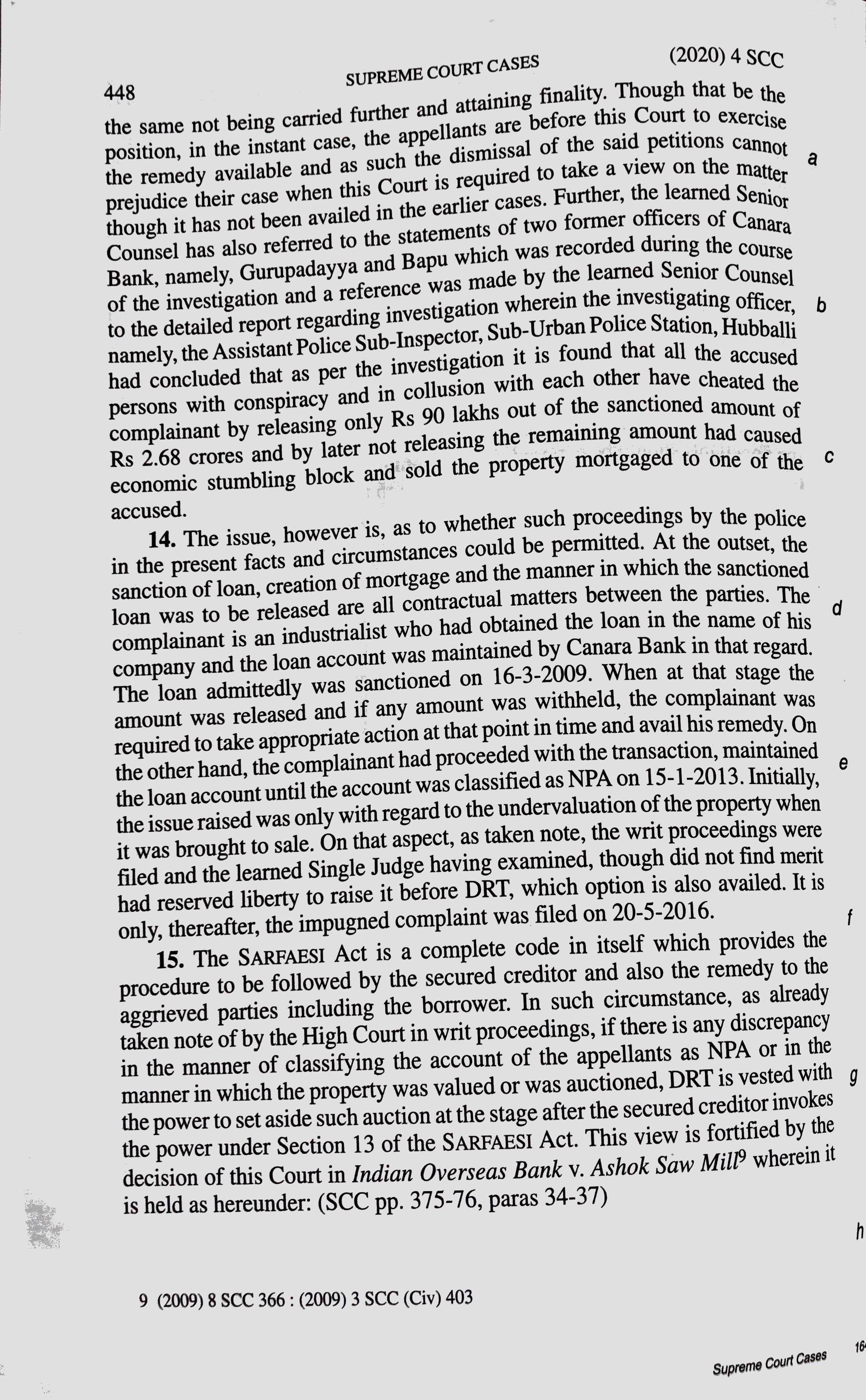
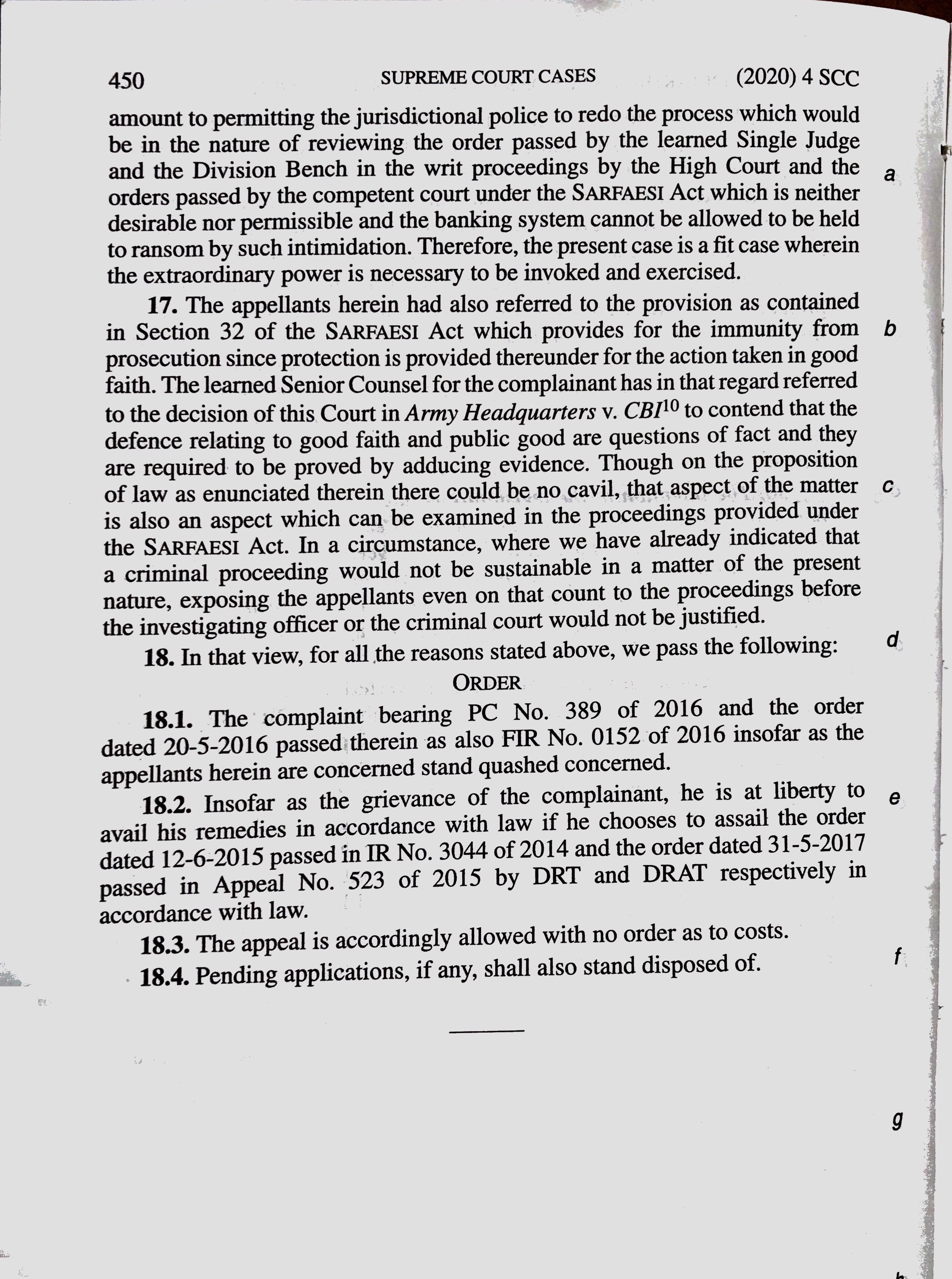
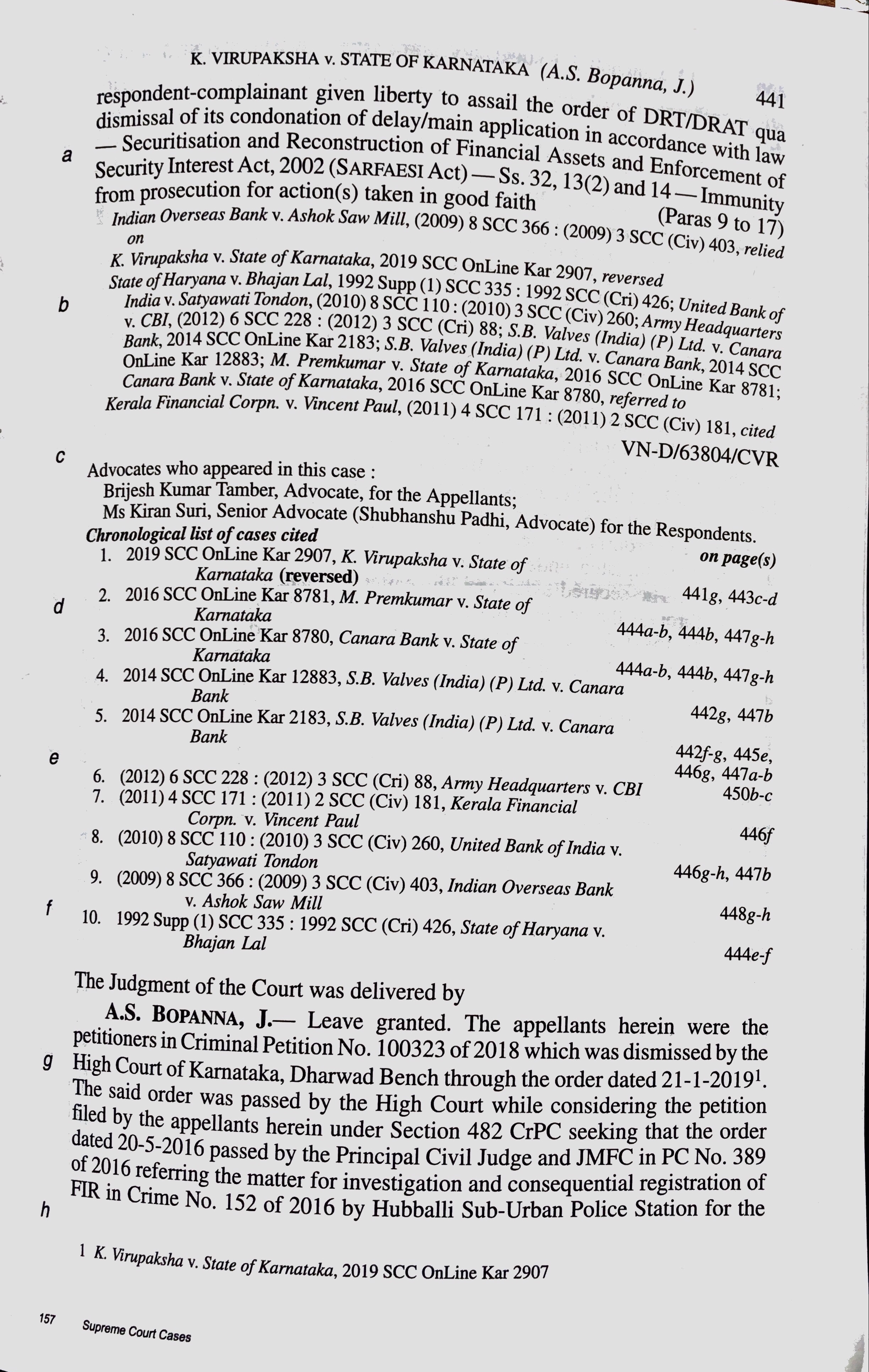
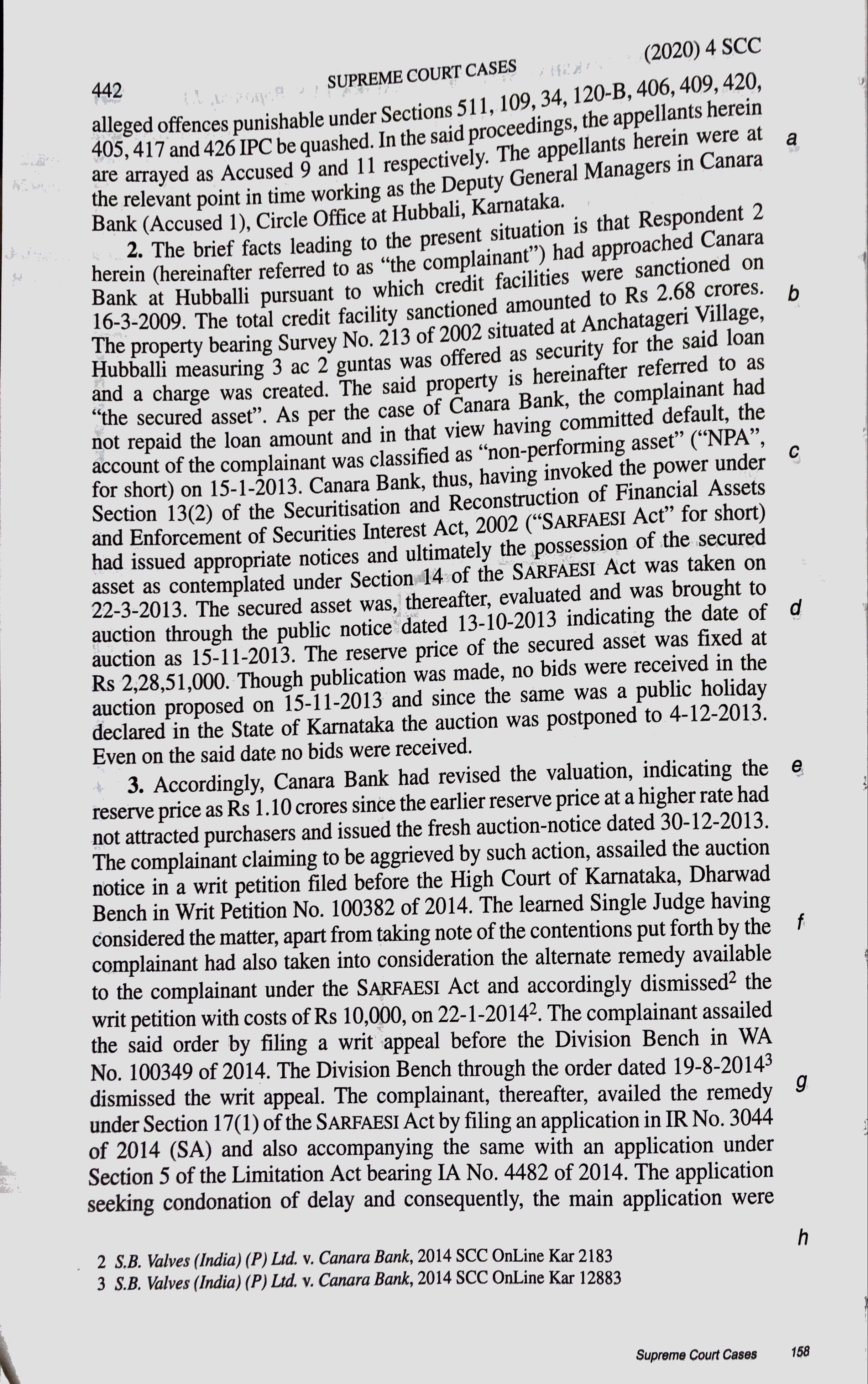
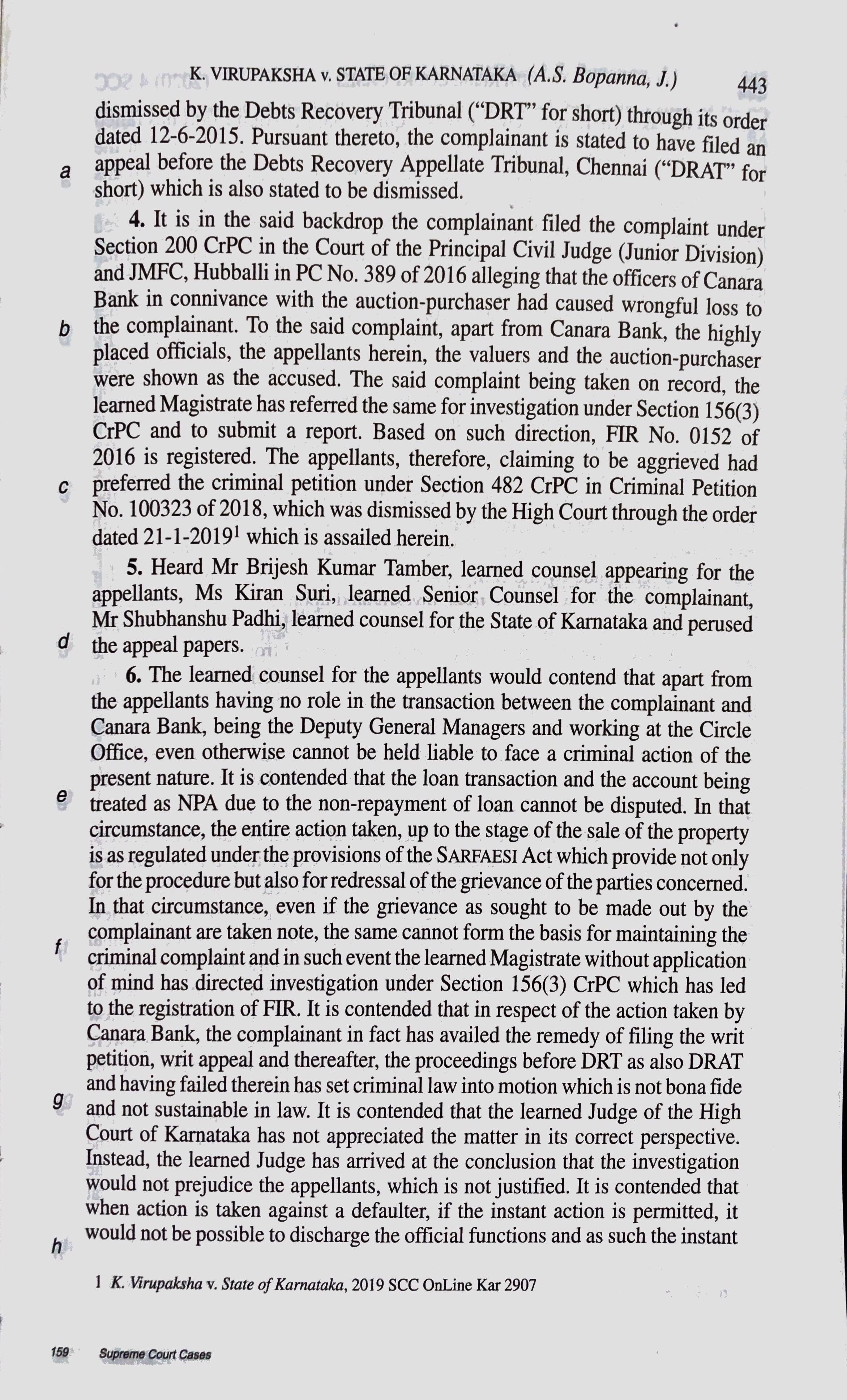
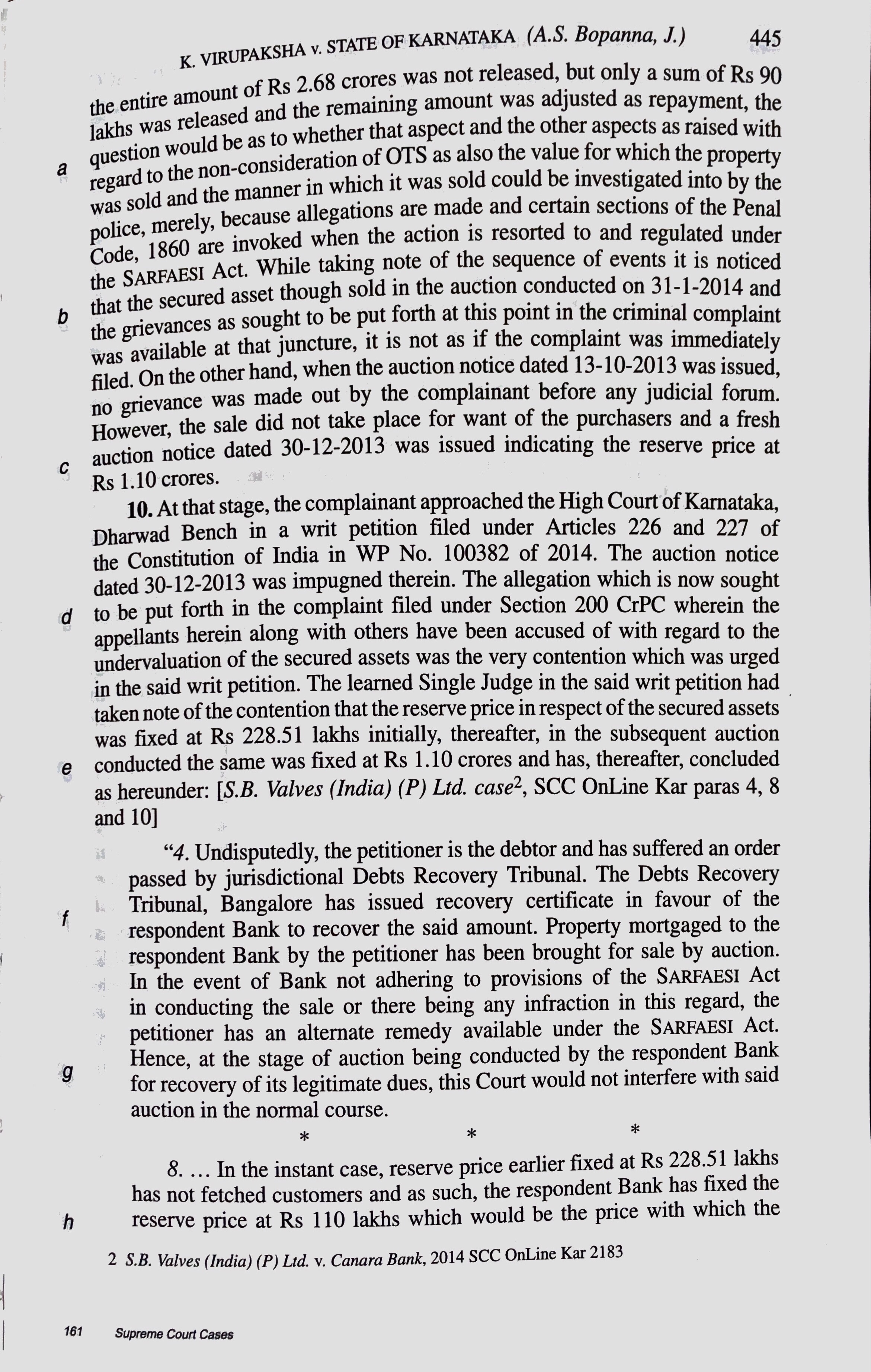
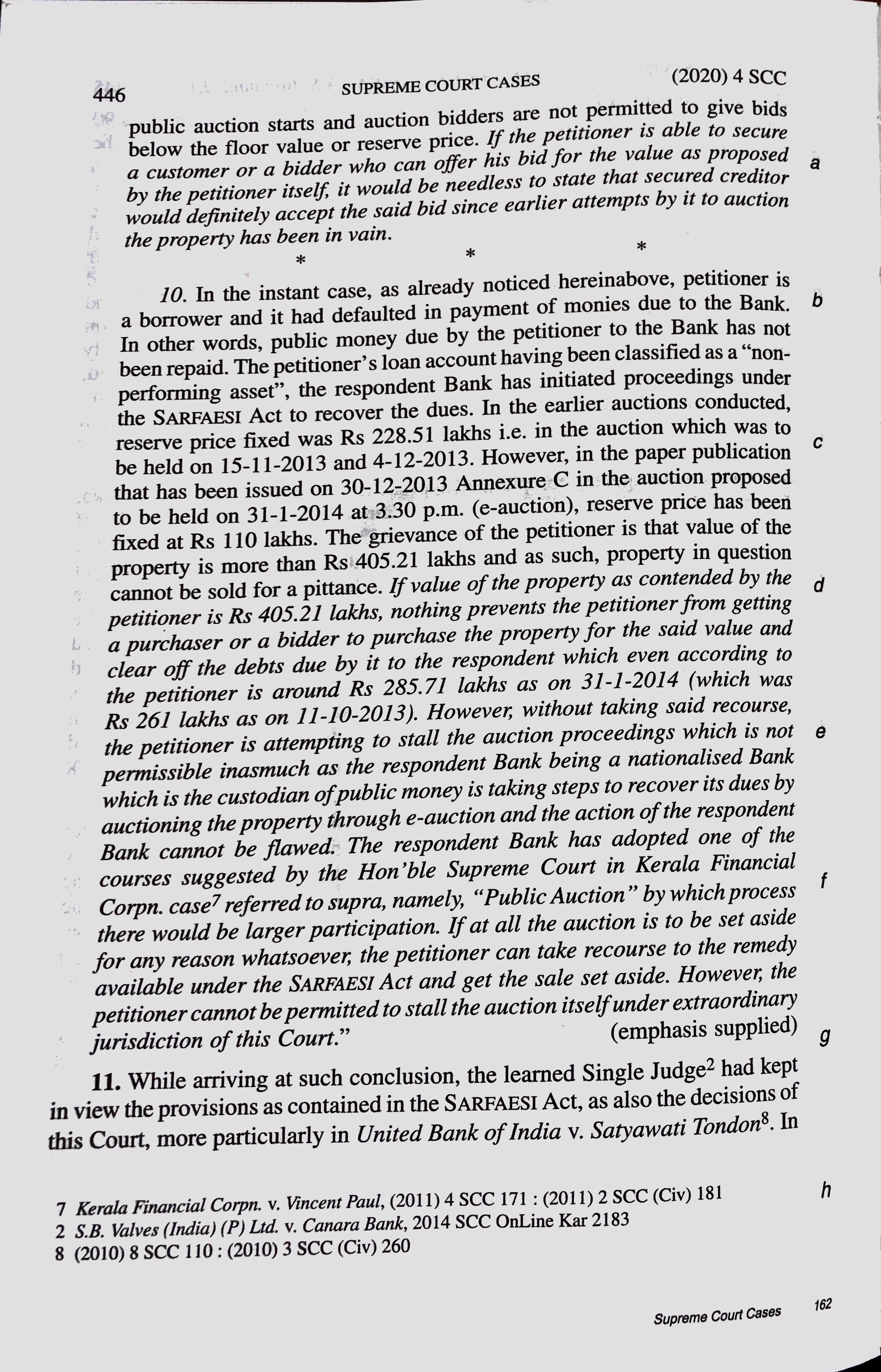
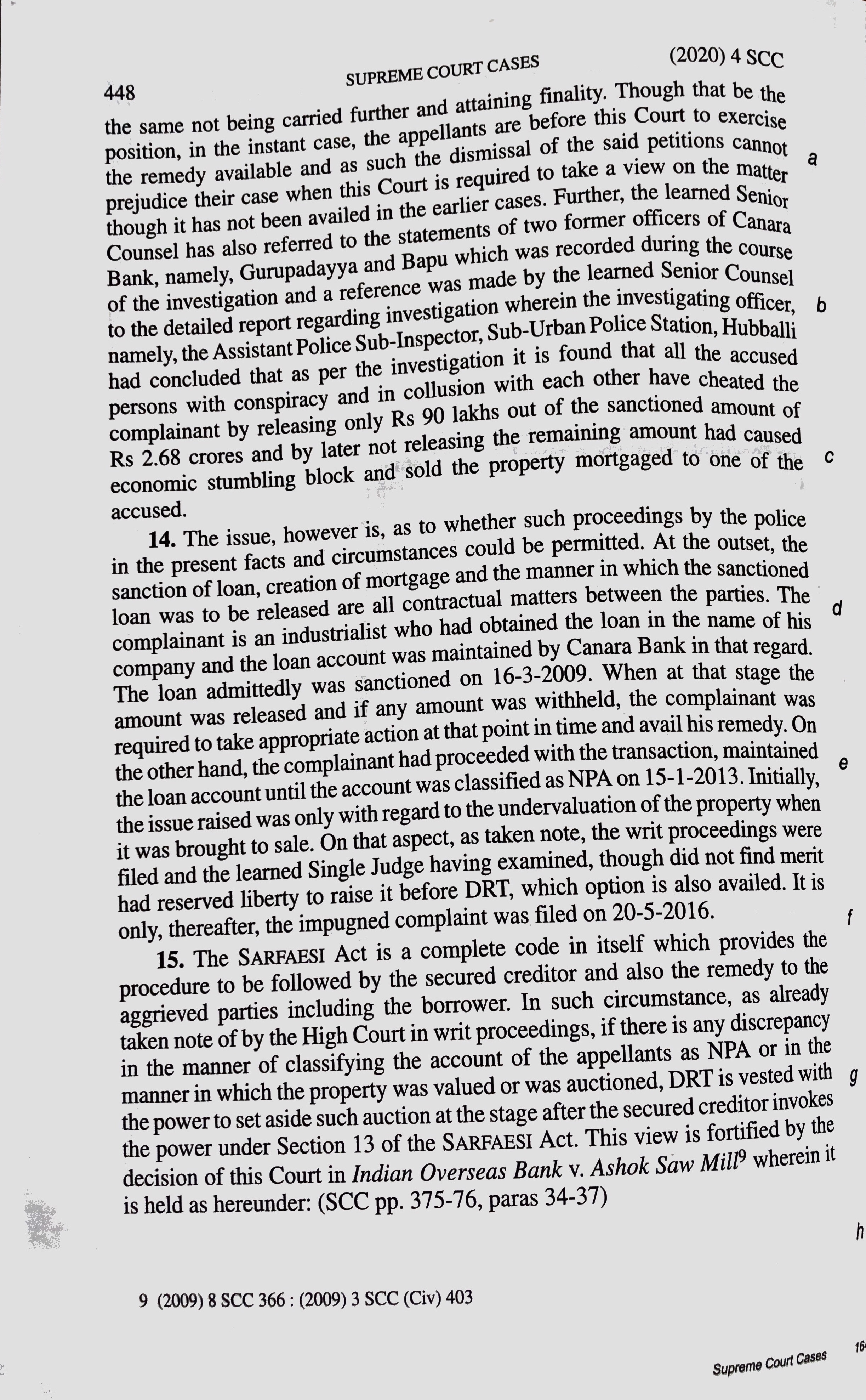
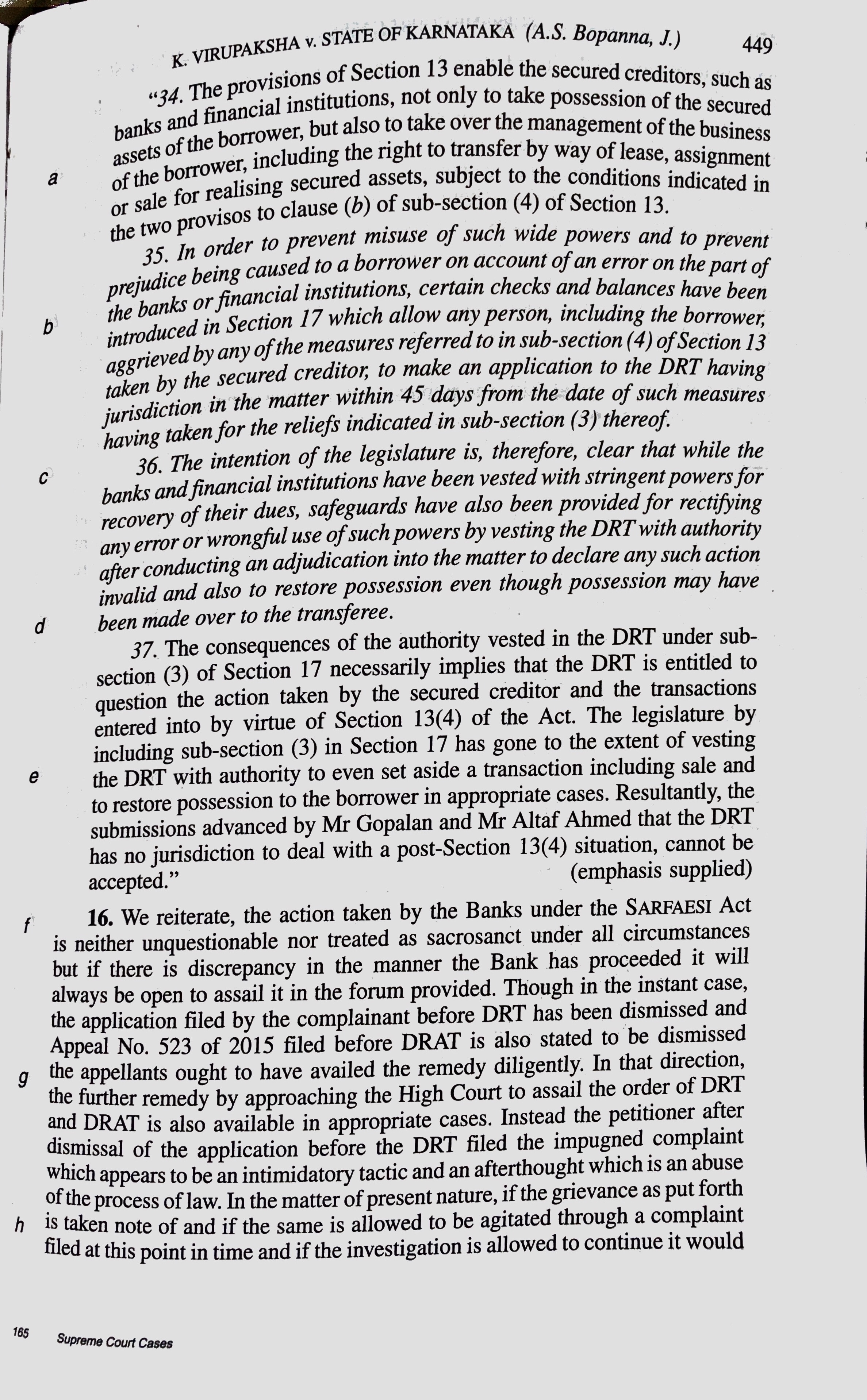
ಸಾಲ ಮ೦ಜೂರು ವಿತರಣೆ ಇತರೆ ಸಿವಿಲ್ ವಿಷಯಗಳ ಬಗ್ಗೆ ಬ್ಯಾ೦ಕ್ ಅಧಿಕಾರಿಗಳ ಮೇಲೆ ಕ್ರಿಮಿನಲ್ ಮೊಕದ್ದಮೆ ಹೂಡಲು ಬರುವುದಿಲ್ಲ. ಸರ್ಫ಼ಾಸಿ ಕಾಯ್ದೆ ಅಡಿ ಕ್ರಮ ಕೈಗೊಳ್ಳಬಹುದು. ಸರ್ವೋಚ್ಚ ನ್ಯಾಯಾಲಯ. (ತೀರ್ಪು ಲಗತ್ತಿಸಿದೆ)

ಸಾಲ ಮ೦ಜೂರು ವಿತರಣೆ ಇತರೆ ಸಿವಿಲ್ ವಿಷಯಗಳ ಬಗ್ಗೆ ಬ್ಯಾ೦ಕ್ ಅಧಿಕಾರಿಗಳ ಮೇಲೆ ಕ್ರಿಮಿನಲ್ ಮೊಕದ್ದಮೆ ಹೂಡಲು ಬರುವುದಿಲ್ಲ. ಸರ್ಫ಼ಾಸಿ ಕಾಯ್ದೆ ಅಡಿ ಕ್ರಮ ಕೈಗೊಳ್ಳಬಹುದು. ಸರ್ವೋಚ್ಚ ನ್ಯಾಯಾಲಯ. ಸಾಲವನ್ನು ಸರಿಯಾದ ಸಮಯದಲ್ಲಿ ವಿತರಣೆ ಮಾಡದ್ದರಿ೦ದ ತನಗೆ ನಷ್ಟವಾಗಿದೆ ಎ೦ದು ಕ್ರಿಮಿನಲ್ ಮೊಕದ್ದಮೆಯನ್ನು ಸಾಲಗಾರರು ಹೂಡಿದ್ದರು. ಇದನ್ನು ಸರ್ವೋಚ್ಚ ನ್ಯಾಯಾಲಯವು ವಜಾಗೊಳಿಸಿ ಸಾಲಗಾರನು ಸರ್ಫ಼ಾಸಿ ಕಾಯ್ದೆ ಅಡಿ ಕ್ರಮ ಕೈಗೊಳ್ಳಬಹುದೆ೦ದು ಅಭಿಪ್ರಾಯಪಟ್ಟಿದೆ

ಕೆ. ವಿರುಪಾಕ್ಶ ಮತ್ತು ಇತರರು -ವಿರುದ್ದ- ಕರ್ನಾಟಕ ರಾಜ್ಯ ಮತ್ತು ಇನ್ನೊಬ್ಬರು
(2020) 4 ಎಸ್.ಸಿ.ಸಿ. 440

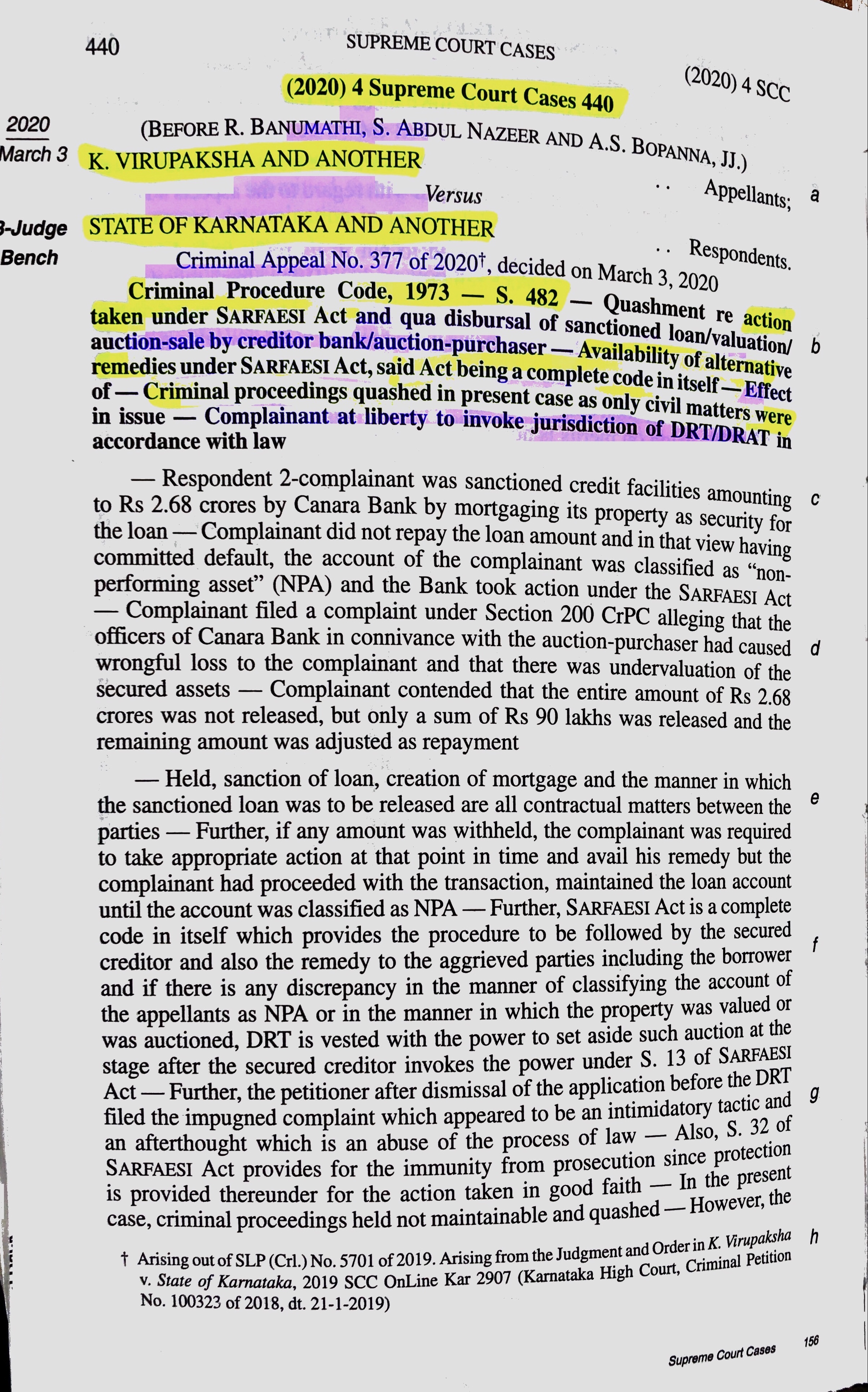
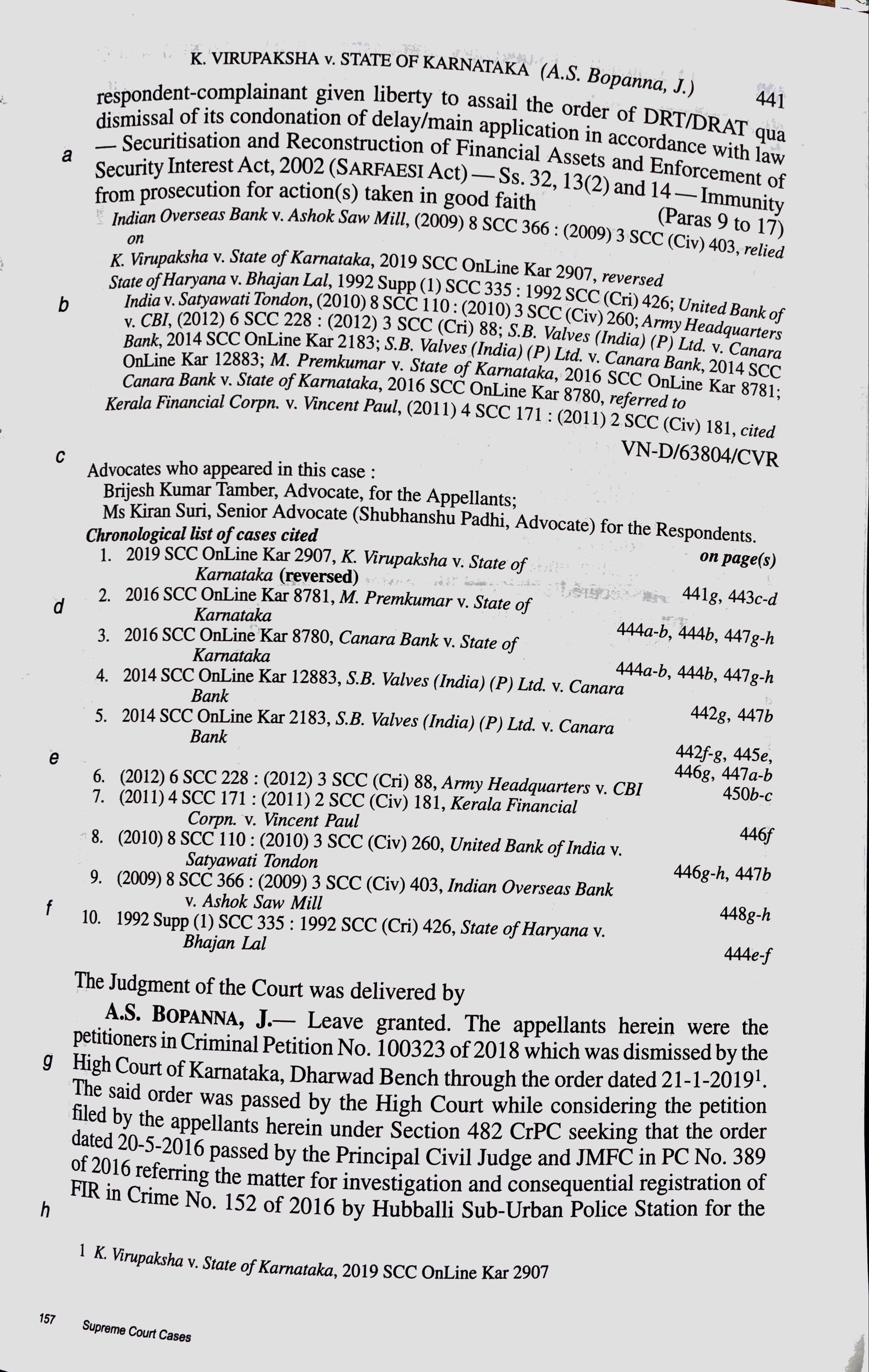
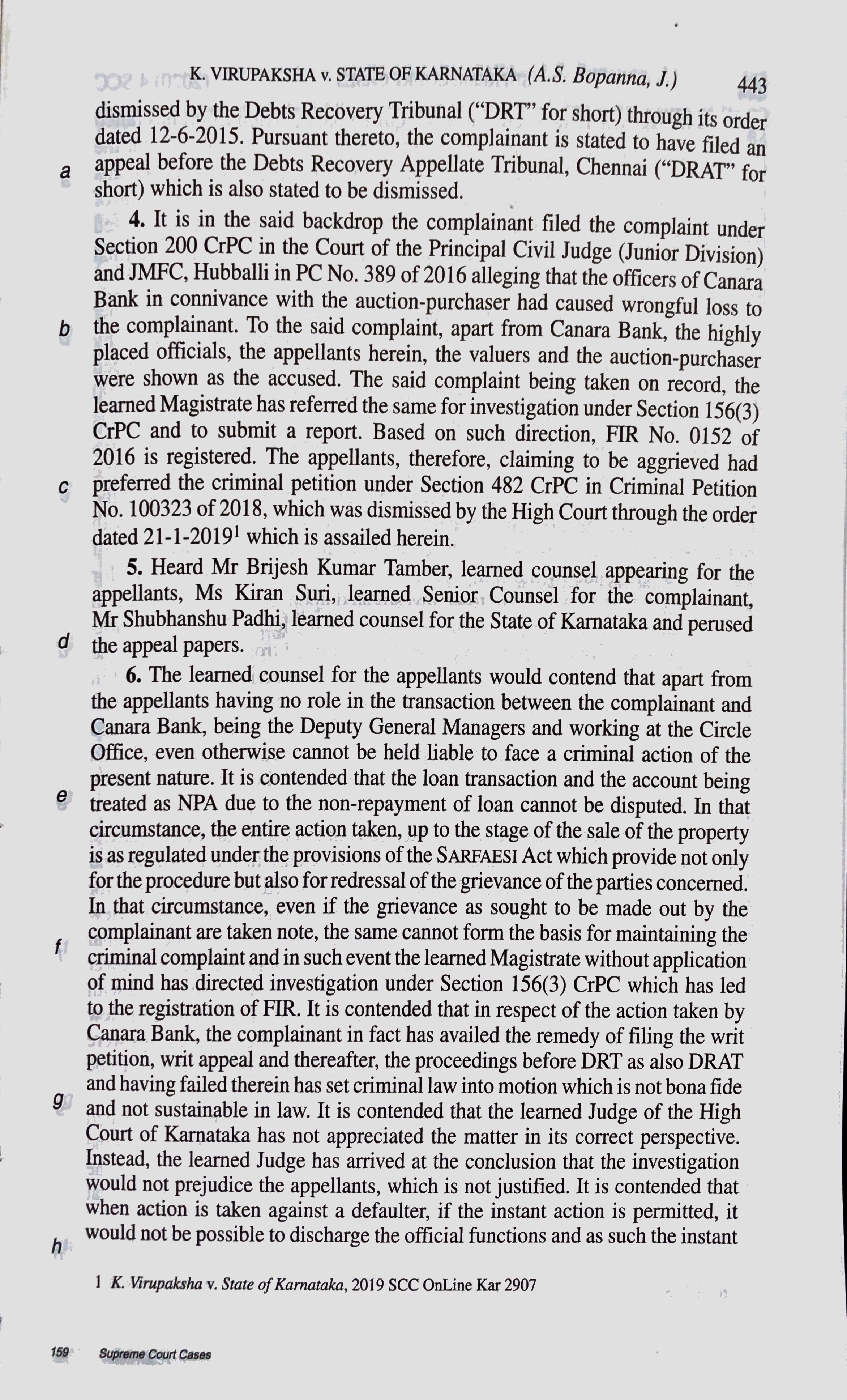
Criminal proceedings against Bank officials regarding sanction and disbursement of loan – not maintainable since remedy is under SARFAESI Act. (Judgment enclosed)

Criminal proceedings against Bank officials. Complaint that the bank officers acted illegally in not fully sanctioning the loan and caused loss to borrower. Alternative remedy available under SARFAESI Act. Criminal proceedings on the allegations which are civil in nature are liable to be quashed.Sanction of loan, creation of mortgage and the manner in which the sanctioned loan was to be released or all contractual matters between the parties. Karnataka High Court judgment reversed.

K. Virupaksha and another vs State of Karnataka and others. (2020) 4 SCC 440

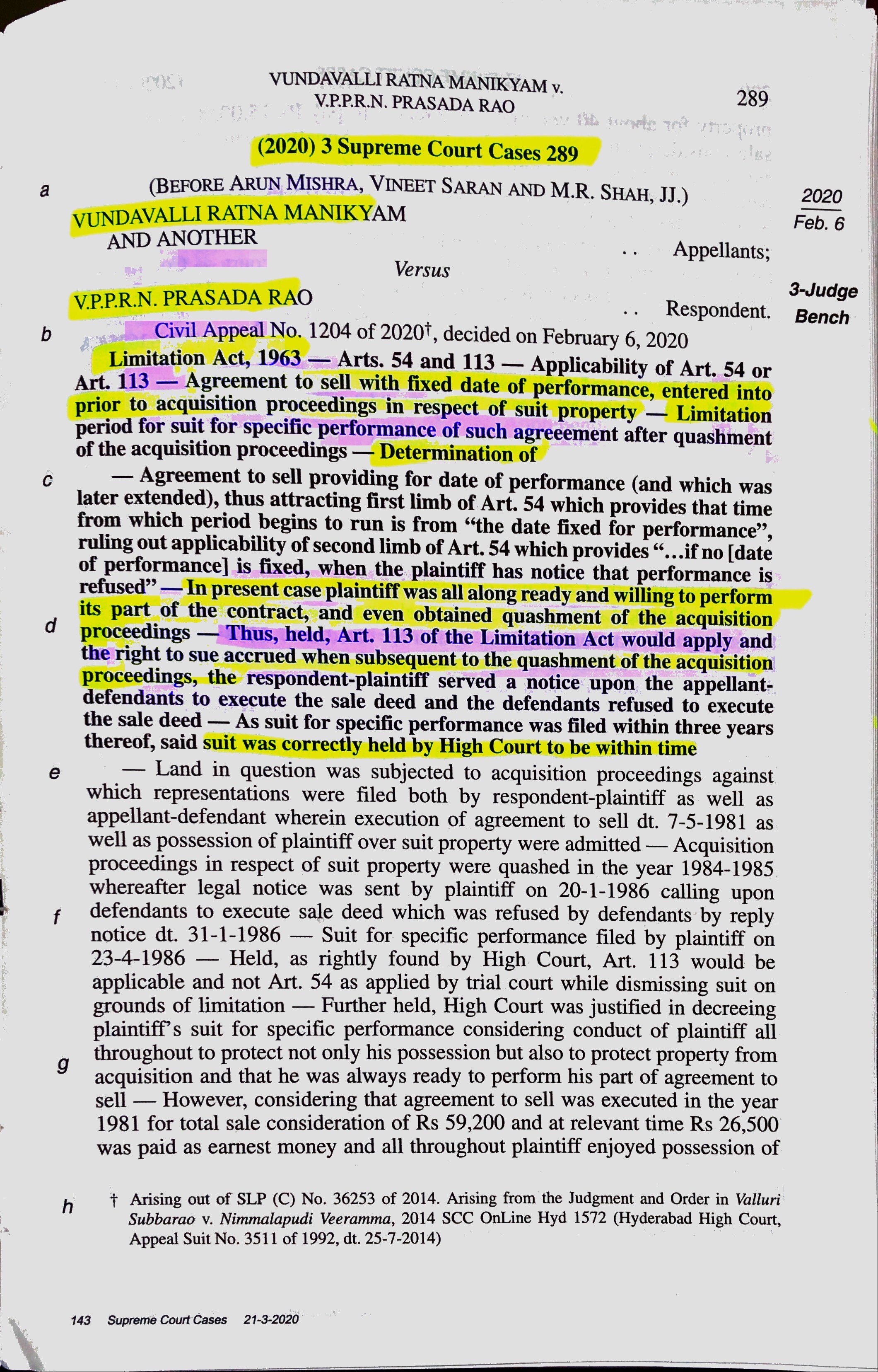
ನಿರ್ದಿಷ್ಟ ಕಾರ್ಯಕ್ಷಮತೆಗಾಗಿ ದಾವೆ. (ಸೂಟ್ ಫ಼ಾರ್ ಸ್ಪೆಸಿಫ಼ಿಕ್ ಪರ್ಫ಼ಾರ್ಮೆನ್ಸ್). ಕಾಲಮಿತಿ.

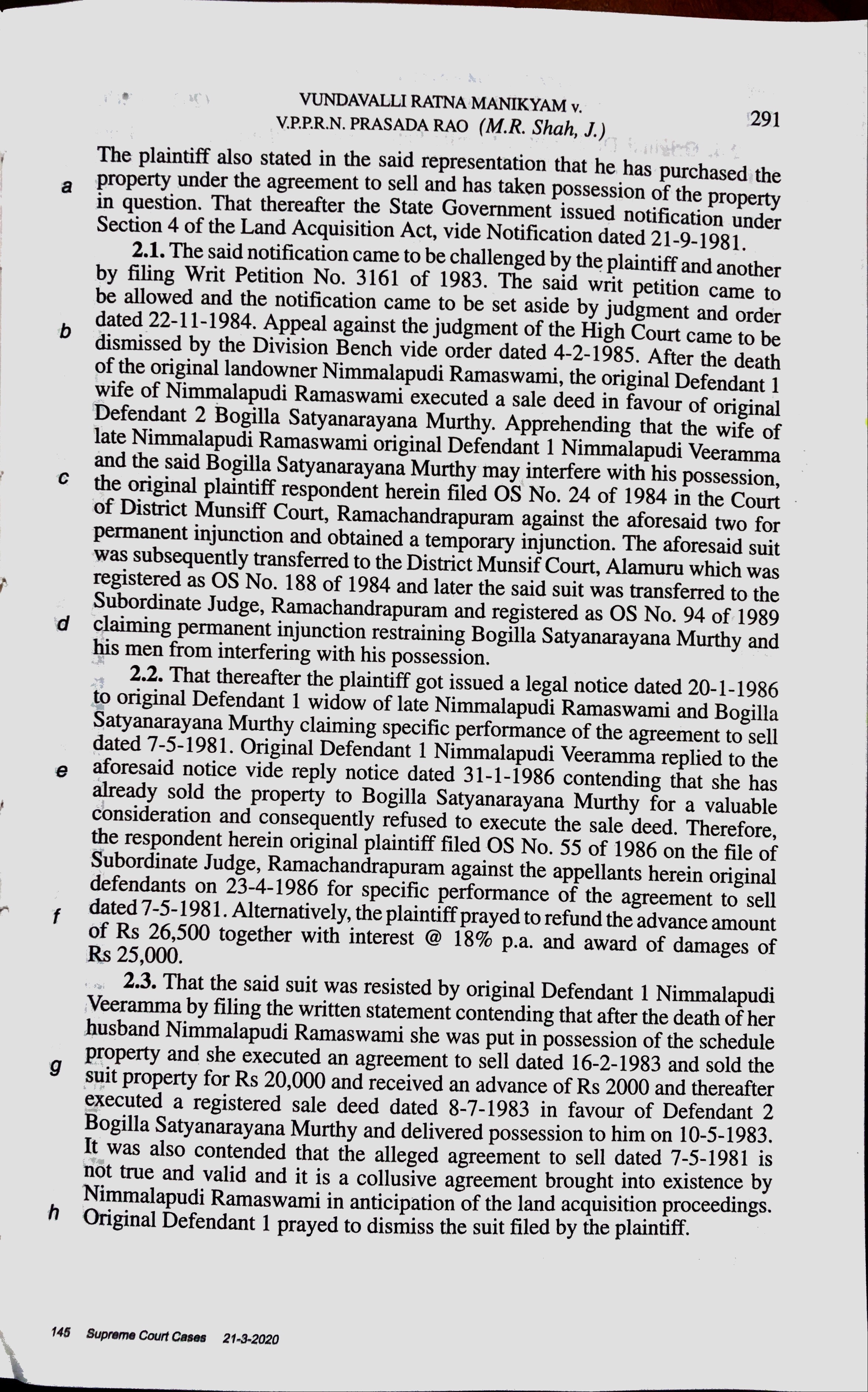
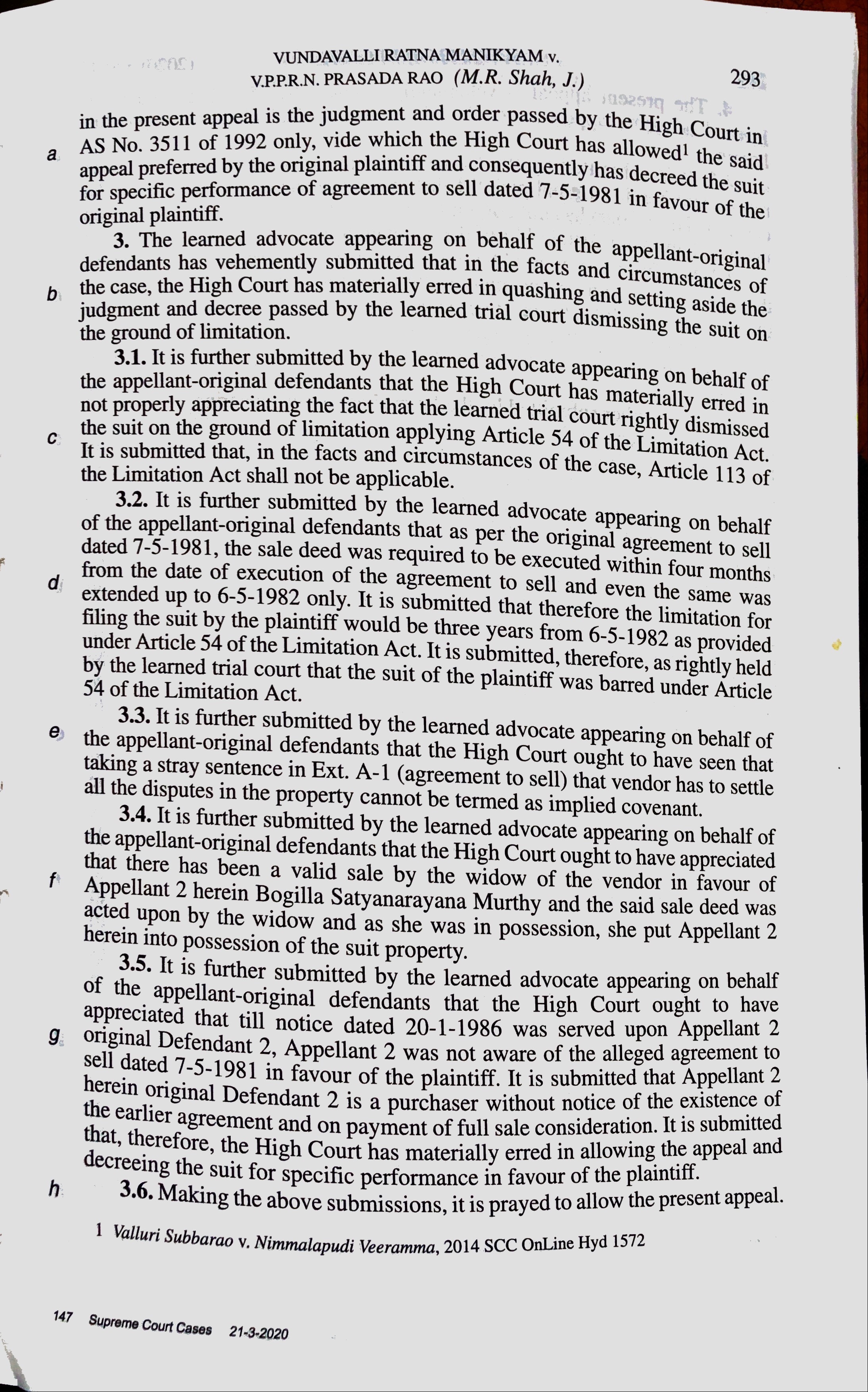
ನಿರ್ದಿಷ್ಟ ಕಾರ್ಯಕ್ಷಮತೆಗಾಗಿ ದಾವೆ. ಸೂಟ್ ಫ಼ಾರ್ ಸ್ಪೆಸಿಫ಼ಿಕ್ ಪರ್ಫ಼ಾರ್ಮೆನ್ಸ್. ಕಾಲಮಿತಿ. ಖರೀದಿಗೆ ಒಪ್ಪ೦ದವಾದ ಜಮೀನು ಒಪ್ಪ೦ದದ ನ೦ತರ ಭೂಸ್ವಾದೀನಕ್ಕೆ ಒಳಪಡುತ್ತದೆ. ಖರೀದಿದಾರನು ಜಮೀನನ್ನು ಭೂಸ್ವಾದೀನದಿ೦ದ ಹೊರತರಲು ದಾವೆ ಹೂಡಿ ಜಯಗಳಿಸುತ್ತಾನೆ. ಆದರೆ ನ೦ತರ ಮಾರಾಟಗಾರನು ಜಮೀನನ್ನು ಮಾರಾಟ ಮಾಡಲು ನಿರಾಕರಿಸುತ್ತಾನೆ. ಇ೦ತ ಸನ್ನಿವೇಶದಲ್ಲಿ, ನಿರ್ದಿಷ್ಟ ಕಾರ್ಯಕ್ಷಮತೆಗಾಗಿ ದಾವೆ ಹೂಡಲು ಕಾಲಮಿತಿಯು, ಜಮೀನು ಭೂಸ್ವಾದೀನದಿ೦ದ ಹೊರಬ೦ದ ನ೦ತರವೇ ಉ೦ಟಾಗುತ್ತದೆ. ಆದ್ದರಿ೦ದ ವಾದಿಯು ಹೂಡಿದ ದಾವೆಯು ಕಾಲಮಿತಿಯ ಒಳಗಿದೆ. ಹಾಗೂ ವಾದಿಯು ಯಾವತ್ತೂ ಜಮೀನು ಕೊಳ್ಳಲು ತಯಾರಿದ್ದಾನೆ. ದಾವೆಯನ್ನು ಉಚ್ಚನ್ಯಾಯಾಯಲವು ಪುರಸ್ಕರಿಸಿರುವುದು ಸರಿ ಇದೆ. ಆದರೆ ವಿಳ೦ಬದ ಕಾರಣ ಮಾರಾಟದ ದರವನ್ನು ರೂ. 59,200 ರಿ೦ದ ರೂ. 15,00,000 ಕ್ಕೆ ಏರಿಸಲಾಗಿದೆ.
ಉ೦ಡವಲ್ಲಿ ರತ್ನ ಮಾಣಿಕ್ಯ೦ ವ್ಸ್ ವಿ.ಪಿ.ಪಿ.ಆರ್.ಎನ್. ಪ್ರಸಾದ ರಾವ್
(2020) 3 ಎಸ್. ಸಿ. ಸಿ. 289

(ತೀರ್ಪು ಲಗತ್ತಿಸಿದೆ)

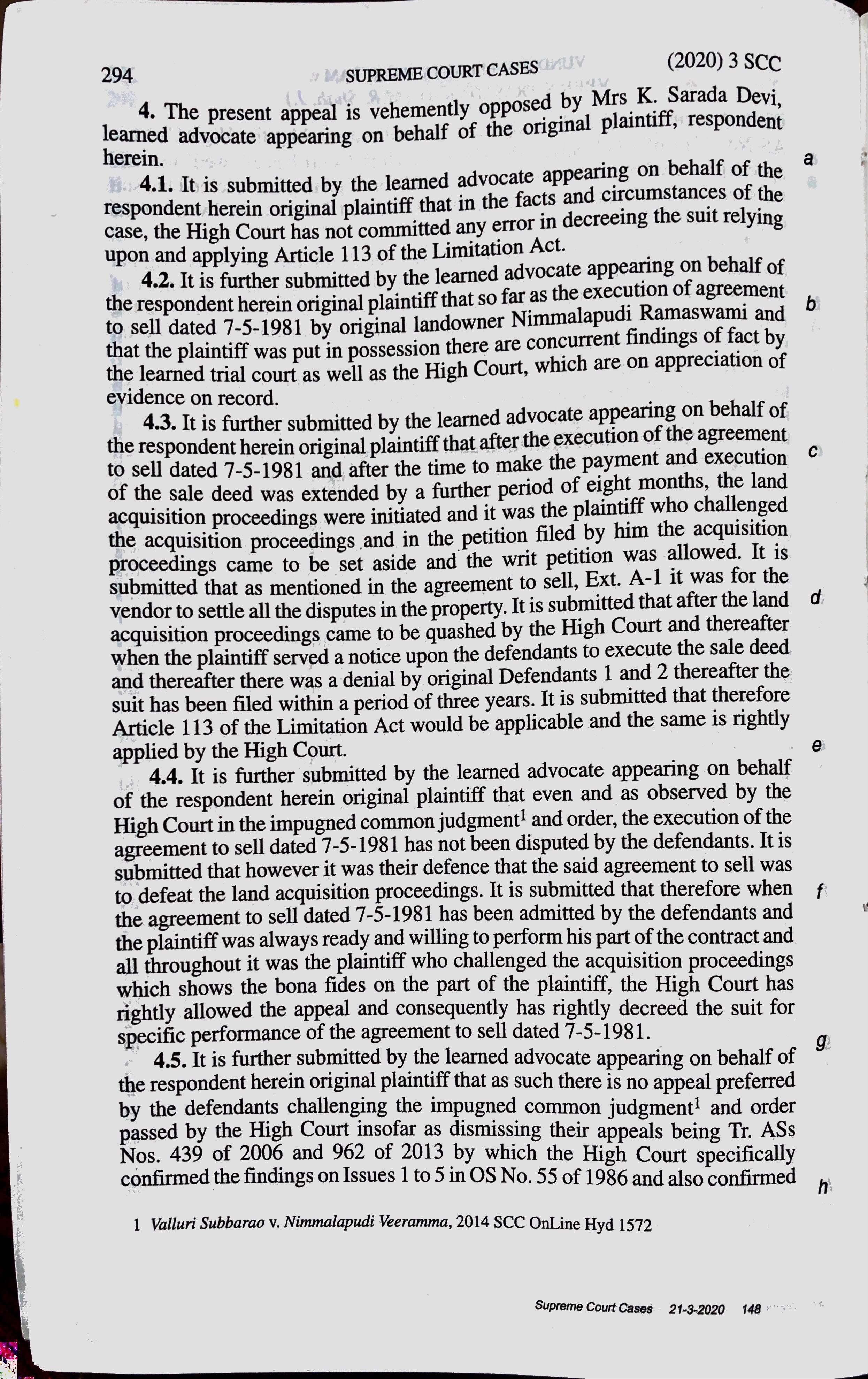
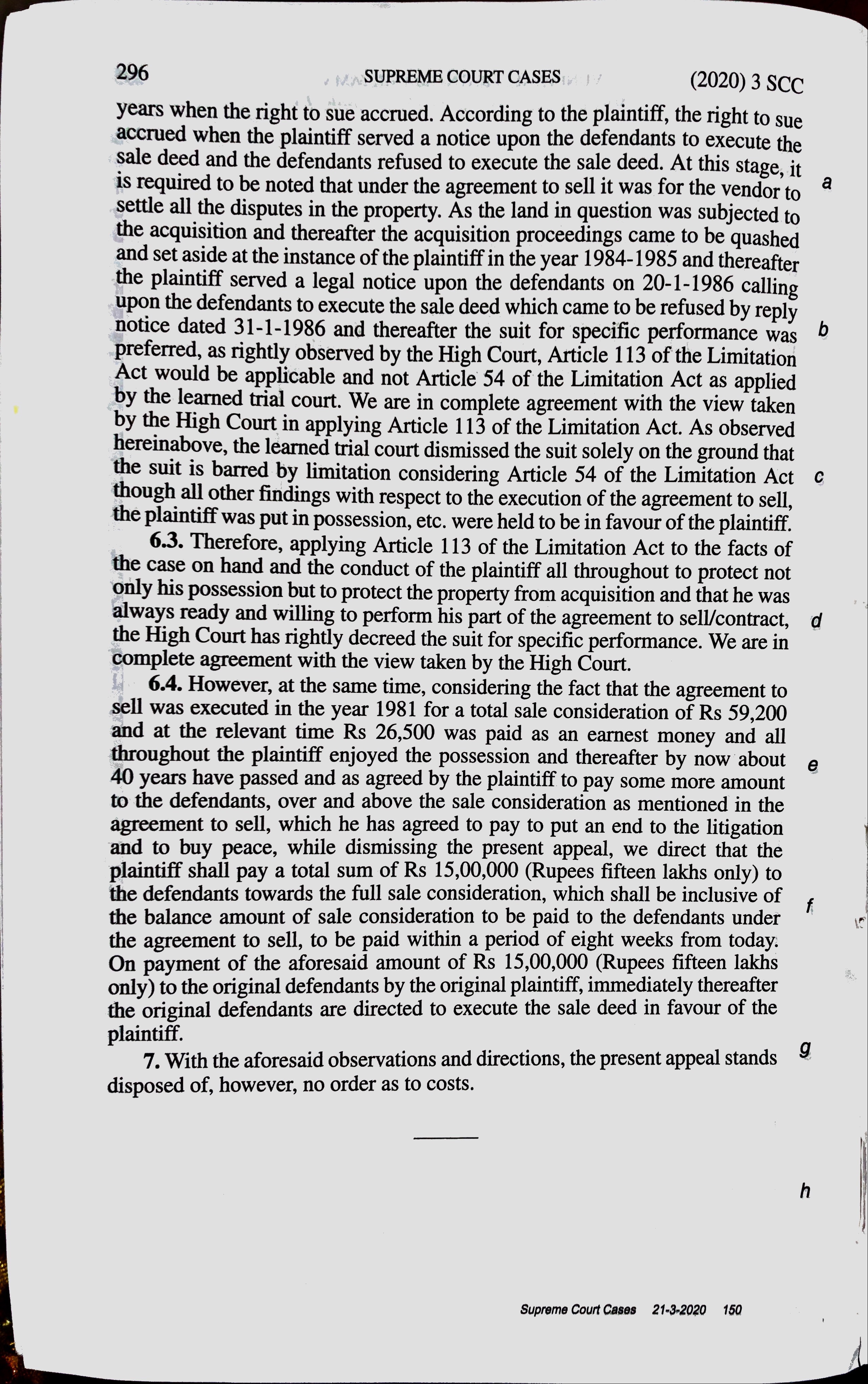
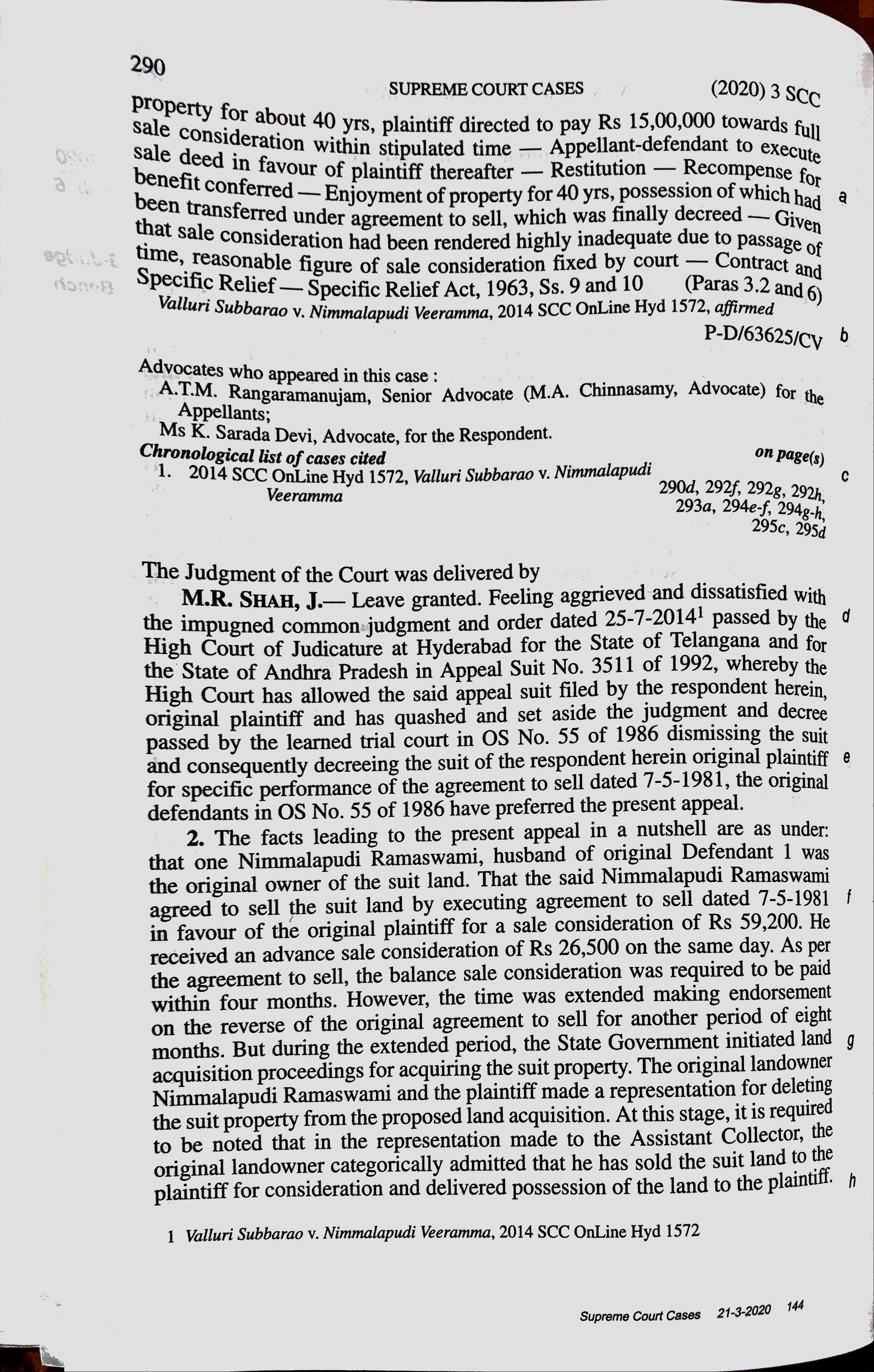
Suit for specific performance. Limitation starts after quashing of acquisition proceedings at the instance of the purchaser. (2020) 3 SCC 289 (Judgment enclosed)

Agreement to purchase. Acquisition proceedings initiated after the agreement. Acquisition proceedings were quashed at the instance of the purchaser. Time to sue for specific performance commences after quashing of the acquisition proceedings. The plaintiff has always been ready and willing to perform his part of the contract.

Compiled by S.Basavaraj, Daksha Legal