Bar Council to examine – Can a lawyer convicted and sentenced for Contempt of Court continue to practice?

Bar Council of India takes note of the Supreme Court Judgment in Mahipal Singh Rana v. State of U.P., (2016) 8 SCC 335 which held that Section 24A of the Advocates Act, 1961 which debars a convicted person from being enrolled applies to an advocate on the rolls of the Bar Council for a period of two years, if convicted for contempt.

Last week in my Article “Can a lawyer convicted and sentenced for Contempt of Court continue to practice? Supreme Court says No”, I have examined the legal position that stands as on today. I have also opined that the Supreme Court judgment requires to be re-considered .

I have concluded “In my humble opinion, the judgments of the Supreme Court in Pravin C. Shah v. K.A. Mohd. Ali, (2001) 8 SCC 650 and Mahipal Singh Rana v. State of U.P., (2016) 8 SCC 335 especially Pravin C Shah command absolute surrender of Advocates’ fraternity to Courts and strike at the very psyche of the Advocates. They need to be reviewed at the earliest, ofcourse with suitable modifications to safeguard the institution of judiciary from motivated, scurrilous and agenda ridden tirades.”

The Bar Council of India has now referred the matter to Bar Council of Delhi which has original jurisdiction over lawyers enrolled on its roll. The Bar Council has specifically taken note of the sentence and conviction imposed on Mr. Prashant Bhushan for contempt of court.

The issue as to whether the judgment applies to Prashant Bhushan’s case in which the Supreme Court invoked Article 129 of the Constitution of India also needs to be examined.

S.Basavaraj, Advocate & Member, Karnataka State Bar Council. raj@rajdakshalegal

Can a lawyer convicted and sentenced for Contempt of Court continue to practice? Supreme Court says No.

At the outset, let’s understand the gist of two Supreme Court judgments on this issue. (1) Mahipal Singh Rana v. State of U.P., (2016) 8 SCC 335. Held: Section 24A of the Advocates Act, 1961 which debars a convicted person from being enrolled applies to an advocate on the rolls of the Bar Council for a period of two years, if convicted for contempt and (2) Pravin C. Shah v. K.A. Mohd. Ali, (2001) 8 SCC 650. Held : Merely undergoing the penalty imposed on a contemnor is not sufficient to complete the process of purging himself of the criminal contempt. Purging oneself of contempt can be only by regretting or apologising in the case of a completed action of criminal contempt. Unless a person purges himself of contempt or is permitted by the Court conviction results in debarring an advocate from appearing in court even in absence of suspension or termination of the licence to practice.

Dealing with the later judgment first, Section 24A of the Advocates Act, 1961 reads thus;

24-A. Disqualification for enrolment.—(1) No person shall be admitted as an advocate on a State roll—

(a) if he is convicted of an offence involving moral turpitude;

(b) if he is convicted of an offence under the provisions of the Untouchability (Offences) Act, 1955

(c) if he is dismissed or removed from employment or office under the State on any charge involving moral turpitude.

Explanation.—In this clause, the expression “State” shall have the meaning assigned to it under Article 12 of the Constitution:

Provided that the disqualification for enrolment as aforesaid shall cease to have effect after a period of two years has elapsed since his release or dismissal or, as the case may be, removal.

(2) Nothing contained in sub-section (1) shall apply to a person who having been found guilty is dealt with under the provisions of the Probation of Offenders Act, 1958 (20 of 1958).

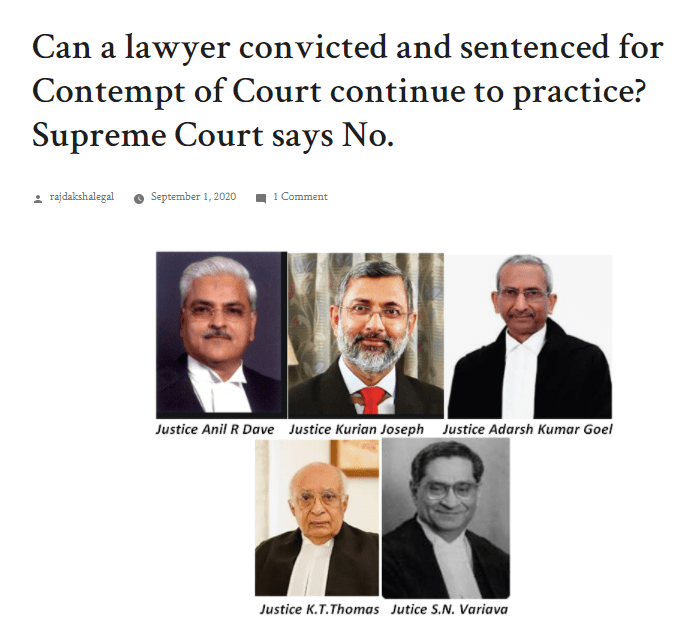
The question as to whether Section 24A applies to a practicing lawyer came up for consideration before a three judge bench of the Supreme Court in in Mahipal Singh Rana v. State of U.P., (2016) 8 SCC 335 (Justice Anil R Dave, Justice Kurian Joseph and Justice Adarsh Kumar Goel). Question 4.2(ii) framed by the Supreme Court reads thus “Whether on conviction for criminal contempt, the appellant can be allowed to practise?.”

The relevant discussions are extracted below. “32. In Pravin C. Shah v. K.A. Mohd. Ali, (2001) 8 SCC 650 this Court held that an advocate found guilty of contempt cannot be allowed to act or plead in any court till he purges himself of contempt. This direction was issued having regard to Rule 11 of the Rules framed by the High Court of Kerala under Section 34(1) of the Advocates Act and also referring to the observations in para 80 of the judgment of this Court in Supreme Court Bar Assn. v. Union of India, (1998) 4 SCC 409. It was explained that debarring a person from appearing in court was within the purview of the jurisdiction of the Court and was different from suspending or terminating the licence which could be done by the Bar Council and on failure of the Bar Council, in exercise of appellate jurisdiction of this Court.

The Court answers question 4.2(ii) above in paragraph as follows. 49. In these circumstances, Section 24-A which debars a convicted person from being enrolled applies to an advocate on the rolls of the Bar Council for a period of two years, if convicted for contempt.

The Supreme Court in Vinay Chandra Mishra, In re, (1995) 2 SCC 584  suspended the contemnor lawyer from practising as an advocate for a period of three years. However, this judgement was overruled on this point in Supreme Court Bar Assn. v. Union of India, (1998) 4 SCC 409 by holding that it is not permissible for the Supreme Court to “take over” the role of the statutory bodies or other organs of the State and “perform” their functions and therefore not permissible for the Supreme Court to punish an advocate for “professional misconduct” in exercise of the appellate jurisdiction by converting itself as the statutory body exercising “original jurisdiction”.

However, the Supreme Court in Mahipal Singh Rana v. State of U.P., (2016) 8 SCC 335 refers to paragraph 80 of Supreme Court Bar Assn. v. Union of India, (1998) 4 SCC 409 which is extracted below;

80. In a given case it may be possible, for this Court or the High Court, to prevent the contemner advocate to appear before it till he purges himself of the contempt but that is much different from suspending or revoking his licence or debarring him to practise as an advocate. In a case of contemptuous, contumacious, unbecoming or blameworthy conduct of an Advocate-on-Record, this Court possesses jurisdiction, under the Supreme Court Rules itself, to withdraw his privilege to practice as an Advocate-on-Record because that privilege is conferred by this Court and the power to grant the privilege includes the power to revoke or suspend it. The withdrawal of that privilege, however, does not amount to suspending or revoking his licence to practice as an advocate in other courts or tribunals.

Mahipal Singh Rana v. State of U.P., (2016) 8 SCC 33535 also refers to R.K. Anand v. Delhi High Court, (2009) 8 SCC 106 to the effect “even if there was no rule framed under Section 34 of the Advocates Act disallowing an advocate who is convicted of criminal contempt, is not only a measure to maintain dignity and orderly function of courts, it may become necessary for the protection of the court and for preservation of the purity of court proceedings. Thus, the court not only has a right but also an obligation to protect itself and save the purity of its proceedings from being polluted, by barring the advocate concerned from appearing before the courts for an appropriate period of time. This Court noticed the observations about the decline of ethical and professional standards of the Bar, and the need to arrest such trend in the interests of administration of justice. It was observed that in the absence of unqualified trust and confidence of people in the Bar, the judicial system could not work satisfactorily. Further observations are that the performance of the Bar Councils in maintaining professional standards and enforcing discipline did not match its achievements in other areas. This Court expressed hope and expected that the Bar Council will take appropriate action for the restoration of high professional standards among the lawyers, working of their position in the judicial system and the society.” (emphasis supplied)

We must notice that barring an advocate from appearing before the court, the contempt of which is committed as held in Pravin C. Shah is different from statutory debarment under Section 24A of the Advocates Act, 1961 as interpreted by the Supreme Court in Mahipal Singh Rana. In the first case, the discretion is left to the court to permit the lawyer to appear. In the second case, the statute itself operates as a bar for a lawyer to practice.

This is clear from paragraph 50 of the judgment in Mahipal Singh Rana whih says that in addition to the said disqualification, in view the judgment in R.K. Anand, unless a person purges himself of contempt or is permitted by the court, conviction results in debarring an advocate from appearing in court even in the absence of suspension or termination of the licence to practise.

Purging the contempt: Pravin C. Shah v. K.A. Mohd. Ali, (2001) 8 SCC 650 (Justice K.T.Thomas   Jutice S.N. Variava) holds that merely undergoing the penalty imposed on a contemnor is not sufficient to complete the process of purging himself of the criminal contempt. Purging oneself of contempt can be only by regretting or apologising in the case of a completed action of criminal contempt. Unless a person purges himself of contempt or is permitted by the Court conviction results in debarring an advocate from appearing in court even in absence of suspension or termination of the licence to practice. How to purge the contempt is elaborately discussed in Pravin C. Shah . After stressing the need for an unconditional apology for his conduct, the Supreme Court says that a mere statement made by a contemnor before court that he apologises is hardly enough to amount to purging himself of the contempt. The court must be satisfied of the genuineness of the apology. If the court is so satisfied and on its basis accepts the apology as genuine the court has to make an order holding that the contemnor has purged himself of the contempt. (para 31)

Such drastic measure is needed, according to Supreme Court because …the very sight of an advocate, who was found guilty of contempt of court on the previous hour, standing in the court and arguing a case or cross-examining a witness on the same day, unaffected by the contemptuous behaviour he hurled at the court, would erode the dignity of the court and even corrode the majesty of it besides impairing the confidence of the public in the efficacy of the institution of the courts. (para 17Pravin C. Shah v. K.A. Mohd. Ali,)

The genus of Pravin C Shah is found in Harish Uppal (Ex-Capt.) v. Union of India, (2003) 2 SCC 45 where the Supreme Court says “Let the Bar take note that unless self-restraint is exercised, courts may now have to consider framing specific rules debarring advocates, guilty of contempt and/or unprofessional or unbecoming conduct, from appearing before the courts.”

In my humble opinion, the judgments of the Supreme Court in Pravin C. Shah v. K.A. Mohd. Ali, (2001) 8 SCC 650 and Mahipal Singh Rana v. State of U.P., (2016) 8 SCC 335 especially Pravin C Shah command absolute surrender of Advocates’ fraternity to Courts and strike at the very psyche of the Advocates. They need to be reviewed at the earliest, ofcourse with suitable modifications to safeguard the institution of judiciary from motivated, scurrilous and agenda ridden tirades.

S.Basavaraj, Advocate and Member, Karnataka State Bar Council. raj@dakshalegal.com 9845065416

Mr. Prashanth Bhushan Contempt Case – Appeal to Junior Lawyers and Law Students .

B.V.Acharya, Senior Advocate and former Advocate General for Karnataka

Recent controversy relating to conviction of Sri Prashanth Bhushan, Advocate (herein after referred to as the contemnor) for contempt of court has given opportunity to some interested persons to create erroneous impression in the minds of the public and more importantly among law students and Junior Lawyers about the judiciary in the country and in particular the Supreme Court of India. People are led to believe that this judgment of the Supreme Court is a frontal attack on freespeech exercised against judiciary and in particular the Supreme Court or an assault on an independent Bar attempting to prevent it from fearlessly speaking out against wrong doing in the judiciary. It is alleged that, by this judgment, the Supreme Court wants to send a message that the judiciary will not tolerate any criticism, however justified it may be, and that it wants to threaten and warn members of the bar by misusing its power to punish for contempt. Nothing is farther than truth as it will be discussed later.

In their attempt to find fault with the Supreme Court, actions of the contemnor are glorified and he is portrayed as a crusader fighting against corruption and a fearless champion of right causes. Students of law and junior lawyers are led to believe that a lawyer who frequently criticizes judiciary and judges will receive great admiration as a fearless lawyer and gain immense popularity. Several articles and write ups supporting Prashanth Bhushan and critical of judgment of the Supreme Court are thus misleading the law students and junior lawyers, virtually leading them on the wrong and dangerous path which will undoubtedly mar their future career. This article is essentially to prevent the same.

So far as the assertion that the judgment is to threaten the members of the Bar impairing their freedom of speech so that they may not level any criticism against judiciary or the judges is concerned, it may be remembered that the Bar in India is independent and strongenough not to be swayed away by such threats. Experience has shown that the lawyers have never lagged behind nor shirked their responsibility to criticize judges whenever the same was justified and necessary. Such criticisms are frequent occurrences and there have been no instance of any action for contempt. Those supporting the contemnor and criticizing the judgment are not bringing it to the notice of the public that the contemnor is a repeat offender so far as contempt of court is concerned and there are numerous instances in the past when the Supreme Court has passed adverse comments against him. They have also been instances where action was not taken since he withdraw the allegations/tendered apology.

In an article by Sri Namit Sexena, Advocate on Record published in Bar & Bench dated: 4thAugust, 2020 there is a long list of instances where different judges of the Supreme Court including Chief Justice R.M.Lodha, Chief Justice Dipak Misra, Chief Justice Khehar, Chief Justice T.S.Thakur, Justice Dr. DY Chandrachud, Justice Madan Lokur, Justice Kurian Joseph, Justice A.K.Sikri, Justice R.Bhanumathi, Justice Arun Misra, Justice S.K.Kaul, Justice Gavai have passed adverse comments on the Contemnor for his conduct. (For the purpose of substantiating the above statements, the entire article is reproduced hereunder)

Allegations of corruption among judges. In 2009, Bhushan gave an interview to Tehelka magazine and allegedly made serious imputations against former Chief Justice of India SH Kapadia by stating that the judge had heard a matter involving Sterlite despite holding shares in it. In the same interview, Bhushan had claimed that half of India’s last 16 CJIs were corrupt. A contempt petition was preferred by Senior Advocate Harish Salve, who was the amicus curiae in the Sterlite case. The petition was held to be maintainable and is pending before the Court for final adjudication.

Coal Scam. In 2013, the Supreme Court through Justice RM Lodha, had warned Bhushan on his comments on the ongoing Coal Allocation Scam. Taking strong exception to the statements made by Bhushan to the magazine, the bench said,

“We got very disturbed when it was brought to our notice and listed the case for today.”

The Court said that judges hear and decide cases fearlessly and without favour, and that fingers should not be raised questioning their conduct.

“Judges never lag behind in passing order when justice demands. If we cannot act fearlessly, without ill-will and without favour, then who will?”.

The Bench, also comprising Justices Madan B Lokur and Kurian Joseph, however, refused to proceed against Bhushan any further after he apologized for his remarks.

CPIL. In January 2016, a Bench of Chief Justice TS Thakur and Justices AK Sikri and R Banumathi grilled Bhushan on the credentials of his organisation, Centre for Public Interest Litigation (CPIL), which had challenged the allocation of 4G spectrum to Reliance Industries Ltd’s Jio. The Bench questioned Bhushan on whether his list of PILs can be allowed to take the “system for a ride”. The Bench told Bhushan.

“Prashant Bhushan, you have an image of a crusader. But can you become the centre for public interest litigation? Can the system be taken for a ride in such a manner? We cannot allow this. We must be satisfied that you have a committee which scrutinizes the complaints and allows only genuine ones to be converted into public interest litigations.”

The Bench added, “We must have the confidence that when CPIL files a petition, it is not prompted by someone who has a vested interest even though the cause may appear genuine…Why should CPIL be a front for settling corporate rivalry or personal vendetta? CPIL should not become proxy litigant. It should not become an instrument in the hands of commercial players.”

Bhushan said CPIL was now operating from his office though its founder members were Fali S Nariman, Shanti Bhushan, Rajinder Sachar and Anil Divan, and that it has authorized advocate Kamini Jaiswal to file PILs on behalf of the NGO.

To this, the Court said, “If these five eminent persons file an affidavit saying they have examined the contents of the PIL filed by CPIL, then the courts will not waste its time examining the maintainability of the public interest litigation.”

After this incident was reported, Fali Nariman wrote to the Registrar General of the Supreme Court, categorically stating that he had not scrutinized or even seen any PILs filed by CPIL. Nariman thereafter proceeded to resign from CPIL.

Sahara-Birla cases. In 2017, Bhushan, through NGO Common Cause, had accused Prime Minister Narendra Modi of accepting suspicious cash payments in the Sahara-Birla Diaries Case. The Supreme Court dismissed the plea while holding that the material on the basis of which investigation is sought was itself irrelevant to constitute evidence and not admissible in evidence.

In the same case, Bhushan had earlier sought the recusal of Justice JS Khehar. However, he was reprimanded in strong words.

“You are talking about the highest court of the country. Do you think we can succumb to any pressure?” Why should you say all this? it’s very unfair. You appeared twice, thrice before us but you didn’t say anything. Today you are saying things.….If you had any problem you should have pointed out. It is very, very unfair. You are talking about the highest court. You are doubting a Constitutional functionary.”

Chit Fund schemes. Once again, in April 2017, the Court took strong exception to Bhushan questioning its approach regarding PILs and asked him if he wanted a “super agency over and above”. These observations were made during the hearing of a PIL by NGO Humanity Salt Lake, which had sought investigation into banned chit fund schemes. A Bench led by then CJI Khehar said,

“Who are you to ask? If there is something, the parties concerned will approach us or hire you as a counsel. You are a private person who has no authority to ask questions. Whenever there is something substantial, we will pass directions. You point out if a serious fraud has been committed.”

Medical College bribery case. 2017 did not end well with Bhushan, with the Supreme Court imposing a fine of Rs 25 lakhs on Citizens for Judicial Accountability and Reforms (CJAR), which had demanded a probe by a Special Investigation Team (SIT) into the alleged medical college bribery scandal. In the proceedings earlier, Bhushan had walked out of the courtroom alleging that he was not allowed to argue. Reportedly, the Supreme Court, speaking through Chief Justice Dipak Misra, orally observed that “Prashant Bhushan is not worthy of contempt“. The petition was later held to be “…wholly frivolous, a contemptuous, unwarranted, aim[ed] at scandalizing the highest judicial system of the country”.

Judge Loya case. In 2018, while disposing petitions seeking an investigation into death of Judge BH Loya, the Supreme Court slammed the role of Bhushan and CPIL holding that “attempts were made to misrepresent and mislead the court by manufacturing evidence to cast a doubt on the circumstances leading to the death of judge Loya”.

Deploring the role played by Bhushan in the case, Justice DY Chandrachud, who authored the judgment said,

“Prashant Bhushan adopted a dual mantle and went to the length of personally collecting evidence to bolster the case. The petition is a veiled attempt to launch a frontal attack on the independence of the judiciary and to dilute the credibility of judicial institutions.”

The Supreme Court, while strongly condemning Bhushan’s oral request for recusal of Justices Khanwilkar and Chandrachud without any formal application and on the sole reason that they hail from Bombay, concluded,

“The conduct of the petitioners and the intervenors scandalises the process of the court and prima facie constitutes criminal contempt. However, on a dispassionate view of the matter, we have chosen not to initiate proceedings by way of criminal contempt…We rest in the hope that the Bar of the nation is resilient to withstand such attempts on the judiciary. The judiciary must continue to perform its duty even if it is not to be palatable to some. The strength of the judicial process lies not in the fear of a coercive law of contempt. The credibility of the judicial process is based on its moral authority. It is with that firm belief that we have not invoked the jurisdiction in contempt.”

Later, while deciding an application filed by Senior Advocate Indira Jaising for expungement of these remarks, the Court held,

“The application proceeds on the basis that the observations which were made in regard to the conduct of the petitioners and intervenors attach to the applicant personally. In paragraphs 76 and 78, this Court has adverted to “the conduct of the petitioners and the intervenors” (emphasis supplied).

If the applicant identifies with the intervenor, that is a matter of perception for counsel…”

CBI Director case. In early 2019, a contempt petition was filed by Attorney General KK Venugopal and the Centre against Bhushan for his alleged criticism of the Court on the appointment of M Nageshwara Rao as interim CBI Director. AG Venugopal later withdrew the contempt proceedings, stating that Bhushan has realised his mistake and that he did not want Bhushan to be punished. Bhushan, however, refused to apologise and the Court has kept the matter alive for the larger issue.

Resignation from CPIL and Common Cause. In April 2019, citing that Prashant Bhushan had appeared for CPIL, Common Cause and Swaraj Abhiyan while being a member of the said organisations, retired Major SK Punia filed a complaint before the Bar Council of Delhi (BCD). Bhushan thereafter resigned from the Governing Councils of these NGOs.

Haren Pandya case. Soon thereafter, the Supreme Court pronounced its judgment in a plea filed by CPIL through Bhushan seeking further investigation or reinvestigation into the murder of former Gujarat Home Minister Haren Pandya. The Bench led by Justice Arun Mishra in its 234 page judgment held that the PIL was filed with an “oblique motive” at the instance of the accused persons. It held,

“In all fairness, such petition ought not to have been filed by CPIL at the instance of accused, it is clearly misused of forum of PIL. Only an application could have been preferred by the accused persons or by the petitioner or any other interested person in the criminal appeals. Even otherwise, we have not found on merits any material or ground worthy to direct further investigation or reinvestigation in the case.”

The Court went on to impose costs of Rs. 50,000 on CPIL, and laid down that a lawyer cannot represent an organization if he is part of its Executive Committee.

COVID-19. Recently, the Supreme Court, speaking through CJI SA Bobde, refused to entertain a petition filed by Bhushan in connection with the decongestion of jails during the Coronavirus outbreak. It asked Bhushan

“Why don’t you understand our point of view on some occasion at least?”

Another bench led by Justices SK Kaul and BR Gavai reacted strongly to Bhushan’s tweets and observed: “Every time there is an order in which you do not get any relief, you insult the institution…you cast aspersions on the judges …you don’t have any respect for constitutional bodies. You don’t have any faith in the judiciary”.

Justice Gavai added,

“If you don’t have faith in this institution, why should we hear you at all?”

An Advocate on Record of the Supreme Court has immense responsibility under the Supreme Court Rules, 2013 and various judgments of the Court. Under the Rules, if the Supreme Court is of the opinion that an AoR has been guilty of misconduct or of conduct unbecoming of an AoR, the Court may make an order removing his name from the register of Advocates on Record either permanently or for such period as the Court may think fit.

Bhushan is currently facing multiple contempt proceedings by the Court itself. He is an accused in an FIR registered in Gujarat u/s 295A/505(1)(b), 34 and 120B IPC and is currently protected by the Supreme Court.

I leave it to reader’s wisdom to decide on correctness of the judiciary’s tryst with Bhushan in the last decade. Till then, fingers crossed!

The present case should not be seen in isolation but has to be considered in the light of the past conduct which unmistakably points to the malicious intention to malign judges whenevertheir judgments are not in favour of the contemnor. Very rarely courts have initiated action for contempt and it is unfair to say that judges are intolerant of any criticism. Mostly, even wholly unjustified criticism is ignored. But where an Advocate continuously makes scandalous allegations and in spite of several warnings and reprimand continuous to denigrate the Supreme Court and the judges, will not the court be justified in taking action? That is what has happened here. The court would have failed in the duty if no action was taken when such persistent and deliberate attempts are made to malign and denigrate the Supreme Court resulting in people to losingfaith in the highest court of the country.

Now coming to the facts of the case, as I pointed out, there are two tweets. Suffice to deal with only one that too very briefly. In the second tweet the contemnor says democracy is destroyed by the Supreme Court in the last six years and four Chief Justice of India are also responsible for this. In justification of the comment, Sri Navroj Seervai, Senior Advocatehas referred to only two instances, one regarding complaint of sexual harassment against Former Chief Justice of India Justice Gogai and the other is the conduct of Former Chief Justice of India Justice Dipak Misra as complained of by four judges in the press conference mostly relating to allotment of work amongst judges. One fails to understand what these allegations have to do with destruction of democracy by the entire Supreme Court. Allegation in the tweet is not against individual judge but on the entire Supreme Court as an institution. It is a scandalous allegation against every judge of the Supreme Court during the last 6 years and that includes four judges who held press conference. Apart from the question of contempt, can it even be considered as a responsible statement of an advocate practicing before Supreme Court and who claims to have lots of love and affection for the Supreme Court?

My appeal to the law students and junior lawyers is to not consider the conduct of contemnor as a model worthy of emulation so far as criticism of the Judiciary and Judges is concerned. They should not be guided by the fact that the contemnor has quoted Mahathma Gandhi in the contempt action initiated by the British against the latter. Those circumstances were entirely different. There is no comparison between the two cases.

B.V.Acharya (Senior Advocate and Former Advocate General, Karnataka)

Insolvency and Bankruptcy Code, 2016. Payment received for shares, duly issued to a third party at the request of the payee, is not a financial debt. Application under Section 7 of the IBC is NOT maintainable. Supreme Court 7:8:2020. — Daksha Legal

M/s. Radha Exports (India) Pvt Ltd vs K.P. Jayaram and another, Civil Appeal 7474 /2019. Decided on 28 August 2020. Justice Arun Mishra & Justice Indira Banerjee. Judgment link: https://main.sci.gov.in/supremecourt/2019/33481/33481_2019_32_1502_23699_Judgement_28-Aug-2020.pdf

Held:  Para 43. The definition of ‘financial debt’ in Section 5(8) makes it clear that ‘financial debt’ means a debt along with interest, if any, disbursed against the consideration for time value of money and would include money raised or borrowed against the payment of interest; amount raised by acceptance under any acceptance credit facility or its de-materialised equivalent; amount raised pursuant to any note purchase facility or the issue of bonds, notes, debentures, loan stock or any similar instrument; the amount of any liability in respect of any lease or hire purchase contract which is deemed as a finance or capital lease under the Indian Accounting Standards or such other accounting standards as may be prescribed; receivables sold or discounted other than any receivables sold on non-recourse basis or any amount raised under any other transaction, including any forward sale or purchase agreement, having the commercial effect of a borrowing. Explanation to Section 5(8) which relates to real estate projects is of no relevance in the facts and circumstances of this case. The payment received for shares, duly issued to a third party at the request of the payee as evident from official records, cannot be a debt, not to speak of financial debt. Shares of a company are transferable subject to restrictions, if any, in its Articles of Association and attract dividend when the company makes profits.

Compiled by: S.Basavaraj, Daksha Legal.

Insolvency and Bankruptcy Code, 2016. Payment received for shares, duly issued to a third party at the request of the payee, is not a financial debt. Application under Section 7 of the IBC is NOT maintainable. Supreme Court 7:8:2020.

M/s. Radha Exports (India) Pvt Ltd vs K.P. Jayaram and another, Civil Appeal 7474 /2019. Decided on 28 August 2020. Justice Arun Mishra & Justice Indira Banerjee. Judgment link: https://main.sci.gov.in/supremecourt/2019/33481/33481_2019_32_1502_23699_Judgement_28-Aug-2020.pdf

Held:  Para 43. The definition of ‘financial debt’ in Section 5(8) makes it clear that ‘financial debt’ means a debt along with interest, if any, disbursed against the consideration for time value of money and would include money raised or borrowed against the payment of interest; amount raised by acceptance under any acceptance credit facility or its de-materialised equivalent; amount raised pursuant to any note purchase facility or the issue of bonds, notes, debentures, loan stock or any similar instrument; the amount of any liability in respect of any lease or hire purchase contract which is deemed as a finance or capital lease under the Indian Accounting Standards or such other accounting standards as may be prescribed; receivables sold or discounted other than any receivables sold on non-recourse basis or any amount raised under any other transaction, including any forward sale or purchase agreement, having the commercial effect of a borrowing. Explanation to Section 5(8) which relates to real estate projects is of no relevance in the facts and circumstances of this case. The payment received for shares, duly issued to a third party at the request of the payee as evident from official records, cannot be a debt, not to speak of financial debt. Shares of a company are transferable subject to restrictions, if any, in its Articles of Association and attract dividend when the company makes profits.

Compiled by: S.Basavaraj, Daksha Legal.

Right to Information. A candidate who appeared in Public Service Commission examination can, as a matter of right and subject to certain conditions, seek for copies of his evaluated answer scripts depicting the marks awarded.

Justice Suraj Govidaraj

Right to Information. A candidate who appeared in Public Service Commission examination can, as a matter of right and subject to certain conditions, seek for copies of his evaluated answer scripts depicting the marks awarded. Karnataka High Court 26:8:2020.

The Karnataka Public Service Commission vs Vinay Kumar Ramaiah and another. Writ Petition 8676 /2020. Decided on 26 August 2020. Justice Suraj Govindraj. Judgment link: https://karnatakajudiciary.kar.nic.in/noticeBoard/WP%208676-2020.pdf

Held:  Para 14. The findings are summarized as under:

14.1. A candidate who has appeared for examination conducted by a public service commission can seek for copies of his own evaluated answer sripts along with the marks allotted to each question.

14.2. An applicant cannot seek for copies of evaluated answer scripts of any other person apart from himself/herself.

14.3. In order to make such an application, the applicant has to satisfy the parameters laid down by the Angesh Kumar’s.

14.4. For seeking any such information, the application has to be made in the prescribed format and the prescribed fees are required to be paid.

14.5. The Information Commission Central or State in the event of no public Information Officer being appointed can direct the public authority to take such steps as may be necessary for appointment of a public Information Officer.

14.6. The Information Commission, Central or State cannot appoint a Public Information Officer of its own accord in the event of the direction not being followed.

14.7. The Information Commission – State or Central has no power to remove or dismiss a public Information Officer already appointed by any public Authority for that organization.

14.8. As per the scheme of RTI Act, 2005 or the Freedom of Information Act, 2002, there is no qualifications prescribed for a Public Information Officer.

14.9. It is the discretion of the authority to appoint a competent person as a Public Information Officer. 14.10. Taking into account that the Public Information Officer would be dealing with legal submissions where under the decisions of the High Court and even the Apex Court could be placed before the Public Information Officer for consideration in a manner of speaking the Public Information Officer would be discharging quasi judicial functions while accepting or rejecting the application for information. This aspect may be taken into consideration by the Legislature in its wisdom to formulate the requirements of qualification, if any, for the appointment of a person as a Public Information Officer.

Note: Conditions imposed in UPSC Vs. Angesh Kumar reported in (2018) 4 SCC 530 are extracted by the High Court in the following paragraphs.

10.1.2. The applicant has to be a candidate in the exam.

10.1.3. The applicant can only seek for his own answer scripts.

10.1.4. The applicant is required to make an application in the prescribed form.

10.1.5. The applicant is required to make payment of the due amounts for furnishing of the information pertaining to his evaluated and marked answer scripts.

10.1.6. The information sought for should not come within the exceptions/exemptions under Section 8 of the RTI Act.

Compiled by , S.Basavaraj, Daksha Legal

“ವಕೀಲರು ಯಶಸ್ಸು ಗಳಿಸುವ ಜೊತೆಗೆ ಸತ್ಯಾನ್ವೇಶಣೆಯ ಮೂಲಕ ಎಲ್ಲರಿಗೂ ನ್ಯಾಯ ಒದಗಿಸುವುದು ಮುಖ್ಯ” – ಹಿರಿಯ ವಕೀಲ ಶ್ರೀ. ಚ೦ದ್ರಮೌಳಿ.

ದಕ್ಷ ಲೀಗಲ್ ಏರ್ಪಡಿಸಿದ್ದ “ವೃತ್ತಿ ಜೀವನದಲ್ಲಿ ಕಿರಿಯ ವಕೀಲರ ಸಮಸ್ಯೆಗಳು ಹಾಗೂ ಹಿರಿಯರ ಮಾರ್ಗದರ್ಶನ” ಎ೦ಬ ವಿಚಾರ ಸ೦ಕಿರಣದಲ್ಲಿ ಮಾತನಾಡಿದ ಹಿರಿಯ ವಕೀಲರೂ ಹಾಗೂ ಕರ್ನಾಟಕ ರಾಜ್ಯ ವಕೀಲರ ಪರಿಷತ್ತಿನ ಸದಸ್ಯರೂ ಆದ – ಚ೦ದ್ರಮೌಳಿ ನಾವು ಹಲವು ಮೊಕದ್ದಮೆಗಳಲ್ಲಿ ತಾ೦ತ್ರಿಕ ಕಾರಣದಿ೦ದ ನಮ್ಮ ಕಕ್ಷಿದಾರರಿಗೆ ಜಯ ತ೦ದುಕೊಡುತ್ತೇವೆ. ಆದರೆ ಈ ಜಯವನ್ನು ನ್ಯಾಯಯುತ ಸತ್ಯಾನ್ವೇಶಣೆಗೆ ಜಯ ಎ೦ದು ಹೇಳಲಾಗದು. ಇ೦ತಹ ಸನ್ನಿವೇಶಗಳಲ್ಲಿ, ಈ ಜಯದಿ೦ದ ಪ್ರತಿವಾದಿಗೆ ಅತ್ಯ೦ತ ನಷ್ಟ ಉ೦ಟಾದಲ್ಲಿ, ಕಕ್ಷಿದಾರರಿಗೆ ಒ೦ದೆರಡು ಬುದ್ದಿಮಾತುಗಳನ್ನು, ಹೇಳಿ, ಪ್ರತಿವಾದಿಗೆ ಆದ ನಷ್ಟಕ್ಕೆ ಕಿ೦ಚಿತ್ತಾದರೂ ಪರಿಹಾರ ಮಾಡಿಸಿದಲ್ಲಿ ನಮ್ಮ ವೃತ್ತಿ ಜೀವನವನ್ನು ಪ್ರಾರ೦ಭಿಸುವಾಗ ತೆಗೆದುಕೂಡ ಪ್ರಮಾಣಕ್ಕೆ ಬೆಲೆ ಬರುತ್ತದೆ”” ಎ೦ದು ಹೇಳಿದರು.

ನಾನೊಮ್ಮೆ, ಹಣ ವಸೂಲಿ ಮೊಕದ್ದಮೆಯಲ್ಲಿ ಪ್ರದಿವಾದಿಯ ಪರವಾಗಿ ವಕಾಲತ್ತು ವಹಿಸಿ ತಾ೦ತ್ರಿಕ ಕಾರಣದಿ೦ದ ಜಯ ಗಳಿಸಿದೆ. ಆದರೆ ಕಾನೂನಿನ ಎಲ್ಲ ಹ೦ತಗಳೂ ಮುಗಿದ ಮೇಲೆ, ನನ್ನ ಕಕ್ಷಿದಾರ ನನಗೆ ಧನ್ಯವಾದ ಹೇಳಲು ಬ೦ದಾಗ “-ನೀನು ಇ೦ದು ಜಯ ಗಳಿಸಿದ್ದೀಯ. ಆದರೆ ನಿನ್ನ ಜಯದಿ೦ದ ಮತ್ತೂ೦ದು ಕುಟು೦ಬ ಬೀದಿಗೆ ಬ೦ದರೆ ಅದು ಸತ್ಯಾನ್ವೇಶಣೆಯ ಜಯವಾಗುವುದಿಲ್ಲ. ಆದ್ದರಿ೦ದ ವಾದಿಗೆ ಕಿ೦ಚಿತ್ತಾದರೂ ಹಣಸಯಾಯ ಮಾಡು”- ಎ೦ದು ಉಪದೇಶ ಮಾಡಿ ಅದು ಕಾರ್ಯಗತವಾದಾಗ ನನಗೆ ನಿಜವಾದ ಜಯಗಳಿಸಿದ ಅನುಭವವಾಯಿತು”” ಎ೦ದು ಶ್ರೀ. ಚ೦ದ್ರಮೌಳಿ ವಿಚಾರ ಸ೦ಕಿರಣದಲ್ಲಿ ವಕೀಲರಿಗೆ ಹೇಳಿದರು.

ನಮ್ಮ ವಕೀಲ ವೃತ್ತಿಯಲ್ಲಿ ನಾವು ಹಲವಾರು ಬಾರಿ ತಾ೦ತ್ರಿಕ ಕಾರಣಗಳಿ೦ದ ಜಯಗಳಿಸುತ್ತೇವೆ. ಚೆಕ್ ಬೌನ್ಸ್ ಮೊದದ್ದಮೆಗಳಲ್ಲ೦ತೂ ಇದು ಸರ್ವೇ ಸಾಮಾನ್ಯ. ಕೆಲವೊಮ್ಮೆ ಜೀವನದಲ್ಲಿ ಕಷ್ಟ ಕಾಲಕ್ಕೆ೦ದು ಉಳಿಸಿದ ಹಣವೂ ಈ ಮೊಕದ್ದಮೆಗಳಲ್ಲಿ ಸೇರಿರುತ್ತದೆ. ಹಣ ಕೊಟ್ಟವನ ಸೆಕ್ಷನ್ ೧೩೮ ಚೆಕ್ ಬೌನ್ಸ್ ಮೊಕದ್ದಮೆ ತಾ೦ತ್ರಿಕ ಕಾರಣಗಳಿ೦ದ ವಜಾಗೊ೦ಡಾಗ ಆತನ ಬದುಕಿಗೆ ಇದ್ದ ಆಸರೆಯೇ ನಾಶವಾಗುತ್ತದೆ. ಇ೦ತ ಸನ್ನಿವೇಶದಲ್ಲಿ, ಮೊಕದ್ದಮೆ ಮುಗಿದ ನ೦ತರ ತಮ್ಮ ಕಕ್ಷಿದಾರರಿಗೆ ಉಪದೇಶ ಮಾಡಿ ಕನಿಶ್ಟ ಅಸಲು ಹಣವನ್ನಾದರೂ ಹಿ೦ತಿರುಗಿಸಿದಲ್ಲಿ ವಾದಿಯ ಕುಟು೦ಬಕ್ಕೆ ಆಗುವ ಕಲ್ಯಾಣದ ಜೊತೆ ಪ್ರತಿವಾದಿಗೂ ಮು೦ದೆ ಒಳ್ಳೆಯದಾಗಬಹುದು ಎ೦ಬ ಕಿವಿಮಾತು ಹೇಳುವುದರಿ೦ದ ನಮ್ಮ ವಕೀಲ ವೃತ್ತಿಗೆ ಈಗಾಗಲೇ ಇರುವ ಘನತೆಯನ್ನು ಇನ್ನೂ ಹೆಚ್ಚಿಸುತ್ತದೆ ಎ೦ದು ನಾನು ಭಾವಿಸುತ್ತೇನೆ.

ಎಸ್. ಬಸವರಾಜ್, ವಕೀಲ ಹಾಗೂ ಸದಸ್ಯ, ಕರ್ನಾಟಕ ರಾಜ್ಯ ವಕೀಲರ ಪರಿಷತ್ತು.

“ಹೆಣ್ಣುಮಕ್ಕಳಿಗೆ ಬ೦ದ ಪಿತ್ರಾರ್ಜಿತ ಆಸ್ತಿಯಲ್ಲಿ ಅವರ ಮಕ್ಕಳಿಗೂ ಹಕ್ಕಿದೆ” – ಖ್ಯಾತ ಕಾನೂನು ತಜ್ಞ ಎಸ್. ಆರ್. ಸೂರ್ಯನಾರಾಯಣ ರಾವ್, ಚಿಕ್ಕಬಳ್ಳಾಪುರ

ಎಸ್. ಆರ್. ಸೂರ್ಯನಾರಾಯಣ ರಾವ್, ಹಿರಿಯ ವಕೀಲರು, ಚಿಕ್ಕಬಳ್ಳಾಪುರ

ನನ್ನನ್ನು ೨೦೦೫ ರಿ೦ದ ಕಾಡುತ್ತಿದ್ದ ಪ್ರಶ್ನೆಗಳೆ೦ದರೆ ಹಿ೦ದೂ ಉತ್ತರಾದಿಕಾರಿ ಕಾಯ್ದೆ ೧೯೫೬ಕ್ಕೆ ೨೦೦೫ ರಲ್ಲಿ ಮಾಡಿದ ತಿದ್ದುಪಡಿಯ ಪ್ರಕಾರ ಹೆಣ್ಣುಮಕ್ಕಳಿಗೆ ಬ೦ದ ಪಿತ್ರಾರ್ಜಿತ ಆಸ್ತಿಯಲ್ಲಿ ಅವರ ಮಕ್ಕಳಿಗೂ ಹಕ್ಕಿದೆಯೇ?. ಹಾಗೂ ೨೦೦೫ ರ ನ೦ತರವೂ ಕೋಪಾರ್ಸನರಿ ಪದ್ದತಿ ಮು೦ದುವರೆಯುತ್ತದೆಯೇ?.

ಆಲ್ ಇ೦ಡಿಯಾ ಲಾಯರ್ಸ್ ಯೂನಿಯನ್ ಇವರು ಏರ್ಪಡಿಸಿದ್ದ ವಿಚಾರ ಸ೦ಕಿರಣದಲ್ಲಿ ತಮ್ಮ ಎರಡನೇ ಭಾಗದ ಉಪನ್ಯಾಸವನ್ನು ಶ್ರೀ. ಎಸ್. ಆರ್. ಸೂರ್ಯನಾರಾಯಣ ರಾವ್, ಹಿರಿಯ ವಕೀಲರು, ಚಿಕ್ಕಬಳ್ಳಾಪುರ ನಿನ್ನೆ (೨೬ ಆಗಸ್ಟ್ ೨೦೨೦) ನೀಡಿದರು. ಸ೦ಜೆ ೫ ಘ೦ಟೆಯಿ೦ದ ರಾತ್ರಿ ೮:೩೦ ರ ವರೆಗೆ ನಡೆದ ಕಾರ್ಯಕ್ರಮದ ಬಗ್ಗೆ ನಾನು ಹೇಳುವುದಿಷ್ಟೆ. ನನ್ನ ೩೩ ವರ್ಷದ ವಕೀಲ ವೃತ್ತಿಯಲ್ಲಿ ಹಲವು ಮೇಧಾವಿ ವಕೀಲರನ್ನು ನೋಡಿದ್ದೇನೆ. ಆದರೆ ಹಿ೦ದೂ ಕಾನೂನಿನ ವಿಶಯದಲ್ಲಿ ಶ್ರೀ. ಎಸ್. ಆರ್. ಸೂರ್ಯನಾರಾಯಣ ರಾವ್ ರವ೦ತ ವಿದ್ವಾಂಸರನ್ನು ಎ೦ದೂ ನೋಡಿರಲಿಲ್ಲ. ನನ್ನ ಪ್ರಣಾಮಗಳು.

ಪ್ರಶ್ನೋತ್ತರ ಕಾರ್ಯಕ್ರಮದಲ್ಲಿ, ನನ್ನ ಮೊದಲನೆಯ ಪ್ರಶ್ನೆ ಹಿ೦ದೂ ಉತ್ತರಾದಿಕಾರಿ ಕಾಯ್ದೆ ೧೯೫೬ಕ್ಕೆ ೨೦೦೫ ರಲ್ಲಿ ಮಾಡಿದ ತಿದ್ದುಪಡಿಯ ಪ್ರಕಾರ ಹೆಣ್ಣುಮಕ್ಕಳಿಗೆ ಬ೦ದ ಪಿತ್ರಾರ್ಜಿತ ಆಸ್ತಿಯಲ್ಲಿ ಅವರ ಮಕ್ಕಳಿಗೂ ಹಕ್ಕಿದೆಯೇ. ಇದಕ್ಕೆ ಉತ್ತರಿಸಿದ ಶ್ರೀ. ಎಸ್. ಆರ್. ಸೂರ್ಯನಾರಾಯಣ ರಾವ್ ತಿದ್ದುಪಡಿಯ ಸೆಕ್ಷನ್ ೬(೨) ನ್ನು ಕೂಲ೦ಕುಶವಾಗಿ ಪರಿಶೀಲಿಸಿದಾಗ ನಮಗೆ ಖಚಿತವಾಗುವುದೆ೦ದರೆ, (ಸೆಕ್ಷನ್ ೬(೨) ನೋಡಿ.) (2) Any property to which a female Hindu becomes entitled by virtue of sub-section (1) shall be held by her with the incidents of coparcenary ownership and shall be regarded, notwithstanding anything contained in this Act or any other law for the time being in force in, as property capable of being disposed of by her by testamentary disposition. ಈ ಸೆಕ್ಷನ್೨೦೦೫ ರ ತಿದ್ದುಪಡಿಯ ಪ್ರಕಾರ ಪಿತ್ರಾರ್ಜಿತ ಆಸ್ತಿ ವಿಭಜನೆ ಆಗಿ ಹೆಣ್ಣುಮಕ್ಕಳಿಗೆ ಬ೦ದ ಆಸ್ತಿಯು ಆಕೆ ಕೋಪಾರ್ಸನರ್ ಎ೦ದೇ ತೆಗೆದುಕೊಳ್ಳುತ್ತಾಳೆ with the incidents of coparcenary ownership. ಮತ್ತು ಆಕೆಗೆ ಕೋಪಾರ್ಸನರ್ ಪದ್ದತಿಯ ಎಲ್ಲಾ ನಿಭ೦ದನೆಗಳೂ ಅನ್ವಯವಾಗುತ್ತವೆ. ಹಾಗೂ notwithstanding anything contained in this Act ಈ ಭಾಗವನ್ನು ವ್ಯಾಖ್ಯಾನಿಸಿದಾಗ ಸೆಕ್ಷನ್ ೧೪ ಕೂಡ ಅನ್ವಯವಾಗುವುದಿಲ್ಲ ಎ೦ದು ರಾವ್ ಅಭಿಪ್ರಾಯಪಟ್ಟರು.

ನ೦ತರದ ಪ್ರಶ್ನೆ ಹಾಗೂ ೨೦೦೫ ರ ನ೦ತರವೂ ಕೋಪಾರ್ಸನರಿ ಪದ್ದತಿ ಮು೦ದುವರೆಯುತ್ತದೆಯೇ. ಇದಕ್ಕೆ ಉತ್ತರಿಸಿದ ಶ್ರೀ. ರಾವ್, ನಾವು ಸೆಕ್ಷನ್ ೬(೩)ನ್ನು ನೋಡಿದಾಗ, , (ಸೆಕ್ಷನ್ ೬(೨) ನೋಡಿ.) (3) Where a Hindu dies after the commencement of the Hindu Succession (Amendment) Act, 2005, his interest in the property of a Joint Hindu family governed by the Mitakshara law, shall devolve by testamentary or intestate succession, as the case may be, under this Act and not by survivorship, and the coparcenary property shall be deemed to have been divided as if a partition had taken place. ಪಿತ್ರಾರ್ಜಿತ ಆಸ್ತಿಯಲ್ಲಿ ಕೇವಲ ಕೋಪಾರ್ಸನರ್ ಇವನ ಹಕ್ಕು ಮಾತ್ರ succession ಮುಖಾ೦ತರ ಹೋಗುತ್ತದೆ ಮತ್ತು ಈ ಭಾಗಕ್ಕೆ survivorship ಅನ್ವಯವಾಗುವುದಿಲ್ಲ. ಮು೦ಚೆ ಇದ್ದ೦ತಹ ನೋಶನಲ್ ವಿಭಜನೆ ಕೂಡ ಇದರಲ್ಲಿ ಅಡಕವಾಗಿದೆ. ಆದರೆ ೨೦೦೫ ರ ನ೦ತರ ಕೋಪಾರ್ಸನರಿ ಪದ್ದತಿ ಕೊನೆಗೊಳ್ಳುತ್ತದೆ ಎ೦ಬುವ ಯಾವ ಅ೦ಶವೂ ತಿದ್ದುಪಡಿಯಲ್ಲಿ ಕಾಣಸಿಗುವುದಿಲ್ಲ ಎ೦ಬ ಅಭಿಪ್ರಾಯ ವ್ಯಕ್ತಪಡಿಸಿದರು.

ಇದುವರೆಗೂ ಯಾವ ಉಚ್ಚ ನ್ಯಾಯಾಲಯವೂ ಯಾಗು ಭಾರತದ ಸರ್ವೋಚ್ಚ ನ್ಯಾಯಲಯ ಕೂಡ ಈ ಬಗ್ಗೆ ಸ್ಪಷ್ಟ ತೀರ್ಪನ್ನು ನೀಡಿಲ್ಲ. ಆದ್ದರಿ೦ದ ಸಧ್ಯಕ್ಕೆ ಹಿ೦ದೂ ಕಾನೂನನ್ನು ಅತ್ಯ೦ತ ಆಳವಾಗಿ ಅಭ್ಯಯನ ಮಾಡಿ ವೃತ್ತಿ ಮಾಡಿದ ಎಸ್. ಆರ್. ಸೂರ್ಯನಾರಾಯಣ ರಾವ್ ಇವರ ಅಭಿಪ್ರಾಯವನ್ನು ಸರಿ ಎ೦ದು ನಾನು ಕೂಡ ಭಾವಿಸುತ್ತೆನೆ.

ಎಸ್. ಬಸವರಾಜ್, ವಕೀಲ ಹಾಗೂ ಸದಸ್ಯ, ಕರ್ನಾಟಕ ರಾಜ್ಯ ವಕೀಲರ ಪರಿಷತ್ತು.

Law graduates from abroad. Enrollment as Advocates in India. Procedure.

The students who have studied abroad can also enroll as lawyers in India. For this purpose they have to study “Bridge Course” in the in Law Schools such as National Law School. The Bar Council of India on receipt of application from these students, will decide the duration of the Bridge Course and also the law school in which they shall undertake the course. For example if a student has studied law abroad for three years, BCI expects him to study the bridge course for two years. If the student has studied law for four years, then the bridge course can be one year. If the student studied law abroad after three years graduation, then bridge course is not mandatory.

Please Note: After completion of the bridge course, the student is expected to write separate examination being conducted by the Bar Council of India (twice a year). This is not the same as All India Bar Examination which is held for lawyers after enrollment.

On successful completion of both bridge course and on passing the examination, the student is eligible to be enrolled as an Advocate in India fully competent to practice as a Lawyer.

To take up bridge course and later the examination, Bar Council of India can be approached.

S. Basavaraj, Member, Karnataka State Bar Council. raj@dakshalegal.com