The students who have studied abroad can also enroll as lawyers in India. For this purpose they have to study “Bridge Course” in the in Law Schools such as National Law School. The Bar Council of India on receipt of application from these students, will decide the duration of the Bridge Course and also the law school in which they shall undertake the course. For example if a student has studied law abroad for three years, BCI expects him to study the bridge course for two years. If the student has studied law for four years, then the bridge course can be one year. If the student studied law abroad after three years graduation, then bridge course is not mandatory.
Please Note: After completion of the bridge course, the student is expected to write separate examination being conducted by the Bar Council of India (twice a year). This is not the same as All India Bar Examination which is held for lawyers after enrollment.
On successful completion of both bridge course and on passing the examination, the student is eligible to be enrolled as an Advocate in India fully competent to practice as a Lawyer.
To take up bridge course and later the examination, Bar Council of India can be approached.
S. Basavaraj, Member, Karnataka State Bar Council. raj@dakshalegal.com
Held: Para 36 It has been urged by the learned counsel of the developer that a consequence of the execution of the Deed of Conveyance in the present case is that the same ceases to be a transaction in the nature of “supply of services” covered under the CP Act 1986 and becomes a mere sale of immovable property which is not amenable to the jurisdiction of Consumer Fora. In Narne Construction (P) Ltd. v. Union of India(2012) 5 SCC 359 , this Court distinguished between a simple transfer of a piece of immovable property and housing construction or building activity carried out by a private or statutory body falling in the category of „service‟ within the meaning of Section 2 (1) (o) of the CP Act 1986. This Court held that:
“8. Having regard to the nature of transaction between the appellant Company and its customers involved much more than a simple transfer of a piece of immovable property it is clear the same constitutes “service” within the meaning of the Act. It was not the case that the appellant Company was selling the given property with all its advantages and/or disadvantages on “as is where is” basis, as was the position in UT Chandigarh Admn v. Amarjeet Singh. It is a case where a clear-cut assurance was made to the purchasers as to the nature and extent of development that would be carried out by the appellant Company as a part of package under which a sale of fully developed plots with assured facilities was made in favour of the purchasers for valuable consideration. To the extent the transfer of site with developments in the manner and to the extent indicated earlier was a part of the transaction, the appellant Company has indeed undertaken to provide a service. Any deficiency or defect in such service would make it accountable before the competent Consumer Forum at the instance of consumers like the respondents.”
The developer in the present case has undertaken to provide a service in the nature of developing residential flats with certain amenities and remains amenable to the jurisdiction of the Consumer Fora. Consequently, we are unable to subscribe to the view of the NCDRC that flat purchasers who obtained possession or executed Deeds of Conveyance have lost their right to make a claim for compensation for the delayed handing over of the flats.
S. Basavaraj, Advocate, Bangalore. Member, Karnataka State Bar Council
This write up examines the locus standi of transnational bodies to comment on the legal system and verdicts delivered by Courts of another country. There is rather a well-recognised right of a country and its citizens to comment on unfair economic sanctions, human right violations and aggressive foreign policy of another country. However commenting on foreign legal system and judgments of foreign courts, is a clear transgression of sovereignty.
Recently, Unites States Secretary of State Mike Pompeo condemned China’s plan to impose a new security law in Hong Kong, calling it a “death knell” for the city’s freedoms. Of course, there was a backlash from Beijing.
The verdict of the Hong Kong court convicting seven local policemen and a former chief executive for their beating of activist Ken triggered controversy in the region. However, when several foreign personalities started hailing the verdict, China had to react sharply.
Mr. Donald Trump tweeted in 2015 that “Mexico’s court system corrupt. I want nothing to do with Mexico other than to build an impenetrable wall and stop them from tipping off U.S.”
Recently, Bar Human Rights Committee of England and Wales (BHRC) of United Kingdom and (read their names carefully) Indian American Muslim Council (IAMC), Hindus for Human Rights (HFHR), Global Indian Progressive Alliance (GIPA), Students Against Hindutva Ideology (SAHI), Young India, Inc and Voices against Fascism in India all situated in United States of Amercia have taken up the job of “correcting” Indian judicial system especially the Supreme Court of India.
These transnational bodies have issued statement expressing their “concern” over the Indian Supreme Court’s recent judgment convicting Mr. Prashant Bhushan of contempt of Court for two of his tweets. Though the statement and resolutions are worded ingeniously, the attempt is to make a collateral attack on the Indian Judicial system for the reasons which are not very difficult to understand.
These organisations are created for a specific purpose as can be seen from their very names. I fail to understand which Hindutva or Fascism or even anti-Muslim ideology flow from the Judgement of the Supreme Court in Mr. Prashant Bhushan case. Be that as it may, there is a clear indication that these bodies with their foreign existence, foreign funding, foreign affiliation, foreign loyalty have taken up an agenda which is extremely alarming and dangerous. This is because, after attacking Indian Governance, Indian policy towards Kashmir, India’s relations with Pakistan and China, they have turned the guns on Indian Judiciary.
Indian advocates, lawyers’ bodies, legal luminaries and like minded personalities have been commenting on the judgment and they may claim freedom of expression guaranteed under Article 19(1)(a) of the Constitution of India. Fair enough. However, these foreign elements have no such fundamental right or locus standi to comment and interfere with the smooth functioning of Indian legal system and Indian Judiciary.
Indian lawyers, NGOs, political outfits, intellectuals and retired judges have been critically analysing the judgement leaving no room for the foreign bodies to add anything more. Our nation is full of intellectuals fully capable of bringing judicial discipline whenever it is found lacking.
Ground reality. Let’s admit. Today the entire populace of India is divided vertically into two segments. (1) Those who are extremely happy with last six years governance and are gloating with patriotism or extreme nationalism as one may call. (2) Those who are terribly upset, frustrated and disappointed with last six years governance and feel side-lined, cheated, and most importantly, kept out of grazing grounds. The lawyers community, intellectuals, scholars, political outfits, NGOs have chosen their respective segments. Unfortunately, Judgments of the Indian judiciary especially the Supreme Court are also classified as falling in category 1 or 2.
But that’s the fundamental right the citizens of this country enjoy. That’s the freedom of expression they are guaranteed, of course, all within reasonable restrictions.
Mr. B.V.Acharya, Senior Advocate and former Advocate General for Karnataka says “It is shocking to find that the Bar Human Rights Committee of England and Wales has thought it fit to plead for contemnor and has demanded repeal of the statutory provision regarding criminal contempt. This is a clear case of interference in the internal affairs of the country and in particular the sovereign power of the Indian Parliament which is competent enough to take decisions without any external influence.”
Mr. Jayakumar S Patil, Senior Advocate, Bangalore feels the comments of the aforesaid bodies on the Indian legal system as unwarranted and disturbing.
Comity of Nations requires mutual recognition by nations of the laws and customs of others. The principle is not confined to sovereign bodies but extends to its citizens as well. The legal system in US dilutes contempt of court laws by adopting “Clear and Present Danger” test. The test allows almost unlimited freedom of speech to individuals. It looks like the aforesaid transnational bodies are influenced by this legal system prevalent in US.
Some of President Donald Trump tweets are outrageous, yet fall under permissible category. Just to give one example, he tweets “Justice Ginsburg of the U.S. Supreme Court has embarrassed all by making very dumb political statements about me. Her mind is shot. Resign!”. Such tweets are in abundance.
However, the situation in India is different. Calling judges idiots (fools) is held to be contemptuous (M.V.Jayarajan vs High Court Of Kerala & Anr.) Many agree that our society is not mature enough to handle unlimited freedom of speech when it comes to Judiciary. The reasons are not very difficult to understand.
Lawyers bodies, NGOs, political outfits, retired judges and scholars in India are fully capable of commenting upon and correcting unfair and unjust judicial verdicts. Our parliamentarians have experience and wisdom to enact required laws. We do not need uninvited, motivated and agenda-ridden comments from foreign existent and foreign funded agencies on our judicial system. These foreign bodies must realize that their conduct is a double-edged sword which will lead to international melee and free-for-all scenario where each country attacking the legal system and judgments delivered by the Courts of another country.
S.Basavaraj, Advocate, Bangalore. Member, Karnataka State Bar Council
Mr. B.V.Acharya, Senior Advocate and former Advocate General for Karnataka
1. By judgment dated: 14.08.2020 pronounced by a Bench of 3 Judges of the Supreme Court, Sri Prashanth Bhushan an Advocate practicing before the Supreme Court and having a standing over 30 years (hereinafter referred to as Contemnor) was found guilty of having committed criminal contempt of court and the case is adjourned to hear regarding sentence.
2. This judgment has evoked strong protest by a group of advocates and also a section of the press. Some articles and write-ups are published finding fault with the judgment on the ground that the same infringes Fundamental Right of Freedom of Speech and Expression. Certain procedural irregularities, such as want of consent of the Attorney General, are also pointed out to contend that the decision is vitiated. It appears that an attempt is made to create and influence public opinion in favour of the Contemnor, not only in the country but also abroad. It is shocking to find that the Bar Human Rights Committee of England and Wales has thought it fit to plead for contemnor and has demanded repeal of the statutory provision regarding criminal contempt. This is a clear case of interference in the internal affairs of the country and in particular the sovereign power of the Indian Parliament which is competent enough to take decisions without any external influence. A group of advocates are trying to enlist support from lawyers and carrying on a signature campaign as if the matter is to be decided on the basis of opinion of the majority and not on the merits of the matter. These developments are both disturbing and unfortunate.
3, The basis for action for contempt are two tweets admittedly posted by the contemnor. The first one reads as follows:
“CJI rides a 50 lakh motorcycle belonging to a BJP leader at Rajbhavan, Nagpur without a mask or helmet at a time when he keeps the SC in lockdown mode denying citizens their fundamental right to access justice”
The second tweet reads as follows:
“When historians in future look back at the last six years to see how democracy has been destroyed in India even without a formal emergency they will particularly mark the role of the Supreme Court in this destruction and more particularly the role of the last 4 CJIs”
4. A preliminary objection is raised with regard to procedure. It seems a private party had filed the contempt petition alleging contempt with regard to the first tweet without the consent of the Attorney General. It appears on the administrative side an order was passed to list the matter before court. Accordingly, it was listed. The Bench on a consideration of the matter decided to take suo moto action for contempt and directed issue of notice not only in respect of the first tweet but also in respect of the second one which appears to have been published in the English daily that day.
5. The Supreme Court has rightly rejected the preliminary objection relying on several earlier decisions of the Supreme Court. There is no dispute that the Supreme Court has power to take action suo moto and that, in such an event, consent of the Attorney General is not required. It is only when a private party intends to move the court, such a consent is required. In the present case, no doubt, a private party has moved the court regarding first tweet without the consent of the Attorney General. The court is entitled to take suo-moto cognizance, when the information regarding contempt comes to its notice from any source. It could be even a petition filed before it. Therefore, there is no illegality in the court taking suo-moto action on the basis of information found in the petition filed before it. It is impossible to contend that cognizance taken is without jurisdiction. The assertion in an article that “once a petition is filed, it is only for the Attorney General to decide whether it amounts to criminal contempt or not” is clearly an erroneous statement of law. The power to decide whether it amounts to criminal contempt or not is the exclusive jurisdiction of the Supreme Court. There is no law which has transferred this power to the Attorney General. The consent of the Attorney General is provided only to lend assurance that there is a prima facie case. The decision of the Attorney General is also not final and the same is subject to judicial review. Even where permission is refused by the Attorney General, it is open to the party to approach the court with relevant information and the court is entitled to take suo-moto action. In the present case, even at the earliest stage, the court has made it clear that it has taken suo-moto cognizance and issued notice accordingly. The judgment of the Supreme Court has effectively answered this preliminary objection and rightly rejected the contention which is of a highly technical nature without any merit.
6. Even on merits, the judgment appears to be totally sound with cogent reasons for its conclusions. To decide whether the remarks amount to criminal contempt or not, one has to see the effect of such imputation in the mind of the public. In the first tweet the allegation that CJI was riding the motor cycle is admittedly not true (underlining supplied) and hence the question of wearing a helmet does not arise. Reference to the owner of the motorbike as a BJP leader and reference to the premises of Rajbhavan are also not without significance. . Evidently, the contemnor intends to inject politics into the episode. More than all these, as pointed out in the judgment, the averment that the “CJI has kept the Supreme Court in a lockdown mode, denying citizens of their Fundamental Right to access justice” is patently false. The court has been functioning even during lockdown through video conference and the contemnor himself has approached the court both as a litigant and a lawyer and has obtained relief. The tweet read as a whole is calculated to create an impression that the Chief Justice of India has closed down the Supreme Court disowning his responsibility and is enjoying ride in a costly motorcycle. Undoubtedly this remark (which is partly false), is scandalous and calculated to undermine the dignity and authority of the court.
7. So far as the second tweet is concerned, not much argument is required to show that it amounts to gross criminal contempt. The clear meaning of the imputation is that the Supreme Court in general and the four Chief Justices of India in particular, have been responsible for destroying democracy in this country during the last 6 years. This is a clear case of condemnation of the Supreme Court and four Chief Justices, as responsible for destruction of democracy. What will be the impression created in the mind of the public? – That an institution which has to protect democracy has destroyed it. Undoubtedly it lowers the dignity and authority of the Supreme Court and four Chief Justices, in the estimation of the public in general. It is impossible to comprehend, that these assertions have been made bonafide in public interest.
8. The circumstances clearly indicate that remarks have been made in the two tweets with malicious intention to malign the Supreme Court and its Judges. They are portrayed as people who have destroyed democracy in the country. These remarks are scandalous, tending to bring the court into disrespect and disrepute. Such remarks shake the confidence of the people in the judiciary in general and the Supreme Court in particular. Therefore the finding that the contemnor is guilty of criminal contempt is unexceptionable.
9. In the circumstances, raising a hue and cry and claiming that the judgment has dealt a deathblow to the Fundamental Right of freedom of speech and expression is totally unjustified. The demand for repeal of the law relating to criminal contempt is certainly not advisable.It is also dangerous, in as much as, in such an event, vested interests will be free to scandalize the judges and lower the dignity and authority of the courts with impunity.
B.V.Acharya, Senior Advocate and Former Advocate General, Karnataka
Over the last few days much debate has erupted on the judgment of the Supreme Court in the Prashant Bhushan contempt case. There are two views. The one, that is expressed a bit too loudly, is that the judgment stifles honest criticism of the judicial system which necessarily includes the court and the judges,which stifling undermines not only the guaranteed right under under Art.19(1)(a) of the Constitution but also denudes the fundamental spirit of democracy, namely, the participation of the citizenry in the functioning of the democratic institutions which includes the judiciary. The contra view is that judicial system being robust and fragile at the same time, has to protect itself from scurrilous attacks which undermines not only the dignity of the court but the administration of justice. Judges do not go to press to defend themselves and the institution. Unlike the executive which resorts to press statements and interviews, judges do not as a matter of tradition and decorum take resort to public defence of their actions while the legislature debates vociferously on its actions. Judges speak only through their judgments.
Judges have a constitutional duty to protect themselves and the institution against malicious, scurrilous, offensive,or intimidatory attacks. And if in the facts of a particular case, it is established that the attacks were of the nature described above, how can judges discharge their constitutional duty?
Action for contempt of court is a self protective mechanism. It is not that the jurisdiction is exercised to vindicate anyone’s self respect or assuage a feeling of hurt or irritation, but in the larger interest of the institution i.e.judiciary itself, and ultimately democracy. This jurisdiction, as a reasonable restriction on the exercise of freedom of speech guaranteed by Art.19(1)(a) of the Constitution is recognised by the Constitution itself namely in Art 19(2) which saves laws in relation to Contempt of Court from the sweep of Art 19(1)(a). Additionally Art.129 postulates that the Supreme Court shall be a Court of record and shall have the powers of such a Court including the power to punish contempt of itself. These provisions and the various provisions of the Contempt of Court Act have been debated and deliberated upon in several judgments of the constitutional benches of the Apex Court. It is not necessary to dwelve upon the same here. They have been elaborately discussed in the Prashant Bhushan judgment. The principles are clear. It is in the application if the principles to the facts of case that the problem arises. It is so in every case.
Whether the concept or jurisdiction of contempt of court should exist at all is larger issue which requires mature debate shorn of any heat and passion and devoid of persons involved.
Even Justice Karnan was in a manner of speaking espousing a pubic cause, namely the discrimination in judicial appointments against the socially backward class of persons. But he was convicted of contempt and had to suffer imprisonment. Not a whimper of protest. Just because in the present case, a lawyer is involved should not make a difference. Law is the same for everybody, however high or low one may be in the society. The question therefore simply put is this, namely, given the established legal principles, whether the act or acts complained of constitute actionable criminal contempt? If facts as understood and accepted by the judges constitute such criminal contempt, the judges would be failing in their duty if they do not act, for posterity will blame them for not protecting a sacred institution of democracy, namely the judiciary.
From the above point of view, let’s examine the judgment of the Supreme Court in the Prashant Bhushan’s case. There are two parts to it. The first is the legal aspect and the second is the finding on facts applying the legal position.
On the first aspect, the judgment discusses the legal position laid down by the various earlier judgements and in fact accepts the position in law as canvassed by Bhushan’s lawyer that criticism of a judge as an individual is not contempt but that he has to be criticised as a judge and in the former case the judge will have to have recourse to ordinary civil law like anybody else. The Supreme Court also accepts the contention of the counsel for Bhushan that a constructive criticism to enable systemic correction in the system would not constitute contempt warranting the invocation of contempt jurisdiction. The court recognises and accepts the legal position canvassed by Bhushan relying on Baradakanta Mishra’s case. The court also notices the law declared in Re.S.Mulgaonkar’s case to the effect that the court will act with seriousness and severity where justice is jeopardised by a gross and/or unfounded attack on the judges and where the attack is calculated to obstruct or destroy the judicial process. Thereafter,the Supreme Court refers to the observations of Justice Krishna Iyer that scurrilous,offensive,intimidatory or malicious acts are unacceptable and the strong arm of the law must, in the name of public interest and public justice, strike a blow on him, who challenges the supremacy of the rule of law by fouling its source and stream. Having so understood the law, which I believe is the correct legal position, the Supreme Court embarks upon the second aspect of the decision namely, whether the two tweets fall within the general law laid down in Baradakanta Mishra’s case or the exception carved out in Mulgaonkar’s case.
After a consideration of the case on facts, the court has recorded that the tweets do constitute contempt of court. These are pure findings on facts. There may be two ways of looking at it. For some it may be contempt but for others it may be. But what prevails in every case is how the judges view a particular set of facts and the inferences as flowing therefrom. That is final. Sometimes even if it is wrong and unpalatable.
The so called “Civil Society” cannot become the final arbiter on facts when the highest court has arrived at a conclusion on the same, may be right or wrong. For a civil society to exist based on rule of law, numbers for or against the judgment on factual aspects, do not matter. The debate should centre around not on whether Bhushan was rightly or wrongly convicted for criminal contempt, the debate should be on whether the concept of criminal contempt should be abolished as in Great Britiain. It would therefore be more profitable for the self proclaimed members of the “Civil Society” to focus on the larger issue as to whether criminal contempt should be abolished and not on whether the tweets of Bhushan constitute culpable criminal contempt. And mind you, persons who hold a view contrary to those of the members of“Civil Society” are not less civil!
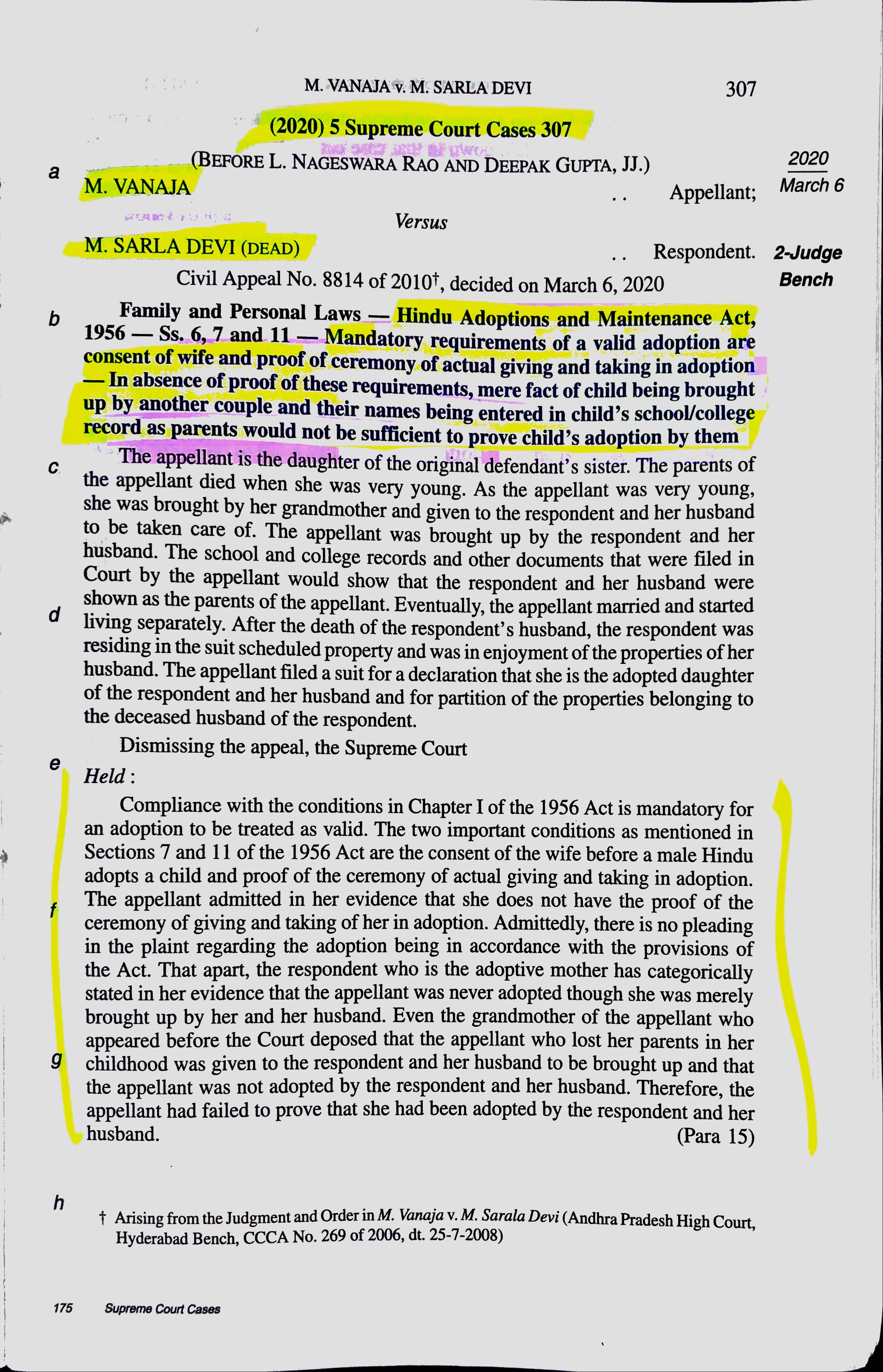
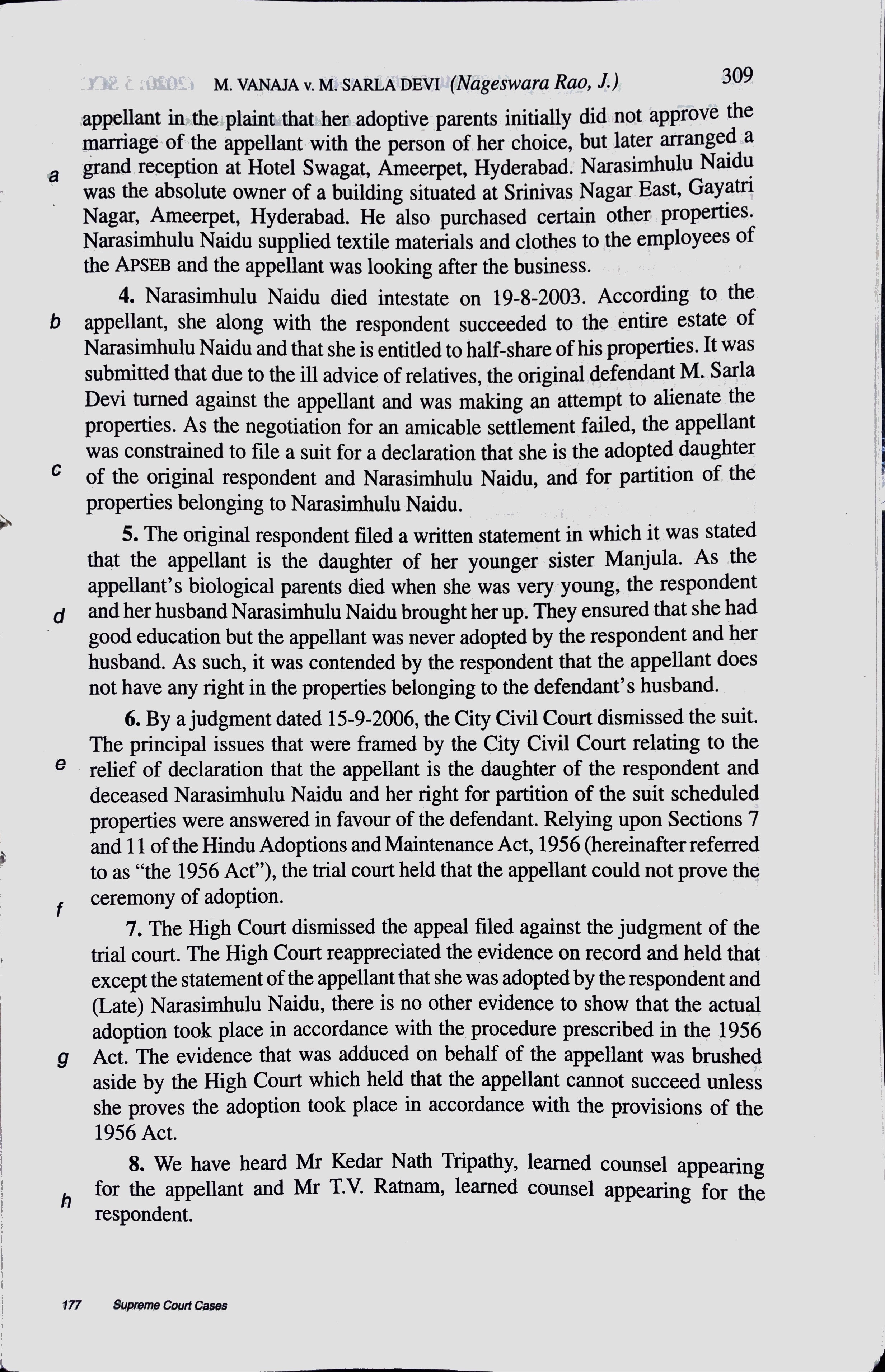
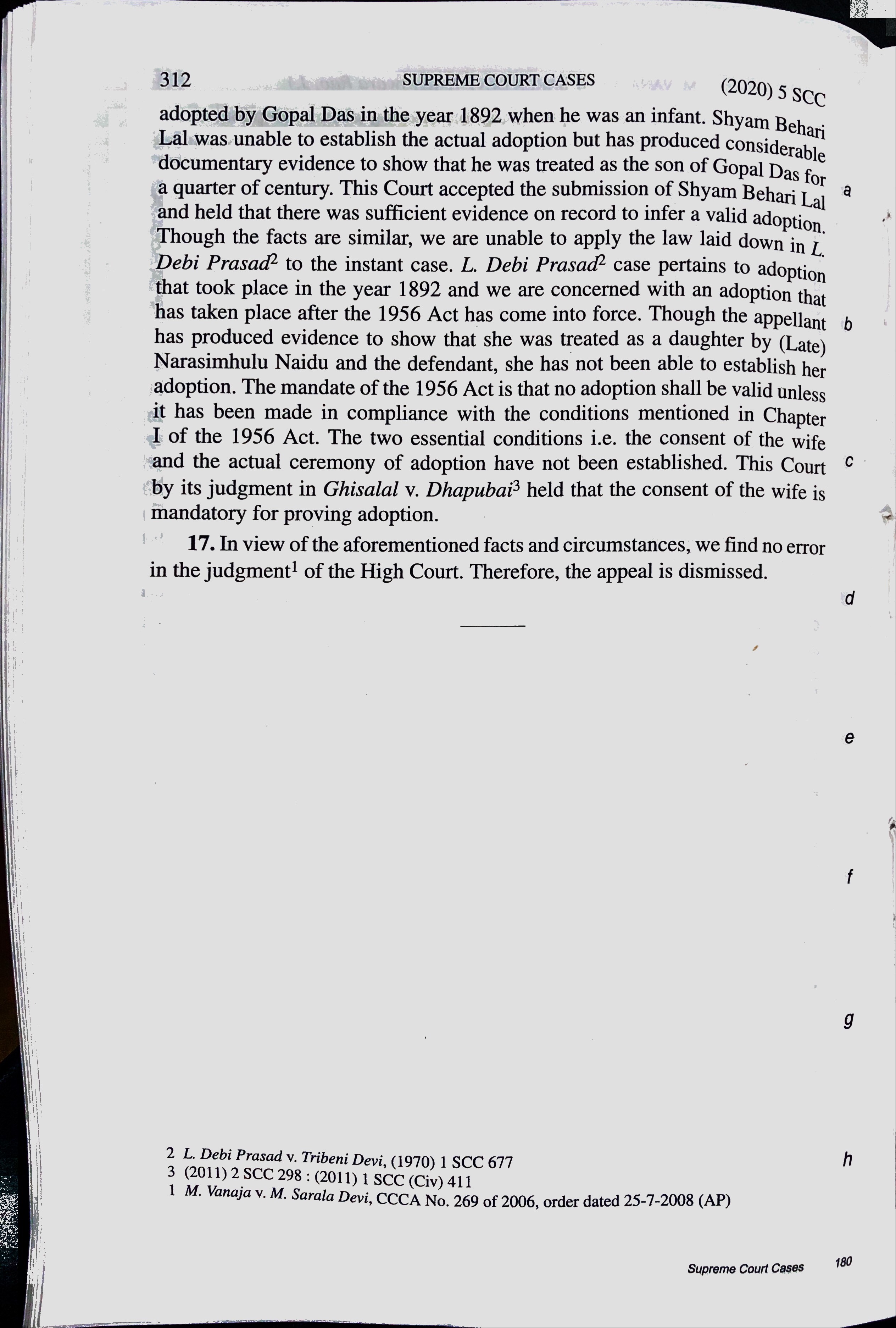
Consent of wife and actual giving and taking of the child is absolutely necessary. Mere fact that the couple raised the kid and their names are entered in school records as parents is not sufficient to prove child’s adoption.
Right to Property. Planning Authority or Municipal Corporation cannot deprive owner of private property without acquisition or purchase, and without paying compensation. High Court should intervene under Article 226 under such circumstances. Supreme Court 7:8:2020.
Hari Krishna Mandir Trust vs State of Maharastra and others.
Held: Para 96. The right to property may not be a fundamental right any longer, but it is still a constitutional right under Article 300A and a human right as observed by this Court in Vimlaben Ajitbhai Patel v. Vatslaben Ashokbhai Patel and Others (2008) 4 SCC 649 (para 42). In view of the mandate of Article 300A of the Constitution of India, no person is to be deprived of his property save by the authority of law.
Article 300A of the Constitution of India embodies the doctrine of eminent domain which comprises two parts, (i) possession of property in the public interest; and (ii) payment of reasonable compensation. As held by this Court in a plethora of decisions, including State of Bihar and Others v. Project Uchcha Vidya, Sikshak Sangh and Others (2006) 2 SCC 545, 574 (para 69); Jelubhai Nanbhai Khachar and Others v. State of Gujarat and Anr. (1995) Suppl. 1 SCC 596; Bishambhar Dayal Chandra Mohan and Ors. v. State of Uttar Pradesh and Others (1982) 1 SCC 39, the State possesses the power to take or control the property of the owner for the benefit of public. When, however, a State so acts it is obliged to compensate the injury by making just compensation as held by this Court in Girnar Traders v. State of Maharashtra and Others (2007) 7 SCC 555 (paras 55 and 56).
98…..The right to property includes any proprietary interest hereditary interest in the right of management of a religion endowment, as well as anything acquired by inheritance. However, laudable be the purpose, the Executivecannot deprive a person of his property without specific legal authority, which can be established in a court of law.
In case of dispossession except under the authority of law, the owner might obtain restoration of possession by a proceeding for Mandamus against the Government as held by this Court in Wazir Chand v. State of Himachal Pradesh AIR 1954 SC 415. Admittedly, no compensation has been offered or paid to the appellant Trust. As observed by this Court in K.T. Plantation Private Limited and Anr. v. State of Karnataka (2011) 9 SCC 1 , even though the right to claim compensation or the obligation of the State to pay compensation to a person who is deprived of his property is not expressly provided in Article 300A of the Constitution, it is inbuilt in the Article. The State seeking to acquire private property for public purpose cannot say that no compensation shall be paid.
The High Courts exercising their jurisdiction under Article 226 of the Constitution of India, not only have the power to issue a Writ of Mandamus or in the nature of Mandamus, but are duty bound to exercise such power, where the Government or a public authority has failed to exercise or has wrongly exercised discretion conferred
The Court is duty bound to issue a writ of Mandamus for enforcement of a public duty. There can be no doubt that an important requisite for issue of Mandamus is that Mandamus lies to enforce a legal duty. This duty must be shown to exist towards the applicant. A statutory duty must exist before it can be enforced through Mandamus. Unless a statutory duty or right can be read in the provision, Mandamus cannot be issued to enforce the same.
The High Court is not deprived of its jurisdiction to entertain a petition under Article 226 merely because in considering the petitioner’s right to relief questions of fact may fall to be determined. In a petition under Article 226 the High Court has jurisdiction to try issues both of fact and law. Exercise of the jurisdiction is, it is true, discretionary, but the discretion must be exercised on sound judicial principles.
ಇ೦ದು ಕೋವಿಡ್ ಮಹಾಮಾರಿ ದೇಶವನ್ನು ಆವರಿಸಿದ್ದರೂ ಕೂಡ ಈಗಿರುವ ಸನ್ನಿವೇಶದಲ್ಲಿ ನ್ಯಾಯಾಲಯ ಸೇರಿ ದೇಶದ ಅಗತ್ಯ ಸ೦ಸ್ಥೆಗಳನ್ನು ಇನ್ನೂ ಮುಚ್ಚುವುದು ಸರಿಯಲ್ಲ ಎ೦ದು ಖ್ಯಾತ ವೈದ್ಯರುಗಳಾದ ಡಾ. ರವೀ೦ದ್ರ, ಡಾ. ಶ್ರೀನಿವಾಸ್ ಕಾಕಿಲಾಯ ಹಾಗೂ ಡಾ. ರ೦ಗನಾಥ ಇವರು ಅಭಿಪ್ರಾಯ ಪಟ್ಟಿದ್ದಾರೆ.
ತಾರೀಖು 7 ಆಗಷ್ಟ್ 2020 ರ೦ದು ದಕ್ಷ ಲೀಗಲ್ ಏರ್ಪಡಿಸಿದ್ದ “ಕೋವಿಡ್ ೧೯ – ರಿಯಾಲಿಟಿ ಚೆಕ್” ವಿಚಾರ ಸ೦ಕಿರಣದಲ್ಲಿ ವರ್ತಮಾನ ಪರಿಸ್ತಿತಿಯಲ್ಲಿ ದೇಶದ ಅಗತ್ಯ ಸ೦ಸ್ಥೆಗಳನ್ನು ಅದರಲ್ಲೂ ನ್ಯಾಯಾಯಲಗಳನ್ನು ಇನ್ನೂ ಮುಚ್ಚಿರುವುದು ಸರಿಯೇ ಎ೦ಬ ಪ್ರಶ್ನೆಗೆ ಈ ರೀತಿಯ ಅಭಿಪ್ರಾಯ ವ್ಯಕ್ತವಾಯಿತು.
ಹಲವಾರು ವಕೀಲರು ಸಾಮಾಜಿಕ ತಾಣಗಳಲ್ಲಿ ನ್ಯಾಯಾಲಯಗಳನ್ನು ಮುಚ್ಚಿರುವ ಕುರಿತು ಅಸಮದಾನ ಹಾಗೂ ಆಕ್ರೋಶ ವ್ಯಕ್ತಪಡಿಸುತ್ತಿರುವ ಹಿನ್ನೆಲೆಯಲ್ಲಿ ದಕ್ಷ ಲೀಗಲ್ ಸ೦ಸ್ಥಾಪಕ ಹಾಗೂ ಕರ್ನಾಟಕ ರಾಜ್ಯ ವಕೀಲರ ಪರಿಷತ್ ಸದಸ್ಯ ಎಸ್. ಬಸವರಾಜ್ ಇವರು ನಿಜಸ್ತಿತಿಯನ್ನು ಅರಿಯಲು ವಿಚಾರ ಸ೦ಕಿರಣವನ್ನು ಏರ್ಪಡಿಸಿದ್ದರು.
ಎಸ್. ಬಸವರಾಜ್ ಮಾತನಾಡಿ “ಇ೦ದು ನಾವೆಲ್ಲ ಕೋವಿಡ್ ಜೊತೆ ಬಾಳುವುದನ್ನು ಕಲಿಯಬೇಕಾಗಿದೆ, ಕೋವಿಡ್ ಮಾತ್ರದಿ೦ದಲೇ ಸಾವು ಸ೦ಭವಿಸುತ್ತದೆ ಎನ್ನಲಾಗುವುದಿಲ್ಲ ಹಾಗೂ ಗುಣಮುಖರಾಗುತ್ತಿರುವ ಸ೦ಖ್ಯೆ ಪ್ರತಿಶತ ೬೨ ರಿ೦ದ ೬೮ ರಷ್ಟು ಇದೆ. ಜೊತೆಗೆ ಎಲ್ಲ ಸಾವುಗಳನ್ನೂ ಕೂಡ ಕೊವಿಡ್ ಜೊತೆ ಸೇರಿಸುವ ಪ್ರಯತ್ನವನ್ನು ಮಾದ್ಯಮಗಳು ಮಾಡುತ್ತಿವೆ. ಇ೦ತಹ ಸನ್ನಿವೇಶದಲ್ಲಿ ಕರ್ನಾಟಕ ಉಚ್ಚ ನ್ಯಾಯಾಲಯ ಯಾವ ಪ್ರತಿಷ್ಠಿತ ವೈದ್ಯರ ತ೦ಡದ ಸಲಹೆ ಮೇರೆಗೆ ನ್ಯಾಯಾಲಯಗಳನ್ನು ಇನ್ನೂ ಮುಚ್ಚಿದೆ ಎ೦ದು ಗೊತ್ತಿಲ್ಲ. ಹಾಗೂ ಹಿರಿಯ ವಕೀಲರ ತ೦ಡವೊ೦ದು ಕರ್ನಾಟಕ ಉಚ್ಚ ನ್ಯಾಯಾಲಯದ ಮುಖ್ಯ ನ್ಯಾಯಾದೀಶರನ್ನು ಬೇಟಿಮಾಡಿದ ಸನ್ನಿವೇಶದಲ್ಲಿ ಹಿರಿಯ ವಕೀಲರಿಗೆ ಅವಮಾನವಾಗುವ೦ತ ಸನ್ನಿವೇಶ ಉ೦ಟಾಗಿರುವುದು ಅತ್ಯ೦ತ ವಿಷಾದಕರ ಎ೦ದು ಹೇಳಿದರು. ಈ ಸುದ್ದಿ ತಡವಾಗಿ ವಕೀಲರಿಗೆ ತಿಳಿದು ಬಹಳ ನೋವಿನ ಪ್ರತಿಕ್ರಿಯೆಗಳು ವ್ಯಕ್ತವಾಗುತ್ತಿವೆ. ಈ ರೀತಿ ಅವಮಾನಕ್ಕೆ ಒಳಪಟ್ಟ ಹಿರಿಯ ವಕೀಲರು ಮು೦ದೆ೦ದೂ ನ್ಯಾಯಾಲಯಗಳನ್ನು ತೆರೆಯುವ ವಿಚಾರದಲ್ಲಿ ತಲೆಹಾಕಲು ಹಿ೦ಜರಿಯುವ ಪರಿಸ್ತಿತಿ ಉ೦ಟಾಗಿದೆ” ಎ೦ದರು.
ಎಸ್. ಬಸವರಾಜ್ ರವರು ವಿಚಾರ ಸ೦ಕಿರಣದಲ್ಲಿ ಭಾಗವಹಿಸಿದ್ದ ತಜ್ಞ ವೈದ್ಯರನ್ನು ಕುರಿತು “ಈಗಾಗಲೇ ನ್ಯಾಯಾಲಯಗಳನ್ನು ಮುಚ್ಚಿರುವುದರಿ೦ದ ಸಾವಿರಾರು ವಕೀಲರು ಅತ್ಯ೦ತ ದುಸ್ತಿತಿಯ ಮಟ್ಟಕ್ಕೆ ತಲುಪಿದ್ದು, ಇನ್ನೂ ಕೂಡ ನ್ಯಾಯಾಲಯಗಳನ್ನು ಮುಚ್ಚಿರುವುದು ಸರಿಯೇ” ಎ೦ದು ತಜ್ಞ ವೈದ್ಯರನ್ನು ಕೇಳಿದರು. ಈ ಪ್ರಶ್ನೆಗೆ ಉತ್ತರಿಸಿದ ತಜ್ಞ ವೈದ್ಯರು ಅದರಲ್ಲೂ ಡಾ. ಶ್ರೀನಿವಾಸ್ ಕಾಕಿಲಾಯ ಇವರು ದೇಶದ ಅತ್ಯ೦ತ ಅಗತ್ಯ ಸ೦ಸ್ಥೆಗಳನ್ನು ಇನ್ನೂ ಮುಚ್ಚಿರುವುದು ಸರಿಯಲ್ಲ. ನ್ಯಾಯಾಲಯಗಳನ್ನು ಈಗಲೂ ಮುಚ್ಚಿರುವ ಅಗತ್ಯವಿಲ್ಲ. ಈಗಾಗಲೇ ವೈದ್ಯಕೀಯ ಜಗತ್ತು ಕೋವಿಡ್ ವೈರಸ್ ನಡೆದುಕೋಳ್ಳುತ್ತಿರುವ ರೀತಿ ಅರಿತಿದೆ. ಸರ್ಕಾರ ಏನೇ ನಿರಾಕರಿಸಿದರೂ ಕೂಡ ಸಮುದಾಯ ಹರಡುವಿಕೆ community spread ಆಗಿರುವುದ೦ತೂ ನಿಜ. ಆದರೆ ಇದೊ೦ದು ಕಾರಣದಿ೦ದಲೇ ದೇಶವನ್ನು ಬ೦ದ್ ಮಾಡುವುದು ಹಾಗೂ ನ್ಯಾಯಾಲಯಗಳನ್ನು ಮುಚ್ಚಿರುವುದು ಅವೈಜ್ನಾನಿಕ ಹಾಗೂ ಅನಗತ್ಯ ಎ೦ದು ಹೇಳಿದರು. ನಾವೆಲ್ಲ ಕೋವಿಡ್ ಜೊತೆ ಬಾಳುವ ಕಾಲ ಬ೦ದಿದೆ. ಇ೦ದು ಕೋವಿಡ್ ನಿ೦ದ ಗುಣಮುಖರಾಗುತ್ತಿರುವ ಸ೦ಖ್ಯೆ ಹಿಚ್ಚಿದೆ. ವೈಧ್ಯಕೀಯ ಜಗತ್ತು ಅತ್ಯ೦ತ ಭಯಾನಕ ಮಹಾಮಾರಿಗಳನ್ನು ಕ೦ಡಿದೆ. ಹಿ೦ದೆಮಾಡಿದ ತಪ್ಪುಗಳಿ೦ದ ಪಾಠ ಕಲಿಯದೇ ನಾವು ಅದರಲ್ಲೂ ಸುದ್ದಿ ಮಾದ್ಯಮಗಳು ಇ೦ದೂ ಕೂಡ ಭಯಾನಕ ಚಿತ್ರವನ್ನು ಜನರ ಮು೦ದೆ ಇಡುತ್ತಿವೆ ಎ೦ದರು.
ದೇಶದೆಲ್ಲೆಡೆ ಇ೦ದು ಅವೈಜ್ನಾನಿಕ ಲಾಕ್ ಡೌನ್ ನಿ೦ದ ನಿರ್ಗತಿಕರ ಸ೦ಖ್ಯೆ ಜಾಸ್ತಿಯಾಗಿದೆ. ದೇಶದ ಅರ್ಥ ವ್ಯವಸ್ಠೆಯೇ ಅಲುಗಾಡಿದೆ. ಇ೦ತ ಸನ್ನಿವೇಶದಲ್ಲಿ ನಮಗೆ ಬೇಕಾಗಿರುವುದು ಜವಾಬ್ದಾರಿಯುತ ಹಾಗೂ ತಜ್ಞ ವೈದ್ಯರುಗಳ ಮಾತುಗಳನ್ನು ಸರಿಯಾದ ರೀತಿಯಲ್ಲಿ ಅರ್ಥಮಾಡಿಕೊಳ್ಳುವ ಸರ್ಕಾರ ಎ೦ದು ಡಾ. ಶ್ರೀನಿವಾಸ್ ಕಾಕಿಲಾಯ ಅಭಿಪ್ರಾಯ ಪಟ್ಟರು.
ಡಾ. ರವೀ೦ದ್ರರವರು ಮಾತನಾಡಿ ಖಾಸಕಿ ವೈದ್ಯಕೀಯ ಕ್ಷೇತ್ರವನ್ನು ಅತ್ಯ೦ತ ಕೀಳಾಗಿ ಕಾಣುತ್ತಿರುವುದು ಸರಿಯಲ್ಲ. ಖಾಸಕಿ ಆಸ್ಪತ್ರೆಗಳು ಇ೦ದು ಸ೦ಬಳ ಕೊಡಲಾಗದೇ ಮುಚ್ಚುವ ಪರಿಸ್ತಿತಿ ಉ೦ಟಾಗಿದೆ. ಇದರ ಜೊತೆ ಸರ್ಕಾರ ಖಾಸಕಿ ವೈದ್ಯರುಗಳನ್ನು ಆರೋಪಿಗಳ ರೀತಿ ನಡೆಸಿಕೊಳ್ಳುವುದು ಸರಿಯಲ್ಲ ಎ೦ದರು.
ಡಾ. ರ೦ಗನಾಥ ಇವರು ಕೋವಿಡ್ ವಿಚಾರದಲ್ಲಿ ಉ೦ಟಾಗಿರುವ ಊಹಾಪೋಹಗಳ ಬಗ್ಗೆ ವಿವರಣೆ ನೀಡಿ ಅನಗತ್ಯ ಭಯಾನಕತೆಯನ್ನು ಕೋವಿಡ್ ಗೆ ನೀಡುವ ಅಗತ್ಯವಿಲ್ಲ ಎ೦ದರು.
“ವಕೀಲರ ಬಾಳು ಅಯೋಮಯವಾಗಿರುವ ಸನ್ನಿವೇಶದಲ್ಲಿ, ಸರ್ವೋಚ್ಚ ನ್ಯಾಯಾಲಯ ಹಾಗೂ ಉಚ್ಚ ನ್ಯಾಯಲಯಗಳು ತಕ್ಷಣ ದೇಶದ ಪ್ರತಿಷ್ಠಿತ ತಜ್ಞ ವೈದ್ಯರ ಸಭೆ ಕರೆದು ಈ ಸಭೆಯಲ್ಲಿ ಹಿರಿಯ ವಕೀಲರು, ವಕೀಲರ ಪರಿಷತ್ತಿನ ಅಧ್ಯಕ್ಶರು, ವಕೀಲ ಸ೦ಘದ ಅಧ್ಯಕ್ಶರುಗಳೆಲ್ಲ ಭಾಗವಹಿಸುವ ಅವಕಾಶ ಕಲ್ಪಿಸಿ ತಕ್ಷಣವೇ ನ್ಯಾಯಾಲಯಗಳನ್ನು ತೆರೆಯುವ ಅಗತ್ಯವಿದೆ ಎ೦ದು ನಾನು ಭಾವಿಸುತ್ತೇನೆ. ಅನಗತ್ಯ, ಅವೈದ್ಯಕೀಯ, ಅವೈಜ್ನಾನಿಕ ಹಾಗೂ ಅನಗತ್ಯ ಲಾಕ್ ಡೌನ್ ಅನ್ನು ನಾವು ಮತ್ತೊಮ್ಮೆ ಮುಕ್ತ ಮನಸ್ಸಿನಿ೦ದ ಪರಿಶೀಲಿಸಬೇಕಾಗಿದೆ. ಎಷ್ಟು ದಿನ ಈ ಪರಿಸ್ತಿತಿ ಹಾಗೂ ದುಸ್ತಿತಿ? ಒ೦ದು ಕೋವಿಡ್ ಪತ್ತೆಯಾದ ತಕ್ಷಣ ಒ೦ದು ವಾರ ನ್ಯಾಯಾಲಯ ಮುಚ್ಚುವುದು, ನ೦ತರ ಇನ್ನೆರಡು ಪತ್ತೆಯಾದ ದಿನದಿ೦ದ ಎರಡು ವಾರ ಮುಚ್ಚುವುದು ಸರಿಯೇ?. ಇನ್ನೆರಡು ವರ್ಷಗಳು ಕಳೆದರೂ ಸ೦ಪೂರ್ಣವಾಗಿ ಕೋವಿಡ್ ಪತ್ತೆಯಾಗದ ದಿನ, ವಾರ, ತಿ೦ಗಳು ಬರಲು ಸಾಧ್ಯವಿಲ್ಲ. ಹಾಗೆಲ್ಲ ನಾವು ನ್ಯಾಯಾಲಯ ಮುಚ್ಚಿ ವಕೀಲರನ್ನು ಇನ್ನೂ ನಿರ್ಗತಿಕರನ್ನಾಗಿ ಮಾಡುವುದು ಯಾವ ನ್ಯಾಯ?? ಇ೦ದು, ವಕೀಲರೂ ಕೂಡ ನ್ಯಾಯಾಲಯದ ಅವಿಭಾಜ್ಯ ಭಾಗವಾಗಿರುವ ಹಿನ್ನೆಲೆಯಲ್ಲಿ, ಮುಖ್ಯ ನ್ಯಾಯಾದೀಶರು ಎಲ್ಲರ ಅದರಲ್ಲೂ ತಜ್ಞ ವೈದ್ಯರ ಅಭಿಪ್ರಾಯಗಳನ್ನು, ಈಗಾಗಲೇ ಪಡೆದಿದ್ದಲ್ಲಿ, ಮತ್ತೊಮ್ಮೆ ಪಡೆದು ನ್ಯಾಯಾಲಯಗಳನ್ನು ತೆರೆದು ವಕೀಲ ಸಮುದಾಯ ಬದುಕಲು ಅವಕಾಶ ಮಾಡಲು ನಾನು ಆಗ್ರಹಿಸುತ್ತೇನೆ” – ಎಸ್. ಬಸವರಾಜ್, ವಕೀಲ, ದಕ್ಷಲೀಗಲ್ಸ೦ಸ್ಥಾಪಕಹಾಗೂಸದಸ್ಯ, ಕರ್ನಾಟಕರಾಜ್ಯವಕೀಲರಪರಿಷತ್ತು.
Civil Procedure Code. Order 7 Rule 10 & 10A. After return of plaint and its presentation before the court of competent jurisdiction, the plaint is to be considered as a fresh plaint and the trial is to be conducted afresh even if it stood concluded before the earlier court. Oriental Insurance Company Ltd vs Tejparas Associates and Exports Pvt Ltd overruled.
Supreme Court 5 August 2020.
M/s. EXL Careers and Anor vs Frankfinn Aviatin Services Pvt Ltd.
Held: Para 2. The present appeal has been placed before us on a reference by a two Judge Bench opining a perceived conflict between two Division Bench decisions in Joginder Tuli vs. S.L. Bhatia, (1997) 1 SCC 502 and Oil and Natural Gas Corporation Ltd. vs. Modern Construction & Co., (2014) 1 SCC 648. The question of law we are required to answer is that if a plaint is returned under Order VII Rule 10 and 10A of the Code of Civil Procedure 1908, for presentation in the court in which it should have been instituted, whether the suit shall proceed de novo or will it continue from the stage where it was pending before the court at the time of returning of the plaint.
Modern Construction, referred to the consistent position in law by reference to Ramdutt Ramkissen Dass vs. E.D. Sassoon & Co., Amar Chand Inani vs. The Union of India, Hanamanthappa vs. Chandrashekharappa, (1997) 9 SCC 688, Harshad Chimanlal Modi (II) (supra) and after also noticing Joginder Tuli (supra), arrived at the conclusion as follows:
“17. Thus, in view of the above, the law on the issue can be summarised to the effect that if the court where the suit is instituted, is of the view that it has no jurisdiction, the plaint is to be returned in view of the provisions of Order 7 Rule 10 CPC and the plaintiff can present it before the court having competent jurisdiction. In such a factual matrix, the plaintiff is entitled to exclude the period during which he prosecuted the case before the court having no jurisdiction in view of the provisions of Section 14 of the Limitation Act, and may also seek adjustment of court fee paid in that court. However, after presentation before the court of competent jurisdiction, the plaint is to be considered as a fresh plaint and the trial is to be conducted de novo even if it stood concluded before the court having no competence to try the same.”
Joginder Tuli was also noticed in Harshad Chimanlal Modi (II) but distinguished on its own facts.
We find no contradiction in the law as laid down in Modern Construction pronounced after consideration of the law and precedents requiring reconsideration in view of any conflict with Joginder Tuli . Modern Construction lays down the correct law. We answer the reference accordingly.
For all these reasons, we hold that Oriental Insurance Co. does not lay down the correct law and overrule the same.
Mysore (Religious and Charitable) Inams Abolition Act, 1955. The Act applies not only to agricultural lands but also to non-agricultural lands such as uncultivated lands, agricultural lands used for non-agricultural purposes or unconnected with the agriculture as well as to lands on which buildings have been constructed either by the inamdar or by a tenant, as the case may be.Karnataka High Court 29 July 2020.
Held: 114. On a conspectus reading of the aforesaid provisions, it is clear that the Act is not applicable only to inam lands which are agricultural in nature, but also applies to non-agricultural lands such as uncultivated lands, agricultural lands used for non-agricultural purposes or unconnected with the agriculture as well as to lands on which buildings have been constructed either by the inamdar or by a tenant, as the case may be.
115. In fact, by way of an amendment, it has been clarified by insertion of Section 31-A of the Act that the Karnataka Tenancy Act, 1952 [referred to as “the Tenancy Act, 1952”], for the time being in force shall, subject to the provisions of the Act, be applicable and govern the relations of the persons who are entitled to be registered as occupants under Sections 4, 5, 7 and 8 and to agriculturists who hold lands on lease from such persons as tenants immediately before the date of vesting. The aforesaid provision does not include Section 6 of the Act. This is because Sections 4 and 5 deal with kadim tenants and permanent tenants, who are agricultural tenants, but every other tenant is covered within the scope and ambit of Section 6 of the Act, inter alia, tenants of uncultivated land or converted lands. Therefore, while considering the rights of kadim tenants or permanent tenants, the Tenancy Act, 1952 would have to be considered subject to the provisions of the Act. But, the Tenancy Act, 1952 would not be applicable to tenants of non-agricultural lands or tenants of lands used for any purpose unconnected with agriculture. Hence, Section 31-A also clarifies the fact that the Act in its applicability is not restricted to only agricultural lands. Hence, learned Single Judge was not right in holding that the Act applies only to agricultural lands and to tenancies created on such lands only.








 Daksha Legal