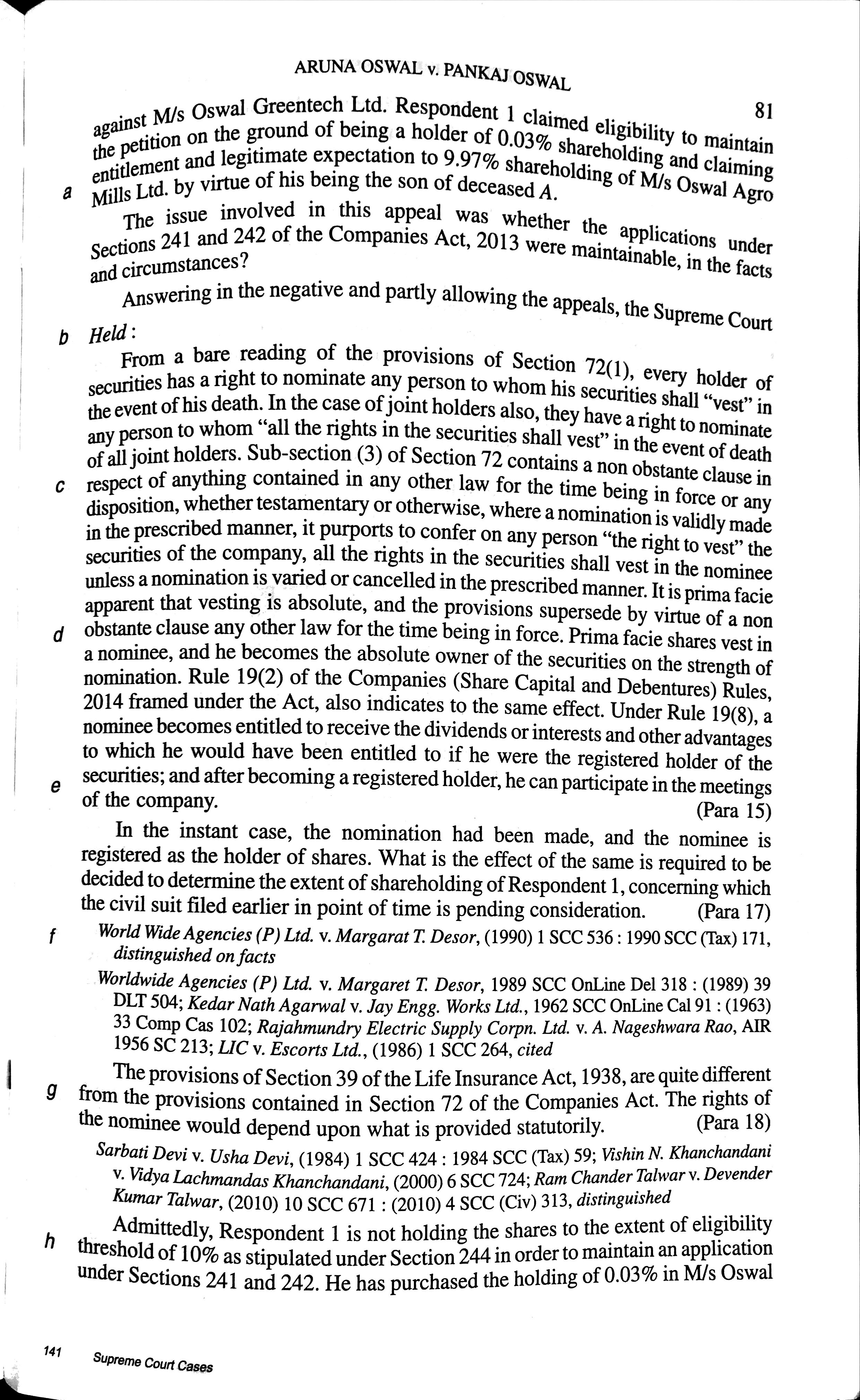
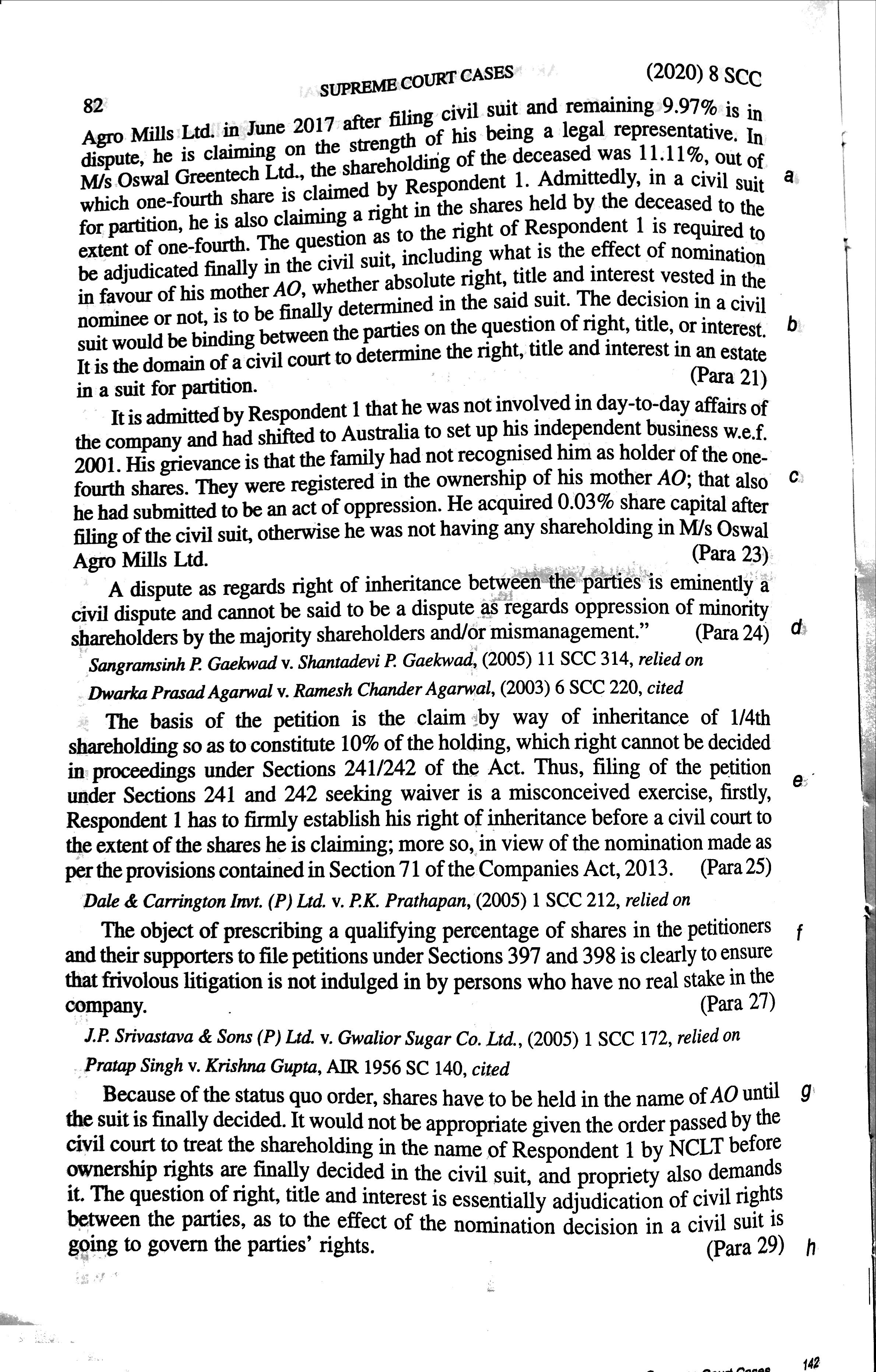
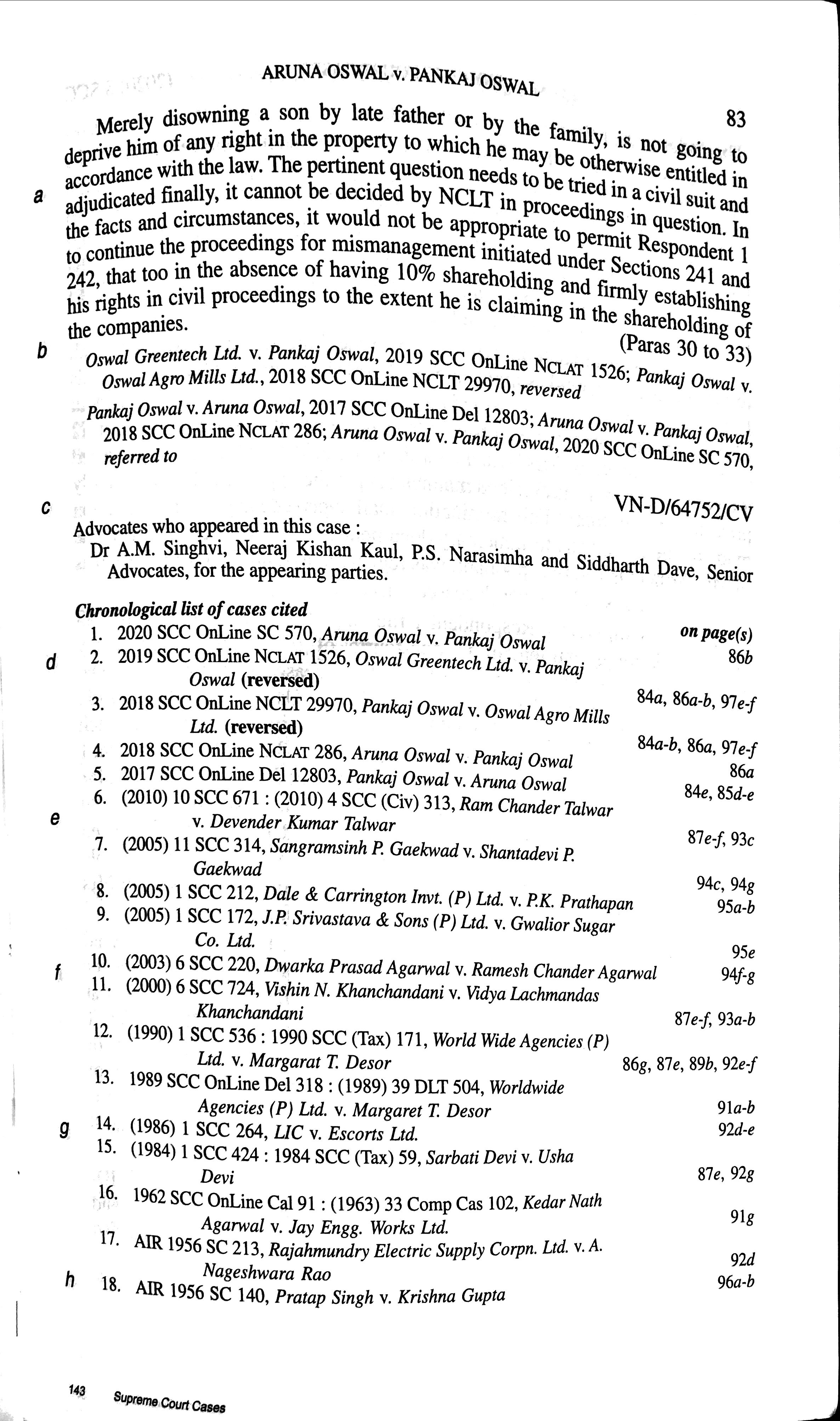
National Company Law Tribunal has no jurisdiction to decide succession issues. Such dispute is not oppression of minorities or mismanagement. Supreme Court.

Corporate Laws. National Company Law Tribunal has no jurisdiction to decide succession issues. A dispute as regards right of inheritance between the parties is eminently a civil dispute and cannot be said to be a dispute as regards oppression of minority shareholders by the majority shareholders or mismanagement.

Aruna Oswal vs Pankaj Oswal (2020) 8 SCC 79.

Criminal Trial. When the person lodging the FIR is subsequently accused of the offence, it is an admission of certain facts. It’s admissibility is not barred. Law on the point discussed. Karnataka High Court29:10:2020

Daksha Legal Short Notes of Cases

Chandrashekara vs State of Karnataka. Criminal Appeal 1574/2015 decided on 29 October 2020. Justice B. Veerappa and Justice K. Natarajan.

Judgment Link: http://judgmenthck.kar.nic.in/judgmentsdsp/bitstream/123456789/346192/1/CRLA1574-15-23-10-2020.pdf

Investigating Officers in NDPS Cases Are ‘Police Officers’. Confessional Statements Made To Them Are Not Admissible Supreme Court 29:10:2020

Tofan Singh vs State of Tamil Nadu. Criminal Appeal 152/2013 decided on 29 October 2020. (Majority view) Justice R.F.Nariman, Justice Navin Sinha and Justice Indira Banerjee.

Judgment Link: https://main.sci.gov.in/supremecourt/2012/26682/26682_2012_33_1501_24551_Judgement_29-Oct-2020.pdf

Adverse Possession. Ingredients of “animus posudendi”, explained. Person in adverse possession need not canvass his adverse possession till eternity. After satisfying the requirement adverse possession generates title over the subject property as former’s product. Karnataka High Court. 12:10:2020

Jadiyappa vs Gurusiddappa. Regular First Appeal 100107/2016 decided on 12 October 2020. Justice N.K. Sudhindrarao and Justice Ravi Hosmani.

Judgment Link: http://judgmenthck.kar.nic.in/judgmentsdsp/bitstream/123456789/345360/1/RFA100107-16-12-10-2020.pdf

HELD: The claim of adverse possession or perfecting of title cannot be in the form of person in  possession canvassing that he  is in adverse possession till eternity. After satisfying the requirement adverse possession generates title over the subject property as former’s product.

Relevant Paragraphs: 24. The process regarding adverse possession is unique and significant. It is a process wherein a person’s right of possession satisfying all the ingredients for the prescribed period transforms into a title and one person need not go for declaration of completion of  prescribed  period, as such, it is the  fulfillment of  the  requirement  in order to get title.

25. Insofar as possession in order to satisfy the ingredients of animus posudendi, the mental element, the time of entering into possession must be that genuinely the person who is so entering or being inducted must feel that he is entitled to  in possession.  It  is  in  this connection Ex.P.4 mutation entry or the fact of mutation wherein the plaintiff is claim to have surrendered the property in favour of the defendant. The next one is the “corpus” possession which is established  in  respect  of  suit schedule property.

27. In other words, the claim of adverse possession or perfecting of title cannot be in the form of person in  possession canvassing that he  is in adverse possession till eternity. After satisfying the requirement adverse possession generates title over the subject property as former’s product.

28. In the overall circumstances  of  the  case, the physical possession of the plaintiff is not established. The revenue entries  by  themselves do not confer the title. However, terms and conditions attached to them continue and the person who claims title  over such property fails  to provide materials against the revenue entries, the entries would then  gain importance.  By virtue of legal concept declaring ownership or revenue entries, presumption thereon, physical possession, the bone of contention between the parties, pleadings oral and documentary evidence, legal position applicable such as that the plaintiff has failed to establish title  and  lawful possession.

Compiled by S. Basavaraj, Advocate, Daksha Legal.

SARFAESI Act. Issuance of a defective notice under section 13(2) will not vitiate proceedings unless substantial prejudice being caused to the borrower. Judgment of Karnataka High Court reversed. Supreme Court 27:10:2020.

M/s. L&T Housing Finance Limited vs M/s. Trishul Developers and another. Civil Appeal 3413/2020 decided on 27 October 2020. Justice L. Nageswara Rao, Justice Hemant Gupta and Justice Ajay Rastogi.

Judgment Link: https://main.sci.gov.in/supremecourt/2019/25979/25979_2019_38_1501_24436_Judgement_27-Oct-2020.pdf

HELD: 15. Notably from the very inception at the stage, when the
proposal of taking a term loan from the appellant was furnished
by the respondents vide their application dated 15th May, 2015
and accepted by the appellant vide sanction letter dated 07th
August, 2015 (P1), the letterhead which was used for the purpose
clearly indicates that on the top of the letterhead towards right, it
reflects “L&T Finance (Home Loans)” and on the bottom towards
left, is of “L&T Housing Finance Ltd.” with their registered office
in Mumbai and this has been duly signed by the authorised
signatory of the borrower for M/s. Trishul Developers and by its
guarantors.

16. It manifests from the record that the respondents from the
initial stage are aware of the procedure which is being followed by
the appellant in its correspondence while dealing with its
customers and that is the same practice being followed by the
appellant when demand notice dated 16th December, 2016 was
served at a later stage. The demand notice in explicit terms
clearly indicates the execution of the Facility Agreement dated
11th August, 2015 between the appellant (L&T Housing Finance
Ltd.) and the respondents (M/s. Trishul Developers through its partners) and of the default being committed by the respondents
(borrower/guarantor) in furtherance thereof, a notice under
Section 13(2) of the SARFAESI Act was served on the same
pattern of the letterhead which is being ordinarily used by the
appellant in its correspondence with its customers and the
demand notice dated 14th June, 2017 without leaving any iota of
doubt is in reference to the non­fulfillment of the terms and
conditions of the Facility Agreement dated 11th August, 2015
executed between the parties and even the schedule of security
profile which has been annexed thereto is in reference to the
execution of Facility Agreement dated 11th August, 2015 and its
non­compliance of the provisions of the SARFAESI Act.

17. Even in the reply to the demand notice which was served by
the respondents through their counsel dated 08th August, 2017
in compliance to Section 13(3A) of the SARFAESI Act, there was
no confusion left in reference to the correspondence taken place
between the appellant (secured creditor) and the respondents
(borrower) tendering their justification and assigning reasons for
which compliance could not have been made and no objection
was indeed raised by the respondents in regard to the defect if any, in the demand notice dated 14th June, 2017 which was served by the secured creditor i.e. “L&T Housing Finance Ltd.” in
compliance to the provisions of the SARFAESI Act or in
furtherance to the proceedings initiated at the behest of the
appellant under Section 13(4) read with Section 14 of the Act, for
the first time, a feeble attempt was made in raising the alleged
technical objection in a Securitisation Application filed before the
DRT and succeeded.

18. It may be relevant to note that the respondents (borrower)
did not deny advancement of loan, execution of Facility
Agreement, their liability and compliance of the procedure being
followed by the secured creditor (appellant) prescribed under the
SARFAESI Act.

19. In the facts and circumstances, when the action has been
taken by the competent authority as per the procedure
prescribed by law and the person affected has a knowledge
leaving no ambiguity or confusion in initiating proceedings under
the provisions of the SARFAESI Act by the secured creditor, in
our considered view, such action taken thereof cannot be held to
be bad in law merely on raising a trivial objection which has no legs to stand unless the person is able to show any substantial
prejudice being caused on account of the procedural lapse as
prescribed under the Act or the rules framed thereunder
still with
a caveat that it always depends upon the facts of each case to
decipher the nature of the procedural lapse being complained of
and the resultant prejudiced if any, being caused and there
cannot be a straitjacket formula which can be uniformly followed
in all the transactions.

Compiled by S. Basavaraj, Advocate, Daksha Legal.

Kindly share Important Trial Court Judgments.

When we read reportable decisions of High Courts and the Supreme Court, we also notice how trial court judgments are upheld as following the correct legal position. Many trial court judgments are really inspiring for the young aspirants of judgeship. Hence, apart from publishing reportable High Court and Supreme Court judgments, Daksha Legal proposes to publish important trial court judgments. Needless to say, these decisions are not binding. However, they guide young judges and candidates who take up judge examinations. This is to request the learned advocates to forward trial court judgments which critically examines and follows legal position. Please send the judgements to raj@dakshalegal.com

NOTE. Please do not send the judgments if they are already reversed by higher courts.

Karnataka Stamp Act, 1957. Intending purchaser already in possession prior to agreement of sale. Purchaser has to pay stamp duty as if possession delivered ‘under the agreement’. Stamp duty cannot be avoided by relying on prior possession. Karnataka High Court 9:10:2020

K. V. Venkatasubbaiah vs Rajappa by lrs. Writ Petition 17460/2015 decided on 9 October 2020. Justice N.S. Sanjay Gowda.

Judgment Link: http://judgmenthck.kar.nic.in/judgmentsdsp/bitstream/123456789/345036/1/WP17460-15-09-10-2020.pdf

HELD: If a person who already claim to be in  possession, seek to contend  in the agreement of sale that they are in possession or being continued in possession in part performance of the contract of sale, then, automatically Article 5 (e) (i) of  the Schedule to the Act would be attracted and notwithstanding the earlier possession, the purchaser would still have to pay stamp duty as  conveyance  (Article 20) on the market value of the property.

Relevant Paragraphs: 7. The question that arises for consideration in this  writ petition is: “Whether a recital in an Agreement of Sale that the defendants were already in possession could be a factor to  be  considered in determining the stamp duty payable and ignoring the term that possession was being delivered under the Agreement in part performance of the contract?”

13. …Article 5 (e) of the Schedule – When possession of the property is delivered or is agreed to be delivered before executing the conveyance, the stamp duty is same as a conveyance.

14. A plain reading of the said Article would indicate  that if the Agreement relates to the sale  of  an immovable property and if in part performance of the contract, possession is delivered or is agreed to be delivered without executing the conveyance, then stamp duty on the agreement of sale would have to be paid as would be payable for a conveyance under Article 20 on the market value of the property. Therefore, for  attracting Article 5 (e) (i) of the Schedule to the Act, essentially, the instrument (document) should be a document under which an immovable property is agreed to be sold and more importantly, in part performance of the Agreement, possession has been delivered or has been agreed to be delivered.

15. In other words, whenever, in part performance of  an agreement of sale, the agreement indicates that possession is being handed over to the prospective purchaser, then, stamp duty as prescribed for a Conveyance will have to be paid on the market value of the property.

19. Under Section 53A of the Transfer of Property Act….., a purchaser by entering into a Contract of Sale and securing possession in  furtherance of the said contract would be protected against any claim by the seller in respect of any right in respect of the property, except, of course those rights which are expressly provided in the contract of sale. Thus, a purchaser, by drafting of an appropriate contract, can protect his possession over the immovable property against the seller, without completing the conveyance.

20 If such a course is adopted, it would lead to not  only to a situation whereby the conveyance is not concluded but it would also inevitably result in evasion of stamp duty which would otherwise have to be paid on   the Deed of conclusion of conveyance. This would  thereby impact the revenue that the State would receive as Stamp Duty, which is undoubtedly, an  essential  source of revenue to the State.

25. Viewed from this angle, it becomes clear that the possession of the purchaser prior to the execution of the Agreement of Sale would be of no relevance at all for the purposes of applying Article 5(e)(i)  of the Schedule to  the Act.  All that would be required for attracting Article   5 (e)(i) of the Schedule to the Act is that the Agreement contains a recital that, in part performance of the agreement of sale, the prospective purchaser is either being put in possession or is agreed to be put in possession.

26. Thus, in this case, as a necessary consequence of the above discussion, it would emerge that the prior possession of the defendants over the lands as recited in the agreement would be of no relevance for the purpose of determining the stamp duty payable on the execution of the agreement of sale and the singularly  key ingredient to be considered is the recital that possession was being delivered under the agreement in part performance of the contract.

28. ….if a person such as the defendants who already claim to be in  possession, seek to contend  in the agreement of sale that they are in possession or being continued in possession in part performance of the contract of sale, then, automatically Article 5 (e) (i) of  the Schedule to the Act would be attracted and notwithstanding the earlier possession, the purchaser would still have to pay stamp duty as  conveyance  (Article 20) on the market value of the property.

Compiled by S.Basavaraj, Advocate, Daksha Legal. .

Arbitration and Conciliation Act, 1996. Correction and interpretation of award & additional award under Section 33 forms part of the arbitral award. Only recourse is appeal under Section 34. No writ is maintainable against such an award. Karnataka High Court 15:10:2020

Hubli Electricity Supply Company Ltd vs M/s. Sharavathy Conductors Company Pvt Ltd. Writ Petition 103813/2016 decided on 15 October 2020. Justice S. Vishwajith Shetty.

Judgment Link: http://judgmenthck.kar.nic.in/judgmentsdsp/bitstream/123456789/345144/1/WP103813-16-15-10-2020.pdf

Note: The dispute between Hubli Electricity Supply Company Ltd and M/s. Sharavathy Conductors Company Pvt Ltd was referred to arbitration and the same was decided by Karnataka Micro  and Small Enterprises Facilitation Council Bangalore/Arbitral Authority on 23:7:2015. Application under Section 33(1)(a) & (4) was filed by the respondent on 18:8:2015 seeking additional award. The additional award was passed on 10:2:2016. The challenge to original award was made much after filing of this application.

Relevant Paragraphs: 7.From a reading of Section 33 of the Act, it is very clear that the Arbitral Authority has got a power to correct and interpret its order and also pass additional award if an application is filed by the aggrieved party within the period prescribed in the said provision. A reading of sub-section 2 of Section 33 makes it very clear that if the Arbitral Tribunal considers an application under sub-section 1 of Section 33 and passes an order, it shall form part of the arbitral award. Perusal of the order impugned in this writ petition makes it clear that the said order is passed by Arbitral Authority in exercise of its powers under Section 33(1) of the Act. Therefore, the impugned order now passed by the Arbitral Authority forms a part of the original arbitral award.

8. Recourse available under the Act against any arbitral award is provided under Section 34 of the Act. The petitioner is therefore required to challenge the impugned order, which forms the integral part of the original award by taking recourse to Section 34 of the Act and the same cannot be challenged invoking Article 226 and 227 of the Constitution of India.

Compiled by S.Basavaraj, Advocate, Daksha Legal

Private Schools. State action should be facilitative and complimentary to the establishment of private schools. “Don’t compare grant of permission to start educational institution with that of a wine shop. Adopt fair standards”. – Karnataka High Court to Government.

Nexgen Education Trust (Regd) vs State of Karnataka and others. Writ Petitions 6058/2020 & 9554/2020 decided on 21 October 2020.

Judgment link:http://judgmenthck.kar.nic.in/judgmentsdsp/bitstream/123456789/345480/1/WP6058-20-21-10-2020.pdf

The respondents have invoked the provision ..in a pedantic way like a village priest ritualistically murmuring the hymn without knowing its inner meaning; the constitutional guarantee of free-primary-education will not fructify in the absence of enough number of schools and therefore, the State action should be facilitative & complimentary to the establishment of private schools; the authorities need to be told that there exists a certain difference between a requisition for the grant of permission for founding a school and an application for the grant of  excise  license for opening a wine shop, they being poles asunder; the impugned orders lack elements of reason & justice; the process by which they have been made falls short of “fair standards” which a Welfare State should profess & practice.” – Justice Krisha S Dixit.

Relevant paragraphs : 6. Way back in 1930, in Interview with Izvestia, Rabindranath Tagore, had powerfully diagnosed: ‘In my view the imposing tower of misery which today rests on the heart of India has its sole foundation in the  absence  of  education’;  Jean Dreze and Amartya Sen in their treatise “An Uncertain Glory – INDIA AND ITS CONTRADICTIONS” in Chapter V at pages 107 to 109 write as under:

“The role of basic education in the  process  of  development and social progress is very wide and critically important. First, the capability to read and write and count has powerful effects on our quality of life; education leads to an informed life, to communicate with others, and to be generally in touch with what is going on. In a society, particularly in the modern world, where so much depends on the written medium, being illiterate is like being imprisoned, and school education opens a door through which people can escape incarceration. Second, our economic opportunities and employment prospects depend greatly on our educational achievements… Third, illiteracy muffles the political voice of people and thus contributes directly to their insecurity  … Fourth, basic education can play a major role in tackling public health problems in general and public health in particular … Fifth, educational development has often been the prime mover in bringing about changes in public perceptions of the range  and reach of what can be called human rights … Sixth,  education can also make a difference to the understanding and use of legal rights… When people are illiterate, their ability to understand, invoke and use their legal rights can be very limited… Lack of schooling can directly lead to insecurities… Seventh,…the schooling of young women can substantially enhance the voice and power of women in family decisions… Eighth, even though education is no magic bullet against class barriers, it can make a big contribution to reduce inequalities related to the divisions of class and caste… Last but not least, learning and studying can be immensely enjoyable …  quite apart from the long run benefits people receive from it…”

7. 86th Amendment to the  Constitution  has introduced Article 21A with effect from 12.12.2002 which reads “The State shall provide free and compulsory education to all children of the age of six to fourteen years in such manner as the State may, by law, determine.” This provision is strengthened by adding clause (k) to Article 51A which enacts that it is a duty of a parent or guardian to provide opportunities for education to his/her child or ward between the age of six & fourteen years; the importance of these new provisions can be understood by the observations of the Apex Court to the effect that without Article 21A, the other fundamental rights are rendered meaningless; without education, a citizen may never come to know of his other rights; since there is no corresponding constitutional right to higher education, the fundamental stress has to  be  on primary and elementary education, so that a proper foundation for higher education can be effectively laid vide BHARTIYA SEWA SAMAJ TRUST vs. YOGESHBHAI AMBALAL PATEL, (2012) 9 SCC 310;

8. It needs to be noted that the Parliament has enacted the Right to Education Act, 2009 and expanded its scope by a few amendments inter alia imposing an obligation even on private schools to admit students from the State Government quota, subject to certain conditions; this is because of the fact that the school education in the country inter alia suffers from the limitation of coverage; there are no enough number of government/public schools to cater to the societal need; a corresponding statutory duty is cast on the private schools to make the fundamental right to free education at the primary level, meaningful; if the applications for grant of permission to establish such schools are mindlessly declined, that would muffle the inner voice of the aforesaid constitutional amendments that are complimented by legislative instruments; the first sentence in the first paragraph of the Writ Petition, reads – “That the petitioner Trust has one of its object, is to establish educational institution and provide educational facilities to all sections of societies on no profit and no loss basis”; this has not been controverted by the respondents in their Statement of Objections; there is some material on record to show that the petitioner-Trust has been running several educational institutions; the version of the answering  respondents  that the petitioner-Trust is not adhering to Government Orders, lacks material particulars, to say the least;  the  school  building in question is completely surrounded by a compound wall; in cities like Bangalore, several schools and fuel stations co-exist & function as peaceful neighbours; it is nobody’s case that precautionary measures cannot be taken to avoid likely accidents; therefore, the existence of a petrol pump beside it, is only a feeble ground to deny permission;

9. The above aspects have not factored even in the penumbra of impugned decision making at the hands of the answering respondents; they have invoked the provisions of Rule 4 of Karnataka Educational Institutions (Classification, Regulation and Prescription of Curricula etc) Rules, 1995 as amended vide notification dated 08.03.2018, in a pedantic way like a village priest ritualistically murmuring the hymn without knowing its inner meaning; the constitutional guarantee of free-primary-education will not fructify in the absence of enough number of schools and therefore, the State action should be facilitative & complimentary to the establishment of private schools; the authorities need to be told that there exists a certain difference between a requisition for the grant of permission for founding a school and an application for the grant of  excise  license for opening a wine shop, they being poles asunder; the impugned orders lack elements of reason & justice; the process by which they have been made falls short of “fair standards” which a Welfare State should profess & practice.

In the above circumstances, these Writ Petitions succeed; a Writ of Certiorari issues invalidating the impugned orders; the matter is remitted back to the 2nd respondent- DDPI for consideration afresh, in accordance with law and after providing an opportunity of hearing to all the stakeholders. Time for compliance is eight weeks from the date a copy of this order is produced, subject to the rider that delay if brooked shall entail the concerned official personally with a cost of Rs.10,000/- per week payable to the petitioner-Trust; the time taken by the petitioner-Trust for production of documents or the like, shall be excluded while computing the said period of eight weeks.

Compiled by S. Basavaraj, Advocate, Daksha Legal.

IPC. Sections 304B and 498A. Cruelty by husband falling short of gravity under Section 304B. He can still be convicted under Section 498A. Karnataka High Court. 21:10:2020

Kallegowda and another vs State of Karnataka. Criminal Appeal 539 & 504/2014 decided on 21 October 2020.

Judgment Link: http://judgmenthck.kar.nic.in/judgmentsdsp/bitstream/123456789/345479/1/CRLA539-14-21-10-2020.pdf

Relevant Paragraphs: 25. In order to prove the dowry death as contemplated under Section 304B of IPC and presumption under Section 113B of Indian Evidence Act, necessary ingredients are required to be placed on record by the prosecution. The initial burden of proving the case by bringing the evidence against the accused will not shift. However, if the prosecution is able to bring all the circumstances and after discharging the burden of proving the fact that the deceased was subjected to harassment due to demand of dowry soon prior to the death, then the burden shifts on  the accused to rebut the same by leading evidence. The Hon’ble Supreme Court has held in Baijnath and others vs. State of Madhya Pradesh reported in (2017) 1 SCC 101 at paragraph 29 and 30 as follows:

“29. Noticeably this presumption as well is founded on the proof of cruelty or harassment of the woman dead for or in connection with any demand for dowry by the person charged with the offence. The presumption as to dowry death thus would get activated only upon the proof of the fact that the deceased lady had been subjected to cruelty or harassment for or in connection with any demand for dowry by the accused and that too in the reasonable contiguity of death. Such a proof is thus the legislatively mandated prerequisite to invoke the otherwise statutorily ordained presumption of commission of the offence of dowry death by the person charged therewith.

30. A conjoint reading of these three  provisions, thus predicate the burden of the prosecution to unassailably substantiate the ingredients of the two offences by direct and convincing evidence so as to avail the presumption engrafted in Section 113-B of the Act against the accused. Proof of cruelty or harassment by the husband or her relative or the person charged is thus the sine qua non to inspirit the statutory presumption, to draw the person charged within the coils thereof. If the prosecution fails to demonstrate by cogent, coherent and persuasive evidence to prove  such fact, the person accused of either of the above referred offences cannot be held guilty by taking refuge only of the presumption to cover up the shortfall in proof.”

27. In order  to attract Section 304B of IPC and Section 113-B of Indian Evidence Act for drawing a legal presumption, the prosecution has to satisfy the ingredients of 304B is very much essential. The Hon’ble Supreme Court in the case of Hira Lal vs. State (Government of NCT of Delhi) reported in (2003) 8 SCC 80, at paragraph-8 has held as under:

(Section 304B IPC extracted) The provision has application when death of a woman is caused by any burns or bodily injury or occurs otherwise than under normal circumstances within seven years of her marriage and it is shown that soon before her death she was subjected to cruelty or harassment by her husband or any relatives of her husband for, or in connection with any demand for dowry. In order to attract application of Section 304B IPC, the essential ingredients are as follows: (i) The death of a woman should be caused by burns or bodily injury or otherwise than under a normal circumstance. (ii) Such a death should have occurred within seven years of her marriage. (iii) She must have been subjected to cruelty or harassment by her husband or any relative of her husband. (iv) Such cruelty or harassment should be for or in connection with demand of dowry. (v) Such cruelty or harassment is shown to have been meted out to the woman soon before her death. (Section 113-B Evidence Act extracted) The necessity for insertion of the two provisions has been amply analyzed by the  Law Commission of India in its 21st Report dated 10-8-1988 on “Dowry Deaths and Law Reform”. Keeping in view the impediment in  the pre-existing law in securing evidence to prove dowry-related deaths, the legislature thought it wise to insert a provision relating to presumption of dowry death on proof of certain essentials. It is in this background that presumptive Section 113-B in the Evidence Act has been inserted. As per the definition of “dowry death” in Section 304B IPC and the wording in the presumptive Section 113-B of the Evidence Act, one of the essential ingredients, amongst others, in both the provisions is that the woman concerned must have been “soon before her death” subjected  to cruelty or harassment “for or in connection with the demand of dowry”. Presumption under Section 113-B is a presumption of law. On  proof of the essentials mentioned therein, it becomes obligatory on the court to raise a presumption that the accused caused  the dowry death.”

28. In view of the law laid down by the Hon’ble Supreme Court in the above said case and on perusal of the  evidence on record, the prosecution failed to place any evidence on record to show that the accused has harassed the deceased in connection with the demand of dowry soon prior to the death in order to attract Section 304B of IPC or to draw a legal presumption under Section 113-B of Indian Evidence Act, that the death of the deceased was dowry death.

30. On perusal of the explanation (b) to 498A clearly  goes to show that accused No.1 harassed the deceased for receiving the fixed deposit and to encash the same but the deceased refused to do so which amounts to cruelty under Section 498A of IPC. Therefore, we hold the prosecution though failed to prove the offences against the accused Nos.2 and 4 for the offences punishable under Sections 498A, 304B of IPC and Sections 3 and 4 of DP Act and also failed to prove the offence against accused No.1 under Section 304B of IPC and Sections 3 and 4 of DP Act, but, successful in proving the offence under Section 498A.

Compiled by S.Basavaraj, Advocate, Daksha Legal.