Relevant paragraphs: 7. In a partition suit, first a preliminary decree is passed declaring the rights of the parties in the schedule property. During the course of final decree proceedings, the court has jurisdiction to alter shares if it is occasioned by the death of one of the sharers. Notwithstanding the declaration of rights in the preliminary decree, there may be more than one preliminary decree. If there is no dispute regarding some of the joint family properties, or the claim for partition is admitted by the defendants in respect of some of the suit schedule properties, then the Court can proceed under Order XII Rule 6 of CPC and pass preliminary decree in respect of such items at once. Thereafter, after contest yet another preliminary decree in respect of the other items of property. Similarly, there can be more than one Final Decree also.
13. However, this principle cannot be extended to include a property which was not the subject matter of the suit, at the time of passing of the preliminary decree. Variation of shares already declared in the property which is the subject matter of the suit is totally different from varying the subject matter of the suit. The reason being that what is the share to which a party to a suit is entitled to in law is purely a question of law, whereas a share in a property is dependent on the nature of the property which is purely a question of fact, which is to be decided on the facts and circumstances of the case based on the evidence adduced. Therefore, once a preliminary decree is passed in respect of the subject matter of the suit, question of including or adding a property to the subject matter of the suit subsequently and claiming a share in respect of the property so included or added is not permissible in law. In respect of the said property a separate suit is maintainable, if sufficient cause is shown for its exclusion in the earlier suit for partition.
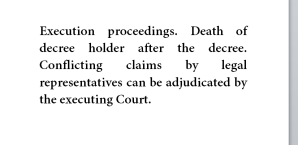
Relevant Paragraphs: 8. We may state that Order XXII of the Code is applicable to the pending proceedings in a suit. But the conflicting claims of legal representatives can be decided in execution proceedings in view of the principles of Rule 5 of Order XXII.
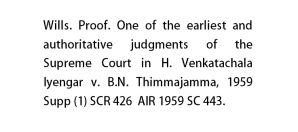
18. What is the true legal position in the matter of proof of wills? It is well-known that the proof of wills presents a recurring topic for decision in courts and there are a large number of judicial pronouncements on the subject. The party propounding a will or otherwise making a claim under a will is no doubt seeking to prove a document and, in deciding how it is to be proved, we must inevitably refer to the statutory provisions which govern the proof of documents. Sections 67 and 68 of the Evidence Act are relevant for this purpose. Under Section 67, if a document is alleged to be signed by any person, the signature of the said person must be proved to be in his handwriting, and for proving such a handwriting under Sections 45 and 47 of the Act the opinions of experts and of persons acquainted with the handwriting of the person concerned are made relevant. Section 68 deals with the proof of the execution of the document required by law to be attested; and it provides that such a document shall not be used as evidence until one attesting witness at least has been called for the purpose of proving its execution. These provisions prescribe the requirements and the nature of proof which must be satisfied by the party who relies on a document in a court of law. Similarly, Sections 59 and 63 of the Indian Succession Act are also relevant. Section 59 provides that every person of sound mind, not being a minor, may dispose of his property by will and the three illustrations to this section indicate what is meant by the expression “a person of sound mind” in the context. Section 63 requires that the testator shall sign or affix his mark to the will or it shall be signed by some other person in his presence and by his direction and that the signature or mark shall be so made that it shall appear that it was intended thereby to give effect to the writing as a will. This section also requires that the will shall be attested by two or more witnesses as prescribed. Thus the question as to whether the will set up by the propounder is proved to be the last will of the testator has to be decided in the light of these provisions. Has the testator signed the will? Did he understand the nature and effect of the dispositions in the will? Did he put his signature to the will knowing what it contained? Stated broadly it is the decision of these questions which determines the nature of the finding on the question of the proof of wills. It would prima facie be true to say that the will has to be proved like any other document except as to the special requirements of attestation prescribed by Section 63 of the Indian Succession Act. As in the case of proof of other documents so in the case of proof of wills it would be idle to expect proof with mathematical certainty. The test to be applied would be the usual test of the satisfaction of the prudent mind in such matters.
19. However, there is one important feature which distinguishes wills from other documents. Unlike other documents the will speaks from the death of the testator, and so, when it is propounded or produced before a court, the testator who has already departed the world cannot say whether it is his will or not; and this aspect naturally introduces an element of solemnity in the decision of the question as to whether the document propounded is proved to be the last will and testament of the departed testator. Even so, in dealing with the proof of wills the court will start on the same enquiry as in the case of the proof of documents. The propounder would be called upon to show by satisfactory evidence that the will was signed by the testator, that the testator at the relevant time was in a sound and disposing state of mind, that he understood the nature and effect of the dispositions and put his signature to the document of his own free will. Ordinarily when the evidence adduced in support of the will is disinterested, satisfactory and sufficient to prove the sound and disposing state of the testator’s mind and his signature as required by law, courts would be justified in making a finding in favour of the propounder. In other words, the onus on the propounder can be taken to be discharged on proof of the essential facts just indicated.
20. There may, however, be cases in which the execution of the will may be surrounded by suspicious circumstances. The alleged signature of the testator may be very shaky and doubtful and evidence in support of the propounder’s case that the signature, in question is the signature of the testator may not remove the doubt created by the appearance of the signature; the condition of the testator’s mind may appear to be very feeble and debilitated; and evidence adduced may not succeed in removing the legitimate doubt as to the mental capacity of the testator; the dispositions made in the will may appear to be unnatural, improbable or unfair in the light of relevant circumstances; or, the will may otherwise indicate that the said dispositions may not be the result of the testator’s free will and mind. In such cases the court would naturally expect that all legitimate suspicions should be completely removed before the document is accepted as the last will of the testator. The presence of such suspicious circumstances naturally tends to make the initial onus very heavy; and, unless it is satisfactorily discharged, courts would be reluctant to treat the document as the last will of the testator. It is true that, if a caveat is filed alleging the exercise of undue influence, fraud or coercion in respect of the execution of the will propounded, such pleas may have to be proved by the caveators; but, even without such pleas circumstances may raise a doubt as to whether the testator was acting of his own free will in executing the will, and in such circumstances, it would be a part of the initial onus to remove any such legitimate doubts in the matter.
21. Apart from the suspicious circumstances to which we have just referred, in some cases the wills propounded disclose another infirmity. Propounders themselves take a prominent part in the execution of the wills which confer on them substantial benefits. If it is shown that the propounder has taken a prominent part in the execution of the will and has received substantial benefit under it, that itself is generally treated as a suspicious circumstance attending the execution of the will and the propounder is required to remove the said suspicion by clear and satisfactory evidence. It is in connection with wills that present such suspicious circumstances that decisions of English courts often mention the test of the satisfaction of judicial conscience. It may be that the reference to judicial conscience in this connection is a heritage from similar observations made by ecclesiastical courts in England when they exercised jurisdiction with reference to wills; but any objection to the use of the word “conscience” in this context would, in our opinion, be purely technical and academic, if not pedantic. The test merely emphasizes that, in determining the question as to whether an instrument produced before the court is the last will of the testator, the court is deciding a solemn question and it must be fully satisfied that it had been validly executed by the testator who is no longer alive.
22. It is obvious that for deciding material questions of fact which arise in applications for probate or in actions on wills, no hard and fast or inflexible rules can be laid down for the appreciation of the evidence. It may, however, be stated generally that a propounder of the will has to prove the due and valid execution of the will and that if there are any suspicious circumstances surrounding the execution of the will the propounder must remove the said suspicions from the mind of the court by cogent and satisfactory evidence. It is hardly necessary to add that the result of the application of these two general and broad principles would always depend upon the facts and circumstances of each case and on the nature and quality of the evidence adduced by the parties. It is quite true that, as observed by Lord Du Parcq in Harmes v. Hinkson1 “where a will is charged with suspicion, the rules enjoin a reasonable scepticism, not an obdurate persistence in disbelief. They do not demand from the Judge, even in circumstances of grave suspicion, a resolute and impenetrable incredulity. He is never required to close his mind to the truth”. It would sound platitudinous to say so, but it is nevertheless true that in discovering truth even in such cases the judicial mind must always be open though vigilant, cautious and circumspect.
23. It is in the light of these general considerations that we must decide whether the appellant is justified in contending that the finding of the High Court against him on the question of the valid execution of the will is justified or not. It may be conceded in favour of the appellant that his allegation that Lakshmamma has put her signatures on the will at five places is proved; that no doubt is a point in his favour. It may also be taken as proved that Respondent 1 has failed to prove that Lakshmamma was unconscious at the time when the will is alleged to have been executed. It is true she was an old woman of 64 years and had been ailing for some time before the will was executed. She was not able to get up and leave the bed. In fact she could sit up in bed with some difficulty and was so weak that she had to pass stools in bed. However, the appellant is entitled to argue that, on the evidence, the sound and disposing state of mind of Lakshmamma is proved. Mr Iyengar, for the appellant, has strongly urged before us that, since these facts are established, the court must presume the valid execution of the will and in support of his contention he has invited our attention to the relevant statements on the point in the text books dealing with the subject. Jarman on Wills2 says that “the general rule is ‘that the onus probandi lies in every case upon the party propounding a will and he must satisfy the conscience of the court that the instrument so propounded is the last will of a free and capable testator’”. He adds that, “if a will is rational on the face of it, and appears to be duly executed, it is presumed, in the absence of evidence to the contrary, to be valid”. Similarly, Williams on Executors and Administrators3 has observed that, “generally speaking, where there is proof of signature, everything else is implied till the contrary is proved; and evidence of the will having been read over to the testator or of instructions having been given is not necessary”. On the other hand, Mr Viswanatha Sastri, for Respondent 1, contends that the statements on which the appellant has relied refer to wills which are free from any suspicions and they cannot be invoked where the execution of the will is surrounded by suspicious circumstances. In this connection, it may be pertinent to point out that, in the same text books, we find another rule specifically mentioned. “Although the rule of Roman Law”, it is observed in Williams, “that ‘Qui se scripsit haeredem’ could take no benefit under a will does not prevail in the law of England, yet, where the person who prepares the instrument, or conducts its execution, is himself benefited by its dispositions, that is a circumstance which ought generally to excite the suspicion of the court, and calls on it to be vigilant and zealous in examining the evidence in support of the instrument in favour of which it ought not to pronounce, unless the suspicion is removed, and it is judicially satisfied that the paper does express the true will of the deceased”4.
29. According to the decisions in Fulton v. Andrew5 “those who take a benefit under a will, and have been instrumental in preparing or obtaining it, have thrown upon them the onus of showing the righteousness of the transaction”. “There is however no unyielding rule of law (especially where the ingredient of fraud enters into the case) that, when it has been proved that a testator, competent in mind, has had a will read over to him, and has thereupon executed it, all further enquiry is shut out”. In this case, the Lord Chancellor, Lord Cairns, has cited with approval the well-known observations of Baron Parke in the case of Barry v. Butlin6. The two rules of law set out by Baron Parke are: “first, that the onus probandi lies in every case upon the party propounding a will; and he must satisfy the conscience of the court that the instrument so propounded is the last will of a free and capable testator”; “the second is, that, if a party writes or prepares a will under which he takes a benefit, that is a circumstance that ought generally to excite the suspicion of the court and calls upon it to be vigilant and zealous in examining the evidence in support of the instrument in favour of which it ought not to pronounce unless the suspicion is removed, and it is judicially satisfied that the paper propounded does express the true will of the deceased”. It is hardly necessary to add that the statement of these two rules has now attained the status of a classic on the subject and it is cited by all text books on wills. The will propounded in this case was directed to be tried at the Assizes by the Court of Probate. It was tried on six issues. The first four issues referred to the sound and disposing state of the testator’s mind and the fifth to his knowledge and approval of the contents of the will. The sixth was whether the testator knew and approved of the residuary clause; and by this last clause the propounders of the will were made the residuary legatees and were appointed executors. Evidence was led at the trial and the Judge asked the opinion of the jurors on every one of the issues. The jurors found in favour of the propounders on the first five issues and in favour of the opponents on the sixth. It appears that no leave to set aside the verdict and enter judgment for the propounders notwithstanding the verdict on the sixth issue was reserved; but when the case came before the Court of Probate a rule was obtained to set aside the verdict generally and have a new trial or to set aside the verdict on the sixth issue for misdirection. It was in dealing with the merits of the finding on the sixth issue that the true legal position came to be considered by the House of Lords. The result of the decision was that the rule obtained for a new trial was discharged, the order of the Court of Probate of the whole will was reversed and the matter was remitted to the Court of Probate to do what was right with regard to the qualified probate of the will.
30. The same principle was emphasized by the Privy Council in Vellasawmy Servai v. Sivaraman Servai7 where it was held that, where a will is propounded by the chief beneficiary under it, who has taken a leading part in giving instructions for its preparation and in procuring its execution, probate should not be granted unless the evidence removes suspicion and clearly proves that the testator approved the will.
31. In Sarat Kumari Bibi v. Sakhi Chand8 the Privy Council made it clear that “the principle which requires the propounder to remove suspicions from the mind of the Court is not confined only to cases where the propounder takes part in the execution of the will and receives benefit under it. There may be other suspicious circumstances attending on the execution of the will and even in such cases it is the duty of the propounder to remove all clouds and satisfy the conscience of the court that the instrument propounded is the last will of the testator”. This view is supported by the observations made by Lindley and Davey, L. JJ., in Tyrrell v. Painton9. “The rule in Barry v. Butlin6, Fulton v. Andrew5 and Brown v. Fisher10, said Lindley, L.J., “is not in my mind confined to the single case in which the will is prepared by or on the instructions of the person taking large benefits under it but extends to all cases in which circumstances exist which excite the suspicions of the court”.
32. In Rash Mohini Dasi v. Umesh Chunder Biswas11 it appeared that though the will was fairly simple and not very long the making of it was from first to last the doing of Khetter, the manager and trusted adviser of the alleged testator. No previous or independent intention of making a will was shown and the evidence that the testator understood the business in which his adviser engaged him was not sufficient to justify the grant of probate. In this case the application for probate made by the widow of Mohim Chunder Biswas was opposed on the ground that the testator was not in a sound and disposing state of mind at the material time and he could not have understood the nature and effect of its contents. The will had been admitted to the probate by the District Judge but the High Court had reversed the said order. In confirming the view of the High Court the Privy Council made the observations to which we have just referred.
33. The case of Shama Charn Kundu v. Khettromoni Dasi12 on the other hand, was the case of a will the execution of which was held to be not surrounded by any suspicious circumstances. Shama Charn, the propounder of the will, claimed to be the adopted son of the testator. He and three others were appointed executors of the will. The testator left no natural son but two daughters and his widow. By his will the adopted son obtained substantial benefit. The probate of the will with the exception of the last paragraph was granted to Shama Charn by the trial Judge; but, on appeal the application for probate was dismissed by the High Court on the ground that the suspicions attending on the execution of the will had not been satisfactorily removed by Shama Charn. The matter was then taken before the Privy Council; and Their Lordships held that, since the adoption of Shama Charn was proved, the fact that he took part in the execution of the will and obtained benefit under it cannot be regarded as a suspicious circumstance so as to attract the rule laid down by Lindley, L.J., in Tyrrell v. Painton9. In Bai Gungabai v. Bhugwandas Valji13 the Privy Council had to deal with a will which was admitted to probate by the first court, but on appeal the order was varied by excluding therefrom certain passages which referred to the deed-poll executed on the same day by the testator and to the remuneration of the solicitor who prepared the will and was appointed an executor and trustee thereof. The Privy Council held that “the onus was on the solicitor to satisfy the court that the passages omitted expressed the true will of the deceased and that the court should be diligent and zealous in examining the evidence in its support, but that on a consideration of the whole of the evidence (as to which no rule of law prescribed the particular kind required) and of the circumstances of the case the onus was discharged”. In dealing with the question as to whether the testator was aware that the passages excluded by the appeal court from the probate formed part of the instrument, the Privy Council examined the evidence bearing on the point and the probabilities. In conclusion Their Lordships differed from the view of the appeal court that there had been a complete failure of the proof that the deed-poll correctly represented the intentions of the testator or that he understood or approved of its contents and so they thought that there were no grounds for excluding from the probate the passages in the will which referred to that deed. They, however, observed that it would no doubt have been more prudent and business-like to have obtained the services of some independent witnesses who might have been trusted to see that the testator fully understood what he was doing and to have secured independent evidence that clause 26 in particular was called to the testator’s attention. Even so, Their Lordships expressly added that in coming to the conclusion which they had done they must not be understood as throwing the slightest doubt on the principles laid down in Fulton v. Andrew5 and other similar cases referred to in the argument.
34. In Perera v. Perera14 it was held that when the testator is of sound mind when he gives instructions for a will but at the time of signature accepts the instrument drawn in pursuance thereof without being able to follow its provisions, he must be deemed to be of sound mind when it is executed. The will of Perera with which the court was concerned in this case was signed with a cross by the testator in the presence of five witnesses present at the same time who duly subscribed the will in the presence of the testator. The Notary Public was also among the persons present but he did not attest the will. No objection was taken in the court of first instance on this ground, but, in the Court of appeal, the said objection was raised and it was held that the will was invalid on the ground that though the Notary Public was present he had not attested the instrument. The case was then taken to the Supreme Court in its collective capacity on review preparatory to an appeal to Her Majesty. The Supreme Court reversed the judgment under appeal and then proceeded to determine the case on the merits. The Court held by a majority decision that the testator was of sound and disposing state of mind and restored the order of the Primary Judge. Against this decision there was an appeal. In this case, the evidence about the instructions given by the testator was very clear; and there was not the slightest reason for disbelieving the statement of Gooneratne that he had drawn the will faithfully in accordance with the details of instructions given to him. The will prepared from the said instructions seemed to be fair and just disposition of the testator’s property. There was no concealment about the preparation of the will. The instructions were given on June 1 and it was in the evening of June 4 that the will was brought to the testator for execution. It is on these facts that it was held, following the observations of Sir James Hannen in Parker v. Felgate15 that if a person has given instructions to a solicitor to make a will and the solicitor prepares it in accordance with those instructions, all that is necessary to make it a good will if executed by the testator is that he should be able to think thus far: “If I gave my solicitor instructions to prepare a will making certain dispositions about my property I have no doubt that he has given effect to my intention and I accept the document which is put before me as carrying it out”. We would again like to emphasize that the evidence about the instructions was very clear and definite in this case and it was also clearly established that the will which was just and fair was executed faithfully in accordance with the said instructions given by the testator. In such a case whether or not the will should be admitted to probate would depend upon the opinion which the court may form about the relevant evidence adduced in support of the will. It would be difficult to deduce any principle from this decision and to seek to apply it to other cases without reference to their facts.
35. The last case to which reference must be made is the decision of the Privy Council in Harmes v. Hinkson1. It appears that, in this case, the testator George Harmes died in the city of Regina on April 4, 1941. Two days later Mr Hinkson brought to the manager of the Canada Permanent Trust Company at its office in Regina a document which purported to be the will of the said Harmes. It was dated April 3, 1941, and named the Trust Company as executor. Under the will Mr Hinkson by a devise and bequest of the residue was to benefit to a sum of more than £ 50,000. Mr Hinkson was by profession a barrister and solicitor and had drawn the will with no witness present until after the body of the document was complete. Then two nurses were called in to witness its due execution. The learned Judge of the Surrogate Court, after a lengthy trial affirmed the will and decreed probate in solemn form. On appeal, by a majority decision the order of the trial court was reversed. Then there was a further appeal to the Supreme Court of Canada. It was heard by five learned Judges. By a majority (Hudson, J., alone dissenting) the appeal was allowed and the decree of the Surrogate Court was restored. Against this decision the appellant obtained special leave to appeal to His Majesty-in-Council and it was urged on his behalf that, since the document was charged with suspicion from the outset, probate should not have been granted to the respondent Hinkson. The Privy Council did not accept this contention and dismissed the appeal. It was in dealing with the appellant’s contention about the suspicions surrounding the execution of the will that Lord Du Parcq made the observations which we have already quoted. Prima facie the facts on which the appellant relied were strong enough; but the question which according to Their Lordships fell to be decided in the appeal was whether the learned trial Judge’s decision on the facts was erroneous and so manifestly erroneous that an appellate court ought to set it aside. Their Lordships then referred with approval to the principles which had been frequently enunciated as to the respect which the appellate court ought to pay to the opinion which a Judge who has watched and listened to the witness has formed as to their credibility (Powell v. Streatham Manor Nursing Home16. Their Lordships then briefly referred to the evidence led in the case and observed that it was impossible for them judging only from the printed page to decide between the various opinions of Mr Hinkson’s character which its perusal may leave open for acceptance by different minds. In the result they came to the conclusion in agreement with the Supreme Court that the trial court’s decision on the facts must stand. It would thus be noticed that the decision of the Privy Council proceeded more on the basis that there was no justification for interfering with a finding of fact recorded by the trial Judge particularly when the said finding rested on his appreciation of the evidence given by several witnesses before him. In this connection it is significant to note that the allegation of the appellant that Mr Hinkson had exercised undue influence on the testator was repelled by the Privy Council with the observation that their acceptance of the Judge’s findings of fact leaves them no alternative but to reject it. Thus this decision merely serves to illustrate the importance which the Privy Council attached to the finding of fact recorded by the trial court in this case.
39. In this connection we would like to add that the learned trial Judge appears to have misdirected himself in law inasmuch as he thought that the proof of the signature of the testatrix on the will raised a presumption that the will had been executed by her. In support of this view the learned Judge has referred to the decision of the Calcutta High Court in Surendra Nath Chatterji v. Jahnavi Charn Mukerji17. In this case no doubt the Calcutta High Court has held that on the proof of the signature of the deceased or his acknowledgment that he has signed the will he will be presumed to have known the provisions of the instrument he has signed; but Mr Justice B.B. Ghose, in his judgment, has also added that the said presumption is liable to be rebutted by proof of suspicious circumstances and that undoubtedly is the true legal position. What circumstances would be regarded as suspicious cannot be precisely defined or exhaustively enumerated. That inevitably would be a question of fact in each case. Unfortunately the learned trial Judge did not properly assess the effect of suspicious circumstances in the present case to which we have already referred and that has introduced a serious infirmity in his final conclusion. Incidentally we may also refer to the fact that the appellant obtained a power of attorney from the testatrix on the same day; and that has given rise to the argument that the appellant was keen on taking possession and management of the properties under his control even before the death of the testatrix. There is also another circumstance which may be mentioned and that is that the Sub-Registrar, in whose presence the document was registered on the same day, has not been examined though he was alive at the date of the trial. On these facts then we are inclined to hold that the High Court was justified in reversing the finding of the trial court on the question of the due and valid execution of the will.
1 (1946) 50 CWN 895
2 Jarman on Wills— Vol. I, 8th Edn., p. 50
3 Williams on Executors and Administors— Vol. I, 13th Edn., p. 92
4 Williams on Executors and Administrators, Vol. I, 13th Edn., p. 93
Relevant Paragraphs: 10. As per Section 6 of the Passport Act, 1967, the Passport Authority shall refuse to make an endorsement for visiting any country under Clause (b) or (c) of Sub-Section 2 of Section 6 of the said Act on any or more of the grounds mentioned in Section 6 of the Act.
11.A reading of Section 6(2)(f) of the Passport Act indicates that, the passport authority shall refuse to issue a passport or travel document for visiting any foreign country, if a criminal proceeding is pending against the applicant in India . However, the said provision does not provide for refusing to issue a passport for a person who intends to travel back to India . Hence, reading of this provision clearly indicates that it is applicable only for issuing a fresh passport and not for renewal of passport and this view is fortified by the decision of the Delhi High Court rendered in the case of Ashok Khanna –vs- Central Bureau of Investigation (265 (2019) DLT 614). Delhi High Court while interpreting Section 6 of the Passport Act, 1967 has held that the Passport Authority can refuse to issue passport or an endorsement for visiting any country but nowhere in the provision it is mentioned that even for renewal of passport, the Authority can refuse to renew the passport.
13. In the instant case, petitioner is seeking for renewal for his passport, therefore, said request cannot be rejected by taking shelter under Section 6(2)(f) of the Act and Notification bearing No.G.S.R 570 (E) dated 25.8.1993 issued by the Ministry External Affairs, Government of India.
15. The Apex Court in the case of Satwant Singh Sawhney supra, has held that under Article 21 of the Constitution of India, no person can be deprived of his right to travel except according to procedure established by law. Hence, Petitioner’s right to travel cannot be curtailed on the pretext that a criminal case is pending against him by refusing to renew his passport.
16. The Apex Court in the case Suresh Nanda –vs- CBI supra has held that despite criminal case filed against the petitioner therein he was entitled to hold the passport since the passport had not been impounded in accordance with law. Hence, merely because a criminal case is pending against the Petitioner, he cannot be disqualified from holding a passport, when admittedly his passport has not been impounded under Section 10(3) of the Passport Act.
19. For the aforesaid discussion , I am of the view that the Petitioner is entitled for renewal of his passport for a limited period subject to certain terms and conditions.
Relevant Paragraphs: 5. Learned counsel appearing for the petitioner submits that even though land was notified for acquisition in the year 1999, it has not been followed by issuance of final notification under Section 28(3) of ‘the Act’, 1966 till date. The impugned preliminary notification has lapsed by operation of law since the final notification which should have been issued within a reasonable time has not been issued till date.
10….The final notification will have to be issued within reasonable time, if period of limitation is not prescribed under the KIAD Act. In the instant case, even after a lapse of twenty years, final notification has not been issued. The decisions rendered in the case of M.N.Shivanna and Others supra and W.A.No.2402/2014 are squarely applicable to the case on hand. The impugned preliminary notification as such has lapsed by operation of law since the Respondents have abandoned the land from acquisition.
11. On the question of maintainability of the writ petition, learned counsel for KIADB has relied upon the decision of the Apex Court in the case SHIV KUMAR & ANOTHER(2019) 10 SCC 229…..The view taken by the Apex Court was taken in the context of Section 11(3) of the Right to Fair Compensation and Transparency in Land Acquisition, Rehabilitation and Resettlement Act, 2013 which is akin to Section of 4 of Land Acquisition Act, 1894 . The said provision contains a prohibition that no person shall cause any transaction of land or create any encumbrance on the land specified in the preliminary notification without the prior permission of the competent authority.
12. ..Under the KIAD Act, there is no restriction for alienating the land specified in the preliminary notification. The Karnataka Land (Restriction on Transfer) Act, 1991 which imposes restriction on transfer of lands applies only to Bangalore Development Act, 1976 and Karnataka Urban Development Act, 1987. Even assuming that the act is applicable to the proposed acquisition under KIAD Act, it is only after publication of declaration under Section 28(3) of the Act, the land specified in said final declaration cannot be transferred without the permission from the competent authority. Further, there cannot be an indefinite embargo on the owner of the land to alienate his land.
Prayer in the Writ Petition – for direction to the second respondent-Examination Board to dispense with the requirement of final examination, treating his performance in the Preparatory Examination itself as the final one, since he is a chronic patient of “OSTEOGENESIS IMPERFECTA”, with 75% physically disability.
Relevant Paragraphs: 3(a) “OSTEOGENESIS IMPERFECTA” (OI) is explained by standard medical text books as a group of genetic disorders that mainly affect the bones; the term literally means an imperfect bone formation, since it results in bones that break easily; this is believed to be caused by defective genes that affect how the body makes collagen, a protein that is associated with the formation and strengthening of the bones;
3(c) ….Court cannot turn Nelson’s Eye to the suffering of the students who are struck with this tortuous disease that lasts for the life, medication for its mitigation arguably not yielding much relief; the authentic medical literature which the counsel for the petitioner has produced warrants a soft approach to the students who are victimized by this disease; the Apex Court in STATE OF RAJASTHAN vs. OM PRAKASH, (2002) 5 SCC 745 has stressed the need for a sensitive approach when dealing with the matter relating to children; the Office Memorandum dated 26.02.2013 issued by the Government of India empowers the school/examination authorities to accord reprieve to such students by making appropriate provision.
3(d) The Government being the guardian of the citizens vide parens patria has shown an appreciable gesture in formulating a humane policy through the said O.M.; consistent with this policy, the authorities responsible for conduct of examinations have to show relaxation and reprieve to the suffering students of the kind;
Writ of Mandamus issues to the second respondent to extend to the petitioner and other similarly circumstanced candidates the relaxation by elongating the duration of final examination of X Standard through additional two hours; discretion lies with the authorities to grant longer extension as well keeping in view the degree of disability, subject to the rider that this concession is not abused by the unscrupulous.
Note: The Honorable Court made reference to: ‘No Child Left Behind Act of 2001’ and its improved version ie., ‘Every Student Succeeds Act, 2015’ enacted by the US Congress (Parliament), keeping with the Human Rights Jurisprudence; there are several international conventions which deal with Child Rights and more particularly differently abled juveniles; the United Nations Convention on the Rights of People with Disabilities, 2006 is ratified by India; Article 24 of the same provides that education shall be without discrimination and shall be on the basis of equal opportunity and further that the Government shall ensure an inclusive education system at all levels; the UN Millenium Development Goal (MDGs) includes access to and completion of universal primary education by 2015 providing a basic policy framework for including the children with special needs and disabilities till the age of 18 years; in fact the Central Government through the Ministry of Human Resource Development has initiated a new scheme called ‘Integrated Education for Disabled Children in Secondary Schools’ (IEDSS) with the main objective of providing equal educational opportunities even for children with disabilities in the regular school system from 9th Std. to PUC; such protective measures ensure that the diseased/disabled children do not lag behind in the academic race, which neo educationists often brand as ‘mad rat race of life’.
Relevant Paragraphs: 8&20 The Apex Court also in the similar circumstances in the case of Chandrakeshwar Prasad v. State of Bihar and Anr. in Criminal Appeal No.932/2016 and State of Bihar v. Md. Shahabuddin in Criminal Appeal No.933/2016 decided on 30.09.2016, reported in (2016) 9 SCC 443 held that the suppression of material facts before the Court regarding the several criminal antecedents of the accused while obtaining the order of bail makes the aforesaid order vitiated. No doubt, the State while considering the earlier bail petition did not bring it to the notice of this Court about the pendency of several cases against this petitioner. Merely registering of several cases against respondent No.2 is not a ground to invoke Section 439(2) of Cr.P.C. While exercising the power under Section 439 (2) of Cr.P.C., the Court has to look into the material available on record.
23. Merely because the prosecution has failed to bring out the said cases which are pending against him while considering the bail petition, the same cannot be a ground for canceling the same. The Apex Court, in Neeru Yadav’s case taking note of the fact that he was a history-sheeter and involved in murder and dacoity cases, has invoked Section 439(2) of Cr.P.C.
24. To invoke Section 439 (2) of Cr.P.C., there must be material before the Court to show that there is violation of conditions of the bail order granted or the accused is coming in the way of trial. Mere filing of cases is not a ground to come to the conclusion that he is a habitual offender and he has to be tried and found material that he is having criminal antecedents and having considered the nature of cases registered against him and the offences invoked against him, it requires full fledged trial to ascertain the truth. The judgments of Chandrakeshwar Prasad and Shahabuddin cases do not assist the case of the petitioner to invoke Section 439(2) of Cr.P.C. When no such circumstances have been made out in the case on hand, this Court is not inclined to exercise powers conferred under Section 439(2) of Cr.P.C.
25. In the absence of any cogent material on record, the liberty of any person as envisaged under Article 21 of the Constitution of India cannot be curtailed on the mere ground of number of cases being pending against him. It is settled law that Section 439(2) of Cr.P.C. has to be invoked in exceptional cases when it causes miscarriage of justice, if it is not invoked and the same has to be exercised sparingly and not mere asking of the cancellation of bail.
Relevant paragraphs: 12. In the case of, United Bank of India Vs. Satyawati Tandon and others it is held that when a particular Legislation contains a detailed mechanism for redressal of grievance, High Court should not interfere under Article 226 of the Constitution of India.
13.… it is the solemn duty of the Court to apply the correct law without waiting for an objection to be raised by a party when the law stands well settled. In financial matters, grant of ex parte interim orders can have deleterious effect. Loans from Financial Institution are granted by public money generated at tax payers’ expense. Such loan does not become the property of the person taking the loan but retains its character of public money given in the fiduciary capacity.
Admittedly, Bank has initiated proceedings under the SARFAESI Act. Petitioners’ remedy lies in an appeal under Section 17 of the SARFAESI Act. In view of this settled position, this petition must fail and it is accordingly dismissed.
ORDER 1. We hold that in view of the Constitutional mandate of clause (3) of Article 243E, it is the mandatory duty of the SEC to complete elections of a Grama Panchayat before its term is over;
2. It is only in very exceptional circumstances that the SEC can conduct elections after expiry of the term of Panchayat. Whether such exceptional circumstances exist or not is a matter within the exclusive domain of the SEC. The State Government plays no role in deciding whether such exceptional circumstances are in existence. For deciding whether such circumstances are in existence, it is always open for the SEC to consult the Government on factual aspects;
3. We, therefore, direct the State Election Commission to finalize the schedule of elections of Grama Panchayats. The SEC shall announce the schedule of the Panchayat Elections within three weeks from today;
4. Needless to add that the State Government is under an obligation to provide necessary funds to the SEC for holding of Grama Panchayat elections;
5.The writ petition is partly allowed on the above terms.
(i) The Registry shall not raise an objection (item no.11 in Form No.14) regarding failure to mention the age of a party in the cause title so long as the parties are described either as “major” or “minor.” If a party wants to claim the benefit of being a senior citizen, he/she must state the age;
(ii) The objection regarding non-compliance of item no.12 in Form No.14 shall not be raised;
(iii) The objection regarding item no.35 in Form No.14 shall not be raised if I.A for bringing on record or a supporting affidavit contains a statement either mentioning the date of death of a party, or that the applicant is not aware of the date of death;
(iv) The objection regarding item no.29 in Form No.14 shall not be raised;
(v) The objection regarding item nos.37 and 40 of Form No.14 shall not be raised;
(vi) When a case can be heard without a party rectifying a particular non-essential objection, it is the duty of the Court to waive such objection and proceed to hear the case on the merits.
In the light of the aforesaid discussion, the Registrar (Judicial) will issue necessary directions to the Appeal Examiners and other staff members in the light of what we have laid down in this decision.







 Daksha Legal