Relevant paragraphs: 13 & 14. Negotiable Instruments Act are three in numbers- Promissory note, bill of exchange and cheque. The very commencement of the word in the definition states that cheque is a bill of exchange. As a matter of provision of law even certain gaps are permitted to be filled in by the drawee so long it does not cause prejudice to the drawer in the matter of date, amount, signature and related. In this connection any part of alteration that effects the very nature of the cheque would be a material alteration that renders the cheque invalid.
15. The plain reading of Section 20 of the Negotiable Instruments Act reveals that the instrument may be either wholly blank or having written thereon an incomplete negotiable instrument. Thus, even if a blank promissory note is given it cannot be taken as a defence to avoid a decree based on such instrument, once it is found that the document produced before the court satisfies the requirements of a promissory note within the meaning of the Act. In this connection I am guided by Judgment of this court in the case of H.Maregowda Vs Thippamma reported in AIR 2000 Kant 169.
Relevant paragraphs: 11….Permanent Lok Adalat constituted under section 22B(1) of the LSA Act is conferred with both conciliatory and adjudicatory functions; and Permanent Lok Adalat is invested with the power and jurisdiction to pass an award on merits as provided under sub-section (8) of section 22C after observing or following the procedure prescribed under section 22C of the LSA Act. Sub- section (8) of section 22C specifically provides that, “Where the parties fail to reach at an agreement under sub-section (7), the Permanent Lok Adalat shall, if the dispute does not relate to any offence, decide the dispute.”
12. The Act is silent as to whether Permanent Lok Adalat could proceed to decide the dispute ex-parte in the absence of the parties. But a conjoint reading of section 22C and section 22D of the Act which deals with the procedure of Permanent Lok Adalat, makes it evident that while conducting the conciliation proceedings or deciding a dispute on merit under the Act, Permanent Lok Adalat shall be guided by the principles of natural justice, objectivity, fair play, equity and other principles of justice and shall not be bound by the Code of Civil Procedure, 1908 and the Indian Evidence Act, 1872. There is nothing in the amended Chapter VIA to suggest that if any of the parties fail to respond to the notice or fail to participate in the proceedings, Permanent Lok Adalat is disabled to decide the dispute or pronounce the order. The only requirement laid down under section 22D of the amended Act is that while deciding the dispute, Permanent Lok Adalat shall be guided by the principles of natural justice, objectivity, fair play, equity and other principles of justice and nothing more. The Act does not prohibit Permanent Lok Adalat from passing any ex-parte award. If such restriction is read into the Act, it would frustrate the very object of constituting Permanent Lok Adalat, as the respondent in every case who is invariably interested in defeating the claim of the petitioner, may thwart the impending action or decision by Permanent Lok Adalat, by successfully evading service of notice or remaining absent during the conduct of the proceedings. Therefore, the argument of learned counsel for petitioners that Permanent Lok Adalat has no jurisdiction to pass exparte award does not find support from any provisions of the Act or the Rules framed thereunder.
14. …..No doubt the statute does not expressly require Permanent Lok Adalat to give reasons in support of its decision, but having assumed the jurisdiction to adjudicate the disputes touching upon the rights and liabilities of the parties, failure to give reasons would render the decision invalid for the added reason that the appellate or the revisional authority would be deprived of the opportunity to test the correctness or validity of the order passed by Permanent Lok Adalat.
Relevant portion: Para. 1. The present petition is filed by accused .. under Section 439 of Cr.P.C. praying to release him on bail …for the offences punishable under Section 306 of IPC.
5. SPP submits…that the deceased has left a death note by mentioning the name of the petitioner-accused No.1 and the said death note itself is self-explanatory to show that it is the petitioner- accused No.1 who is responsible for the death of the deceased.
7. But when the financial transactions have taken place in the year 2002 and on 28.7.2020 there was some conversation between the petitioner-accused No.1 and the deceased, the same was not disclosed as to when exactly and at what time the petitioner-accused No.1 told the deceased to die or whatever she wants to do she could do. In the absence of any specific period, it cannot be inferred that the deceased was not abetted by the petitioner-accused No.1 and because of such abetment said to have been made by the petitioner-accused No.1, the deceased has committed suicide by hanging herself. There is no clarity in mentioning the timings as to when exactly she called the petitioner-accused No.1 and who in turn told her to die. Be that as it may, even it is the specific case of the prosecution that the deceased has left a death note. Even though she has not informed the complainant about the factual matrix of the case, while writing the death note, at least she could have mentioned as to when exactly and at what time the petitioner-accused No.1 told her to die or whatever she wants to do she could do. In the absence of any particular material in the death note, it cannot be inferred that it is the petitioner-accused No.1 who abetted the deceased and because of the same, the deceased has committed suicide. The death note and other aspects which have been intended to be relied upon by the prosecution are the matters which have to be considered and appreciated during the course of trial.
Held: 9. On close reading of Section 41A of the Act, it indicates that where the arrest of a person is not required under the provisions of sub-section (1) of Section 41 of Cr.P.C., then the notice could be got issued to the person against whom a reasonable complaint has been made or credible information has been received or suspicion exists for having committed a cognizable offence to appear before him and it also makes it clear that it is the duty of the person to comply the terms of the notice and when the said person complies and continues to comply with notice, he shall not be arrested in respect of the offence referred to in the notice unless for the reasons to be recorded. The police officer is of the opinion that he ought to be arrested and in that regard he has to pass an order.
10. On going through the said provision and the records, admittedly a notice has been got issued under Section 41A of Cr.P.C. When once notice has been issued under Section 41A of Cr.P.C., that itself makes it clear that the arrest of the petitioner is not required. Be that as it may. It is the submission of the learned counsel for the petitioner that on 10.09.2020 at about 9.30 p.m. he has been taken to custody and was there till 14.09.2020. In that event, if police wanted to arrest him, definitely they could have done so. Not arresting and issuing notice under Section 41A of Cr.P.C. and sending him, goes to show that in terms of the provisions of Section 41A of Cr.P.C., they do not want to apprehend or arrest the petitioner.
11. …there is no apprehension of arrest of the petitioner-accused. Petition for anticipatory bail rejected.
Section 41A. (1) Notice of appearance before police officer.The police officer shall in all cases where the arrest of a person is not required under the provisions of sub- section (1) of section 41, issue a notice directing the person against whom a reasonable complaint has been made, or credible information has been received, or a reasonable suspicion exists that he has committed a cognizable offence, to appear before him or at such other place as may be specified in the notice.
(2) Where such a notice is issued to any person, it shall be the duty of that person to comply with the terms of the notice.
(3) Where such person complies and continues to comply with the notice, he shall not be arrested in respect of the offence referred to in the notice unless, for reasons to be recorded, the police officer is of the opinion that he ought to be arrested.
(4) Where such person, at any time, fails to comply with the terms of the notice or is unwilling to identify himself, the police officer may, subject to such orders as may have been passed by the competent Court in this behalf, arrest him for the offence mentioned in the notice.
Relevant Paragraphs: While considering the bail application, the parameters which have to be considered has been stated in the case of Siddharam Satlingappa Mhetre Vs. State of Maharashtra and others (cited supra) have to be kept in view. Keeping in view the said ratio laid down, on perusal of the factual matrix on hand, it indicates that while commission of the offences which have been alleged, the complainant has also joined his hands and subsequently he came up with a complaint, that is a matter which has to be considered and appreciated during the course of trial. The only consideration which has to be looked into for the purpose of granting or refusing bail is whether the accused would be readily available for trial and whether he is likely to abuse the discretion granted in his favour by tampering with evidence. If there is no prima facie case, there is no question of considering other circumstances. Even where a prima facie case is established, the approach of the Court in the matter of bail is not that the accused should be detained by way of punishment, but whether the presence of the accused would be readily available for trial or that he is likely to abuse the discretion granted in his favour. This proposition of law has been laid down by the Hon’ble Apex Court in the case of Bhagirathsinh Judeja Vs. State of Gujarat, reported in 1984 AIR(SC) 372.
18. In catena of decisions, even in Constitutional Bench law relating to grant of anticipatory bail has been discussed and emphasized that the provisions of anticipatory bail enshrined in Section 438 of Cr.P.C. is conceptualized under Article 21 of the Constitution of India which relates to personal liberty and it shall be given a liberal interpretation. This aspect has also been upheld by the Hon’ble Apex Court in the case of Bhadresh Bipinbhai Sheth Vs. State of Gujarat & another
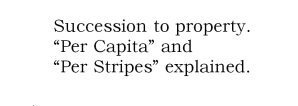
Succession to property. “Per Capita” and “Per Stripes” – explained in simple diagram & words.
In Per Stirpes a person’s share of the inheritance will go to his heir. In Per Capita heirs will not receive any share.
Consider an example where, Mr.X has two children A and B. A has a son S1 and daughter D1 and B has a son S2 and daughter D2. A dies before X. Then after the death of X
In per stripes, A and B each will get 1/2 the share after a notional partition and their share will go to their respective children according to the rules of intestate succession applicable.
In per capita the entire property will go to B and the heirs of A will not get any share. So Per Capita distribution looks at the number of surviving heads on the generational line.
Before the 1956 Act in the above example on death of X – B, S1 and S2 would be the coparcenors( per capita) and would hold the property as joint tenants and their share would decrease on birth of a new coparcenor and increase on death of an exsisting coparcenor.
After the 1956 Act, on death of X – since A and B have a class 1 female heir they hold the property as tenants in common. A notional partition would be done and A and B would first get 1/2 share each ( per stripe )
Then A’s 1/2 share would be divided between himself and his son. So A is left with 1/4 and S1 will get 1/4. Then the 1/4 share in the hands of A would become his separate property and in this his son and daughter would have equal share. So D1 would get 1/8 and S1 will finally get 1/8 + 1/4. same per stripe division will happen in B’s branch.
After the 2005 Amendment on the death of X, A and B will get 1/2 share and on death of A and B their children will get equal shares. So S1, S2, D1 and D2 will all get 1/4 share each.
Relevant Paragraphs: 4 (a) The essential grievance of the petitioner emanates from the so called ‘admitted’ charge of plagiarism. Ramanatha Aiyar’s “Advanced Law Lexicon” 3rd Edn, Wadhwa Nagpur states: “Plagiarism: Publishing borrowed thoughts as original; stealing literary matter from the work of another author. The act or an instance of copying or stealing another’s words or ideas and attributing them as ones own”; the learned Lexicographer also mentions about Paul Goldstein’s ‘Copyright’s Highway 12 (1994) which lucidly explains the concept as under: “Plagiarism, which many people commonlythink has to do with copyright, is not in fact a legal doctrine. True plagiarism is an ethical, not a legal, offense and is enforceable by academic authorities, not Courts. Plagiarism occurs when someone – a hurried student, a neglectful professor, an unscrupulous writer – falsely claims someone else’s words, whether copyrighted or not, as his own. Of course, if the plagiarized work is protected by copyright, the unauthorized reproduction is also a copyright infringement.”
4(c) Plagiarism is a very serious matter that involves ethics and reputation of the student/person concerned; proven plagiarism operates as a hazardous stigma at the campus and the person carrying the same is ordinarily shunned; it may affect his educational and employment opportunities as well; that is the reason, why the respondent-University has taken appreciable pains in meticulously structuring the provision in the extant Regulations so that the innocents are not victimized; however, it has not adhered to the minimum of the fairness standards enacted therein; ‘more is not necessary to specify and less is insufficient to leave it unsaid’.
4(d)The entire episode of so called ‘plagiarism’ is framed on the basis of a few notoriously cryptic mails exchanged between the Course Teacher and the Exam Department, detrimentally keeping the petitioner in darkness;
4(f) It has been a long settled position of law that a stray sentence giving the impression of admission of the guilt shall not be interpreted in isolation when the rest of the matter in the representations suggests the contra; one has to gather a holistic impression from reading the entire text and not a few sporadic sentences appearing here & there in a script, whilst considering if what is stated amounts to admission. An acclaimed jurist of yester decades Mr.Rupert Cross in his treatise ‘EVIDENCE’, (3rd Edn. London- Butterworks 1967) at page 433 states: “An admission being any statement … which is adverse to a party’s case, the only conditions of admissibility, when thestatement emanates from the party himself concern the capacity in which he is acting and the reception of the entirety of the statement…”; it is more so when one is dealing with the educational career of young minds like the petitioner herein; loose & lavish wording of the representations, need to be given a due discount; the respondent –University is not justified in seeking shelter under a leaking umbrella of a poor student.
4(g)What intrigues this Court is about the enormity of unfair treatment which the petitioner was meted out at the hands of a Law University, in a serious matter like this; it is anguishing that the University did not afford an opportunity of personal hearing despite his written requestin Biblical literature, even God is said to have given an opportunity of hearing to Adam & Eve before punishing them for consuming the proscribed fruit, in the Eden Garden; which heavens would have fallen down, had a reasonable opportunity of personal hearing been afforded, remains as a mystery rapped in enigma; after all, procedural fairness is a constitutional mandate when the answering respondent is an instrumentality of the “State” under Article 12 of the Constitution; it is high time thatthis University of national repute be reminded that it is dealing with our children and not others’ chattel.
ORDER. In the above circumstances, this writ petition succeeds; a Writ of Certiorari issues quashing the impugned orders at Annexures-H & L1; a Writ of Mandamus issues to the respondent-University to assess and award marks to the petitioner’s Project Work in question; petitioner shall be continued to keep the term by way of carry over/carry forward, disregarding the attendance shortage, if any.
Relevant paragraphs: 19, 20 & 21.…When the defendants have denied the very execution of the agreement, receipt of the sale advance amount and the signatures, it is the burden on the plaintiffs to prove the same and in the absence of proof, the suit filed by the plaintiffs has been rightly dismissed by the Trial Court. Our view is fortified by the dictum of the Hon’ble Apex Court in the case of Thiruvengada Pillai vs. Navaneethamal reported in AIR 2008 SC 1541. Judgment in N.T. Vijayakumar and others vs. The Allahabad Bank, Nehru Road Branch, Shimoga, reported in 1999(2) Kar. L.J. 490, Shivakumar and others vs. Sharanabasappa and others reported in 2020 SCC Online SC 385, relied on.
22. The plaintiffs have failed to prove the very execution of the document by the defendants and receipt of advance amount of Rs.35.00 lakhs. In the absence of the same, the suit filed by the plaintiffs for the relief of specific performance is not maintainable. Though learned counsel for the appellants contended that the plaintiffs were always ready and willing to perform their part of the contract as contemplated under Section 16(c) of the Specific Relief Act, the same cannot be accepted. Admittedly, the very agreement itself is not proved. Therefore, the question of readiness and willingness would not arise. Appeal dismissed.
Relevant pages (paragraphs are not numbered): 19. As early as in the year 1948, the Privy Council in THE PALESTINE KUPAT AM BANK CO-OPERATIVE SOCIETY LTD.VS GOVERNMENT OF PALESTINE ANDOTHERS reported in AIR 1948 PC 207 observed as follows: – “In construing a grant of land, a description by fixed boundaries is to be preferred to a conflicting description by area. The statement as to area is to be rejected as falsa demonstratio.”
Same view was taken referring to this decision by the High Court of Madras in DHARMAKANNY NADAR SIVISESHAMUTHU AND OTHERS VS MAHALINGAM NADAR GOPALAKRISHNA NADAR AND OTHERS reported in AIR 1963 MADRAS 147 and it is reproduced as under: “Where the property sold is part of a definite survey number and in the sale deed the exact boundaries of the part sold are given and the area mentioned is only approximate, the description by boundaries should prevail in ascertaining the actual property sold under the document”.
This Court in NARASIMHA SHASTRY VS MANGESHA DEVARU reported in ILR 1988 KAR 554 has held as under: – “Where the sale deed mentioned the boundaries specifically and clearly to identify the property, the actual extent of the land not being clear, the recitals as to boundaries should prevail.”
It seems to me to be quite clear that what was sold was the whole of the property with definite boundaries and that the measurements were not accurately given, the mistake being in the measurement alone. Therefore, there was no reason for Judges to restrict the ownership to a smaller extent. It is well established by several decisions of Courts that where the boundaries in a document are vague and indefinite, the area should prevail, but where the boundaries are specific and definite, the area must be taken as given only approximately.
This is, therefore, a clear case of precise and accurate description in a document of the property sold by its boundaries. The measurement by area should, therefore, be considered only approximate. I, therefore, come to the conclusion that the general principles laid down by the decisions cited above that the description by boundaries should prevail where the boundaries are exact and where the area is approximate should be applied in this case, ….
I repeat that it is not a case where the boundaries in a document are vague and indefinite, so that the area should prevail. It follows therefore, that if the boundaries are specific and definite, the area must be taken as has given only approximate.
As already observed above, it is well established by several decisions of Courts that where the boundaries in a document are vague and indefinite, the area should prevail, but where the boundaries are specific and definite, the area must be taken as given approximately. It is perhaps well to observe that if the description of a boundary is ambiguous, otherwise uncertain or in conflict with the occupation, Courts may settle the position of the disputed boundary.
31….Section 12(4) of Act, 1984 mandates the competent authority to examine the investigation report submitted on behalf of the Lokayukta/Upalokayukta. On this point Dr.K.Lalitha vs The State of Karnataka and others 2019 (4) KLJ 344 assists the petitioners case. Similarly, Rule 14-A(2)(iii) of Rules, 1957 provides two options to the Government that after due examination of the investigation report of the Upalokayukta under Section 12(3) of Act 1984, Government has to make up its mind as to whether matter is required to be entrusted to the Lokayukta/Upalokayukta with reference to Rule 11 of Rules, 1957 or entrusting to disciplinary authority with reference to Rule 12 of Rules, 1957. In such circumstances, it is mandatory for the Government to record reasons as to why the matter is being entrusted to the Lokayukta/Upalokayukta or to disciplinary authority.…It is obligatory on the part of the Government when it is in receipt of investigation report under Section 12(3) of the Act 1984, to reveal the reasons as to why matter is entrusted to Lokayukta/Upalokayuta or disciplinary authority, when option is provided under statute.
Doctrine of per incuriam.Paragraphs 36-40
Ingredient with the judgment per incuriam as quoted by Sir John Salmond in his ‘Treatise on Jurisprudence’ has aptly stated the circumstances under which a precedent can be treated as per incuriam. It is stated that a precedent is not binding for which it was rendered in ignorance of a statute or a rule having the force of statute or delegated legislation.
Mr.Govindrajan in his book called ‘Invoking the doctrine of per incuriam’, states that the Rule applies even though the Court knew of the statutes in question but it did not refer to and had not present to its mind the precise terms of the statute. Similarly, a Court may know all the extension of a statute and yet not appreciate its relevancy to the matter on hand, such a mistake is again per incuriam so as to vitiate the decision. Even the lower Court can impugn a precedent on such grounds.