Karnataka High Court disposes more than 15,000 cases during Covid-19 period via Video Conferencing.

S.Basavaraj, Advocate, Daksha Legal.

Karnataka High Court has disposed more than 15,000 cases during Covid-19 period via Video Conferencing. Though physical appearance is allowed in few court halls, majority of the cases have been heard via video conferencing.

Covid related lock-down was imposed on 26 March 2020. Immediately thereafter, the Hon’ble Chief justice bench started hearing matters including PILs seeking directions to Government to effectively fight the situation. The Benches hearing matters view video link were increased gradually and as of now even the old matters like Regular First Appeals are being heard and disposed by the Hon’ble Judges.

Perhaps the biggest ever hearing on video conferencing was Securities Exchange Board of India vs Franklin Templeton Trustees Services Pvt Ltd & others decided on 24 October 2020. The batch of Writ Appeal/Petitions were heard where nine Senior Advocates including Solicitor General of India and Additional Solicitor General of India and more than 25 instructing counsel participated– all logged in from different parts of the country and one from abroad. 5000 pages of documentation and marathon hearing for 25 working days including two Court holidays, totally 61 hours of hearing made this case unique.

The website shows that on 24 November, the Principal bench at Bangalore there are 67 video conferences with several judges combination hearing almost all types of cases. In Dharward and Kalburgi benches, totally 13 Hon’ble Judges are hearing the matters via video conference.

As on today, the total strength of the Judges is 46. Though the pendency has increased considerably for want of judges earlier, the disposal of cases is likely to reach its optimum level from next year.

S.Basavaraj, Advocate, Daksha Legal. Member, Karnataka State Bar Council

Motor Vehicle Act. Insurance company not limiting insurance policy till fitness certificate period can not escape liability on the ground that vehicle’s fitness certificate lapsed on the date of accident. Karnataka High Court.

Chetan Kumari L.M. vs The Manager, Oriental Insurance Co. Ltd. and another. Miscellaneous First Appeal 948/2015 decided on 11 November 2020.

Judgment Link: http://judgmenthck.kar.nic.in/judgmentsdsp/bitstream/123456789/330682/1/MFA948-15-11-03-2020.pdf

Relevant paragraphs: 5. The Tribunal, noting that the offending Maruti Car did not possess a fitness certificate as on the date of the accident, though it had a fitness certificate on the date of issuance of the insurance policy, held that the owner of the offending car i.e., insured has violated the terms of the policy and therefore, imposed the penalty on the owner of the car and discharged the Insurance Company from its liability.

11. Having perused the documents and the judgment, it is seen that as on the date of the issuance of the insurance policy, there was a fitness certificate and vehicle was being plied on the road. At the time of issuance of insurance policy, the insurer has not limited its liability till the date of validity of the fitness certificate. The insurer had issued a policy beyond the validity of the fitness certificate. Therefore, the insurer cannot now contend that the policy would be valid only until the date of the validity of the fitness certificate more so when the insurer has collected the premium for the entire period without any limitation. Needless to say that at the time of issuance of the insurance policy, the insurer has to verify the validity of the required document including the existence of a valid fitness certificate Therefore, I am of the considered opinion that when the insurer knowing fully well that the fitness certificate was valid only till 23.07.2013 having issued a policy to cover the period beyond the said date, insurer would be liable to make payment of compensation for the entire period during which the insurance policy is in operation subject to recovering the same from the insured on account of  violation  committed  by  the  insured  in  not renewing the fitness certificate as agreed by the insured in terms of the policy.

Appeal allowed.

Compiled by S. Basavaraj, Advocate, Daksha Legal.

Motor Vehicle Act. JCB is a non-transport, construction equipment vehicle. Person holding licence to drive Light Motor Vehicle is authorized to drive JCB. Karnataka High Court.

Reliance General Insurance Company Limited vs S. Ramya and others. Miscellaneous First Appeal 6789/2010 decided on 9 November 2020.

Judgment Link: http://judgmenthck.kar.nic.in/judgmentsdsp/bitstream/123456789/348449/1/MFA6789-10-09-11-2020.pdf

Relevant paragraphs: 6. The Tribunal while considering  the  question  of liability, held that the JCB in question was a  construction vehicle and that construction equipment would not fall within the Class of non  transport  vehicle and that the driver of the JCB not only  possessed  a  driving licence to drive the light motor vehicle but also a light  motor  vehicle  cab.  Thus,  the  Tribunal  held  that the driver of the offending JCB was  authorized  to  drive the JCB in question, since it fell within the meaning of a ‘light transport vehicle’. The Tribunal therefore, fastened the liability to pay the compensation upon the insurer of the offending vehicle – JCB.

7. Learned counsel for the insurer in this  appeal contended that the JCB is not a vehicle which is classified anywhere in the Motor Vehicles Act as either a ‘transport vehicle’ or as a ‘construction vehicle’.

10. It is not in dispute that the Central  Government in  terms  of  its  notification  dated  19.06.1992 had clearly  delineated  ‘construction equipment vehicles’ as  ‘non transport vehicles’.  In  view of the fact that the driver of the  JCB  in  question  possessed a licence to drive a light motor vehicle and in view of what was held by the Apex Court in the case of Mukund Dewangan Vs. Oriental Ins.Co.Ltd.  2017(14)SCC663, the driver of the JCB was indeed authorized to drive a JCB in question and therefore, the Tribunal was right in fixing the liability to pay the compensation upon the insurer.

Compiled by S. Basavaraj & Sumana Chamarty, Daksha Legal.

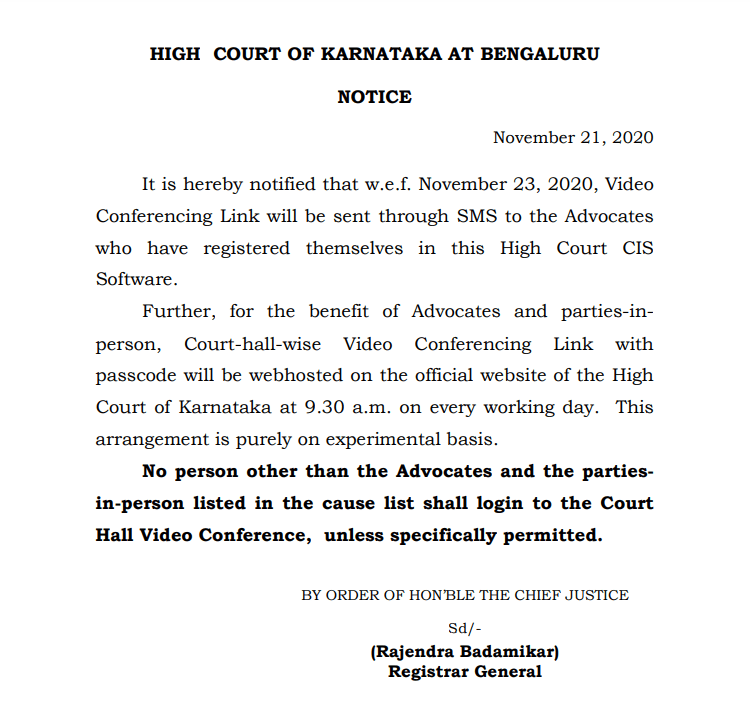
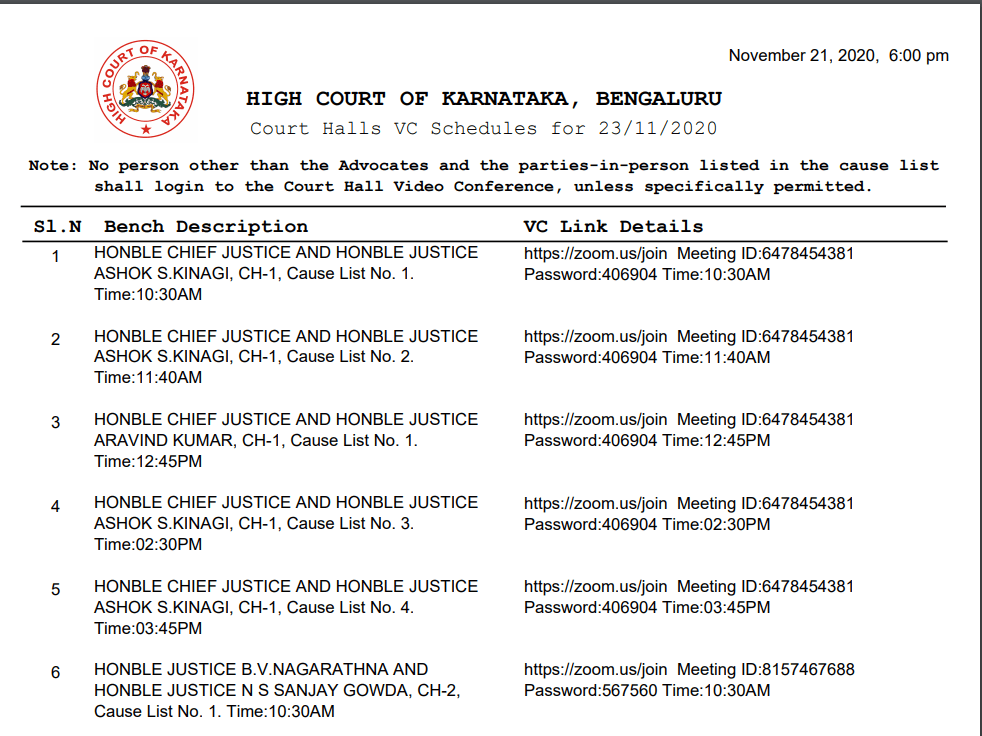
Karnataka High Court webhosts Court-hall-wise Video Conferencing Links with passcodes from 23 November 2020.

The Karnataka High Court has issued a notification regarding webhosting of Court-hall-wise Video Conferencing Links with passcodes from 23 November 2020. This is subject to caution. The notice in this regard reads as follows:

The Links are shared on the Official website of the High Court and the same can be accessed by clicking the following link: https://karnatakajudiciary.kar.nic.in/chvclinks.php

“Rule against clog on redemption” “Once a mortgage is always a mortgage” – explained with judgments.

-S. Basavaraj, Advocate, Daksha Legal.

Section 60 of the Transfer of Property Act, 1882, (extracted below) confers the right of redemption on the mortgagor. This is a statutory right. The right of redemption is an incident of a subsisting mortgage and it subsists so long as the mortgage subsists. English law on this aspect is based on principles of equity. Indian law is based on justice, equity and good conscience.

Rule against clog on redemption simply connotes that anything which obstructs the right of the mortgagor to redeem his property is void. Such obstruction constitutes a clog on the right to redemption. The resultant principle i.e. ‘once a mortgage always a mortgage’ states that there can no covenant that modifies the character of the mortgage agreed between the parties that would stop the mortgagor to redeem his property back on payment of the principal and respective interests.

The right of redemption is a right which a mortgagor may seek to enforce, and not a ‘liability’ which he may be compelled to discharge.

It is a right of the mortgagor on redemption to get back the property. He is entitled to hold and enjoy as he was entitled to hold and enjoy it before the mortgage. If he is prevented from doing so or is prevented from redeeming the mortgage, such prevention is bad in law. If he is so prevented, the equity of redemption is affected by that whether aptly or not, and it has always been termed as a clog. Such a clog is inequitable.

The law does not tolerate clog on redemption. However, each case has to be judged and decided in its own perspective. For example long term for redemption by itself, is not a clog on equity of redemption.

Whether or not in a particular transaction there is clog on the equity of redemption, depends primarily upon the period of redemption, the circumstances under which the mortgage was created, the economic and financial position of the mortgagor, and his relationship vis-à-vis him and the mortgagee, the economic and social conditions in a particular country at a particular point of time, custom, if any, prevalent in the community or the society in which the transaction takes place, and the totality of the circumstances under which a mortgage is created, namely, circumstances of the parties, the time, the situation, the clauses for redemption either for payment of interest or any other sum, the obligations of the mortgagee to construct or repair or maintain the mortgaged property in cases of usufructuary mortgage to manage as a matter of prudent management, these factors must be co-related to each other and viewed in a comprehensive conspectus in the background of the facts and the circumstances of each case, to determine whether these are clogs on equity of redemption.

A mortgage is essentially and basically a conveyance in law or an assignment of property as a security for the payment of debt or for discharge of some other obligation for which it is given. The security must, therefore, be redeemable on the payment or discharge of such debt or obligation. Any provision to the contrary, notwithstanding, is a clog or fetter on the equity of redemption and, hence, bad and void. “Once a mortgage must always remain a mortgage”, and must not be transformed into a conveyance or deprivation of the right over the property.

A mortgage cannot be made altogether irredeemable or redemption made illusory. The law must respond and be responsive to the felt and discernible compulsions of circumstances that would be equitable, fair and just, and unless there is anything to the contrary in the statute, court must take cognisance of that fact and act accordingly. In the context of fast changing circumstances and economic stability, long term for redemption makes a mortgage an illusory mortage, though not decisive. It should prima facie be an indication as to how clogs on equity of redemption should be judged. Pomal Kanji Govindji v. Vrajlal Karsandas Purohit, (1989) 1 SCC 458

Denial of title: During the subsistence of the mortgage it is not open to the mortgagee to dispute the title of the mortgagor. A mortgagee who has been put in possession pursuant to the mortgage, cannot deny the relationship. For once a mortgage it is always a mortgage. In other words the application of the Rule would arise only when the title is disputed or doubted. The application of the Rule estoppel would arise even when there is some scope or doubt regarding title and when there is some dispute is raised as regards the title of the mortgagor. Assuming the mortgagee has succeeded in raising some doubt regarding the title then it is all the more necessary to apply the rule. In such a case the Rule would come into play and the estoppel would operate. Subramanian v. Karuppayee Ammal, 1997 SCC OnLine Mad 431: (1998) 1 CTC 79, at page 84  :

Adverse possession: A mortgagee cannot claim title to the property, by way of adverse possession. S.K. Rajendran v. K. Sakthivel, 2011 SCC OnLine Mad 688 : (2011) 2 MWN (Civil) 460, at page 463  :

Decree: Unless and until final decree for redemption or foreclosure is passed, right to redeem is not lost.Thus, right of redemption can be extinguished either by Act of the parties or by (decree) of a Court. The ‘decree of the Court’ used in Section 60 of the Transfer of Property Act, 1882 has reference to the decree passed in the suit for redemption or foreclosure extinguishing the right of redemption. Right to redeem is not extinguished in case the final decree for redemption or fore-closure omits to make such declaration. Rosamma v. B.V. Ramachandrappa, 2000 SCC OnLine Kar 297: (2000) 7 Kant LJ 307: (2001) 3 ICC 715: 2000 AIHC 4782, at page 315:  

Limitation and consequences of creating excess interest by the mortgagee: A suit for redemption of mortgage could be filed within 60 years. But if the mortgagee had created an interest in excess of the right enjoyed by him, then to recover possession against the third party the suit had to be filed within 12 years of the transfer becoming known to the plaintiff. The rationale in cutting down the period of 60 years to 12 years is clear. The 60 years period is granted as a mortgagee always remains a mortgagee and thus the rights remain the same. However, when an interest in excess of the interest of the mortgagee is created then the third party is not claiming under the mortgagee. The position of such a person could not be worse than that of a rank trespasser who was in open and hostile possession. As the title of the rank trespasser would get perfected by adverse possession on expiry of 12 years so also the title of such transferee would get perfected after 12 years. The period of 12 years has to run from the date of knowledge by the plaintiff of such transfer. It is always for the party who lies the suit to show that the suit is within time. Thus in cases where the suit is filed beyond the period of 12 years, the plaintiff would have to aver and then prove that the suit is within 12 years of his/her knowledge. In the absence of any averment or proof, to show that the suit is within time, it is the plaintiff, who would fail. Whenever a document is registered the date of registration becomes the date of deemed knowledge. In other cases where a fact could be discovered by due dilience then deemed knowledge would be attributed to the plaintiff because a party cannot be allowed to extend period of limitation by merely claiming that he had no knowledge. – M.K. Shekarappa v. Shivagangamma, 2007 SCC OnLine Kar 179: ILR 2007 KAR 2473: (2007) 5 Kant LJ 93: (2007) 4 AIR Kant R 330: (2007) 4 ICC 308: 2007 AIHC 2530, at page 2484:

Section 60. Right of mortgagor to redeem.—At any time after the principal money has become due, the mortgagor has a right, on payment or tender, at a proper time and place, of the mortgagemoney, to require the mortgagee (a) to deliver to the mortgagor the mortgage-deed and all documents relating to the mortgaged property which are in the possession or power of the mortgagee, (b) where the mortgagee is in possession of the mortgaged property, to deliver possession thereof to the mortgagor, and (c)at the cost of the mortgagor either to re-transfer the mortgaged property to him or to such third person as he may direct, or to execute and (where the mortgage has been effected by a registered instrument) to have registered an acknowledgement in writing that any right in derogation of his interest transferred to the mortgagee has been extinguished:

Provided that the right conferred by this section has not been extinguished by act of the parties or by decree of a Court.

The right conferred by this section is called a right to redeem, and a suit to enforce it is called a suit for redemption.

Nothing in this section shall be deemed to render invalid any provision to the effect that, if the time fixed for payment of the principal money has been allowed to pass or no such time has been fixed. the mortgagee shall be entitled to reasonable notice before payment or tender of such money.

Redemption of portion of mortgaged property.—Nothing in this section shall entitle a person interested in a share only of the mortgaged property to redeem his own share only, on payment of a proportionate part of the amount remaining due on the mortgage, except only where a mortgagee, or, if there are more mortgagees than one, all such mortgagees, has or have acquired, in whole or in part, the share of a mortgager.

Compiled by S. Basavaraj, Advocate, Daksha Legal

Civil Procedure Code. Mere marking of an inadmissible document does not establish its proof. Marking is a ministerial act & admitting it in evidence is judicial. Law on the point discussed. Karnataka High Court.

Ismailbee vs Mehtab Saheb. Regular Second Appeal 868/2007 decided on 22 October 2020.

Judgment Link: http://judgmenthck.kar.nic.in/judgmentsdsp/bitstream/123456789/349005/1/RSA868-07-22-10-2020.pdf

Relevant paragraphs: 26. ….the documents of which registration is required by Transfer of Property Act, 1882, shall be compulsorily required to be registered otherwise such documents shall not affect any immovable property. So, when once the transaction has been reduced to a form of document viz., “exchange deed”, then registration is compulsory. Such documents are not admissible as the evidence of any transaction affecting any immovable property comprised therein.

40. Marking the document in evidence is one thing and the proof, admissibility, evidentiary value of the document and acting upon it is other thing. Simply, because the document is marked as an exhibit without there being any objection by the opposite party, when it is produced in examination-in-chief that will not enure benefit to the party to claim declaration of title in a immovable property or extinguishing title of opposite party in immovable property, when admittedly the immovable property which were exchanged are worth more than Rs.100/- and requires registration.

42. The learned Single Judge of this Court in another decision reported in ILR 2003 KAR 3716 in the case of Krishna vs Sanjeev has considered the difference between “marking”, “admitting the documents” and “proof of documents during trial of the suit” as under:- “11. Marking of a document is a ministerial act whereas, admitting a document in evidence is a judicial act. Before a document is let in evidence, there should be a judicial determination of question wherever it can be admitted in evidence or not. In other words, the Court admitting a document must have applied its mind consciously to the question whether the document was admissible or not.

44. Therefore, simply because Ex.P.1 is marked in the examination-in-chief without objection by opposite party, at the time of marking it, the said document cannot be used and acted upon as a evidence of title to grant declaration of title, as it being not sufficiently stamped and not registered. The said document also cannot be looked into for collateral purpose, in view of proviso to Section 49 of the Registration Act, 1908 and Section 118 of the Transfer of Property Act, 1882.

Compiled by S. Basavaraj, Advocate, Daksha Legal.

Negotiable Instruments Act. Section 138. When a probable defence is set up by accused, burden is on the complainant to explain it. Standard of proof applicable to evaluate such explanation is ‘beyond reasonable doubt’. Failure to explain material contradictions results in dismissal of complaint. Karnataka High Court.

Santosh vs Harilal. Criminal Appeal 2784/2012 decided on 11 November 2020.

Judgment Link: http://judgmenthck.kar.nic.in/judgmentsdsp/bitstream/123456789/349010/1/CRLA2784-12-11-11-2020.pdf

Relevant Paragraphs: 17. The facts of the present case are not on par with those in Bir Singh Vs. Mukesh Kumar reported in (2019) 4 SCC 197, however, pivots on a different issue. The trial Court on consideration of the material omissions and contradictions in the version of the complainant regarding period of transaction as well as amount due not matching the cheque amount involved, acquitted the accused. As rightly submitted by learned counsel for the accused, the standard of proof for upsetting the presumption in favour of complainant is preponderance of probabilities as held in Vijay Vs. Lakshman & Ors. 2013 (3) SCC 86 . In order to do so, accused need not step into the witness box to prove that cheque issued was not in discharge of a legally recoverable debt or liability under Section 138 of the NI Act. He can very well establish the same by setting up a defence by preponderance of probabilities to upset the rebuttable presumption available to complainant as per Rangappa vs. MohanRangappa2010 (11) SCC 441, case when a probable defence is set up by accused, burden of explaining the same is on the complainant and standard of proof applicable for evaluating such explanation would be proved beyond reasonable doubt.

18. On over all consideration of the entire evidence on record, omissions and contradictions with regard to the period of transaction and amount involved coupled with failure to produce books of accounts by the complainant, who is a businessman  and the transaction being a part of his business, the Trial Court, in my opinion, has rightly come to the conclusion that the complainant has failed to prove that an offence under Section 138 of the N.I. Act was committed by the accused and therefore, acquittal of the accused for the offence is justified. Hence, there is no merit in the appeal. Accordingly, it is dismissed.

Compiled by S. Basavaraj, Advocate, Daksha Legal.

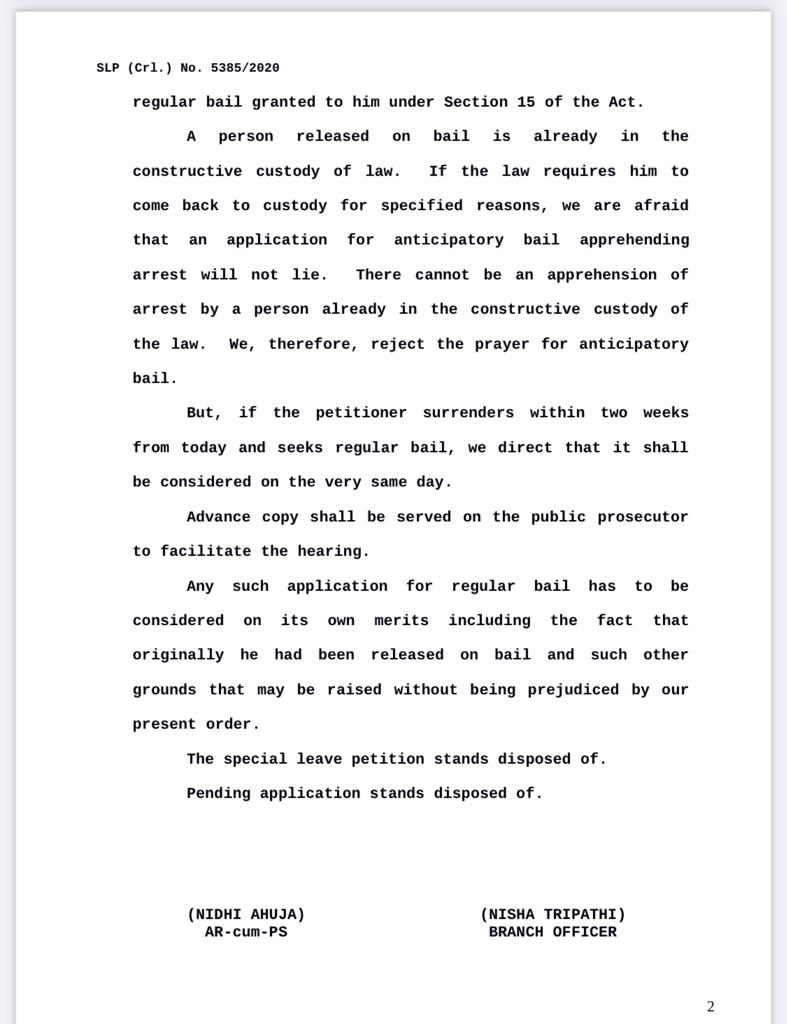
Anticipatory Bail. Person whose regular bail is cancelled cannot seek anticipatory bail since he is in the constructive custody of the law. Supreme Court.

Manish Jain vs Haryana State Pollution Control Board. Special Leave Petition (Crl) 5385/2020, decided on 20 November 2020. Judgment below.

Compiled by S. Basavaraj, Advocate, Daksha Legal.

Motor Vehicles Act. Even adult person can claim compensation for the death of elder/younger brother. However, unless dependency is proved, compensation cannot be awarded. Karnataka High Court.

Raju Singh vs Sharanappa and others. Miscellaneous First Appeal 103546/2019 decided on 11 November 2020.

Judgment Link: http://judgmenthck.kar.nic.in/judgmentsdsp/bitstream/123456789/349058/1/MFA103546-19-11-11-2020.pdf

Relevant paragraphs: 8 &9. There can be no two opinions that even an adult younger brother or grown up son is entitled to claim compensation under the head of loss of dependency subject to condition that they demonstrate that they were indeed dependant on the income of the deceased. The point that arises for consideration in this appeal is whether the appellant has made out a case for grant of compensation under the head of loss of dependency? In the absence of any evidence to the contrary, we are of the considered opinion that the reasoning and conclusion of the Tribunal does not call for any interference.

13. In the ruling of National Insurance Company Limited, the Apex Court entered upon the facts of the case and after appreciating the same, held in paragraph 15 as under: “15. It is thus settled by now that the legal representatives of the deceased have a right  to  apply for compensation. Having said that, it must necessarily follow that even the major married and earning sons of the deceased being legal representatives have a right to apply for compensation and it would be the bounden duty of the Tribunal to consider the application irrespective of the fact whether the concerned legal representative was fully dependant on the  deceased and not to limit the claim towards conventional heads only.

14. As noted by the Tribunal and as concluded by us, we do not find any material which demonstrates such a fact in the present case. In the absence of evidence demonstrating that the adult was dependant on the  income of the deceased or that the deceased was caring for the welfare and well being of the claimant, the claimant would not be entitled to claim compensation under the head of loss of dependency.

Appeal rejected

Compiled by S. Basavaraj, Advocate, Daksha Legal

Negotiable Instruments Act. Power of Magistrate to convert trial of complaint under Section 138 is confined only to convert the case into a summons triable case and not as warrant case. Karnataka High Court.

M/s. Mahathru Technologies vs M/s Creative Infotech. Criminal Petition 1329/2020 decided on 19 November 2020.

Judgment Link: http://judgmenthck.kar.nic.in/judgmentsdsp/bitstream/123456789/348866/1/CRLP1329-20-19-11-2020.pdf

Relevant paragraphs: Question referred by the Hon’ble single judge to larger bench. “Whether in a case for offence punishable under Section 138 of the Negotiable Instruments Act, 1881, the Court of Magistrate exercising its power under the second proviso to Section 143 of the Negotiable Instruments Act, if it appears to the said Court that it is undesirable to try the case summarily, after recording reasons, can proceed to try/hear the said case as a warrant case?”. The reference was made in view of the conflicting views expressed by the coordinate Benches on the above issue in M/S. Mesh Trans Gears Private Limited, Bangalore –vs- Dr. R. Parvathareddy – ILR 2014 KAR 5237 and Mahendra Kumar –vs- Gangamma.B – ILR 2018 KAR 4761, by relying upon a decision of another learned Single Judge in M/S. Leo Granex –vs- M/S. Pavillion Granites & others – ILR 2009 KAR 4062.

16. There is a substantial difference between the procedure prescribed by the provisions of Cr.P.C for trial of a ‘warrant case’ and trial of a ‘summons case’. In case of trial of a warrant case, under the provisions of Section 245 of Cr.P.C, the learned Magistrate is bound to consider the plea of discharge for the offence alleged against the accused. Section 246 of Cr.P.C, provides for framing of charge. Section 244 contemplates recording of evidence before charge. However, under the procedure prescribed for trial of a summons case, there is no requirement of framing of charge. Thus, between the two, the procedure applicable to a summons case is  less  cumbersome and expeditious, as compared to the procedure applicable to a warrant case. A trial in a summons case can be concluded more expeditiously than a trial of warrant case, as in the case of trial of  a warrant case, a charge is required to be framed which is not at  all the requirement in case of a summons case.

21. If the learned Magistrates are allowed to convert the complaints filed alleging an offence punishable under Section 138 of the said Act of 1881 into a warrant triable case, the consequence will be disastrous as the trial will be prolonged. Lot  of time will have to be devoted for hearing of  discharge  application and for framing of charge. It will amount to defeating the very object of introducing Chapter XVII containing Sections 138 to 142 in the said Act of 1881 with effect from 1st April 1989.

22. Therefore, for the foregoing reasons, we answer the question formulated by the learned Single Judge in the  order dated 29th June 2020 in the negative. It is held that the power of the learned Magistrate to convert the trial of a complaint under Section 138 of the said Act of 1881 under the second proviso to sub-section (1) of Section 143 is confined only to converting the case into a summons triable case.

Compiled by S. Basavaraj, Advocate, Bangalore