Relevant paragraph : 36. The observations of the Hon’ble Apex Court and the various High Courts in the long line of rulings narrated supra, obviates any detail discussion with regard to the maintainability of a writ petition against the Bar Association invoking the provisions of Article 226 of the Constitution of India. That apart, as detailed supra, some of the obligation, the 3rd respondent has cast upon itself, bears a public character. The Advocates are not mere arbiters but officers of the court who assist the Court in the running of the justice delivery system and it is such officers of the court who constitute the 3rd respondent Society. That the constituents of the 3rd respondent Society are answerable to the Court and to the 1st respondent with regard to their conduct in the discharge of their professional duties. Both the 1st respondent and the Court can by no stretch of imagination be described as private entities. That apart, if the objects of the 3rd respondent Society are juxtaposed with the observations of the Hon’ble Apex Court in Dwarkanath Vs. Income Tax Officer 1965 (3) SCR 536 and Supreme Court Bar Association and othersvs.B.D.Kaushik(2011)13SCC774 case, it is apparent that the 3rd respondent discharges obligations of a public character. Hence, the writ petition invoking the provisions of Article 226 of the Constitution of India praying for a relief as against the 3rd respondent is required to be held as maintainable.
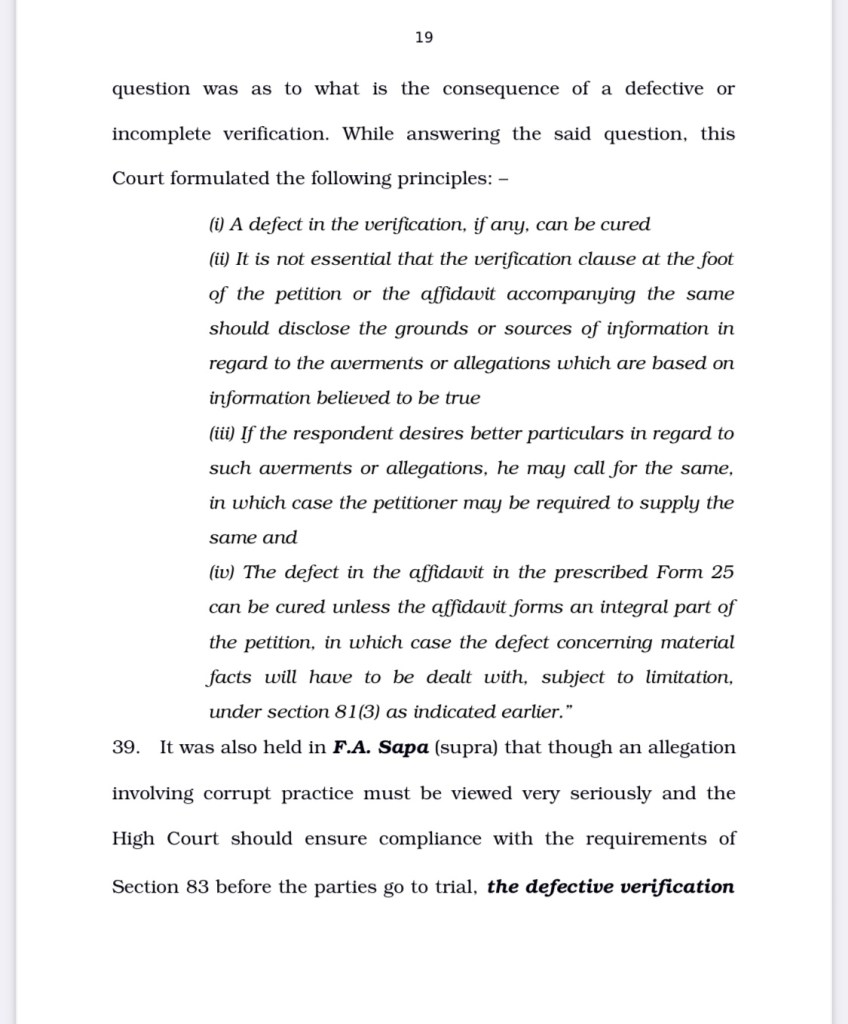
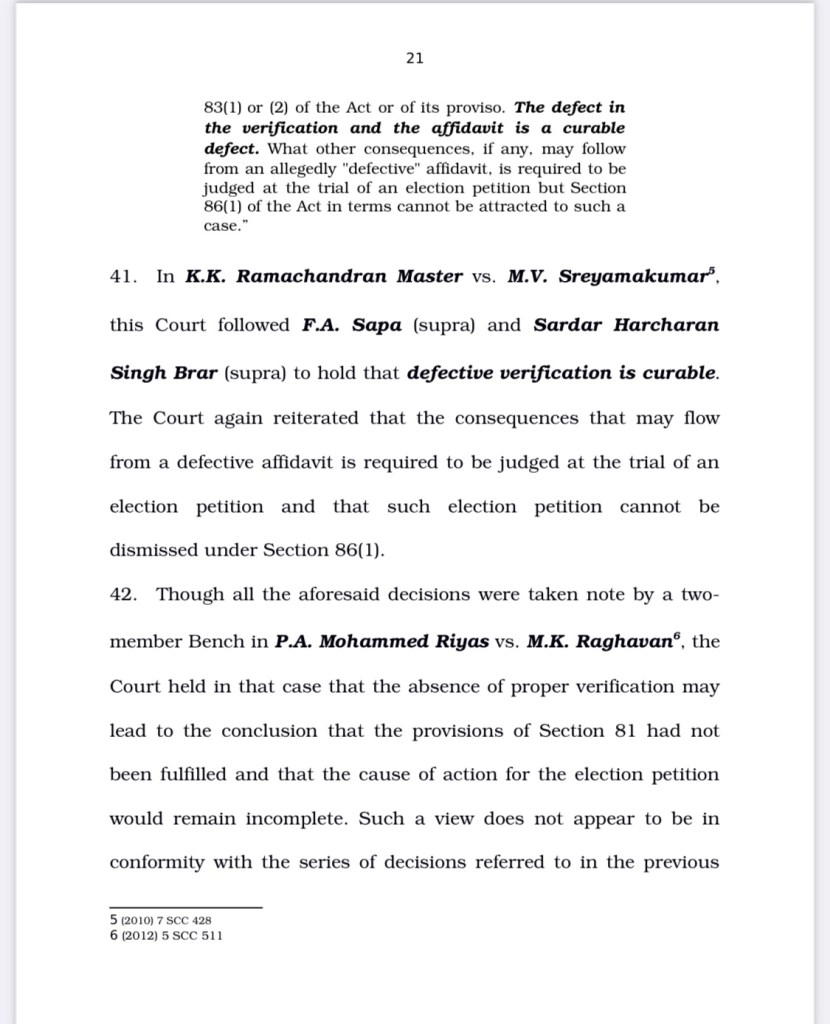
Relevant para: 43. The upshot of the above discussion is that defective verification is a curable defect. An election petition cannot be thrown out in limine, on the ground that the verification is defective.
Relevant paragraphs: 8 &9. The State, when it enters into a contract, must do so fairly without discrimination, arbitrariness and unreasonableness. Any act of the State should withstand the test of judicial review under Article 14 of the Constitution. This power of review is normally exercised by the constitutional courts to rein any unbridled executive functioning. In a democratic State, rule of law is of paramount importance and the Courts are required to act as guardians of rule of law. Arbitrariness and unfairness in a contract defies the basics of rule of law. The respondent No.1 is the beneficiary of the work done by the petitioner and it is clear from the facts and circumstances of the case that the instrumentalities of respondent No.1 have acted in a arbitrary and unfair manner after the work is completed.
10. The Hon’ble Apex Court in the case of ABL Internatiional Ltd. and Ors. –vs- Export Credit Guarantee Corporation of India Ltd. and Ors. 1has held as under:
“23. It is clear from the above observations of this Court, once State or an instrumentality of State is a party to the contract, it has an obligation in law to act fairly, justly and reasonably which is the requirement of Article 14 of the Constitution of India. .”
11. In the very same judgment, the Hon’ble Apex Court considered the question of maintainability of a writ petition against a State for enforcement of right arising out of a contractual obligation. The Hon’ble Apex Court at para-29 of the aforesaid judgment has held as under:
“29. From the above discussion of ours, following legal principles emerge as to the maintainability of a writ petition:-
In an appropriate case, a writ petition as against a State or an instrumentality of a State arising out of a contractual obligation is maintainable.
Merely because some disputed questions of facts arise for consideration, same cannot be a ground torefuse to entertain a writ petition in all cases as a matter of rule.
A writ petition involving a consequential relief of monetary claim is also maintainable.”
12. The Apex Court in the case of KUMARI SHRILEKHA VIDYARTHI ETC., VS STATE OF U.P. AND OTHERS – AIR 1991 SC 537, has held that State action in contractual matter can be reviewed under Article 14 of the Constitution. In paragraphs 22, 23, 24, 28 & 29 of the said decision, the Apex Court has held as under:
“22. There is an obvious difference in the contracts between private parties and contracts to which the State is a party, Private parties are concerned only with their personal interest whereas the State while exercising its powers and discharging its functions, acts indubitably, as is expected of it, for public good and in public interest. The impact of every State action is also on public interest. This factor alone is sufficient to import at least the minimal requirements of public law obligations and impress with this character the contracts made by the State or its instrumentality. It is a different matter that the scope of judicial review in respect of disputes failing within the domain of contractual obligations may be more limited and in doubtful cases the parties may be relegated to adjudication of their rights by resort to remedies provided for adjudication of purely contractual disputes. However, to the extent, challenge is made on the ground of violation of Article 14 by alleging that the impugned act is arbitrary, unfair or unreasonable, the fact that the dispute also falls within the domain of contractual obligations would not relieve the State of its obligation to comply with the basic requirements of Article 14. To this extent, the obligation is of a public character invariably in every case irrespective of there being any other right or obligation in addition thereto. An additional contractual obligation cannot divest the claimant of the guarantee under Article 14 of non-arbitrariness at the hands of the State in any of its actions.
23. Thus, in a case like the present, if it is shown that the impugned State action is arbitrary and, therefore, violative of Article 14 of the Constitution, there can be no impediment in striking down the impugned act irrespective of the question whether an additional right, contractual or statutory, if any, is also available to the aggrieved persons.
27. The State cannot be attributed the split personality of Dr. Jekyll and Mr. Hyde in the contractual field so as to impress on it all the characteristics of the State at the threshold while making a contract requiring it to fulfil the obligation of Article 14 of the Constitution and thereafter permitting it to cast off its garb of State to adorn the new robe of a private body during the subsistence of the contract enabling it to act arbitrarily subject only to the contractual obligations and remedies flowing from it. It is really the nature of its personality as State which is significant and must characterize all its actions, in whatever field, and not the nature of function, contractual or otherwise, which is decisive of the nature of scrutiny permitted for examining the validity of its act. The requirement of Article 14 being the duty to act fairly, justly and reasonably, there is nothing which militates against the concept of requiring the State always to so act, even in contractual matters. There is a basic difference between the acts of the State which must invariably be in public interest and those of a private individual, engaged in similar activities, being primarily for personal gain, which may or may not promote public interest. Viewed in this manner, in which we find no conceptual difficulty or anachronism, we find no reason why the requirement of Article 14 should not extend even in the sphere of contractual matters for regulating the conduct of the State activity.
28. Even assuming that it is necessary to import the concept of presence of some public element in a State action to attract Article 14 and permit judicial review, we have no hesitation in saying that the ultimate impact of all actions of the State or a public body being undoubtedly on public interest, the requisite public element for this purpose is present also in contractual matters. We, therefore, find it difficult and unrealistic to exclude the State actions in contractual matters, after the contract has been made, from the purview of judicial review to test its validity on the anvil of Article 14.
29. It can no longer be doubted at this point of time that Article 14 of the Constitution of India applies also to matters of governmental policy and if the policy or any action of the Government, even in contractual matters, fails to satisfy the test of reasonableness, it would be unconstitutional ”
Relevant paragraphs: 2. As far as a writ of mandamus is concerned, the well settled law has been reiterated by the Apex Court in the case of Saraswati Industrial Syndicate Ltd. and others –vs- Union of India. (1974) 2 SCC 630 Paragraphs-24 and 25 of the said judgment read thus:
“24. As the appeals fail on merits we need not discuss the technical difficulty which an application for a writ of certiorari would encounter when no quasi-judicial proceeding was before the High Court. The powers of the High Court under Article 226 are not strictly confined to the limits to which proceedings for prerogative writs are subject in English practice. Nevertheless,the well recognized rule that no writ ororder in the nature of a mandamus wouldissue when there is no failure to perform amandatory duty applies in this country aswell. Even in cases of alleged breaches of mandatory duties, the salutary general rule, which is subject to certain exceptions, applied by us, as it is in England, when a writ of mandamus is asked for, could be stated as we find it set out in Halsbury’s Laws of England (3rd Edn.), Vol.13, p: 106):“As a general rule the order willnot be granted unless the partycomplained of has known what it washe was required to do, so that he hadthe means of considering whether ornot he should comply, and it must beshown by evidence that there was adistinct demand of that which theparty seeking the mandamus desiresto enforce, and that that demand wasmet by a refusal.”
25. In the cases before us there was no such demand or refusal. Thus, no ground whatsoever is shown here for the issue of any writ, order, or direction under Article 226 of the Constitution. These appeals must be and are, hereby, dismissed but in the circumstances of the case we make no order as to costs.”
3. As far as a writ of mandamus is concerned, a High Court can issue such a writ enjoining the respondents to perform their statutory duty. However, the condition precedent for invoking the jurisdiction of this Court for seeking a writ of mandamus is that the petitioner must demand justice and seek compliance of statutory obligations of the respondents.
4. When the question of making such a demand arises, the same has to be made to the authority, which is under the legal obligation to do or not to do a particular act. For example, if a grievance of writ petitioner is about the failure of a municipal corporation to take action of demolition of an illegal construction, naturally the demand in writing has to be made to the competent authority under the Karnataka Municipal Corporations Act, 1976, which is empowered to take action of demolition. If the representation is made to an authority which is not competent to take action as demanded in the representation, the said authority is not under an obligation to act as per the representation.
5 & 6. The well settled rule is that ordinarily while filing legal proceedings, if more efficacious relief can be sought by a litigant, he must seek that relief. The representation has to be addressed only to the authority which is under a legal obligation to take action.
Therefore, this Court deems it proper to issue the following interim directions:
i) The State Government shall place on record the details about the number of First Information Reports registered for the offences punishable under the Manual Scavengers Act, the details of the cases in which charge sheets were filed, the details of the cases which are pending and the details of the cases which resulted into conviction. The figures of cases which resulted into acquittal shall be also placed on record;
ii) The State Government shall place on record the compliance of the decisions taken in the meeting held on 23rd February 2018 under the Chairmanship of the then Additional Chief Secretary;
iii) The State Government shall produce necessary material to show that the District Level Survey Committees as contemplated by sub-clause (c) of Rule 2 of the Manual Scavengers Rules have been duly constituted. The State Government shall also call for the data from all the Districts for ascertaining whether the District Level Survey Committees have conducted surveys of manual scavengers and whether the Committees have published the final list of Manual Scavengers of the respective Districts;
iv) The State Government shall place on record the necessary details as regards the constitution of the State Level Survey Committees as well as the details regarding the number of meetings of the State Level Survey Committee has held and the gist of functions so far discharged by the State level Committee;
v) The State Government shall place on record comprehensive data about the survey of insanitary latrines throughout the State and the details about the conversion/demolition of insanitary latrines;
vi) The State Government shall also place on record whether any notification has been issued in exercise of power conferred by the second proviso of subsection (2) of Section 5 of the Manual Scavengers Act;
vii) The State Government shall place on record the details relating to final publication of the District-wise final lists of Manual Scavengers and the publication of State level final list of Manual Scavengers;
viii) The State Government shall call for reports from the authorities/authorized officers specified for implementing the provisions of the Manual Scavengers Act under Section 18. The State Government shall ensure that the directions are issued to authorized officers/authorities to comply with the requirements of Section 19;
ix) The State Government shall place on record the details about number of meetings held at the Districts, Sub-Divisional and the State level Vigilance Committees;
x) The State Government shall issue directions to all the Local Authorities to implement the provisions of the Manual Scavengers Act and the Rules by specifically referring to the obligations and duties under various provisions. The compliance by the Local Authorities shall be monitored regularly by the State Level Monitoring Committee;
xi) The State Government shall direct all the Local Authorities to comply with the obligations under subsections (2) and (3) of Section 4 and to immediately ascertain the requirement of number of sanitary community latrines within their respective jurisdictions and thereafter, make construction of such latrines. The data of such community sanitary latrines constructed in the State shall be placed on record;
xii) The State Government shall immediately initiate awareness campaign on a large scale for elimination of the practice of open defecation and ensure that all Local Authorities comply with their obligation of eliminating the practice of open defecation in their jurisdiction. The State Government shall take help of NGOs and the Karnataka State Legal Services Authority to conduct the campaigns in rural areas;
xiii) The State Government shall place on record the steps taken for rehabilitation of manual scavengers as provided in Section 13 by stating whether there are any Schemes of Central and State Government for rehabilitation of the manual scavengers as contemplated by Section 13;
xiv) The Union of India shall place on record the copies of the notifications, if any, issued in exercise of the powers under explanation (b) to clause (g) of Section 2 of the Manual Scavengers Act;
xv) The State Government shall place on record all the details regarding the compliance with the directions contained in paragraph 23.3 of the decision of the Apex Court in the case of Safai Karamchari Andolan (Supra);
xvi) The Karnataka High Court Legal Services Committee and all the District Legal Services Authorities will be entitled to convene meetings of all the stakeholders for assisting them for making compliance with the directions issued by this Court and for implementation of the Manual Scavengers Act and the Rules framed thereunder; and
xvii) Compliance affidavits shall be filed by the State Government and all concerned on or before 30th January 2021.
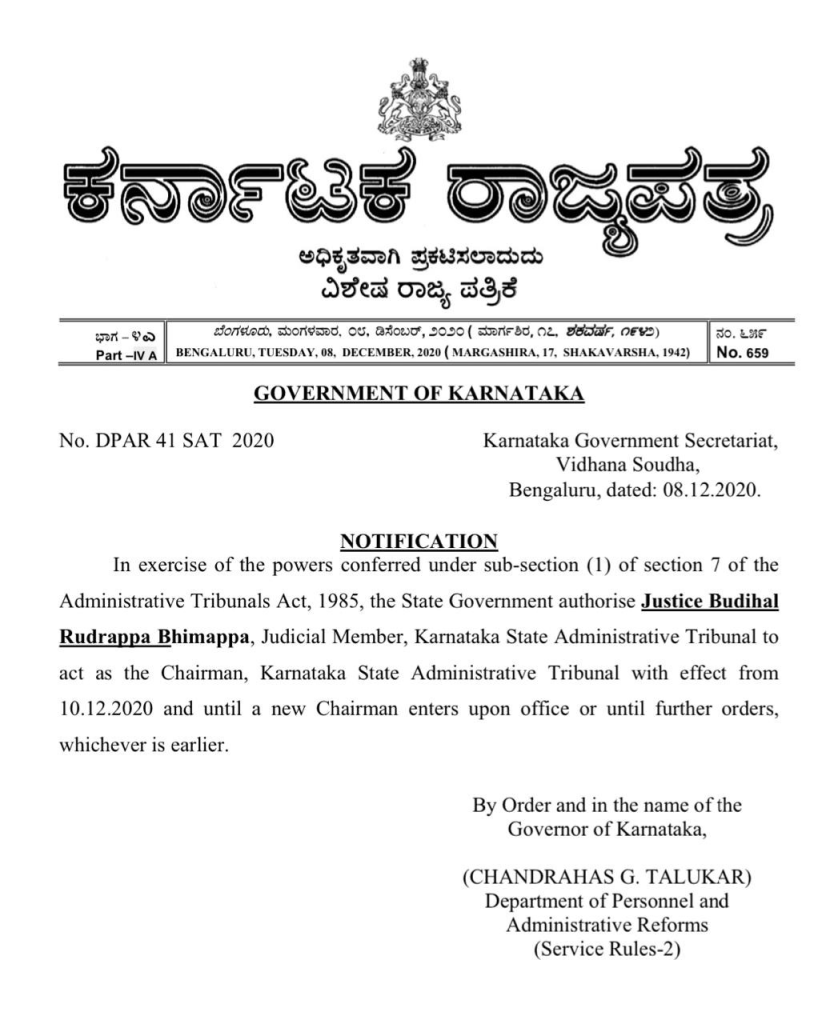
Justice Budhihal R.B. is appointed as Chairman, Karnataka Administrative Tribunal.
Justice Budihal R.B: Born on 1-10-1956. Enrolled as an Advocate on 07-09-1983 and Practiced on Civil and Criminal side at Bagalkot and Bijapur. Appointed as District and Sessions Judge during May, 1996. Served as an Additional District and Sessions Judge at Bangalore and Gulbarga and as Principal District and Sessions Judge at Gadag, City Civil Court at Bangalore and Belgaum. Also served as the Registrar (Judicial), Registrar (Vigilance), Secretary to Hon’ble Chief Justice and Registrar General. Appointed as Additional Judge of the High Court of Karnataka on 24-10-2013 and Permanent Judge on 04.03.2016.
Justice Budhihal retired on 30.9.2018. The President of India appointed him as Judicial Member of Karnataka State Administrative Tribunal by Order No. A-11014/8/2018-AT, dated 12.06.2019. On 14.06.2019 his Lordship assumed charge as Judicial Member of Karnataka State Administrative Tribunal.
Relevant paras. 24. At the outset, it ought to be noted that Section 122 of the Transfer of Property Act, 1882 neither defines acceptance, nor does it prescribe any particular mode for accepting the gift.
25. The word acceptance is defined as “is the receipt of a thing offered by another with an intention to retain it, as acceptance of a gift.” (See Ramanatha P. Aiyar: The Law Lexicon, 2nd Edn., page 19).
26. The aforesaid fact can be ascertained from the surrounding circumstances such as taking into possession the property by the donee or by being in the possession of the gift deed itself. The only requirement stipulated here is that, the acceptance of the gift must be effectuated within the lifetime of the donor itself.
27. Hence, being an act of receiving willingly, acceptance can be inferred by the implied conduct of the donee.
29. In order to show acceptance, the counsel for the appellant drew our attention to the mutation records. The Mutation entry in the Revenue Record of Gram Sedriya, District Pali dated 28.10.1968 clearly reflects that half portion of appellant’s land was bestowed as a gift by the appellant to his son through a registered instrument of gift dated 19.12.1963.
30. Furthermore, the statement dated 31.08.1984, rendered by the appellantdonor before the Court of Additional District Magistrate indicates that the donee was already a major at the time of the execution of the gift deed. He further stated that after execution of the gift deed the donee started cultivating on the same.
32. Therefore, the abovementioned circumstances clearly indicate that there was an acceptance of the gift by the donee during the lifetime of the donor. Not only the gift deed in itself contained recitals about transfer of possession, but also the mutation records and the statements of the both the donor and donee indicate that, there has been an acceptance of the gift by conduct.
Relevant Paragraphs: 6. The only question which arises for consideration of this Court in this petition is:“Whether the insertion of Section 143A of the N.I. Act is having a prospective effect or can also be given retrospective effect?”
7. It is well settled proposition of law that always the substantive law which affects the rights of the parties will have prospective effect unless it has been given a retrospective effect expressly in the statute itself. …..in the case of G.J.Raja Vs. Tejraj Surana 2019 SCC OnLine SC 989, the issue came up before the Court directly with regard to interpretation of Section 143A of the N.I. Act and the Hon’ble Apex Court has held that Section 143A of the N.I. Act is having prospective effect in nature and confined to the cases where the offences were committed after the introduction of Section 143A of the N.I. Act. At paragraph-23 of the said decision, it has been observed by the Hon’ble Apex Court as under:-
“23. In our view, the applicability of Section 143A of the Act must, therefore, be held to be prospective in nature and confined to cases where offences were committed after the introduction of Section 143A, in order to force an accused to pay such interim compensation.”
When the Hon’ble Apex Court has interpreted and laid down the ratio holding that Section 143A of the N.I. Act is to be prospective in operation and is made applicable only in the cases where the offence under Section 138 of the Act was committed after insertion of Section 143A in the statute.
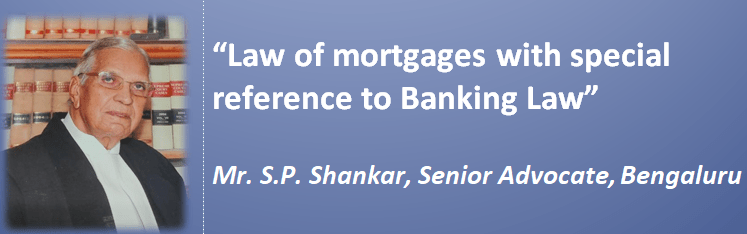
Law of mortgages with special reference to Banking Law Banking institutions, in India, are primarily supporting every commercial transaction in aid of development of commercial enterprise. Howsoever well possessed a man is, he would not convert his assets into liquid cash, for purposes of investment in trade/commerce. He necessarily starts such enterprises with borrowed funds. It is in this manner banking institution would picture itself in trade and commerce. A banker is obviously a stranger to an entrepreneur. Words of entrepreneur are taken as true and correct and on that basis the banker would take up the proposal of the entrepreneur for processing loan and the like. Risk–appetite is common to the banker and the entrepreneur. The banker who deals with public money has greater responsibility in marshalling its funds, channelizing the same for various purposes and closely supervise utilization/application of funds by the borrower and lastly, ensure recovery with interest and costs. The whole process is complicated. Bankers have neither experience nor enterprise muchless expertese in running the industry itself, should the repayment of borrowed money is delayed or staggered. Entrepreneurs have often ended penniless, midstream in their business. This aspect would destroy the confidence in the entrepreneur and hopes of the banker besides affecting the security of the depositors. It is in the above background, collaterals and security for repayment of loan with interest assumes primary importance. As stated earlier, bank deals with funds of the depositor. Bank only manages such funds prudently and economically so that besides serving the depositors, the bank should make reasonable profit to take care of its administrative expenses and also provide for accumulation of funds. Technical terms are avoided. To strike a balance in the banking business, collaterals and securities for loan would assume greater role. Even in the matter of obtaining security, bank has to be prudent both in terms of getting the best security and loan processing is less expensive. It is in this background, Law of Mortgages would picture itself in the scenario. Mortgages of immovable properties and charges on them are found and dealt with in chapter IV of Transfer of Property Act vide Sections 58-104. Kinds of Mortgages are dealt with in Section 58. They are simple mortgage, Mortgage by conditional sale, Usufructuary mortgage, English mortgage, Mortgage by deposit of title deeds and Anomalous mortgage. Of several mortgages the one that facilitates the banker is the Mortgage by deposit of title deeds. Mortgage by deposit of title is also known as equitable mortgage. Subject matter of Equitable mortgage is the “interest” of the mortgagor in the mortgaged property, in contra distinction to “Right, Title and Interest” in the property itself. The striking illustration in this behalf is the interest of lessee in the mortgaged property, which could be merely the leasehold rights. This aspect is further supported by Law vide Section 108(j) of T.P. Act. Section 108(j) would empower and authorize lessees to transfer absolutely or by way of mortgage or sub-lease the whole or any part of his “interest” in the demised property. Section 58(d) R/w Section 108 (j) would thus permit a situation where a long term lessee may mortgage the lease hold rights and secure loan from a bank. This comes by way of assignment of lease hold rights. The earliest decision in this behalf is one rendered by five judges of the Hon’ble Supreme Court in the case reported in AIR 1952 SC 156. This decision is followed every now and then, to sustain the banking transaction of loan advanced by a banker on the security of lease hold rights. Equitable mortgage is and shall not be a document containing terms of loan like the amount lent, rate of interest or other terms and conditions of loan. An equitable mortgage merely consists of a report or a writing by the borrower affirming that he has deposited the title deeds, with the intent of securing loan and creating a charge on his interest in the property and more importantly recording the fact that he has delivered possession of deeds of title. The significant and beneficial aspect of equitable mortgage is that property situated anywhere in India can be subject matter of equitable mortgage at place other than where the property is situate and in the authorized cities vide Section 58(d). Only a few cities in India are designated cities, where title deeds are deposited. By fiction, equitable mortgage can be created by deposit of title deeds of property situated elsewhere, in a designated city. This facility afforded by the statute would augur well, in the matter of banking transactions. It does not involve stamp duty as it is a mere report or memorandum evidencing deposit of title deeds and delivery of those documents. It does not require registration. The question as to whether equitable mortgage by deposit of title deeds requires registration or not has been resolved by Apex Court in AIR 1950 SC 272, AIR 1965 SC 1591 and many more. High court of Karnataka in ILR 2000 Kar 1962 has held that memorandum accompanying the deposit of title deeds containing only a statement that a deposit is made by way of security for repayment of loan, does not need registration. The memorandum is only evidence of the fact that the title deeds are deposited with the Mortgagee. Documents of title could be mere patta of lands in mufassil areas. Document of Mortgage is itself is a title of the mortgagee. An expired lease is a document of title if it is renewed and kept valid. Share certificates could be document of title. Where possession is given to vendee on the basis of agreement to sell, such agreement is a good security. Original probate of a will accompanied by certified copy of redemption relating to the property, even if lost, can create equitable mortgage. The list of title deeds is only illustrative. Essential aspect is delivery of title deeds made by the borrower to the creditor or his agent. Such delivery must be with intent to create security. The bank would save cost of stamp duty and registration and would therefore facilitate credit transaction. This would improve commercial enterprise, a positive aspect of Law. Mortgage is a transfer of an interest in immovable property. The immovable property has to be and is always specific. Mortgage could be to secure existing or future debts. Mortgage can be effected by co-owners, Pardanashian woman or by beneficiaries under Trust. There could be mortgage in favour of a minor. In Simple mortgage, possession remains with mortgagor. A mortgagor would bind himself personally to pay if the security offered in inadequate. Mortgagee shall have the right to sell or cause the mortgaged property to be sold for recovery of dues. Mortgage by conditional sale creates liability. This type of mortgage is ostensible sale with personal liability on default of payment of mortgage money on a given date. There is distinction between mortgage by conditional sale and a sale with clause for repurchase. That stipulation/clause for repurchase should be in the same document contemporaneously entered while taking the loan. Distinction between sale and mortgage would itself be a subject matter of serious discussion. Usfructuary mortgage involves delivery of possession, right of mortgagee to appropriate rents and profits. There is no personal liability of the mortgagor. Time limit for redemption is stipulated. Distinction between usfructuory mortgage and lease is apparent and should be clearly understood. An English mortgage is one where personal liability exists. Transfer is absolute and not conditional, in contrast. There can be a proviso for re-conveyance. Possession of the property is given to mortgagee. Anomalous Mortgage is one that does not come under any of the above mortgages. Rights and remedies of mortgagee are set out in Chapter IV vide Sections 67, 67A, 68, 69, 69A -79. Marshalling and contribution are also provided in respect of security to the bank. Thus mortgage by deposit of title deeds would make the transaction ( borrowing from and lending by banks to debtors) an effective and economical mode from the point of view of the Banker and the borrower. In addition, the bank has now the support of DRT Act and Securitization Act. Jurisdiction of civil courts is barred in respect of recovery of dues outstanding to a bank. Separate Forum is created in these days of Tribunalisation. Realising the rigors of civil litigation, accompanied by need to pay advolerm court fee and unimaginable contest raised by the borrowers and the never ending process of execution, Union of India enacted DRT Act and Securitization Act giving power to the banking institution to recover debts in an expeditious manner and in the most inexpensive procedure. The laudable object of Union of India in enacting this enactment is set out in Mardia Chemicals. Bank has the right to sell the mortgaged property. Though this right to sell is available in common law it has its own inhibitions. Securitization Act has made the maters far easy and has stipulated several conditions against the borrower, were he to indulge in procrastinating means and methods. Sections 13 to 17 of Securitization Act serve as a Code by itself. Banks are authorized to sell the mortgaged property, realize the dues and make the recovered amount available for further advances. This perspective is laudable from the point of view of law makers. In reality even these two enactments have been deprived of the intended teeth and verve. Law of mortgages obtaining in common law, has yielded in favour of relieving the bank from rigors of unending litigation and has assisted the borrower in reducing the cost of litigation. This is hardly realized by the borrowers muchless by the institution of Courts. Validity of Securitization Act and the special procedure for bank for recovery of dues have been tested, to the relief of Bankers. The common law remedies available to a borrower including one time settlement is not be applied to or enforced on the bankers. One time settlement ( OTS) is a matter of discretion. Circular of RBI confers discretion on the Bank but never confers a right on borrower. Inspite of this undeniable statement of Law borrowers invoke Article 226 and keep the banks under strangle hold. Yet, the society has witnessed large scale borrowings and un-pardonable defaults on the part of celebrated borrowers like Vijaya Malya, Nirav Modi, Subrotho Mukherji and the hallowed persons. Society has also evidenced public authorities like Ministers pressurizing the bank to lend money to these celebrated and favoured borrowers. It became the lot of court in England to notice and highlight in extradition proceedings that huge loans to Vijaya Malya was blessed by the then Finance Minister and Prime Minister. The other illustration is that of Punjab National Bank and allied banking institutions as well as Co-operative banks. It is time to rationalize banking practices and secure the interest of depositors irreversibly. RBI is the prime and Central Bank of India. It is enjoined under the Banking Regulation Act 1949 and RBI Act to assume responsibility, impose banking sanctions and help recover huge debts. No debt is less than 10 to 15 thousand crores. Interest is accruing. It is time that the Reserve Bank of India takes the role of monitoring and enforce fiscal discipline. S.P. Shankar 4-12-2020 Senior Advocate
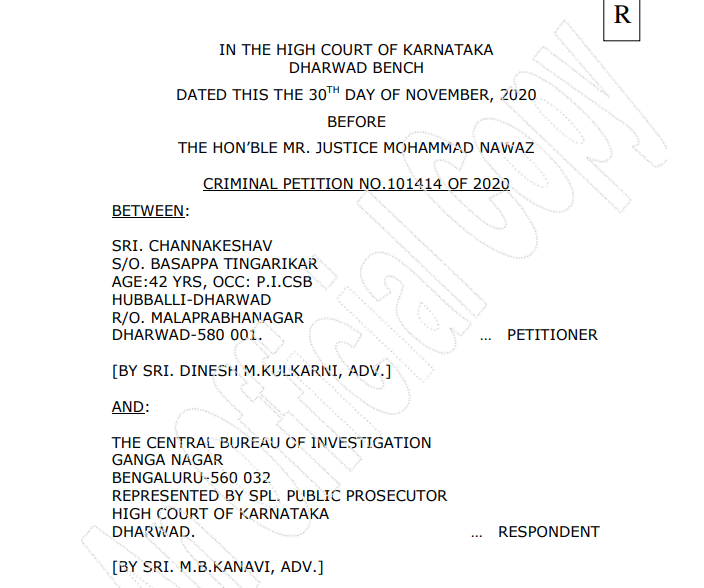
Relevant paragraphs: 9.…The petitioner has a reasonable apprehension of his arrest by the respondent-police. The petitioner is presently working as Police Inspector in the Police Commissionerate, Hubballi-Dharwad. There are no previous complaints or remarks against him. Petitioner has undertaken to abide by the conditions which may be imposed by this Court. As such, this Court is of the view that the arrest and detention of the petitioner/accused is not warranted and he may be directed to appear before the Investigating Officer/respondent-CBI and co-operate with the investigation of the case.
10. It is well settled that law of bails dovetails two conflicting interests namely, on the one hand, the requirements of shielding the society from the hazards of those committing crimes and potentiality of repeating the same crime while on bail and on the other hand absolute adherence of the fundamental principle of criminal jurisprudence regarding presumption of innocence of an accused until he is found guilty and the sanctity of individual liberty. As observed by the Hon’ble Apex Court, a great ignominy, humiliation and disgrace is attached to the arrest and it would lead to many serious consequences. Usual anxiety of investigating agency is to ensure that an accused should fully co-operate with them and be available as and when they require him. An order of anticipatory bail does not in anyway, directly or indirectly, takeaway from Investigating Officer his power and right to fully investigate into charge made against an accused. In the instant case when the petitioner has already appeared and co-operated with the respondent, whenever called upon to do so, then custodial interrogation is not warranted. Hence, the relief sought by petitioner/accused can be granted by imposing suitable conditions.












 Daksha Legal