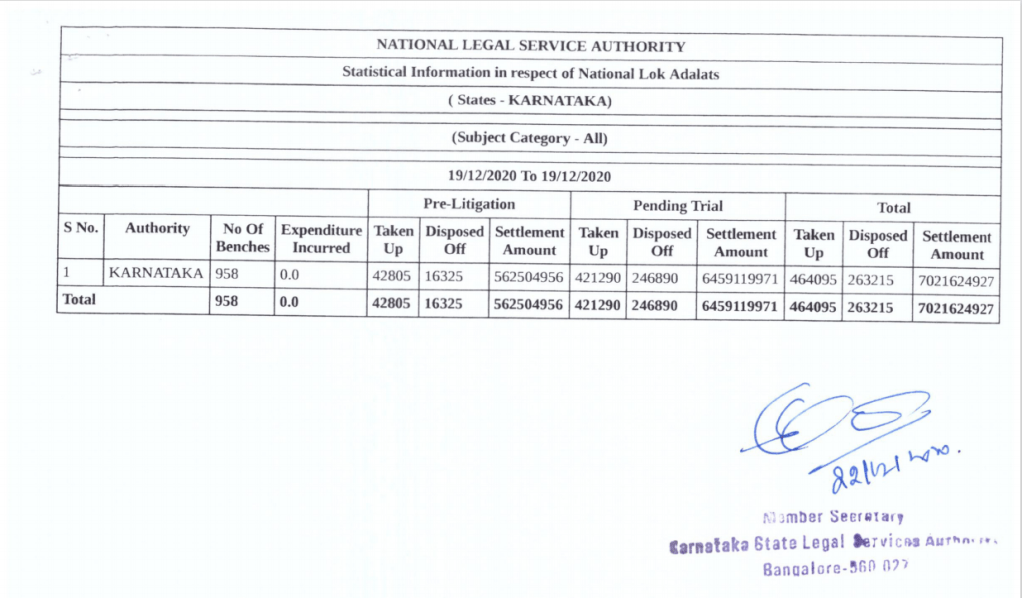
In perhaps one of the biggest Lok Adalats, the E Lok Adalat held by the Karnataka State Legal Services Authority on 19 December 2020 disposed 16325 pre-litigation and 2,46,890 pending cases.The total settlement amount in pre-litigation cases is Rs. 56,25,04,956/- and in pending cases Rs. 645,91,19,971/- totaling Rs.702,16,24,927/-.
It is to be noted that 958 benches were constituted with zero expenditure incurred. Details of the event are given below.
FULL JUDGMENT: ROHINTON FALI NARIMAN, J.— Leave granted. Respondent 1 filed a civil suit dated 5-3-2013 before the Civil Judge, Senior Division, Solan under Section 6 of the Specific Relief Act in which the following reliefs were claimed: “(a) Declaring that the effect the plaintiff was running business in Shop No. 3 in the name and style M/s Om Garments owned by proforma Defendant 2 in Anand Complex, the Mall Solan w.e.f. 28-1-2013 on the basis of partnership deed of the said date with proforma Defendant 2 and the plaintiff has been wrongly dispossessed by Defendant 1 from Shop No. 3 in the intervening night of 3-3-2013 and 4-3-2013 illegally, wrongfully, without the consent of the plaintiff or proforma Defendant 2. (b) Decree for permanent prohibitory injunction restraining Defendant 1 from causing any interference on any portion of the suit premises/Shop No. 3 mentioned above.”
A written statement was filed by the appellant herein denying the averments made in the suit and stating that he has been in possession since 2004 as a tenant of the landlady, who is Respondent 2 before us. The landlady also filed a written statement dated 5-7-2013 in which she stated that apart from the partnership entered into with Respondent 1, the petitioner was her tenant w.e.f. 2004.
An Order 39 Rule 1 application was filed which was dismissed by the learned Single Judge on 21-4-2015 saying that the relief asked for could not be granted at this stage as it would amount to decreeing the suit itself. An appeal filed before the Additional District Judge met with the same fate. By the judgment dated 19-12-2016, the appellate court held: “However, when it is an admitted case of Defendant 2, admittedly landlady of the suit shop, that she has rented the suit shop to Defendant 1-respondent and has set up counter-defence that in fact Defendant 1 has sublet the suit shop to the plaintiff which is not at all the case of the plaintiff, prima facie it is clear on record that the suit shop was rented by Defendant 2 to respondent-Defendant 1 and Defendant 1 has been running the suit shop since 17-9-2004 when both the defendants have also reduced rent agreement into writing, copy of which is also available in the case file. As per the rent agreement, the tenancy had commenced w.e.f. 1-9-2004. Nothing has come on record, if Defendant 1-respondent had ever vacated-surrendered the possession of the shop in favour of landlady nor is it the case of Defendant 2 that she ever sought eviction of Defendant 1 from the suit shop. It appears from the copy of partnership deed having been relied upon by the applicant that both the applicant and Defendant 2 had connived with each other in order to oust Respondent 1 who is tenant over the suit shop and filed the suit as well as application for temporary and mandatory injunction in the court. Moreover, when the applicant herself has come with the plea that she is out of possession of the suit shop and she has prayed that possession in her favour be restored qua the suit shop by way of temporary injunction and at the same time the applicant has failed to prove on record that she has prima facie case of balance of convenience lies in her favour or that she is going to suffer irreparable loss as discussed above, hence, by allowing of the application as prayed by the applicant would amount to decree of the suit in favour of the applicant without giving the parties to prove their respective claims by leading evidence. Even when it has come on record that Respondent 1 is in actual possession of the suit property which was rented out to him by Defendant 2 landlady in the year 2004 and nothing has come on record that Defendant 1 had ever been evicted from the suit shop in accordance with law or he ever surrendered the possession of the suit property in favour of Defendant 2, it is clear on record that Respondent 1 has prima facie case and balance of convenience also lies in her favour.”
By the impugned judgment dated 10-4-20181, a learned Single Judge of the High Court of Himachal Pradesh set aside the concurrent findings of fact and allowed a revision petition. This was done without dealing with any of the aspects set out by the first appellate court. From what one is able to gather, given the language used in the judgment, it appears that the learned Judge was swayed by the fact that a police complaint had been filed on 3-2-2013 in which dispossession was acquiesced in.
We are constrained to observe that every legal canon has been thrown to the winds by the impugned judgment1. First and foremost, the 1999 Amendment to CPC added a proviso to Section 115, which reads as follows: “115. Revision.—(1) The High Court may call for the record of any case which has been decided by any court subordinate to such High Court and in which no appeal lies thereto, and if such subordinate court appears— (a) to have exercised a jurisdiction not vested in it by law, or (b) to have failed to exercise a jurisdiction so vested, or (c) to have acted in the exercise of its jurisdiction illegally or with material irregularity, the High Court may make such order in the case as it thinks fit: Provided that the High Court shall not, under this section, vary or reverse any order made, or any order deciding an issue, in the course of a suit or other proceeding, except where the order, if it had been made in favour of the party applying for revision, would have finally disposed of the suit or other proceedings.
* * (3) A revision shall not operate as a stay of suit or other proceeding before the court except where such suit or other proceeding is stayed by the High Court.” A reading of this proviso will show that, after 1999, revision petitions filed under Section 115 CPC are not maintainable against interlocutory orders.
Even otherwise, it is well settled that the revisional jurisdiction under Section 115 CPC is to be exercised to correct jurisdictional errors only. This is well settled. In DLF Housing & Construction Co. (P) Ltd. v. Sarup Singh2 this Court held: (SCC pp. 811-12, para 5) “5. The position thus seems to be firmly established that while exercising the jurisdiction under Section 115, it is not competent to the High Court to correct errors of fact however gross or even errors of law unless the said errors have relation to the jurisdiction of the court to try the dispute itself. Clauses (a) and (b) of this section on their plain reading quite clearly do not cover the present case. It was not contended, as indeed it was not possible to contend, that the learned Additional District Judge had either exercised a jurisdiction not vested in him by law or had failed to exercise a jurisdiction so vested in him, in recording the order that the proceedings under reference be stayed till the decision of the appeal by the High Court in the proceedings for specific performance of the agreement in question. Clause (c) also does not seem to apply to the case in hand. The words “illegally” and “with material irregularity” as used in this clause do not cover either errors of fact or of law; they do not refer to the decision arrived at but merely to the manner in which it is reached. The errors contemplated by this clause may, in our view, relate either to breach of some provision of law or to material defects of procedure affecting the ultimate decision, and not to errors either of fact or of law, after the prescribed formalities have been complied with. The High Court does not seem to have adverted to the limitation imposed on its power under Section 115 of the Code. Merely because the High Court would have felt inclined, had it dealt with the matter initially, to come to a different conclusion on the question of continuing stay of the reference proceedings pending decision of the appeal, could hardly justify interference on revision under Section 115 of the Code when there was no illegality or material irregularity committed by the learned Additional District Judge in his manner of dealing with this question. It seems to us that in this matter the High Court treated the revision virtually as if it was an appeal.” (SCR at p. 373)
The learned counsel appearing for the respondents argued before us and attempted to support the judgment. He cited the judgment of Dorab Cawasji Warden v. Coomi Sorab Warden3. Para 16 of this judgment is set out hereinbelow: (SCC pp. 126-27) “16. The relief of interlocutory mandatory injunctions are thus granted generally to preserve or restore the status quo of the last non-contested status which preceded the pending controversy until the final hearing when full relief may be granted or to compel the undoing of those acts that have been illegally done or the restoration of that which was wrongfully taken from the party complaining. But since the granting of such an injunction to a party who fails or would fail to establish his right at the trial may cause great injustice or irreparable harm to the party against whom it was granted or alternatively not granting of it to a party who succeeds or would succeed may equally cause great injustice or irreparable harm, courts have evolved certain guidelines. Generally stated, these guidelines are— (1) The plaintiff has a strong case for trial. That is, it shall be of a higher standard than a prima facie case that is normally required for a prohibitory injunction. (2) It is necessary to prevent irreparable or serious injury which normally cannot be compensated in terms of money. (3) The balance of convenience is in favour of the one seeking such relief.” This judgment also makes it clear that when a mandatory injunction is granted at the interim stage, much more than a mere prima facie case has to be made out. None of the aforesaid statutory provisions or judgments have either been adverted to or heeded by the impugned judgment1.
We, therefore, set aside the impugned judgment1 and restore the judgment of the courts below.
Since the suit filed is a Section 6 suit which is a summary proceeding in itself, the trial court should endeavour to dispose of the suit itself within a period of six months from today.
The appeal is allowed in the aforesaid terms. ——— † Arising out of SLP (C) No. 10850 of 2018, Arising from the Judgment and Order in Sashi Verma v. Tek Singh, 2018 SCC OnLine HP 2151 (Himachal Pradesh, Shimla Bench, CMPMO No. 154 of 2017, dt. 10-4-2018) 1 Sashi Verma v. Tek Singh, 2018 SCC OnLine HP 2151 2 DLF Housing & Construction Co. (P) Ltd. v. Sarup Singh, (1969) 3 SCC 807 : (1970) 2 SCR 368 3 Dorab Cawasji Warden v. Coomi Sorab Warden, (1990) 2 SCC 117
IN THE SUPREME COURT OF INDIA BEFORE S.N. VARIAVA AND H.K. SEMA, JJ.) MIDAS HYGIENE INDUSTRIES (P) LTD. AND ANOTHER- Appellants; Versus SUDHIR BHATIA AND OTHERS – Respondents. Civil Appeal No. 107 of 2002, decided on January 22, 2004
This appeal is against the judgment of the High Court dated 20-9-2001.
Briefly stated, the facts are as follows: The appellants filed a suit for passing off and for infringement of copyright. In the suit an application for interim injunction under the provision of Order 39 Rules 1 and 2 of the Code of Civil Procedure was filed. A learned Single Judge of the High Court in order dated 31-7-2001 noted the following facts: “(i) The defendant admittedly worked with the plaintiff prior to launching its business. (ii) The plaintiff’s prior and prominent user of the phrase Laxman Rekha as a part of the description of crazy lines as shown by the documents i.e. advertisements at least of 1991 produced by the plaintiff showing prominent user of the phrase Laxman Rekha. (iii) The defendant’s non-denial of the plaintiff’s assertions in the notice dated 28-2-1992 to the effect that the plaintiff used the phrase ‘Laxman Rekha’ on its product. (iv) The plaintiff’s assertion of the ownership of copyright in the packaging containing the words ‘Laxman Rekha’. (v) The defendant has not chosen to give an explanation why he adopted ‘Magic Laxman Rekha’. (vi) The defendant’s averments in Suit No. 1967 of 1996 that the product Magic Laxman Rekha was used by it since 1992. (vii) The defendant’s statement in the application made to the Trade Mark Registry on 30-5-1996 for registration of trade mark ‘Magic Laxman Rekha’ claiming continuous user since 1992.”
In view of these facts, the learned Single Judge granted an interim injunction preventing the respondents, their servants, agents, distributors, stockists or any other person acting on their behalf from manufacturing, marketing, distributing or selling insecticides, pesticides as well as insect repellent under the name LAXMAN REKHA as well as packing design having similar colour scheme, get-up, background and colour combination as that of the appellants’ copyright.
The respondents filed an appeal which has been disposed of by the impugned judgment. The Division Bench in spite of noting the factors which have been set out by the learned Single Judge, has vacated the injunction merely on the ground that there was delay and laches in filing the suit. It has held that such delay and laches disentitled grant of injunction. The respondents were merely directed to file regular accounts of their sales in court.
The law on the subject is well settled. In cases of infringement either of trade mark or of copyright, normally an injunction must follow. Mere delay in bringing action is not sufficient to defeat grant of injunction in such cases. The grant of injunction also becomes necessary if it prima facie appears that the adoption of the mark was itself dishonest.
In this case it is an admitted position that the respondents used to work with the appellants. The advertisements which had been issued by the appellants in the year 1991 show that at least from that year they were using the mark LAXMAN REKHA on their products. Not only that but the appellants have had a copyright in the marks KRAZY LINES and LAXMAN REKHA with effect from 19-11-1991. The copyright had been renewed on 23-4-1999. A glance at the cartons used by both the parties shows that in 1992 when the respondent first started he used the mark LAXMAN REKHA on cartons containing colours red, white and blue. No explanation could be given as to why that carton had to be changed to look almost identical to that of the appellant at a subsequent stage. This prima facie indicates the dishonest intention to pass off his goods as those of the appellants.
In our view on the facts extracted by the learned Single Judge, this was a fit case where an interim injunction should have been granted and should have been continued. In our view the Division Bench was entirely wrong in vacating that injunction merely on the ground of delay and laches. Under the circumstances, the impugned order is set aside and that of the trial court is restored. It is clarified that all observations made by the High Court and by this Court are prima facie and shall not be taken into consideration at the time of the trial of the suit.
The appeal stands disposed of accordingly. No order as to the costs.
Relevant paragraphs: 16. The Conduct Rules of the State defines and regulates the conduct of a Government servant which is hedged by certain conditions with regard to conduct or otherwise and what would amount to misconduct. The conduct Rules being made applicable under Rule 39(b) cannot empower the Corporation to entrust an enquiry to the hands of the Lokayukta as there is no provision in the conduct Rules for such entrustment.
17. The power of entrustment of an enquiry to the hands of the Lokayuka is dealt with under KCS(CCA) Rules which not only contains provision for such entrustment, but also deals with elaborate procedure for conduct of disciplinary proceedings against Government Servant.
Therefore, KCS(CCA) Rules without being specifically adopted cannot and would not mean that the said Rules can be applied, bringing it, within the sweep of Rule 39 of the said Rules of the Corporation, unless KCS(CCA) Rules is specifically adopted by a decision of the Board of the Corporation. In view of the preceding analysis, I hold that power to entrust the enquiry to the hands of the Lokayukta is not available with the Corporation. Therefore, the entrustment of the enquiry to the hands of the Lokayukta by the Managing Director of the Board will have to be held as an act without jurisdiction.
The answer is yes. However this comes with a condition which is found in the Rule framed by the Bar Council of India. The same reads thus
SECTION II – DUTY TO THE CLIENT
13. An Advocate should not accept a brief or appear in a case in which he has reason to believe that he will be a witness and if being engaged in a case, it becomes apparent that he is a witness on a material question of fact, he should not continue to appear as an Advocate if he can retire without jeopardising his client’s interests.
At appellate stage this issue will not arise. However, in most of the relatives cases involving matrimonial disputes, partition, domestic violence etc, emotions fly high. If an unsavory comment is made against parents or close relatives it creates emotional turmoil and the possibility of the lawyers getting enraged is common. Hence, it is advisable to engage a friend lawyer in such circumstances.
The grievance of the petitioner is that her nomination for the election to the Guddekoppa Gram Panchayat, Thirthahalli Taluk, has been rejected by the Returning Officer by order dated 13.12.2020 at Annexure-A. This writ petition is filed seeking a direction or to issue a writ of certiorari to quash the impugned order dated 13.12.2020 at Annexures-A.
2. When this Court called upon the learned counsel for the petitioner to make his submission regarding the maintainability of the writ petition in view of the statutory bar imposed under Section 15 of the Karnataka Grama Swaraj and Panchayat Raj Act, 1993 which provides that no election to fill a seat in the gram panchayat shall be called in question except by an election petition filed before the designated court within whose territorial jurisdiction the panchayat area concerned or the major portion of the panchayat area concerned is constituted by any candidate at said election, learned counsel submits that statutory bar under section 15 does not come in the way of this Court in exercising its extraordinary jurisdiction under Article 226 of the Constitution of India. Learned counsel placed reliance on a decision of the Division Bench in the case of Ramakrishnappavs./Presiding Officer reported in ILR 1991 KAR 4421.
3. This Court has gone into the decision cited by the learned counsel for the petitioner. The decision rendered by the Division Bench on 06.11.1991 was in the backdrop of there being on express constitutional provision pertaining to the election of Panchayats, Municipalities, Municipal Corporations etc. The judgment was rendered having regard to Article 329 of the Constitution which dealt with the elections to the Parliament and State Legislature. There being no constitutional provisions, the Division Bench proceeded to hold that Article 329 could not be invoked with respect to the election to a Co-operative society.
4. The Constitution of India has undergone substantial change in the year 1993. Provisions covering the elections of Panchayat, Municipalities, Municipal Corporations and Co-operative Societies have been incorporated under separate chapters. Chapter IX which pertains to the panchayats was added into constitution w.e.f., 24.04.1993. Article 243-O clearly bars interference of Court in electoral matters pertaining to the panchayats. Article 243-O (b) provides that no election to any panchayat shall be called in question except by an Election Petition presented to such authority and in any such manner as is provided for by or under any law made by the Legislature of the State.
5. Consequently, the writ petition is not maintainable. If the petitioner is aggrieved by rejection of the nomination, she can proceed to file a Election Petition duly constituted before the designated court as provided under Section 15 of the Act.








 Daksha Legal