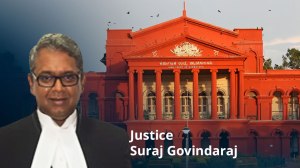
The High Court of Karnataka has constituted a constituted a Committee chaired by Hon’ble Smt. Justice B.V. Nagarathna to bring out a book entitled “History of Courts of Karnataka”.
The High Court has made general appeal to persons with knowledge in this behalf and tapping all sources of information. The High Court has requested such persons to share any information as regards the legal, legislative and judicial history of Karnataka; in other words, any information on and relevant to the history of Courts in Karnataka.
Relevant paragraphs: 3. In this writ petition, petitioner has inter alia prayed for a direction against Director of Enforcement to register a case of money laundering arising out of scheduled offences set out in Special Case No.69/2020 on the file of learned XXIII Additional City Civil and Sessions Judge, Bengaluru based on the information given by petitioner in its representation dated January 31, 2020.
4. Shri. Nagesh, learned Senior Advocate made following submissions. Petitioner has unconditionally withdrawn the PIL. Therefore, this petition is not maintainable on the ground of public policy.
13. In the PIL, Director of Enforcement was arrayed as respondent No.7. As recorded hereinabove, petitioner had sought for a direction against respondents No. 1 to 10 therein to constitute a multi-Disciplinary Team to investigate and prosecute Mr. Azim Premji and his associates. Prayer clause (i) in this writ petition is for a direction against the Enforcement Directorate to register a case for offences of money laundering arising out of the scheduled offences in Special Case No.69/2020. The trial of the said case has been stayed by the Hon’ble Supreme Court of India.
16. This Court, after considering the rival contentions and the authorities in Sarguja Transport Service Vs. State Transport Appellate Tribunal, M.P.Gwalior and others (1987)1 SCC 5 and Sheonandan Paswan Vs. State of Bihar and others (1987)1 SCC 288 in W.P. No.13838/2020 filed by the petitioner herein, has held that the said writ petition was not maintainable on the ground of public policy.
17 & 18. The ratio in the case of Sarguja is fully applicable to the facts of this case also. In view of the above, the preliminary objection raised by learned Senior Advocates for private respondents that this writ petition is not maintainable on the ground of public policy is sustained. Resultantly, writ petition stands dismissed.
Held: 14. What constitutes a police station has been defined in Section 2(s) of the Code, which reads as under:- “2(2): “police station” means any post or place declared generally or specially by the State Government, to be a police station, and includes any local area specified by the State Government in this behalf.”
15. As per Section 2(o) of the Code, “officer in charge of a police station” includes, when the officer in charge of the police station is absent from the station- house or unable from illness or other cause to perform his duties, the police officer present at the station-house who is next in rank to such officer and is above the rank of constable or, when the State Government so directs, any other police officer so present.”
16. On going through the scheme of the Code, Section 173(2) of the Code contemplates submission of report of investigation. From plain reading of the said provision it is evident that it is the officer in-charge of a police station who is authorized to forward and submit the report in the prescribed form to the jurisdictional Magistrate to take cognizance. The words used in Section 173(2) are “shall forward” which themselves give the meaning that it is the officer in-charge of the police station to file the final report. Though it is contended by the learned SPP-I that under Section 36 of the Code, the superior officer of the police station may exercise the same powers, as could be seen from the said Section, it is the police officers superior in rank to an officer-in- charge of the police station have been conferred with such power as that of the officer in-charge of the police station. But in the case on hand, CCB police are not the officers superior in rank to an officer in-charge of the police station in the local jurisdiction. In that light, the contention which has been taken up by the learned SPP-I is not acceptable. It is even not much denied that the CCB is not a police station by itself.
17. When CCB is not a police station then admittedly the final report filed by CCB which is an Investigating Agency is not in contemplation with the provisions of Section 173(2) of the Code.
18..…As per Section 2(s) of the Code the State Government has to declare either generally or specially any post or place to be a police station, but no such declaration is forthcoming before this Court. In that light, admittedly the investigation has been done by the CCB and it is he who had submitted the report in terms of Section 173 of the Code and in view of the discussion made by me above, he cannot be considered to be an officer-in- charge. In that light, the trial Court ought not to have taken cognizance on the report submitted by the CCB.
On a Contempt of Court Petition (CCC 674/2020) filed by the Samaj Parivartana Samudaya, alleging inaction on the part of the Government officials to implement the earlier order of the Karnataka High Court, the Division Bench headed by the Hon’ble Chief Justice warned the Government officials that it would initiate contempt of court proceedings if the earlier order is not implemented.
The Court heard the submissions of Mr. A.R.Goutham, Advocate for S. Basavaraj, Advocate, Daksha Legal. PDF of contempt petition below
Facts of the case. Samaj Parivarthan Samudaya – SPS had filed a Public Interest Litigation in Writ Petition 49/2020 seeking directions to the Government of Karnataka to take appropriate action against H.D. Kumaraswamy, D.C. Thammanna and Savithramma for violating various provisions of law dealing with agrarian reforms in the State of Karnataka and also for illegally grabbing lands. SPS also sought a direction to the State Government to implement the order of the Lokayukta in this regard. Hon’ble Court disposed the Writ Petition on 14:1:2020 recording the undertaking of the State Government that it would take action within three months.
The Karnataka Lokayukta’s order dated 5:8:2014 related to major land grabbing involving around 200 Acres of land (including 110 Acres of Gomala Land) by H.D. Kumaraswamy, the former Chief Minister of Karnataka, his close relatives and associates D.C. Thammanna, the former Minister for transportation and his sister- in law Savithramma.
In the relevant portion of the Lokayukta Order, it has been mentioned that Survey No. 7,8,9,10,16 and 17 in Kethaganahalli Village of Bidadi Hobli in Ramanagara Taluk comprising of village common lands in total measuring 110 acres and 32 guntas of Government Pasture Lands (Gomala Land) which the Karnataka State Government had earmarked for public usage such as Lake, Burial Ground and to persons belonging to Scheduled Tribe (ST), and Scheduled Caste (SC), for irrigation purpose has been encroached by various persons.
The encroachment of the granted lands by H.D. Kumaraswamy, D.C. Thammanna and Savitramma is reflected in the letter of the Assistant Commissioner, Ramanagara dated 25:8:2014 under the subject “Ex-Chief Minister Shri H.D. Kumaraswamy, other family members and his close relative MLA Maddur Shri D.C. Tammanna, his family members have grabbed 200 Acres of land including 110 Acres of Gomal lands that needs to be restored to Govt.”. The Assistant Commissioner enclosed a detailed 10 page report entitled the same as the subject of the said letter.
The order of the Hon’ble High Court having not been implemented, SPS approached the Court on the contempt side. The Hon’ble Court expressed its displeasure today over the inaction on the part of the Government and warned that if the order is not complied with in letter and spirit, appropriate contempt of court proceedings would be initiated against the officials concerned.
Note: This is a matter where, at the instance and on the advice of client, Advocate filed a Writ Petition before the Division Bench of the Karnataka High Court praying that his matter which is pending before the learned single judge of the High Court be heard by the bench of the Chief Justice or any other court which is constituted by the judge hailing from a different State other than Karnataka. The Hon’ble division bench found the conduct of the petitioner highly contemptuous and dismissed the same with exemplary cost of Rs. 1,00,000/-. On the conduct of the counsel, the Hon’ble Court said as follows:
14. Before we part with this order, we must say something about the role of the members of the Bar. It is well settled that a member of the Bar is expected to act first as an Officer of the Court and thereafter, as the mouthpiece of his client. In this behalf, we cannot avoid temptation of what is observed in paragraph 7 of the decision of the Apex Court in the case of T.Arvindam vs T.V. Satyapal and another (1977) 4 SCC 467. Paragraph 7 of the said case reads thus:
“7. We regret the infliction of the ordeal upon the learned Judge of the High Court by a callous party. We more than regret the circumstance that the party concerned has been able to prevail upon one lawyer or the other to present to the Court a case which was disingenuous or worse. It may be avaluable contribution to the cause of justice ifcounsel screen wholly fraudulent and frivolouslitigation refusing to be beguiled by dubious clients.And remembering that an advocate is an officer ofjustice he owes it to society not to collaborate inshady actions. The Bar Council of India, we hope will activate this obligation. We are constrained to make these observations and hope that the co- operation of the Bar will be readily forthcoming to the Bench for spending judicial time on worthwhile disputes and avoiding the distraction of sham litigation such as the one we are disposing of. Another moral of this unrighteous chain litigation is the gullible grant of ex parte orders tempts gamblers in litigation into easy courts. A judge who succumbs to ex parte pressure in unmerited cases helps devalue the judicial process. We must appreciate Shri Ramasesh for his young candour and correct advocacy.”
15. The Apex Court expressed displeasure about the manner in which the party concerned was able to prevail upon a lawyer to represent before the Court a case like this. In this case, we have before us a young member of the Bar who should follow what is laid down by the Apex Court. In paragraph 7 of the aforesaid decision, when the Apex Court said that it may be a valuable contribution to the cause of justice if the Advocates screen wholly fraudulent and frivolous litigations refusing to be beguiled by dubious clients. We hope and trust that the learned counsel appearing for the petitioner has learnt a lesson and he will hereafter follow what the Apex Court expects the members of the Bar to follow.
Relevant paragraphs.: 8. It is stated that it is due to the large number of samples which are received, there being limited resources available for the Forensic Science Laboratory, that there is a delay in submitting the examination reports and the same is not intentional and therefore, Smt. Namitha Mahesh, learned HCGP would submit that the Forensic Science Laboratory has acted in the best possible manner with the limited resources, there are no errant officials as such no action is required to be taken, she further submits that all officers of FSL are working overtime to submit their reports.
9. It is further stated that the organisational set up of Forensic Science Laboratory in the State is that there is an apex State Forensic Science Laboratory (SFSL) located in Bengaluru where 13 different Sections are functioning.
10. The State has also established five Regional Forensic Science Laboratory (RFSL) in five Police Range headquarters viz Mysuru, Mangaluru, Davanagere, Belagavi and Kalaburgi, however, out of 13 Sections a maximum of only two sections are functioning in as such, all the samples as regards the remaining 11 other Sections are required to be sent to the SFSL for examination.
12. Apart from the above, it is stated that the officers of the Forensic Science laboratories are also required to travel to courts to depose as regards the reports authored by him or her.
13. There are 6994 cases which are pending trial, on account of the reports from the FSL not having been received. There are more than 35738 samples pending examination. The shocking and unacceptable aspect is the time taken for submission of reports – a Norcotic matter takes 1 year, Computer/mobile/audio-video forensics takes about 1 and half year, a DNA test takes 1 and haf years, these being average time, as can be seen from the present case itself, it has taken 4 years for the report to be submitted. If the accused is in custody, the delay would result in a large number of undertrials being kept in jail during the pendency of the above report. On account of the delay in receipt of the aforesaid scientific reports, there is a high social cost. If the report is received belatedly and the same does not support the case of the prosecution, many a time it could result in innocent persons being incarcerated. The other side of the coin is that the victim or victim’s family also suffers on account of such delay, not knowing what will happen and when. Each accused has a right of speedy trial. The victim or the victim’s family also has a right to a speedy trial. An Accused has a right to an expeditious trial, more so when he/she is in judicial custody. The said custody cannot be extended merely on the ground that the FSL is unable to furnish the reports in time and/or the number of FSL are lesser than that required. Such a delay infringes on the right to life of an accused under Article 21 of the constitution of India. Delay by the FSL in providing a report whatever the reason may be is resulting in a situation which cannot be countenanced under law. In the case of an accused on bail, he/she continues to evade prosecution due to the delay in receipt of these reports. The effect of the delay in furnishing the reports not only delays the trial in a matter, it is also possible that due to the said delay the sample may degrade or get contaminated, thus negating the very purpose of forensic examination. The details of samples being degraded or contaminated have not been provided. However, this would also be required to be looked into. It is needless to say that Forensic Evidence like DNA reports, chemical analysis reports, bioanalysis reports play a critical role in the investigation of serious crimes, like Murder, sexual assault cases, forgery etc.,. The delay in submitting forensic reports by FSL necessarily hampers the proceedings in a case. One of the biggest impediment to a speedy trial is the delay in the filing of FSL reports. Cases are adjourned for years due to non-receipt of these reports. Some cases are not even committed to the sessions court or special Court as the case may be due to non-receipt of the reports.
Guidelines are required to be issued as regards the time period in which a particular kind of sample would be examined and report submitted to the concerned court, as regards future samples received. A monitoring system is required to be established to monitor the passage of the sample from the time it was collected to the date of submission of the report in Court. Apart from the above, a study as regards the latest equipment available, modernisation of the Laboratories, a process of the equipment to be updated from time to time is also to be put in place. From the data provided, it is also seen that many of these scarce human resources spend unproductive man-days in travelling to the courts in far-flung places in Karnataka to depose in the matter. Thus bringing about one more inefficiency in the system. In the year 2018, 1135 man-days were lost, and in 2019, 1222 man-days were lost.
Even if the said officer of the FSl is required to appear and depose in a particular manner, it will also be advisable to permit the said evidence to be led through video conference facilitating. It is immediately required to connect the FSL’s with the Courts in a similar manner as the jails are connected to the Court. This would save a large number of man-days lost on account of such unnecessary travel by the FSL officers. The trial Courts to permit the examination and or cross-examination of the FSL officers through video conferencing. The trial Court has to maintain a strict vigil on adjournments being granted for the production of FSL reports, the trial Court ought to insist on the reports being submitted at the earliest.
Question: Whether any person can file a proceeding against the directors of a company and/or the company under Section 439(2) of the Act of 2013 ?
14.5 The requirement of prior sanction under the Prevention of Corruption Act is to protect an officer against unnecessary prosecution during the time that he was discharging his function as an officer of the State, in such situation it is mandated that prior sanction from the concerned authority has to be obtained which authority would apply its mind to the facts and come to a conclusion as to whether the proceedings are to be initiated or not.
14.6 The same in my opinion cannot be equated to authorised person under Section 439. There is a specific prohibition to the Court to take cognizance except upon a complaint in writing by the registrar, a shareholder of the company or a person authorised by the Central Government in that behalf.
14.7 Admittedly, the respondent is neither the Registrar nor a shareholder nor has he obtained any authorisation from the Central Government. Therefore, the respondent would not in my considered opinion have any locus to initiate penal proceedings under Section 439 of the Act of 2013 or even if he initiates any action, the court dealing with such a matter cannot take cognizance of such a complaint.
14.8 I Answer Point No.2 by holding that Act of 2013 being a Special enactment containing a specific embargo, the embargo is required to be given complete effect to by this Court. This Court cannot travel beyond the intention of the legislature and water down the requirements of Section 439. In view thereof, I am of the considered opinion that the finding of the Special Economic Court in its order dated 3.7.2017 was proper and correct. Section 19 of the Prevention of Corruption Act and Section 439 of Act of 2013 are not pari materia with each other.
15.1 In view of the above finding in respect of point No.2, it is but required that to initiate proceeding under Section 439(2) and/or if before the Court taking cognizance such matter arises than the court can take cognisance only on a complaint in writing by the Registrar or shareholder of the company or a person authorised by the Central Government in that behalf.
15.2 I answer Point No. 3 by holding that apart from the named persons a complaint can also be filed by a person authorised by Securities and Exchange Board of India in terms of the proviso (1) of Section 439(2) or the Official Liquidator in terms of Section 439(4), no other person can initiate any criminal proceeding against a
HELD: The concept of “bar of limitation” on the one hand and the idea of “delay & latches” on the other by their very nature, are different from each other, although their successful invocation may arguably serve the same purpose in a litigation; the former absolutely bars the recourse to remedy; and the later may deny the remedy in the proceedings in question, the right to remedy being kept open for pursuit in other proceedings; prescription of period of limitation for claiming legal remedies is normally the prerogative of the legislature, whereas, the ground of ‘delay & latches’ is a matter of discretion inhering the Courts; this discretion needs to be exercised in accordance with the rules of reason & justice, is beside the point; the right to remedy ordinarily commits legal suicide if the limitation period prescribed therefor lapses; no court/authority has discretion to entertain the claim for it’s grant; Sec.3(1) of the Limitation Act, 1963 dictates their rejection at the threshold, regardless of the contention from the other side.
The delayed making of a Counterclaim by way of amendment of Written Statement is one thing and the making of a time barred Counterclaim by way of such amendments, is another; in treating the former, the court has discretion in the sense that it may grant leave to amend the Written Statement or refuse; in other words, a Written Statement can be amended even belatedly, for introducing a Counterclaim therein with the leave of court, provided that leave to amend is sought for within the statutory period of limitation; for that purpose, a Counterclaim shall be treated to be a suit by fiction of law; however, leave may be denied inter alia on the ground of ‘delay & latches’, even if the period of limitation has not expired; in such event, defendant may bring a separate suit; this is one scenario.
The other scenario is: where a time barred Counterclaim is sought to be introduced by amendment to the Written Statement; in such a case, no leave can ever be granted; Court has no discretion to entertain such a claim; in such matters, there is no discretion to disobey the mandate of law, namely, Sec.3(1) r/w 3(2)(b)(ii) of the Limitation Act; a time-barred Counterclaim cannot be made even if there is no ‘delay & latches’ in moving the application for amendment of pleadings; to put it shortly, time-barred claims cannot be the subject matter of pleadings or their amendments.
Note: The kind of law reporting by few agencies in the recent past has reached the level of sensationalism. Headings are crafted in such a way as to receive sharp reactions on the social network. Few judges are targeted for their judgments. In the guise of Articles by legal experts and retired judges, a particular ideology is being propagated. These agencies are sponsored by groups having direct political nexus. The photos accompanying article are sometimes obnoxious. Recently a politician with criminal conviction and another one with charge sheet in criminal cases are shown along with Supreme Court Judges. Law reporting is reduced to the level of TRP gaining television channels. The Karnataka High Court has recently dealt with the related issue regarding flawed reporting as follows in the above named judgment.
“Flawed method of law-reporting and its inherent dangers: It is high time that some strict norms are laid down for regulating the mode and method of law reporting; there are several agencies in the country which have their own uncertain and varying ways of reporting the judgments of constitutional courts; the pattern of law report does not match with that of the original judgment on record; the paragraphs in the reported judgments at times do not match with the paragraphs in the original; not rarely, even paraphrasing of some parts of original judgments by the law reporting agency, is also noticed when rulings are cited by the lawyers; all this puts both Bar and the Bench to some avoidable difficulty in ascertaining the law laid down and its scope; there is a lurking risk of the editorial notes that are interjected in the body of judgments reported,being inadvertently construed as part of the ratio; this is not a happy thing to happen; much deliberation in this regard is not needed.“
Relevant paragraphs: 1. Petitioner being the plaintiff in a money suit in Com.O.S.No.7213/2012 is at the door steps of the Writ Court for assailing the order dated 10.11.2020 a copy whereof is at Annexure-A whereby the learned LXXXII Addl. City Civil Judge, Bengaluru, having allowed respondent-defendant’s application in I.A.No.IV filed u/o VI Rule 17 r/w Sec. 151 of CPC, 1908 has accorded leave to amend the Written Statement for incorporating a Counterclaim therein; the respondent having entered caveat through it’s counsel, opposes the Writ Petition.
4.A The question whether a Counterclaim can be filed separately after the filing of the Written Statement or can be introduced by way of amendment to the already filed Written Statement, subject to compliance of requisites and save with all just exceptions, is no longer res integra vide Ashok Kumar Kalra vs Wind Cdr Surendra Agnihotri and others (2020) 2 SCC 394.
Questions for determination:
(i) whether leave to incorporate the time- barred Counterclaim by way of amendment to the Written Statement can be granted u/o VI Rule 17 of CPC, 1908 … ? and
(ii) whether Court granting leave to amend the Written Statement for taking up a Counterclaim can relax the period of limitation prescribed for filing the same, by invoking the doctrine of relation back … ?
4F(a) The concept of “bar of limitation” on the one hand and the idea of “delay & latches” on the other by their very nature, are different from each other, although their successful invocation may arguably serve the same purpose in a litigation; the former absolutely bars the recourse to remedy; and the later may deny the remedy in the proceedings in question, the right to remedy being kept open for pursuit in other proceedings; prescription of period of limitation for claiming legal remedies is normally the prerogative of the legislature, whereas, the ground of ‘delay & latches’ is a matter of discretion inhering the Courts; this discretion needs to be exercised in accordance with the rules of reason & justice, is beside the point; the right to remedy ordinarily commits legal suicide if the limitation period prescribed therefor lapses; no court/authority has discretion to entertain the claim for it’s grant; Sec.3(1) of the Limitation Act, 1963 dictates their rejection at the threshold, regardless of the contention from the other side.
4F(a) The delayed making of a Counterclaim by way of amendment of Written Statement is one thing and the making of a time barred Counterclaim by way of such amendments, is another; in treating the former, the court has discretion in the sense that it may grant leave to amend the Written Statement or refuse; in other words, a Written Statement can be amended even belatedly, for introducing a Counterclaim therein with the leave of court, provided that leave to amend is sought for within the statutory period of limitation; for that purpose, a Counterclaim shall be treated to be a suit by fiction of law; however, leave may be denied inter alia on the ground of ‘delay & latches’, even if the period of limitation has not expired; in such event, defendant may bring a separate suit; this is one scenario.
4F(c) The other scenario is: where a time barred Counterclaim is sought to be introduced by amendment to the Written Statement; in such a case, no leave can ever be granted; Court has no discretion to entertain such a claim; in such matters, there is no discretion to disobey the mandate of law, namely, Sec.3(1) r/w 3(2)(b)(ii) of the Limitation Act; a time-barred Counterclaim cannot be made even if there is no ‘delay & latches’ in moving the application for amendment of pleadings; to put it shortly, time-barred claims cannot be the subject matter of pleadings or their amendments; a careful perusal of the Written Statement and the subject amendment application filed by the respondent, leaves no manner of doubt that the Counterclaim in question is hopelessly time-barred and a right not to be Counterclaimed has accrued to the petitioner-plaintiff.
The respondent’s contention that he has already laid the foundation for the filing of Counterclaim in the original Written Statement itself, pales into insignificance since what the law of limitation bars is the remedy and not the grounds on which it is founded; in other words, even if the respondent had taken up all the grounds in his Written Statement as filed originally, a prayer for counter decree cannot be belatedly superadded once the same becomes time-barred.
In the above circumstances, this Writ Petition is entitled to succeed and accordingly it does; a Writ of Certiorari issues quashing the impugned order; the subject application of the respondent seeking leave to amend the Written Statement for introducing the Counterclaim is dismissed.