The High Court of Karnataka, Chief Justice Abhay Shreeniwas Oka and Justice Sachin Shankar Magadum, ordered notice in a Public Interest Litigation filed by Samaj Parivarthan Samudaya challenging the appointment of Sriyuts – M.P. Renukacharya , Mahadev Prakash, Mohan A. Limbikai , Sunil G.S., Shankargowda Patil, M.B. Marmkal and Laksminarayana as advisors to Chief Minister and conferring Minister status to them. The writ petition questioned the appointments as violative of Article 164(1A) of the Constitution of India. Read the petition.
HELD: 4. The object of supplemental proceedings (applications for arrest or attachment before judgment, grant of temporary injunctions and appointment of receivers) is to prevent the ends of justice being defeated. The object of Order 38 Rule 5 CPC in particular, is to prevent any defendant from defeating the realisation of the decree that may ultimately be passed in favour of the plaintiff, either by attempting to dispose of, or remove from the jurisdiction of the court, his movables. The scheme of Order 38 and the use of the words “to obstruct or delay the execution of any decree that may be passed against him” in Rule 5 make it clear that before exercising the power under the said Rule, the court should be satisfied that there is a reasonable chance of a decree being passed in the suit against the defendant. This would mean that the court should be satisfied that the plaintiff has a prima facie case. If the averments in the plaint and the documents produced in support of it, do not satisfy the court about the existence of a prima facie case, the court will not go to the next stage of examining whether the interest of the plaintiff should be protected by exercising power under Order 38 Rule 5 CPC. It is well settled that merely having a just or valid claim or a prima facie case, will not entitle the plaintiff to an order of attachment before judgment, unless he also establishes that the defendant is attempting to remove or dispose of his assets with the intention of defeating the decree that may be passed. Equally well settled is the position that even where the defendant is removing or disposing his assets, an attachment before judgment will not be issued, if the plaintiff is not able to satisfy that he has a prima facie case.
5. The power under Order 38 Rule 5 CPC is a drastic and extraordinary power. Such power should not be exercised mechanically or merely for the asking. It should be used sparingly and strictly in accordance with the Rule. The purpose of Order 38 Rule 5 is not to convert an unsecured debt into a secured debt. Any attempt by a plaintiff to utilise the provisions of Order 38 Rule 5 as a leverage for coercing the defendant to settle the suit claim should be discouraged. Instances are not wanting where bloated and doubtful claims are realised by unscrupulous plaintiffs by obtaining orders of attachment before judgment and forcing the defendants for out-of-court settlements under threat of attachment.
6. A defendant is not debarred from dealing with his property merely because a suit is filed or about to be filed against him. Shifting of business from one premises to another premises or removal of machinery to another premises by itself is not a ground for granting attachment before judgment. A plaintiff should show, prima facie, that his claim is bona fide and valid and also satisfy the court that the defendant is about to remove or dispose of the whole or part of his property, with the intention of obstructing or delaying the execution of any decree that may be passed against him, before power is exercised under Order 38 Rule 5 CPC. Courts should also keep in view the principles relating to grant of attachment before judgment.
HELD: 23. A Receiver, having regard to the provisions contained in Order 40 Rule 1 of the Code of Civil Procedure, is appointed only when it is found to be just and convenient to do so. Appointment of a Receiver pending suit is a matter which is within the discretionary jurisdiction of the Court. Ordinarily the Court would not appoint a Receiver save and except on a prima facie finding that the plaintiff has an excellent chance of success in the suit.
24. It is also for the plaintiff not only to show a case of adverse and conflict claims of property but also emergency, danger or loss demanding immediate action. Element of danger is an important consideration. Ordinarily, a Receiver would not be appointed unless a case has been made out which may deprive the defendant of a de facto possession. For the said purpose, conduct of the parties would also be relevant.
Relevant paragraphs:22. The sole issue raised by the respondents in this appeal, who are the appellants in Civil Appeals Nos. 4411-12 of 2002, is whether the finding of the courts below that the partnership firm stood dissolved on account of death of one of the partners was correct in the light of the express provisions of the Partnership Act, namely, Section 42(c) of the same.
23. Before we proceed to examine the correctness of this concurrent finding arrived at by the courts below, it is necessary to examine the relevant provisions of the Partnership Act, 1932 and the relevant clauses of the partnership deed entered between the original plaintiff and the original defendant. “Partnership” is defined under Section 4 of the Act which reads as under:
“4. Definition of ‘partnership’, ‘partner’, ‘firm’ and ‘firm name’.—‘Partnership’ is the relation between persons who have agreed to share the profits of a business carried on by all or any of them acting for all.”
24. Section 42 of the Act reads as under:
“42. Dissolution on the happening of certain contingencies.—Subject to contract between the partners a firm is dissolved—
(a) if constituted for a fixed term, by the expiry of the term;
(b) if constituted to carry out one or more adventures or undertakings, by the completion thereof;
(c) by the death of a partner; and
(d) by the adjudication of a partner as an insolvent.”
25. Dissolution of a partnership firm on account of death of one of the partners is subject to the contract entered into by the parties. In this context, it is pertinent to refer to the terms of the deed of partnership. Clause 22 of the partnership deed reads as follows:
“The partnership shall be in force for a period of 42 years certain from this date and the death of any partner shall not have the effect of dissolving the firm.”
This clause clearly states that death of any partner shall not have the effect of dissolving the firm. However, in the facts and circumstances of the case, we are not in a position to give absolute effect to this clause of the deed of partnership.
26. The learned counsel for the respondents contended that since the parties agreed that in spite of the death of any of the partners, the firm shall continue for 42 years irrespective of the death of the original plaintiff (since deceased). They further argued that it clearly contemplates that the legal representative of the partner, who dies, would be under a duty to enter into a fresh deed of partnership. The legal representatives were precluded from claiming benefits if they deny entering into a fresh partnership agreement.
27. In order to arrive at the conclusion that the partnership firm stood dissolved on account of death of one of the partners, the High Court had rightly placed reliance on S. Parvathammal v. CIT2 wherein the High Court held that in a firm consisting of two partners on account of death of one of the partners, the firm automatically is dissolved and observed as follows: (ITR pp. 161-62)
“… a partnership normally dissolves on the death of a partner unless there was an agreement to the contrary. There was no such agreement in the original partnership deed. Even assuming that there was such an agreement, in a partnership consisting of two partners, on the death of one of them, the partnership automatically comes to an end and there is no partnership which survives and into which a third party can be introduced. Hence, on the death of S, the original partnership was dissolved. The subsequent taking in of the assessee as a partner was only as a result of the entering into of a new partnership between R and the assessee. Partnership was not a matter of heritable status but purely one of contract.”
In the light of the aforementioned case, it is clear that when there are only two partners constituting the partnership firm, on the death of one of them, the firm is deemed to be dissolved despite the existence of a clause which says otherwise. A partnership is a contract between the partners. There cannot be any contract unilaterally without the acceptance by the other partner.
Relevant portion: It would be relevant to note that the basic principle governing the granting of a petition under Section 24 CPC is that the petition is not to be dealt with in a light hearted manner and transfer of a case from one Court to another should not be granted readily for any fancied notion of the petitioning litigant because of the reason that such transfer of a case from one Judge to another in effect casts a doubt on the integrity, competence and reputation of the concerned Judge. Unless and until a sufficiently cogent ground is disclosed, transfer should not be allowed as a matter of course. For the purpose of such transfer, balance of convenience of the parties should be considered. It is well established that whenever Courts are called upon to consider the plea of transfer in matrimonial matters, the convenience of the wife is relevant consideration.
I can say only this much that “unless the balance is strongly in favour of petitioner, the respondent’s choice of forum should rarely be disturbed”. This is strong language. However, in matrimonial cases, it is readily understandable that a strong preference should be given to the forum and Court chosen by the wife.
Bangalore Turf Club Limited vs State Information Commissioner. Writ Petition 18449/2015 and connected matters decided on 13 January 2021.Justice P.B. Bajanthri.
Relevant paragraphs: 28. In this context, it is necessary to reproduce extract of the KIC order dated 01.07.2013 (Sri Umapathi S vs PIO & The Secretary, BTC, (Para.10 and 11 of W.P.18449/2015) “Firstly, land measuring 32,17,995 Sq.Ft, where the Bangalore Race Court is existing was given on lease to the Bangalore Turf Club as per the lease agreement dated 09-09-1923 and except the collection of betting tax, entertainment tax and license fee, no other revenue was collected in respect of the land till GO No.FD 14 CRC67 dated 02-11-1968 was issued by the Government. In the aforesaid GO, lease amount of Rs.50,000/- per annum was fixed and later it was enhanced to Rs.1,00,000, 5,00,000, 30,00,000. However, on the request of the Turf Club to treat it on par with the KSCA or Golf Club as a sports activity, and modify the decision fixing the lease amount at Rs.30,000,00/- per year was considered by the government and issued the GO dated 05-09- 2000 leasing from 01-01-1989 to 31-12-1999 and from 01-01-2000 to 31-12-2009 for lease amount of Rs.10,000,00/- per year and thereafter to increase @ 10% per year. Considering (a) the location of the land in the heart of the Bangalore Metropolitan City, (b) extent of 32,17,995 Sq. Ft of land being leased FREE for 45 years from 09-09-1923 to 02-11-1968, (c) and then at the rate of Rs.50,000/- per year i.e., at a very meager rate of Re.0.015/- sq ft, and (d) then again at a very meager rate of Re.0.92 per sq. ft. per year for over a period of 21 years from 01-01- 1989 to 31-12-2009 (see CAG report), it is evident to note that the government has indirectly financed the Club.”
29. In the aforementioned writ petition in W.P.58192/2013, the order of KIC dated 16.09.2013 (UMAPATI S vs Secretary, Mysore Race Club Limited., Mysore, relevant Paras. 9, 10 and 11 reads as under: “9) In the Government Order No.FD.21.CRC.94 Bangalore dated 30-11-1996 it is stated that an area of 153 acres and 39 guntas of land in SY. Nos.4 and 74 of Kurubarhalli, Mysore Kasaba Hobli has been leased on lease amount of Rs.80,000/- Per Annum for the first five years period, thereafter, lease rent was Rs.1.6 lakhs per annum from 5-2-1985 to 31-3-1986, from 1-4- 1986 to 31-3-1991 it was Rs.1.6 lakhs per annum, from 1-4-1991 to 31-3-1996 lease amount was Rs.2 lakhs per annum, from 1996 to 2001 it was Rs. 2.5 lakhs per annum and from 1-4-2001 to 31- 3-2006 lease amount was Rs. 2.75 laksh per annum. From 1-4-2006 lease was ot renewed till 5-3-2013 and on 5-3-13 same has been renewed vide Government Order PWD.213.BMS.2007 Bangalore dated 5-3-13 and Annual Lease amount is fixed at the rate of 2% of the Annual Gross Income of Mysore Race Club Ltd.”
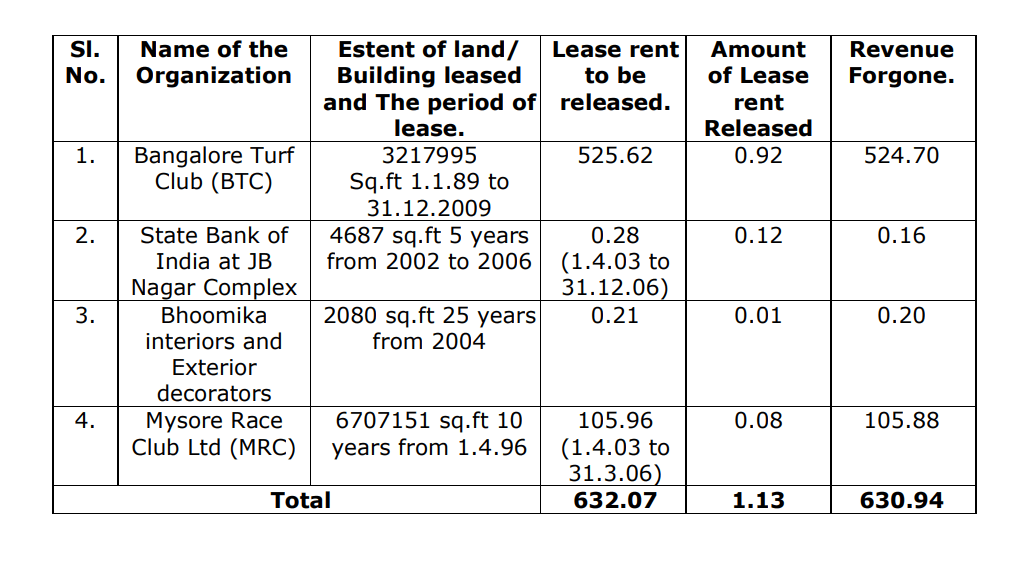
7.2.82 Scrutiny of records in four test-checked divisions revealed that fixation of concessional rent while leasing Government lands/buildings for non-charitable commercial purposes in respect of four premises resulted in foregoing of revenue of Rs.630.94 crore for the period from 1 April 2003 to 31 March 2008 as mentioned below:
30. Perusal of the aforesaid information, it is evident that petitioners have availed concession of lease amount. If one takes note of the market value as on the date of various lease deeds, it is evident that larger chunk of monetary gains has favoured the petitioners from the State Largesse. In fact, State Government should have resorted to distribute the State Largesse while adhering to Article 14 of the Constitution, Courts have time and again held that State Largesse is required to be distributed while adhering to Article 14 of the Constitution.
31….one has to come to the conclusion that State Largesse had not been distributed in the manner known to law. At the same time, each of the petitioners are beneficiaries of State Largesse at a concessional rate as is evident from the records and findings given by the KIC in its orders read with audit reports.
32. It is necessary to take note of what is meant by ‘Largesse’ – Government is simply funding its Largesses towards private charities anyway, and politicizing the nonprofit world to an unprecedented degree in the process
Compiled by S. Basavaraj, Advocate, Daksha Legal. raj@dakshalegal.com
Relevant paragraphs: 2. In these petitions, contesting respondents – complainants filed applications seeking certain information from the respective petitioners. In not providing information sought or in not taking any action on their application, contesting respondents resorted to approach KIC and KIC passed order against each of the petitioner.
30. …it is evident that petitioners have availed concession of lease amount. If one takes note of the market value as on the date of various lease deeds, it is evident that larger chunk of monetary gains has favoured the petitioners from the State Largesse. In fact, State Government should have resorted to distribute the State Largesse while adhering to Article 14 of the Constitution, Courts have time and again held that State Largesse is required to be distributed while adhering to Article 14 of the Constitution
31..one has to come to the conclusion that State Largesse had not been distributed in the manner known to law. At the same time, each of the petitioners are beneficiaries of State Largesse at a concessional rate as is evident from the records and findings given by the KIC in its orders read with audit reports.
32. It is necessary to take note of what is meant by ‘Largesse’ – Government is simply funding its Largesses towards private charities anyway, and politicizing the nonprofit world to an unprecedented degree in the process.
33. Further, the following would come under the definition of ‘Largesse’ viz., synonyms of ‘Largessee’ are bestowal, comp, donation, durative, faining, free bie, gift, give away, handsel, lagniappe, present, presentation, alms, benefaction, beneficence, benevolence, charity, contribution, dole, hand out, oblation, offering, philanthropy, tithe, grant, subsidy, remberance, tribute, valentine, bonus, boon, windfall, courtesy, favour, generosity, sacrifice, gratuity, propine, award, prize, reward, liberalise. If these meanings are taken into consideration for the purpose of State Largesse, one has to draw inference that each of the petitioners are the beneficiary of substantially financed by way of indirectly by funds provided by the Government.
36. No-doubt each of the petitioners were not controlled by the Government of Karnataka in any manner and at the same time Section 2(h) of Act, 2005 are to be read independently from Section 2(h)(a) to (d)and (i) and (ii). If part of (d) and (i) and (ii) ingredients are taken into consideration, petitioners would fall under the definition of ‘public authority’, since, monetarily each of the petitioners were beneficiary as their lease deeds revealed that they have been given substantial financial aid/concession.
47. In view of the principle laid down in the case of THALAPPALAM’s supra and DAV supra, it is crystal clear that Section 2(h) is required to be taken note of “and includes any” (i) and (ii) are to be read independently. Petitioners are all non-government organizations and who are all benefited from the State like indirectly funded by the State Government, while availing at concessional rate in respect of leased out land in favour of each of the petitioner. Consequently, non-government organization whoever benefited by directly or indirectly by funds provided by the appropriate Government would fall under ‘‘public authority’’ under Section 2(h) of Act, 2005. Since substantial financing can be both direct or indirect. To give an example, if a land in a city is given free of cost or on heavy discount to hospitals, educational institutions or such other body like sports club, this in itself could be substantial financing. The very establishment of such an institution, if it is dependent on the largesse of the State in getting the land at a cheap price, would mean that it is substantially financed. Further, the value of the land will have to be evaluated not only on the date of allotment but even on the date when the question arises as to whether the said body or NGO is substantially financed. In Writ Petition No.58192/2013 the order of KIC dated 16.09.2013 at para.10 reveals the following details of extent of land, building leased and the period of lease, lease rent to be released, amount of lease rent released and revenue foregone:
50. If these material information is taken into consideration, one has to draw inference that petitioners do fall under the definition of ‘public authority’ under Act.
Relevant paragraphs: 2(a) The suit was filed by the respondent on 27.06.2012; it is founded on alleged defamation; plaintiff claims the damages in a sum of Rupees Ten Crore; Written Statement has been filed on 13.08.2012 resisting the suit; issues have been framed years ago; plaintiff’s evidence was completed on 06.02.2019; matter was posted to 26.02.2019 for the defence evidence; however, petitioner & his counsel remained absent and therefore, his evidence being taken as nil, case was posted for arguments.
2 (c) ….The opinion of the learned judge that the petitioner has been dragging on the suit proceeding is formed on the basis of what has been reflected in the Order Sheet; there is no reason to doubt the same; in matters like this, a Writ court cannot run a race of opinions with learned judges of the Courts below. When the suit was posted for arguments, about a year thereafter the subject applications are moved once again, for reopening the suit stage; no affidavit of the petitioner is filed in support thereof nor any reason is assigned for not filing one. The explanation offered by the advocate on record as above on behalf of the petitioner for not availing the umpteen opportunities earlier granted for leading defence evidence is hardly plausible, to say the least.
2(d) The suits founded on the tort of defamation need to be tried as expeditiously as possible; reputation, be it personal or occupational, for any person is sacrosanct; the Apex Court has ruled that, the right to reputation is a facet of Article 21 of the Constitution of India; the public memory being too short to be little, the claim for redressal for the hurt of reputation merits speedier consideration and ideally speaking, before the public memory fades; in defamation suits, award of damages in terms of money hardly constitutes a full recompense for the injury suffered; delayed justice makes it still worse; this is an added reason for the speedy trial of such suits; they cannot be allowed to be dragged on indefinitely; this inarticulate premise having animated the decision of the learned trial judge, impugned order is not vulnerable for challenge.
(e) The impugned order cannot be faltered for yet another reason too; learned judge of the Court below having exercised his discretion in accordance with rules of reason & justice, has made the impugned order the kind of which does not merit a deeper examination at the hands of a Writ Court exercising a limited supervisory jurisdiction constitutionally vested in it by Article 227, vide SADHANA LODH Vs. NATIONAL INSURANCE CO. LTD., & ANOTHER, (2003) 3 SCC 524.
In the above circumstances, this writ petition being devoid of merits, is liable to be rejected in limine and accordingly, it is.
Relevant paragraphs: 2 (c) ….The opinion of the learned judge that the petitioner has been dragging on the suit proceeding is formed on the basis of what has been reflected in the Order Sheet; there is no reason to doubt the same; in matters like this, a Writ court cannot run a race of opinions with learned judges of the Courts below.
2(d) The suits founded on the tort of defamation need to be tried as expeditiously as possible; reputation, be it personal or occupational, for any person is sacrosanct; the Apex Court has ruled that, the right to reputation is a facet of Article 21 of the Constitution of India; the public memory being too short to be little, the claim for redressal for the hurt of reputation merits speedier consideration and ideally speaking, before the public memory fades; in defamation suits, award of damages in terms of money hardly constitutes a full recompense for the injury suffered; delayed justice makes it still worse; this is an added reason for the speedy trial of such suits; they cannot be allowed to be dragged on indefinitely; this inarticulate premise having animated the decision of the learned trial judge, impugned order is not vulnerable for challenge.
(e) The impugned order cannot be faltered for yet another reason too; learned judge of the Court below having exercised his discretion in accordance with rules of reason & justice, has made the impugned order the kind of which does not merit a deeper examination at the hands of a Writ Court exercising a limited supervisory jurisdiction constitutionally vested in it by Article 227, vide SADHANA LODH Vs. NATIONAL INSURANCE CO. LTD., & ANOTHER, (2003) 3 SCC 524.
In the above circumstances, this writ petition being devoid of merits, is liable to be rejected in limine and accordingly, it is.











 Daksha Legal