“Adopt Objective Assessment of Relative Merit for appointment of High Court Judges.” Senior Advocate urges SC Collegium.

Senior Advocate S Basavaraj has urged the Supreme Court collegium to adopt the system of “objective assessment of relative merit” of the candidates for elevation as High Court Judges.

The letter reads;

The procedure of circulating the judgments of the High Court Judges prospective candidates and making an objective assessment of their relative merit and scrutinising the judgments authored by High Court judges who are under consideration for elevation to the Supreme Court was introduced recently.

I am given to understand that the collegiums of various High Courts including the Karnataka High Court have sent names of learned Advocates for being elevated as Judges of the High Courts.

In this regard I respectfully request the Collegium of the Hon’ble Supreme Court to adopt similar criteria for appointment of High Court judges from the Bar. This suggestion/comment is prompted by the fact that many candidates have not appeared or argued any case let alone being part of reported Judgments.

While considering the proposal for Senior Advocate designation, the Committee thoroughly scrutinises relative merit of the learned Advocates.

This includes scrutinising the cases argued by them, reported judgements, articles and probono work.

Hence, I request your goodself to kindly adopt an objective assessment of the relative merit of the Advocates. The best way to assess is to call for details which are required for designation of a Senior Advocate.
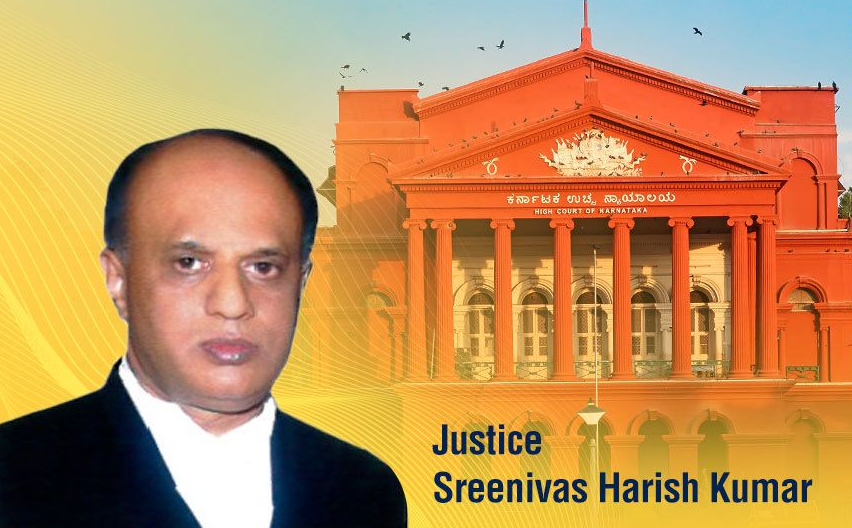
Writing Judgments by hand. Clarity of thought and dedication personified.

During the interactive session with office bearers of various Bar Associations on 26th November 2022 at Tumkur, we had a pleasant surprise. Justice Sreenivas Harish Kumar of the Karnataka High Court revealed/informed that all his judgments, except the one dictated in the open court, are hand-written by him. This gives complete command over the facts of the case and clarity of thought he added.

Very few judges have/had this ability of writing judgements by hand. I think Shri. Mahadevappa, Dist Judge would type his judgements on his old typewriter. Justice Padmaraj of the Karnataka High Court would prepare elaborate notes at home/chamber and dictate the judgments in the open court.

Many Advocates draft their pleadings by hand.

“Writing elaborate judgments by hand is a tedious job. But delivering handwritten, landmark and authoritative judgement brings utmost satisfaction. Handwriting of letters is gone with the advent of sms & whatsapp. I am really happy that his lordship preserves the art of hand-writing” – says another Judge.

S.Basavaraj, Senior Advocate, Bengaluru.

Disposal of cases. Karnataka High Court crosses monthly filing rate.

Karnataka High Court (Principal Bench) has, perhaps for the first time, disposed cases more than the filing rate.

TheVirtual Justice Clock” (digital information provided on the Karnataka High Court website) gives monthly details of “cases instituted in last month” and “cases disposed in last month” apart from other details such as (1) Cases filed by Senior Citizen (2) Cases filed by Woman (3) Cases pending for last 1 year, 1 to 3 years, 3 to 5 years, 5 to 10 years, 10 to 20 years, 20 to 30 years and above 30 years.

The cases instituted in September in the Principal Bench of the Karnataka High Court were 6594 and the disposed cases were 6977 i.e. more than 400 cases.

The cases instituted in September in the Dharwad Bench of the Karnataka High Court were 2119 and the disposed cases were 2007.

The cases instituted in September in the Principal Bench of the Karnataka High Court were 1074 and the disposed cases were 770.

The increase in number of judges has also contributed to disposal of cases. However, the fact remains that the efficiency of the Karnataka High Court in the matter of disposal of cases on merits has always been exemplary.

I had the opportunity of hearing the speech delivered by Justice  Sudhanshu Dhulia, Judge, Supreme Court of India in the Bar Council Seminar held in Guwahati on 10 September 2022. His lordship said “I am not so much worried about pendency of cases . I am worried about the day a client loses faith in the judicial system and stops approaching the Courts.”

While this is the harsh reality, interim orders granted by the Constitutional Courts and pendency of cases certainly act as deterrent for the Executive from indulging in arbitrary and illegal acts. An interim order granted in one matter will prevent the subordinate Courts and the Executive from passing illegal orders.

There was a Judge in Karnataka High Court (who ultimately made his way to SC as CJ) who was known for his infamous “Consider and Pass Orders” decisions. Thousands and thousands of cases which ought to have been heard on merits and ‘decided’ were ‘disposed’ under this “Consider and Pass Orders” category resulting in grave injustice. Such practice cannot be certainly called speedy justice.

Fortunately we see the finest combination of patient hearing and deciding of cases on merits in Karnataka High Court. There is a perfect balance in this regard. I am sure unnecessary pendency of cases will be a thing of the past soon with the hard-work and strong determination being exhibited both by the Judges and the Lawyers.

S.Basavaraj, Senior Advocate and Chairman, Karnataka State Bar Council Law Academy, Bengaluru

“Corruption is an insidious plague that has wide range of corrosive effects on the society. It is high time for the State Govt to bring back the glory of the Institution of Lokayukta.” Karnataka High Court while quashing the ACB.

Read the Judgment

Brother Judge told me that someone from Delhi called him and enquired about me. He did not stop there. Justice Sandesh reveals.

Karnataka High Court judge alleges threat of transfer for ACB officer

Mahesh P S  vs State of Karnataka
Criminal Petition 4909 of 2022. Daily Order dated 11 July 2022
Justice H P Sandesh

The Special Counsel appearing for ACB placed the investigation materials collected till date as directed by this Court in a sealed cover and the same is taken on record.

2. The Registrar (Judicial) also placed on record the details of B-reports, which have been received from 18 districts of the State and the same are placed on record. The Registrar (Judicial) submits that report from the remaining districts is yet to be received.

3. Sri Prasanna Kumar, the learned Standing Counsel appearing for Central Bureau of Investigation (CBI) placed the report on record in compliance with the order dated 07.07.2022 and the same is taken on record. The report discloses that the raid conducted on the residential house of ADGP.

4. This Court would like to make it clear that the learned counsel Sri Ashok Haranahalli appears and submits that SLP is filed before the Apex Court by ACB and he is not the counsel for ACB before this Court and he also states that there cannot be any attack on the judiciary while dispensing the justice and it amounts to attack on the independence of judiciary and insist for revealing the threat. When this matter was heard on 29.06.2022, this Court found inaction on the part of the ACB in arraigning the real accused inspite of the material against the Deputy Commissioner and not shown enthusiastic investigation and hence observed the same during the proceedings and the matter was adjourned to 04.07.2022. In the meanwhile, on account of superannuation of the Hon’ble Chief Justice, a dinner was arranged by this Court to bid farewell on 01.07.2022. “A Hon’ble sitting Judge came and sat by the side of me and stated that he received a call from Delhi (not disclosed the name) and said that the person who called from Delhi, enquired about me and immediately I replied that I am not affiliated to any political party and the Hon’ble Judge did not stop the same there itself and further said that ADGP is from North India and he is powerful and also gave an instance of transfer of Senior Judge of this Court to some other State and told that for no mistake on his part, he was transferred and chances of one side feeding to them” and the same is nothing but an attack on the independence of judiciary and interference in dispensation of justice. Thus, this Court when found inaction on the part of ACB in not properly investigating the matter and a threat was made to summon the Service Record (SR) of the ADGP. On perusal of the SR, for the period of assessment 2009-2010, the Reviewing Authority, a remark was made that the Officer has to give adequate attention to police image while performing his duties or supervising the duties of subordinate officers/ranks. It is further observed in column No.9 that lesser strength are loose supervision, soft going on subordinates, inability to say ‘No’. For the year 2008-2009 i.e., from 01.04.2008 to 31.03.2009, the remark is that his ability to take tough stand shall improve. It is emerged in the service record that he was working as S.P. in Bellary and he was transferred and within six days again got it transferred to Bellary and the counsel for CBI submits that the Hon’ble Supreme Court is monitoring the mining case and CBI raid was conducted on the residence of the ADGP.

5. Apart from that, the Deputy Director of DPAR submits the records regarding the CBI raid in respect of residence of ADGP, wherein found material, requires an enquiry and requested the State Government to enquire into the matter and now the CBI report is also placed on record and the learned Standing Counsel for CBI submits that not received any enquiry report from the State Government. On perusal of material it is clear that CBI conducted the raid on the residential house of ADGP on 05.04.2013 and found material to enquire the matter and the same is not reached to the logical end. When all these materials are found and also the B-reports which have been submitted by ACB, in respect of 5 matters only ACB has given the details and other 99 B-reports are dumped to the Court without giving any details like crime, offences, status of B-report. Hence, this Court summoned the details from the respective Courts through the Registrar (Judicial). Having taken note of no details are given and the way in which the officer who is in helm of affairs not assisted the Court, found that the same is not done in the interest of public as observed by this Court in the order dated 07.07.2022 wherein this Court cited the judgment of the Apex Court wherein it is held that if the investigation is not proceeding legally, Court can take note of the public interest as the sole consideration and a Constitutional Court monitors an investigation only when circumstances compel it to do so, such (illustratively) a lack of enthusiasm by the Investigating Officer or agency (due to ‘pressures’ on it) in conducting a proper investigation, or a lack of enthusiasm by the concerned Government in assisting the investigating authority to arrive at the truth, or a lack of interest by the investigating authority or the concerned Government to take the investigation to its logical conclusion for whatever reason, or in extreme cases, to hinder the investigation.

6. In the case on hand also lack of enthusiasm and the investigation not taken place legally and not assisted the Court by ACB properly and the said circumstances forced to call all the details including SR as well as B-reports which have been submitted before the Trial Courts that is only in the interest of public and the Constitutional Court monitors the investigation only when the circumstances compel it to do so. The ACB, only after this Court found the material and on observation of the Court, arraigned the Deputy Commissioner as accused and arrested him and also conducted the raid on the house of Deputy Commissioner. The B-report also discloses that the accused are let-off by making the accused to refund the bribe money and not considered the digital material regarding demand and acceptance.

7. Having discussed above, it is appropriate to direct the Chief Secretary and DPAR that while posting the officers that too in a institution which is established for prevention of corruption to take note of the public interest and should not be posted any tainted officer to the helm of affairs of the institution which is established to prevent the corruption.

8. The Chief Secretary before posting an officer for the office which is established for prevention of corruption, shall consider the officer is having credibility/integrity and also take note of antecedents while posting to take the institution to the great height.

9. The Secretary to the DPAR also shall bring it to the notice of the Chief Secretary while posting an officer in helm of affairs of prevention of corruption in ACB, to furnish all the details regarding the service records as well as the integrity of the officer. The other day, a mention was made before the Court by the Deputy Secretary of DPAR that due to the pressure, the same cannot be done and should not yield to such pressure in the interest of the public.

10. The posting should not be considered either by external influence or internal influence and the same cannot be a criteria while posting the officers to the institution.

11. The officers who have to be posted to prevent the corruption, their family members or any other persons should not be facing any investigation either by ACB or Lokayukta or otherwise, the family members or relatives who are facing the investigation by ACB or Lokayukata, may take advantage of the same.

12. While posting the officers, not to post the officers who have faced the traps or enquiry conducted by the ACB or Lokayukta.

13. The Special Counsel appearing for ACB has filed a memo stating that Special Leave Petition (SLP (Crl.) Provisional Application No.13963-2022) is filed before the Apex Court challenging the order dated 07.07.2022 and the said petition is listed on 12.07.2022 and prays this Court to adjourn the matter and the said memo is taken on record and the Special Counsel appearing for ACB is directed to furnish a copy of the said memo along with its enclosures to the learned counsel appearing for the petitioner since copy is not served.

14. The learned counsel appearing for the petitioner opposes for the adjournment sought by the Special Counsel appearing for ACB on the ground that the matter has been moved before the Apex Court against the order dated 07.07.2022 and the same is not bearing on the bail petition. The matter is listed tomorrow before the Apex Court and hence it is appropriate to grant two days time keeping in view of the contention of the learned counsel for the petitioner that the personal liberty of a person who is in custody is also involved.

15. The registry is directed to communicate this order to the Chief Secretary as well as to the Secretary to the DPAR forthwith.

16. The Registrar (Judicial) is directed to keep the further investigation materials furnished before the Court by ACB in safe custody.

17. List the matter on 13.07.2022 at 2.30 p.m., to hear the bail petition.

‘Ok’, ‘Thanks’, ‘Yea’. Mind your (Court) language & manners.

S.Basavaraj, Senior Advocate and Chairman, Karnataka State Bar Council Law Academy

On Friday, (8 July 22) a learned Judge of the Karnataka High Court had to advise a junior advocate not to use ‘Yea’ in the Court while arguing.

I have seen many young lawyers using such Law college campus language. Few say ‘Ok’, ‘Thanks’ etc.

Few years ago, there was a joke doing the rounds that a HC Judge’s lawyer son after getting interim order from another HC Judge said “Thank you uncle”!.  This might not be true. But I have seen many young lawyers using “thanks my lord“.

The College campus language is difficult to give up. However, it has no place when you take up a serious profession like Advocacy.

Instead of ‘Ok’ or ‘Thanks’ please say ‘I am obliged’ or ‘I am grateful’ or simply ‘much obliged’.

Justice Ramachandraiah of Karnataka High Court in his reply speech to farewell given by the Advocates Association Bangalore lamented at the Lawyers saying; “my friend is making a false statement” or “my friend is misleading the court”. Such blatant accusations do not gel with noble profession he said. He advised to say “the statement of my learned friend is factually incorrect” or “my learned friend is making out of the record statement”.

Another mistake most of us commit is addressing a person without affixing Mr. or Mrs. My senior Mr. S.Vijay Shankar, Senior Advocate and former AG never ever addressed anyone without the prefix Mr. or Mrs. He would call even his steno as Mr. so & so. When you are arguing, please add prefix Mr. or Mrs, be it your counterpart or the litigant. This will only add elegance to your language.

Recently, I came across a gentleman obtaining reply from the High Court of Karnataka under the RTI Act as to whether it wasn’t permissible to sit cross-legged in court. In my 33 years of practice whenever I sit on the front row (immediately after the arguing Bar), I make sure I never cross legs. It is not that you are showing utmost humility or humbleness to the Judge. It is just that you are maintaining personal discipline. I want to ask the above gentleman whether he would sit cross-legged in front of a Minister or the Governor when he meets them for his personal work.

Another rude behaviour is to exchange words with the counterpart during the arguments. This trivializes court proceedings. Very often, we interject when the opposite counsel is arguing either to correct a mistake or to state factually correct fact. We even intervene when the Judges speak. This is, to an extent, part of arguments. But never ever exchange words with the opponent counsel across the Bar to make it a verbal war. As I said one can intervene, if it is absolutely necessary and with the permission of the court. But all such statements or clarifications must be addressed to the Court/Judge and not to the opposite counsel.

Whenever you submit photocopies of the judgments to the Court, please make sure your opponent counsel also gets copies. It is a good gesture involving very little expenditure. This will also prevent unnecessary adjournments.

Never take adjournment without informing the opposite lawyer. On many occasions I waited for my matter almost whole day only to realise that the opposite counsel had taken adjournment at the beginning of the court proceedings. This practice is still in vogue putting the advocates in practical difficulties.

Remember, self-discipline is the best way to build and enrich the institution. Good mannerisms will go a long way in shaping the advocacy & remain beacon of light in posterity.