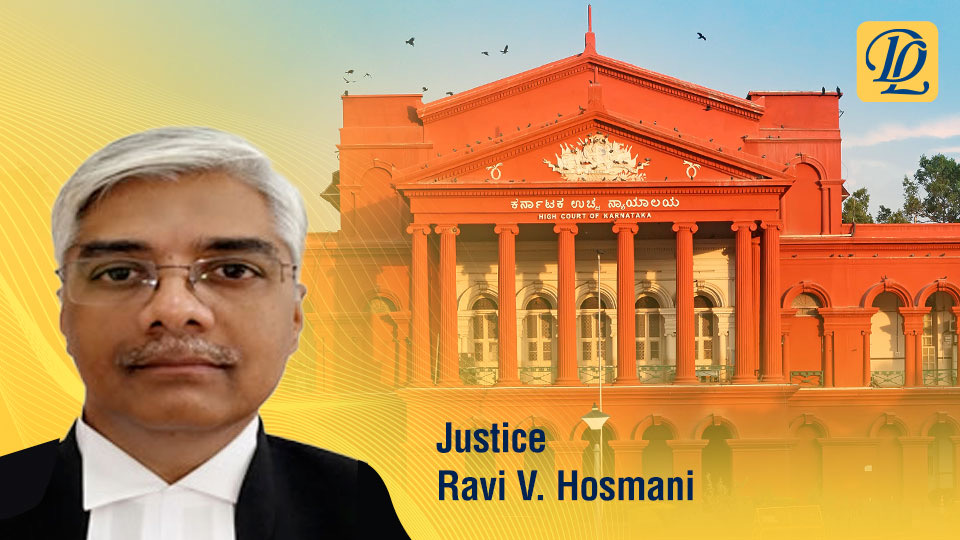
“Know Your Judge.” Justice Ravi V Hosmani. Karnataka High Court.

Justice Ravi Hosmani is celebrating his 52nd birthday today.

Justice Ravi Venkappa Hosmani was born on 29.07.1971. Enrolled as an Advocate on 07.07.1995 at Bengaluru. Started practice before the High Court of Karnataka at Bangalore both on the Original and Appellate stages in Writ Jurisdiction as well as on the Civil Appellate side. Also appeared before the Trial Courts, Appellate Authorities, Tribunals etc. And from July 2008 practised before the High Court of Karnataka Dharwad Bench. Appointed as Additional Judge of the High Court of Karnataka and taken oath on 07.01.2020 and Permanent Judge on 25.09.2021.

Important judgments delivered by Justice Ravi V Hosamani.

The specified value and suit valuation in IPR suits below Rs. 3 lakhs shall be examined by the Courts to ensure it is not arbitrary or unreasonable and the suit is not undervalued. Karnataka High Court.

https://dakshalegal.com/judgements/actionView/RbQ1DGFvwqSIFy1MmB9JiRBaS
N.I Act. Section 138. When a probable defence is set up by accused, burden is on the complainant to explain it. Karnataka High Court.

https://dakshalegal.com/judgements/actionView/fq80TkD3zDwKK8sXA2DbB6aiV
Motor Vehicles Act, 1988. Death of employee. Amount received by dependents under group insurance scheme is NOT a pecuniary advantage and can NOT be deducted from the MVC compensation. Karnataka High Court. (DB)
https://dakshalegal.com/judgements/actionView/rDJ9RaN3TSSjBom75EJF8zhJg
Criminal Law. Testimony of a witness who identified the accused for the first time in Court without knowing him before, and in the absence of any Test Identification Parade, would be valueless and unreliable. Karnataka High Court.

https://dakshalegal.com/judgements/actionView/mY1PIXZM0ajyiKOSeJpO8YW8q

When suit for specific performance is dismissed and in the absence of prayer against dispossession, defendant/owner has a right to get back possession of the property in accordance with law. Karnataka High Court.

https://dakshalegal.com/judgements/actionView/zlFzikw5TNr024mhpReL9oDFn

Suit for partition. Défense of prior partition becomes weak when revenue entries do not stand separately and exclusively in the name of the family members. Karnataka High Court.
https://dakshalegal.com/judgements/actionView/Vau54IxDF81BKpQE2MXKSVuBq
Defendant cannot be placed exparte merely on process server report unless the court is satisfied that each one of the steps contemplated for service of notice is complied with. Karnataka High Court.
https://dakshalegal.com/judgements/actionView/Znlxcx7AtjlQeU4bsqKdw4NyP
A co-owner cannot seek temporary injunction against another co-owner on the ground of adverse possession unless there is a partition of the property by metes and bounds. Karnataka High Court.

https://dakshalegal.com/judgements/actionView/xDbapeyzt9Dx35Aq4Ywhvqcup
Registration Act. When refusal of registration is endorsed on a deed, the only remedy is appeal under Section 72. The refusal cannot be recalled under Section 68(2). Karnataka High Court.
https://dakshalegal.com/judgements/actionView/JJpx9xxdHdsFBsKdqZFskgW9u

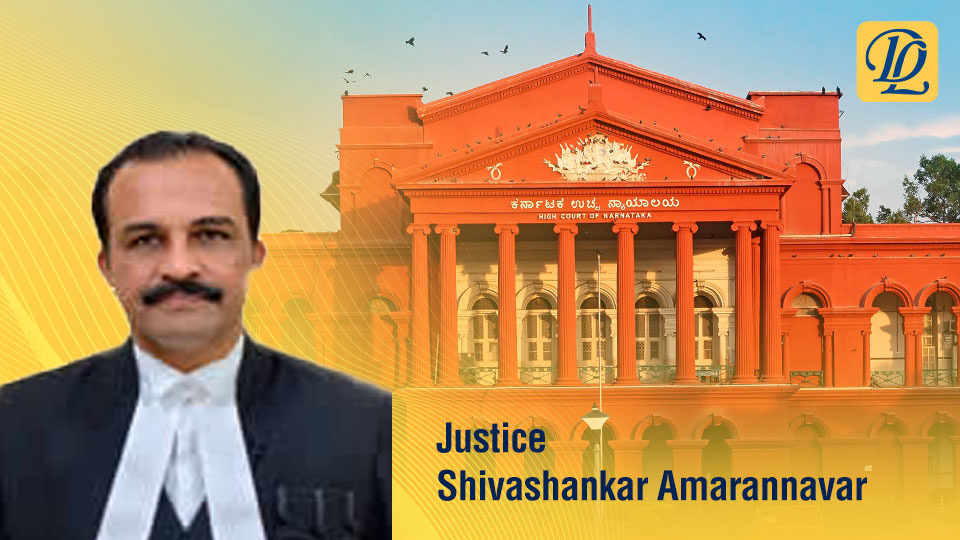
“Know Your Judge.” Justice Shivashankar Amarannavar. Karnataka High Court.

Justice Shivashankar Amarannavar celebrates his 53rd birthday today.

Justice Shivashankar Amarannavar was born on 20.07.1970. He did B.Com., LL.M. (Karnataka University, Dharwad). He enrolled as an Advocate on 24 June, 1994.

Justice Amarannavar started practicing in Dharwad District Court in the chambers of his father- Mr. B.M. Amarannavar. Worked as Special Public Prosecutor, Fast Track Court, Dharwad. Worked as part-time faculty member in University College of Law, Dharwad.

He was directly appointed as District and Sessions Judge on 25 February 2008 and served as Additional City Civil and Sessions Judge, Bengaluru, Principal District and Sessions Judge, Bagalkot and Udupi.

He served as Registrar (Vigilance), High Court of Karnataka and also served as Principal City Civil and Sessions Judge, Bengaluru. Appointed as an Additional Judge of High Court of Karnataka, Bengaluru on 04-05-2020 and Permanent Judge on 25.09.2021.
Important Judgments delivered by Justice Shivashankar Amarannavar.
Cr.P.C. Section 41A. When police issues notice under Section 41A, the apprehension of arrest is not completely ruled out. Hence petition for anticipatory bail is maintainable. Karnataka High Court.
https://dakshalegal.com/judgements/actionView/UvLcCfWt9zz8hqYgMNIp1b57g
Service law. A public servant cannot be left without a post. Transfer of a public servant without him being posted elsewhere amounts to a legal malafide. Karnataka High Court. (DB)
https://dakshalegal.com/judgements/actionView/Sxs9TQjgLAV4Kxg63TCdcVphR
Suit for partition by daughters based on the amended Section 6 of the Hindu Succession Act. Properties sold prior to 20 December 2004 are not available for partition. Karnataka High Court.
https://dakshalegal.com/judgements/actionView/0R1Rtm7hRxWDaySPGxTf9Bh2e
Plea of adverse possession in the written statement and the plea of ownership based on grant in the oral evidence run contrary to each other thus disproving both the claims. Karnataka High Court.
https://dakshalegal.com/judgements/actionView/W9VCtfh2fFoFiwsGSCew2i1KR
Proof of Will. When the attestor of a Will turns/declared hostile, other evidence showing proper execution of the Will can be relied upon. Karnataka High Court.
https://dakshalegal.com/judgements/actionView/vIxP7km1PBt6udnTaEVxORzzC
Principle of Feeding the Grant by Estoppel would enure to the benefit of purchasers of Inam lands upon the re-grant under the Karnataka (Religious and Charitable) Inam Abolition Act, 1955. Karnataka High Court.
https://dakshalegal.com/judgements/actionView/90PkZnIHxbeuZPe8Pkz7cgGZW

Adoption of child precedes proper ceremonies being performed. Mere adoption deed without proof of required ceremonies does not prove adoption. Karnataka High Court.
https://dakshalegal.com/judgements/actionView/t0cONtKUtRo9OFb5Fh5B5lIkb

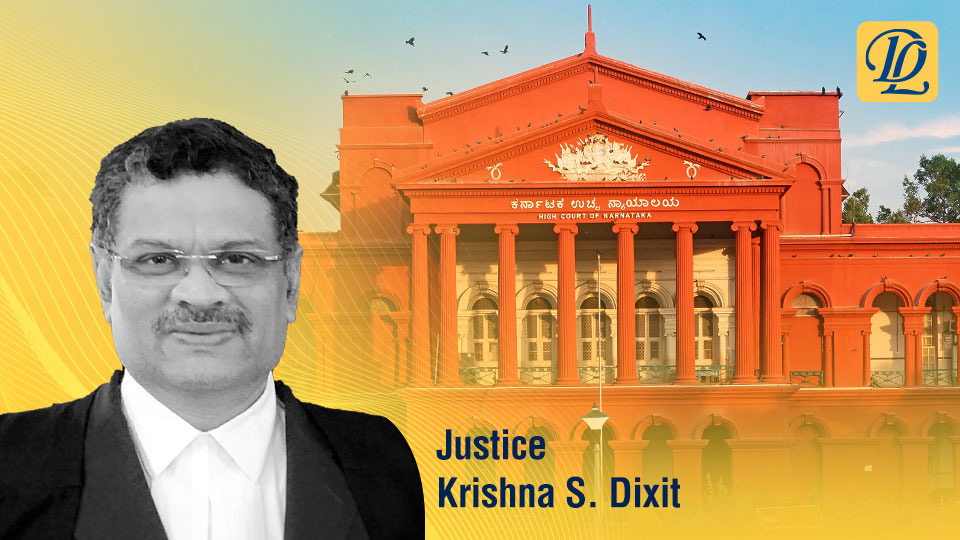
“Know Your Judge”. Justice Krishna S Dixit. Karnataka High Court.

Justice Krishna S. Dixit celebrates his 59th birthday today

Hon’ble Mr. Justice Krishna S. Dixit was born on 20 July 1964. He enrolled as an advocate in July 1989. Since then, he was practicing in the Hon’ble High Court of Karnataka & High Court of Madras, specializing in Law of Writs, Election Laws & Service Laws.

Justice Dixit was appearing in cases before the Service Law Tribunals of several States. He was appointed as the Senior Standing Counsel for the Election Commission of India and also as an Addl. Central Government Standing Counsel since 1999.

He has also served as Standing Counsel for the University Grants Commission, the Competition Commission of India, the Telecom Regulatory Authority of India, Karnataka Veterinary Sciences University, Bhabha Atomic Research Centre, National Institute of Unani Medicines, etc. He was appointed as Amicus Curiae in a few matters before the Hon’ble High Court of Karnataka.

He was Panel Counsel for few Nationalized Banks. He was also a para academician and a part-time lecturer in a Law College in Bengaluru for few years. He was contributing articles to a few Kannada & English Newspapers & magazines. He also participated in several television debates on matters of contemporary relevance.

Having been appointed as the Assistant Solicitor General of India in the year 2014, he was appearing for the Central Government in numerous important cases till his Elevation as a Judge of the High Court of Karnataka on 14th February 2018.

Justice Dixit has delivered many inspirational lectures. Links to few lectures are here:

Important judgments delivered by Justice Krishna S Dixit.

Cr.P.C. Incriminating material. Can be utilized against the accused only if the same is brought to his attention with opportunity to explain it. (DB)
https://dakshalegal.com/judgements/actionView/aGWFpOqljsIaZRTNDRZaS8Atz
Election Tribunal has no power to grant interim order staying election of the returned candidate.
https://dakshalegal.com/judgements/actionView/juN6tZ0Hibe82ckBmtIIOUhSr
Dying Declaration anatomised- “Death waiting at the doorsteps gives a unique serenity to the mind compelling the maker to state nothing but the truth.”
https://dakshalegal.com/judgements/actionView/NZMv26Oc67p87uqVqeR7Yvwr1

Private Schools. State action should be facilitative and complimentary to the establishment of private schools. “Don’t compare grant of permission to start educational institution with that of a wine shop. Adopt fair standards”.
https://dakshalegal.com/judgements/actionView/OKxPDk1BkPUlbM2xHbaAMljnm

Civil Procedure Code. Transposition of Defendant as Plaintiff. Filing of counterclaim by defendant is not a condition for transposition. What is required for transposition is not the Counterclaim but an identity of interest. Karnataka High Court.

https://dakshalegal.com/judgements/actionView/RFvBnMiGoOGdObMUS3z9lA7ys

Transfer of Property Act 1882. Section 114. Relief against forfeiture for non-payment of rent. The section does NOT come to the rescue of a tenant who lacks bonafides in conduct. Karnataka High Court.
https://dakshalegal.com/judgements/actionView/kZabplcPeCt5SdVbVj0ALwNl4
Arbitration and Conciliation Act. Amendment to Section 8. Application by any person claiming through or under the party to arbitration agreement-is prospective and does NOT apply to suits instituted prior to 23:10:2015. Karnataka High Court.
https://dakshalegal.com/judgements/actionView/TEYFPwA3X19z5HBd8VoTTBiJJ
‘Perjury has become a way of life in the Law Courts.’ – Karnataka High Court while dismissing appeal arising out of a false claim under the Motor Vehicles Act with exemplary costs. (DB)
https://dakshalegal.com/judgements/actionView/UnGJ3FlFGrdyoYtX1QPfquR3O
Electricity Supply. Purchaser of industry is liable to pay arrears towards electricity supply to earlier owner. However, there shall be apportionment of purchaser’s liability when only a part of industry is purchased. Karnataka High Court. (DB)
https://dakshalegal.com/judgements/actionView/GSXi9BnEuEx6AfoHOcfAekwHs
Bank loans. One Time Settlement. Once the OTS payment is made by the principal borrower, the surety is also discharged. Law on One Time Settlement discussed. Karnataka High Court. (DB)
https://dakshalegal.com/judgements/actionView/eWkUtPXgjJN3aZLmaJnwQkOmC
Muslim man marrying second wife. First wife can stay away from the matrimonial home, seek divorce and retain exclusive custody of her minor child. Karnataka High Court.
https://dakshalegal.com/judgements/actionView/TfgD3t7FGoYpxBMuzEwCmsAYo
Games of skill involve elements of expression and enjoy protection under Article 19(1)(a). State cannot criminalize online games involving skill. Karnataka High Court. (DB)
https://dakshalegal.com/judgements/actionView/VSOMq1h2zg2FMAmFeav0saZDS
Once the lands have vested in the State for a public purpose, the erstwhile owners cannot seek their restoration on the ground that they were put to use for some other public purpose. Karnataka High Court.
https://dakshalegal.com/judgements/actionView/prLgvTrBEnTSEiqlqrVOq9vuz

SC /ST (Prevention of Atrocities Act),1989 is prospective in operation. No prosecution for the acts committed prior to coming into force of the Act. Karnataka High Court.
https://dakshalegal.com/judgements/actionView/81ZSj19JBKH6cbxSH0yMjAE3Z
Hijab is NOT part of essential religious practice. Prescription of uniform is a reasonable restriction. Govt order is valid. Karnataka High Court. (DB)
https://dakshalegal.com/judgements/actionView/fUUQHSk4w2r34zz0BLShELpDi
Renewal of passport. Authorities cannot insist on production of facilitative order from the Court simply because criminal case is pending against the passport holder. Karnataka High Court.
https://dakshalegal.com/judgements/actionView/8YxVKdJhyg5h5r6PTmnnCjHdv
“Political rallies have some elements of dissemination of knowledge & information to the public at large and they generate lot of political awareness in the voting masses”. Karnataka High Court on PM Modi’s Road Show. (DB)
https://dakshalegal.com/judgements/actionView/NwNGlnf5JKYgPzQWOr0Kmd3S6
Only in rare circumstances a lady acquires the caste status of her husband provided she pleads and proves her admission to the community of the husband by social acceptance. Karnataka High Court.
https://dakshalegal.com/judgements/actionView/VI9zUFM1cgAAKjJvl2hMJtXvj
”Vajpayee led NDA–Government was toppled for want of one vote.” Election set aside by a very small margin is not a ground to set aside judgement in election petition. Karnataka High Court.
https://dakshalegal.com/judgements/actionView/9Al1g30G4pky8ZBm3sAq1YFyl

Lodging of accounts of electoral expenditure is aimed at transparency, purity and accountability. Disqualification due to failure cannot be avoided on flimsy grounds. Karnataka High Court.
https://dakshalegal.com/judgements/actionView/I54EPy7agaxZvI2TGrmauuNGt
“Delay in completion of acquisition and payment of compensation is akin to State taking away the ‘oxygen mask’ from the gasping patient”. Karnataka High Court. permits landowner to sell 50% of the land under acquisition to payoff debts.
https://dakshalegal.com/judgements/actionView/0ID2rNfZY608pnqj9AaQ5frQM
”Arbitrary rowdy sheeting affects liberty, privacy and reputation of citizens.” Karnataka High Court issues exhaustive guidelines.
https://dakshalegal.com/judgements/actionView/er9u3dZ69aeHLTU0AZeWF3OQf
”Judges some times make law if the statutes made by the Parliament fall short of meeting the requirements of the time”. Karnataka High Court while awarding just compensation in motor vehicle case. (DB)
https://dakshalegal.com/judgements/actionView/wjNiFzZQ4HQ9gQX1OlCL4RTBr
Motor Vehicle Tribunal should adopt philosophy of the Constitution of India on ‘life’ and ‘dignity of human-being’ in assessing loss of future prospects to award just compensation. Karnataka High Court. (DB)
https://dakshalegal.com/judgements/actionView/Nqbqtdvd2e8xgsRt8wrHHQfwh
Universities are not the notional extensions of the government departments, nor their vassals. Govt should stop poking nose in the affairs of the Universities. Karnataka High Court. (DB)
https://dakshalegal.com/judgements/actionView/p3TVqnO7dsDfyniMWedikjTNh
Service Law. In the matter of ”ad-hoc appointments” and ”appointment by rotation”, rule of seniority need not be followed. Karnataka High Court. (DB)
https://dakshalegal.com/judgements/actionView/UvYD8pcuwgo8kvfZtUwQwE4pG
Ordinarily in matters of recruitment, only aggrieved candidate can complain against illegalities in the process. Association of employees cannot espouse individual/personal cause of its members. Karnataka High Court. (DB)
https://dakshalegal.com/judgements/actionView/061N1uQuPUsnn1XIWdnpqsmNI
Land acquisition cannot be frowned upon for lack of detailed consideration in Section 5-A report unless it is shown to be violative of provisions of the Act or in colourable exercise of power. Karnataka High Court. (DB)
https://dakshalegal.com/judgements/actionView/eXKaC5L8wOOdncTtV0n52Vqke
Courts cannot don the hat of a town planner or that of an Accountant to minutely examine a lesser extent of land would have fulfilled the objective or whether the project could have been implemented satisfactorily at another location. Karnataka High Court. (DB)
https://dakshalegal.com/judgements/actionView/ysGWMbEYYTcNT7kJHCPSJ4KCa
Substantial question of law under Section 260A of the Income Tax Act need not necessarily be a question of law of general importance. Karnataka High Court explains the meaning and scope of Section 260A. (DB)
https://dakshalegal.com/judgements/actionView/mDSRCm9R2Pj3fUsGKh5KtuP7R
”Ordinarily, in civilized jurisdictions functionaries of the constitutional bodies are not subjected to subpoena”. Karnataka High Court, while setting aside summons issued to the Election Commissioner of India in election petition. (DB)
https://dakshalegal.com/judgements/actionView/4wZc659KoqNzFkvG2HcH54RW3
Sale of explosive substance being ‘res extra commercium’ like the liquor, poison, etc., no citizen can claim an unrestricted fundamental right. Karnataka High Court.
https://dakshalegal.com/judgements/actionView/Ef5eQWlBoGWlu5dtbLI85OC2l
Re-determination of property tax by the Corporation under the KMC Act without prior consultation with Property Tax Board is impermissible. Karnataka High Court.
https://dakshalegal.com/judgements/actionView/1mwzg66hyNX6sDZb25otRJ07d
Transactions between banker and borrower are purely contractual. Private lending agency/Bank does not fit into the term ‘other authorities’ within the meaning of Article 12 of the Constitution. Karnataka High Court.
https://dakshalegal.com/judgements/actionView/xyAOmSfXhBfoHFx3OGNG2iYVw
Intra-Court appeal is maintainable against an interlocutory order passed in an Election Petition under the Representation of the People Act, 1951. Karnataka High Court. (DB)
https://dakshalegal.com/judgements/actionView/8xZNGnAVPWW8CpqYRFHKmGmIG
“The dead have no rights and can suffer no wrongs’’ (G W Paton). Section 394 Cr.P.C. providing for abatement of proceedings on the death of the accused is not unconstitutional. Karnataka High Court.
https://dakshalegal.com/judgements/actionView/MqUfKlFORNfPn9L0FKXdGoj4d
”Mere possibility of ‘grave consequences’ is no ground to quash proceedings under Section 26 of the Competition Act, 2002”. Karnataka High Court imposes cost of Rs. 10 lakhs on Intel for abusing process of Court.
https://dakshalegal.com/judgements/actionView/Vka6Eem0119oYUTM8ALw2wvLS
Unless there is a ‘true dispute’ between the parties, arbitration clause in government contracts cannot be invoked on the basis of a ‘make believe dispute’ to withhold bills. Karnataka High Court.
https://dakshalegal.com/judgements/actionView/FSsU3b4KDZ1Yqaj7Clxq9J3F1
An accused who secures anticipatory bail with condition to co-operate in the investigation cannot normally seek quashment of the criminal proceedings. Karnataka High Court.
https://dakshalegal.com/judgements/actionView/40EvHLN4hmDCBj2kFpqG1YAFp
Writ petition is maintainable against banks like Punjab National Bank functioning under the umbrella of the National Housing Bank Act, 1987. Karnataka High Court.
https://dakshalegal.com/judgements/actionView/IBbsozoUk6JgVrNyCvJ49mXK8
Where the Statute does not prescribe the minimum fine amount, but, only prescribes the maximum, the authority levying substantial amount as fine has to give cogent reasons in support thereof. Karnataka High Court.
https://dakshalegal.com/judgements/actionView/8whmYCmm9eXG2jWJ68RAZFAr4
Renewable energy. Licensing authority must take appropriate measures at the time of granting license to see that huge projects are not imperilled by avoidable litigations. Karnataka High Court.
https://dakshalegal.com/judgements/actionView/L8DRHctXGGjodcrVVIsld0whg
Federation of Karnataka Chambers of Commerce and Industry is not ‘State’ within the meaning of Article 12 of the Constitution of India. Karnataka High Court.
https://dakshalegal.com/judgements/actionView/w8OKzSagZSr25UtjhQzQN5qsf
Merely because the avowed objects of a private body linguistically partake the nature of certain functions which ordinarily governmental bodies do, it does not thereby become a limb or agency of the State. Karnataka High Court.
https://dakshalegal.com/judgements/actionView/giheJQRI2w2LOoYAyy60pGhE2
Karnataka Certain Inams Abolition Act, 1977. Application in Form 1 seeking regrant of land filed after 31 March 1991 cannot be entertained by the Land Tribunal.
https://dakshalegal.com/judgements/actionView/IsrkJxC6pUFwmOLnFyWNb17gp
Devotees can question grant of occupancy rights in favour of Archak/Poojary under the Karnataka Certain Inams Abolition Act, 1977. Karnataka High Court.
https://dakshalegal.com/judgements/actionView/ZyhHSpLPUcvuzgFnVl5VO1hom
“Principle that the tiller of the land should be conferred occupancy rights is not applicable to the lands held by the Ex-serviceman”. Karnataka High Court orders restoration of tenanted lands to Soldier.
https://dakshalegal.com/judgements/actionView/9t3EJ6ppG2BGSdBc2NUw3ZxkK
Punja lands in Dakshina Kannada District can be brought under cultivation and occupancy rights can be granted u/s 48A of the Karnataka Land Reforms Act, 1961. Karnataka High Court.
https://dakshalegal.com/judgements/actionView/W7PU8BZHQkz2DzjfxETgvCsRi
Karnataka Land Reforms Act. Tenancy cannot be claimed against a person who is not a landlord even within the extended definition. Karnataka High Court quashes Land Tribunal order after 25 years.
https://dakshalegal.com/judgements/actionView/Us62GMbpZ4o0i17JtpvP2MuU9
Promissory Estoppel. Concession given by a statutory authority cannot be withdrawn unless the concession was contrary to law. Karnataka High Court.
https://dakshalegal.com/judgements/actionView/szxIZix9coUEDcDkWqM8nFdqf
Government cannot act as a robber of citizens lands; taking away private lands for the purported public purpose without compensation against the spirit of constitutional guarantee enacted u/a 300A. Karnataka High Court.
https://dakshalegal.com/judgements/actionView/6AWwXoV26eRdHh730kb45V87Q
Land acquisition. Enormous delay in passing awards. Karnataka High Court awards additional interest at 12% per annum from the date of the notification/possession.
https://dakshalegal.com/judgements/actionView/MUys3sBzUtzftFT6lzHNMQN05
When a public function/duty is to be discharged by a statutory authority, even when no time period is prescribed, the same has to be done within a reasonable time. Karnataka High Court.
https://dakshalegal.com/judgements/actionView/92S6X6AdNqiGXFOGfEinzMAEp
‘Our Constitution is founded on human values’. Displaced slum dwellers who were granted Hakku Patraas and Possession Certificates are also entitled to Transferable Development Rights. Karnataka High Court.
https://dakshalegal.com/judgements/actionView/wCDmxg1LZuiMcdizxtReRK5ss
Acquiring body denotifying land from the acquisition proceedings; retaining the possession and allotting the land for industrial purposes. Fresh acquisition proceedings to rectify the mistake cannot be said to be illegal. Karnataka High Court.
https://dakshalegal.com/judgements/actionView/sHdfFswQkTDFMn43BdDDxxukd
Forcible takeover of land for road widening simply because other landowners voluntarily surrendered their lands is impermissible. Karnataka High Court restrains Govt from interfering with landowners properties except in accordance with law.
https://dakshalegal.com/judgements/actionView/KgzxBwzMGfufa06OJZxv7H31S
‘Doctrine of Substituted Security’ entitles mortgagee to anything that is substituted for the mortgaged property. Bank can claim compensation amount if the mortgaged property is acquired. Karnataka High Court.
https://dakshalegal.com/judgements/actionView/EGC1vKzQYR3Xl4Kxg2XBGt9pn
Acquisition of lands under the National Highways Act, 1956. Landowners are entitled for solatium as if the acquisition has been made under the provisions of Land Acquisition Act, 1894. Karnataka High Court.
https://dakshalegal.com/judgements/actionView/rEAkudLb0Q4fRM5pwrezw3mT0
The amendment of 2022 to the KIADB Act incorporating the provisions of land acquisition 2013 Act is prospective in operation, notwithstanding the word ‘deemed’ occurring therein. Karnataka High Court.
https://dakshalegal.com/judgements/actionView/tdFoIhXBHiP8fpdWmwXZASPot
Decree for specific performance of sale agreement against allottee of a site can be enforced against the allotter BDA even when the BDA was not a party to the suit. Karnataka High Court.
https://dakshalegal.com/judgements/actionView/Lyn2r2SOedMTsuLZ3sHT0vwux
When a judgment is stayed, ordinarily, it is not prudent to press them into service as a binding rule, since its precedential force is in suspended animation. Karnataka High Court.
https://dakshalegal.com/judgements/actionView/3sJNciO9SoWGCSgN8d98OUwYM
Karnataka High Court invokes the principle of “Full faith and credit clause” under Article 261 to bind statutory body BDA to comply with intra-party decree even though BDA was not party to the suit.
https://dakshalegal.com/judgements/actionView/LEQne3UAbKWOoSCQE43DVLaz0
“Records of acquisition proceedings missing” cannot be pleaded in a Writ Petition to declare lapsing of acquisition proceedings especially when the names of the owners continue in the revenue records. Karnataka High Court.
https://dakshalegal.com/judgements/actionView/6ZvHuENXgEW94De62CmS6WuvF
Karnataka Land Revenue Act, 1964. Section 133. Where the RTC entries are made without any ‘title facts’ such as grants, alienations, they do not enjoy presumptive value even if they are long standing. Karnataka High Court.
https://dakshalegal.com/judgements/actionView/iWUxFljY9uC9D0oCfQTsosOxy
”It is incongruous not to acknowledge the contribution of Veerashaiva/Lingayat Mutts in achieving the constitutional aspiration of eradicating illiteracy and its associated evils by providing free education without discrimination”. Karnataka High Court.
https://dakshalegal.com/judgements/actionView/rRF9cdry5ys9UtmAF97mk3eFo
Transferable Development Rights. Once lands are surrendered by the owners, State is bound to issue TDR. State cannot contend that the lands are no longer required. Karnataka High Court.
https://dakshalegal.com/judgements/actionView/Vhiv86zsuHhblZY3jGeprUWRK
Confinement of Pontiff in prison/custody cannot be a ground to appoint Administrator to the Mutt in the absence of legislative sanction. Karnataka High Court.
https://dakshalegal.com/judgements/actionView/Vjo9hU7wVf7K7Scw6bN2OO4B5
“The Act is aimed at ‘distribution of material resources of community’ in the sense of Article 39(b) of the Constitution.” Karnataka High Court upholds the validity of the Karnataka Conferment of Ownership on Mulageni or Volamulageni Tenants Act.
https://dakshalegal.com/judgements/actionView/Ldzu8cBPaPyuHtiEOhNllSGcX
Copyright infringement. Merely because a civil dispute is being fought between the parties, the criminal proceedings cannot be halted, per se, on that ground. Karnataka High Court.
https://dakshalegal.com/judgements/actionView/X7zh30s8QS7DyEwt6oMv98gZz
Prevention of Corruption Act. Giving effect to the orders of the superior officer/authority is part of official duty and cannot be construed as misconduct. Karnataka High Court.
https://dakshalegal.com/judgements/actionView/TlamgjTYCh5aMzXONxW760rH6
“Janani Janma Bhoomischa Swargaadapi Gariyasi”. Karnataka High Court orders grant of parole to incarcerated man to see his dying mother.
https://dakshalegal.com/judgements/actionView/EyVaeIRjhAyAzOyjIFEMDBPvo
We are living in different times, of terrorism. ‘’Bail is a rule & jail is an exception’’ has spent itself when it comes to acts of terrorism. Karnataka High Court reject bail plea of accused involved in ‘K.G.Halli Riots’. (DB)
https://dakshalegal.com/judgements/actionView/aFC0UtUF9VOrAODWsEMnWn9v0
Abuse of social media is antithetical to the democratic process which has led to manipulation and fragmentation of society on the tainted lines of political ideologies. It alters civic engagement that may hijack democracy. Karnataka High Court.
https://dakshalegal.com/judgements/actionView/MC9uC1j3hRwk1J6h7lW17HiEX
Information Technology Act. Power to block under section 69A(1) of the Act read with Website Blocking Rules is not tweet-specific but extends to user accounts in their entirety. Karnataka High Court.
https://dakshalegal.com/judgements/actionView/tCYzaPdnSKbJIe9Irzs2KKust

“Race-based admissions adopted by Harvard University and University of North Carolina violate Equal Protection Clause and are unconstitutional”. United States Supreme Court.

STUDENTS FOR FAIR ADMISSIONS, INC. vs PRESIDENT AND FELLOWS OF HARVARD COLLEGE
Decided June 29, 2023

Chief Justice John Roberts
Justice Clarence Thomas.
Justice Samuel Alito.
Justice Sonia Sotomayor
Justice Elena Kagan
Justice Neil Gorsuch
Justice Brett Kavanaugh
Justice Amy Coney Barrett
Justice Ketanji Brown Jackson

Majority view: Justice Roberts, Justice Thomas, Justice Alito, Justice Gorsuch, Justice Kavanaugh, Justice Barrett, Justice Thomas, Justice Gorsuch, Justice Thomas and Justice Kavanaugh
Harvard College and the University of North Carolina (UNC) are two of the oldest institutions of higher learning in the United States. Every
year, tens of thousands of students apply to each school; many fewer are admitted. Both Harvard and UNC employ a highly selective admissions process to make their decisions. Admission to each school can depend on a student’s grades, recommendation letters, or extracurricular involvement. It can also depend on their race. The question presented is whether the admissions systems used by Harvard College and UNC are lawful under the Equal Protection Clause of the Fourteenth Amendment.

….When the 40-member full admissions committee begins its deliberations, it discusses the relative breakdown of applicants by race. The goal of the process, according to Harvard’s director of admissions, is ensuring there is no “dramatic drop-off” in minority admissions from the prior class….

UNC has a similar admissions process. Every application is re[1]viewed first by an admissions office reader, who assigns a numerical rating to each of several categories. Readers are required to consider the applicant’s race as a factor in their review. Readers then make a written recommendation on each assigned application, and they may provide an applicant a substantial “plus” depending on the applicant’s race. At this stage, most recommendations are provisionally final. A committee of experienced staff members then conducts a “school group review” of every initial decision made by a reader and either approves or rejects the recommendation. In making those decisions, the committee may consider the applicant’s race.

Petitioner, Students for Fair Admissions (SFFA), is a nonprofit or[1]ganization whose stated purpose is “to defend human and civil rights secured by law, including the right of individuals to equal protection under the law.” SFFA filed separate lawsuits against Harvard and UNC, arguing that their race-based admissions programs violate, re[1]spectively, Title VI of the Civil Rights Act of 1964 and the Equal Pro[1]tection Clause of the Fourteenth Amendment. After separate bench trials, both admissions programs were found permissible under the Equal Protection Clause and this Court’s precedents. In the Harvard case, the First Circuit affirmed, and this Court granted certiorari. In the UNC case, this Court granted certiorari before judgment.

Held: Harvard’s and UNC’s admissions programs violate the Equal Protection Clause of the Fourteenth Amendment.

a) Because SFFA complies with the standing requirements for or[1]ganizational plaintiffs articulated by this Court in Hunt v. Washington State Apple Advertising Comm’n, 432 U. S. 333, SFFA’s obligations un[1]der Article III are satisfied, and this Court has jurisdiction to consider the merits of SFFA’s claims. The Court rejects UNC’s argument that SFFA lacks standing be[1]cause it is not a “genuine” membership organization. An organiza[1]tional plaintiff can satisfy Article III jurisdiction in two ways, one of which is to assert “standing solely as the representative of its members,” Warth v. Seldin, 422 U. S. 490, 511, an approach known as rep[1]resentational or organizational standing. To invoke it, an organization must satisfy the three-part test in Hunt. Respondents do not suggest that SFFA fails Hunt’s test for organizational standing. They argue instead that SFFA cannot invoke organizational standing at all be[1]cause SFFA was not a genuine membership organization at the time it filed suit. Respondents maintain that, under Hunt, a group qualifies as a genuine membership organization only if it is controlled and funded by its members. In Hunt, this Court determined that a state agency with no traditional members could still qualify as a genuine membership organization in substance because the agency repre[1]sented the interests of individuals and otherwise satisfied Hunt’s three-part test for organizational standing. See 432 U. S., at 342. Hunt’s “indicia of membership” analysis, however, has no applicability here. As the courts below found, SFFA is indisputably a voluntary membership organization with identifiable members who support its mission and whom SFFA represents in good faith. SFFA is thus enti[1]tled to rely on the organizational standing doctrine as articulated in Hunt.

(b) Proposed by Congress and ratified by the States in the wake of the Civil War, the Fourteenth Amendment provides that no State shall “deny to any person . . . the equal protection of the laws.” Proponents of the Equal Protection Clause described its “foundation[al] principle” as “not permit[ing] any distinctions of law based on race or color.” Any “law which operates upon one man,” they maintained, should “operate equally upon all.” Accordingly, as this Court’s early decisions inter[1]preting the Equal Protection Clause explained, the Fourteenth Amendment guaranteed “that the law in the States shall be the same for the black as for the white; that all persons, whether colored or white, shall stand equal before the laws of the States.”

Despite the early recognition of the broad sweep of the Equal Pro[1]tection Clause, the Court—alongside the country—quickly failed to live up to the Clause’s core commitments. For almost a century after the Civil War, state-mandated segregation was in many parts of the Nation a regrettable norm. This Court played its own role in that ig[1]noble history, allowing in Plessy v. Ferguson the separate but equal regime that would come to deface much of America. 163 U. S. 537.

After Plessy, “American courts . . . labored with the doctrine [of sep[1]arate but equal] for over half a century.” Brown v. Board of Education, 347 U. S. 483, 491. Some cases in this period attempted to curtail the perniciousness of the doctrine by emphasizing that it required States to provide black students educational opportunities equal to—even if formally separate from—those enjoyed by white students. See, e.g., Missouri ex rel. Gaines v. Canada, 305 U. S. 337, 349–350. But the inherent folly of that approach—of trying to derive equality from ine[1]quality—soon became apparent. As the Court subsequently recog[1]nized, even racial distinctions that were argued to have no palpable effect worked to subordinate the afflicted students. See, e.g., McLau[1]rin v. Oklahoma State Regents for Higher Ed., 339 U. S. 637, 640–642. By 1950, the inevitable truth of the Fourteenth Amendment had thus begun to reemerge: Separate cannot be equal.

The culmination of this approach came finally in Brown v. Board of Education, 347 U. S. 483. There, the Court overturned the separate but equal regime established in Plessy and began on the path of inval[1]idating all de jure racial discrimination by the States and Federal Gov[1]ernment. The conclusion reached by the Brown Court was unmistak[1]ably clear: the right to a public education “must be made available to all on equal terms.” 347 U. S., at 493. The Court reiterated that rule just one year later, holding that “full compliance” with Brown required schools to admit students “on a racially nondiscriminatory basis.” Brown v. Board of Education, 349 U. S. 294, 300–301.

In the years that followed, Brown’s “fundamental principle that ra[1]cial discrimination in public education is unconstitutional,” id., at 298, reached other areas of life—for example, state and local laws requiring segregation in busing, Gayle v. Browder, 352 U. S. 903 (per curiam); racial segregation in the enjoyment of public beaches and bathhouses Mayor and City Council of Baltimore v. Dawson, 350 U. S. 877 (per cu[1]riam); and antimiscegenation laws, Loving v. Virginia, 388 U. S. 1. These decisions, and others like them, reflect the “core purpose” of the Equal Protection Clause: “do[ing] away with all governmentally im[1]posed discrimination based on race.” Palmore v. Sidoti, 466 U. S. 429, 432.

Eliminating racial discrimination means eliminating all of it. Ac[1]cordingly, the Court has held that the Equal Protection Clause applies “without regard to any differences of race, of color, or of nationality”— it is “universal in [its] application.” Yick Wo v. Hopkins, 118 U. S. 356, 369. For “[t]he guarantee of equal protection cannot mean one thing when applied to one individual and something else when applied to a person of another color.” Regents of Univ. of Cal. v. Bakke, 438 U. S. 265, 289–290.

Any exceptions to the Equal Protection Clause’s guarantee must survive a daunting two-step examination known as “strict scrutiny,” Adarand Constructors, Inc. v. Peña, 515 U. S. 200, 227, which asks first whether the racial classification is used to “further compelling governmental interests,” Grutter v. Bollinger, 539 U. S. 306, 326, and second whether the government’s use of race is “narrowly tailored,” i.e., “necessary,” to achieve that interest, Fisher v. University of Tex. at Austin, 570 U. S. 297, 311–312. Acceptance of race-based state action is rare for a reason: “[d]istinctions between citizens solely because of their ancestry are by their very nature odious to a free people whose institutions are founded upon the doctrine of equality.”.

Continue to read the judgement……

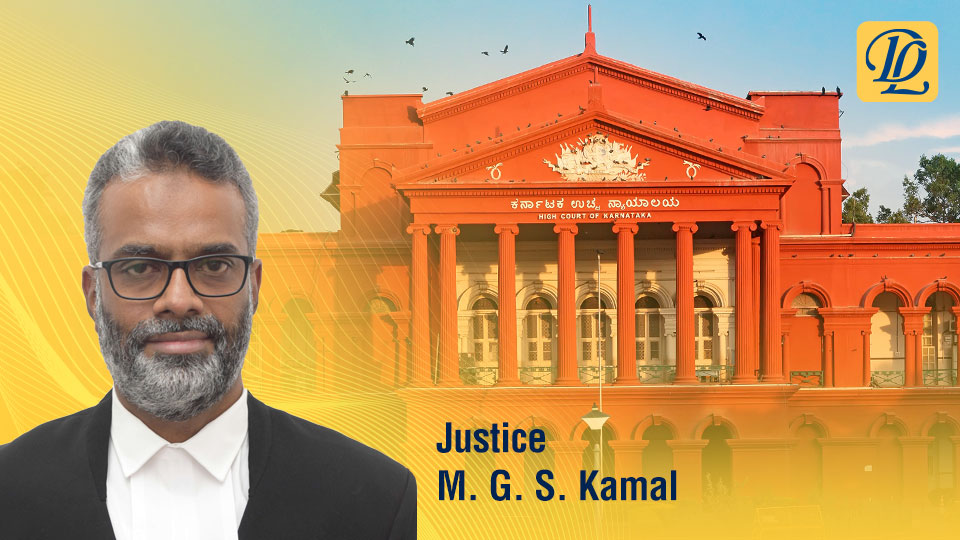
“Know Your Judge”. Justice M.G.S. Kamal. Karnataka High Court.

Justice M. G. Shukure Kamal celebrates his 52nd birthday today.

Justice M. G. Shukure Kamal was born on 30 June, 1971 at Kodlipet, Kodagu District. He did his Primary & Secondary education both at Kodlipete and Suntikoppa of Kodagu District. Hr completed his PUC at Govt. Senior College, Madikeri and did his BAL.,LL.B. at Vidyavardhaka Law College, Mysuru.

Justice M. G. Shukure Kamal was enrolled as an Advocate with the Karnataka State Bar Council on 05.08.1994. He appeared before the High Court of Karnataka, City Civil and Sessions Court, Chief Metropolitan Magistrate Courts, Debt Recovery Tribunals at Bengaluru, mainly in Civil, Criminal, Constitutional, Labour, Arbitration, Revenue and Wakf matters.

Justice M. G. Shukure Kamal was appointed as Additional Judge of the High Court of Karnataka and taken oath on 17.03.2021 and Permanent Judge on 30.09.2022.

Few important judgments delivered by Justice M.G. Shukure Kamal.

Principles of Natural Justice. In the absence of any legal right, the principles do not apply. Authority passing resolution in favour of a person without any statutory backing can withdraw it without prior notice. Karnataka High Court. (DB)
https://dakshalegal.com/judgements/actionView/8F95oMjflcK7kGLOEPJRldxP0
Land Acquisition Act 1894. Land acquired and vested with the Government can NOT be withdrawn. Unless there is material to rebut statutory presumption, notification under Section 16(2) is evidence of taking possession. Karnataka High Court. (DB)
https://dakshalegal.com/judgements/actionView/ljt4a0rFVxsAt3fsVgY2qpHAg
Land Acquisition Act, 1894. Market value. Amount awarded under consent award in respect of similarly situated land acquired for similar purpose can be treated to be the base price. Karnataka High Court. (DB)
https://dakshalegal.com/judgements/actionView/huQ69rIl4plqf8MDGxm7wXvwi
A representative suit cannot be permitted to the withdrawn or compromised without complying with mandatory procedure under Order 1 Rule 8 (4) of the Civil Procedure Code. Karnataka High Court.
https://dakshalegal.com/judgements/actionView/htOFX8GmA6d4FfJIna0mmYzbw
Education. Though admission deadline is inviolable if the authority extends it, admission of students beyond deadline is valid. Karnataka High Court. (DB)
https://dakshalegal.com/judgements/actionView/LUk3jLI4ox8RD1JdPJWVz0vuP

Though a minor can be beneficiary/ recipient under a contract, he cannot be subjected to any obligation or burden of performance of any reciprocal promise. Karnataka High Court.
https://dakshalegal.com/judgements/actionView/JDI95FWSKigms8pAkBC6oyIWg
Action taken pursuant to and upon an insufficiently stamped document cannot be termed as illegal, null and void and nonest in the eye of law in the absence of any specific provisions thereof. Karnataka High Court.
https://dakshalegal.com/judgements/actionView/zvipRa8JbuGYcclb7n1LuIlL1
Suit for specific performance. Merely because the agreement does not stipulate any time, the same cannot be expected remain unperformed for all the time to come. Karnataka High Court.
https://dakshalegal.com/judgements/actionView/ls2xoQe158EfjdSBGKEL8Tj7P
Bombay-Karnataka area. Succession among Hindus coming under the Bombay School of Inheritance. Sister was entitled for a share if the succession had opened prior to 1956. Karnataka High Court.
https://dakshalegal.com/judgements/actionView/bsKseN5ePmLnGorxkcs8cflzu
“Writ Petition seeking revision of voters list cannot be maintained except by the persons aggrieved.” Karnataka High Court, while dismissing the petition filed by MLA seeking rectification of voters list of his constituency. (DB)
https://dakshalegal.com/judgements/actionView/J4m08ex04SUdZhgPtNWDb6kGT
Indian Succession Act. Succession Certificate cannot be issued in respect of immovable property in Karnataka. Authorities cannot insist on production of Succession Certificate for transfer of khata of the property bequeathed under a Will.
https://dakshalegal.com/judgements/actionView/yXwqTsEUy3ETcZz41cDLHK8Aq

“Know Your Judge”. Chief Justice Prasanna B. Varale. Karnataka High Court.

Chief Justice Prasanna B. Varale celebrates his 61st birthday today.

Hon’ble Mr. Justice Prasanna B. Varale was born on 23rd June, 1962 at Nipani, Belagavi District, Karnataka. Graduated in Arts and Law from Dr. Babasaheb Ambedkar Marathwada University.

He enrolled as an Advocate on 12 August, 1985. He joined the chambers of Advocate Sri.S.N.Loya and practiced on Civil & Criminal Side. He served as lecturer in Law at Ambedkar Law College, Aurangabad from 1990 to 1992.

Justice Prasanna B. Varale also worked as Assistant Government Pleader and Additional Public Prosecutor, High Court Bench at Aurangabad AND Additional Standing Counsel for Union of India.

Justice Prasanna B. Varale was elevated as Judge at Bombay High Court on 18 July 2008

Justice Prasanna B. Varale took oath as the Chief Justice of High Court of Karnataka on 15 October 2022.

Important Judgments delivered by Chief Justice Prasanna B Varale in Karnataka High Court.

KMMC Rules. When the order of Competent Authority is approved by the Controlling Authority, who is also the Revision authority, Revision can only be filed before the State Government. Karnataka High Court. (DB)
https://dakshalegal.com/judgements/actionView/qShEUGV1528ixEHut1KH6TnwW
Committees under Article 194(3) of the Constitution are not vested with adjudicatory jurisdiction which belongs to judicature under the constitutional scheme. Karnataka High Court. (DB)
https://dakshalegal.com/judgements/actionView/DRiFF4ELOPCsOOmhovGy5jU0W
“Writ Petition seeking revision of voters list cannot be maintained except by the persons aggrieved.” Karnataka High Court, while dismissing the petition filed by MLA seeking rectification of voters list of his constituency. (DB)
https://dakshalegal.com/judgements/actionView/J4m08ex04SUdZhgPtNWDb6kGT

“Know Your Judge”. Justice Pradeep Singh Yerur. Karnataka High Court.

Justice Pradeep Singh Yerur celebrates his 53rd birthday today.

Justice Pradeep Singh Yerur was born on 21.06.1970. He enrolled as an Advocate on 30.05.1997.

He practiced in the field of Constitutional law, Labour Laws, Company Laws, Intellectual Property, Penal Laws, Banking Laws, Negotiable Instrument Laws, Property Laws, Consumer Protection Laws, Service law, House Rent Laws, Family Laws, Land Acquisition, Economic Offence Laws, Education Law before High Court of Karnataka, Punjab and Haryana High Court and Supreme Court of India.

He was appointed as Additional Judge of the High Court of Karnataka and taken oath on 11.11.2019 and Permanent Judge on 08.09.2021.

Important judgments delivered by Justice Pradeep Singh Yerur.

N.I. Act. Cheque issued to managing partner of partnership firm. Complaint filed in the name of partnership firm not maintainable. Karnataka High Court.
https://dakshalegal.com/judgements/actionView/C16w9m6iE6J0BBcUuy87Ae9xP
Indian Penal Code. Section 304A. There must be a direct nexus between death of a person and rash and negligent act of accused. Death due to electrocution. Criminal negligence against Section officer of the electric company not proved. Karnataka High Court.
https://dakshalegal.com/judgements/actionView/4MpYauDJITGNmYOKgh0ysQjpt
Writ Jurisdiction. Petition under Article 226 would NOT lie for issuance of a writ of Habeas Corpus for tracing missing persons. Only in cases of illegal detention or custody, such writ can be issued. Karnataka High Court. (DB)
https://dakshalegal.com/judgements/actionView/7dnnGY4fs8ZGPrEmHoN6rqfDn
Judicial review. A rule cannot be challenged on grounds of individual hardship. Courts cannot question wisdom behind policy decisions. Karnataka High Court upholds Rule increasing age limit of doctors for posts of General Duty Medical Officers. (DB)
https://dakshalegal.com/judgements/actionView/4lVGYOIbyypQHUyCzS3aiaDsB
Judicial review. Look Out Circular issued by Bank against debtor in larger public interest and economic interest of the nation cannot be the subject matter of judicial scrutiny. National interest is paramount. Karnataka High Court. (DB)
https://dakshalegal.com/judgements/actionView/X4iEbMksseVqQJv1vtIhS9h8B
‘Perjury has become a way of life in the Law Courts.’ – Karnataka High Court while dismissing appeal arising out of a false claim under the Motor Vehicles Act with exemplary costs. (DB)
https://dakshalegal.com/judgements/actionView/UnGJ3FlFGrdyoYtX1QPfquR3O
Electricity Supply. Purchaser of industry is liable to pay arrears towards electricity supply to earlier owner. However, there shall be apportionment of purchaser’s liability when only a part of industry is purchased. Karnataka High Court. (DB)
https://dakshalegal.com/judgements/actionView/GSXi9BnEuEx6AfoHOcfAekwHs
Bank loans. One Time Settlement. Once the OTS payment is made by the principal borrower, the surety is also discharged. Law on One Time Settlement discussed. Karnataka High Court. (DB)
https://dakshalegal.com/judgements/actionView/eWkUtPXgjJN3aZLmaJnwQkOmC

Trademark. Authoritative judgment of the Karnataka High Court on ‘passing off’, ‘infringement’ ‘distinctiveness’ and ‘deceptive similarity’. (DB)
https://dakshalegal.com/judgements/actionView/MfPnsXBbOlvpKV6KOXRO2t5Ul
Bar under Section 132 of the Karnataka Land Reforms Act does not apply to a suit where the very jurisdiction of the Land Tribunal to grant occupancy rights is questioned. Karnataka High Court.
https://dakshalegal.com/judgements/actionView/bN0vbWQgHa0mBnhrV8WSCdt2l
Employees Compensation Act, 1923. Section 4A(3)(a). Interest at 12% per annum shall be awarded from the date of the accident and not after expiry of thirty days thereafter. Karnataka High Court.
https://dakshalegal.com/judgements/actionView/6s7pEruP4ffWYwZu6H6Iy1XNk
RTE Act. Government has no power to conduct examinations of its own other than the regular examinations conducted by the schools. Karnataka High Court.
https://dakshalegal.com/judgements/actionView/WUmRGdrqOcMSUQROi3I7lJTVZ

Karnataka SC/ST PTCL Act. Delay of 20 years in applying for cancellation of the sale. Such application cannot be entertained by the authorities. Karnataka High Court.
https://dakshalegal.com/judgements/actionView/SQ6ctMwB7r3JcaU6Bh9cOfo7J
We are living in different times, of terrorism. ‘’Bail is a rule & jail is an exception’’ has spent itself when it comes to acts of terrorism. Karnataka High Court reject bail plea of accused involved in ‘K.G.Halli Riots’.
https://dakshalegal.com/judgements/actionView/aFC0UtUF9VOrAODWsEMnWn9v0
Transfer of license for distribution of essential commodities is governed by the Control Order prevalent at the time of grant of license. Restrictions imposed in the subsequent Order cannot be applied. Karnataka High Court.
https://dakshalegal.com/judgements/actionView/irvtPGTvLkMNp5MsEfOTOZxgC

“Know Your Judge”. Justice Sreenivas Harish Kumar. Karnataka High Court.

Justice Sreenivas Harish Kumar celebrates his 60th birthday today.

Justice Sreenivas Harish Kumar enrolled as an advocate on 11.02.1987 and practiced independently at Chikkaballapur, City Civil Court and High Court of Karnataka, Bangalore on Civil side.

He was directly appointed as District and Sessions Judge on 27th May, 2002 and served as Additional Districts and Sessions Judge at Tumkuru; and City Civil Court, Bangalore and Principal District and Sessions Judge at Bidar, Chitradurga, Bangalore Rural Districts.

He also served as Director Karnataka Judicial Academy, Bengaluru.

Justice Sreenivas Harish Kumar was appointed as an Additional Judge of the High Court of Karnataka on 14.11.2016 and Permanent Judge on 03.11.2018.

Important judgments delivered by Justice Sreenivas Harish Kumar.

Public Trust. Decision on application under section 92 CPC shall be taken by looking into only the plaint averments. Application can be opposed only with reference to plaint averments only. Karnataka High Court. (DB)
https://dakshalegal.com/judgements/actionView/UCEQ7YmlB4HlEReX0r7fq0pK5
Civil Procedure Code. Order granting leave under section 92 in respect of public trust is a judicial order and can be questioned by revision petition under section 115.
https://dakshalegal.com/judgements/actionView/yzVpyl6PXJAhqgYU4rV78bi5A
Attachment before judgment in a suit for damages for defamation cannot be passed since the claim for damages is not an ascertained sum arising from a transaction between the parties. Karnataka High Court.
https://dakshalegal.com/judgements/actionView/JYFVrsvVCBLUP808IlrLZa2T7
Attachment before judgment. The plaintiff must be able to demonstrate that on the day when the suit was filed, the defendant owed to him in a certain sum of money on account of a transaction between them. Karnataka High Court.
https://dakshalegal.com/judgements/actionView/iNwfIo0FHGE3ky8FzNKZgXnWh
Caveat cannot curtail Court’s power to pass interim orders when party approaching court makes out an extraordinary circumstance in the presence of caveator. Karnataka High Court.
https://dakshalegal.com/judgements/actionView/eKzc6oWv0mjYWQSpSnP8HzGT7
Filing of Caveat cannot curtail Court’s power to pass interim orders when party approaching court makes out an extraordinary circumstance in the presence of caveator. Karnataka High Court.
https://dakshalegal.com/judgements/actionView/DmP6WrUjR3MUHWO01yw2PFFbz
Executing Court can order arrest of the judgement debtor on oral application of the decree holder, without issuing arrest notice, only if the judgement debtor is within the precincts of the Court. Karnataka High Court.
https://dakshalegal.com/judgements/actionView/CeBxHJwRlYcJTqE4PcxQeoROv
Court cannot place accused exparte in cheque bounce cases and proceed with the trial. Court must secure presence of the accused if he does not appear despite service of summons. Karnataka High Court.
https://dakshalegal.com/judgements/actionView/uDR1b4mRA4vZklQQt1YFB5Y0M
MVC Case. Split multiplier. Higher multiplier for the salary component and lower multiplier for the pension component is justified when the person had no future prospect of re-employment. Karnataka High Court explains. (DB)
https://dakshalegal.com/judgements/actionView/rF9w2HacF7tOstqC4XzSmHFCN
Dowry death. Failure to explain reasons within the knowledge of the accused, under Section 313 Cr.P.C, renders the defence of the accused unreliable. Karnataka High Court.
https://dakshalegal.com/judgements/actionView/YXiqmTlVtPW1wVYd94d1ubxI7
When temporary injunction sought in an appeal preferred against decree, the appellate court can look into the evidence and findings of the trial court to form an opinion regarding the nature or status of the property. Karnataka High Court.
https://dakshalegal.com/judgements/actionView/w4ThkSrxNE4DwSQrqzxVjvlBQ
Cheque issued towards refund of failed marriage expenses constitutes enforceable debt under Section 138 of the N.I. Act and the same is not hit by Section 23 of the Contract Act. Karnataka High Court.
https://dakshalegal.com/judgements/actionView/o8iClgW00pJKJGjn4DIZK926x

Default imprisonment for non-payment of fine is a penalty and not a sentence. The default sentence cannot be for a period more than one fourth of maximum imprisonment period that can be imposed as sentence. Karnataka High Court.
https://dakshalegal.com/judgements/actionView/90KbsnOJp2ADsr0XOrrlKIgdE
Cheque bounce case. Single complaint in respect of several cheques issued from Company account as well as personal account is maintainable if the transaction is same. Karnataka High Court.
https://dakshalegal.com/judgements/actionView/dNCPL15SjH5pR7a4w8Lc6uUlr
Cheque bounce case. Unless accused introduces a specific defence questioning financial capacity of complainant, Court cannot go into this question on its own and give a finding. Karnataka High Court.
https://dakshalegal.com/judgements/actionView/O9HMqO2wIJGCtnqIpWNYPa53h
Every seasoned advocate trains the witnesses before they are examined in the court. Such training cannot be branded as ‘tutoring the witness’. Karnataka High Court.
https://dakshalegal.com/judgements/actionView/BeDHhtClpXCo7L1sFgql1coz6
SARFAESI Act. Whether action can be taken in relation to security interest created in an agricultural property can also be dealt with by the Debt Recovery Tribunal. Writ petition cannot be entertained on this ground alone. Karnataka High Court.(DB)
https://dakshalegal.com/judgements/actionView/fEy5S0lOame5iJnrKATE0TvAB
If search and seizure effected pursuant to a FIR disclose a different distinct offence, there is no bar for registration of a second FIR even though the first FIR is quashed by the Court. Karnataka High Court.
https://dakshalegal.com/judgements/actionView/dAxQIBxxCMKrPtp8yAL034R4p
If trial court declines to frame or reframe issue despite request made by a party during pendency of suit, the same can be agitated in appeal against the final judgment. Karnataka High Court. (DB)
https://dakshalegal.com/judgements/actionView/lH7jYBhmYGl3TWI7ZWsfepBku
Omission to put question to accused under section 313 Cr.P.C, cannot be a good ground to upset conviction unless it has resulted in miscarriage of justice or prejudiced the interest of the accused substantially. Karnataka High Court.
https://dakshalegal.com/judgements/actionView/Os1BAPTK7UMdal6qiWPq2AQfj
There is no bar for the informant police officer to undertake investigation so long as the investigation is free of bias and prejudice. Karnataka High Court.
https://dakshalegal.com/judgements/actionView/V77topspSyDs99Xw0hAaHSvNs
First of its kind; Karnataka High Court grants ‘John Doe’ injunction order against unknown defendant/respondent.
https://dakshalegal.com/judgements/actionView/vFrxsGzw3ADALVVqy1J817iiD
Prevention of Corruption Act, 1988. Amended Section 19 is retrospective in operation and previous sanction for prosecution of retired public servant necessary even prior to the amendment. Karnataka High Court.
https://dakshalegal.com/judgements/actionView/XsnVYVIDLEHNcAEs6HL4Ei0Kd
Registered sale deed or release deed do not require attestation and it is not necessary to examine attesting witnesses unless the execution of the document is specifically denied by its executor. Karnataka High Court.
https://dakshalegal.com/judgements/actionView/UtI6TUqSRlxiXrfSnULaM64Zw
Election petition. Defeated candidate securing zero vote in a booth does not give rise to assumption of bogus voting. Suspicion does not take the place of evidence. Karnataka High Court.
https://dakshalegal.com/judgements/actionView/imYx1GHhjOSMFzfqotJdZkF7E
Match fixing does not amount to cheating under Section 420 Indian Penal Code though it may indicate dishonesty, indiscipline and mental corruption of a player. Karnataka High Court.
https://dakshalegal.com/judgements/actionView/XJEIjJ6aCmTaGvMT948iBkJjh
SC/ST (Prevention of Atrocities) Act. Obtaining false caste certificate by non SC/ST person can not be construed as an offence under the Act. Karnataka High Court.
https://dakshalegal.com/judgements/actionView/KXB2N3HsjwH8hIcy9IMlh5OCb

”Article 25 of the Constitution cannot be understood as affording protection to those who indulge in conversion under the camouflage of propagation of his or her religion”. Karnataka High Court while quashing criminal proceedings against police officers.
https://dakshalegal.com/judgements/actionView/SctbBAUvVYw1CSMxMVcZ2b8dU
Arbitration and Conciliation Act. Section 8. Non-signatory defendants cannot be exposed to arbitral proceedings especially when the cause of action against all the defendants is same and cannot be bifurcated. Karnataka High Court.
https://dakshalegal.com/judgements/actionView/rx83qVA7XsStuXAv3JFBekPah
Hindu Succession Act. Section 14. Life interest created to wife under Will beyond her share in a notional partition is not a pre-existing right. Bequeath is only life interest. Wife will not get absolute right. Karnataka High Court. (DB)
https://dakshalegal.com/judgements/actionView/s3By08wWSkDhYnWeNIZ9jzX0K
Limitation Act. Article 65-b. Recovery of possession when mortgagee sells the property mortgaged. The Article does NOT apply when the property is sold under a statute. Karnataka High Court. (DB)
https://dakshalegal.com/judgements/actionView/a0si6Vak9Zptt4JfkzJ6gWFKB
Transfer of Property Act. Section 43. Feeding the grant by estoppel does NOT apply if the transferee knows that the transferor did not possess the title at the time of transfer. Karnataka High Court.
https://dakshalegal.com/judgements/actionView/8dPDjhgy7Fbr11zfO0LdC7J46
Prosecution for dishonour of cheque issued towards time barred debt is permissible when cheque was issued under a subsequent written agreement between the parties. Karnataka High Court.
https://dakshalegal.com/judgements/actionView/fjHyJBCNCuyfvj24ZFWHCJxn8
Inclusion of properties already partitioned in a suit for partition amounts to vexatious and scandalous litigation. Court can order deleting the properties from the plaint under Order 6 Rule 16 of CPC. Karnataka High Court.
https://dakshalegal.com/judgements/actionView/oarJCd8AcDey37g4CGwf297ze
Partition Act. Party who applies for sale of the property under Section 2 cannot opt for purchase of the share of the other parties under Section 3. Karnataka High Court.
https://dakshalegal.com/judgements/actionView/AyJ2wImDu5VSceufc4MgIGEqY

Plea to appoint second Upa-Lokayukta. Karnataka High Court orders notice to Govt.

Samaj Parivarthan Samudaya has filed a Writ Petition (PIL) seeking directions to the Government of Karnataka to appoint second Upa-Lokayutka. The division bench of the Karnataka High Court consisting the Chief Justice and Justice Ashok S Kinagi has ordered notice to the Government. Writ Petition 3139/2023, Samaj Parivarthan Sumudaya vs State of Karnataka.

Mr. A R Goutham, Advocate, Daksha Legal made submissions before the bench.

Hitherto two Upa-Lokayuktas were appointed to the institution of Lokayukta. After Justice Ananda retired, the second Upa-Lokayukta post is vacant. At present, there is only one Upa-Lokayukta i.e. Justice K N Phanindra who has taken up huge responsibility travelling all over the State of Karnataka.

Mulageni Tenancy.

Bipin Hegde, Advocate, Bangalore.

The recent judgment of the Karnataka High Court in Clarence Pais and others vs The State of Karnataka and another, upholds the validity of Karnataka Conferment of Ownership on Mulageni or Volamulageni Tenants Act, 2011. (Mulageni Act).

Similar to other land tenancy laws, the Mulageni Act confers full ownership on the tenants and the sub-tenants on payment of normative compensation.

This brief article deals with the history of Mulageni tenancy.

Mulageni tenancy is mainly prevalent in Dakshina Kannada district. Mula connotes ‘root’. Muladar is the landlord or owner of the land. Geni in Kannada means is the rental amount payable to Muladar either in cash or kind. Normally the tenant would pay geni in the form of produce every year.

A unique feature of Mulageni tenancy is that a Mulageni is permanent lease or a lease in perpetuity. The Mulagenidar can also transfer the land to another Mulagenidar for a consideration. The transfer can be without the permission of the Muladar. However, the new Mulagenidar has to pay the rental to the Muladar.

The right of eviction is conferred on the Muladar only if the Mulagenidar fails to pay the rent. One more feature is that the rental amount is nominal since the land was developed by the Mulagenidar.

After Tippu Sultan was killed in the Mysore War of 1799 the entire areas which were ruled by Tippu came under the administration of East India Company. The British Company demanded huge revenue from the landowners in the form of Shamil in addition to Kist amount. Later, these two collections were merged and ‘Sarasari Geni’ was fixed. However Mulageni tenancy as such was not abolished by the British. It was continued even after the independence.

The revolutionary reforms in the agricultural tenancy occurred in 1973 with the Karnataka Land Reforms (Amendment) Act of 1973. This legislative reforms helped many Mulagenidars to buy cheaply their full ownership and abandon the Muladars system.

Thus the revolutionary Land Reforms Act of 1973 did not abolish the Mulageni system although there was much dilution in the number of those households coming under the Mulageni system. The Mulagenidars were considered permanent tenants and the ownership of the land to Muladars was in perpetuity.

Karnataka Conferment of Ownership on Mulageni or Volamulageni Tenants Act, 2011.

The preamble to the Act states that the Act is to provide for conferment of ownership on mulagenidars or volamulagenidars. The Act takes note of the the huge investments made by the Mulagenidars by putting up structures, and improvements to the property either residential or commercial and the practical difficulty of the tenants to enjoy the holding to its full extent. The Act considers it in the public interest to provide for conferment of ownership on mulgenidars and volamulgenidars.

Section 3 of the Act deals with conferment of ownership right on Mulagenidar and Volamulagenidar and says that every mulagenidar or volamulagenidar who, on the date of commencement of the Act, is in possession and enjoyment of the holding shall be entitled to be conferred with ownership of the holding, on his fulfilling the conditions specified in the succeeding sections and on conferring such ownership right on him. The Section saves mortgages or charges created in respect of such holding.

Section 4 deals with conditions for eligibility of conferment of ownership. Mulgenidar or volamulagenidar shall be eligible for conferment of ownership right on him under the Act if he pays to the mulgar or intermediary an amount as may be determined by the Competent Authority by taking into consideration such guidelines as may be prescribed. Section 7 empowers the Competent Authority to determine the amount payable to the mulgar. The amount payable is 500 times of the lease rental as is evidenced in the records. However, where the Mulageni lease is conditional requiring the permission of the Mulgar for alienation of the property the amount payable shall be calculated at 1000 times of the lease rent.

Section 8 provides for issuance of Certificate of ownership. Section 9 provides for appeal and Section 10 bar jurisdiction of the Civil Courts to settle, decide or deal with any question which falls under the Act.

Challenge to the Mulageni Act. The constitutional validity of the Mulageni Act was questioned on the following grounds. (1) State legislature lacks competence to enact the Act. (2) Want of proper Presidential Assent to the Act under Article 254(2) of the Constitution. (3) Presidential Assent to the impugned Act does not extend to the protective Proviso to Article 31C. (4) The Act is discriminatory. (5) The Act is manifestly arbitrary & massively unjust. (6) The Act lacks public purpose and therefore is violative of Articles 26 & 300A of the Constitution. (7) The compensation payable to the muldars is illusory so as to render the impugned Act void under Article 300A of the Constitution.

The Karnataka High Court considers each one of these questions meticulously. One of the interesting arguments advanced on behalf of the petitioners is that the constitutional amendment to Article 31C vide 42nd Amendment Act 1976 which extended protection to the statutes made to give effect to any of the Directive Principles in Part IV
having been struck down in Minerva Mills case the original position therein is restored and that does not extend protection to the impugned Act under Article 31C.

Let me simply this argument. Relevant portion of Article 31C in its original form read as follows. (please see the highlighted portion)

31C. Saving of laws giving effect to certain directive principles.—
Notwithstanding anything contained in article 13, no law giving effect to the policy of the State towards securing the principles specified
in clause (b) or clause (c) of article 39 shall be deemed to be void on the ground that it is inconsistent with, or takes away or abridges any of the rights conferred by article 14, article 19 or article 31.

Provided that where such law is made by the Legislature of a State, the
provisions of this article shall not apply thereto unless such law, having been reserved for the consideration of the President, has received his assent.

The constitutional validity of Article 31C in its original form was upheld by the Supreme Court in Kesavananda Bharti case. However the Parliament amended Article 31C. The relevant portion reads as follows. (please see the highlighted portion) .

31C. Saving of laws giving effect to certain directive principles.—
Notwithstanding anything contained in article 13, no law giving effect to the policy of the State towards securing all or any of the principles laid down in Part IV shall be deemed to be void on the ground that it is inconsistent with, or takes away or abridges any of the rights conferred by article 14 or article 19

Provided that where such law is made by the Legislature of a State, the
provisions of this article shall not apply thereto unless such law, having been reserved for the consideration of the President, has received his assent.

Thus, the Parliament expanded the scope of Article 31C to include all or any of the principles laid down in Part IV instead of clause (b) or clause (c) of article 39.

This amendment was struck down by the Supreme Court in Minerva Mills case primarily on the ground that primacy of Part IV could not be given over Part III.

The argument of the petitioners was that with the Supreme Court striking down the amendment to Article 31C, the original position i.e. reference to clause (b) or clause (c) of article 39 got restored. Since the Mulageni Act is not enacted to give effect to Articles 39 (b) or (C), the same is unconstitutional.

The High Court deals with this question in paragraph IX as follows.

Firstly the impugned Act is made to give effect to the Directive Principles in Articles 39(b) & (c) which figured in the original text of Article 31C and continue till date; if that be so, one need not see what happened to 42nd Amendment of 1976 in Minerva Mills; Secondly, whether such a protection extends to the laws made to give effect to all other Directive Principles contained in Part IV is being examined by a Bench of Nine Judges in Property Owners Association vs State of Maharashtra; Thirdly, as already discussed above, no Assent of the President is secured to the impugned Act in terms ofnproviso to Article 31C. Fourthly, Sanjeev Coke having adverted to Minerva Mills extends protection to the statutes that are made to give effect to any of the Directive Principles in Part IV of the Constitution, of course
subject to Assent under the Proviso to Article 31C.

 Whether Minerva Mills case has the effect of restricting the scope of Article 31C only to Articles 39 (b) and (c) or it extends to all the provisions of Part IV is pending adjudication before the Supreme Court. But the fact remains that provisions similar Mulageni Act have already been upheld.

The hitherto continued confusion, lack of ownership and the related eternal problems have been finally put to rest by the Judgement of the Karnataka High Court.

This assures dignity and the human right to property to many Mulagenidars for sure.