Destruction of the environment is “Ecocide”. Person stacking iron ore in open space causing Air and Water pollution is liable for prosecution. Karnataka High Court

NOTE: The Karnataka High Court applies the principle of “Ecocide” in a case involving Air and Water pollution by trader who stacked iron ore in open place causing Air and Water pollution. Ecocide is criminalized human activity that violates the principles of environmental justice, as by substantially damaging or destroying ecosystems or by harming the health and well-being of a species. Though Ecocide has not yet been accepted as an internationally punishable crime by the United Nations, the municipal laws worldwide have made destruction of the environment, fauna and flora as punishable offences. In India, the Water (Prevention and Control of Pollution) Act- 1974 and the Air (Prevention and Control of Pollution) Act- 1981 have occupied the filed.

M/s. Dream Logistics Company vs Karnataka State Pollution Control Board. Criminal Petition 101728/2017 decided on 6 November 2020.

Judgment Link: http://judgmenthck.kar.nic.in/judgmentsdsp/bitstream/123456789/348072/1/CRLP101728-17-06-11-2020.pdf

Relevant paragraphs: 10.11 In the present case, the Petitioner is stated to have dumped iron ore in the area allocated to it in an open space. Iron ore as a term would indicate is the mineral iron ore contained in soil, which needs to be extracted therefrom. Thus, in a sense what is dumped in port area is soil containing iron ore. Once the soil dries up, there is a great possibility of dry soil being blown away by the air spreading the dry soil along with iron ore in and around the area of port. If not  for the Petitioner having used the area for dumping of the iron ore, no pollution could have occurred. Whether it occurred or not  is a subject matter of trial? However, the allegation as regards occurrence of the air pollution on the basis of the iron ore being dumped by the Petitioner in the allocated area is something which requires investigation and if found to be true and correct, the same would require the Petitioner to stand trial.

10.15 The fact that the allocated area is a port area, there are villages around the area also ocean beside the area would also be of considerable importance. Since apart from dry iron ore being blown away by the wind, in the event of rains occurring, the water which mixes with the said iron ore could seep into the ground, polluting the groundwater and mixing with the ocean nearby, which would cause environmental damages to the habitat as also adversely affecting the fishes and other living creatures in the ocean. If there is large scale pollution of this kind, it could also result in an ecological disaster causing untold harm and misery to human beings and the environment, even resulting in large scale death of aquatic life.

10.16 Encyclopedia Britannica defines Genocide as “the deliberate and systematic destruction of   a   group   of   people   because   of their ethnicity, nationality, religion, or race. The     term,     derived     from     the Greek genos (“race,” “tribe,” or “nation”) and the Latin cide (“killing”),  was  coined by Raphael Lemkin, a Polish-born jurist who served as an adviser to the U.S. Department of War during World War II.”

10.17 The United Nations Office on Genocide prevention gives the background of Genocide asunder: The word “genocide” was first coined by Polish lawyer Raphäel Lemkin in 1944 in his book Axis Rule in Occupied Europe. It consists of the Greek prefix genos, meaning race or tribe, and the Latin suffix cide, meaning killing. Lemkin developed the term partly in response to the Nazi policies of systematic murder of Jewish people during the Holocaust, but also in response to previous instances in history of targeted actions aimed at the destruction of particular groups of people. Later on, Raphäel Lemkin led the campaign to have Genocide recognised and codified as an international crime.

10.18 In my opinion, the large scale destruction of environment and habitat of animals is no less than the offence of Genocide, since it is the destruction of the environment, the offence would qualify to be “Ecocide”, which would amount to causing the death and destruction of the environment and other living creatures. It is time that this aspect is recognised and due action thereon taken in our country, like that taken in other countries.

10.19 Dictionary.com defines ecocide as: “the destruction of large areas of the natural environment by such activity as nuclear warfare, overexploitation of resources, or dumping of harmful chemicals.”

10.20 Merrium Webster defines ecocide as: “the destruction of large areas of the natural environment as a consequence of human activity”.

10.21 It is now absolutely required for the preservation of human life as we now know it, to preserve the environment and nature. It is only by preservation of the environment and nature that mankind can be preserved. There is an absolute and imperative need for all to adopt sustainable living and development. Man must not only sustain himself but also sustain nature, which sustains him.

10.22 In view thereof, the Pollution Control Authorities are required to be ever vigilant to avoid, if possible, the occurrence, if not, when it occurs to stop such pollution, by taking necessary steps immediately. Thereafter to initiate necessary action by following due procedure of law to punish the guilty so that the same has a deterrent effect as against future violators. The principle of “Polluter Pays” would also be applicable to take restorative action for such pollution or environmental destruction caused.

Compiled by S. Basavaraj, Advocate, Daksha Legal.
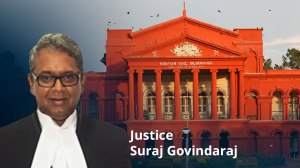
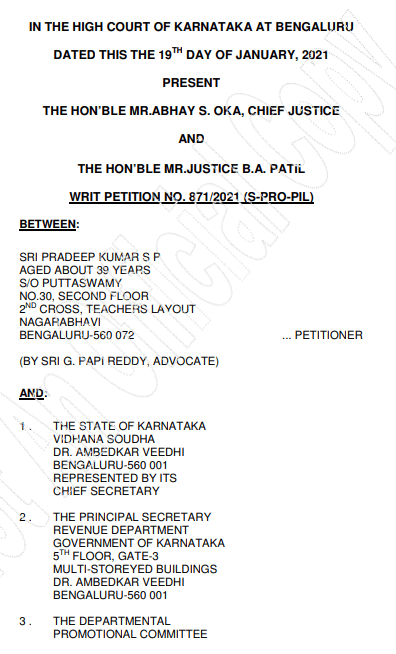
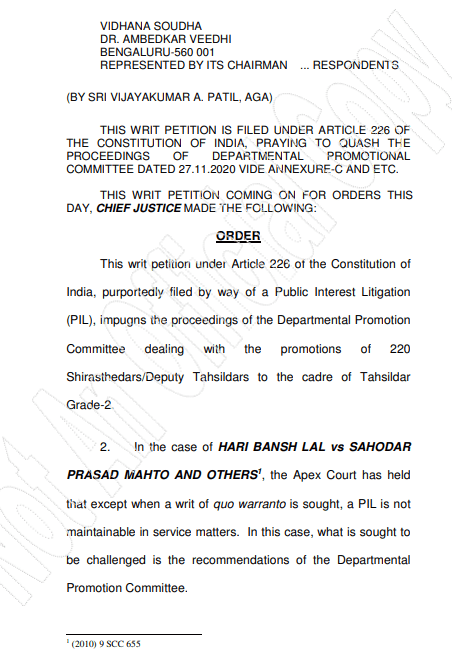
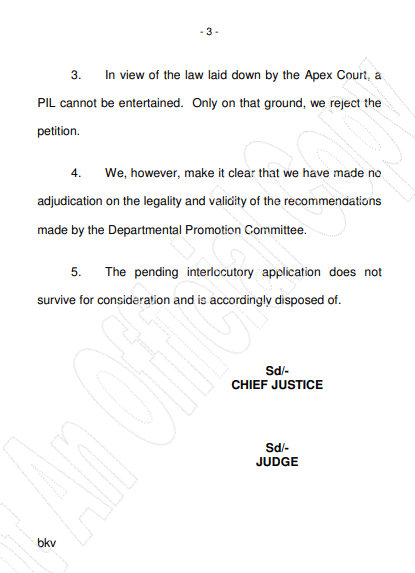
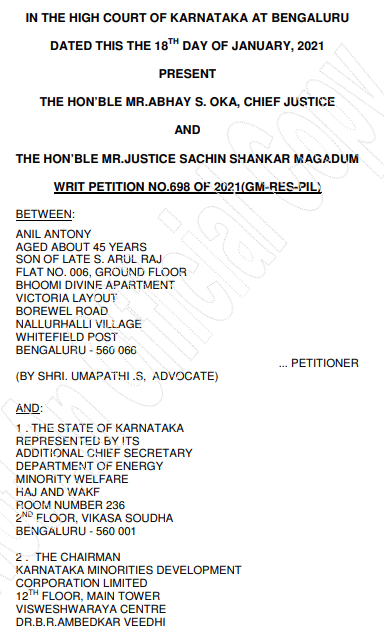
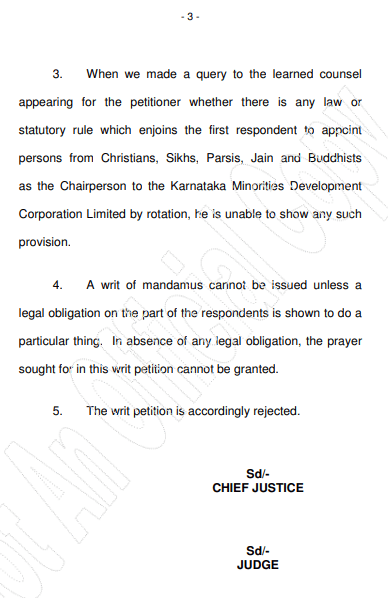
Writ seeking appointment of members from religious minorities as Chairman of Minorities Development Corporation by rotation. In the absence of a legal obligation, such a direction cannot be issued. Karnataka High Court.

Read judgment:

Service Law. Principle that person who participates in the selection process cannot challenge the procedure for selection is not absolute. Estoppel and acquiescence would not apply in case of glaring illegalities in the selection. Karnataka High Court.

Dr. Raghavendra H.K. vs The State of Karnataka and others. Writ Petition 4923/2020 decided on 16 January 2021.

Judgment Link: http://judgmenthck.kar.nic.in/judgmentsdsp/bitstream/123456789/360403/1/WP4923-20-16-01-2021.pdf

Relevant paragraphs: 17. Insofar as the contention of the respondents that the petitioner is estopped from challenging the selection process after having participated on the ground of acquiescence is concerned, the said principle is not a panacea to all the ills and illegalities committed by the Selecting Authorities. It is noticed that the Selecting Authorities time and again commit glaring illegalities in selections contrary to the statute, appoint candidates contrary to law and try to take shelter under the plea of estoppel against the candidates who challenge the act of the Selecting Authorities and consequent appointments, on a specious plea that the candidate cannot turn around and challenge the selection process or procedure stipulated for selection, after having participated in the selection process. The same plea is advanced in unison by the respondent – University and the selected candidate. The plea of the said respondents is unacceptable to me.

18. The University has made selections blatantly contrary to Rule 6 of the Special Rules which has resulted in the appointment of respondent No.7 to the post of Assistant Professor in the Department of English and denial of the entitlement of the petitioner to be considered for such appointment. The petitioner has not questioned the notification, process of selection or procedure adopted, but has questioned the selection of respondent No.7 as contrary to law. Such a challenge can be made only after the outcome of the selection process for which the candidate should partake in the said selection process. This view of mine, in this regard, is fortified by judgments of the Apex Court in the case of Raj Kumar vs shakri raj reported in (1997) 9 SCC 527.….But in his case, the Government have committed glaring illegalities in the procedure to get the candidates for examination under the 1955  Rules,  so  also  in  the  method  of selection and exercise of the power in taking out from the purview of the Board and also conduct of the selection in accordance with the Rules. Therefore, the principle of estoppel by conduct or acquiescence has no application to the facts in this case.

19. The Apex Court in the latest judgment, in the case of Dr.(Major) Meeta Sahai Vs. Union of India reported in (2019) 20 SCC 17, considering the entire case law in point has held as follows:,,,,,,However, we must differentiate from this principle insofar as the candidate by agreeing to participate in the selection process only accepts the prescribed procedure and not the illegality in it. In a situation where a candidate alleges misconstruction of statutory rules and discriminating consequences arising therefrom, the same cannot be condoned merely because a candidate has partaken in it. The constitutional scheme is sacrosanct and its violation in any manner is impermissible. In fact, a candidate may not have locus to assail the incurable illegality or derogation of the provisions of the Constitution, unless he/she participates in the selection process.

If the facts obtaining in the case at hand is considered in the light of law laid down by the Apex Court in the afore-extracted judgment, the petition cannot be shown the doors of the Court for an exit, merely because the petitioner has participated in the selection process as it is only the outcome of selection that has brought out the illegality committed by the University in selecting respondent No.7 contrary to the Special Rules.

21. Thus, in terms of the afore-extracted judgment of the Apex Court considering all the judgments on the issue of estoppel, acquiescence and waiver as in the case of Dr.(Major) Meeta Sahai (supra) held that illegality in a selection process can be found by a candidate only on its participation and not otherwise.

Writ Petition allowed.

Compiled by S. Basavaraj, Advocate, Daksha Legal.
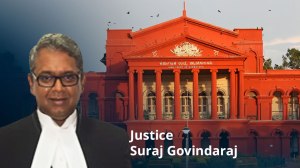
Claim to property based on adverse possession. Period starts from the time of giving up the claim based on title. Plea of title and adverse possession are mutually inconsistent. Karnataka High Court.

Noor Aftab Parveen and others vs H.N. Chandrashekar by lrs. Regular Second Appeal 864/2015 decided on 15 January 2021.

Judgment Link: http://judgmenthck.kar.nic.in/judgmentsdsp/bitstream/123456789/359967/1/RSA864-15-15-01-2021.pdf

Relevant portion page 23: The claim of adverse possession requires fulfillment of the three criteria concurrently which are:- (a) nec vi – adverse in continuity (b) nec clam – adverse in publicity (c) nec precario – adverse to a competitor in denial of title and to his knowledge.

The claim of adverse possession cannot run concurrently with acceptance of title. The judgment of Apex Court in the case of Karnataka Board of Wakf v. Government of India and Others (2004) 10 SCC 779 as regards this aspect further sheds light and the following extract need be noticed.

“12. A plaintiff filing a title suit should be very clear about the origin of title over the property. He must specifically plead it. (See S.M.Karim v. Bibi Sakina [AIR 1964 SC 1254].) In P. Periasami v. P. Periathambi [(1995) 6 SCC 523] this Court ruled that: (SCC p.527, para 5) “Whenever the plea of adverse possession is projected, inherent in the plea is that someone else was the owner of the property.” The pleas on title and adverse possession are mutually inconsistent and the latter does not  begin to operate until the former is renounced.

Another aspect that needs to be noticed is that mere possession without the requisite animus would not turn possession into possession which is adverse. In fact, as regards to the construing of “intention to dispossess” in the case of Powell  v.  McFarlane  and  Another 1979 (38) P. & C.R. 452, it was observed as follows:-

“(2) If the law is to attribute possession of land to a person who can establish no paper title to possession, he must be shown to have both factual possession and the requisite intention to possess (“animus possidendi”)

“…..If his acts are open to more than one interpretation and he has not made it perfectly plain to the world at large by his actions or words that he has intended to exclude the owner as best he can, the courts will treat him as not having had the requisite animus possidendi and consequently as not having dispossessed the owner.”

The right of the plaintiff to sue for possession would remain till the defendant acquires positive title by adverse possession so as to extinguish the plaintiff’s right, which alone would result in extinguishment of plaintiff’s right under Section 27 of the Limitation Act.

Compiled by S. Basavaraj, Advocate, Daksha Legal.

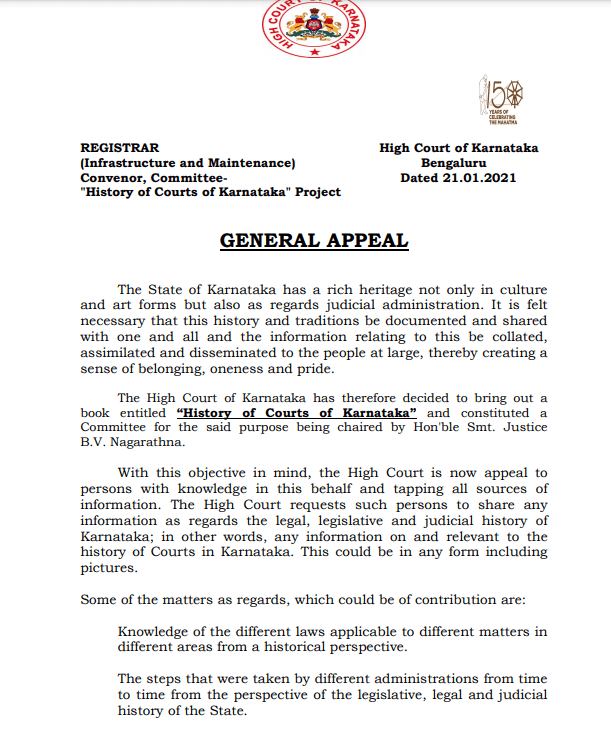
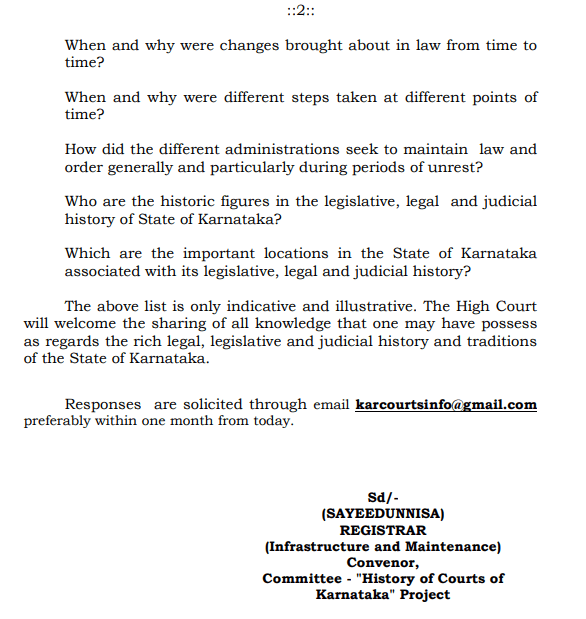
High Court of Karnataka to bring out book entitled “History of Courts of Karnataka”. Makes general appeal for information.

The High Court of Karnataka has constituted a constituted a
Committee chaired by Hon’ble Smt. Justice B.V. Nagarathna to bring out a book entitled “History of Courts of Karnataka”.

The High Court has made general appeal to persons with knowledge in this behalf and tapping all sources of information. The High Court has requested such persons to share any information as regards the legal, legislative and judicial history of Karnataka; in other words, any information on and relevant to the history of Courts in Karnataka.


Public policy. Unconditional withdrawal of public interest litigation acts as a bar to file fresh writ petition seeking same reliefs. Karnataka High Court.

India Awake for Transparency vs The Director Directorate of Enforcement and others. Writ Petition 12073/2020 decided on 21 January 2021.

Judgment Link: http://judgmenthck.kar.nic.in/judgmentsdsp/bitstream/123456789/359840/1/WP12073-20-21-01-2021.pdf

Relevant paragraphs: 3. In this writ petition, petitioner has inter alia prayed for a direction against Director of Enforcement to register a case of money laundering arising out of scheduled offences set out in Special Case No.69/2020 on the file of learned XXIII Additional City Civil and Sessions Judge, Bengaluru based on the information given by petitioner in its representation dated January 31, 2020.

4. Shri. Nagesh, learned Senior Advocate made following submissions. Petitioner has unconditionally withdrawn the PIL. Therefore, this petition is not maintainable on  the  ground of public policy.

13. In the PIL, Director of Enforcement was arrayed as respondent No.7. As recorded hereinabove, petitioner had sought for a direction against respondents No. 1 to 10 therein to constitute a multi-Disciplinary Team to investigate and prosecute Mr. Azim Premji and his associates. Prayer clause (i) in this writ petition is for a direction against  the Enforcement Directorate to register a case for offences of money laundering arising out of the scheduled offences in Special Case No.69/2020. The trial of the said case has been stayed by the Hon’ble Supreme Court of India.

16. This Court, after considering the rival contentions and the authorities in Sarguja Transport Service Vs. State Transport Appellate Tribunal, M.P.Gwalior and  others (1987)1 SCC 5 and Sheonandan Paswan Vs. State of Bihar and  others (1987)1 SCC 288 in W.P. No.13838/2020 filed by the petitioner herein, has held that the said writ petition was not maintainable on the ground of public policy.

17 & 18. The ratio in the case of Sarguja is fully applicable   to the facts of this case also. In view of the above, the preliminary objection raised by learned Senior Advocates for private  respondents that this writ petition is not maintainable on the ground of public policy is sustained. Resultantly, writ petition stands dismissed.

Compiled by S. Basavaraj, Advocate, Daksha Legal.
Criminal Procedure Code. Section 173(2). Magistrate cannot take cognizance of the final report submitted by Central Crime Branch since CCB is not a police station. Karnataka High Court.

Dr. M.G. Gopal vs State by Central Police (CCB). Criminal Revision Petition 34/2018 and connected matter decided on 18 January 2021.

Judgement Link: http://judgmenthck.kar.nic.in/judgmentsdsp/bitstream/123456789/359830/1/CRLRP34-18-18-01-2021.pdf

Held: 14. What constitutes a police station has been defined in Section 2(s) of the Code, which reads as under:- “2(2): “police station” means any post or place declared generally or specially by the State Government, to be a police station, and includes any local area specified by the State Government in this behalf.”

15. As per Section 2(o) of the Code, “officer in charge of a police station” includes, when the officer in charge of the police station is absent from the station- house or unable from illness or other cause to perform   his duties, the police officer present at the station-house who is next in rank to such officer and is above the rank  of constable or, when the State Government so directs, any other police officer so present.”

16. On going through the scheme of the Code, Section 173(2) of the Code contemplates submission of report of investigation. From plain reading of the said provision it is evident that it is the officer in-charge of a police station who is authorized to forward and submit the report in the prescribed form to the jurisdictional Magistrate to take cognizance. The words  used  in  Section 173(2) are “shall forward” which themselves give the meaning that it is the officer in-charge of the police station to file the final report. Though it is contended by the learned SPP-I that under Section 36 of the Code, the superior officer of the police station may exercise the same powers, as  could be seen from the said Section, it  is the police officers superior in rank to an officer-in- charge of the police station have been conferred  with such power as that of the officer in-charge of the police station. But in the case on hand, CCB police are not the officers superior in rank to an officer in-charge of the police station in the local jurisdiction. In that light, the contention which has been taken up by the learned SPP-I is not acceptable. It is even not much denied that the  CCB is not a police station by itself.

17. When CCB is not a police station then admittedly the final report filed by CCB which is an Investigating Agency is not in contemplation with the provisions of Section 173(2) of the Code.

18..…As per Section 2(s) of the Code the State Government has   to declare either generally or specially any post or place  to be a police station, but no such declaration is forthcoming before this Court. In that light, admittedly  the investigation has been done by the CCB and it is he who had submitted the report in terms of Section 173 of the Code and in view of the discussion made by  me above, he cannot be considered to be an officer-in- charge. In that light, the trial Court ought not to have taken cognizance on the report submitted by the CCB.

Compiled by S. Basavaraj, Advocate, Daksha Legal.

Land grabbing charges against H.D.Kumarasway. Karnataka High Court warns initiation of contempt proceedings against the Government officials.

On a Contempt of Court Petition (CCC 674/2020) filed by the Samaj Parivartana Samudaya, alleging inaction on the part of the Government officials to implement the earlier order of the Karnataka High Court, the Division Bench headed by the Hon’ble Chief Justice warned the Government officials that it would initiate contempt of court proceedings if the earlier order is not implemented.

The Court heard the submissions of Mr. A.R.Goutham, Advocate for S. Basavaraj, Advocate, Daksha Legal. PDF of contempt petition below
Facts of the case. Samaj Parivarthan Samudaya – SPS had filed a Public Interest Litigation in Writ Petition 49/2020 seeking directions to the Government of Karnataka to take appropriate action against H.D. Kumaraswamy, D.C. Thammanna and Savithramma for violating various provisions of law dealing with agrarian reforms in the State of Karnataka and also for illegally grabbing lands. SPS also sought a direction to the State Government to implement the order of the Lokayukta in this regard. Hon’ble Court disposed the Writ Petition on 14:1:2020 recording the undertaking of the State Government that it would take action within three months.

The Karnataka Lokayukta’s order dated 5:8:2014 related to major land grabbing involving around 200 Acres of land (including 110 Acres of Gomala Land) by H.D. Kumaraswamy, the former Chief Minister of Karnataka, his close relatives and associates D.C. Thammanna, the former Minister for transportation and his sister- in law Savithramma.

In the relevant portion of the Lokayukta Order, it has been mentioned that Survey No. 7,8,9,10,16 and 17 in Kethaganahalli Village of Bidadi Hobli in Ramanagara Taluk comprising of village common lands in total measuring 110 acres and 32 guntas of Government Pasture Lands (Gomala Land) which the Karnataka State Government had earmarked for public usage such as Lake, Burial Ground and to persons belonging to Scheduled Tribe (ST), and Scheduled Caste (SC), for irrigation purpose has been encroached by various persons.

The encroachment of the granted lands by H.D. Kumaraswamy, D.C. Thammanna and Savitramma is reflected in the letter of the Assistant Commissioner, Ramanagara dated 25:8:2014 under the subject “Ex-Chief Minister Shri H.D. Kumaraswamy, other family members and his close relative MLA Maddur Shri D.C. Tammanna, his family members have grabbed 200 Acres of land including 110 Acres of Gomal lands that needs to be restored to Govt.”. The Assistant Commissioner enclosed a detailed 10 page report entitled the same as the subject of the said letter.

The order of the Hon’ble High Court having not been implemented, SPS approached the Court on the contempt side. The Hon’ble Court expressed its displeasure today over the inaction on the part of the Government and warned that if the order is not complied with in letter and spirit, appropriate contempt of court proceedings would be initiated against the officials concerned.

The matter is adjourned to 16 February 2021.

“A member of the Bar is expected to act first as an Officer of the Court and thereafter, as the mouthpiece of his client”. Karnataka High Court censures lawyer for filing contemptuous petition.

V. Gururaj vs Sri. Sri. Vidya Sreesha Theertharu. Writ Petition 44/2021 decided on 12 January 2021.

Judgment Link: http://judgmenthck.kar.nic.in/judgmentsdsp/bitstream/123456789/359672/1/WP44-21-12-01-2021.pdf

Note: This is a matter where, at the instance and on the advice of client, Advocate filed a Writ Petition before the Division Bench of the Karnataka High Court praying that his matter which is pending before the learned single judge of the High Court be heard by the bench of the Chief Justice or any other court which is constituted by the judge hailing from a different State other than Karnataka. The Hon’ble division bench found the conduct of the petitioner highly contemptuous and dismissed the same with exemplary cost of Rs. 1,00,000/-. On the conduct of the counsel, the Hon’ble Court said as follows:

14. Before we part with this order, we must say something about the role of the members of the Bar. It is well settled that a member of the Bar is expected to act first as an Officer of the Court and thereafter, as the mouthpiece of his client. In this behalf, we cannot avoid temptation of what is observed in paragraph 7 of the decision of the  Apex Court in  the case of T.Arvindam vs T.V. Satyapal and another (1977) 4 SCC 467. Paragraph 7 of the said case reads thus:

“7. We regret the infliction of the ordeal upon the learned Judge of the High Court by a callous party. We more than regret the circumstance that the party concerned has been able to prevail upon one lawyer or the other to present to the Court a case which was disingenuous or worse. It may be a valuable contribution to the cause of justice if counsel screen wholly fraudulent and frivolous litigation refusing to be beguiled by dubious clients. And remembering that an advocate is an officer of justice he owes it to society not to collaborate in shady actions. The Bar Council of India, we hope will activate this obligation. We are constrained to make these observations and hope that the co- operation of the Bar will be readily forthcoming to the Bench for spending judicial time on worthwhile disputes and avoiding the distraction of sham litigation such as the one we are disposing of. Another moral of this unrighteous chain litigation is the gullible grant of ex parte orders tempts gamblers in litigation into easy courts. A judge who succumbs to ex parte pressure in unmerited cases helps devalue the judicial process. We must appreciate Shri Ramasesh for his young candour and correct advocacy.”

15. The Apex Court expressed displeasure about the manner in which  the party concerned  was able to prevail upon a lawyer to represent before the Court a case like this. In this case, we have before us a young member of the Bar  who should follow what is laid down by the Apex Court.  In  paragraph 7 of the aforesaid decision, when the Apex Court  said that it may be a valuable contribution to the  cause  of justice if the Advocates screen wholly fraudulent and frivolous litigations refusing to be beguiled by dubious clients. We hope and trust that the learned counsel appearing for the petitioner has learnt a lesson and he will hereafter follow what the Apex Court expects the members of the Bar to follow.

Compiled by S. Basavaraj, Advocate, Daksha Legal