Thanks to the digitalisation of Court proceedings. We had the benefit of hearing the arguments of some of the greatest lawyers of our time in the Hijab case.
The brightest arguments were from the youngest lawyers. Mr. Devadatt Kamat made powerful yet impassionate submissions throughout the proceedings. His knowledge of law and professionalism stole the show. Professor Ravivarma Kumar was, as always, at his best. Mr. Sanjay Hegde reiterated the arguments of Mr. Kamat with little poetic tinge.
The onslaught from the respondent’s side came from the Advocate General with able assistance of his team. The Arguments of the Advocate General were outstanding. Mr. Sajan Poovayya’s arguments, to say the least, coup de grâce.
The contribution of other learned lawyers was noteworthy.
The Hon’ble Judges heard eight eminent lawyers for 27 hours. Went through 210 judgements cited at the Bar and 600 pages of written arguments filed by the learned advocates. Each day, they would carry seven bags full of files for reading.
Considering the sensational issue involved, this is the second historic judgement after Ram Janmabhumi judgement delivered by the Supreme Court.
“ಉಡುಪಿಯ ಪ್ರೀ-ಯೂನಿವರ್ಸಿಟಿ ಕಾಲೇಜಿನ ಪರವಾಗಿ ಪ್ರತಿವಾದಿಯ ಪರವಾಗಿ ಸಲ್ಲಿಸಿದ ಸಲ್ಲಿಕೆಗಳು ಮತ್ತು ದಾಖಲೆಯಲ್ಲಿ ಇರಿಸಲಾದ ವಿಷಯಗಳಿಂದ, 2004 ರಿಂದ ಡ್ರೆಸ್ ಕೋಡ್ನೊಂದಿಗೆ ಎಲ್ಲವೂ ಸರಿಯಾಗಿದೆ ಎಂದು ನಾವು ಗಮನಿಸಿದ್ದೇವೆ. (ಉಡುಪಿ ಎಂಟು ಮಠಗಳು ನೆಲೆಗೊಂಡಿರುವ ಸ್ಥಳವಾಗಿದೆ) ಆಚರಿಸುವ ಹಬ್ಬಗಳಲ್ಲಿ ಮುಸ್ಲಿಮರು ಸಹ ಭಾಗವಹಿಸುತ್ತಾರೆ ಎಂದು ನಾವು ಪ್ರಭಾವಿತರಾಗಿದ್ದೇವೆ. ಶೈಕ್ಷಣಿಕ ಅವಧಿಯ ಮಧ್ಯದಲ್ಲಿ ಅದು ಹೇಗೆ ಇದ್ದಕ್ಕಿದ್ದಂತೆ ಹಿಜಾಬ್ನ ಸಮಸ್ಯೆಯನ್ನು ಹುಟ್ಟುಹಾಕುತ್ತದೆ ಮತ್ತು ಅಧಿಕಾರದಿಂದ ಪ್ರಮಾಣದಿಂದ ಹೊರಹಾಕಲ್ಪಟ್ಟಿದೆ ಎಂದು ನಾವು ದಿಗ್ಭ್ರಮೆಗೊಂಡಿದ್ದೇವೆ. ಹಿಜಾಬ್ ವಿವಾದ ತೆರೆದಿರುವ ವಿಧಾನವು ಕೆಲವು ‘ಕಾಣದ ಕೈಗಳು’ ಸಾಮಾಜಿಕ ಅಶಾಂತಿ ಮತ್ತು ಅಸಂಗತತೆ ಕೆಲಸ ಮಾಡುತ್ತಿದೆ ಎಂಬ ವಾದಕ್ಕೆ ಅವಕಾಶವನ್ನು ನೀಡುತ್ತದೆ. ಹೆಚ್ಚಿನದನ್ನು ನಿರ್ದಿಷ್ಟಪಡಿಸುವ ಅಗತ್ಯವಿಲ್ಲ. ನಡೆಯುತ್ತಿರುವ ಪೊಲೀಸ್ ತನಿಖೆಯ ಮೇಲೆ ಪರಿಣಾಮ ಬೀರಬಾರದು ಎಂಬ ಉದ್ದೇಶದಿಂದ ನಾವು ಪ್ರತಿಕ್ರಿಯಿಸುವುದಿಲ್ಲ. ಮುಚ್ಚಿದ ಕವರ್ನಲ್ಲಿ ನಮಗೆ ಒದಗಿಸಲಾದ ಪೊಲೀಸ್ ಪೇಪರ್ಗಳ ಪ್ರತಿಗಳನ್ನು ನಾವು ಪರಿಶೀಲಿಸಿದ್ದೇವೆ ಮತ್ತು ಹಿಂತಿರುಗಿಸಿದ್ದೇವೆ. ಈ ವಿಷಯದ ಬಗ್ಗೆ ತ್ವರಿತ ಮತ್ತು ಪರಿಣಾಮಕಾರಿ ತನಿಖೆಯನ್ನು ಯಾವುದೇ ವಿಳಂಬವಿಲ್ಲದೆ ಅಪರಾಧಿಗಳನ್ನು ಕಾನೂನು ಕ್ರಮಕ್ಕೆ ತರಲಾಗುವುದನ್ನು ನಾವು ನಿರೀಕ್ಷಿಸುತ್ತೇವೆ. “
ರೇಶಮ್ ಮತ್ತು ಇನ್ನೊಬ್ಬ vs ಸ್ಟೇಟ್ ಆಫ್ ಕರ್ನಾಟಕ ಮತ್ತು ಇತರರು.
2022 ರ ರಿಟ್ ಅರ್ಜಿ 2347 ಅನ್ನು 15 ಮಾರ್ಚ್ 2022 ರಂದು ನಿರ್ಧರಿಸಲಾಗಿದೆ
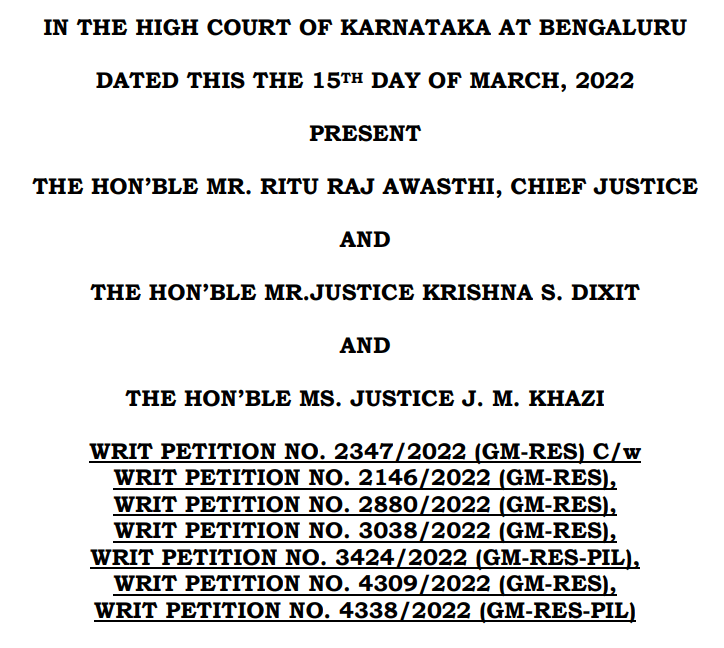
ಮುಖ್ಯ ನ್ಯಾಯಮೂರ್ತಿ ರಿತು ರಾಜ್ ಅವಸ್ತಿ, ನ್ಯಾಯಮೂರ್ತಿ ಕೃಷ್ಣ ದೀಕ್ಷಿತ್ ಮತ್ತು ನ್ಯಾಯಮೂರ್ತಿ ಜೆ.ಎಂ.ಖಾಜಿ
ರಾಷ್ಟ್ರ ಮಟ್ಟದಲ್ಲಿ ಒ0ದು ಪ್ರಭಲವಾದ ಜ್ಯಾತ್ಯಾತೀತ ಕಾನೂನು ವೇದಿಕೆ ಮಾಡಬೇಕು ಅನ್ನುವ ಆಸೆಯಿ0ದ ಶ್ರಿ. ದೇವೇಗೌಡರನ್ನು ಬೇಟಿಯಾಗಬೇಕು ಅ0ತ ಸ್ನೇಹಿತ ಎಮ್.ಎಲ್.ಸಿ ಶ್ರೀ. ಬೋಜೇಗೌಡರಿಗೆ ಕೇಳಿದ್ದೆ. ಶ್ರಿ. ದೇವೇಗೌಡರು ಕಳೆದ ವಾರ ಸ0ಜೆ 5:30ಕ್ಕೆ ಮನೆಗೆ ಬರಹೇಳಿದ್ದರು. ತಮ್ಮ ಪಕ್ಷದ ಕಚೇರಿಯಿ0ದ ಮನೆಗೆ ಸರಿಯಾಗಿ 5:20ಕ್ಕೆ ಬ0ದು ನನಗೆ ತಮ್ಮ ಕೊಠಡಿಗೆ ಬರಲು ಕೋರಿದರು. ಗೌಡರು “ಕುಮಾರಣ್ಣ ನಿಮ್ಮ ಬಗ್ಗೆ ಬಹಳ ಹೇಳಿದ್ದಾರೆ“ ಅ0ದಾಗ ನನಗೆ ಆಶ್ಚರ್ಯ. ನನ್ನ ಬಗ್ಗೆ ಆಗಲೇ ತಿಳಿದುಕೊ0ಡಿದ್ದಾರೆ ಮತ್ತು ನನ್ನ ಬಗ್ಗೆ ಒಳ್ಳೆಯದನ್ನು ಕೇಳಿದ್ದಾರೆ ಎ0ದು.
ಮು0ದಿನ 45 ನಿಮಿಷದವರೆಗೆ ಯಾವುದೋ ಹಳೆಯ ಪರಿಚಯದವರ0ತೆ ಬಹಳೆ ಮಾತನಾಡಿದರು. ನನ್ನ ಬಗ್ಗೆ ವಿಚಾರಿಸಿದರು. ಕೆಲ ತಿ0ಗಳ ಹಿ0ದೆ ಗೌಡರು ನನ್ನ ಹಳ್ಳಿಗೆ ಬೇಟಿ ನೀಡಿ ನನ್ನ ಚಿಕ್ಕಪ್ಪ ಹಾಗೂ ಜೆ.ಡಿ.ಎಸ್ ಮುಖ0ಡ ಶ್ರಿ. ರೇಣುಕಾರ್ಯರ ಮನೆಗೆ ಹೋಗಿದ್ದನ್ನು ನೆನಪಿಸಿದೆ.
ಶ್ರಿ. ದೇವೇಗೌಡರ ಅತ್ಯ0ತ ವಿಶಿಷ್ಟ ಗುಣವನ್ನು ಅ0ದು ಗಮನಿಸಿದೆ. ವಿದ್ಯಾವ0ತರಿಗೆ, ತಿಳಿದುಕೊ0ಡವರಿಗೆ ಅವರು ಕೊಡುವ ಮರ್ಯಾದೆ. ನಾನು ಅವರ ಜೊತೆ ಇದ್ದ ಸಮಯದಲ್ಲಿ ಅವರು ತೋರಿದ ಗೌರವಪೂರ್ವ ಭಾವನೆ ಶ್ಲಾಘನೀಯ.
ನಾನು ಹೊರಟಾಗ ನಾನು ದಯವಿಟ್ಟು ಕುಳಿತೇ ಇರಿ ಎ0ದರು ಕೋರಿದರೂ ಎದ್ದು ನಿ0ತು ವಿದಾಯ ಹೇಳಿದರು.
ಈಗಿನ ಪರಿಸ್ತಿತಿಯಲ್ಲಿ ಎಲ್ಲ ರಾಜಕೀಯ ಪಕ್ಷಗಳೂ ತೀವ್ರವಾದವನ್ನು ಮ0ಡಿಸುತ್ತಿದ್ದಾರೆ. ಒ0ದು ಪ್ರಭಲ ಹಾಗೂ ಜಾತ್ಯಾತೀತ ಕಾನೂನು ವೇದಿಕೆ ಬೇಕಾಗಿದೆ. ಅತ್ಯ0ತ ಗ0ಬೀರವಾದ ವಿಷಯಗಳಲ್ಲಿ ಸ0ವಿದಾನದ ಹಿನ್ನೆಲೆಯಿ0ದ ಇ0ದು ಯಾವ ಪಕ್ಷದ ಕಾನೂನು ವೇದಿಕೆಗಳೂ ಮಾತನಾಡುತ್ತಿಲ್ಲ. ಆದ್ದರಿ0ದ ನನ್ನ ಪ್ರಯತ್ನ ರಾಷ್ಟ್ರ ಮಟ್ಟದಲ್ಲಿ ಒ0ದು ಒಳ್ಳೆಯ ಕಾನೂನು ವೇದಿಕೆ ನಿರ್ಮಿಸುವುದು.
ನನ್ನ ಪ್ರಯತ್ನ ಕೈಗೂಡುತ್ತದೆಯೋ ಇಲ್ಲವೋ ಗೊತ್ತಿಲ್ಲ. ಆದರೆ ಮಾಜಿ ಪ್ರದಾನಿ ಶ್ರಿ. ದೇವೇಗೌಡರು ಒಬ್ಬ ಸಾದಾರಣ ವಕೀಲನಿಗೆ ಈ ರೀತಿ ಗೌರವದಿ0ದ ನಡೆಸಿಕೊ0ಡಿದ್ದು ಮರೆಯಲಾರದ ಅನುಭವ.
ಎಸ್. ಬಸವರಾಜ್, ಹಿರಿಯ ವಕೀಲ ಹಾಗೂ ಅಧ್ಯಕ್ಷ, ಕರ್ನಾಟಕ ರಾಜ್ಯ ವಕೀಲರ ಪರಿಷತ್ ಕಾನೂನು ಅಕೇಡೆಮಿ.
NKGSB Cooperative Bank Limited vs Subir Chakravarty and others. Civil Appeal ../2022 in S.L.P. 30240 of 2019 decided on 25 February 2022 Justice A.M. Khanwilkar and Justice C.T. Ravikumar
39. It is well established that an advocate is a guardian of constitutional morality and justice equally with the Judge. He has an important duty as that of a Judge. He bears responsibility towards the society and is expected to act with utmost sincerity and commitment to the cause of justice. He has a duty to the court first. As an officer of the court, he owes allegiance to a higher cause and cannot indulge in consciously misstating the facts or for that matter conceal any material fact within his knowledge. In the case of harma & Ors. vs. High Court of Punjab & Haryana AIR 1957 SC 250 the Court noted that in all professional functions, an advocate should be diligent and his conduct should conform to the requirements of the law by which he plays a vital role in the preservation of society and justice system. As an officer of the court, he is under a higher obligation to uphold the rule of law and justice system.
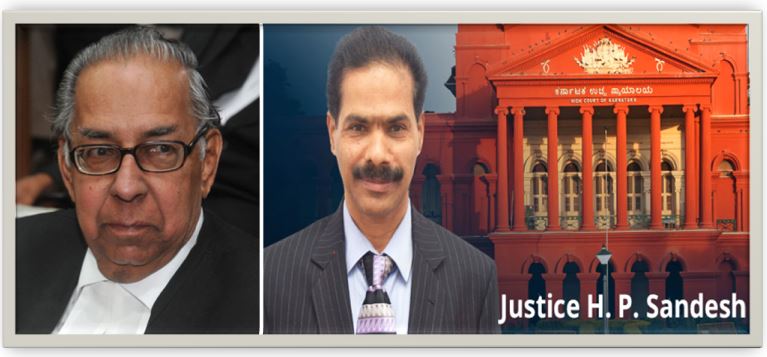
In a recent order pronounced by Justice H.P. Sandesh of the High Court of Karnataka, the learned Judge has recommended that the Additional Sessions Judge who has granted bail / anticipatory bail in the case should be sent to the Karnataka State Judicial Academy for training. This is a serious adverse comment or rebuke of the Judge concerned.
This direction has the effect of demoralising the Sessions Judges of the State who are dealing with applications under Section 438 and 439 of the Cr.P.C. and prompting them to dismiss most of the applications so that they will not suffer adverse comments from the High Court. Already there is a view (as recently expressed by the High Court of Calcutta) that the judges of the District Judiciary are stingy in the matter of grant of bail. It is not surprising that statistics show that 69% of inmates of the jails in India are under trials. Now with this above order, the position is worse for applicants for bail or anticipatory bail before session judges /Magistrate and in border line cases, applications are sure to be dismissed.
Judges are after all human beings and have therefore their own views, prejudices and opinions. Admittedly grant or refusal of bail is discretionary, of course to be exercised judicially. On same set of facts two Judges may render conflicting decisions, more so in the case of discretionary matters. It is a well known fact that there are judges who are considered pro conviction or pro acquittal, pro labour or pro management, pro landlord or pro tenant , pro establishment or pro citizen , conservative or progressive thinking and so on. The Judges dealing with bail applications are no exception. Some are liberal in the matter of grant of bail, some are very strict. In the recent case of Arnab Goswami, while the District Judiciary and High Court declined to grant bail, the Supreme Court quickly took a contrary view and granted bail, which some commented, was a hasty decision. In such matters personal view point and opinion of the judges do play an important role and one cannot expect all judges to act similarly, as computers do.
The learned judge has stated that the Sessions Judge should go to the Judicial Academy for training in “Applying Judicial thought process” and “endeavour to learn judicial discretion”. I do not think, exercise of Judicial discretion could be a subject of training. There are hundreds of cases, where Supreme Court has reversed the discretionary orders of the High Courts holding that the judicial discretion has been exercised capriciously and the decision is perverse. High Courts reverse several discretionary orders of grant or refusal of temporary injunctions in pending suits, which could be done only if the order under appeal is perverse, capricious or arbitrary.
Therefore the Court reversing a discretionary order directing the judge whose order is reversed to undergo training in Judicial academy may not be a good precedent. Such a direction may encourage Sessions Judges/Magistrate to reject bail applications even in deserving cases to be on the safer side.
In the case on hand, the High Court may or may not be right in reversing the order, as we do not know the full facts. However the Sessions Judge cannot be faulted, for observing that the case is not punishable with death or imprisonment for life. Section 437 Cr.P.C. itself has placed such cases in a different category.
The High Court Judgment at one place records that charge sheet has been filed in the case. It is also a relevant consideration. However in another part of this judgment, the High Court finds fault with the Sessions Judge for granting bail even before investigation is completed. The charge includes Section 498A IPC and demand of dowry. Misuse of these provisions have been the subject matter of adverse comments in many judgments of the Supreme Court and lower courts have been directed to exercise caution in such cases. In a decision rendered few days back a bench of Supreme Court (Comprising of Justices S. Abdul Nazeer and Krishna Murari ) while quashing a FIR against the in laws of the woman who had accused them and her husband of cruelty and harassment for dowry noticed “ increased tendency to employ provisions like section 498A IPC ….. as instruments to settle personal scores against husband and his relatives.” After refereeing to some earlier cases they said “ Decisions clearly demonstrate that this court has at numerous instances express concern over the misuse of section 498A IPC and the increased tendency of implicating relatives of the husbands in matrimonial disputes……….False implications by way of general omnibus allegations made in the course of matrimonial disputes, if left unchecked would result in misuse of the process of law. Therefore this court by way of its Judgements has warned the courts from proceeding against relatives and in laws of the husband (woman), when no prima facie case is made out against them”
As seen from the judgment of the High Court, main evidence relied on is a voice message said to have been sent by the victim before her death stating that if anything happens to her, the named accused (her husband and parents) will be responsible for the same. Such declarations are found in many death notes in cases of suicide and the Supreme Court and the High Courts have directed caution in relying on such declarations which have become common. In many cases, employees committing suicide have named many executives of the companies as responsible for suicide and such declarations have been found to be not true. In the present case, strangely the voice message said to have been sent is not to the parents or relatives but to their neighbors.The message is not of any past act of cruelty or harassment for dowry.
At best, it can be said that prosecution has made out a prima facie case. It is settled law that mere making out prima facie case is not sufficient to deny bail, particularly in cases where punishment is not death or imprisonment for life .In the case of Bhagiratsinh Judeja Vs State of Gujarath (AIR 1984 S.C.372 ) the Supreme Court has observed “ We fail to understand what the learned Judge of the High Court desires to convey when he says that once a prima facie case is established, it is necessary for the court to examine the nature and gravity of circumstances in which the offence was committed. If there is prima facie case,there is no question of considering other circumstances. But even where a prima facie case is established , the approach of the court in the matter of bail is not that the accused should be detained by a way of punishment but whether the presence of the accused would be readily available for trial or that he is likely to abuse the discretion granted in his favour by tampering with evidence”.
In the Case on hand, it is not even alleged or found by the High Court that accused is likely to abscond or evidence may be tampered with as important witnesses are complainant and his relatives. It is unnecessary to go into details, as my only purpose is to point out that on facts opinions always differ.
One can appreciate the sympathy and the concern shown by the learned Judge of the High Court towards the victim . However that should not result in detention of the accused at pretrial stage as a measure of punishment.
It appears, the main reasons which prompted the learned High Court Judge to deny the bail, is that dowry death case is a heinous offence and hence the order of the Sessions Judge granting bail is capricious and perverse and therefore unsustainable. It cannot be laid down as proposition of law, that in heinous offenses (including dowry death or murder) bail cannot be granted. It is hoped that soon in appropriate cases, the High Court it self will clarify this position, as other wise the present decision may act as a dangerous precedent. So far as the recommendation regarding training in Judicial Academy is concerned, I hope the Hon’ble Chief Justice will pass suitable order taking all aspects into consideration.
Mr. Sajan Poovayya, Senior Advocate who appeared for the President and Vice President of collage development and management committee today, completely annihilated the arguments of the petitioners. His fundamental submission was that his school is committed to impart Secular education and it cannot allow the students to wear whatever they want depending on their religion. If allowed, the same would destroy the cohabitation expected in educational institution. Mr. Sajan Poovayya arguments are here;
Mr. Poovayya quoted from the judgment rendered by the Hon’ble Supreme Court of India in SR Bommai v. Union of India, (1994) 3 SCC 1 which shed considerable light on the understanding of “secularism” in the constitutional sense.
It is also apposite to refer to Article 39(f) – “that children are given opportunities and facilities to develop in a healthy manner and in conditions of freedom and dignity …” placed in Part IV – Directive Principles of State Policy of the Constitution of India. The intersection of Directive Principles of State Policy and nation building has been referred to time and time again, including in Mohd. Ahmed Khan v. Shah Bano Begum, (1985) 2 SCC 556.
Article 39(f) was introduced by the Forty-Second Amendment, i.e., the very amendment which expressly introduced the word “Secular” into the Preamble.
In imparting secular education, the ideals that the State should seek to instil amongst children, are informed by inter alia the following provisions of the Constitution: a. Core constitutional principles which have been held to be not only a part of part III but also a part of the basic structure such as ‘secularism’; b. Children should turn out to be students not just capable of but also inclined to perform fundamental duties (Article 51A) such as: i. Uphold the unity and integrity of India (Article 51A(c)); ii. To promote spirit of harmony and the spirit of common brotherhood amongst all the people of India transcending religious, linguistic and regional or sectional diversities; to renounce practices derogatory to the dignity of women (Article 51A(e)); iii. To develop scientific temper, humanism and the spirit of inquiry and reform (Article 51A(h)); iv. To strive towards excellence in all spheres of individual and collective activity do that the nation constantly rises to higher levels of endeavour and achievement (Article 51A(j)). c. Likewise, the Karnataka Education Act, 1983 enlists inter alia the endeavour to cultivate a scientific and secular outlook through education.
Whilst homes and society provide religious and cultural upbringing, the constitutional endeavour of school is to promote common brotherhood by transcending inter alia religious diversities. This objective will fail if religious attire is permitted in schools imparting secular education.
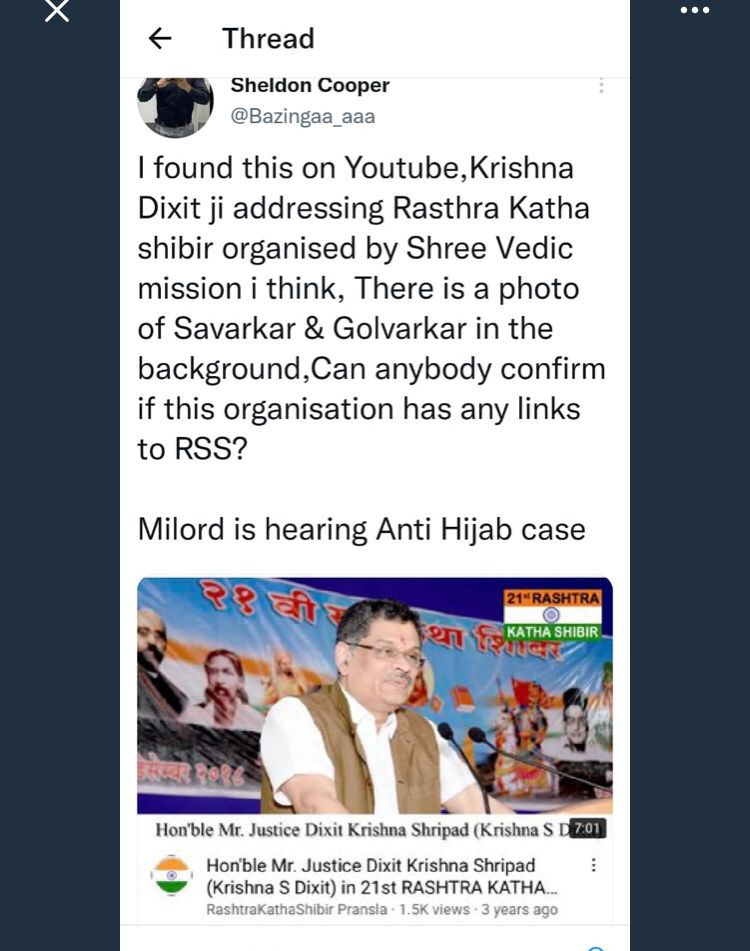
Many disturbing posts and messages are circulated by a group called “Mangalore Muslims” making false, motivated and highly derogatory comments on Justice Krishna Dixit. See below;
The comments insinuate Justice Krishna Dixit participating in a function having RSS links. These comments are made by few fanatics without even knowing what is “Rashtra Katha Shibir”. I personally verified from the organisers and their website and the reality is far from what is projected by the fanatics.
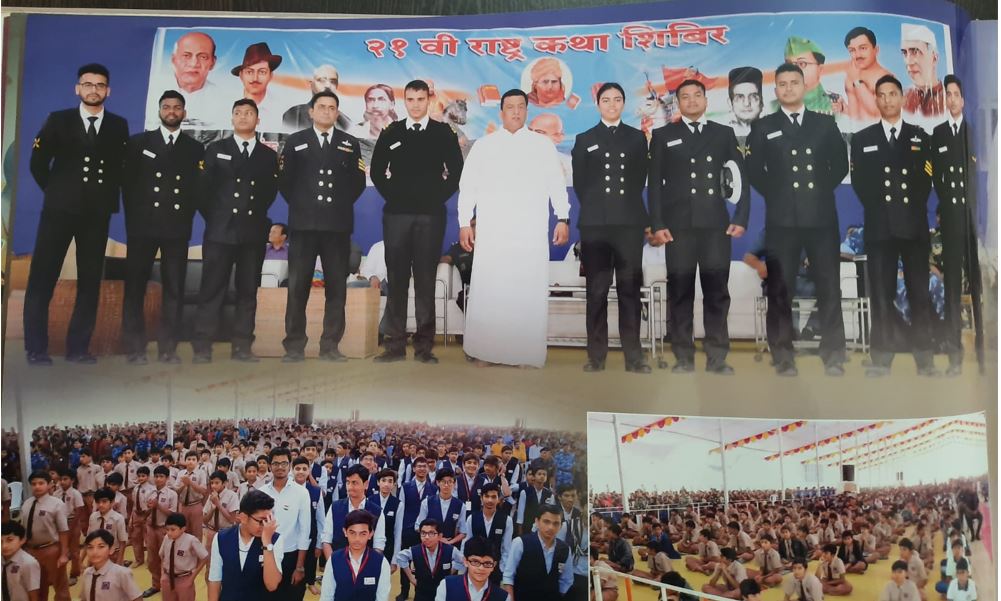
“Rashtra Katha Shibir” has nothing to do with RSS. The founder of Shri Vedic Mission Trust Swami Dharmbandhu organizes Rashtrakatha Shivir every year in the month of December at Pransla in the district of Rajkot, Gujarat. Since 2002, he has facilitated this platform whereby the youth and specially the students from different corners of the country assemble. Shri Vedic Mission Trust has been organizing ten days youth camp at Pransala for the past 21 years under the Rashtra Katha Shivir series. This year 22 Rashtra Katha Shivir has organised by Swami Dharambandhu at Pransala was held from 28 Dec 2019 to 05 Jan 2020. More than 12000 students from 27 States and Union Territories participated in this Shibir. Besides, enlightening students on the pristine cultural values, Swami also conducts regular shivbirs for teachers training across the nation. There will be intensive training program in different departments from Morning 5am to 10pm. Shri Vedic Mission Trust has been organizing ten days youth camp at Pransala for the past 21 years under the Rashtra Katha Shivir series.
Former Prime Minister Dr. Manmohan Singh, Governor of Tamilnadu B. L Purohit, Meghalaya Governor Tathagata Roy will be Chief Guest of 22 Rashtra Katha Shibir. The camp aims to provide a platform for orientation and nurturing of youth in various disciplines such as National Integration, Social Harmony and Religious harmony and Martial Arts, to mention a few.
Justice M.N.Venkatachalaiah, Justice Santosh Hegde, Justice Dinesh Maheshwari, Mr. Shashi Tharoor and several such greats too have graced function. Justice Krishna Dixit attended one such function to give speech. See the video links below.
Those who are slinging mud at the judiciary are those who are willing to send their own women folk to the dark ages. The oblique agenda is to somehow get Justice Krishna Dixit recused from the case. Judiciary has witnessed such dirty tactics in the past. Over the decades such attempts have only made our judiciary one of the strongest institution in the world.
ಎರಡು ದಿನ ನಿರ0ತರ ವಾದದಲ್ಲಿ ಅತ್ಯ0ತ ಚಾಕಚಕ್ಯತೆ, ಕಾನೂ ಪರಿಣತಿ ಹಾಗೂ ವಕೀಲವೃತ್ತಿಯ ಮೇರು ಗುಣಗಳ ಮೂಲಕ ಕರ್ನಾಟಕದ ಅಡ್ವೋಕೇಟ್ ಜನರಲ್ ಶ್ರೀ. ಪ್ರಭುಲಿ0ಗ ನಾವದಗಿ ಇದುವರೆಗೂ ಹಿಜಾಬ್ ಪರ ಮ0ಡಿಸಿದ್ದ ವಾದಗಳನ್ನು ಬುಡಮೇಲು ಮಾಡಿದರು.
ಯಾವ ಆಚರಣೆ ಮಾಡದಿದ್ದರೆ ಒ0ದು ಧರ್ಮವೇ ಅವನತಿ ಹೊ0ದುತ್ತದೆಯೊ ಅ0ತಹ ಆಚರಣೆಗಳನ್ನು ಮಾತ್ರ “ಅಗತ್ಯ ಧಾರ್ಮಿಕ ಆಚರಣೆ“ ಎ0ದು ಕರೆಯಬಹುದು ಎ0ದು ತಮ್ಮ ವಾದವನ್ನು ಅತ್ಯ0ತ ಮಾರ್ಮಿಕವಾಗಿ ಪ್ರಭುಲಿ0ಗ ನಾವದಗಿ ಮ0ಡಿಸಿದರು.
ಹಿಜಾಬ್ ಹಾಕಲಿಕ್ಕೆ ಈ ದೇಶದಲ್ಲಿ ಯಾವ ಅಡಚಣೆಯೂ ಇಲ್ಲ. ಆದರೆ ಶಿಕ್ಷಣ ಸ0ಸ್ದೆಗಳಲ್ಲಿ ಸಮವಸ್ತ್ರ ಧರಿಸುವುದು ಈ ದೇಶದ ಸ0ವಿದಾನದ ಮೌಲ್ಯಗಳನ್ನು ಎತ್ತಿಹಿಡಿದ0ತೆ. ಆದ್ದರಿ0ದ ಶಿಕ್ಷಣ ಸ0ಸ್ದೆಗಳಲ್ಲಿ ಹಿಜಾಬ್ ಗೆ ಅವಕಾಶ ಇಲ್ಲ ಎ0ದು ನಾವದಗಿ ವಾದಿಸಿದರು. ಅವರ ವಾದಗಳು ಈ ರೀತಿ ಇವೆ.
ಹಿಜಾಬ್ ಖಡ್ಡಾಯವಾಗಿ ಧರಿಸುವುದು ಅಗತ್ಯ ಧಾರ್ಮಿಕ ಆಚರಣೆ ಎ0ಬುವುದನ್ನುಒಪ್ಪುವುದಾದರೆ ಹಿಜಾಬ್ ದರಿಸಲು ಮನಸ್ಸಿಲ್ಲದ ಹೆಣ್ಣುಮಕ್ಕಳ ಹಕ್ಕುಗಳಿಗೆ ಒಡೆತ ಕೊಟ್ಟ0ತೆ. ಸ0ವಿದಾನದಲ್ಲಿ 19(1)(ಅ) ಪರಿಚ್ಛೇದ ಮೂಲಭೂತ ಹಕ್ಕುಗಳ ಪ್ರಕಾರ ಹಿಜಾಬ್ ಧರಿಸುವುದನ್ನು ಒಪ್ಪಬಹುದಾದರೂ, ಕೆಲವೊ0ದು ಸ್ಥಳಗಳಲ್ಲಿ ಈ ದಿರಿಸನ್ನು ನಿಷೇದಿಸುವ ಅಧಿಕಾರವನ್ನು ಸರ್ಕಾರ ಸ0ವಿದಾನದ 19(1)(2) ಪರಿಚ್ಛೇದ ಪ್ರಕಾರ ಹೊ0ದಿದೆ.
ಸಂವಿಧಾನದ ಪರಿಚ್ಛೇದ 25 ಮತ್ತು 26 ರ ಅಡಿಯಲ್ಲಿ ಖಾತರಿಪಡಿಸಲಾದ ರಕ್ಷಣೆಯು ಸಿದ್ಧಾಂತ ಅಥವಾ ನಂಬಿಕೆಯ ವಿಷಯಗಳಿಗೆ ಸೀಮಿತವಾಗಿಲ್ಲ ಆದರೆ ಧರ್ಮದ ಅನುಸಾರವಾಗಿ ಮಾಡಿದ ಕಾರ್ಯಗಳಿಗೆ ವಿಸ್ತರಿಸುತ್ತದೆ. ಆದ್ದರಿಂದ ಆಚರಣೆಗಳು, ಸಮಾರಂಭಗಳು ಮತ್ತು ಪೂಜಾ ವಿಧಾನಗಳಿಗೆ ಖಾತರಿ ನೀಡುತ್ತದೆ. ಧರ್ಮದ ಅವಿಭಾಜ್ಯ ಅಂಗ. ಧರ್ಮದ ಅವಿಭಾಜ್ಯ ಅಥವಾ ಅಗತ್ಯ ಭಾಗ ಯಾವುದು ಎಂಬುದನ್ನು ಅದರ ಸಿದ್ಧಾಂತಗಳು, ಆಚರಣೆಗಳು, ತತ್ವಗಳು, ನೀಡಿದ ಧರ್ಮದ ಐತಿಹಾಸಿಕ ಹಿನ್ನೆಲೆ ಇತ್ಯಾದಿಗಳನ್ನು ಉಲ್ಲೇಖಿಸಿ ನಿರ್ಧರಿಸಬೇಕು. “ಧರ್ಮದ ಅತ್ಯಗತ್ಯ ಭಾಗ ಅಥವಾ ಆಚರಣೆಗಳು” ಎಂಬುದರ ಅರ್ಥವು ಈಗ ಸ್ಪಷ್ಟೀಕರಣದ ವಿಷಯವಾಗಿದೆ. ಧರ್ಮದ ಅಗತ್ಯ ಭಾಗವೆಂದರೆ ಧರ್ಮವನ್ನು ಸ್ಥಾಪಿಸಿದ ಪ್ರಮುಖ ನಂಬಿಕೆಗಳು. ಅಗತ್ಯ ಆಚರಣೆ ಎಂದರೆ ಧಾರ್ಮಿಕ ನಂಬಿಕೆಯನ್ನು ಅನುಸರಿಸಲು ಮೂಲಭೂತವಾದ ಆಚರಣೆಗಳು. ಅಗತ್ಯ ಭಾಗಗಳು ಅಥವಾ ಆಚರಣೆಗಳ ಮೂಲಾಧಾರದ ಮೇಲೆ ಧರ್ಮದ ಮೇಲ್ವಿಚಾರವನ್ನು ನಿರ್ಮಿಸಲಾಗಿದೆ, ಅದು ಇಲ್ಲದೆ ಧರ್ಮವು ಯಾವುದೇ ಧರ್ಮವಾಗುವುದಿಲ್ಲ. ಒಂದು ಧರ್ಮಕ್ಕೆ ಒಂದು ಭಾಗ ಅಥವಾ ಆಚರಣೆ ಅತ್ಯಗತ್ಯವೇ ಎಂಬುದನ್ನು ನಿರ್ಧರಿಸಲು ಪರೀಕ್ಷೆಯು ಆ ಭಾಗ ಅಥವಾ ಆಚರಣೆಯಿಲ್ಲದೆ ಧರ್ಮದ ಸ್ವರೂಪವು ಬದಲಾಗುತ್ತದೆಯೇ ಎಂದು ಕಂಡುಹಿಡಿಯುವುದು. ಆ ಭಾಗ ಅಥವಾ ಆಚರಣೆಯನ್ನು ತೆಗೆದುಹಾಕುವುದರಿಂದ ಆ ಧರ್ಮದ ಗುಣಲಕ್ಷಣ ಅಥವಾ ಅದರ ನಂಬಿಕೆಯಲ್ಲಿ ಮೂಲಭೂತ ಬದಲಾವಣೆಗೆ ಕಾರಣವಾದರೆ, ಅಂತಹ ಭಾಗವನ್ನು ಅತ್ಯಗತ್ಯ ಅಥವಾ ಅವಿಭಾಜ್ಯ ಅಂಗವೆಂದು ಪರಿಗಣಿಸಬಹುದು.
ಧರ್ಮದ ಅರ್ಥ – ಆರ್ಟಿಕಲ್ 25 ರಲ್ಲಿ ಬಳಸಲಾದ ಪದ ಮತ್ತು ಆರ್ಟಿಕಲ್ 25 ರ ಮೂಲಕ ನೀಡಲಾದ ರಕ್ಷಣೆಯ ಸ್ವರೂಪವು ಎಂ. ಇಸ್ಮಾಯಿಲ್ ಫಾರುಕಿ (ಡಾ) ವಿರುದ್ಧ ಯೂನಿಯನ್ ಆಫ್ ಇಂಡಿಯಾ ಯಲ್ಲಿನ ಸಂವಿಧಾನದ ಪೀಠದ ನಿರ್ಧಾರದ ಘೋಷಣೆಯಿಂದ ಇತ್ಯರ್ಥಗೊಳ್ಳುತ್ತದೆ. ಆರ್ಟಿಕಲ್ 25 ಕೇವಲ ಧರ್ಮದ ಅವಿಭಾಜ್ಯ ಅಂಗಗಳಾದ ಆಚರಣೆಗಳು ಮತ್ತು ಆಚರಣೆಗಳನ್ನು ಆಚರಿಸುವ ಸ್ವಾತಂತ್ರ್ಯವನ್ನು ರಕ್ಷಿಸುತ್ತದೆ. ಆದ್ದರಿಂದ, ಭಾರತದ ಸಂವಿಧಾನದ 25 ನೇ ವಿಧಿಯು ಈ ಪ್ರಕರಣದಲ್ಲಿ ಯಾವುದೇ ಅನ್ವಯವನ್ನು ಹೊಂದಿರುವುದಿಲ್ಲ.
ಧರ್ಮಕ್ಕೆ ಅನ್ಯವಾದ, ಅನಗತ್ಯವಾದ ಸಂಚಯವಾಗಿರುವ ಮೂಢ ನಂಬಿಕೆಗಳನ್ನು ಧರ್ಮದ ಅಗತ್ಯ ಭಾಗಗಳೆಂದು ಪರಿಗಣಿಸಲಾಗುವುದಿಲ್ಲ. ಧಾರ್ಮಿಕ ನಂಬಿಕೆ ಮತ್ತು/ಅಥವಾ ನಂಬಿಕೆಗೆ ಅತ್ಯಗತ್ಯವಾಗಿರುವ ವಿಷಯಗಳು ನ್ಯಾಯಾಲಯದ ಮುಂದೆ ಸಾಕ್ಷ್ಯಾಧಾರದ ಮೇಲೆ ನಿರ್ಣಯಿಸಲ್ಪಡುತ್ತವೆ, ಅಂತಹ ನಂಬಿಕೆಯ ಅಗತ್ಯತೆಯ ಬಗ್ಗೆ ಧರ್ಮವನ್ನು ಪ್ರತಿಪಾದಿಸುವ ಸಮುದಾಯವು ಏನು ಹೇಳುತ್ತದೆ. ಒಂದು ಪರೀಕ್ಷೆಯೆಂದರೆ ಧರ್ಮದಿಂದ ಅಗತ್ಯವಾದ ನಂಬಿಕೆ ಎಂದು ಹೇಳಲಾದ ನಿರ್ದಿಷ್ಟ ನಂಬಿಕೆಯನ್ನು ತೆಗೆದುಹಾಕಿದ ಸನ್ನಿವೇಶದಲ್ಲಿ ಧರ್ಮವು ಉಳಿಯುತ್ತದೆಯೇ? ಸಮಾನವಾಗಿ, ಧಾರ್ಮಿಕ ಸಮುದಾಯದ ವಿವಿಧ ಗುಂಪುಗಳು ನ್ಯಾಯಾಲಯದ ಮುಂದೆ ಪ್ರಸ್ತುತಪಡಿಸಲಾದ ಅಗತ್ಯತೆಯ ಅಂಶದ ಬಗ್ಗೆ ವಿಭಿನ್ನ ಧ್ವನಿಗಳೊಂದಿಗೆ ಮಾತನಾಡಿದರೆ, ಅಂತಹ ವಿಷಯವು ಅತ್ಯಗತ್ಯವೇ ಅಥವಾ ಅಲ್ಲವೇ ಎಂಬುದನ್ನು ನ್ಯಾಯಾಲಯವು ನಿರ್ಧರಿಸುತ್ತದೆ. ಧಾರ್ಮಿಕ ಚಟುವಟಿಕೆಗಳನ್ನು ಜಾತ್ಯತೀತ ಚಟುವಟಿಕೆಗಳೊಂದಿಗೆ ಬೆರೆಸಬಹುದು, ಈ ಸಂದರ್ಭದಲ್ಲಿ ಚಟುವಟಿಕೆಯ ಪರೀಕ್ಷೆಯ ಪ್ರಬಲ ಸ್ವರೂಪವನ್ನು ಅನ್ವಯಿಸಬೇಕು. ನ್ಯಾಯಾಲಯವು ಸಾಮಾನ್ಯ-ಪ್ರಜ್ಞೆಯ ದೃಷ್ಟಿಕೋನವನ್ನು ತೆಗೆದುಕೊಳ್ಳಬೇಕು ಮತ್ತು ಪ್ರಾಯೋಗಿಕ ಅಗತ್ಯತೆಯ ಪರಿಗಣನೆಯಿಂದ ಕಾರ್ಯಗತಗೊಳಿಸಬೇಕು.
ಈ ಹಿನ್ನೆಲಿಯಿ0ದ ನೋಡಿದಾಗ ಹಿಜಾಬ್ ಯಾವ ಕಾರಣಕ್ಕೂ ಇಸ್ಲಾ0 ಧರ್ಮದ ಧರ್ಮದ ಅವಿಭಾಜ್ಯ ಅಥವಾ ಅಗತ್ಯ ಭಾಗ ಎ0ದು ಹೇಳಲು ಸಾದ್ಯವಿಲ್ಲ.
In what can be construed as magnificent display of professionalism, Karnataka Advocate General Mr. Prabhuling Navadagi met each one the arguments of the petitioners. Addressing his arguments on 21 February, the AG annihilated the arguments of the petitioners. The following judgements were quoted extensively.
Durgah Committee, Ajmer and Another v. Syed Hussain Ali and Others AIR 1961 SC 1402. Para 33. We will first take the argument about the infringement of the fundamental right to freedom of religion. Articles 25 and 26 together safeguard the citizen’s right to freedom of religion. Under Article 25(1), subject to public order, morality and health and to the other provisions of Part 3, all persons are equally entitled to freedom of conscience and their right freely to profess, practise and propagate religion. This freedom guarantees to every citizen not only the right to entertain such religious beliefs as may appeal to his conscience but also affords him the right to exhibit his belief in his conduct by such outward acts as may appear to him proper in order to spread his ideas for the benefit of others. Article 26 provides that subject to public order, morality and health, every religious denomination or any section thereof shall have the right—
(a) to establish and maintain institutions for religious and charitable purposes;
(b) to manage its own affairs in matters of religion;
(c) to own and acquire movable and immovable property; and
(d) to administer such property in accordance with law.
The four clauses of this article constitute the fundamental freedom guaranteed to every religious denomination or any section thereof to manage its own affairs. It is entitled to establish institutions for religious purposes, it is entitled to manage its own affairs in the matters of religion, it is entitled to own and acquire movable and immovable property and to administer such property in accordance with law. What the expression “religious denomination” means has been considered by this Court in Commissioner, Hindu Religious Endowments, Madras v. Sri Lakshmindra Thirtha Swamiar of Sri ShirurMutt [(1954) SCR 1005] . Mukherjea, J., as he then was, who spoke for the Court, has quoted with approval the dictionary meaning of the word “denomination” which says that a “denomination” is a collection of individuals classed together under the same name, a religious sect or body having a common faith and organisation and designated by a distinctive name. The learned Judge has added that Article 26 contemplates not merely a religious denomination but also a section thereof. Dealing with the questions as to what are the matters of religion, the learned Judge observed that the word “religion” has not been defined in the Constitution, and it is a term which is hardly susceptible of any rigid definition. Religion, according to him, is a matter of faith with individuals or communities and it is not necessarily theistic. It undoubtedly has its basis in a system of pleas or doctrines which are regarded by those who profess that religion as conducive to their spiritual well-being, but it is not correct to say that religion is nothing else but a doctrine or belief. A religion may not only lay down a code of ethical rules for its followers to accept, it might prescribe rituals and observances, ceremonies and modes of worship which are regarded as integral parts of religion, and these forms and observances might extend even to matters of food and dress (pp. 1023, 1024). Dealing with the same topic, though in another context, in Venkataramna Devaru v. State of Mysore [(1958) SCR 895] Venkatarama Aiyar, J. spoke for the Court in the same vein and observed that it was settled that matters of religion in Article 26(b) include even practices which are regarded by the community as part of its religion, and in support of this statement the learned Judge referred to the observations of Mukherjea, J., which we have already cited. Whilst we are dealing with this point it may not be out of place incidentally to strike a note of caution and observe that in order that the practices in question should be treated as a part of religion they must be regarded by the said religion as its essential and integral part; otherwise even purely secular practices which are not an essential or an integral part of religion are apt to be clothed with a religious form and may make a claim for being treated as religious practices within the meaning of Article 26. Similarly, even practices though religious may have sprung from merely superstitious beliefs and may in that sense be extraneous and unessential accretions to religion itself. Unless such practices are found to constitute an essential and integral part of a religion their claim for the protection under Article 26 may have to be carefully scrutinised; in other words, the protection must be confined to such religious practices as are an essential and an integral part of it and no other.
Commissioner of Police and Others v. AcharayaJagadishwarananda Avadhuta and Another (2004) 12 SCC 770. Para 9. The protection guaranteed under Articles 25 and 26 of the Constitution is not confined to matters of doctrine or belief but extends to acts done in pursuance of religion and, therefore, contains a guarantee for rituals, observances, ceremonies and modes of worship which are essential or integral part of religion. What constitutes an integral or essential part of religion has to be determined with reference to its doctrines, practices, tenets, historical background, etc. of the given religion. (See generally the Constitution Bench decisions in Commr., H.R.E. v. Sri Lakshmindra Thirtha Swamiar of Sri Shirur Mutt [AIR 1954 SC 282 : 1954 SCR 1005] , Sardar Syedna Taher Saifuddin Saheb v. State of Bombay [AIR 1962 SC 853 : 1962 Supp (2) SCR 496] and Seshammal v. State of T.N. [(1972) 2 SCC 11 : AIR 1972 SC 1586] regarding those aspects that are to be looked into so as to determine whether a part or practice is essential or not.) What is meant by “an essential part or practices of a religion” is now the matter for elucidation. Essential part of a religion means the core beliefs upon which a religion is founded. Essential practice means those practices that are fundamental to follow a religious belief. It is upon the cornerstone of essential parts or practices that the superstructure of a religion is built, without which a religion will be no religion. Test to determine whether a part or practice is essential to a religion is to find out whether the nature of the religion will be changed without that part or practice. If the taking away of that part or practice could result in a fundamental change in the character of that religion or in its belief, then such part could be treated as an essential or integral part. There cannot be additions or subtractions to such part because it is the very essence of that religion and alterations will change its fundamental character. It is such permanent essential parts which are protected by the Constitution. Nobody can say that an essential part or practice of one’s religion has changed from a particular date or by an event. Such alterable parts or practices are definitely not the “core” of religion whereupon the belief is based and religion is founded upon. They could only be treated as mere embellishments to the non-essential (sic essential) part or practices.
Javed and Others v. State of Haryana and Others. (2003) 8 SCC 369. Para 44. The Muslim law permits marrying four women. The personal law nowhere mandates or dictates it as a duty to perform four marriages. No religious scripture or authority has been brought to our notice which provides that marrying less than four women or abstaining from procreating a child from each and every wife in case of permitted bigamy or polygamy would be irreligious or offensive to the dictates of the religion. In our view, the question of the impugned provision of the Haryana Act being violative of Article 25 does not arise. We may have a reference to a few decided cases.
45. The meaning of religion — the term as employed in Article 25 and the nature of protection conferred by Article 25 stands settled by the pronouncement of the Constitution Bench decision in M. Ismail Faruqui(Dr) v. Union of India [(1994) 6 SCC 360] . Article 25 merely protects the freedom to practise rituals and ceremonies etc. which are only the integral parts of the religion. Article 25 of the Constitution of India will, therefore, not have any application in the instant case.
A.S Narayana Deekshitulu v. State of Andhra Pradesh and Others (1996) 9 SCC 548. Para 86. A religion undoubtedly has its basis in a system of beliefs and doctrine which are regarded by those who profess religion to be conducive to their spiritual well-being. A religion is not merely an opinion, doctrine or belief. It has outward expression in acts as well. It is not every aspect of religion that has been safeguarded by Articles 25 and 26 nor has the Constitution provided that every religious activity cannot be interfered with. Religion, therefore, cannot be construed in the context of Articles 25 and 26 in its strict and etymological sense. Every religion must believe in a conscience and ethical and moral precepts. Therefore, whatever binds a man to his own conscience and whatever moral or ethical principles regulate the lives of men believing in that theistic, conscience or religious belief that alone can constitute religion as understood in the Constitution which fosters feeling of brotherhood, amity, fraternity and equality of all persons which find their foothold in secular aspect of the Constitution. Secular activities and aspects do not constitute religion which brings under its own cloak every human activity. There is nothing which a man can do, whether in the way of wearing clothes or food or drink, which is not considered a religious activity. Every mundane or human activity was not intended to be protected by the Constitution under the guise of religion. The approach to construe the protection of religion or matters of religion or religious practices guaranteed by Articles 25 and 26 must be viewed with pragmatism since by the very nature of things, it would be extremely difficult, if not impossible, to define the expression religion or matters of religion or religious belief or practice.
87. In pluralistic society like India, as stated earlier, there are numerous religious groups who practise diverse forms of worship or practise religions, rituals, rites etc.; even among Hindus, different denominantsand sects residing within the country or abroad profess different religious faiths, beliefs, practices. They seek to identify religion with what may in substance be mere facets of religion. It would, therefore, be difficult to devise a definition of religion which would be regarded as applicable to all religions or matters of religious practices. To one class of persons a mere dogma or precept or a doctrine may be predominant in the matter of religion; to others, rituals or ceremonies may be predominant facets of religion; and to yet another class of persons a code of conduct or a mode of life may constitute religion. Even to different persons professing the same religious faith some of the facets of religion may have varying significance. It may not be possible, therefore, to devise a precise definition of universal application as to what is religion and what are matters of religious belief or religious practice. That is far from saying that it is not possible to state with reasonable certainty the limits within which the Constitution conferred a right to profess religion. Therefore, the right to religion guaranteed under Article 25 or 26 is not an absolute or unfettered right to propagating religion which is subject to legislation by the State limiting or regulating any activity — economic, financial, political or secular which are associated with religious belief, faith, practice or custom. They are subject to reform on social welfare by appropriate legislation by the State. Though religious practices and performances of acts in pursuance of religious belief are as much a part of religion as faith or belief in a particular doctrine, that by itself is not conclusive or decisive. What are essential parts of religion or religious belief or matters of religion and religious practice is essentially a question of fact to be considered in the context in which the question has arisen and the evidence — factual or legislative or historic — presented in that context is required to be considered and a decision reached.
Indian Young Lawyers Assn. (Sabarimala Temple-5J.) v. State of Kerala, (2019) 11 SCC 1 Para. 176.6. It is only the essential part of religion, as distinguished from secular activities, that is the subject-matter of the fundamental right. Superstitious beliefs which are extraneous, unnecessary accretions to religion cannot be considered as essential parts of religion. Matters that are essential to religious faith and/or belief are to be judged on evidence before a court of law by what the community professing the religion itself has to say as to the essentiality of such belief. One test that has been evolved would be to remove the particular belief stated to be an essential belief from the religion—would the religion remain the same or would it be altered? Equally, if different groups of a religious community speak with different voices on the essentiality aspect presented before the Court, the Court is then to decide as to whether such matter is or is not essential. Religious activities may also be mixed up with secular activities, in which case the dominant nature of the activity test is to be applied. The Court should take a common-sense view and be actuated by considerations of practical necessity.
266. This case marked a nuance of the essential practices doctrine laid down in Shirt Mutt [Commr., Hindu Religious Endowments v. Sri LakshmindraThirtha Swamiar of Sri Shirur Mutt, 1954 SCR 1005 :AIR 1954 SC 282] , where a denomination was granted “complete autonomy” to determine which practices it considered to be essential. In ShirurMutt [Commr., Hindu Religious Endowments v. Sri Lakshmindra Thirtha Swamiar of Sri Shirur Mutt, 1954 SCR 1005 : AIR 1954 SC 282] , the autonomy to decide what is essential to religion was coupled with the definition of religion itself, which was to comprehend belief and practice. In Devaru [Shri Venkataramana Devaru v. State of Mysore, 1958 SCR 895 : AIR 1958 SC 255] , the Court laid down a crucial precedent in carving out its role in examining the essentiality of such practices. While the Court would take into consideration the views of a religious community in determining whether a practice qualified as essential, this would not be determinative.
267. Prior to Devaru [Shri VenkataramanaDevaru v. State of Mysore, 1958 SCR 895 : AIR 1958 SC 255] , this Court used the word “essential” to distinguish between religious and secular practices in order to circumscribe the extent of State intervention in religious matters. The shift in judicial approach took place when “essentially religious” (as distinct from the secular) became conflated with “essential to religion”. The Court’s enquiry into the essentiality of the practice in question represented a shift in the test, which now enjoined upon the Court the duty to decide which religious practices would be afforded constitutional protection, based on the determination of what constitutes an essential religious practice.
270. Before parting with the judgment, Gajendragadkar, J. issued an important “note of caution” : (Durgah Committee case [DurgahCommittee, Ajmer v. Hussain Ali, (1962) 1 SCR 383 : AIR 1961 SC 1402] , AIR p. 1415, para 33)
“33. In order that the practices in question should be treated as a part of religion they must be regarded by the said religion as its essential and integral part; otherwise even purely secular practices which are not an essential or an integral part of religion are apt to be clothed with a religious form and may make a claim for being treated as religious practices within the meaning of Article 26. Similarly, even practices though religious may have sprung from merely superstitious beliefs and may in that sense be extraneous and unessential accretions to religion itself. Unless such practices are found to constitute an essential and integral part of a religion their claim for the protection under Article 26 may have to be carefully scrutinised; in other words, the protection must be confined to such religious practices as are an essential and an integral part of it and no other.”
This statement pushed the essential religious practices doctrine in a new direction. The Court distinguished, for the first time, between “superstitious beliefs” and religious practice. Apart from engaging in a judicial enquiry to determine whether a practice claimed to be essential was in fact grounded in religious scriptures, beliefs, and tenets, the Court would “carefully scrutinise” that the practice claiming constitutional protection does not claim superstition as its base. This was considered a necessary safeguard to ensure that superstitious beliefs would not be afforded constitutional protection in the garb of an essential religious practice. The Court also emphasised that purely secular matters clothed with a religious form do not enjoy protection as an essential part of religion.
272. In a strong dissent, Sinha, C.J. concluded that the matter of excommunication was not purely of a religious nature. Clarifying that his analysis was confined to the civil rights of the members of the community, Sinha, C.J. opined : (Sardar SyednaTaher case [Syedna Taher Saifuddin Saheb v. State of Bombay, 1962 Supp (2) SCR 496 : AIR 1962 SC 853] , AIR pp. 860-61, para 11)
“11. … The impugned Act, thus, has given full effect to modern notions of individual freedom to choose one’s way of life and to do away with all those undue and outmoded interferences with liberty of conscience, faith and belief. It is also aimed at ensuring human dignity and removing all those restrictions which prevent a person from living his own life so long as he did not interfere with similar rights of others.”
Sinha, C.J. drew a distinction between “matters of religion” as protected under Article 26(b) and activities associated with religion, though not intimately connected with it : (AIR p. 864, para 18)
“18. … Now, Article 26(b) itself would seem to indicate that a religious denomination has to deal not only with matters of religion, but other matters connected with religion, like laying down rules and regulations for the conduct of its members and the penalties attached to infringement of those rules, managing property owned and possessed by the religious community, etc., etc. We have therefore, to draw a line of demarcation between practices consisting of rites and ceremonies connected with the particular kind of worship, which is the tenet of the religious community, and practices in other matters which may touch the religious institutions at several points, but which are not intimately
273.Durgah Committee [Durgah Committee, Ajmer v. Hussain Ali, (1962) 1 SCR 383 : AIR 1961 SC 1402] and Saifuddin [Syedna Taher Saifuddin Saheb v. State of Bombay, 1962 Supp (2) SCR 496 : AIR 1962 SC 853] established the role of this Court in scrutinising claims of practices essential to religion in order to deny constitutional protection to those practices that were not strictly based in religion. Ascertaining what was “essential” to a religious denomination “according to its own tenets” required a scrutiny of its religious texts. DurgahCommittee [Durgah Committee, Ajmer v. Hussain Ali, (1962) 1 SCR 383 : AIR 1961 SC 1402] laid down that the court would “carefully scrutinise” claims to deny constitutional protection to those claims which are religious but spring from superstitious beliefs and are not essential to religion. Saifuddin [Syedna Taher Saifuddin Saheb v. State of Bombay, 1962 Supp (2) SCR 496 : AIR 1962 SC 853] laid down that a practice grounded on an obnoxious social rule or practice may be within the ambit of social reform that the State may carry out. This view infuses the doctrine with a safeguard against claims by religious denominations that any practice with a religious undertone would fall within the protection afforded by Article 26(b) to them to “manage its own affairs in matters of religion”.
280. The question of the essential religious nature of the tandava dance was considered again in 2004, in Commr. of Police v. Acharya Jagadishwarananda Avadhuta [Commr. of Police v. Acharya Jagadishwarananda Avadhuta, (2004) 12 SCC 770] [Avadhuta (2)]. After Avadhuta(1) [Acharya Jagadishwaranand Avadhuta v. Commr. of Police, (1983) 4 SCC 522 : 1984 SCC (Cri) 1] , the religious book of the Anand Margis, Carya-Carya, was revised to prescribe the Anand tandava as an essential religious practice. Laying emphasis on the “essential” nature of the practice claimed, the majority, in a 2-1 split verdict, held that the practice must be of such a nature that its absence would result in a fundamental change in the character of that religion : [Avadhuta (2) case [Commr. of Police v. Acharya Jagadishwarananda Avadhuta, (2004) 12 SCC 770] , SCC pp. 782-83, para 9]
“9. … Essential part of a religion means the core beliefs upon which a religion is founded. Essential practice means those practices that are fundamental to follow a religious belief. It is upon the cornerstone of essential parts or practices that the superstructure of a religion is built, without which a religion will be no religion. Test to determine whether a part or practice is essential to a religion is to find out whether the nature of the religion will be changed without that part or practice. If the taking away of that part or practice could result in a fundamental change in the character of that religion or in its belief, then such part could be treated as an essential or integral part. There cannot be additions or subtractions to such part because it is the very essence of that religion and alterations will change its fundamental character. It is such permanent essential parts which are protected by the Constitution. … Such alterable parts or practices are definitely not the “core” of religion whereupon the belief is based and religion is founded upon. They could only be treated as mere embellishments to the non-essential (sic essential) part or practices.”
The essentiality test came to be linked to the “fundamental character” of the religion. If the abrogation of a practice does not change the fundamental nature of the religion, the practice itself is not essential. Rejecting the claim of the Anand Margis, the majority held that the Ananda Margi order was in existence (1955-66) even without the practice of the tandava dance. Hence, such a practice would not constitute the “core” of the religion. Further, religious groups could not be permitted to alter their religious doctrine to recognise certain religious practices, in order to afford them constitutional protection.
285 [Ed. : Para 285 corrected vide Official Corrigendum No. F.3/Ed.B.J./104/2018 dated 19-2-2019.] . In its jurisprudence on religious freedom, this Court has evolved a body of principles which define the freedom of religion under Article 25 and Article 26 to practices “essential” to the religion. The Constitution has been held to protect not only freedom of religious belief, but acts done in pursuance of those beliefs. While the views of a religious denomination are to be taken into consideration in determining whether a practice is essential, those views are not determinative of its essentiality. The Court has assumed a central role in determining what is or is not essential to religious belief. Intrinsic to the role which the Court has carved out, it has sought to distinguish between what is religious and what is a secular practice, even if it is associated with a religious activity. Going further, the Court has enquired into whether a practice is essential to religion. Essentiality of the practice would, as the Court has held, depends on whether the fundamental character of a religion would be altered, if it were not observed. Above all, there is an emphasis on constitutional legitimacy, which underscores the need to preserve the basic constitutional values associated with the dignity of the individual. The ephemeral distinction between religion and superstition becomes more coherent in terms of the need to preserve fundamental constitutional values associated with human liberty.
286. In determining the essentiality of a practice, it is crucial to consider whether the practice is prescribed to be of an obligatory nature within that religion. If a practice is optional, it has been held that it cannot be said to be “essential” to a religion. A practice claimed to be essential must be such that the nature of the religion would be altered in the absence of that practice. If there is a fundamental change in the character of the religion, only then can such a practice be claimed to be an “essential” part of that religion.