“Know Your Judge”. Justice Vijaykumar Adagouda Patil. Karnataka High Court.

Justice Vijaykumar A Patil celebrates his 48th birthday today.

Hon’ble Mr. Justice Vijaykumar Adagouda Patil was born on 14.10.1975. Native of Shedbal, Kagawad Tq, Belgaum District. He completed primary & secondary education at native place. Obtained B.A. degree from Shivananda College, Kagawad. Graduated in Law from University Law College, Dharwad. Completed LL.M. from Post Graduate Department of Studies in Law, Karnataka University, Dharwad & secured 2nd rank.

Justice Vijaykumar A Patil enrolled as Advocate on 16.07.1999 and practiced at Bengaluru, joined the chambers of Hon’ble Shri Justice Ashok B. Hinchigeri. He practiced in various branches of Law. He worked as High Court Government Pleader & Addl. Government Advocate for a period of 11 years. During the practice, he represented as Standing Council for KIADB, Karnataka Slum Development Board, Karnataka Rural Infrastructure Development Corporation & Mysore Urban Development Authority.

He worked as Honorary Lecturer at Sheshadripuram Law College and KLE Society’s Law College, Bengaluru.

Justice Vijaykumar Adagouda Patil was sworn-in as Additional Judge of the High Court of Karnataka on 09.02.2023.

Important judgements delivered by Hon’ble Mr. Justice Vijaykumar A Patil.

When the State takes over private land of a person who has undisputed title over it, the owner cannot be asked to approach the civil court for compensation. Refusal to pay compensation violates constitutional mandate. Karnataka High Court. (DB)
https://dakshalegal.com/judgements/actionView/bERYifzXGcQO8qX7vDVPlXsOW

Divorce. When the allegations of cruelty are consistent and specific which are not refuted by making available for cross-examination and in the absence of any contrary evidence on record, the court shall dissolve the marriage. Karnataka High Court. (DB)
https://dakshalegal.com/judgements/actionView/CcE8QyK6U6NgWpzIomK5Unuqn
Land grabbing. If the possession over land is traceable to a registered sale deed, the Special Court has no jurisdiction to entertain complaint. Karnataka High Court. (DB)
https://dakshalegal.com/judgements/actionView/XRxBJuFYPSQ0ctwCSh8GbyjZc

Prior purchasers are necessary parties in a suit for specific performance by the subsequent agreement holder. Karnataka High Court.
https://dakshalegal.com/judgements/actionView/jL8cs7sKAtnnXjNfRoiFNgUzD

Interpretation of statutes. Where a discretion is conferred on a authority coupled with an obligation the word ‘may’ which denotes discretion should be construed to mean a command. Karnataka High Court.
https://dakshalegal.com/judgements/actionView/FaKA12RGdz9NfvBS9UuOpzwDn

“Political rallies have some elements of dissemination of knowledge & information to the public at large and they generate lot of political awareness in the voting masses”. Karnataka High Court on PM Modi’s Road Show.
https://dakshalegal.com/judgements/actionView/NwNGlnf5JKYgPzQWOr0Kmd3S6

‘Consider Datta Peetha issue without reference to High Power Committee report’. Karnataka High Court upholds single Judge’s order. (DB)
https://dakshalegal.com/judgements/actionView/mVgd7xfgAK2vOFC4nysDDVUg3

Karnataka High Court upholds NEET of National Medical Commissioner and counselling process seat matrix stipulating quotas for admission in private Homeopathic Medical Colleges. (DB)
https://dakshalegal.com/judgements/actionView/nW2GSxm8I8gYjpaheb2ijgvis

Child custody. Principle of Comity of Courts cannot override the consideration of best interest and welfare of the child. Karnataka High Court. (DB)
https://dakshalegal.com/judgements/actionView/ii56nqhi8YyfpUPoGPyxExnR3

Wife wilfully abandoning husband cannot claim maintenance under Section 125 Cr.P.C. especially when husband has not refused or neglected to maintain her. Karnataka High Court.(DB)
https://dakshalegal.com/judgements/actionView/rmNh0winpUpq8bFSitxsW7H57

Unlawful Activities (Prevention) Act. Special Court has jurisdiction to deal with the order of extension of remand as well as the applications seeking default bail. Karnataka High Court.(DB)
https://dakshalegal.com/judgements/actionView/7wGnMBRpAVZFYIT3FV4ISmNBP

Karnataka SC/ST (PTCL) Act. Initiation of proceedings 7 years after the sale that too after receiving the entire sale consideration is hit by doctrine of unreasonable delay. Karnataka High Court. (DB)
https://dakshalegal.com/judgements/actionView/JE1YmGs0wo7RiVFlmAN3euYam

Hindu Marriage Act. Mere inability of the wife to obey decree for restitution of conjugal rights is not a ground to dismiss her petition for divorce. Karnataka High Court. (DB)
https://dakshalegal.com/judgements/actionView/guHwrCwsRPd0Moq21Ydldsbnb

Obtaining approval or sanction from the Government is not mandatory while issuing Preliminary Notification under Section 4(1) of the Land Acquisition Act for acquisition of lands in favour of the Karnataka Housing Board. Karnataka High Court. (DB)
https://dakshalegal.com/judgements/actionView/QKFjIvT1x5DfTFO1kDFcut5Ed

When the State takes over private land of a person who has undisputed title over it, the owner cannot be asked to approach the civil court for compensation. Refusal to pay compensation violates constitutional mandate. Karnataka High Court. (DB)
https://dakshalegal.com/judgements/actionView/bERYifzXGcQO8qX7vDVPlXsOW

Divorce. When the allegations of cruelty are consistent and specific which are not refuted by making available for cross-examination and in the absence of any contrary evidence on record, the court shall dissolve the marriage. Karnataka High Court.
https://dakshalegal.com/judgements/actionView/CcE8QyK6U6NgWpzIomK5Unuqn

ಮುಸ್ಲಿಮರ ಮಸೀದಿ ಮು0ದೆ ಗಣೇಶ ಆಚರಣೆ. ಹೊಸ ಜಾತ್ಯಾತೀತ ಪರ್ವದ ಆರ0ಭ.

ಮೊನ್ನೆ ಮುಸ್ಲಿಮ್ ಮಸೀದಿಯೊ0ದರ ಮು0ದೆ ಗಣೇಶನ ಮೆರವಣಿಗೆ ವೇಳೆ ಹಿ0ದೂಗಳು ಮಸೀದಿಗೆ ಮ0ಗಳಾರತಿ ಮಾಡುತ್ತಿರುವ ಹಾಗೂ ಇನ್ನೊ0ದು ಗಣೇಶ ಮೆರವಣಿಗೆ ವೇಳೆ ಮುಸ್ಲಿ0 ಸಮುದಾಯದವರು ಹಿ0ದೂಗಳಿಗೆ ಪ್ರಸಾದ ನೀಡುತ್ತೀರುವ ಚಿತ್ರಗಳನ್ನು ಕ0ಡು ಖುಶಿಯಾಯ್ತು.

ಕೆಲ ದಶಕಗಳ ಹಿ0ದಿನ ಮಾತು. ನಮ್ಮ ತಾಲೂಕಿನ ಗಣೇಶ ಮೆರವಣಿಗೆ, ಮದುವೆ ಮೆರವಣಿಗೆ ಆಥವಾ ದೇವರ ಜಾತ್ರೆ ಸಮಯದಲ್ಲಿ ಯಾವ ಕಾರಣಕ್ಕೂ ಸಾಬರ ಮಸೀದಿ ಮು0ದೆ ಸಾಗುವ ಅನುಮತಿ ಇರಲಿಲ್ಲ. ಅಕಸ್ಮಾತ್ ಮೆರವಣಿಗೆ ಆ ಹಾದಿಯಲ್ಲಿ ಹೋಗಲೇಬೇಕಾದರೂ ಮಸೀದಿಗೆ ಮು0ಚೆ ಹಾಗೂ ಮಸೀದಿ ನ0ತರ ಅರ್ಧ ಕಿಲೋಮೀಟರವರೆಗೆ ನಿಶ್ಯಬ್ಧ ಕಾಪಾಡಬೇಕಾಗಿತ್ತು. ಘೋಷಣೆ ಇರಲಿ ಸ0ಪ್ರದಾಯದ ಓಲಗ ತಮ್ಮಟೆ ಕೂಡ ನಿಶಿದ್ದ.

ಮೊದಲು ಇದು ಬರಿ ಆಜ಼ಾಮ್ ಕೂಗುವ ಸಮಯದಲ್ಲಿ ಇದ್ದದ್ದು ಕಾಲಕ್ರಮೇಣ ಎಲ್ಲ ಸಮಯದಲ್ಲೂ ಪಾಲಿಸಬೇಕಾದ, ಒ0ದು ಉಸಿರುಕಟ್ಟುವ ವಾತಾವರಣವಾಗಿ ಬದಲಾಯಿತು. ಇದನ್ನುಕರ್ನಾಟಕದ ಎಲ್ಲ ಹಳ್ಳಿ, ತಾಲೂಕು, ಜಿಲ್ಲಾ ಮಟ್ಟದಲ್ಲಿ ವ್ಯವಸ್ತಿತವಾಗಿ ಖಡ್ಡಾಯವಾಗಿ ಪಾಲಿಸಬೇಕಾಗಿತ್ತು.

ಕ್ರಮೇಣ ಈ ಪದ್ದತಿ ವಿರುದ್ದ ಅಸಮದಾನದಿ0ದ ಪ್ರಾರ0ಭವಾಗಿ ತೀವ್ರತರವಾದ ಹೊಡೆದಾಟ ಬಡಿದಾಟದ ಮಟ್ಟಕ್ಕೆ ಹೋಯಿತು. ಪ್ರತಿ ವರ್ಷದ ಮೆರವಣಿಗೆ, ಪ್ರತಿ ಜಾತ್ರೆ ಸಮಯದಲ್ಲಿ ರಸ್ತೆಗಳು ಯುದ್ದಭೂಮಿಗಳಾಗಿ ಪರಿವರ್ತನೆಗೊ0ಡವು.

ಮು0ದೆ ”ಹಿ0ದೂ ಜಾಗೃತನಾಗಿದ್ದಾನೆ”, ”ಜೈ ಶ್ರೀರಾಮ್” ಇತ್ಯಾದಿ ಘೋಷಣೆಗಳು ಮೊಳಗುವ ಜೊತೆಗೆ ಮಸೀದಿ ಮು0ದೆಯೇ ಮೆರವಣಿಗೆ ತೆಗೆಯುತ್ತೇವೆ ಅ0ತ ಹಿ0ದೂಗಳೂ, ಯಾವ ಕಾರಣಕ್ಕೂ ಬಿಡಲ್ಲ ಅ0ತ ಸಾಬರೂ ತಮ್ಮ ದೇವರುಗಳನ್ನು ಕಾಪಾಡುವ ನಿಟ್ಟಿನಲ್ಲಿ ಭದ್ರವಾಗಿ ನಿ0ತರು.

ನ0ತರ ಯಾರ ಕೈ ಮೇಲಾಯಿತೊ, ಯಾರು ಸೋತರೋ ಅ0ಬುವ ಬಗ್ಗೆ ಚರ್ಚೆ ಬೇಡ.

ಇ0ದು ಕಾಲ ಬದಲಾಗಿದೆ. ಸಾಬರ ಮಸೀದಿ ಮು0ದೆ ಹಿ0ದೂ ದೇವರುಗಳ ಮೆರವಣಿಗೆ ಹೋಗುವುದಿರಲಿ, ಎರಡೂ ಪ0ಗಡಗಳೂ ಸೇರಿ ಎರಡೂ ಪ0ಗಡಗಳ ಹಬ್ಬ ಆಚರಿಸುವ ಮಟ್ಟಿಗೆ ಇ0ದು ಹೊಸ ಪರ್ವ ಜನಿಸಿದೆ.

ಈ ಮನಸ್ತಿತಿಯನ್ನು, ಈ ಧಾರ್ಮಿಕ ಸಮತೋಲನವನ್ನು ಕಾಪಾಡೋಣ. ಬಡ ಸಾಬರೂ ಹಿ0ದೂಗಳೂ ದೊಡ್ಡಮಟ್ಟದ ರಾಜಕೀಯ ಆಟವನ್ನು ಕೆಲವರಿಗೆ ಬಿಟ್ಟು ಈಗ ಬೀಸುತ್ತಿರುವ ಹೊಸ ಗಾಳಿಯಲ್ಲಿ ಜನಿಸಿದ ಹೊಸ ಸ್ವಚ್ಚ ಜಾತ್ಯತೀತ ವಾತಾವರಣವನ್ನು ಮು0ದಿನ ಪೀಳಿಗೆಗಳಿಗೂ ಹಬ್ಬಿಸುವ ಕೆಲಸ ಮಾಡೋಣ.

ಎಸ್. ಬಸವರಾಜ್,
ಹಿರಿಯ ವಕೀಲರು
ಬೆ0ಗಳೂರು
9845065416

“Know Your Judge”. Justice J M Khazi. Karnataka High Court.

Justice Miss. Justice J.M. Khazi is celebrating her 60th birthday today.

Hon’ble Ms. Justice J. M. Khazi: Born on 8th October 1963, at Indi the then Bijapur (now Vijayapura) District to Late Smt. Rashida Begum & Late Sri. M.A. Kazi as their eldest daughter. She has an elder brother and 3 younger sisters. Her Father Late Sri. M.A. Kazi served throughout Karnataka and retired as Public Prosecutor. She had her Education upto PUC at Badami, Gadag, Navalgund, Ballari and Mandya. She did her B.Sc. and LL.B at Shivamogga and LL.M. through Kuvempu University (Distance Education).

She started practice at Vijayapura and Bengaluru on both Civil and Criminal side. At Bengaluru practiced in the office of Sri.Ashok R.Kalyanshetty. She was selected as Civil Judge & JMFC during October 1993 and worked at Tumakuru, Somwarpet, Mandya, Bengaluru and Nelamangala. Promoted as Senior Civil Judge during 2003 and worked at Bengaluru and Sagar.

Justice Khazi was promoted as District & Sessions Judge during July 2009 and worked as District & Sessions Judge, Bengaluru and Tumakuru, Prl. District and Sessions Judge, Shivamogga, Registrar (Administration) and Secretary to Hon’ble the Chief Justice, High Court of Karnataka, Presiding Officer, Karnataka Wakf Tribunal, Bengaluru, KSTAT, Bengaluru and now working as Registrar (Vigilance), High Court of Karnataka.

Justice Khazi was appointed as Additional Judge of the High Court of Karnataka and taken oath on 25.03.2021 and Permanent Judge on 30.09.2022.

Justice Khazi’s hobbies include Reading, gardening and listening to music.

Important Judgments delivered by Hon’ble Miss. Justice J M Khazi.  

Reference and incorporation in a contract. Mere reference to another document in a contract will not incorporate terms of the document into the contract. Karnataka High Court. (DB))

https://dakshalegal.com/judgements/actionView/YhevCqTOX3IIuaUuBCBOcrpMT

Essential Commodities Act. Initiation of criminal proceedings without making company an accused are not maintainable and are liable to be quashed. Karnataka High Court.

https://dakshalegal.com/judgements/actionView/RnMAONIMRWfDBd00W2zhpRqc4

Civil dispute being converted into criminal case amounts to abuse of process of law. Karnataka High Court quashes criminal proceedings initiated by apartment owner against the office bearers for disconnecting electricity supply.

https://dakshalegal.com/judgements/actionView/WQAWTNEbMqHT522Fh75hNO7V0

Pendency of civil case is not a ground to dismiss criminal proceeding. Criminal case regarding forgery of Will cannot be dismissed on the ground that the finding in criminal case will have a binding effect in pending civil suit. Karnataka High Court.

https://dakshalegal.com/judgements/actionView/aYo7MjDUUaDRFPz178BJ58cie

Re-Compensate forest land taken four decades ago for Harangi Reservoir Project. Karnataka High Court directs the State Government to handover 11,722 hectares of Revenue lands to Forest Department. (DB)

https://dakshalegal.com/judgements/actionView/LXo6lxWJN6y6j6wSCY6SkBAfm

Will. Principles governing proof of Will and mode of proving Will explained. Karnataka High Court. (DB)

https://dakshalegal.com/judgements/actionView/L6iO0LJmuCqUlLxRRIb7lIfXP

Hindu Law. Separated son has No right in ancestral property left by kartha. He can claim share as Class-I heir after death of Kartha in notional partition. Karnataka High Court. (DB)

https://dakshalegal.com/judgements/actionView/O48Ush1dCXcJfD5NS6zxFN2du

CLARIFICATION – Second wife, married during life time of first wife, getting share in the property of deceased husband. Karnataka High Court Judgment. (DB)

https://dakshalegal.com/judgements/actionView/Q6pLpDEcEUPMtGqw7guNuXZ5h

Hijab is NOT part of essential religious practice. Prescription of uniform is a reasonable restriction. Govt order is valid. Karnataka High Court. (DB)

https://dakshalegal.com/judgements/actionView/fUUQHSk4w2r34zz0BLShELpDi

Appellate Court cannot decide criminal appeal before it by taking into account evidence recorded in another case even though it might be a cross-case or a counter case. Karnataka High Court issues exhaustive guidelines. (DB)

https://dakshalegal.com/judgements/actionView/bhsWrPRyYV9oCFkT0RI6nzBkw

Production of same medical bills repeatedly in MVC case to get higher compensation. Karnataka High Court deprecates the conduct of the Advocate.

https://dakshalegal.com/judgements/actionView/7ccqoErnzEnrfuVNLBaSl7tWy

Grant of benefit by statutory authority inadvertently or by mistake to few persons does not create right to other similarly situated persons to claim such benefit. Karnataka High Court. (DB)

https://dakshalegal.com/judgements/actionView/19BMMo2vnTxIlTvSZyktbgp4J

Reference and incorporation in a contract. Mere reference to another document in a contract will not incorporate terms of the document into the contract. Karnataka High Court. (DB)

https://dakshalegal.com/judgements/actionView/YhevCqTOX3IIuaUuBCBOcrpMT

Essential Commodities Act. Initiation of criminal proceedings without making company an accused are not maintainable and are liable to be quashed. Karnataka High Court.

https://dakshalegal.com/judgements/actionView/RnMAONIMRWfDBd00W2zhpRqc4

Civil dispute being converted into criminal case amounts to abuse of process of law. Karnataka High Court quashes criminal proceedings initiated by apartment owner against the office bearers for disconnecting electricity supply.

https://dakshalegal.com/judgements/actionView/WQAWTNEbMqHT522Fh75hNO7V0

Pendency of civil case is not a ground to dismiss criminal proceeding. Criminal case regarding forgery of Will cannot be dismissed on the ground that the finding in criminal case will have a binding effect in pending civil suit. Karnataka High Court.

https://dakshalegal.com/judgements/actionView/aYo7MjDUUaDRFPz178BJ58cie


Enforcement Directorate must inform and provide copy of arrest order and grounds of arrest to the person being arrested. – Supreme Court approves the dictum of the Karnataka High Court.

Justice Suraj Govindaraj of the Karnataka High Court in Bineesh Kodiyeri vs Directorate Enforcement, Writ Petition 13261 of 2020 decided on 16 March 2021 had declared that the Enforcement Directorate – Investigating-arresting Officer under the Prevention of Money Laundering Act 2002 must inform and provide copy of arrest order and grounds of arrest to the person being arrested and that mere oral information would not be sufficient.

The Supreme Court in Pankaj Bansal vs Union of India & Ors, Criminal Appeal Nos 3051-3052 of 2023, (Justice A.S. Bopanna and Justice Sanjay Kumar) decided on 3 October 2023 approved the declaration of the Karnataka High Court (though not specifically referring to it). The Supreme Court has held it would be necessary, henceforth, that a copy of such written grounds of arrest is furnished to the arrested person as a matter of course and without exception.

The Karnataka High Court dealt with the issue as follows;

“The question is as to whether the  arresting officer is required to only inform the grounds of arrest or provide the same in writing to the person arrested for an offence under the PMLA. The PMLA has various provisions relating to the offence of money laundering as regards which stringent punishments are prescribed. Furthermore, in terms of Section 45 of the  PMLA for the person arrested to seek bail, it is required that such a person establishes before the said Court that the accused is not guilty of the offence alleged against him.

The expression ‘inform him of grounds of such arrest”- under Section 19(1) of the PMLA would have to be read in conjunction with Section 45 of the PMLA and cannot be read in isolation.

There could be a loss in communication if the said information is provided orally, inasmuch as the accused being a legally illiterate person or a layman, if the accused were not able to understand the grounds of arrest if orally informed, he would not be in a position to  convey or communicate the same to his  near and dear ones or his lawyers so as to satisfy the requirement of Section 45 of the PMLA. More so when the requirement for granting bail is placed at such a high standard.

To enable the accused to make out a case for bail, it is required that there is no loss in communication, and the exact reasons or grounds of arrest are required to be conveyed to the accused. This, in my considered opinion, can only be done in writing, in a language known to the accused as also in English.

In terms of Section 45 of PMLA, such a person can seek bail and obtain bail only if such a  person were to establish that he is not guilty of the offence alleged against him. The defence of the accused and/or claim that the accused is not guilty in order to be granted bail by a Court can only be adjudicated by the Court on a touchstone of the contents of the arrest order and reasons for arrest or grounds for arrest.

This works in two manners.  Firstly  that it  is  only if the grounds for arrest are available with the accused, the accused can endeavour to contradict the said grounds so as to, at this stage, prima facie establish he/she is not guilty  of such an offence. Secondly, the court can take into consideration the reasons for arrest  as stated in the grounds for arrest where the standard is reason to believe that the arrestee is guilty of the offence and juxtaposing the same to the requirement provided under Section 45  of the PMLA for grant bail, i.e. for the accused/arrestee to establish that the said arrestee is not guilty of the said offence. This, in my considered opinion, cannot be done without both the reasons for arrest, i.e. grounds for arrest, as also grounds for the grant of bail being placed before the said Judge, which would essentially mean that the same is to be in  writing and be capable of being produced by the accused before such Court.

There is considerable force in the submission made by Sri. Aravind Kamath learned Senior counsel that one of the safeguards put in place  by the legislature to prevent abuse of the powers vested with the Authority under the PMLA is providing grounds of arrest to the arrestee.  These grounds of arrest would not only have to be provided to the arrestee but also would form part of the case diary or the investigation file. Thus unless there are grounds sufficient to arrest a person which is recorded in writing, no person could be arrested under the PMLA. This by itself would be a safeguard so as to prevent any arbitrary exercise of power and/or an indiscriminate arrest being carried out by the authorities under the PMLA.

In that view of the matter, unless the accused is aware of the exact grounds of arrest and/or  as to what the said accused is required to answer  to, so as to establish that he is not guilty of the offence, he would not be able to meet the requirement of Section 45 of the PMLA. I am of the considered opinion that it would, but, be required for the Arresting Officer to provide the grounds of arrest to any person being arrested under PMLA in writing, mere oral information would not be sufficient. In that  regard, necessary acknowledgement from the arrestee would have to be obtained in writing confirming the receipt of the same in writing.

As observed above, since it is required that the arresting officer inform and provide the arrestee with the arrest order and grounds of arrest in writing, it would be required that the investigating officer establish the positive fact of having provided the same in writing, since the negative cannot be established by the arrestee. Hence, in such cases, apart from obtaining the acknowledgement of the arrestee on the said arrest order and grounds of arrest, it may also  be advisable for the arresting officer to email the said arrest order and grounds of arrest to the arrestee’s email account, to the e-Mail account  of the lawyer and or the near and dear ones of the arrestee, if the lawyer or the near and dear ones are provided with a physical copy of the arrest order or grounds of arrest to obtain their acknowledgement of having received the same. The court before whom the arrestee has been produced to mandatorily enquire about the providing of the physical copy of the arrest order and grounds for the arrest in writing and record the response of the arrestee in the order sheet under the signature of the arrestee and the like.

The Karnataka High Court held that in terms of Section 19 of PMLA, the Investigating Officer or the arresting officer is required to inform and provide a physical copy of the arrest order and grounds of arrest to the person being arrested. Mere oral information would not be sufficient.

The Supreme Court observations.

That being so, there is no valid reason as to why a copy of such written grounds of arrest should not be furnished to the arrested person as a matter of course and without exception. There are two primary reasons as to why this would be the advisable course of action to be followed as a matter of principle. Firstly, in the event such grounds of arrest are orally read out to the arrested person or read by such person with nothing further and this fact is disputed in a given case, it may boil down to the word of the arrested person against the word of the authorized officer as to whether or not there is due and proper compliance in this regard. In the case on hand, that is the situation insofar as Basant Bansal is concerned. Though the ED claims that witnesses were present and certified that the grounds of arrest were read out and explained to him in Hindi, that is neither here nor there as he did not sign the document. Non-compliance in this regard would entail release of the arrested person straightaway, as held in V. Senthil Balaji (supra). Such a precarious situation is easily avoided and the consequence thereof can be obviated very simply by furnishing the written grounds of arrest, as recorded by the authorized officer in terms of Section 19(1) of the Act of 2002, to the arrested person under due acknowledgment, instead of leaving it to the debatable ipse dixit of the authorized officer.

We may also note that the grounds of arrest recorded by the authorized officer, in terms of Section 19(1) of the Act of 2002, would be personal to the person who is arrested and there should, ordinarily, be no risk of sensitive material being divulged therefrom, compromising the sanctity and integrity of the investigation. In the event any such sensitive material finds mention in such grounds of arrest recorded by the authorized officer, it would always be open to him to redact such sensitive portions in the document and furnish the edited copy of the grounds of arrest to the arrested person, so as to safeguard the sanctity of the investigation.

On the above analysis, to give true meaning and purpose to the constitutional and the statutory mandate of Section 19(1) of the Act of 2002 of informing the arrested person of the grounds of arrest, we hold that it would be necessary, henceforth, that a copy of such written grounds of arrest is furnished to the arrested person as a matter of course and without exception.

POCSO Act. Law Commission responds to Karnataka High Court judgment on under 18 sexual relationships.

The 22nd Law Commission headed by Justice Justice Ritu Raj Awasthi has taken note of the Karnataka High Court judgment in State of Karnataka vs Basavaraj Yellappa Madar, Criminal Appeal 100515 of 2021 decided on 4 November 2022 (Justice Suraj Govindaraj and Justice G. Basavaraj) while recommending amendments to POCSO Act.

The Karnataka High Court while disposing the Criminal Appeal observed, inter alia, that “the aim and objective of POCSO Act is to protect the minor children from sexual exploitation and it is made clear that a minor cannot provide consent, the minor under POCSO Act being a person under the age of 18 years. Having come across several cases relating to minor girls above the age of 16 years having fallen in love and eloped and in the meantime, having had sexual intercourse with the boy, we are of the considered opinion that the Law Commission of India would have to rethink on the age criteria, so as to take into consideration the ground realities

The Law Commission, while referring to Karnataka High Court Judgement recommends amendment to POCSO Act to address situations where there is approval, even if not explicit consent in the eyes of the law, from children aged between 16 and 18 years who are in intimate relationships. The Commission says that such cases should not be treated with the same severity as those that were originally envisioned to fall under the POCSO Act.

Therefore, the Commission has determined that it is appropriate to introduce guided judicial discretion in the sentencing of such cases to ensure a balanced approach that safeguards the best interests of minors.

The Karnataka High Court raised concerns about the increasing number of cases involving minor girls who are above the age of 16 years engaging in romantic relationships, eloping and having sexual intercourse with boys.

The Madhya Pradesh High Court also drew the Commission’s attention to the problems while enforcing the POCSO Act. The Karnataka High Court pointed out the injustice that occurs in cases of statutory rape where there is de facto consent from the girl. The Commission was requested to recommend amendments to the POCSO Act, granting discretionary power to special judges.

The Commission has recommended amendments to Section 4 and Section 8 of the POCSO Act, Sections 375 and 376 of the Indian Penal Code (IPC), as well as the inclusion of a proviso and an explanation in Section 18 of the Juvenile Justice Act.

The report has recommended that after sub-section (3), sub-sections (4) to (9) should be added. These additional sub-sections would grant discretion to the courts to reduce sentences in cases where there is approval, though not statutory consent, of a child above sixteen years of age.

The report also suggests renaming Section 8, which currently provides punishment for sexual assault, as Section 8(1). Additionally, sub-sections (2) to (7) should be incorporated to empower the courts with discretion to reduce sentences in similar cases.

The Commission recommends that courts take various factors such as the child’s tacit approval, the age difference between the accused and the child, the accused’s lack of criminal history, whether or not a child was born out of the offence and other circumstances like family acceptance or marriage into account.

The Commission suggests that offenders falling under the new sub-sections introduced in Section 4 and 8 of the POCSO Act should be included within the scope of Section 18 of the JJ Act.

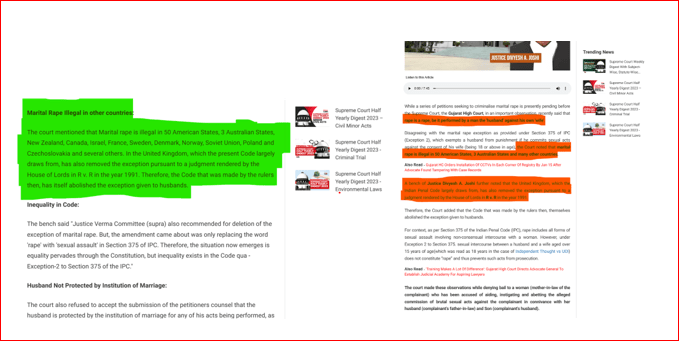
It has noted that even though Exception 2 of Section 375 exempts husbands from liability for consensual intercourse with their wives above 15 years, the Supreme Court has ruled that the age should be read as 18 years, making such acts rape under this provision.

The Commission stresses that providing reprieve under the POCSO Act for cases of adolescent romantic relationships would be ineffective without a corresponding amendment in Section 375 of the IPC, as lovers and husbands of minors would still be punishable under this provision.

Law Commission Report enclosed below.

Immediate need for electing the Leader of the Opposition to save the Institution of Lokayukta.

S.Basavaraj, Senior Advocate, Bengaluru

The delay in electing/selecting the Opposition Leader in Karnataka has damaged the institution against corruption in Karnataka.
While everyone including BJP political party blamed the Congress Government for destroying the Lokayukta institution by creating Anti Corruption Bureau, the inaction on the part of BJP in electing the Opposition Leader has further weakened the institution of Lokayukta. This is despite the fact that the Karnataka High Court struck down ABC and restored powers to Lokayukta.
Section 3 of the Karnataka Lokayukta Act, 1984 deals with appointment of Lokayukta and Upalokayukta. We are presently concerned with appointment of additional Upalokayukta. A person to be appointed as an Upalokayukta shall be a person who has held the office of a judge of a High Court for not less than five years and shall be appointed on the advice tendered by the Chief Minister in consultation with the Chief Justice of the High Court of Karnataka, the Chairman, Karnataka Legislative Council, the Speaker, Karnataka Legislative Assembly, the Leader of the Opposition in the Karnataka Legislative Council and the Leader of the Opposition in the Karnataka Legislative Assembly.
Thus consulting the Leader of the Opposition in Karnataka Legislative Assembly and the Leader of the Karnataka Legislative Council is absolutely necessary for the appointment of additional Upalokayukta.
The BJP political party lost power and the new Congress Government was formed in May 2023. Even after almost 5 months BJP has not been able to elect the opposition leader in both the Houses.
Both the Lokayukta and the Lokayukta handle the works like Departmental enquiries; Public and private grievances with regard to all activities of the government; Enquire into allegations against public servants; Conducting raids, Investigating trap cases; Visiting districts for open hearings; Meeting walk-in complainants on a daily basis; Calling aggrieved persons and concerned officials to discuss issues raised; Examination of 200 files every day; Preparation of final notes under Section 12 (3) of the Act before making recommendations; Advice and preparation if case is challenged before Karnataka State Administrative Tribunal. Tender legal advice on fitness of case for appeal; Monitor vigilance department’s work, police and statistics. It is submitted that as on today there is only one Upalokayukta to assist the Lokayukta in the above duties. While the government was pleased to appoint a Lokayukta and one Upalokayukta, it has not appointed the second Upalokayukta as sanctioned in 1984.
Previously there were two Upalokayuktas. After Justice Ananda retired only Justice Phanindra is handling major workload. If the second Upalokayukta, as mandated in 1984, is not appointed, the institution of the Lokayukta will be unable to continue its mandate due to huge pendency thus affecting its usefulness. There is a large increase in complaints over the course of several years and months.
Speedy remedy to people’s grievance is required to keep the people’s confidence in the institute of the Ombudsman. There are thirty-one districts in the State of Karnataka. The Upalokayukta has to visit every district at least once a month to give justice to the institution of the Ombudsman. He is required to spend at least three days to open hearings, meet petitioners, complainants, among others. Thus, we can see it is impossible for one person to cover the whole State in one month.
Even in the matter of constitutional courts like the High Courts and the Supreme Court of India, the judiciary has lamented at lack of judges to dispose and decide the pending cases. Pendency of cases is the main reason for the institutional failure in rendering speedy justice to the aggrieved persons. The Hon’ble Supreme Court as stressed the need for filling up of the vacancies in the judicial positions from the civil courts level till the Supreme Court of India.
The institution of Lokayukta is a unique body to redress the grievances of citizens against mal administration and corruption. It is a matter of fact that the grievances against the governmental machinery is writ large and the reasons are not very difficult to perceive. In this regard an efficient body fully equipped with infrastructure and manpower is absolutely essential.
Samaja Parivarthana Samudaya has filed a public interest litigation seeking appointment of additional Upalokayukta and the High court of Karnataka has already issued notice to the State Government.
The BJP political party must elect the Leader of the opposition at the earliest to strengthen the institution of Lokayuka.
The internal bickering in the BJP has led to crumbling of a citadel and the BJP, which blamed the Congress for weakening the institution of Lokayukta, is answerable to the public at large.

“Know Your Judge”. Justice Hemant Chandangoudar. Karnataka High Court.

Justice Hemant Chandangoudar is celebrating his 54th birthday today.

Justice Hemant Chandangoudar was born on 28:9:1969. His father Shri. Rajashekar Chandanagoudar was a noted lawyer with vast experience in civil and land reforms laws. Justice Hemant Chandangoudar enrolled as an Advocate on 11:2:1994. He practiced under his father and conducted Civil, Constitutional, Service and Land Reforms mattes.

He was appointed as Additional Judge of the High Court of Karnataka and taken oath on 11:11:2019 and Permanent Judge on 08.09.2021.

Within short span of time, Justice Hemant Chandangoudar has earned the reputation of being one of the finest Judges having great judicial temperament and balanced approach. Justice Hement Chandangoudar is a keen golfer.

Important Judgments delivered by Justice Hemant Chandangoudar.
Passport Act. Mere pendency of criminal case not a ground to refuse renewal of passport to return to India. Karnataka High Court.
https://dakshalegal.com/judgements/actionView/IYZyUTxTkrz6vQKoHzAM8m3Qi

Karnataka Societies Registration Act. Prosecution for not conducting annual general body meeting cannot launched after six months from the date of the alleged offence. Karnataka High Court.
https://dakshalegal.com/judgements/actionView/j1ztmZf81oJ3xCdJE7mDIyY17

If land falls within Corporation limits, there is no requirement to obtain permission under Section 95 of the Karnataka Land Revenue Act for diverting agricultural land for non-agricultural purpose. Karnataka High Court.

https://dakshalegal.com/judgements/actionView/4Cf22BBPuGEHgl3yvzkl5DuxD

Criminal Law. Life imprisonment means imprisonment for complete span of life. Consecutive sentences in case of conviction for several offences at one trial does not arise. Application for clarification of sentence is not maintainable. Karnataka High Court. (DB)

https://dakshalegal.com/judgements/actionView/k0E96nReluOkSg9gvuq8PnrHW

N.I. Act. Section 138. When cheque is delivered for collection within the territorial jurisdiction of a Court where the payee maintains the account, proceedings cannot be initiated in other place. Karnataka High Court.

https://dakshalegal.com/judgements/actionView/ESSCuN0zqriQ0coMIe4zq6joZ

When a Company nominates a Director under Section 49(2) of the Legal Meteorology Act, 2009, initiation of penal proceedings against other Directors is not permissible. Karnataka High Court.

https://dakshalegal.com/judgements/actionView/wynqYcXQrNs1NUmlfjcLeWQya

Motor Vehicles Act, 1988. Section 147. Person travelling on mud-guard of a tractor is NOT an authorized passenger. Persons working on ploughing/crushing machines attached to tractor are NOT employees. Karnataka High Court. (DB)

https://dakshalegal.com/judgements/actionView/HbBtN5g8ZHicpKA3eaBENJyOJ

Customary divorce among Panchamasali Lingayats, though recognised under Section 29-2 of the Hindu Marriage Act, the same is required to be proved strictly in accordance with Section 60 of the Evidence Act. Karnataka High Court.

https://dakshalegal.com/judgements/actionView/M3lu7cUEG3iXQjSJgdWwteNog

Attornment of tenancy in favour of purchaser is not required to initiate eviction proceedings under the Karnataka Rent Act, 1999. Karnataka High Court.
https://dakshalegal.com/judgements/actionView/UJIgp8PAV6ubiZ69ljDsWs9pp

Karnataka Land Reforms Act. Tenancy created under registered lease deed by grandfather during minority of grandson. Same is binding unless the lease is challenged within three years after grandson attains majority. Karnataka High Court.

https://dakshalegal.com/judgements/actionView/SwB7LT4spBIz5jKT1vV88ItHT

Land Acquisition. Challenge to land acquisition can be rejected by courts on the ground constructive resjudicata and res judicata. Issue regarding fraud already adjudicated binds subsequent proceedings. Karnataka High Court. (DB)
https://dakshalegal.com/judgements/actionView/d0X2XjoAT0FZy9dBVCr00kYdK

Undue influence, unless specifically pleaded in the plaint, cannot be assumed by the court based on evidence during trial. Karnataka High Court reiterates. (DB)

https://dakshalegal.com/judgements/actionView/QKHQY8Y45w2hsjzFSEP28j4gM

RTC entries in revenue records. Deputy Commissioner exercising power under the Karnataka Land Revenue Act cannot sit over the validity of registered title deed. Karnataka High Court.

https://dakshalegal.com/judgements/actionView/2eJQtuXa2eDheElWlQcsWPBcW

FIR for the offence under Section 498-A IPC cannot be registered against woman alleged to be in illicit relationship with complainant’s husband unless essential ingredients of the offence are made out. Karnataka High Court.

https://dakshalegal.com/judgements/actionView/lvN7kJwcmRKYBW8Laz8BFq5Z0

Defamation. When a class of persons are mentioned to have been defamed and if such a class is indefinite, the complaint cannot be entertained. Karnataka High Court.

https://dakshalegal.com/judgements/actionView/7hbbZ0OP2YJJ5HldkNH4bA6Aq

Offence by Companies. A person cannot be prosecuted unless he is shown to be in-charge of the Company as Managing director or Director. Karnataka High Court.

https://dakshalegal.com/judgements/actionView/l00aAxel9jRtWiFHtglyV9faC

Vendor committing breach of agreement to sell his property and returning the advance amount to purchaser does not constitute criminal breach of trust. Karnataka High Court.
https://dakshalegal.com/judgements/actionView/jDwyBCpVQut78C7ErmZL9V6GJ
SC/ST (Prevention of Atrocities) Act, 1989. ”Pre-existing civil disputes cannot be converted into offences under the Act”. Karnataka High Court while quashing criminal proceedings under the Act.
https://dakshalegal.com/judgements/actionView/ZKXD8ZifIuxSpuncQIW5inc2I
Negotiable Instruments Act. Directors of a company cannot be held vicariously guilty of the offence punishable under Section 138 when the company is not arrayed as an accused in the complaint. Karnataka High Court reiterates.
https://dakshalegal.com/judgements/actionView/WHoWFICspEWTW6pstF6BMiiz2

Mahazar drawn contrary to Section 100 (4) Cr.P.C. is only irregular. Same cannot be termed as illegal if seizure can be proved upon search conducted. Karnataka High Court.
https://dakshalegal.com/judgements/actionView/6OjcSJKK8Uh88flZn6rL263Sw
Person who gifted immovable property to Municipality on the assurance of alternative site is entitled to receive market value compensation if there is no provision for allotment of alternate site. Karnataka High Court.
https://dakshalegal.com/judgements/actionView/6tcnaGfT1PstdIrRgvApZlpyq
Obtaining power of attorney from property owner and selling the property to third party does not by itself amount to cheating unless obtaining the power of attorney was with an intention to deceive the owner. Karnataka High Court.
https://dakshalegal.com/judgements/actionView/mOsgR6LejDZgENVSegGAIkCUv

Mere inducement to invest in money doubling scheme in the absence of dishonest intention to cheat the investor from the inception does not constitute either cheating or criminal breach of trust. Karnataka High Court.
https://dakshalegal.com/judgements/actionView/3oMjL1hUwePHrwgQKdCuH291G

FIR lodged during pendency of civil suit between parties giving criminal texture to civil dispute and to wreak vengeance is liable to be quashed. Karnataka High Court.
https://dakshalegal.com/judgements/actionView/c3G6hMKPLNL7zZmWwpNcNmPnG

Bar under Article 363 of the Constitution to enquire into disputes arising out of merger agreement or instrument of accession between Ruler of an Indian State and the Government applies even to Revenue proceedings. Karnataka High Court.
https://dakshalegal.com/judgements/actionView/yZJbLUEItqe8gQKqumFdIspAj

Drugs and Cosmetics Act. Serving Government analyst report on accused after expiration of drug’s shelf life deprives valuable right of the accused to get the drug re-analysed. Criminal proceedings are liable to be quashed Karnataka High.

https://dakshalegal.com/judgements/actionView/J4k3rRkxDhmyGTFdgDE25JlG6
Range Forest Officer cannot register FIR in respect non-cognizable offences under the Karnataka Forest Act without obtaining prior permission from the Magistrate. Karnataka High Court.
https://dakshalegal.com/judgements/actionView/kymaUTX6bIcghtFpkU8xtiQFd
Director of a company who resigned by submitting required Form before the Registrar of Companies cannot be held liable for bouncing of cheque issued after his retirement. Karnataka High Court.
https://dakshalegal.com/judgements/actionView/hP2uNRcOWRR00pLzAlmlxxJel

Private complaint in respect of a cognizable offence without complying with Sections 154(1) and 154(3) of Cr.P.C is not maintainable. Karnataka High Court reiterates.
https://dakshalegal.com/judgements/actionView/ORvcHiMN312tgRSCqGZQsuo9f
Conscious possession of live cartridges fully knowing the consequences is essential to constitute offence under Sections 3 and 25(1)(a) of the Arms Act. Karnataka High Court.
https://dakshalegal.com/judgements/actionView/xQxUVXGsWbLUDhnf4Vq2DMsvL

When there is no clause prescribing minimum quantity of electricity to be purchased by Govt Electricity Company under Power Purchase Agreement, licensee cannot be restrained from injecting power generator into the grid. Karnataka High Court.
https://dakshalegal.com/judgements/actionView/9aG4cQkVlyxZi56ReWF8AyKPy
To constitute offence under Section 3(1)(j) of the SC & ST (Prevention of Atrocities) Act, the accused must have employed the person for manual scavenging knowing fully well that he belongs to SC & ST community. Karnataka High Court.
https://dakshalegal.com/judgements/actionView/mZUpgeGYTeOmehaWrp2Biuydi

Persons who had ceased to be directors of company cannot be arrayed as accused in proceedings under the NI Act in respect of cheque issued by the Company. Karnataka High Court reiterates.
https://dakshalegal.com/judgements/actionView/D9lXfgi4nQ5IfWE2yKMlululc

Instigating Police personnel to go on mass leave and to participate in the strike seeking redressal of grievances do not constitute the offence of Sedition. Karnataka High Court.
https://dakshalegal.com/judgements/actionView/byjURSsWQHzUAGIRI2ApBXppu
Employee working under contractor sustaining injuries does not fall under the definition of ‘worker’ as defined under Section 2(l) of the Factory Act. Karnataka High Court.
https://dakshalegal.com/judgements/actionView/5XcAFTLPlT6xs7I8raG5PDfPo
BBMP Act 2020. Whenever transfer of property comes to the knowledge of the Chief Commissioner through notice under Section 149, he is bound to enter the name of the transferee in the property tax register. Karnataka High Court.
https://dakshalegal.com/judgements/actionView/GWNDti9eHnjVABS4ie5D6RlYd
Permission to demolish dilapidated building. Though issuance of notice to adjacent owner is not necessary, it is incumbent to notify when demolition poses threat. Karnataka High Court.
https://dakshalegal.com/judgements/actionView/s6yxAVGsz58ZZ8m6eFstglu4E

Person who relinquishes land in favour of Corporation is entitled to maximum Transferable Development Rights as per the amendment to KTCP Act. Karnataka High Court.
https://dakshalegal.com/judgements/actionView/Gt5pub1C2BQK2p19CYOuSfKHM
President of a Gram Panchayat has no power under the Karnataka Gram Swaraj and Panchayat Raj Act, 1993 to cancel khata registered in favour of a person. Karnataka High Court.
https://dakshalegal.com/judgements/actionView/PSR1baDjD6CKoRU4yYCdNmLMd
BBMP cannot refuse to change khata of property duly purchased under a registered sale deed only on the ground of third-party objection. Karnataka High Court.
https://dakshalegal.com/judgements/actionView/BZENnuF53orZUT1UV1cL6dSpI

Gram Panchayat preventing licensed persons from carrying on business by introducing public auction without authority of law violates fundamental right under Article 19. Karnataka High Court.
https://dakshalegal.com/judgements/actionView/WhQX68DGI8oAFXryN2UWMQQQs
Rejection of restoration application under the PTCL Act filed after 32 years. Remand of the proceedings on the ground of procedural irregularity cannot be ordered when fresh consideration is a futile exercise. Karnataka High Court.
https://dakshalegal.com/judgements/actionView/SwZdZNFa1xGO9jEF5qbCBT3dI
Delimitation of wards based on the population is flexible clothing the Government with power to meet difficult situation since scale of representation may not be always uniform. Karnataka High Court.
https://dakshalegal.com/judgements/actionView/E3ogq1f8YtQVO6izwCQA0TRtx

In the absence of restraint order, mere pendency of a civil dispute cannot be a ground to refuse sanction of layout plan. Karnataka High Court.
https://dakshalegal.com/judgements/actionView/F6HU9nIbvjrPpdW8MODukc77I
Karnataka SC-ST – PTCL Act. Delay of seven years in applying for restoration of the granted land without any explanation for the delay. Application is liable to be rejected. Karnataka High Court.
https://dakshalegal.com/judgements/actionView/iPmyEjO62jHJSYJMlhDobhicD
”Elections are the essence of democracy”. Karnataka High Court directs the Govt to provide reservation for women in the wards having greater women population and to hold elections at the earliest.
https://dakshalegal.com/judgements/actionView/qLfvuiN3dyJsV8kOwPrk4aoGj
When a statutory appeal is rejected as not maintainable, the appellate authority cannot make observations on merits touching the rights of the parties. Karnataka High Court.

https://dakshalegal.com/judgements/actionView/1CD0yWugXJAtYwxUO5fQW1RNd
Even the delay of 25 years cannot be a ground to reject application for restoration of deleted entry in revenue records when the applicant acquired the title by registered sale deed which remains unchallenged. Karnataka High Court.
https://dakshalegal.com/judgements/actionView/8fzCFHYbEBLQXe7w62Jv7vSNP
Limitation to apply for cancellation of khata under Section 114A of the Karnataka Municipal Corporations Act is three years from the date of the order and not from the date of knowledge of the order. Karnataka High Court.
https://dakshalegal.com/judgements/actionView/tylImX3RgHtkSWu8dZY0behJQ
Power of the Deputy Commissioner to demarcate Panchayat area also includes inclusion or exclusion of fishing lakes. Karnataka High Courts.
https://dakshalegal.com/judgements/actionView/Smgn3SlW2hXOMjB1Pbj8ohdW4
Transfer of land allotted in a public auction for an upset price does not attract the provisions of the Karnataka SC/ST (PTCL) Act, 1978.
https://dakshalegal.com/judgements/actionView/AIraUAEcVa3cHn9iS9nN3D0vC
Cheque bounce case. Partnership firm cannot be held liable for dishonour of the cheque issued by a partner in his individual capacity. Karnataka High Court.
https://dakshalegal.com/judgements/actionView/7JAONypVR8L6iMXI4CQGskK2f
Prior service rendered by a teacher in Government Aided Institution shall be counted for the purpose of fixing pension. Karnataka High Court.
https://dakshalegal.com/judgements/actionView/D4zKjT0eX8FQTodjwwUPXTTTU
Criminal proceedings under the Karnataka Private Medical Establishment Act, 2007 cannot be initiated except on a complaint in writing by the authorized officer. Karnataka High Court.
https://dakshalegal.com/judgements/actionView/mnvMf8dZvndsCtjBbt9EcYRbe
Essential Commodities Act, 1955. Criminal proceedings cannot be initiated only against manager of company without arraying the company as accused. Karnataka High Court.
https://dakshalegal.com/judgements/actionView/mFsrQMxiPc0oNLrqjsAnOSGIm

Insecticides Act, 1968. Criminal proceedings cannot be initiated only against director of company without arraying the company as accused. Karnataka High Court.
https://dakshalegal.com/judgements/actionView/dF5GLg3oZyQiUpIYrWoJCzdK8
When agricultural land falling within local planning area is designated for residential purpose, the permission shall be deemed to have been granted subject to payment of fine prescribed under the Karnataka Land Revenue Act. Karnataka High Court.
https://dakshalegal.com/judgements/actionView/QylbHj1fO7jWmQwBkhkEq9KtB
Essential Commodities Act. Manager of a company cannot be prosecuted for substandard goods unless the manufacturer/company is arraigned as an accused. Karnataka High Court.
https://dakshalegal.com/judgements/actionView/EzCAbhsqHl5ZTme6Fro91qFgy

Post-dated cheque presented beyond the period of three months from the date the cheque bears will not attract the provisions of Section 138 of the N I Act. Karnataka High Court.
https://dakshalegal.com/judgements/actionView/ifUf91wuAJ6yYFaS58OEH1SFd
Before initiating criminal proceedings under the Factories Act, the authorities should pass an order on the reply submitted by the occupier or the factory manager to the show cause notice. Karnataka High Court.
https://dakshalegal.com/judgements/actionView/FirtWi1IcJtGX55jokm6b6ein
Persons nominated under Section 352(1)(b) of the Karnataka Municipalities Act, 1964 are not eligible to be included in the electoral roll of the Local Authorities Constituency. Karnataka High Court.
https://dakshalegal.com/judgements/actionView/n7ugD6CJtWkRQiO1MPPt3blIR

When quality supervisor is appointed by a Company under the Fertilizer (Control Order), director of Company cannot be prosecuted for the offences under the Essential commodities Act. Karnataka High Court.
https://dakshalegal.com/judgements/actionView/czMZAfWAelUeWHObYC6lNSUhP
Criminal prosecution launched under the Insecticides Act against director of company without arraigning the Company as an accused is not maintainable. Karnataka High Court.
https://dakshalegal.com/judgements/actionView/H4HRezLcYQhK1OQY4SblfmjcD
When company is alleged to have committed offence under the Karnataka Forest Act, prosecution cannot be launched only against the directors without making the company an accused. Karnataka High Court.
https://dakshalegal.com/judgements/actionView/aOvgmMHfTKoR85ksEAmA6yALe
Proceedings under Section 138 N.I. Act cannot be initiated against a person who ceased to be director of a Company as on the date of issuance of the cheque. Karnataka High Court.
https://dakshalegal.com/judgements/actionView/ad19pWcZiSVEuhtSoUPKXEDCx
Legal Metrology Act. Common complaint in respect of several distinct offences based on different causes of action on different facts and different nature is not maintainable. Karnataka High Court.
https://dakshalegal.com/judgements/actionView/emrk8w7in3Vet6Z6enOinQw2s
Sales officer does not fall within the definition of workman and hence cannot raise a dispute under the Industrial Dispute Act. Karnataka High Court.
https://dakshalegal.com/judgements/actionView/EuJG3lahnCwiopA8gnMmzCCNV
Karnataka Prohibition of Charging Exorbitant Interest Act, 2004. Police conducting raid without registering FIR at the first instance is illegal. Karnataka High Court.
https://dakshalegal.com/judgements/actionView/ZWlkUQgxzZY5iXAcbHzeSR96T
While considering the application to engage private Prosecutor under Section 302 Cr.P.C, the Magistrate must form an opinion as to whether cause of justice would be subserved. Karnataka High Court.
https://dakshalegal.com/judgements/actionView/ycBBANaMyJO88fELyDbP8g1GZ

Karnataka Excise Act. Police Officer entering and conducting search without search warrant or without recording the reasons for dispensing with obtaining search warrant is impermissible. Karnataka High Court.
https://dakshalegal.com/judgements/actionView/lCc9SFQHyu29aJSyTKgBJqu42
Death of employee due to the negligence of the owner/occupier of the factory. Simultaneous prosecution under Section 304-A of IPC and Section 92 of the Factories Act is not permissible. Karnataka High Court.
https://dakshalegal.com/judgements/actionView/Pss0vLAdKgL2IgINsv89rHyvp
Karnataka Tax on Entry of Goods Act. Denatured spirit and ethyl alcohol are two different products. Clarification cannot run counter to the Tax Entries to levy entry tax. Karnataka High Court.
https://dakshalegal.com/judgements/actionView/vgnf93T2JSqPcRRAvpynVWpo1

Insecticides Act. Prior written consent by the State Government or a person authorized by it is mandatory before initiating the criminal prosecution for an offence under the Act. Karnataka High Court.
https://dakshalegal.com/judgements/actionView/UwXvDe0h8garSI86dvF7vn6S0
Insecticides Act. Criminal prosecution only against employee of Company cannot be launched without arraigning the Company also as an accused. Karnataka High Court.
https://dakshalegal.com/judgements/actionView/5VqRdVFKSK94hUqC98j82shRH
Employee of an alleged scamster company cannot be criminally prosecuted unless it is shown that he connived with the fraudsters. Karnataka High Court.
https://dakshalegal.com/judgements/actionView/kyn7Ybwax9bq7UW1RzH9a52Rx
Prosecution for obtaining false caste certificate can be launched only if the certificate is cancelled by the Competent Authority. Magistrate cannot decide the validity of the Caste certificate. Karnataka High Court.
https://dakshalegal.com/judgements/actionView/wOE9XpoTUaBLinXLmrJ3uE1q3

Registration of the FIR under Sections 30 and 35 of the Arms Act which are non- cognizable cases without the order of a Magistrate is illegal. Karnataka High Court.
https://dakshalegal.com/judgements/actionView/0CEPpJx9o5hT8hnKGlubc7zLa
Sale of property pursuant to proceedings under the SARFAESI Act for the default committed by the borrower cannot be given the colour of criminal offences. Karnataka High Court.
https://dakshalegal.com/judgements/actionView/bOwtLFW7pO8fCeyLihPA59CAg
Failure to pay fashion event organiser does not amount to fraud under Section 420 IPC unless there are clear allegations of intention to defraud from the inception. Karnataka High Court.
https://dakshalegal.com/judgements/actionView/laBANU3hGwwtVjL8cgrKLfzAp
Wild Life (Protection) Act, 1972. Cognizance cannot be taken merely on the basis of the final report submitted by the Range Forest Officer. Karnataka High Court.
https://dakshalegal.com/judgements/actionView/xPcoiRvgMJSiOE7bUA1oH07CO

When the purpose of land acquisition is same and lands are similar, same amount of compensation shall be paid to owners, though the lands are lying in different villages. Karnataka High Court.
https://dakshalegal.com/judgements/actionView/9yLCxXaQ6jhuAIBKs9Zd68qPR
Registration of multiple FIR by same person against the same accused based on the same set of facts and the same cause of action is impermissible and violative of Article 21 of the Constitution of India. Karnataka High Court.
https://dakshalegal.com/judgements/actionView/bqcPkZRAFD0CbcArwHfNQTz76
Wild Life (Protection) Act. Magistrate cannot take cognizance merely on the basis of final report by the police unless there is a complaint made by a person prescribed under Section 55A of the Act. Karnataka High Court.
https://dakshalegal.com/judgements/actionView/LUpWLOg9VYXJt8xZX4YldKVqs
Before taking cognizance of offence under Section 138 of N.I. Act against out of station accused, preliminary enquiry must be conducted as contemplated under Section 202 of Cr.P.C. Karnataka High Court.
https://dakshalegal.com/judgements/actionView/U6cr6GKI2LERjunR6Er7bskrg

Company purchasing stolen gold jewellery. Employees of the Company cannot be prosecuted unless the Company is also made accused. Karnataka High Court.
https://dakshalegal.com/judgements/actionView/aWbKlpHhLwxU68hmMeKaTucks
Removal and transportation of sand after obtaining prior permission of the Government does not attract penal provision of Section 379 of IPC since the Section implies removal of the property belonging to another person without consent. Karnataka High Court.
https://dakshalegal.com/judgements/actionView/QUJbdjErTiqgmyrHcgbBvaFQi
Investigation of non-cognizable offences. Mere endorsement by the Magistrate ‘permitted’ on the requisition cannot be construed as order under Section 155(2) of Cr.P.C. Karnataka High Court.
https://dakshalegal.com/judgements/actionView/QeUhepjU2M04pql2ao3hUfxcs

Magistrate cannot register the case on protest petition without first passing orders rejecting the ‘B’ report. Karnataka High Court.
https://dakshalegal.com/judgements/actionView/AODTZAawnSWoifNOY8q8laffR
Prevention of Corruption Act. Competent authority to grant sanction to prosecute head of the Department is the Cabinet. Minister in-charge has no power to grant such sanction. Karnataka High Court.
https://dakshalegal.com/judgements/actionView/iyg9HqcOz2FF9F3FGssU4zIFM
No criminal proceedings can be initiated against Notary Public except by an officer authorised by the Central or State Government by general or special order in this behalf. Karnataka High Court.
https://dakshalegal.com/judgements/actionView/CJoQ7J8zU4xBs6CW7C8My1TCp

Tax cannot be levied on telecommunication towers erected by the Bharat Sanchar Nigam Limited (Government of India undertaking) on the immovable property belongs to it, or the Union of India save as the parliament may by law provide. Karnataka High Court.
https://dakshalegal.com/judgements/actionView/3Xwq9jTHKJs4U2YhMz9c4TS7e
Suit for partition by woman coparcener is not maintainable if the ancestral property was sold before coming into force of the amended Section 6 of the Hindu Succession Act. Karnataka High Court.
https://dakshalegal.com/judgements/actionView/P2MxaZz15WlWu4IzMoyjPRtLJ
Companies Act, 1956. Offence under Section 217 is not a continuing offence. No criminal prosecution can be launched beyond six months in view of Section 468(2)(a) and (b) of Cr.PC. Karnataka High Court.
https://dakshalegal.com/judgements/actionView/jbYeopNntWxR4HGvEeA8QGsuN
Suit filed by Bank for recovery of loan amount due from its debtor is not barred under Section 34 of the SARFAESI Act. Karnataka High Court.
https://dakshalegal.com/judgements/actionView/EtQAj7uYjnpy37Xz5wrQNCc8G
Labour Court awarding partial backwages for proven unauthorised absence of workman for a long period runs contrary to the principle of ‘no work, no pay’ and cannot be justified under Section 11-A of the I D Act. Karnataka High Court.
https://dakshalegal.com/judgements/actionView/1Gsp3yu2p9Oki7haHwebZSsBk
“Prohibition of outdoor advertisement on non-residential private properties violates Articles 14 & 19(1)(a) and (g) of the Constitution of India” declares Karnataka High Court. Directions issued to take strict action against unauthorised hoardings.
https://dakshalegal.com/judgements/actionView/dOi0F3IThoyzWowsPSuvo7ObN

No estoppel against statute. Landowners cannot be deprived of compensation for the Road Margin Area even though they accepted condition and derived benefit under the approved plan. Karnataka High Court.
https://dakshalegal.com/judgements/actionView/eMu2sJos8z9BGvUr6W8NsnyMI
Suit for permanent injunction. Pendency of tenancy dispute under Land Reforms before Tribunal does NOT prevent civil court to deal with issue of possession and to grant temporary/permanent injunction. Karnataka High Court.
https://dakshalegal.com/judgements/actionView/ScJh0BKRkGlwhdd1MQj90YFPM
Industrial Disputes Act. Labour Court must quantify monetary value payable to the Workman before directing the employer to implement the award under Section 33 (2) (c). Karnataka High Court.
https://dakshalegal.com/judgements/actionView/AN331tTek5emkbZCbg2PES1AL
Microbreweries also fall under the Karnataka Excise (Brewery) Rules and are entitled for refund/adjustment of unutilised excise duty and additional excise duty. Karnataka High Court.
https://dakshalegal.com/judgements/actionView/xJU9aqRJYJIvhB1znFjqpTVhk
Offence under Section 78 (3) of the Karnataka Police Act is non-cognizable. Police officer cannot investigate the offence without obtaining orders from the Magistrate. Karnataka High Court.
https://dakshalegal.com/judgements/actionView/coRFjiB0G2ke7XQ1PPLwIDh6J
Word ‘permitted’ is not an order under Section 155 (2) Cr.P.C. Registration of FIR, in the absence of valid order as specified under Section 155 (2) of Cr.P.C. stands vitiated. Karnataka High Court.
https://dakshalegal.com/judgements/actionView/6QAQe1f4r75szw4EN6RbUP4IX
Deputy Commissioner need not follow the procedure prescribed in Rule 5 of the Karnataka Excise Licences (General Conditions) Rules, 1967 while renewing the license. Karnataka High Court.
https://dakshalegal.com/judgements/actionView/qjlgQPQrfVXAPSpNFO1SH6i7d

Religious Institution (Prevention of Misuse) Act, 1988. Election campaign in the temple premises by person who is not in-charge of the affair of the Temple does not attract the Act. Karnataka High Court.
https://dakshalegal.com/judgements/actionView/BsgpKzXTcAM25Z3sOhWQyg6zv
Income Tax Act. Magistrate can take cognizance for the offences under Sections 277 and 278 only on the basis of complaint by the authorized officer with prior sanction from the competent Authority. Karnataka High Court.
https://dakshalegal.com/judgements/actionView/IkRmBpZ1YA70nan88DDcoATWt
Karnataka Police Act. Playing ‘’Andhar Bahar” in private house does not attract Common Gaming-House under the Act. Prosecution cannot launched in such a scenario. Karnataka High Court.
https://dakshalegal.com/judgements/actionView/MCsjqs6fm1r7ZOkQBUqkBrVO2

Karnataka Excise Act. Conducting search without obtaining order from the Magistrate and without recording the grounds for its dispensation under Section 54 is illegal. Karnataka High Court.
https://dakshalegal.com/judgements/actionView/EpD3JyqbM1E6rgCF79ey20d0Y
Mere pendency of litigation, in the absence of any restraint order, cannot be a ground for the Corporation not to enter the name of the purchaser in the khata. Karnataka High Court.
https://dakshalegal.com/judgements/actionView/sxa7XpjNCWSIooAKUORWOM11J
Mere pendency of civil dispute is not a ground to refuse sanction of building plan. Karnataka High Court.
https://dakshalegal.com/judgements/actionView/8by2vUl1sQUSwh7By3TRlw4Ey

“Know Your Judge”. Justice K Somashekar. Karnataka High Court.

Hon’ble Mr. Justice K. Somashekar celebrates his 60th birthday today

Justice K Somashekar was born on 15:9:1963 in a remote village in Chamarajnagar District. It is interesting to note that he was the first person to become a lawyer from his village. He enrolled as an advocate on 27:1:1990 and practiced in Mysore and Chamarajanagar Districts on both Civil and Criminal sides.

Justice K Somashekar was directly appointed as District and Sessions Judge on 17:6:1998 and served as Additional Districts and Sessions Judge at Bijapur (Vijayapura); City Civil Court, Bangalore and Principal District and Sessions Judge at Uttara Kannada, Karwar District; Hassan; Bangalore Rural District, Chitradurga and Principal City Civil and Sessions Judge, Bangalore and also served as Registrar Judicial and Registrar Vigilance, High Court of Karnataka.

Justice K Smashekar was appointed as an Additional Judge of the High Court of Karnataka on 14.11.2016 and Permanent Judge on 03.11.2018.

Important judgments delivered by Justice K. Somashekar.
Criminal Trial. Wife cannot be dragged into criminal case simply because she is signatory to cheques along with her husband who is involved in illegal business transactions. Such practice should be curtailed. Karnataka High Court.

https://dakshalegal.com/judgements/actionView/6RXPosFYC3k8TILkFSu8aVqBC

Mere payment of premium amount before occurrence of accident will not cover liability if the insurance policy is issued with effect from the time after the accident. Karnataka High Court. (DB)
https://dakshalegal.com/judgements/actionView/WdjePhtI9Mcj3G1HCapAgHfzq
“Victim compensation is the social philosophy and legislative implication. Failure on the part of the prosecution to secure a conviction is not a ground to deny compensation”. Karnataka High Court orders compensation to minor girl orphaned due to crime. (DB)
https://dakshalegal.com/judgements/actionView/rVLjpm32tgvn6VSRoo9WKlKwL
Presentation of undated cheque after three years from the date of the transaction by adding the date. Proceeding under Section 138 NI Act will be clearly barred by limitation. Karnataka High Court.
https://dakshalegal.com/judgements/actionView/p92RNehbaj4FcwTvBLmbkS7ee
Criminal trial. In a case resting on circumstantial evidence, motive plays a crucial role. Motive is a double-edged weapon, which will cut either side of the case. Karnataka High Court. (DB)

https://dakshalegal.com/judgements/actionView/ONEImVpFkuwTE0O7NE93h8sWK
Criminal trial. Insistence of plurality of witnesses in proof of any fact will indirectly encourage subornation of witnesses. Karnataka High Court. (DB)
https://dakshalegal.com/judgements/actionView/bzKnZ5IOekWAjffAPiAYxoFzN
Mining irregularities. Karnataka High Court upholds discharge of the accused involved in alleged illegal mining.

https://dakshalegal.com/judgements/actionView/ZV9puTxElmo0VJIVliPcS659J

“Case of the prosecution in entirety is found to be doubtful and is full of inconsistencies”. Karnataka High Court acquits the accused in RTI activist Lingaraju murder case. (DB)

https://dakshalegal.com/judgements/actionView/7ESptiW1T0lwUWU2fELME2RFA
An order of acquittal adds up to the presumption of innocence in favour of the accused and hence the Appellate Court has to be relatively slow in reversing the order. Karnataka High Court. (DB)

https://dakshalegal.com/judgements/actionView/JKErAZPwa2A80zeZY6IJ8YYtf

Dowry Prohibition Act 1961. Wife roping in entire family members of husband with ulterior motive of wreaking vengeance. Such proceedings are liable to be quashed. Karnataka High Court.
https://dakshalegal.com/judgements/actionView/7nibuO3Mhrop4kisSTLTYTvWp
When the prosecution fails to prove its case, benefit of the acquittal can be extended by the appellate court even to the accused who has not preferred appeal challenging the order of conviction. Karnataka High Court. (DB)
https://dakshalegal.com/judgements/actionView/qosie13nmYln8Tx9PKcErf0xo
Criminal Law. Though due to passage of time and memory loss, witnesses deviate from their Police Statements, but when such discrepancies make the foundation of the prosecution case shaky, the Court has to take strict note thereof. Karnataka High Court. (DB)
https://dakshalegal.com/judgements/actionView/6hF6iROyju8TkYh7k5DLfVSAY

When proceedings are initiated under the Karnataka SC/ST (PTCL) Act, the authorities are bound to examine whether the grant comes within the purview of the Act. Karnataka High Court.
https://dakshalegal.com/judgements/actionView/knyP6X0qU1GSKaKOj5QXLenQO
If deposition of the child witness inspires confidence in the mind of the Court and there is no improvement or tutoring, the Court may rely upon the same. Karnataka High Court. (DB)
https://dakshalegal.com/judgements/actionView/pQ4LAEHqp44ZJxjFgvFQO2USf
In determining culpable homicide under Section 299 of IPC, mentality of the accused, nature of the act and its effect upon the victim have to be analysed. Karnataka High Court. (DB)
https://dakshalegal.com/judgements/actionView/2kZLXZsmtqwqqVeJ0eNGBgnaO
Employees’ Provident Funds and Miscellaneous Provisions Act. Competent authority has discretion to reduce the percentage of damages under Section 14B and the same is justiciable. Karnataka High Court. (DB)
https://dakshalegal.com/judgements/actionView/Bo2POtFSS5h25GuN9rYugrfTp
When accused are acquitted for the offences under Sections 498A, 304B IPC and Sections 3 and 4 of the Dowry Prohibition Act, conviction for the murder cannot be sustained. Karnataka High Court. (DB)
https://dakshalegal.com/judgements/actionView/9wWx3qfq6ccbcDdbHYBTCulVJ
Lack of intention on the part of the accused and commission of the act in the heat of passion upon sudden quarrel are the mitigating circumstances. Karnataka High Court reduces sentence from Section 302 IPC to Section 304. (DB)
https://dakshalegal.com/judgements/actionView/E1wfv4VGa0TNsLHRVavLwnGmv
Criminal Law. When trial Court misreads the evidence and arrives at a conclusion erroneously to convict the accused, the appellate Court must intervene to prevent miscarriage of justice. Karnataka High Court. (DB)
https://dakshalegal.com/judgements/actionView/wy3wl6nZw7LFOxlg7RBhBtPaA

Criminal law. To impose the extreme punishment, all the three tests; Crime test, Criminal test and Rarest rare test must be satisfied. Karnataka High Court converts imprisonment till last breath of life to life imprisonment. (DB)
https://dakshalegal.com/judgements/actionView/D6g80YgX9nWSZCkF8cSdIm4iT
Criminal Law. Subsequent voluntary statement of the accused cannot be admissible in evidence and recovery to that effect amounts to “rediscovery of a fact already disclosed and capable of discovery.” Karnataka High Court. (DB)
https://dakshalegal.com/judgements/actionView/pJvQkJitCHqzCvwPtaXmOQYzs

“Know Your Judge” Justice Jyoti Mulimani. Karnataka High Court.

Justice Jyoti Mulimani is celebrating her 55th birthday on 15 August 2023.

Hon’ble Miss. Justice Jyoti Mulimani was born on 15.08.1968. She enrolled as an Advocate on 31.07.1992. She handled all types of Civil Cases. Hindu Law, Probate, Company, Arbitration. Constitutional, Tax & Tariff. Electricity, Education, Service, Motor Vehicles, and Excise matters.
Justice Jyoti Mulimani served as a Mediator and Trainer in Bengaluru Mediation Centre for the past 12 years.
Justice Jyoti Mulimani was appointed as Additional Judge of the High Court of Karnataka and taken oath on 11.11.2019 and Permanent Judge on 08.09.2021.

Important judgments delivered by Miss. Justice Jyoti Mulimani.
Civil court cannot enhance compensation under the Indian Telegraph Act towards diminution value if the Deputy Commissioner has already awarded under a particular head. Karnataka High Court.

https://dakshalegal.com/judgements/actionView/O1BsywYVMpGoNBB8QaiNwyZqS

Tribunal under the Maintenance and Welfare of Parents and Senior Citizens Act can invalidate Gift only if the Gift has condition that the transferee shall provide basic amenities and basic physical needs to the transferor. Karnataka High Court.
https://dakshalegal.com/judgements/actionView/chIQKtpYvZ42859RWCLS4ft83
Hindu Law. Gift by a coparcener of his undivided interest in the coparcenary property either to a stranger or to his relation without the consent of the other coparcener is void. Comprehensive Judgement of the Karnataka High Court.

https://dakshalegal.com/judgements/actionView/aOdOsR8ftiH1ncyfWlXGt0QJt
Agreement of sale in violation of Section 61 of the Karnataka Land Reforms Act, 1961 is void and cannot be enforced. Karnataka High Court.

https://dakshalegal.com/judgements/actionView/m0m8Fh7PT2xy9SNxYuqbjFUcr
Mysore Religious and Charitable Inams Abolition Act. Applies even to non agricultural lands. (DB)
https://dakshalegal.com/judgements/actionView/4ByACiF0WS98wQEro3o06Vo4T

“Know Your Judge. Justice Sunil Dutt Yadav. Karnataka High Court.

Justice Sunil Dutt Yadav celebrates his 51st birthday today.

Hon’ble Mr. Justice Siddappa Sunil Dutt Yadav was born on 3rd August 1972.

As an Advocate, he conducted many matters involving environmental issues and lake preservation on probono basis. His concern towards preservation of lakes helped saving many lakes in and around the city of Bangalore. He played a major role in preservation of Kappattaguda in Gadag district.

Justice Sunil Dutt Yadav was appointed as Additional Judge of the High Court of Karnataka and took oath on 14.02.2018 and Permanent Judge on 07.01.2020.

Important judgments delivered by Justice Sunil Dutt Yadav.
Compensation towards tortious acts of State entities. Concurrent remedy no bar to exercise writ jurisdiction. Karnataka High Court awards compensation of Rs. 1.19 Crore for death and injury due to electrocution.
https://dakshalegal.com/judgements/actionView/vPZub6Too0AvAiDc5t8eMkfhO

Vehicle plying outside permit area. Violation does not absolve insurer of liability. Pay and recover principle applied. (DB)
https://dakshalegal.com/judgements/actionView/vDVshzuNm3MwdcS7lgurfmSTW
Judgments cannot be swayed by emotions. Cases should be proved beyond reasonable doubt. (DB)
https://dakshalegal.com/judgements/actionView/dViOK2BABI3IiXiph7jkRznxM

Claim to property based on adverse possession. Period starts from the time of giving up the claim based on title. Plea of title and adverse possession are mutually inconsistent. Karnataka High Court.
https://dakshalegal.com/judgements/actionView/QKagc6V980HTnl7xEfM4HiMgi
Unlike access to justice, forum convenience is not a fundamental right. Only the Chief Justice of High Court has power to allocate work to puisne judges of respective benches of High Court. Karnataka High Court clarifies. (DB)
https://dakshalegal.com/judgements/actionView/XIgZVFf4o3d3jJEbmUyxY33lS
Service Law. Stigmatic termination of an employee cannot be done by following termination simplicotor Rule abandoning disciplinary proceedings. Karnataka High Court. (DB)
https://dakshalegal.com/judgements/actionView/8QGHjpKex5963oz9t6QZbSdjC
Ineligible candidate cannot plead his innocence in the selection process. Permitting ineligibility to triumph would have the effect of perpetuation of illegality which cannot be allowed. Karnataka High Court. (DB)
https://dakshalegal.com/judgements/actionView/2dtz7B2adBTyEBNBfw1TzH0oH
Speedy conclusion of investigation in criminal cases. Karnataka High Court lays down detailed guidelines.
https://dakshalegal.com/judgements/actionView/ZFcQrXjRrMGN82VvhM97NPPxg
False allegation of impotency by wife would cause mental disharmony to husband and amounts to mental cruelty, which would enable the husband to seek divorce on the ground of cruelty. Karnataka High Court. (DB)
https://dakshalegal.com/judgements/actionView/5hp7g7CWnH668ZRpaKOcpZZEz
Proceedings before the mediator are confidential and cannot be relied on by Courts in deciding cases on merits. Karnataka High Court. (DB)
https://dakshalegal.com/judgements/actionView/xZXEdOEVPYIrXxuIfxE95nYUE
Assessee is entitled for ‘Nil Tax Deduction at Source’ for payments made towards reimbursement of salaries of deputed expatriate employees. Karnataka High Court.
https://dakshalegal.com/judgements/actionView/rvx2Gif8fQNaWlDkBHkjrk4KK
Service Law. Wherever horizontal reservation of eligible candidates are not found, it is the duty of the authorities concerned to then have a vertical reservation. Karnataka High Court.
https://dakshalegal.com/judgements/actionView/HNf1t1OfMM3pnBk7zT0s3J2ic
Service Law. Transfer order, after the period of general transfers without showing place of posting, is not permissible. Place of transfer must be to a vacant post. Karnataka High Court.
https://dakshalegal.com/judgements/actionView/jro3AotRQqjnlaHP7rkYvpR9i
Prevention of Corruption Act. Previous sanction is not required before passing an order for investigation under Section 156(3) of Cr.P.C. Authoritative pronouncement of the Karnataka High Court.
https://dakshalegal.com/judgements/actionView/uMC11qcCsyqqORWjpQYj6y6NI
Karnataka Grama Swaraj and Panchayat Raj Act. Chief Executive Officer cannot terminate employees of the Grama Panchayat since the competent authority is the Gram Panchayat. Karnataka High Court.
https://dakshalegal.com/judgements/actionView/bp7Vg4eMNuXU1Z29XokihcLq2
There must be a specific allegation that the action complained of amounts to interference or attempt to interfere with the free exercise of electoral right by undue influence at an election to constitute offence under Section 171C, IPC. Karnataka High Court.
https://dakshalegal.com/judgements/actionView/4QcASXXRVSpLS3uPidokneM7j
Where driver of vehicle had no valid and effective driving licence, the insurance company shall pay the compensation to the claimant and recover the same from owner of the vehicle. Karnataka High Court reiterates. (DB)
https://dakshalegal.com/judgements/actionView/KTohNi0scrGMCG88PW03QRIMX
MVC Act. Amputation of leg need not always result in 100% disability for the purpose of awarding compensation when the claimant can do the work which is not strenuous in nature. Karnataka High Court. (DB)
https://dakshalegal.com/judgements/actionView/udkOeV7yKIdTeFHtQuBxtwqzQ
Borrower of motor vehicle steps into the shoes of the owner of the vehicle and hence the borrower of the vehicle or his legal heirs are not entitled for compensation. Karnataka High Court. (DB)
https://dakshalegal.com/judgements/actionView/4uLoS35AvEzCdQGRQuO1p74ja
Reservation in promotion. Evaluation of inadequacy of representation need not be made at every stage of making fresh promotion. Karnataka High Court.
https://dakshalegal.com/judgements/actionView/knxZNTma2sfgsZRSgaCc63A92
Arbitration and Conciliation Act, 1996. Even non-signatories will be bound by the arbitration agreement, if there is implied consent to be bound and a direct relationship with the signatory. Karnataka High Court.
https://dakshalegal.com/judgements/actionView/RwktJ4uk6T4mqSOd7Tjvsf4Ld
‘Karnataka High Court rejects the plea of teachers for enhancing age of superannuation.’ Karnataka High Court.
https://dakshalegal.com/judgements/actionView/ghFTp3zuvEj7yrYeQWUjZ51zx
Karnataka Stamp Act. Where possession is not handed over under agreement of sale, levy of stamp duty cannot exceed Rs. 20,000/- Karnataka High Court.
https://dakshalegal.com/judgements/actionView/q2DhDeewY0xyYZrePT49VOcGk
Election Law. Purchase of Medi Assist Policies by a candidate prior to nomination but distribution of the same after the nomination would amount to bribery in terms of Section 123 of the R.P. Act. Karnataka High Court.
https://dakshalegal.com/judgements/actionView/rfUtP496i0I1JOACdFDtNy5Qv
Escaped assessment under the IT Act. ‘Income chargeable to tax’ is income as arising out of the capital gains and not the entire sale consideration. Karnataka High Court.
https://dakshalegal.com/judgements/actionView/LDhQ5ZMpzSRtCF8tZB4jX7X1N
Service Law. Person ineligible for the post cannot question the appointment of another person to the post since Public Interest Litigation is impermissible in Service matters. Karnataka High Court. (DB)
https://dakshalegal.com/judgements/actionView/dkllsV6yLApcTI0vMBk36ueJD
Re-assessment under Section 148A (d) of the Income Tax Act against a Company already merged with another Company is a substantive illegality and without jurisdiction. Karnataka High Court.
https://dakshalegal.com/judgements/actionView/CgvHdr1mZEc19z3PxDaVuJltG
Reopening assessment under Section 148 IT Act. Reasons for issuing notice once communicated and objections received, the officer is duty bound to adjudicate upon the same before reassessment order is passed. Karnataka High Court.
https://dakshalegal.com/judgements/actionView/N22APKkLzsVsJbXAWZm7DZujk
“Disputes between the governmental bodies cannot be dragged before the constitutional courts”. Karnataka High Court sets up committee to resolve the dispute between APMC and BMRCL regarding compensation.
https://dakshalegal.com/judgements/actionView/1HpcSIBdYc8XvcADSpIadJavO