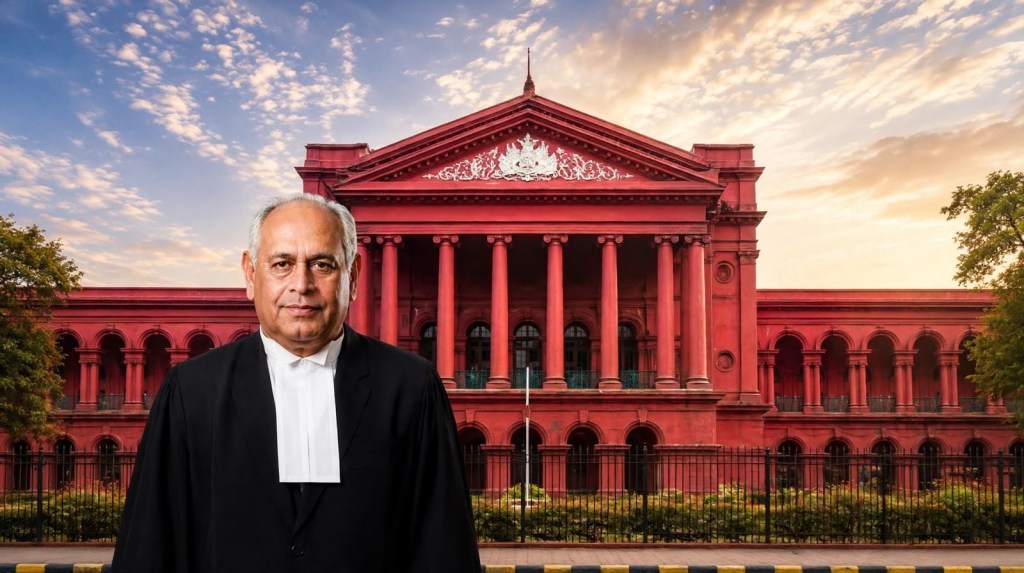
| Chief Justice Vibhu Bakhru was born in Nagpur on November 2, 1966. He did his schooling from Delhi Public School, Mathura Road, New Delhi. After completing his schooling he enrolled as a student with the Institute of Chartered Accountants of India and commenced his articles with Thakur, Vaidyanath Aiyar & Co. on 21.03.1985. He graduated from Delhi University in 1987, after completing the course of B.Com (Hon). He cleared his final examination for Chartered Accountancy, from the Institute of Chartered Accountants of India, in 1989. He received his LLB degree in 1990 and enrolled as an Advocate with Bar Council of Delhi in September, 1990. He practiced in the Supreme Court, High Court of Delhi, Company Law Board and various other Tribunals. He was designated as Senior Advocate by High Court of Delhi on 28th July, 2011. He was appointed as Additional Judge of High Court of Delhi on April 17, 2013 and as Permanent Judge on March 18, 2015 (F/N). Appointed as Acting Chief Justice of Delhi High Court w.e.f. 05.12.2024 to 21.01.2025. Appointed and took oath as the Chief Justice of the Karnataka High Court on 19.07.2025. |
Important judgments delivered by Justice Vibhu Bakru
Karnataka SC/ST(PTCL) Act. Before declaring an alienation void under the Act, the competent authority must record clear finding regarding the true character of the original grant/transaction specifically ascertaining whether the land was granted free, at a concessional/upset price to a protected class, or acquired outright through a genuine public auction. Karnataka High Court.
National Highways Act. Once an arbitral award determining compensation under Section 3G attains finality, the acquiring authority cannot subsequently reopen, recalculate, or reduce the compensation through administrative communications or collateral proceedings. Karnataka High Court.
Arbitration and Conciliation Act. The 30-day timeline prescribed for filing an application for correction or interpretation of an award under Section 33 is strict and can be varied or extended only by mutual agreement of the parties, and not by judicial condonation of delay. Karnataka High Court.
Arbitration and Conciliation Act. Appreciation of evidence or factual findings regarding mutual contractual default and quantum of restitution falls squarely within the domain of the Arbitral Tribunal. So long as the tribunal’s view is a plausible one based on record evidence, Courts will not interfere under the guise of patent illegality. Karnataka High Court.
Karnataka Motor Vehicles Taxation Act. An officer not below the rank of an Inspector of Motor Vehicles possesses the statutory authority to seize and detain a motor vehicle for tax evasion. Transport authorities can cancel a vehicle’s registration upon detecting that registration was obtained through fabricated or fraudulent documents. Karnataka High Court.
Karnataka Civil Courts (Amendment) Act. All Regular First Appeals filed and pending before the High Court on or after 28 August 2007 to be transferred to the subordinate Courts. Judgements already rendered and orders passed in such cases are held valid. Karnataka High Court.
http://dakshalegal.com/news/actionView/0ae640468c73ca82bd330c94
‘Premium FAR’ under the KT&CP Act is constitutionally valid. Empowering the State to permit prospective additional construction upon the payment of premium charges cannot be equated to an illegal regularization scheme. Karnataka High Court.
Environment. Bar against quarrying in a lake bed cannot be relaxed simply because the lake has remained dry for decades. State cannot be estopped from refusing permissions notwithstanding prior ‘no-objection’ reports. Karnataka High Court.
A tenant cannot withhold possession of the subject property till the security deposit is refunded. The remedy available to the tenant is to sue the landlord for refund of the security deposit after handing over possession. Karnataka High Court.
Manufacture, distribution, sale and possession of intoxicants are a privilege of a State. Even in the absence of any legislation, the decision to grant licences and privileges would be a matter of policy governed under Article 162 of the Constitution.
The State has exclusive privilege over the liquor trade, and no citizen has a fundamental right to carry on such business. Adoption of a public auction model for grant of excise licences is a valid policy decision and does not affect existing valid licence holders. Karnataka High Court.
Commercial Courts Act does not oust arbitration, but provides for recourse to the Commercial Division, the Commercial Appellate Division, or the Commercial Court, to the limited extent as contemplated under the Act. Karnataka High Court.
Arbitration and Conciliation Act. Allegations of fraud, criminal wrongdoing, or statutory violations do not, by themselves, oust the jurisdiction of an Arbitral Tribunal. Disputes arising from civil or contractual relationships remain arbitrable where covered by a valid arbitration agreement. Karnataka High Court.
Limitation Act. An assignment of receivables does not give rise to a fresh cause of action or extend the period of limitation. The limitation period for recovery of an assigned claim must be computed from the date on which the assignor originally became entitled to enforce the claim, and not from the date of the assignment. Karnataka High Court.
Karnataka Minor Mineral Concession Rules. In the matter of granting quarry leases, an applicant cannot claim a right of priority over the subject land if their application has already been rejected by the competent authority. The existence of a general land-specific report does not create an indefeasible right in favor of a former applicant whose request is no longer live. Karnataka High Court.
The amendments to the CPC brought about by the enactment of the Commercial Courts Act empower the Court to decree or dismiss a suit where it is demonstrated that the plaintiff has no real prospect of success, or that the defendant has no real prospect of effectively defending the claim. In such circumstances, recourse to rejection of the plaint cannot be resorted to. Karnataka High Court.
Land acquisition. Where a landowner participates in deliberations to determine the quantum of compensation and accepts a portion of that compensation, he is deemed to have acquiesced to the acquisition and cannot subsequently challenge its validity. Karnataka High Court.
Land acquisition. Mere proximity of two villages does not entitle landowners to uniform compensation if there is a clear evidentiary basis for differentiation, such as distinct guidance values and verified sale exemplar data. Differential compensation is legally sustainable when it is based on a rigorous analysis of local market transactions and official guidance values. Karnataka High Court.
Land acquisition. Where the owner possesses excess land under the Karnataka Land Reforms Act, the State is justified in not paying the compensation to that portion. Karnataka High Court.
Karnataka SC/ST (PTCL) Act. An order for the resumption and restoration of land not supported by original grant records or authentic copies is unsustainable. A claim for resumption of land cannot be entertained after an inordinate delay especially when the alienation was carried out through registered sale deeds for valuable consideration. Karnataka High Court.
A mining lease granted in contravention of the mandatory minimum area requirements is void. Such a lease is ineligible for the benefit of ‘deemed extension’ since a statutory legal fiction cannot be invoked to validate or extend an interest that was void at its inception. Karnataka High Court.
Karnataka Land Reforms Act. Occupancy rights arise only after the land vests in the State and the claimant proves tenancy through reliable revenue records showing actual cultivation. Absence of the claimant’s name in the Record of Rights for the relevant period cannot establish tenancy though there are later entries. Karnataka High Court.
Article 14 of the Constitution of India does not envisage any negative equality and the fact that any person has been wrongfully granted any benefit, would not be a ground for extending the benefit to all. Karnataka High Court.
A party to a registered lease agreement cannot seek to modify its essential terms, such as the quantum of rent, based on a disputed oral understanding without documentary proof. A lessor’s failure to exercise a contractual right to terminate a lease for non-payment of rent does not constitute a waiver of their right to recover arrears of rent or damages for the period of occupation. Karnataka High Court.
A fraudulently executed deed of transfer can be quashed under Article 226 of the Constitution of India. Division bench confirms the order of the single judge. Karnataka High Court.
Insolvency and Bankruptcy Code. The Liquidator is entitled to forfeit the entire earnest money deposit and participation deposit money when a successful bidder in an e-auction fails to unconditionally accept the Letter of Intent as per the terms of the auction memorandum. Karnataka High Court.
An appellate court exercising its jurisdiction under Section 13(1-A) of the Commercial Court Act ought not to interfere with the discretionary order of an interlocutory injunction passed by the Commercial Court unless that discretion is shown to have been exercised arbitrarily, capriciously, or perversely. Karnataka High Court.
Backward Class reservation. For determining whether a candidate is excluded on the ground of belonging to the creamy layer, the salary income of the candidate’s parents must be taken into account. Karnataka High Court.
Arbitration & Conciliation Act, 1996. An Arbitral Tribunal’s award of interest higher than the rate expressly stipulated in the contract on contractual amounts constitutes a patent error and is liable to be set aside under Section 34/37 to the extent of the excess interest awarded. Karnataka High Court.
Resjudicata. A mixed question of law and fact once decided between the same parties cannot be reopened in later proceedings and the interpretation of a statute will operate as res judicata where the cause of action remains the same. A pure question of law involving the court’s jurisdiction or validating an illegality is not barred by res judicata, since procedural rules cannot override substantive law. Karnataka High Court.
Karnataka Minor Mineral Concession Rules. A quarrying lease for an area less than the mandatory minimum of two acres can be granted only if it falls under a cluster approach and implements common Environmental Management Plan. In the absence of such material, the rejection of the application is valid and cannot be faulted. Karnataka High Court.
Code of Civil Procedure. In a summary suit, an application to set aside an ex parte decree is maintainable under Order XXXVII Rule 4 and not under Order IX Rule 13. The applicant must demonstrate special circumstances for non-appearance and also establish existence of a triable defense that would entitle him to leave to defend the suit. Karnataka High Court.
Wildlife (Protection) Act. Where land within a National Park’s notified limits is voluntarily surrendered under a Resettlement and Rehabilitation scheme, compensation must be determined under the land acquisition law in force when the scheme was framed, and not under the 2013 Act, even if the surrender occurred after the 2013 Act came into force. Karnataka High Court.
Karnataka Excise (General Conditions of Licences) Rules. ‘Transfer of property’ is different from ‘transmission of property’. Change in the constitution of a partnership firm resulting from death of a constituent partner cannot be termed as transfer to impose transfer fee. Karnataka High Court.
SARFAESI Act. The borrower’s right of redemption stands extinguished once the secured creditor publishes the auction notice. Any subsequent offer to pay dues or match the auction price after publication and confirmation of sale is invalid, as the SARFAESI Act overrides the general right of redemption under Section 60 of the Transfer of Property Act. Karnataka High Court.
Karnataka Land Revenue Act. Revenue authorities are authorized to correct or alter mutation entries in the Record of Rights based on undisputed source-of-title documents even when a civil suit on title is pending. Karnataka High Court.
A superior court exercising jurisdiction under Article 226 can refuse a successive remand to a statutory tribunal that has repeatedly failed to discharge its basic adjudicatory duty, such as examining evidence, despite earlier directions. Karnataka High Court.
Town Planning. The validity of a building plan sanction is governed by the law in force on the date of its approval, not the date of application. Mere submission of an application does not confer any vested right or legitimate expectation for consideration under the earlier regulations, particularly when a later statutory amendment introduces restrictions in the public interest. Karnataka High Court.
General Clauses Act. When the last date for filing a quarry lease renewal application falls on a Sunday or any public holiday, the statutory period for submission automatically extends to the next working day. Rejection of an application filed on the next working day is unsustainable. Karnataka High Court.
Arbitration and Conciliation Act. A civil suit for an injunction to restrain arbitration proceedings is barred under Section 5, as all issues concerning the Arbitral Tribunal’s jurisdiction—including the existence, validity, or limitation of the arbitration agreement—fall exclusively within the Tribunal’s competence under Section 16. Karnataka High Court.
An employer cannot initiate departmental proceedings for incidents that occurred beyond the prescribed limitation period. Once this period has lapsed, an employee’s retirement benefits cannot be withheld indefinitely on the pretext of contemplated disciplinary action. Karnataka High Court.
Karnataka Lokayukta jurisdiction extends to probing misconduct in recruitment, even before formal appointment, as a ‘public servant’ includes anyone ‘who is or was at any time’, a government servant. Karnataka High Court.
Right to Fair Compensation and Transparency in Land Acquisition, Rehabilitation and Re-Settlement Act does not provide a fresh cause of action in respect of the acquisitions of land that stand vested with the State. Any person in possession of the land after the same is vested with the State, is required to be treated as a trespasser. Karnataka High Court.
Commercial Courts Act. Disputes arising from the failure of a lessee to vacate premises used for commercial purposes, after the expiry of the lease term and despite service of notice under Section 106 of the Transfer of Property Act, fall within the jurisdiction of the commercial courts. Karnataka High Court.
Arbitration and Conciliation Act. Arbitral Tribunal is the final arbiter of the disputes and an Arbitrator’s interpretation of the contractual terms are not liable to be interfered with, unless the court finds that no reasonable person could possibly hold the said view. Karnataka High Court.
Karnataka Stamp Act. The maximum stamp duty of Rs. 25 crores on amalgamation of companies specified in the Schedule does not include the additional duty. The duty chargeable under the Act would include not only the stamp duty as imposed under Section 3, but also the additional duty as levied under Section 3B of the Act. Karnataka High Court.
Courts should refrain from interfering with or halting an election process once it has commenced, even in the face of allegations of illegality or procedural non-compliance. The preparation of the electoral roll is merely an intermediate stage, and once the process is underway, it must be allowed to run its course without judicial interruption. Karnataka High Court.
Arbitration and Conciliation Act. Disputes involving allegations of fraud can be referred to arbitration unless the allegations of fraud are so serious that they render the arbitration agreement itself void. Karnataka High Court.
https://www.dakshalegal.com/judgements/actionView/17284d9916b85f4eb00d511e

