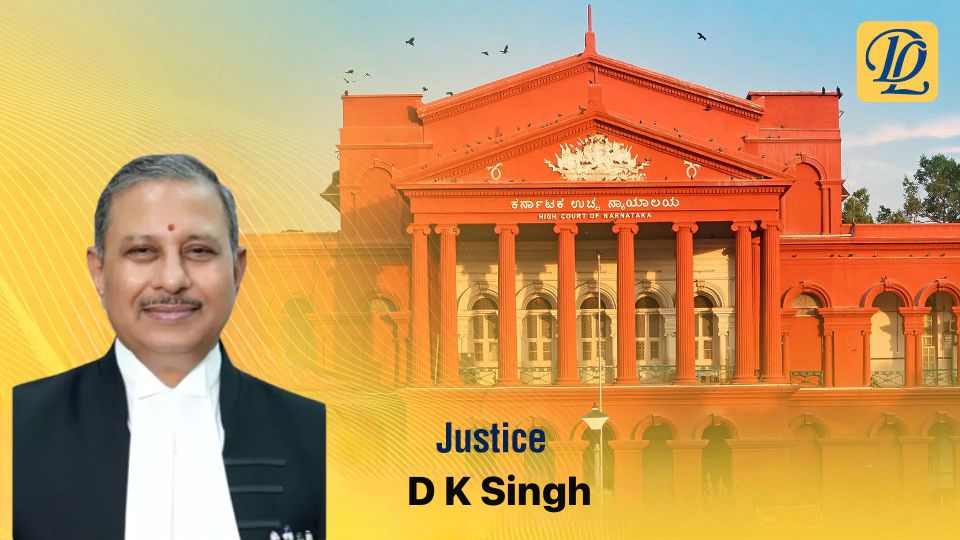
Hon’ble Mr. Justice D K Singh celebrates his 60th birthday today.
Hon’ble Mr. Justice D K Singh: Born to late Guru Prasad Singh and Phool Kunwar on 18.08.1966 at Lucknow, Uttar Pradesh. Did intercollegiate education in Sri Vidhya Mandir Inter College, Harimpur, U.P. obtained Bachelor’s Degree in Bipin Behari Degree College, Jhansi, U.P., Bachelor’s of Degree in Law from Allahabad University and LL.M. From Delhi University. Enrolled as an Advocate in the Bar Council of Delhi and set up legal practice in Allahabad High Court till 1997 and thereafter in Supreme Court from 1998 till the date of appointment, expertising in all matters including Constitutional, Administrative, Civil, Taxation, Arbitration and Criminal laws, was Additional Advocate General for State of Uttar Pradesh and Jharkhand till elevated to the Bench besides Senior Panel Counsel for Union of India.
On 22.09.2017 was appointed as an Additional Judge and took oath as Permanent Judge on 06.09.2019 and later on transferred as Judge of the High Court of Kerala w.e.f. 21.07.2023.
His Lordship was transferred as a Judge of Karnataka High Court and assumed office on 19.07.2025.
Important Judgements delivered by Hon’ble Mr. Justice D K Singh.
Land acquisition. A landowner who has unequivocally expressed ‘No Objection’ to the land acquisition proceedings and sought compensation is not entitled to subsequently seek deletion of their lands from the acquisition. The deletion of such lands cannot be justified on the principle of negative equality, especially when the land forms a large, compact, vacant block suitable for the layout, and any administrative order for deletion is without a proper BDA Board resolution. Karnataka High Court.
Labour Law. When a reinstatement award is passed in favor of a workman, and the implementation of that award is subsequently stayed by an appellate court upon the employer’s challenge, the principle of ‘no work no pay’ will not apply for the period the stay order was in operation, as the workman was prevented from working due to the employer’s legal challenge. Karnataka High Court.
A lease renewal or extension clause is not absolute and cannot be specifically enforced where it expressly makes renewal subject to the lessor’s consent. If the landlord refuses consent after the original term expires, the tenancy lawfully ends and the tenant’s continued possession becomes unlawful. Karnataka High Court.
NICE Project. Karnataka Industrial Areas Development Act. Even in the absence of an express ‘lapsing’ provision, the admitted failure on the part of the authorities to pass the awards for many decades coupled with the absence of any satisfactory explanation for such an inordinate delay renders the land acquisition proceedings unsustainable. Karnataka High Court.
Though a Lokayukta report is not a decree, it becomes binding on statutory authorities once affirmed by the High Court and the Supreme Court. Karnataka High Court deprecates the BDA for violating the rules and depriving a landowner of his right of way to benefit a real estate developer, in disregard of the affirmed Lokayukta report.
Land Acquisition. Principles of res judicata, doctrine of merger, and finality of litigation do not apply when a transaction, administrative action, or judicial decree is subsequently discovered to be tainted by fraud, suppression of material facts, or manipulation of official records. Karnataka High Court quashes the land acquisition proceedings after 37 years.
Adverse Possession. Possession that originates under an agreement of sale or any other permissive or derivative arrangement cannot ripen into adverse possession unless the occupant clearly, unequivocally, and hostilely repudiates the true owner’s title, and such repudiation is brought to the owner’s knowledge. Karnataka High Court.
Hindu Law. When a Mitakshara Hindu father partitions his self-acquired property among his sons, the shares allotted to the sons become their separate and absolute properties. Such property does not acquire the character of ancestral or coparcenary property in the hands of the sons with reference to their own children. Karnataka High Court.
Specific performance. While there is a general presumption that time is not of the essence, this presumption stands rebutted where the parties, by express terms of the contract, employ clear, unambiguous, and unequivocal language indicating their intention to prescribe a definite and mandatory period for performance. Karnataka High Court.
The Courts and Tribunals have inherent power to recall their own orders or judgments if those orders were obtained by fraud, even when statutory review is not available or has been exhausted in the earlier round of litigation. Karnataka High Court.
Land acquisition process initiated by the State for the benefit of a non-existent legal entity is void ab initio and constitutes a ‘statutory and constitutional fraud.’ Karnataka High Court orders criminal investigation by the CBI while quashing the acquisition.
BDA Act. Development scheme does not lapse if it has been substantially implemented. Where possession is taken, infrastructure is formed, sites are allotted, conveyances are registered and third-party rights are created, the acquisition becomes complete and irreversible. Deposit of compensation in the government treasury amounts to valid payment. Karnataka High Court.
Karnataka Town and Country Planning Act. The requirement to relinquish a portion of private land for public purposes as a prerequisite for the sanctioning of a building plan or layout does not amount to ‘compulsory acquisition’. Since such relinquishment is a statutory condition for the grant of a development permit, the landowner is not entitled to compensation. Karnataka High Court.
Indian Contract Act. When a creditor accepts new guarantee agreements and hypothecation deeds from the partners of a reconstituted firm in respect of an existing loan, it constitutes a novation of the contract. Such a substitution of the contract serves to extinguish the liability of the outgoing or retired partners under the original agreements. Karnataka High Court.
Interpretation of Statutes. An amendment styled as ‘for the removal of doubts’ that substantively alters legal liabilities or expands the tax base cannot retroactively impose penal or withholding consequences on past transactions conducted lawfully under the prevailing judicial interpretation at that time. Karnataka High Court.
Income Tax Act. An assessee cannot be held in default for failure to deduct tax pursuant to a retrospective statutory amendment. The obligation to deduct tax is governed by the law prevailing on the date of payment or credit, as no person can be compelled to perform an impossible obligation retrospectively. Karnataka High Court.
Service Law. A cadre created under statutory service rules cannot be abolished by an executive order; such abolition must be effected only by amending the relevant statutory rules or through appropriate legislation. Karnataka High Court.
Service Law. When the State Government provides an explicit assurance through official correspondence that candidates securing a minimum qualifying mark in a selection process will be appointed, such candidates acquire a ‘Legitimate Expectation’ of appointment. The State cannot subsequently deny these appointments by citing the abolition of the cadre or changes in recruitment rules. Karnataka High Court.
A party cannot be held ‘jointly and severally’ liable for a monetary claim in the absence of any oral or documentary evidence linking that party to the transaction. An admission by the plaintiff during cross-examination that a particular defendant was not involved in the deal or the receipt of funds is fatal to the claim against that individual. Karnataka High Court.
Urban Planning. A person who voluntarily relinquishes portion of land in favour of Planning Authority is deemed to have ‘acquiesced’ to that action. Such a party cannot later belatedly challenge the validity of the notification simply because other similarly situated persons succeeded in a legal challenge. Karnataka High Court.
Land acquisition. The power of eminent domain can be exercised by the State only for a legitimate ‘public purpose’ and must strictly adhere to the ‘due process of law.’ Any acquisition initiated on the basis of an incomplete application or conducted with undue haste to benefit a private entity at the cost of original landowners is arbitrary, violates the principles of natural justice, and is liable to be quashed. Karnataka High Court.
Companies Act 1956. The Court will not interfere with a Scheme of Arrangement approved by an overwhelming majority unless it is patently illegal, fraudulent, or based on a perverse valuation; pending misfeasance proceedings or minority share disputes do not bar sanction of an otherwise viable scheme. Karnataka High Court.
When a special statute prescribes a specific time limit for filing an appeal and expressly restricts the period for which delay can be condoned, the Courts cannot exercise discretionary powers to extend that period further. Mere filing and subsequent withdrawal of proceedings before the High Court does not reset the limitation timeline. Karnataka High Court.
‘’Nandi Infrastructure Corridor Enterprise Limited is sitting on a huge land bank without much progress’’. Karnataka High Court directs the State Government to bring fresh planning by discarding the Framework Agreement at the earliest.
The development of townships adjacent to a major infrastructure corridor is considered an integral and inseparable part of the ‘public purpose’ of the project. Once the overarching validity of an infrastructure project and its land requirements have been upheld by the Supreme Court, individual challenges to specific land parcels on the same grounds are barred by the principles of finality of litigation. Karnataka High Court.
Karnataka Lokayukta Act. Chairman of a government company is a ‘public servant’ under the Act. The collective nature of board decisions does not absolve the Chairman of responsibility for ensuring adherence to statutory rules. Karnataka High Court.
Prevention of Money Laundering Act. A transaction concerning a corporate asset that is already under liquidation, executed by a promoter or director without lawful title or authority, and undertaken in circumstances demonstrating absence of good faith, is liable to be declared void. Karnataka High Court.
Karnataka Land Revenue Rules. The State cannot unilaterally re-classify privately owned or previously granted land as ‘B-Kharab’ land for public purposes unless the land is already and factually occupied by public infrastructure like roads, footpaths, tanks, or streams, or be actively used as a burial/cremation ground. Karnataka High Court.
Industrial Disputes Act. A finding on the fairness and propriety of a domestic enquiry recorded in proceedings under Section 33(2)(b) operates as res judicata in subsequent proceedings under Section 10, provided that the finding was reached after a comprehensive enquiry where parties were permitted to lead oral and documentary evidence. Karnataka High Court.
BDA development scheme does not lapse if substantially implemented. Once significant land is taken, layouts formed, sites allotted, and possession lawfully vested in the State, the acquisition cannot be challenged for lapse merely because all land was not used within five years. Karnataka High Court.
Service Law. Seniority in a service cadre must be determined by the employee’s actual date of entry into that cadre. A rule granting a notional appointment date or weightage of past service is arbitrary and void if it confers seniority from a time when the employee was not yet ‘born in the cadre.’ Any such weightage can operate only for assessing eligibility for promotion, not for fixing inter-se seniority between direct recruits and promotees. Karnataka High Court.
Karnataka Lokayukta Act 1984. The Lokayukta has no authority under the Act to adjudicate questions of right, title, or interest in property; such issues can be determined only in appropriate civil proceedings. Karnataka High Court.
A Court Order obtained by misleading the court cannot be the basis for initiating contempt proceedings for its non-compliance. Such order cannot be given effect to and no contempt can be said to have been committed by its non-compliance. Karnataka High Court.
Prevention of Money Laundering Act. The Appellate Tribunal does not possess the inherent power to remand a case back to the Adjudicating Authority. The Appellate Tribunal is a creature of Statute with limited, specifically conferred powers, and the Act does not explicitly vest the power of remand in the Appellate Tribunal. Karnataka High Court.
Though a Lokayukta report is not a decree, it becomes binding on statutory authorities once affirmed by the High Court and the Supreme Court. Karnataka High Court deprecates the BDA for violating the rules and depriving a landowner of his right of way to benefit a real estate developer, in disregard of the affirmed Lokayukta report.
Companies Act. A lease agreement executed by a company’s former management in favor of a related party just before the filing of a winding-up petition, involving valuable assets at a nominal rent, constitutes a fraudulent preference and is void against the Official Liquidator. The Official Liquidator’s right to recover such assets cannot be defeated by a narrow interpretation of limitation, especially given the statutory exclusions provided under Section 458A. Karnataka High Court.
While a General Power of Attorney that is irrevocable and coupled with interest cannot be unilaterally cancelled, the mere use of the term “irrevocable” does not confer such protection if no interest is created. A GPA not coupled with interest, even if registered, is capable of being unilaterally cancelled, and such cancellation does not require prior notice by the Sub-Registrar. Karnataka High Court.
Trademarks Act. A company in liquidation loses its proprietary rights and goodwill over a trade mark when it has been continuously out of use for a long period. Its non-use is not covered by ‘special circumstances’ under Section 47(3). Karnataka High Court.
Karnataka Civil Services (Classification, Control and Appeal) Rules. Departmental proceedings initiated against a retired government servant more than four years after the date of the event are void and barred by limitation. Karnataka High Court.
Karnataka Civil Services (Classification, Control and Appeal) Rules. Natural justice requires that a delinquent officer be given notice and an opportunity to represent before the Disciplinary Authority records its final findings and imposes a penalty. No such hearing is required at the stage of merely recording disagreement with the Inquiry Officer’s findings. Karnataka High Court.
Properties mortgaged to a Bank as collateral security, and acquired prior to the alleged offenses, do not constitute ‘proceeds of crime’ under the PMLA. The attachment of such properties undermines the Bank’s rights as a secured creditor to recover public money under the SARFAESI Act, especially if the Bank was not issued notice under Section 8 of the PMLA. Karnataka High Court.
A land grant made by the Government for a specific purpose with right of resumption does not constitute a full alienation or sale of the land. Neither a mortgage of these limited rights nor the winding-up of the grantee company extinguishes the Government’s power of resumption. Karnataka High Court.
Suit for specific performance. Though the limitation period for filing a suit is three years, the plaintiff’s inaction in waiting until the fag end of the limitation period is a relevant factor in assessing his readiness and willingness to perform the contract. Karnataka High Court.
‘’High-rise buildings containing pocket apartments, irrespective of the luxury and amenities they offer, cannot be permitted to stand where they pose a risk to public safety, particularly to the residents of the building and those residing in the neighbouring and surrounding areas.’’ Karnataka High Court upholds suspension of the sanctioned plan.
Cyber Crime. Where a customer did not initiate or authorised the fraudulent transaction the Bank cannot shift the loss to the customer merely by alleging that the customer shared One Time Password. Karnataka High Court.

