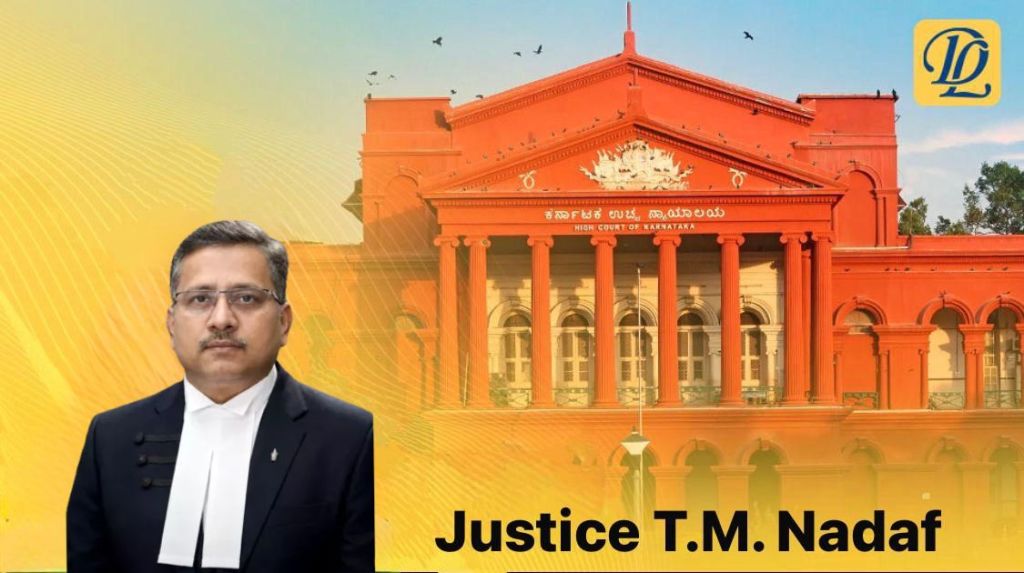
Hon’ble Mr. Justice T.M. Nadaf celebrates his 50th birthday today.
Hon’ble Mr. Justice T. M. Nadaf: Born on 07.07.1976, Native of Shiggaon, Haveri District. Graduated in Law from Vivekananda College of Law, Rajaji Nagar Bengaluru. Enrolled as an Advocate on 11.08.2000. Appeared before Civil Courts, Magistrate Courts, Tribunals, and High Court. In 2008, he shifted his practice to the High Court of Karnataka, Bench at Dharwad, where he distinguished himself through his expertise in civil, constitutional, service, labour, and criminal law. Empanelled as an Advocate in the High Court Legal Cell from 2020 till his elevation. Appointed as an Additional Judge of the High Court of Karnataka on 17.02.2025.
Important Judgments delivered by Hon’ble Mr. Justice T.M. Nadaf.
Even though the amended Section 5 of the PTCL Act removes the limitation period for initiating proceedings, the principle of laches continues to apply. Courts can deny relief in cases where there is an unreasonable delay in seeking restoration of land, especially if such delay causes prejudice to the other party. Karnataka High Court.
Service Law. Termination of a probationer simpliciter is valid when the order merely mentions unsatisfactory performance and does not carry stigma. Previous complaints and actions taken thereon are immaterial if the termination order does not refer to them. Karnataka High Court.
Consumer Protection Act. Complaints against banks alleging deficiency in service, particularly those arising from marital disputes or involving criminal allegations, are not suitable for adjudication through the summary procedure of consumer forums. Such complaints are liable to be dismissed, especially where the complainant had prior knowledge of the transactions in question. Karnataka High Court.
When adjudicating an industrial dispute involving contract labour, the Labour Court has the authority to examine whether the labour contract is a sham or camouflage to deny statutory benefits to the workmen, regardless of the specific terms of the reference. Karnataka High Court.
State Financial Corporations Act. Proceedings under the Act are akin to the execution proceedings and the investigation is summary in nature and not a full-fledged civil trial. Karnataka High Court.
Municipal authorities cannot issue trade licenses that violate zonal regulations governing land use. If a property is designated primarily for residential use with limited permission for commercial use, the issuance of a trade license for commercial activities exceeding the permissible limit does not legalize the unauthorized commercial use. Karnataka High Court.
Karnataka SC/ST (PTCL) Act. A sale deed executed in respect of granted land under the Act and presented for registration prior to obtaining permission is not void ab initio if the registration is completed after obtaining valid permission. Karnataka High Court.
State Financial Corporations Act. Proceedings under the Act are akin to the execution proceedings and the investigation is summary in nature and not a full-fledged civil trial. Karnataka High Court.
Consumer Protection Act. Complaints against banks alleging deficiency in service, particularly those arising from marital disputes or involving criminal allegations, are not suitable for adjudication through the summary procedure of consumer forums. Such complaints are liable to be dismissed, especially where the complainant had prior knowledge of the transactions in question. Karnataka High Court.
Where no proper notice is served on all parties after a prior remand, and the Land Tribunal fails to record who was in actual cultivation as tenant on the relevant date, a fresh remand is justified. Delay in challenge does not bar such relief if the petitioners were unaware of the proceedings due to lack of notice. Karnataka High Court.
When a court grants a legal benefit to certain individuals, the principle of treating similarly situated persons equally requires that the same benefit be extended to all others in identical circumstances, without necessitating separate litigation. Authorities are duty-bound to apply such decisions uniformly to all comparable cases. Karnataka High Court.
The High Court, under Article 226, should not adjudicate property title disputes, especially when a civil suit on the same matter is pending. While a land designation in a master plan may lapse if not acquired or utilized within five years, any subsequent action on a change of land use application depends on the outcome of the title dispute in the civil court. Karnataka High Court.
The regularization of unauthorized land occupation and the subsequent issuance of a Saguvali Chit are invalid if the granting committee’s order lacks a reasoned basis and fails to follow the prescribed legal procedures. Karnataka High Court.
Karnataka SC/ST (PTCL) Act. Mere allegations of fraud against the purchaser and illiteracy on the part of the original grantee, without specific details, are insufficient to invalidate the transaction, particularly when the application for resumption is filed after an inordinate delay. Karnataka High Court.
A disciplinary enquiry and criminal proceedings against a government employee cannot proceed when the foundational report and FIR on which they are based have been quashed. Karnataka High Court.
A subordinate court order based on a submission or concession made by the petitioner’s counsel cannot be questioned in a writ petition since the appropriate course is to seek modification of the order before the same court. Karnataka High Court.
Preventive detention. When the detaining authority has correctly distinguished a ‘public order’ issue from a ‘law and order’ issue, and if all mandatory procedural requirements, such as supplying the detenue with all relied-upon documents, have been strictly complied with, the court will not substitute its own opinion for the subjective satisfaction of the detaining authority. Karnataka High Court.
Motor Vehicles Act. Even non-dependent legal representatives of a deceased person are entitled to compensation for loss of dependency. A married daughter also is considered a legal representative and is entitled to compensation. Karnataka High Court.
Motor Vehicles Act. Combination of tractor and trailer is a goods carriage. Even if only the trailer and not the tractor is insured, the insurer of the trailer remains liable to compensate third-party claims arising from its use. Karnataka High Court.
BDA Act. Development scheme does not lapse if it has been substantially implemented. Where possession is taken, infrastructure is formed, sites are allotted, conveyances are registered and third-party rights are created, the acquisition becomes complete and irreversible. Deposit of compensation in the government treasury amounts to valid payment. Karnataka High Court.
When a special statute prescribes a specific time limit for filing an appeal and expressly restricts the period for which delay can be condoned, the Courts cannot exercise discretionary powers to extend that period further. Mere filing and subsequent withdrawal of proceedings before the High Court does not reset the limitation timeline. Karnataka High Court.
‘High-rise buildings containing pocket apartments, irrespective of the luxury and amenities they offer, cannot be permitted to stand where they pose a risk to public safety, particularly to the residents of the building and those residing in the neighbouring and surrounding areas.’ Karnataka High Court upholds suspension of the sanctioned plan.
When adjudicating an industrial dispute involving contract labour, the Labour Court has the authority to examine whether the labour contract is a sham or camouflage to deny statutory benefits to the workmen, regardless of the specific terms of the reference. Karnataka High Court.
Karnataka Lokayukta Act. An order entrusting a disciplinary enquiry to the Lokayukta based merely on its report under Section 12(3), without independent application of mind or establishment of a prima facie case, and merely reproducing the report despite contrary departmental findings, is liable to be quashed. Karnataka High Court.
Motor Vehicles Act. Insurance company is liable for accidents involving insured machinery like crane on public roads when a specific additional premium ‘third party liability cover’ has been paid for. Karnataka High Court.
Motor Vehicles Act. Holder of licence to drive a Light Motor Vehicle (LMV) can drive/operate mobile crane, it being a non-transport vehicle with an unladen weight below 7,500 kgs. Karnataka High Court.
Indian Registration Act. When a General Power of Attorney holder vested with full powers executes a sale deed, he is deemed to be the ‘person executing’ the document under Section 32(a). In such a case, authentication of the GPA by the Sub-Registrar is not required. Authentication is necessary only when an agent merely presents the document on behalf of the principal. Karnataka High Court.
Writ jurisdiction. The State is not exempt from the application of the doctrine of delay and laches, as an unexplained delay is fatal and prevents the re-opening of a finality attained by an order of the Tribunal. Karnataka High Court.
Urban Planning. A person who voluntarily relinquishes portion of land in favour of Planning Authority is deemed to have ‘acquiesced’ to that action. Such a party cannot later belatedly challenge the validity of the notification simply because other similarly situated persons succeeded in a legal challenge. Karnataka High Court.
When a non-executant seeks declaration that the sale deed is null or void and does not bind on him, he has to merely pay court fee on the value of the reliefs sought and not ad valorem court-fee on the sale consideration mentioned in the sale deeds. Karnataka High Court.
Specific Relief Act. Where the executant of a deed wants it to be annulled, he has to seek cancellation of the deed. But if a non-executant seeks annulment of a deed, he has to seek a declaration that the deed is invalid, or non est, or illegal or that it is not binding on him. (Referred) Karnataka High Court.
Hindu Law. When a Mitakshara Hindu father partitions his self-acquired property among his sons, the shares allotted to the sons become their separate and absolute properties. Such property does not acquire the character of ancestral or coparcenary property in the hands of the sons with reference to their own children. Karnataka High Court.

