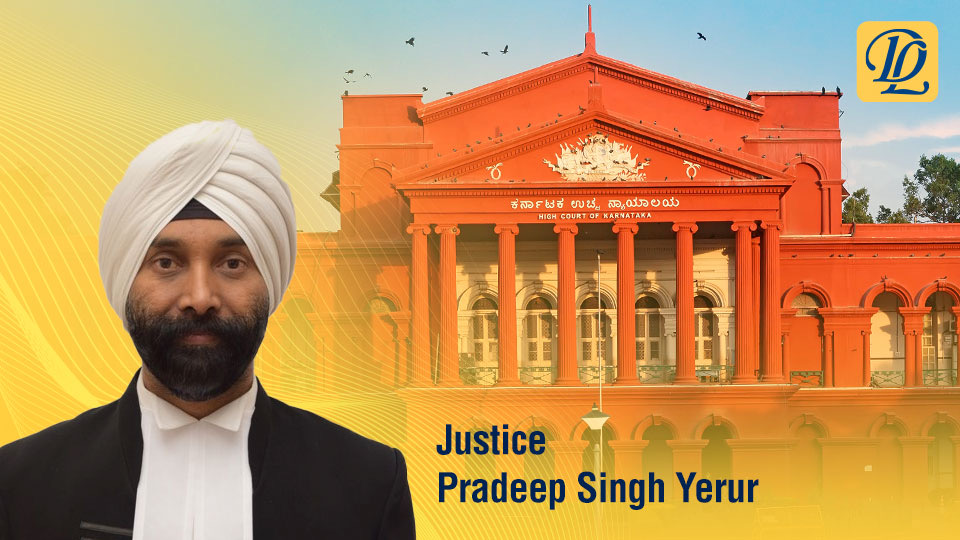
Hon’ble Mr. Justice Pradeep Singh Yerur celebrates his 56th birthday today.
Hon’ble Mr. Justice Pradeep Singh Yerur: Born on 21.06.1970. Enrolled as an Advocate on 30.05.1997.
Practiced in the field of Constitutional law, Labour Laws, Company Laws, Intellectual Property, Penal Laws, Banking Laws, Negotiable Instrument Laws, Property Laws, Consumer Protection Laws, Service law, House Rent Laws, Family Laws, Land Acquisition, Economic Offence Laws, Education Law before High Court of Karnataka, Punjab and Haryana High Court and Supreme Court of India.
Appointed as Additional Judge of the High Court of Karnataka and taken oath on 11.11.2019 and Permanent Judge on 08.09.2021.
Important judgments delivered by Justice Pradeep Singh Yerur.
N.I. Act. Cheque issued to managing partner of partnership firm. Complaint filed in the name of partnership firm not maintainable. Karnataka High Court.
Indian Penal Code. Section 304A. There must be a direct nexus between death of a person and rash and negligent act of accused. Death due to electrocution. Criminal negligence against Section officer of the electric company not proved. Karnataka High Court.
Writ Jurisdiction. Petition under Article 226 would NOT lie for issuance of a writ of Habeas Corpus for tracing missing persons. Only in cases of illegal detention or custody, such writ can be issued. Karnataka High Court.
Judicial review. A rule cannot be challenged on grounds of individual hardship. Courts cannot question wisdom behind policy decisions. Karnataka High Court upholds Rule increasing age limit of doctors for posts of General Duty Medical Officers.
Judicial review. Look Out Circular issued by Bank against debtor in larger public interest and economic interest of the nation cannot be the subject matter of judicial scrutiny. National interest is paramount. Karnataka High Court.
‘Perjury has become a way of life in the Law Courts.’ – Karnataka High Court while dismissing appeal arising out of a false claim under the Motor Vehicles Act with exemplary costs.
Electricity Supply. Purchaser of industry is liable to pay arrears towards electricity supply to earlier owner. However, there shall be apportionment of purchaser’s liability when only a part of industry is purchased. Karnataka High Court.
Bank loans. One Time Settlement. Once the OTS payment is made by the principal borrower, the surety is also discharged. Law on One Time Settlement discussed. Karnataka High Court.
Trademark. Authoritative judgment of the Karnataka High Court on ‘passing off’, ‘infringement’ ‘distinctiveness’ and ‘deceptive similarity’.
Bar under Section 132 of the Karnataka Land Reforms Act does not apply to a suit where the very jurisdiction of the Land Tribunal to grant occupancy rights is questioned. Karnataka High Court.
Employees Compensation Act, 1923. Section 4A(3)(a). Interest at 12% per annum shall be awarded from the date of the accident and not after expiry of thirty days thereafter. Karnataka High Court.
RTE Act. Government has no power to conduct examinations of its own other than the regular examinations conducted by the schools. Karnataka High Court.
Karnataka SC/ST PTCL Act. Delay of 20 years in applying for cancellation of the sale. Such application cannot be entertained by the authorities. Karnataka High Court.
We are living in different times, of terrorism. ‘’Bail is a rule & jail is an exception’’ has spent itself when it comes to acts of terrorism. Karnataka High Court reject bail plea of accused involved in ‘K.G.Halli Riots’.
Transfer of license for distribution of essential commodities is governed by the Control Order prevalent at the time of grant of license. Restrictions imposed in the subsequent Order cannot be applied. Karnataka High Court.
Statutory authority cannot take away property of the Citizen without paying compensation. Karnataka High Court directs conveyance of the alternate property.
Fair price shop. Compassionate allotment of licence on the ground of death of authorized original dealer. Control Order of 2016 and 2021 would not be applicable for the licenses issued earlier. Karnataka High Court.
Motor Vehicles Act. Renewal of permit is a privilege and preferential right of permit holders which shall be considered within a stipulated time failing which deemed renewal kicks in. Karnataka High Court.
‘’It is the duty of the State to take care of the widows and children of ex-servicemen who served this country’’. Karnataka High Court directs proper consideration of application for grant of land by widow of soldier.
Government Advocate has only fiduciary relation with the Government and cannot claim the benefit of forcing the Government to continue his services if the Government does not wish to do so. Karnataka High Court.
Property already vested under the Karnataka Land Reforms Act on 1 March 1974 cannot be subsequently declared as Wakf property. Karnataka High Court.
Order XXII Rule 10 of CPC. Procedure in case of assignment before final order in suit applies even to a suit for permanent injunction. Karnataka High Court.
When property is transferred by way of a registered document, Revenue authorities are duty bound to make entry in the revenue records/mutation records without application of the parties. Karnataka High Court.
Party whose presence would enable the Court to completely and effectively and adequately adjudicate upon all matters in dispute in the suit can be impleaded though no specific relief is sought against such party. Karnataka High Court.
Land acquisition Act of 2013. There is no bar for the land-loser to make an application even after the period of thirty days for reference under Section 64. Karnataka High Court.
When once the tenanted land is vested with the State Government under the Karnataka Land Reforms Act, the same cannot be subsequently declared as Wakf property. Karnataka High Court.
’Direction to mutate name of Government in respect of private property, without following due process of law, is illegal’. Karnataka High Court orders restoration of the owner’s name in the revenue records.
Cr.P.C. Inherent power to recall judgment applies only in cases of lack of jurisdiction, abuse of process, or denial of natural justice. Karnataka High Court.
Change of khata in respect of a purchased site cannot be refused on the ground that the original layout is unauthorised and illegal or that the site falls within the park or other civic area. Karnataka High Court.
A preliminary notification for land acquisition could be quashed if the authorities fail to proceed with the acquisition process within a reasonable time, even if the law does not prescribe a specific time limit. A reasonable period for issuing the final notification is two years. Karnataka High Court.
Labour Law. A Certified Standing Order or condition of service, specifically the age of superannuation, cannot be unilaterally amended by the Certifying Officer during the subsistence of a binding settlement that prohibits the raising of demands involving additional financial burden. Karnataka High Court.
Industrial Disputes Act. A bipartite settlement under Section 18(1) is binding only on the parties to the agreement and does not bind other workers who belong to a separate, non-signatory Union. Karnataka High Court.
Order XXXVII of the CPC. Summary suit. The issuance of summons in the specific format prescribed in Form No. 4-A of Appendix B is a mandatory requirement and not a mere technicality. A general summons issued in an ordinary format cannot set the summary clock in motion against the defendant. Karnataka High Court.
Order VII Rule 14(3) CPC. The production of a document is a procedural step distinct from its admission or proof in evidence. Since, mere production of a document does not amount to its proof and the opposing party retains the right to object to its marking or admissibility at the relevant stage of the trial, the Court should allow such application to ensure that all relevant material is available for a just decision on the merits of the case. Karnataka High Court.
Karnataka Police Act. An externment order must follow a structured procedure, which includes serving the person with a written notice of the allegations, granting a reasonable opportunity to respond, and allowing him to engage legal counsel and present witnesses. Karnataka High Court.
Grant of ad-interim ex-parte order of temporary injunction must comply with the mandatory requirement of the Proviso to Order XXXIX Rule 3 of the CPC, which obligates the Court to record specific reasons for its opinion that the object of granting the injunction would be defeated by delaying the issuance of notice to the opposite party. The failure to record such reasons renders the order unsustainable. Karnataka High Court.
An order of externment is an extraordinary measure that restricts a citizen’s fundamental right to freedom of movement; therefore, it cannot be passed on the basis of vague or ‘omnibus’ allegations. Failure to meet the mandatory requirements renders the externment order arbitrary and liable to be quashed. Karnataka High Court.
Negotiable Instruments Act. Cheque issued towards refund of advance sale consideration upon the failure to execute the sale deed, attracts the provisions of the Act. 2026 Daksha Legal Kar 139-146
https://www.dakshalegal.com/judgements/actionView/b1cccabf55296c4972e1af4b

