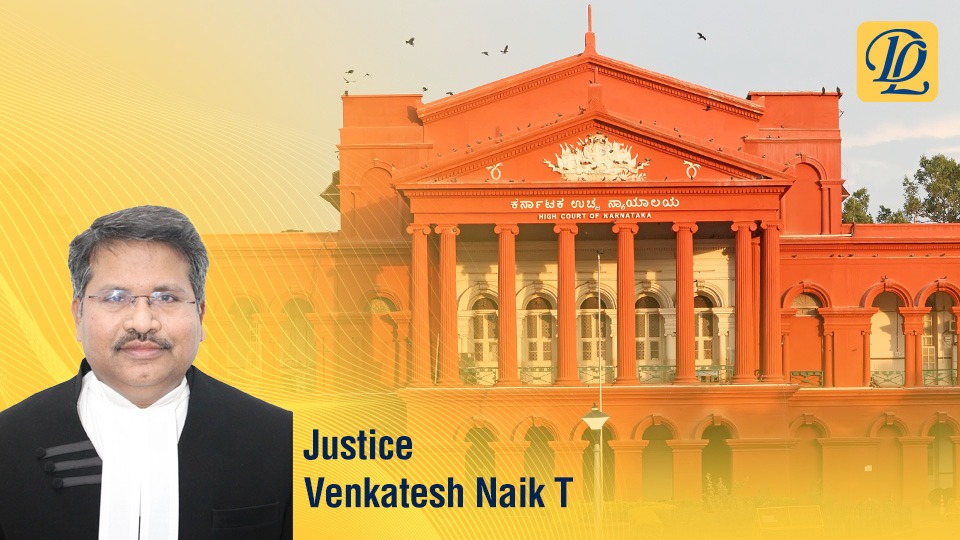
Hon’ble Mr. Justice Venkatesh Naik T celebrates his 51st birthday today.
Hon’ble Mr. Justice Venkatesh Naik Thavaryanaik: Born on 01.06.1975. Native of Chitradurga. Completed B.A.L., L.L.B., from SJM Law College, Chitradurga and secured 3rd Rank. Obtained L.L.M. from Kuvempu University, Shivamogga. Enrolled as Advocate and practiced at Chitradurga. Appointed as District Judge on 02.01.2012. Served as Registrar (Administration) at High Court. Worked at Prl. Secretary to Government, Law Department. Worked as Prl. District & Sessions Judge, Udupi & Bengaluru Rural District.
Sworn-in as Additional Judge of the High Court of Karnataka on 24.01.2023.
Important Judgments delivered by Hon’ble Mr. Justice Venkatesh Naik.
“Speedy trial in NIA cases guarantees the fundamental right under Article 21”. Karnataka High Court directs establishment of three more Special to ensure speedy trial and disposal of the NIA cases.
Karnataka High Court directs amendment of Section 377 IPC to include Necrophilia on the lines of laws prevalent in UK, Canada, NZ etc. Guidelines issued to install CCTVs in mortuaries and to maintain Mortuary hygiene.
Mere act of insulting a person would not satisfy the ingredients of Section 504, IPC. There must be intentional insult with intent to provoke breach of the peace. Karnataka High Court.
Abetment to commit suicide. Merely because a person has been so named in the suicide note, one cannot immediately jump to the conclusion that he is an offender under Section 306 of IPC. Karnataka High Court.
Additional accused can be added under Section 319 Cr.P.C. before the conviction and sentence is pronounced as otherwise the Court gets divested of its power. Karnataka High Court.
Criminal complaints cannot be quashed merely on the ground that the allegations made out by the complainant are civil in nature. Karnataka High Court.
Concept of ”reasonable doubt” in criminal cases. Authoritative judgment of the Karnataka High Court.
Suit for specific performance. When the defendant neither pleads nor leads evidence on hardship, Court shall decree the suit especially when the plaintiff proves readiness & willingness. Karnataka High Court.
Mere expression of words without any intention to cause alarm or cause to do any act which he is not legally bound to do, or to omit to do does not constitute criminal intimidation under Section 506 IPC. Karnataka High Court.
Courts must be liberal in allowing applications to record evidence of witnesses by Audio-Video Electronic means. Karnataka High Court.
Mere use of words ‘Investigating Officer is directed to conduct the investigation’ without applying the judicious mind, does not amount to permission by the Magistrate to take up the investigation for a non-cognizable offence. Karnataka High Court.
Advocates must practice Seven Lamps of Advocacy. Making false allegations against the Presiding Officer cannot be countenanced for transfer of case under Section 407 of Cr.P.C. Karnataka High Court.
Mere act of insulting a person would not satisfy the ingredients of Section 504, IPC. There must be intentional insult with intent to provoke breach of the peace. Karnataka High Court.
Abetment to commit suicide. Merely because a person has been so named in the suicide note, one cannot immediately jump to the conclusion that he is an offender under Section 306 of IPC. Karnataka High Court.
Additional accused can be added under Section 319 Cr.P.C. before the conviction and sentence is pronounced as otherwise the Court gets divested of its power. Karnataka High Court.
Land acquisition. Deletion of certain lands from the acquisition based on objective, rational considerations, including areas that had already been converted for non-agricultural use, extensively developed localities, nurseries, religious institutions, and lands already acquired for other Government projects etc cannot be a ground to challenge the acquisition proceedings. Karnataka High Court.
Land acquisition. Failure to include land in the preliminary notification and denial of the right to file objections vitiates the entire acquisition proceedings. Arbitrary exclusion or inclusion of lands in the acquisition process is discriminatory and unlawful. Karnataka High Court.
A General Power of Attorney duly executed and notarized carries a presumption of validity under Section 85 of the Indian Evidence Act. Mere execution of a cancellation deed and its registration under Book IV of the Registration Act does not amount to constructive notice to third parties. Karnataka High Court.
Service Law. A suspension order cannot be sustained if it is based solely on a criminal case that has been quashed. Continued suspension, in the absence of periodic review is illegal. Karnataka High Court.
Judgment on admission. A suit can be dismissed on the basis of admissions if they are unequivocal and leave no further dispute regarding the material facts in the case. Admissions regarding the validity of a family settlement in a compromise petition falls within the ambit of Order XII Rule 6 CPC. Karnataka High Court.
”Even if disobedience of a court order is undisputed, the court may consider a defence of impossibility to comply and refrain from initiating contempt proceedings if enforcement is deemed impossible”. Karnataka High Court accepts substantial compliance regarding restoration of forest lands in the revenue records.
Constructive Resjudicata. To invoke Order II Rule 2 CPC and to reject the plaint, there should be intentional relinquishment of claim in the earlier suit. Karnataka High Court.
“No breaking of link’’. In a criminal trial based entirely on circumstantial evidence, the Court cannot sustain a conviction for murder based on inadmissible statements and weak circumstantial links that do not exclude the hypothesis of innocence. Karnataka High Court.
‘Uninformed legitimization of trivialities would make a mockery of administration of criminal justice.’ Where the testimony of the primary witness reveals a pre-planned attempt to falsely implicate the accused in coordination with the Police, the evidence loses its credibility, and the accused is entitled to an acquittal. Karnataka High Court.
Dowry death. A conviction cannot rest solely on medical evidence of homicidal death without a credible link showing cruelty soon before death. Where interested witnesses give materially contradictory statements unsupported by independent evidence, statutory presumptions cannot be invoked. If dowry allegations are vague and the prosecution fails to prove guilt beyond reasonable doubt, the accused is entitled to the benefit of doubt. Karnataka High Court.
Companies Act 1956. The Court will not interfere with a Scheme of Arrangement approved by an overwhelming majority unless it is patently illegal, fraudulent, or based on a perverse valuation; pending misfeasance proceedings or minority share disputes do not bar sanction of an otherwise viable scheme. Karnataka High Court.
“Nandi Infrastructure Corridor Enterprise Limited is sitting on a huge land bank without much progress’’. Karnataka High Court directs the State Government to bring fresh planning by discarding the Framework Agreement at the earliest.
The development of townships adjacent to a major infrastructure corridor is considered an integral and inseparable part of the ‘public purpose’ of the project. Once the overarching validity of an infrastructure project and its land requirements have been upheld by the Supreme Court, individual challenges to specific land parcels on the same grounds are barred by the principles of finality of litigation. Karnataka High Court.
Trademarks Act. A company in liquidation loses its proprietary rights and goodwill over a trade mark when it has been continuously out of use for a long period. Its non-use is not covered by ‘special circumstances’ under Section 47(3). Karnataka High Court.
A lease renewal or extension clause is not absolute and cannot be specifically enforced where it expressly makes renewal subject to the lessor’s consent. If the landlord refuses consent after the original term expires, the tenancy lawfully ends and the tenant’s continued possession becomes unlawful. Karnataka High Court.
Karnataka Lokayukta Act. Chairman of a government company is a ‘public servant’ under the Act. The collective nature of board decisions does not absolve the Chairman of responsibility for ensuring adherence to statutory rules. Karnataka High Court.
Prevention of Money Laundering Act. A transaction concerning a corporate asset that is already under liquidation, executed by a promoter or director without lawful title or authority, and undertaken in circumstances demonstrating absence of good faith, is liable to be declared void. Karnataka High Court.
A Court Order obtained by misleading the court cannot be the basis for initiating contempt proceedings for its non-compliance. Such order cannot be given effect to and no contempt can be said to have been committed by its non-compliance. Karnataka High Court.
Properties mortgaged to a Bank as collateral security, and acquired prior to the alleged offenses, do not constitute ‘proceeds of crime’ under the PMLA. The attachment of such properties undermines the Bank’s rights as a secured creditor to recover public money under the SARFAESI Act, especially if the Bank was not issued notice under Section 8 of the PMLA. Karnataka High Court.
Prevention of Money Laundering Act. The Appellate Tribunal does not possess the inherent power to remand a case back to the Adjudicating Authority. The Appellate Tribunal is a creature of Statute with limited, specifically conferred powers, and the Act does not explicitly vest the power of remand in the Appellate Tribunal. Karnataka High Court.
A land grant made by the Government for a specific purpose with right of resumption does not constitute a full alienation or sale of the land. Neither a mortgage of these limited rights nor the winding-up of the grantee company extinguishes the Government’s power of resumption. Karnataka High Court.
Land acquisition. Deletion of certain lands from the acquisition based on objective, rational considerations, including areas that had already been converted for non-agricultural use, extensively developed localities, nurseries, religious institutions, and lands already acquired for other Government projects etc cannot be a ground to challenge the acquisition proceedings. Karnataka High Court.

