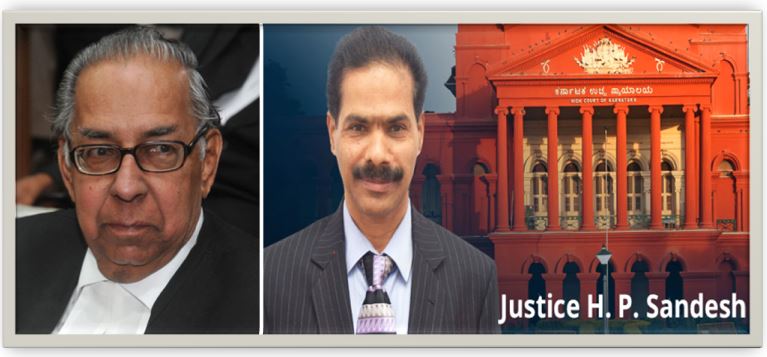
In a recent order pronounced by Justice H.P. Sandesh of the High Court of Karnataka, the learned Judge has recommended that the Additional Sessions Judge who has granted bail / anticipatory bail in the case should be sent to the Karnataka State Judicial Academy for training. This is a serious adverse comment or rebuke of the Judge concerned.
This direction has the effect of demoralising the Sessions Judges of the State who are dealing with applications under Section 438 and 439 of the Cr.P.C. and prompting them to dismiss most of the applications so that they will not suffer adverse comments from the High Court. Already there is a view (as recently expressed by the High Court of Calcutta) that the judges of the District Judiciary are stingy in the matter of grant of bail. It is not surprising that statistics show that 69% of inmates of the jails in India are under trials. Now with this above order, the position is worse for applicants for bail or anticipatory bail before session judges /Magistrate and in border line cases, applications are sure to be dismissed.
Judges are after all human beings and have therefore their own views, prejudices and opinions. Admittedly grant or refusal of bail is discretionary, of course to be exercised judicially. On same set of facts two Judges may render conflicting decisions, more so in the case of discretionary matters. It is a well known fact that there are judges who are considered pro conviction or pro acquittal, pro labour or pro management, pro landlord or pro tenant , pro establishment or pro citizen , conservative or progressive thinking and so on. The Judges dealing with bail applications are no exception. Some are liberal in the matter of grant of bail, some are very strict. In the recent case of Arnab Goswami, while the District Judiciary and High Court declined to grant bail, the Supreme Court quickly took a contrary view and granted bail, which some commented, was a hasty decision. In such matters personal view point and opinion of the judges do play an important role and one cannot expect all judges to act similarly, as computers do.
The learned judge has stated that the Sessions Judge should go to the Judicial Academy for training in “Applying Judicial thought process” and “endeavour to learn judicial discretion”. I do not think, exercise of Judicial discretion could be a subject of training. There are hundreds of cases, where Supreme Court has reversed the discretionary orders of the High Courts holding that the judicial discretion has been exercised capriciously and the decision is perverse. High Courts reverse several discretionary orders of grant or refusal of temporary injunctions in pending suits, which could be done only if the order under appeal is perverse, capricious or arbitrary.
Therefore the Court reversing a discretionary order directing the judge whose order is reversed to undergo training in Judicial academy may not be a good precedent. Such a direction may encourage Sessions Judges/Magistrate to reject bail applications even in deserving cases to be on the safer side.
In the case on hand, the High Court may or may not be right in reversing the order, as we do not know the full facts. However the Sessions Judge cannot be faulted, for observing that the case is not punishable with death or imprisonment for life. Section 437 Cr.P.C. itself has placed such cases in a different category.
The High Court Judgment at one place records that charge sheet has been filed in the case. It is also a relevant consideration. However in another part of this judgment, the High Court finds fault with the Sessions Judge for granting bail even before investigation is completed. The charge includes Section 498A IPC and demand of dowry. Misuse of these provisions have been the subject matter of adverse comments in many judgments of the Supreme Court and lower courts have been directed to exercise caution in such cases. In a decision rendered few days back a bench of Supreme Court (Comprising of Justices S. Abdul Nazeer and Krishna Murari ) while quashing a FIR against the in laws of the woman who had accused them and her husband of cruelty and harassment for dowry noticed “ increased tendency to employ provisions like section 498A IPC ….. as instruments to settle personal scores against husband and his relatives.” After refereeing to some earlier cases they said “ Decisions clearly demonstrate that this court has at numerous instances express concern over the misuse of section 498A IPC and the increased tendency of implicating relatives of the husbands in matrimonial disputes……….False implications by way of general omnibus allegations made in the course of matrimonial disputes, if left unchecked would result in misuse of the process of law. Therefore this court by way of its Judgements has warned the courts from proceeding against relatives and in laws of the husband (woman), when no prima facie case is made out against them”
As seen from the judgment of the High Court, main evidence relied on is a voice message said to have been sent by the victim before her death stating that if anything happens to her, the named accused (her husband and parents) will be responsible for the same. Such declarations are found in many death notes in cases of suicide and the Supreme Court and the High Courts have directed caution in relying on such declarations which have become common. In many cases, employees committing suicide have named many executives of the companies as responsible for suicide and such declarations have been found to be not true. In the present case, strangely the voice message said to have been sent is not to the parents or relatives but to their neighbors.The message is not of any past act of cruelty or harassment for dowry.
At best, it can be said that prosecution has made out a prima facie case. It is settled law that mere making out prima facie case is not sufficient to deny bail, particularly in cases where punishment is not death or imprisonment for life .In the case of Bhagiratsinh Judeja Vs State of Gujarath (AIR 1984 S.C.372 ) the Supreme Court has observed “ We fail to understand what the learned Judge of the High Court desires to convey when he says that once a prima facie case is established, it is necessary for the court to examine the nature and gravity of circumstances in which the offence was committed. If there is prima facie case,there is no question of considering other circumstances. But even where a prima facie case is established , the approach of the court in the matter of bail is not that the accused should be detained by a way of punishment but whether the presence of the accused would be readily available for trial or that he is likely to abuse the discretion granted in his favour by tampering with evidence”.
In the Case on hand, it is not even alleged or found by the High Court that accused is likely to abscond or evidence may be tampered with as important witnesses are complainant and his relatives. It is unnecessary to go into details, as my only purpose is to point out that on facts opinions always differ.
One can appreciate the sympathy and the concern shown by the learned Judge of the High Court towards the victim . However that should not result in detention of the accused at pretrial stage as a measure of punishment.
It appears, the main reasons which prompted the learned High Court Judge to deny the bail, is that dowry death case is a heinous offence and hence the order of the Sessions Judge granting bail is capricious and perverse and therefore unsustainable. It cannot be laid down as proposition of law, that in heinous offenses (including dowry death or murder) bail cannot be granted. It is hoped that soon in appropriate cases, the High Court it self will clarify this position, as other wise the present decision may act as a dangerous precedent. So far as the recommendation regarding training in Judicial Academy is concerned, I hope the Hon’ble Chief Justice will pass suitable order taking all aspects into consideration.
B.V.Acharya, Senior Advocate, Bengaluru.


 Daksha Legal
Well said sir
LikeLike
I Agree with senior counsel’s view. It’s apposite to mention that the periodical training is given to all the judicial officers in all cadre.Now the time is to analyse why the training is not yielding the desired result.
LikeLike
Senior Counsel is right. Circumstances in each case will be different and that shouldn’t be punitive action against the sessions judge. Sessions Court has its own Inherited powers to pass orders. Well said Senior Counsel
LikeLike
The view of the learned senior advocate is absolutely correct.
LikeLike
Senior counsel view is very correct honble judge order will impact too much on the sessions court and magistrate court judges to deny bail, if lower courts denies bail then all accused cannot approach high court because of poorness, such kind of accused will suffer lot
LikeLike