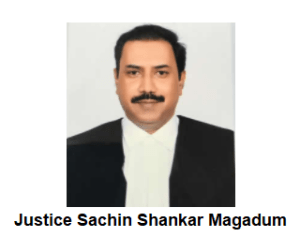
Ratnamma Baramappa Nagara and others vs State of Karnataka and others. Writ Petition 146835-853/2020 decided on 27 August 2020. Justice Sachin Shankar Magadum.
Judgment Link: http://judgmenthck.kar.nic.in/judgmentsdsp/bitstream/123456789/339068/1/WP146835-20-27-08-2020.pdf
Relevant paragraphs: 25. The question that would arise before this Court is, once the members of Zilla Panchayath resolve to initiate no-confidence motion against the fourth respondent-President, whether the no- confidence motion can be kept in abeyance on the premise that Rules are yet to be framed. To answer this question it would be relevant to examine the proposition laid down by the Hon’ble Apex Court in Vipulbhai M. Chaudhary’s case (2005) 8 SCC 1. Wherein at Paragraph 16 while exhaustively dealing with no-confidence motion pertaining to the members of the Co-Operative Societies has held as follows:
“16. The principle of representative democracy is the election of representatives by the people otherwise eligible to cast their vote and the people thus elected, constituting the body for the management of an institution. Thus, in the case of co-operative societies, after the amendment in the Constitution, there has to be a Board of elected representatives, which may be called Board of Directors or Governing Body or a Managing Committee, etc. to which the members entrust the direction and control of the management of the affairs of the society. That representative body selects one among the elected representatives as its Chairman or any other office-bearer, as the case may be. Selection is the act of carefully choosing someone as the most suitable to be the leader or office-bearer. Thus, there is a lot of difference between election of delegates/representatives to constitute a body and selection of a person by the body from amongst the elected members to be the leader. It is to be borne in mind that the management and control of the society is entrusted to the representative body viz. the Board of Directors and that the Chairperson elected by the Board of Directions is the Chairperson of the society and not of the Board of Directors”.
26. The Hon’ble Apex Court having observed as above was also of the view that the Democracy demands accountability and transparency in the activities of the Chairperson especially in view of the important functions entrusted with the Chairperson in the running of Panchayat Raj Institutions. The Apex Court was of the view that such duties can be discharged by the Chairperson only if he/she enjoys the continuous confidence of the majority members in the panchayath. The Apex Court was also of the view that any statutory provision to demonstrate that the Chairperson has lost the confidence of the majority is conducive to public interest and adds strength to such bodies of the self-governance. The Apex Court at Para 25 has further observed thus:
“25. Silence in the Constitution and abeyance as well has been dealt extensively by Michael Foley in his celebrated work The Silence of Constitutions. To quote from the Preface: “ Abeyances refer to those constitutional gaps which remain vacuous for positive and constructive purposes. They are not, in any sense, truces between two or more defined positions, but rather a set of implicit agreements to collude in keeping fundamental questions of political authority in a state of irresolution. Abeyances are, in effect, compulsive hedges against the possibility of that which is unresolved being exploited and given meanings almost guaranteed to generate profound division and disillusionment. Abeyances are important, therefore, because of their capacity to deter the formation of conflicting positions in just those areas where the potential for conflict is most acute. So central are these abeyances, together with the social temperament required to sustain them, that when they become the subject of heightened interest and subsequent conflict, they are not merely accompanied by an intense constitutional crisis, they are themselves the essence of that crisis.”
In Part II, Chapter Four, the author has also dealt with the constitutional gaps and the arts of prerogative. To the extent relevant, it reads as follows (P.82):
“ Gaps in a constitution should not be seen as simply empty space. They amount to a substantial plenum of strategic content and meaning vital to the preservation of a constitution. Such interstices accommodate the abeyances within which the sleeping giants of potentially acute political conflict are communally maintained in slumber. Despite the absence of any documentary or material form, these abeyances are real, and are an integral part of any constitution. What remains unwritten and indeterminate can be just as much responsible for the operational character and restraining quality of a constitution as its more tangible and codified components.”
27.The Apex Court has further held that the co-operative society registered under the Central or the State Act is bound to function as a democratic Institution and conduct its affairs based on democratic principles. The Apex Court was of the view that democratic functioning on democratic principles is to be reflected in the respective Acts or Rules or bye-laws both on the principle and procedure. If such Rules or procedures are not contemplated then it is for the Court to read the democratic principles and if there is no express provision under the Act or Rules, or Bye-laws for removal of an office bearer, such office-bearer is liable to be removed in the event of loss of confidence by following the same procedure by which he was elected to the office. In this background, the contention of the learned Senior counsel appearing for the fourth respondent that this Court cannot exercise jurisdiction under Article 226 of the Constitution of India needs to be out rightly rejected.
30. In the present writ petitions, the petitioners are seeking a writ of mandamus. The petitioners are duly elected members of Zilla Panchayath and having expressed no confidence motion, have submitted a requisition to Respondents 2 and 3 as well as to the fourth respondent. The petitioners have statutory right to seek ‘No-confidence motion. On examination of the averments and grounds raised in the writ petition and also having examined the judgments cited by the learned counsel appearing for the petitioners, it is clearly forthcoming that the petitioners have some legal right to seek ‘No- confidence motion’ against the respondent No.4. The Act clearly contemplates corresponding legal duty upon the respondents.
31.In the present writ petitions, the petitioners are seeking a writ of mandamus. The petitioners are duly elected members of Zilla Panchayath and having expressed no confidence motion, have submitted a requisition to Respondents 2 and 3 as well as to the fourth respondent. The petitioners have statutory right to seek ‘No-confidence motion. On examination of the averments and grounds raised in the writ petition and also having examined the judgments cited by the learned counsel appearing for the petitioners, it is clearly forthcoming that the petitioners have some legal right to seek ‘No- confidence motion’ against the respondent No.4. The Act clearly contemplates corresponding legal duty upon the There are no two opinions about the aphoristic judicial observation that Article 226 of the Constitution confers extraordinary jurisdiction on this Court and that is wide as well as expansive, no fetter can be placed on the exercise of the said extraordinary jurisdiction. The adjudicatory ambit of an issue, indeed, is kept to the discretion of Constitutional Courts. The primary purpose of a writ of mandamus is to protect and establish rights and to impose a corresponding imperative duty on State and its officials.
33…I do not find any legislative intent indicating that the authority exercising power under the amended provisions has to wait until and unless, rules are framed in that regard. The word “may” would in no way preclude the authority from exercising its power under the Statute.
34.… I am of the view that in absence of any such express provision, framing of rules cannot be a condition precedent for exercise of power under the Statute. The Principle Act clearly contemplates a procedure and there would be no impediment for the authority to follow the existing procedure.
Compiled by S.Basavaraj, Advocate, Daksha Legal.

 Daksha Legal
Thanks to members of DAKSHAL LEGAL AND SERVICES FOR THE EXCELLENT INFORMATION
APPASAHEB JAVALKAR BELGAUM VISHAL
KARNATAKA
LikeLike