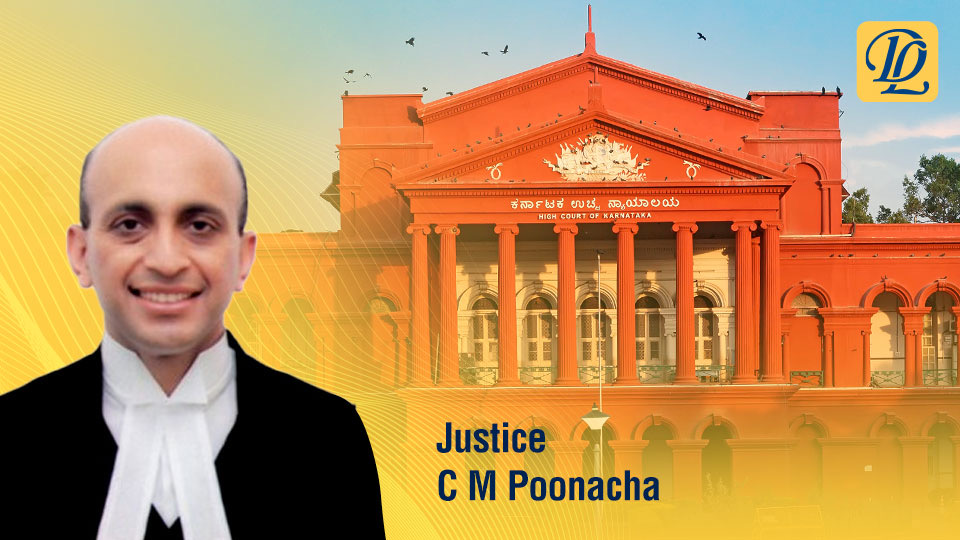
Hon’ble Mr. Justice C.M. Poonacha celebrates his 52nd birthday today.
Hon’ble Mr. Justice C M Poonacha: Born on 06th April 1974. Completed Law from University Law College, Bangalore and enrolled as an Advocate in October 1997.
Joined the chambers of Sri. S.K.V. Chalapathy, Senior Advocate and later his father Sri C. M. Monnappa, Advocate. Co-founded a law firm ‘Lexplexus’ in August 2001. Handled various matters before the District Courts, High Court of Karnataka and Supreme Court of India as well as before various Forums and Tribunals as also numerous Arbitration matters.
Represented various Government Entities, Banks, Insurance Companies and other institutions apart from private clientele. Empanelled with the Karnataka State Legal Services Authority, High Court of Karnataka since 2015.
Appointed as Addl. Government Advocate, High Court of Karnataka in August 2020.
Appointed as Additional Judge, High Court of Karnataka and taken oath on 13.06.2022.
Important Judgements delivered by Hon’ble Mr. Justice C M . Poonacha.
Alienation of the re-granted ‘Service Inam Land’ from the period 1:2:1963 to 7:8:1978 is valid and permission for sale is only a formality since the Deputy Commissioner is bound to give permission. Karnataka High Court reiterates.
Industrial Disputes Act. Employer is not liable to pay Provident Fund contribution in respect of Section 17B wages to employee. Karnataka High Court.
Stay of execution proceedings under Order 21 Rule 29 during pendency of suit does not apply when the suit if filed after initiation of the execution proceedings. Karnataka High Court.
Sale deed executed in violation of an order of injunction passed by a competent Court is unlawful under Section 23 of the Contract Act and the purchaser cannot claim any right or equity under the sale transaction. Karnataka High Court.
Employer is not liable to deposit provident fund contribution in respect of payments made in compliance of Section 17-B of the Industrial Disputes Act. Karnataka High Court.
Industrial Disputes Act. Proportionality of the punishment cannot be gone into by the Tribunal while considering the application of the employer under Section 33(2)(b). Karnataka High Court.
Suit for recovery of arrears of rent. Landlord cannot claim enhanced rent under the lease deed which requires registration but not registered. Karnataka High Court.
Provision regarding regulation of erection of buildings under the Panchayat Raj Act does apply to erection of mere compound wall. Karnataka High Court.
Sufficiency of cause for wife to live separately from husband cannot be gone into in a proceeding under Section 125 Cr.P.C. Negligence or refusal by husband to maintain is sufficient. Karnataka High Court.
Execution of decree. If objector claims through Judgment Debtor, the application is to be rejected. If the claim is based on an independent right, such an application shall be enquired into. Karnataka High Court.
Remand of the entire suit for fresh trial when the first appellate Court records a finding that the decree was a collusive one and material facts having been suppressed, is permissible. Karnataka High Court.
Civil Procedure Code. Summons served on wife of defendant is sufficient service. Presumption arises that the defendant had knowledge of the suit and the date of hearing mentioned in the summons. Karnataka High Court.
The only relevant issue in a suit under Section 6 of the Specific Relief Act is prior possession and illegal dispossession therefrom. Title to the property is irrelevant. Karnataka High Court.
Withdrawal of suit without liberty to institute a fresh suit as contemplated under sub-rule (3) of Order XXIII Rule 1 of the CPC operates as res judicata for fresh suit on the same cause of action. Karnataka High Court.
Question of limitation in a suit for partition arises only if defendants prove ouster of plaintiff from the joint family properties. Karnataka High Court.
Suit for partition. When one co-sharer is in possession of the properties, all other co-sharers are presumed to be in possession on the basis of joint title. Karnataka High Court.
Executing court can go into validity of claim based on Will in final decree proceedings. Karnataka High Court.
Execution Court must consider whether a portion of the property is sufficient to satisfy the decree. Failure amounts to ‘substantial injury’ within the meaning of Order 21 Rule 90. Karnataka High Court.
Karnataka Co-operative Societies Act. Once the calendar of events is published, the District Election Office loses jurisdiction and cannot order postponement of the elections. Karnataka High Court.
If majority of members of a Co-operative Society resign thus bringing strength below the quorum, then all other members shall be deemed to have vacated their office and fresh election shall be held to all the posts. Karnataka High Court.
“Land acquisition for public purpose. Procedural defects which do not go to the root of the matter should not be permitted to defeat a just cause’’. Karnataka High Court while upholding land acquisition by the BDA.
Employers Compensation Act is a beneficial Legislation which requires liberal interpretation. Liability of the insurer cannot be limited to the actual wages paid by the employer. Karnataka High Court.
MV Act. Tribunal cannot simply rely on the pleadings by claimant about his income while applying Section 163A. Tribunal can independently assess the income to give benefit of the section. Karnataka High Court.
Payment of Gratuity Act. Impleading principal instead of the management in claim before the Controlling Authority will not vitiate the proceedings. Karnataka High Court.
Independent suit to set aside compromise decree is maintainable by a person who was not a party to the compromise decree. Karnataka High Court.
Decree of mere declaration of title granted by trial court cannot be set aside when the plaintiffs had sought for other consequential reliefs also in their suit. Karnataka High Court.
Commercial Courts Act. Suit for ejection in respect of a commercial premises with prayer for award of mesne profit falls within the jurisdiction of commercial court under Section 2(1)(c)(vii). Karnataka High Court.
Guardians and Wards Act. The custody of a minor child should be with the natural parents unless they are found unfit. While the child’s preference is a factor, the paramount consideration is their long-term welfare, emotional stability, financial security, and sibling bonding. Prior custody agreements can be revised based on changing circumstances. Karnataka High Court.
A compromise decree that excludes legal heirs is not binding on them. Courts have the power to grant partition instead of mere declaration when justified by the facts of the case. Karnataka High Court.
Hindu Law. Purchaser of a coparcenary share does not acquire title to any defined share in the property and is not entitled to joint possession. He can work out his rights only by a suit for partition and his right to possession would date from the date when a specific allotment is made in his favour. Karnataka High Court.
Pursuant to the amendment introducing Rule 3A to Order 23 of the Civil Procedure Code, appeals against orders recording a compromise, as well as suits challenging the validity of a compromise, are no longer maintainable. Karnataka High Court.
Civil Procedure Code. A party can file a counterclaim until the stage of framing of issues, but the court’s permission to do so cannot be granted thereafter. Karnataka High Court.
Arbitration and Conciliation Act. District Court in a suit filed under Section 34 of the Act has only power either to confirm the order passed by the Arbitrator or set aside the order and remand the matter to the Arbitrator. The award cannot be modified. Karnataka High Court.
Section 92 of the CPC is for the purpose of proper administration of a trust and deals with its internal management. Suit filed against the third parties does not come within the purview of Section 92. Karnataka High Court.
Indian Succession Act. Individuals not party to probate proceedings must seek revocation of probate under Section 263 of the Act, rather than filing an appeal against the probate order. Karnataka High Court.
An officer in-charge of a superior post is empowered to perform all functions, including statutory powers, and not merely routine administrative tasks. ARCS in charge of DRCS post can exercise all powers under the Karnataka Co-operative Societies Act. Karnataka High Court.
Karnataka Co-Operative Societies Act. Certificate of award issued by the Registrar or his authorized representative is equivalent to a decree of a Civil Court and may be executed before the Civil Court accordingly. Karnataka High Court.
Notwithstanding its classification as agricultural land in official records, the market value of land situated within the municipal limits of a city corporation shall be taken into account for the purpose of determining court fees. Karnataka High Court.
When defendant raises a genuine dispute regarding title, thereby casting a cloud on the plaintiff’s title, the plaintiff cannot pursue a suit for mere injunction either preventive or mandatory. Karnataka High Court.
Service Law. Corruption cases warrant severe penalties. Tribunal cannot replace dismissal order with compulsory retirement solely based on sympathy. Karnataka High Court.
Insolvency and Bankruptcy Code. Even statutory dues owed to Government get extinguished if such claims are not part of the insolvency resolution plan. Karnataka High Court.
Questions to be determined by the Court executing decree. Section 47 of the CPC cannot be resorted in a proceeding to execute an arbitral award. Karnataka High Court.
Expiry of arbitration mandate. For the purpose of calculating the period of twelve months, time during which arbitration proceedings were stayed by the Court has to be excluded. Karnataka High Court.
Expiry of the arbitration. When parties file claim, defence, counter-claim, rejoinder and surrejoinder, the last of the pleadings shall be taken as the starting point to calculate twelve months. Karnataka High Court.
Pre-emption under Muslim Law. Party seeking to enforce a customary right must rigorously comply with all the requisite elements and stipulations, as failure to do so will disentitle their claim. Karnataka High Court.
Hindu Succession Act. Daughters cannot claim share in the properties of a person dying intestate before the commencement of the Hindu Succession Act. Karnataka High Court.
Sale of company property after passing the winding up order is void. High Court can order cancellation of the sale deed. Karnataka High Court.
Independent suit challenging compromise decree is not maintainable even by persons who were not parties to the suit. Such plaint is liable to be rejected. Karnataka High Court.
Karnataka Excise Rules. Licence is not a saleable commodity. The rights and liabilities arising from a private agreement between the transferor and transferee are outside the scope of the statutory rules. Once the application is filed with the requisite fees and the transfer process is triggered, the licensee can no longer control the process and withdraw. Karnataka High Court.
Karnataka Minor Mineral Concession Rules. In the matter of granting quarry leases, an applicant cannot claim a right of priority over the subject land if their application has already been rejected by the competent authority. The existence of a general land-specific report does not create an indefeasible right in favor of a former applicant whose request is no longer live. Karnataka High Court.
The amendments to the CPC brought about by the enactment of the Commercial Courts Act empower the Court to decree or dismiss a suit where it is demonstrated that the plaintiff has no real prospect of success, or that the defendant has no real prospect of effectively defending the claim. In such circumstances, recourse to rejection of the plaint cannot be resorted to. Karnataka High Court.
Arbitration and Conciliation Act. The period of limitation stops running on the date on which the request for referring the dispute to arbitration is received by the respondent and not the date on which the statement of claims was filed. Karnataka High Court.
Where civil suit seeking declaration of ownership was abandoned, writ proceedings premised on the same claim ought not to be entertained in absence of any explanation as to why the suit was abandoned. Order of the single judge based on non-existing order set aside. Karnataka High Court.
A Civil or Commercial Court lacks the jurisdiction to grant an injunction restraining a secured creditor from invoking its rights under the SARFAESI Act against a guarantor. Any grievance regarding the measures taken by the Bank under the SARFAESI Act must be addressed exclusively before the Debts Recovery Tribunal under Section 17, and a suit designed to bypass this statutory mechanism is barred under Section 34 of the Act. Karnataka High Court.
A Civil or Commercial Court lacks the jurisdiction to grant an injunction restraining a secured creditor from invoking its rights under the SARFAESI Act against a guarantor. Any grievance regarding the measures taken by the Bank under the SARFAESI Act must be addressed exclusively before the Debts Recovery Tribunal under Section 17, and a suit designed to bypass this statutory mechanism is barred under Section 34 of the Act. Karnataka High Court.
Limitation Act. Section 18(1) is attracted only where an acknowledgment of liability is made before the expiry of the prescribed period of limitation for instituting a suit or application in respect of any property or right. The benefit of the Section can be availed only if such acknowledgment is issued within the subsisting limitation period and not after its expiration. Karnataka High Court.
Arbitration and Conciliation Act. An award that grants a claim barred by the law of limitation suffers from patent illegality and is liable to be set aside as it fails to adhere to the fundamental legal principles governing the admissibility of claims. Karnataka High Court.
Land acquisition. Where a landowner participates in deliberations to determine the quantum of compensation and accepts a portion of that compensation, he is deemed to have acquiesced to the acquisition and cannot subsequently challenge its validity. Karnataka High Court.
Land acquisition. Mere proximity of two villages does not entitle landowners to uniform compensation if there is a clear evidentiary basis for differentiation, such as distinct guidance values and verified sale exemplar data. Differential compensation is legally sustainable when it is based on a rigorous analysis of local market transactions and official guidance values. Karnataka High Court.
Land acquisition. Where the owner possesses excess land under the Karnataka Land Reforms Act, the State is justified in not paying the compensation to that portion. Karnataka High Court.
Commercial Courts Act. An appeal against an order rejecting the application under Order VII Rule 10 of CPC is not maintainable in view of Section 13 of the Act. No appeal is maintainable against an interlocutory order of a Commercial Court unless that specific order is enumerated under Order XLIII of the Code of Civil Procedure. Karnataka High Court.
Karnataka SC/ST (PTCL) Act. An order for the resumption and restoration of land not supported by original grant records or authentic copies is unsustainable. A claim for resumption of land cannot be entertained after an inordinate delay especially when the alienation was carried out through registered sale deeds for valuable consideration. Karnataka High Court.
A mining lease granted in contravention of the mandatory minimum area requirements is void. Such a lease is ineligible for the benefit of ‘deemed extension’ since a statutory legal fiction cannot be invoked to validate or extend an interest that was void at its inception. Karnataka High Court.
Karnataka Land Reforms Act. Occupancy rights arise only after the land vests in the State and the claimant proves tenancy through reliable revenue records showing actual cultivation. Absence of the claimant’s name in the Record of Rights for the relevant period cannot establish tenancy though there are later entries. Karnataka High Court.
Article 14 of the Constitution of India does not envisage any negative equality and the fact that any person has been wrongfully granted any benefit, would not be a ground for extending the benefit to all. Karnataka High Court.
A tenant cannot withhold possession of the subject property till the security deposit is refunded. The remedy available to the tenant is to sue the landlord for refund of the security deposit after handing over possession. Karnataka High Court.
A party to a registered lease agreement cannot seek to modify its essential terms, such as the quantum of rent, based on a disputed oral understanding without documentary proof. A lessor’s failure to exercise a contractual right to terminate a lease for non-payment of rent does not constitute a waiver of their right to recover arrears of rent or damages for the period of occupation. Karnataka High Court.
A fraudulently executed deed of transfer can be quashed under Article 226 of the Constitution of India. Division bench confirms the order of the single judge. Karnataka High Court.
Insolvency and Bankruptcy Board of India has the locus standi to seek a review of orders that affect the objectives of the IBC. However, a review petition cannot be granted if there is no error apparent on the face of the record. Mere pendency of a disciplinary investigation against a Liquidator does not invalidate a sale conducted under a valid e-auction notice. Karnataka High Court.
Insolvency and Bankruptcy Code. The Liquidator is entitled to forfeit the entire earnest money deposit and participation deposit money when a successful bidder in an e-auction fails to unconditionally accept the Letter of Intent as per the terms of the auction memorandum. Karnataka High Court.
An appellate court exercising its jurisdiction under Section 13(1-A) of the Commercial Court Act ought not to interfere with the discretionary order of an interlocutory injunction passed by the Commercial Court unless that discretion is shown to have been exercised arbitrarily, capriciously, or perversely. Karnataka High Court.
Backward Class reservation. For determining whether a candidate is excluded on the ground of belonging to the creamy layer, the salary income of the candidate’s parents must be taken into account. Karnataka High Court.
Resjudicata. A mixed question of law and fact once decided between the same parties cannot be reopened in later proceedings and the interpretation of a statute will operate as res judicata where the cause of action remains the same. A pure question of law involving the court’s jurisdiction or validating an illegality is not barred by res judicata, since procedural rules cannot override substantive law. Karnataka High Court.
Karnataka Minor Mineral Concession Rules. A quarrying lease for an area less than the mandatory minimum of two acres can be granted only if it falls under a cluster approach and implements common Environmental Management Plan. In the absence of such material, the rejection of the application is valid and cannot be faulted. Karnataka High Court.
Code of Civil Procedure. In a summary suit, an application to set aside an ex parte decree is maintainable under Order XXXVII Rule 4 and not under Order IX Rule 13. The applicant must demonstrate special circumstances for non-appearance and also establish existence of a triable defense that would entitle him to leave to defend the suit. Karnataka High Court.
A suit for recovery of possession simpliciter for possessing property based on encroachment without a prayer for declaration of title is maintainable if the defendant’s pleadings and evidence do not cast a cloud upon the plaintiff’s title. Karnataka High Court.
Karnataka Excise (General Conditions of Licences) Rules. ‘Transfer of property’ is different from ‘transmission of property’. Change in the constitution of a partnership firm resulting from death of a constituent partner cannot be termed as transfer to impose transfer fee. Karnataka High Court.
Once an order of regrant under the Karnataka Certain Inams Abolition Act attains finality, the Civil Court’s jurisdiction to review or revisit it is impliedly barred. The Court retains jurisdiction to grant reliefs such as declaration or injunction based on the finalized regrant order. Karnataka High Court.
The utilization of private land by the State for a public purpose without following due process of acquisition constitutes a violation of the landowner’s constitutional right to property guaranteed under Article 300-A of the Constitution. In such circumstances, the Court is duty-bound to direct the State to initiate compulsory acquisition proceedings in accordance with law and ensure payment of just and fair compensation for the land so appropriated. Karnataka High Court.
Hindu Succession Act. Property inherited by a female from her mother becomes her absolute, separate property under Section 14(1). Daughter has no right by birth to challenge the disposition of the property by her mother. Karnataka High Court.
Alienation of the re-granted ‘Service Inam Land’ from the period 1:2:1963 to 7:8:1978 is valid and permission for sale is only a formality since the Deputy Commissioner is bound to give permission. Karnataka High Court reiterates.
A person who was denied registration under the Inams Abolition Act can claim tenancy under the Karnataka Land Reforms Act. Karnataka High Court.
Employees’ Compensation Act. Principal employer is liable for compensation to a contractor’s worker if the work forms part of the principal’s trade or business, even without direct contract. ‘Business’ is to be interpreted broadly, covering all undertakings, not just profit-making ones. Karnataka High Court.
Karnataka Lokayukta jurisdiction extends to probing misconduct in recruitment, even before formal appointment, as a ‘public servant’ includes anyone ‘who is or was at any time’, a government servant. Karnataka High Court.
An individual can be permitted to prosecute an appeal as an indigent person under Order 44 Rule 1 of the Civil Procedure Code, 1908, when a solvency report from the jurisdictional Tahsildar confirms their lack of means, and there is no substantiated evidence to the contrary. Karnataka High Court.
A written statement, once filed, cannot be completely withdrawn or replaced, even if there are allegations of fraud concerning its initial filing. The appropriate legal recourse for a defendant seeking to introduce new facts, add paragraphs, or alter their defense after filing a written statement is to file an application for amendment. Karnataka High Court.
The insurer is liable to pay the compensation awarded even with an expired driver’s license but has the right to recover the amount from the vehicle owner. Karnataka High Court.
When amendment to plaint seeking additional relief is allowed, it relates back to the original suit’s filing date. Consequently, the court fee for the additional relief is calculated based on the market value of the property as of the original suit’s filing date, not the amendment application date. Karnataka High Court.
An irrevocable General Power of Attorney, where full sale consideration for the property has been received by the principal, cannot be unilaterally terminated. Consequently, a party cannot seek temporary injunction based on such an attempted unilateral termination. Karnataka High Court.
Order of injunction restraining alienation or interference with possession in a suit challenging a registered sale deed on grounds of misrepresentation or non-receipt of consideration should be denied when complex factual issues necessitate a full trial, especially if there is a significant delay in filing the suit and the plaintiffs’ interests regarding subsequent alienations are adequately protected by the doctrine of lispendens. Karnataka High Court.
A caretaker or servant, even with long-term possession of a property, does not acquire any right or interest in that property and is obligated to vacate upon the owner’s demand. The courts will not protect the possession of such a person against the true owner, especially when there is no valid rent, lease, or license agreement to support a claim of tenancy, and evidence suggests a caretaker arrangement. Karnataka High Court.
Land Acquisition Act. When determining enhanced compensation for acquired land, particularly land with potential for non-agricultural use but not yet converted, the market value can be calculated based on the Sub-Registrar’s rate for residential property in the vicinity, subject to a deduction for development charges. Karnataka High Court.
A coparcener or sister cannot relinquish the share in favour of one coparcener only. The relinquishment benefits the entire joint family and does not confer an exclusive share upon a named beneficiary. Karnataka High Court.
Land acquisition. Strict pleading rules do not apply in reference cases for enhancement of compensation. The court’s priority is to determine the true market value, and claims for enhanced compensation should not be dismissed due to minor discrepancies between pleadings and evidence. Karnataka High Court.
Industrial land allotment by KIADB. When there is enormous delay in issuing final notification forcing the allottee to cancel the project, the KIADB cannot forfeit portion of the upfront payment made by the allottee. Karnataka High Court.
Arbitration and Conciliation Act. Limitation period for a Section 34 application to set aside an arbitral award commences from the date a party receives the signed award. If formal service is not proven, the date of applying for a certified copy can be deemed the start of the limitation period. Karnataka High Court.
Commercial Courts Act. Suit for ejection in respect of a commercial premises with prayer for award of mesne profit falls within the jurisdiction of commercial court under Section 2(1)(c)(vii). Karnataka High Court.
Guardians and Wards Act. The custody of a minor child should be with the natural parents unless they are found unfit. While the child’s preference is a factor, the paramount consideration is their long-term welfare, emotional stability, financial security, and sibling bonding. Prior custody agreements can be revised based on changing circumstances. Karnataka High Court.
 Daksha Legal