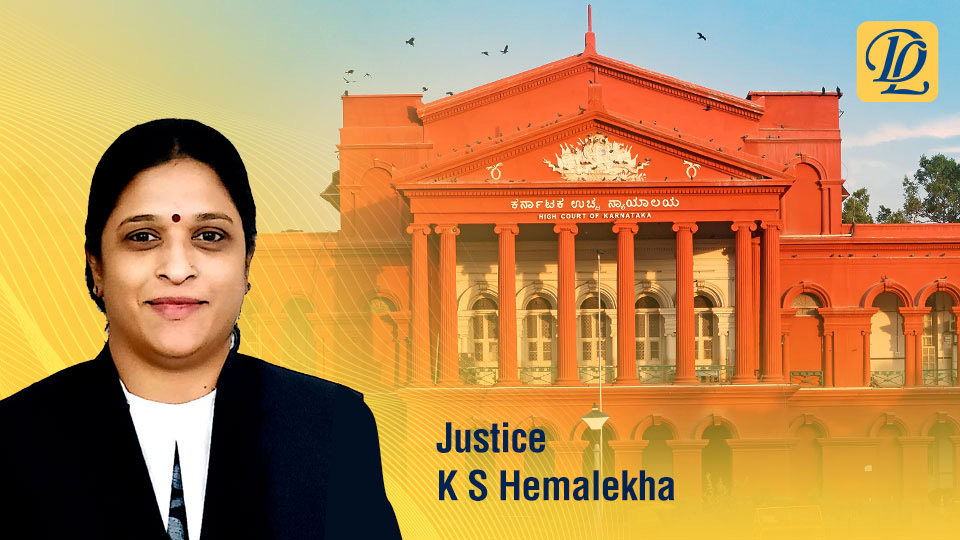
Hon’ble Mrs. Justice K S Hemalekha celebrates her 51st birthday today.
Hon’ble Mrs. Justice Kannankuzhyil Sreedharan Hemalekha: Born on 28th March 1975 at Belgaum to Late Sreedharan who was serving in Airforce and Late Chandramati who was homemaker. Passed S.S.L.C. from Divine Providence Convent School, Belgaum in the year 1990. Awarded with Student of Indian Classical Dance and practised Bharatanatyam, Kathak and folk-Dance forms since the age of 6 years and completed 2 exams in the field of dance. Obtained Bachelors Degree in Commerce from Gogte College of Commerce, Belgaum in the year 1996 and Law Degree from Raja Lakhamgouda Law College, Belgaum in the year 1999. Enrolled as an advocate on 31st July 1999. Practiced as an advocate from 1999 to 2000 in the chambers of Sri Ashok M. Potdar, Advocate at Belgaum and continued practice from 2000 to 2008 in the chambers of Sri G. Balakrishna Shastry, Advocate at Bangalore practiced before Hon’ble High Court. In 2008 established independent office and practiced as an advocate in High Court of Karnataka, Dharwad Bench. Appeared before Civil Court, Magistrate Courts, Administrative Tribunal, Appellate Tribunal, Land Tribunals, State Commission and District court. Practiced in the areas of Civil, Service, Land Laws and other allied laws. Appointed as Central Govt. Standing Counsel in March 2018. Sworn in as Additional Judge of the High Court of Karnataka on 08.11.2021 and as Permanent Judge on 21.09.2023.
Important judgments delivered by Hon’ble Mrs. Justice K S Hemalekha.
Arbitration & Conciliation Act. Even when limitation period to challenge arbitral award under Section 34 expired during closure/vacation of Courts, provisions of Section 4 of the Limitation Act cannot be invoked by the applicant. Karnataka High Court.
Ineligible candidate cannot plead his innocence in the selection process. Permitting ineligibility to triumph would have the effect of perpetuation of illegality which cannot be allowed. Karnataka High Court.
Where information obtained under the RTI Act is not challenged as regards its veracity, the source of information is irrelevant and cannot be excluded from consideration. Karnataka High Court.
False allegation of impotency by wife would cause mental disharmony to husband and amounts to mental cruelty, which would enable the husband to seek divorce on the ground of cruelty. Karnataka High Court.
Proceedings before the mediator are confidential and cannot be relied on by Courts in deciding cases on merits. Karnataka High Court.
Court can allow amendment of pleadings even after commencement of trial if it is satisfied that inspite of due diligence the party “could not have raised” the issue before commencement of the trial. Karnataka High Court.
Judges cannot maintain angelic silence when the court orders are violated with impunity. Karnataka High Court convicts husband who failed to pay maintenance to wife despite repeated court orders.
Preventive detention. Detaining authority cannot plead ignorance of representation by detainee. Non-consideration of the representation renders the detention illegal. Karnataka High Court.
Karnataka High Court deprecates speculative litigation by colleges harming educational prospects of the students. Imposes exemplary costs.
“Unborn child has a right under Article 21 of the Constitution of India.” Karnataka High Court while nixing the agreement to adopt unborn child.
Willful disobedience of the Court order to survey land of the aged/poor farmer. Karnataka High Court imposes cost of Rs. 3 lakhs recoverable from the Tahsildars responsible for the inaction.
Muslim couple enter into agreement to adopt unborn child of Hindu couple to overcome Muslim Law barrier. Karnataka High Court expresses shock while nixing the agreement.
Association providing recreational activities such as Rummy Card Games, Chess, Carom, Billiards/Snooker and other Skilled games only to its members is not required to obtain license under the Karnataka Police Act. Karnataka High Court.
Property of grandfather directly inherited by grandson, when his father had predeceased the grandfather, becomes the self-acquired property of the grandson. Karnataka High Court.
“It is the duty of the Court to uphold and maintain the dignity of the Courts and Majesty of the law”. Karnataka High Court sends the contemnor to jail for selling property in gross violation of interim order.
Right to Information Act. Second appeal under Section 19(3) of the Act by the Public Information Officer is maintainable even in the event no first appeal is preferred under Section 19(1). Karnataka High Court reiterates.
Maintenance and Welfare of Parents and Senior Citizens Act. Transfer must have been made subject to the condition that the transferee shall provide the basic amenities and basic physical needs to the transferor. Karnataka High Court reiterates.
Establishment of circuit Benches ensures speedy and qualitative justice to the needy citizens to their door steps and creates an opportunity to young advocates to excel in profession. Karnataka High Court.
When Civil Court has already dismissed suit for specific performance of sale agreement, the Registrar cannot order registration of the agreement under the Registration Act. Karnataka High Court.
Unconditional allotment of property under a partition will not attract the provisions of the Maintenance and Welfare of Parents and Senior Citizens Act. Karnataka High Court.
Karnataka Court Fees and Suits Valuation Act. Agricultural land coming within municipal area shall be valued as urban land though it is not converted for non-agricultural purposes. Karnataka High Court.
Suit for declaration of the title based on fraud, coercion and misrepresentation shall be filed within three years from the date of registration known to the plaintiff or when the right to sue first accrues. Karnataka High Court.
Suit for partition based on amended Section 6 of the Hindu Succession Act. Plaint can be rejected in respect of a particular item of property which was already sold prior to coming into force of the amendment. Karnataka High Court.
Karnataka SC/ST and OBC (Reservation of Appointments) Rules. Only the Director of Civil Rights Enforcements can prosecute regarding fake caste certificate on the report submitted by the District Caste Verification Committee. Karnataka High Court.
Foreign Contribution (Regulation) Act. Mere possession of permanent registration does not permit recipient to get amounts credited to designated savings bank account. Karnataka High Court.
Examination of attesting witness to prove registered Gift deed becomes necessary only if the executant denies the deed. Karnataka High Court.
Civil Court has no jurisdiction to deal with the correctness of the Land Tribunal order granting occupancy rights. Karnataka High Court.
Pleas of title and adverse possession are mutually inconsistent and the latter does not begin to operate until the former is renounced. Karnataka High Court.
Mere entry in the revenue records would not confer any title without there being a registered document conveying the title to the property. Karnataka High Court.
Adoption. Except the genitive parents, adoptive parents and the adoptive son, others have no locus standi to question the validity of the adoption deed. Karnataka High Court.
‘’Merits Uniform Code on the subject for the whole of India’’. Karnataka High Court on the Hindu Adoption and Maintenance Act.
Transfer of immovable property by way of sale can only be by a deed of conveyance duly stamped and registered as required by law. No right, title or interest in the immovable property can be transferred by way unregistered document. Karnataka High Court.
Transferee under an agreement of sale cannot resist suit for possession when there is a failure on his part to bring a suit for specific performance of contract within the period of limitation. Karnataka High Court.
Employees State Insurance Act. Authorities cannot straightway issue garnishee order under Section 45G without affording an opportunity to the employer. Karnataka High Court.
Industrial Disputes Act. Employees who voluntarily retire from service having accepted benefits under voluntary retirement package cannot raise industrial dispute. Karnataka High Court.
Labour Law. Minor punishment imposed by the management cannot be interfered with by the Labour Court unless there is want of good faith, victimization, unfair labour practice and violation of principles of natural justice. Karnataka High Court.
Payment of Gratuity Act. Service rendered by an employee as daily wager before his regularisation shall also be taken into account for the purpose of calculating the gratuity. Karnataka High Court.
Though scope of an appeal is not allowed to be broadened at the instance of the parties, a party who has not filed appeal can be permitted to raise objections to the findings of the lower Court in the Court of appeal. Karnataka High Court.
Limitation Act. A suit for possession is not barred by limitation under Article 65 unless the defendant proves adverse possession by demonstrating clear, hostile, continuous, and exclusive possession. Mere long-standing possession with permissive origin does not confer ownership rights. A counter-claim for adverse possession requires strict proof, and failure to establish hostile animus leads to its rejection. Karnataka High Court.
Where father dies prior to coming into force of Hindu Succession Act, 1956, daughter cannot claim any right in the property of her father. Only widow can claim such right under the Hindu Women’s Right to Property Act, 1937. Karnataka High Court.
Urban Land (Ceiling and Regulation) Act. Merely recording the State’s name in revenue records does not constitute taking over possession from landowners. Actual/legal transfer of possession must be established. Karnataka High Court.
http://dakshalegal.com/judgements/actionView/934b9ce77ff4d26dfd2b307d
Upon receipt of an application under Order 41 Rule 27 of the CPC for acceptance of additional evidence, the appellate court is duty-bound to consider it on merits. Failure to do so renders the judgment unsustainable. Karnataka High Court.
Adoption of a married person having children. Children born after the adoption cannot claim right in the original family of their father since the father and the children born after the adoption are transplanted to the adoptive family. Karnataka High Court.
Hindu Law. When a married person having children is taken in adoption, children born before the adoption are not transplanted to the adopted family and continue to be the grandchildren in the original family. Their right to partition in that branch is not affected. Karnataka High Court.
Hyderabad Certain Inams Abolition Act does not impose a non-alienation period on lands granted under the Act. Consequently, reliance on other tenancy abolition enactments to cancel land transfers is not permissible. Karnataka High Court.
After the commencement of the Hindu Succession Act, undivided interest of a Hindu in a joint family property can be disposed of by Will as per Section 30. Karnataka High Court examines the position prior to and after the Act.
Limitation Act. When plaintiff’s title is not in dispute and the plea of adverse possession fails, suit for possession based on title cannot be said to be barred by time under Section 65. Karnataka High Court.
Children born to second/void marriage are entitled to equal share in the self-acquired property of their father along with the children from the first marriage. Karnataka High Court.
Transfer of Property Act. In the case of an usufructuary mortgage there is no limitation to seek redemption. Right to seek redemption arises on the date when the mortgagor tenders mortgage money. Karnataka High Court.
Courts shall not adopt hyper-technical ground to dismiss suit for default. Past negligence is not a ground not to restore the suit. Karnataka High Court.
International workers of Indian origin and foreign origin cannot be brought under the purview of the Employees Provident Fund Scheme and the Employees Pension Scheme. Karnataka High Court.
Property of grandfather directly inherited by grandson, when his father had predeceased the grandfather, becomes the self-acquired property of the grandson. Karnataka High Court.
A 30-year lease deed is not mandatory for establishing a pre-primary school. The Government notification exempts pre-primary schools from the land requirements applicable to other educational institutions. Karnataka High Court.
Karnataka SC/ST (PTCL) Act. Lands granted at an upset price to SC/ST individuals are ‘granted lands’ under the Act. The intent of the PTCL Act is to protect the ownership rights of SC/ST communities, regardless of whether the land was granted freely or at a concessional rate. Karnataka High Court.
Unlawful Activities (Prevention) Act. An individual is deemed a ‘terrorist’ based on their involvement in acts defined by Section 15, regardless of scheduled status. Bail under Section 43D(5) is denied if there are prima facie reasonable grounds to believe the accusations are true, without requiring a mini-trial. Karnataka High Court.
When a property is exclusively used or intended for residential apartments, the association of apartment owners must be formed and registered under the specific provisions of the Karnataka Apartment Ownership Act and not under the more general Karnataka Co-operative Societies Act. Karnataka High Court.
Karnataka Civil Services (Appointment on Compassionate Grounds) Rules. The one-year limit for compassionate appointments should not be strictly applied if authorities fail to act on a timely, although informal, application from an illiterate widow, as their inaction deprives eligible dependents of a fair chance to apply. Karnataka High Court.
Hindu Law. In partition of joint family property, a coparcener’s wife is entitled to a share if she is a part of the partition proceedings. On a son’s death, his share devolves equally on his wife and mother as Class I heirs under Section 8 of the Hindu Succession Act, 1956. Karnataka High Court.
In a partition suit, no decree can be granted in favour of a person holding an agreement with a co-sharer. The defendant must prove the sale agreement and possession, which are not deemed admitted merely because the co-sharer has not filed a written statement. The appropriate remedy is a separate suit for specific performance or damages, not a claim within partition proceedings. Karnataka High Court.
A Sub-lessee is bound by a decree for possession obtained by the lessor against the lessee, irrespective of whether a sub-lease was created before or after the suit, provided the ground for eviction determines the sub-lessee’s rights as well. Karnataka High Court.
When a sufficient joint family nucleus formed by pooling income from inherited property and family benefits is proven to exist, the burden shifts to the individual co-sharer to affirmatively demonstrate that any subsequent acquisition was made solely from their independent, separate funds; failure to discharge this burden leads to the acquisition being treated as joint family property subject to partition. Karnataka High Court.
Upon transfer of a leased property, the transferee automatically steps into the shoes of the lessor by operation of law, and the tenant is estopped from questioning the transferee’s title. An ejectment suit filed by the transferee is maintainable once the lease has determined either by efflux of time or by a valid quit notice. Karnataka High Court.
Transfer of Property Act. Quit notice issued to tenant by registered post returned with postal shara ‘’insufficient address’’ is presumed served under Section 27 of the General Clauses Act. Karnataka High Court.
The right to challenge the transfer on the ground that all the co-owners or their heirs have not joined vests exclusively in those non-joining heirs and not in third parties. Karnataka High Court.
Plaintiff in a suit for declaration of title and possession could succeed only on the strength of its own title and that could be done only by adducing sufficient evidence to discharge the onus on it, irrespective of the question whether the defendants have proved their case or not. Karnataka High Court.
Transfer of property under an unregistered General Power of Attorney is void in law. The possession delivered under such a document cannot override the lawful ownership of the true owner. Karnataka High Court.
Specific Relief Act. A decree for specific performance cannot be enforced against subsequent purchasers who successfully establish that they are bonafide purchasers for value without notice of the prior agreement, thereby qualifying for protection under Section 19(b). Karnataka High Court.
Office of an Advocate cannot be treated as a commercial establishment for the purpose of imposing a commercial electricity tariff, since the legal profession is a regulated intellectual and ethical vocation in aid of justice, founded on personal skill, integrity, and fiduciary responsibility, and not a business or trade activity. Karnataka High Court.
Karnataka Industrial Areas Development Act. Provisions which facilitate determination of compensation through a voluntary and amicable consent award are mandatory in nature. The acquiring authority is bound to consider a landowner’s request for a consent award upon such willingness being expressed, notwithstanding the prior passing of a general award. Karnataka High Court.
Land Acquisition Act. A claimant who has previously entered into a consent agreement or accepted a negotiated settlement with the acquiring body for a specific amount of compensation is barred by the principle of estoppel and waiver from subsequently seeking re-determination or enhancement of compensation, as the consent agreement constitutes a final settlement of the claim. Karnataka High Court.
Revised Master Plan, 2015. In private layouts, Civic Amenity sites shall be handed over to the local residents association for maintenance since they are community assets for residents’ maintenance. Karnataka High Court.
Land Acquisition Act 1894. Interest under Section 28 is an accretion to the value of the land and hence forms part of the enhanced compensation. Land acquisition authorities cannot deduct Tax deduction at source (TDS) on such payments made to the landowners. Karnataka High Court.
Karnataka Public Premises (Eviction of Unauthorised Occupants) Act. Once the Bangalore Development Authority transfers ownership of a property to a private party via a registered sale deed, the property no longer falls under the definition of ‘public premises’. The BDA loses the jurisdiction to invoke eviction procedures under the Act. Karnataka High Court.
Land Acquisition. Payment of solatium and interest under the Land Acquisition Act, 1894 are applicable to acquisitions made under the National Highways Act, 1956. Karnataka High Court.
A partition decree obtained by natural legal heirs cannot be reopened or remanded at the instance of a third party claiming under a Will, unless that claimant establishes a strong prima facie legal right through the strict proof of the Will’s execution and attestation. In the absence of such proof, the court will not interfere with the settled rights of the natural heirs. Karnataka High Court.
Once land is formally de-notified from acquisition, the proceedings stand terminated and ownership reverts to the original owner. Any later interference based on payment of compensation to a third party based on fraudulent revenue entries is void. Karnataka High Court.
Bangalore Development Authority Act. An acquisition can be declared abandoned in fact and unenforceable in law if the authority fails to tender compensation and take physical possession over several decades. The acquisition though not automatically lapsed under Section 24(2), stands abandoned in fact and unenforceable in law. Karnataka High Court.
Right to Fair Compensation and Transparency in Land Acquisition, Rehabilitation and Resettlement Act, 2013 does not apply to acquisitions under special statutes such as Bangalore Development Authority Act, since the BDA Act is a self-contained Code for planned development and does not adapt the 2013, Act by reference. Karnataka High Court.
Land Acquisition Act. A request for a reference under Section 18 that is barred by the law of limitation cannot be revived or validated by a subsequent direction of the Lok Adalat. However, the dismissal of a Section 18 application solely on the grounds of limitation does not act as a bar to the land loser’s right to maintain an independent application for re-determination of compensation under Section 28A of the Act. Karnataka High Court.
Executive authorities, including the Special Deputy Commissioner, has no inherent statutory jurisdiction to cancel a registered instrument under the Registration Act since a registered sale deed can only be cancelled or set aside by a competent Civil Court through a substantive suit. Any such order of cancellation is a nullity, and the mere passage of time or delay in challenging such an order does not validate an action taken without the authority of law. Karnataka High Court.
The determination of a Grama Panchayat headquarters is an administrative and policy decision within the exclusive domain of the State. Such a decision cannot be invalidated by the Court merely because one village has a higher population than the designated headquarters. In the absence of manifest illegality or procedural impropriety, the choice of a headquarters based on factors of accessibility, central location, and administrative feasibility is final and not subject to judicial second-guessing. Karnataka High Court.
Statutory authority like BDA has no power to unilaterally cancel or ignore a registered sale deed executed by it, even on the grounds that the allotment was made in violation of its Rules. To cancel a registered instrument, the BDA must initiate appropriate proceedings before a competent Civil Court under the Specific Relief Act, rather than issuing administrative endorsements to dispossess long-standing owners. Karnataka High Court.
Land acquisition. When a statutory fact-finding authority recommends the deletion of specific lands from acquisition based on objective grounds and site inspections, the State Government cannot override such recommendations in a mechanical or arbitrary manner. A final notification issued without addressing the specific grounds for deletion recommended by the Officer is liable to be quashed. Karnataka High Court.
Karnataka Municipal Corporations Act. The Commissioner has no power to initiate, investigate, or adjudicate proceedings concerning the disqualification or cessation of a municipal councilor’s membership. The power to determine such a question is vested exclusively with the State Government under Section 19(3), and such power can only be triggered by a valid reference made by the ‘Corporation’. Karnataka High Court.
Compassionate appointment. State authority does not have the jurisdiction to unilaterally declare a registered adoption deed as invalid or refuse to recognize it based on the personal law of the employee. Karnataka High Court.
The allotment of Civic Amenity sites by an Urban Development Authority is not a matter of pure discretion but is a quasi-judicial process governed strictly by statutory rules. An allotment made without recorded reasons for preferring one applicant over others, or one that ignores the comparative merits of competing institutions is liable to be quashed. Karnataka High Court.
Karnataka Land Revenue Act. Assistant Director of Land Records has a statutory duty to apportion land revenue assessment whenever land is divided into multiple parts under Section 109(2). The ADLR, acting as a subordinate authority, is legally bound to implement the directions and orders issued by superior revenue officers. Karnataka High Court.
‘Pot Kharab’ lands falling under Rule 21(2)(a) of the Karnataka Land Revenue Rules belong to the landowner. When such lands are acquired, the landowners are entitled for compensation. Karnataka High Court.
Karnataka Court Fees and Suit Valuation Act. In a suit for a perpetual injunction concerning immovable property, the plaintiff is permitted under Section 26(c) to value the relief sought. The trial court has the discretion to allow an amendment to a plaint to correct a clerical mistake in the suit’s valuation, as long as it aligns with the relief sought and does not change the nature of the suit itself. Karnataka High Court.
A plaint cannot be rejected merely because the plaintiff disputes her signature on the vakalat, as this is not a ground under Order 7 Rule 11. Such a procedural defect should be allowed to be cured and cannot defeat the party’s substantive rights. Karnataka High Court.
Civil Procedure Code. Rejection of plaint under Order VII Rule 11 constitutes a decree under Section 2 (2) and is appealable under Section 96. Karnataka High Court.
 Daksha Legal