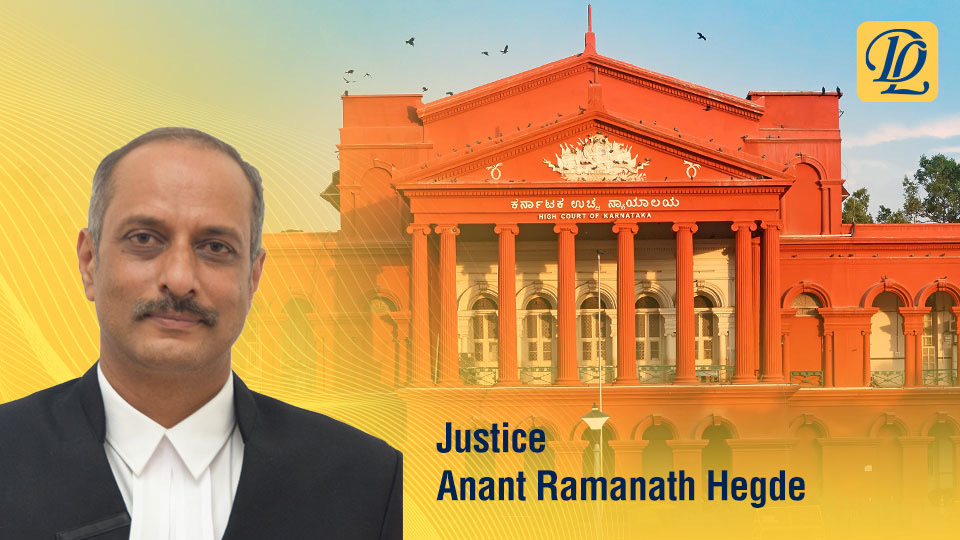
Hon’ble Mr. Justice Anant Ramanath Hegde celebrates his 55th birthday today.
Hon’ble Mr. Justice Anant Ramanath Hegde: Born on 7th March 1971 at Sirsi in North Kanara District of Karnataka State. Completed the degree in law in June 1994 from the University College of Law, Dharwad Commenced practice in Sirsi courts in July 1994 under the guidance of grandfather Sri. A. M. Hegde and father Sri. R. A. Hegde. After the establishment of the High Court Bench in Dharwad, in 2008, started practice in High Court Bench at Dharwad. Sworn in as Additional Judge of the High Court of Karnataka on 08.11.2021 and as Permanent Judge on 21.09.2023.
Important Judgements delivered by Hon’ble Mr. Justice Anant Ramanath Hegde.
Motor Vehicles Act. Power of the Tribunal or the High Court to award just and fair compensation to the victim is not taken away because of prayer for a lesser amount. Karnataka High Court.
Education. ”On account of the pandemic, one cannot give up maintaining standards of education”. Karnataka High Court while rejecting plea of law students to dispense with exams.
Caste Certificate and Creamy Layer Certificate cannot be treated alike. Caste Certificate status is permanent whereas Creamy Layer Certificate status varies from time to time depending on income. Karnataka High Court.
Service law. Principle that ‘Rules of the game cannot be changed once the game has begun’ does not apply if the change is not illegal or contrary to any provision of law. Karnataka High Court.
When the application under Section 11(6) of the Act is pending consideration before the High Court, Arbitrator cannot be appointed by the authority named in the arbitration agreement. Karnataka High Court.
Appointment of Court Commissioner under Order XXVI Rules 9 and 10 of the Code of Civil Procedure. Karnataka High Court lays down authoritative guidelines.
Hindu Succession Act. Amended Section 6. Person who alienates properties in violation of injunction order of the court cannot take advantage of the alienation by taking shelter under the proviso to Section 6(1) of the Act. Karnataka High Court.
“The concept of ‘justice at the doorstep’ flowing from Articles 14 and 21 can’t be an empty formality”. Karnataka High Court suggests increase in the pecuniary jurisdiction of the District Courts to avoid flooding of the First Appeals in the High Court.
Hindu Succession Act. Partition of properties inherited under Section 8 will not change the nature of the properties to coparcenary. Karnataka High Court.
Revenue entries coupled with possession can be relied on in support of the plea of earlier oral/unregistered family arrangement. Karnataka High Court.
Arbitration Act, 1940. Arbitrator cannot award damages for an alleged breach of the contract when the contract does not provide for such damages in the event of such breach. Karnataka High Court.
Proportionality of punishment for Contempt of Court under Order XXXIX Rule 2A, CPC. Order directing civil imprisonment should not be passed as a matter of course. Karnataka High Court.
Contempt of Court under Order XXXIX Rule 2A, CPC. Even persons who are not parties to suit can be punished for contempt of court. Karnataka High Court.
Bombay Public Trust Act, 1950. When the requirements under Section 92 of the Code of Civil Procedure are met, the Civil Court ought to grant permission to sue. Karnataka High Court.
Agreement to sell recording delivery of possession of property before expiry of 15 years contemplated under Section 61 of the Karnataka Land Reforms Act is void and unenforceable. Karnataka High Court.
Photostat copy which is compared with its original is admissible as secondary evidence if other conditions required for production of secondary evidence are met. Karnataka High Court.
Widow of coparcener cannot be disqualified from inheriting her husband’s share in the joint family properties on the ground of she leading an unchaste and immoral life. Karnataka High Court.
Land Acquisition. Time to file cross objections by the landowner starts from the date of receipt of notice of the appeal filed by the beneficiary and not from the date of the award. Karnataka High Court.
Land acquisition. Courts exercising jurisdiction under Article 226 of the Constitution have the power to shift/ alter/ fix the date for reckoning the market value under certain circumstances. Karnataka High Court.
Karnataka Excise Act. Induction of wife of the deceased partner cannot be construed as creating new partnership or new entity for the purpose of issuance of licence. Karnataka High Court.
‘Special provision in favour of women should also pass the test of equality.’ Karnataka High Court strikes down Indian Military Nursing Services Ordinance, 1943 in so far as providing hundred percent reservation for women in the cadre of nursing officers.
Karnataka Stamp Act, 1957. Authorities cannot recover stamp duty ‘not levied or short levied’ beyond the period of five years unless there is fraud, collusion, wilful mis-statement or suppression etc. Karnataka High Court.
Mere irregularity in preparation of voters list in election to local body does not confer right on the members to assert as eligible voters and for counting their votes as valid votes. Karnataka High Court.
Karnataka Co-operative Societies Act. Registrar of Co-operative Societies has no jurisdiction to deal with question relating to approval of regulations applicable to members of Common Cadre Committee. Karnataka High Court.
Nominee or legal representative of deceased member of a Co–operative Society, admitted as a member cannot vote and contest in the election if he does not fulfil the eligibility criteria. Karnataka High Court.
Membership in a Co-operative Society is the basic eligibility to contest in an election. In addition, the member has to fulfil additional eligibility criteria if any fixed under the Statute and Bye-law applicable. Karnataka High Court.
Disqualification of membership in a Co-operative Society on being appointed as paid employee in the same Society. The membership will not automatically revive upon resignation to the employment. Karnataka High Court.
Civil Court has jurisdiction to decide shares of joint family members in the properties in respect of which occupancy rights are granted by the Land Tribunal. Karnataka High Court.
Principle that respondent can question adverse finding in judgment without filing an appeal does not apply to an adverse decree against him. Karnataka High Court.
’Legislation should be drafted in simple, concise language, supported by illustrative examples’. Karnataka High Court emphasizes the need for regular amendments and clarifications to ensure that laws align with constitutional court judgments.
Insurance Act. Amended Section 39 does not override the law relating to succession. Beneficial nominees get the benefits only when the testamentary and non-testamentary heirs do not claim the benefits flowing from the insurance policy. Karnataka High Court.
https://www.dakshalegal.com/judgements/actionView/7653059797a917e90a223762
Does a daughter ‘born after the amendment to Section 6 of the Hindu Succession Act, 1956’, inherit a share by birth in the coparcenary property that was allotted to her father’s share in the partition that took place before the amendment? Karnataka High Court points out the anomaly.
An agreement for sale executed within 15 years of a non-alienation clause under Section 61 of the Karnataka Land Reforms 1961 Act is illegal. Consequently, a party relying on such an agreement is not entitled to seek specific performance. Karnataka High Court.
Civil Court cannot entertain suit challenging the award passed by the Lok Adalath on a compromise, if such suit is filed by the parties to such award or any of the parties claiming through the parties to the said award. Karnataka High Court.
Notice under Section 106 of the Transfer of Property Act is not necessary to file a suit for eviction in case the tenure of the lease has come to an end by efflux of time. Karnataka High Court.
Will. Karnataka High Court recommends making a legal provision to enable recording of statements of testator and attesting witnesses during their lifetime, either before the Sub-Registrar or the Court, to avoid prolonged litigation.
Joint family among Mohammedans. When managing member of family acquires property, other family members can benefit from the acquisition if they can prove their contribution. Karnataka High Court.
Although Mohammedan law does not recognize joint family concept, it is still possible for individuals from the Mohammedan community to live together as a joint family unit or co-own properties. Karnataka High Court.
Suit for partition cannot be rejected for not providing the boundaries of the immovable properties over which the partition is claimed. Identity can be verified by the Court. Karnataka High Court.
Partition. Purchaser of an undivided share cannot claim exclusive share in the joint family properties, seeking allotment of a particular property, without the consent of the other joint family members. Karnataka High Court.
An order refusing or granting ex-parte interim measure on an application under Section 9 of the Arbitration and Conciliation Act falling under ‘Commercial Arbitration Dispute’ is appealable order under Section 37 of the Act. Karnataka High Court.
“Power of review is a creature of Statute’’. Deputy Commissioner has no power to review the order under the Karnataka Land Revenue Act. Karnataka High Court.
Objection relating to the inherent jurisdiction of the trial Court can be raised even for the first time before the appellate Court. Karnataka High Court.
Limitation to make a reference under Section 18 of the Land Acquisition Act 1894. Cause of action arises only after the conclusion of the proceedings under Section 30 of the Act. Karnataka High Court.
Temporary injunction in Trademark cases. Even if two conflicting views are plausible, the Court has to lean in favour of the registered trademark to hold that the trade mark is prima facie valid. Karnataka High Court.
Karnataka Souharda Sahakari Act. Assistant Registrar of Co-operative Societies has no power to wind up a Co-operative Society without the participation of the Federal co-operative, Union Cooperative, Creditors and other stakeholders. Karnataka High Court.
‘’Mubarat’’ is a form of divorce by mutual consent recognized by Muslim Personal Law. Family courts are duty-bound to accept the Mubarat agreement between the parties to dissolve the marriage. Karnataka High Court.
Employer is bound to deduct agreed amount from the salary of member of co-operative society when there is agreement to this effect with prior concurrence with the employer. Karnataka High Court.
Karnataka Co-operative Societies Act. Challenge to sale deed executed by member of a co-operative society in favour of a non-member cannot be subject matter of dispute under section 70. Karnataka High Court.
”Wardi transfer” or ”Mutation entry transfer” is not a recognised mode of transfer of property under the Transfer of Property Act. Karnataka High Court.
Hindu Succession Act. Children of predeceased son or daughter of a woman dying intestate are also entitled to share along with children of the woman as Class-I heirs. Karnataka High Court.
In a suit based on a promissory note, the agreed rate of interest must be honored under Section 79 of the Negotiable Instruments Act until the suit’s filing. Courts lack discretion to alter pre-suit interest rates. Karnataka High Court.
Property owners are entitled to just compensation for structures affected by high tension power lines, even if the structures were built after the power lines were installed, as long as such construction was not legally prohibited. Karnataka High Court.
An appeal against a divorce decree does not abate upon the death of the decree-holder spouse, as it impacts the surviving spouse’s legal status and proprietary rights. Karnataka High Court.
Mere supply of electricity without its actual consumption does not constitute a sale. In such cases, only a tariff can be levied, not a tax. The State lacks legislative competence to impose a tax on electricity charges, including minimum tariffs for electricity that is supplied but not consumed. Karnataka High Court.
A writ petition challenging the constitutional validity of a statutory provision does not become infructuous merely because the provision is amended or repealed during the pendency of the proceedings, if the petitioners have suffered consequences under the unamended law that are capable of being redressed by the Court. Karnataka High Court.
Hindu Succession Act. Where property is granted to a wife under a consent decree for the maintenance of herself and her children, such property vests with her absolutely under Section 14(1), even after the children attain majority, unless the decree contains an express restrictive condition limiting her interest. Karnataka High Court.
Karnataka Rent Act. Civil Court has jurisdiction over eviction suits for commercial premises if the ‘plinth area’ exceeds 14 square metres. For this purpose, the space acquired by the wall must be included. Karnataka High Court.
In cases of unconstitutional tax levies, a person seeking restitution must demonstrate actual loss or damage by proving that the tax burden was borne by them and not passed on to the consumers. Karnataka High Court.
Industrial Disputes Act. Enquiry under Section 33 (2) (b) as to whether domestic enquiry was fair and proper rendered after recording evidence operates as Res judicata between the same parties in a subsequent proceeding challenging the penalty imposed. Karnataka High Court.
High Court can exceptionally exercise its writ jurisdiction to direct a statutory corporation to comply with an industrial award that has attained finality, including payment of withheld back wages. Compelling the workman to resort to the statutory remedy would be unfair given the specific circumstances and the imminent superannuation of the workman. Karnataka High Court.
When a suit for declaration based on title and also by adverse possession fails, the court can pass a decree for possession in favour of the defendant. Such right is traceable to inherent power of the Court saved in Section 151 of the Code of Civil Procedure. Karnataka High Court.
Purchaser of an undivided share is entitled to initiate a final decree proceeding to obtain partition and separate possession of the share purchased from the vendors instead of filing separate suit for partition. Karnataka High Court.
Industrial Disputes Act. A second conciliation proceeding is permissible if both parties jointly request it, even after an initial failure report has been submitted. Karnataka High Court.
Industrial Disputes Act. When a dispute challenges a settlement made under Section 12(3), the government must exercise a ‘higher degree of scrutiny’ and record its reasons for being satisfied that a case for adjudication exists before referring it. Karnataka High Court.
Easements Act. Conversion of agricultural land into non-agricultural use does not extinguish a right of way granted under a sale deed. However, the dominant owner must exercise this right in the least onerous manner, causing minimum inconvenience to the servient owner. Karnataka High Court.
When an employee is insured under the Employees State Insurance Act, he or his dependents cannot make a claim for compensation under the Workmen’s Compensation Act in respect of an employment injury sustained. Karnataka High Court.
Suit for partition. Trial Courts should proceed suo motu to draw the final decree after the preliminary decree to prevent undue delay. Karnataka High Court calls for informed discussions among stakeholders to evolve an effective procedure supported by an appropriate legislative framework.
An application under Order XXI Rule 97 of the CPC for removal of obstruction cannot be entertained to resolve dispute between the decree holder and a person claiming title through the decree holder – an alleged purchaser. The applicant has liberty to file a separate suit to establish his claim. Karnataka High Court.
Evidence Act. A registered, 30 year old adoption deed carries a presumption of due execution which, when coupled with proof of the customary ‘giving and taking’ ceremony, is sufficient to establish the adoption, provided the challenging party fails to rebut the presumption. Karnataka High Court.
Hindu Succession Act. Property acquired through a Will from a collateral (such as brother or uncle) is separate property, not coparcenary property. Succession opens under Section 8 leading to equal shares for all Class I heirs. Karnataka High Court.
Karnataka Stamp Act, 1957. Authorities cannot recover stamp duty ‘not levied or short levied’ beyond the period of five years unless there is fraud, collusion, willful mis-statement or suppression etc. Karnataka High Court.
Civil Procedure Code. Plaint cannot be rejected under Order VII Rule 11(d) simply because it is filed before a non-Commercial Court when it ought to have been filed before a Commercial Court. The proper course of action is to return the plaint for presentation before the correct jurisdictional court. Karnataka High Court.
The trial courts may, during the trial and in the interest of effective administration of justice, indicate the nature of evidence it expects from both parties. Such guidance cannot be construed as the Court siding with either party. Courts are vested with the authority to insist upon better and more satisfactory proof where necessary. Karnataka High Court.
Where the plaintiff establishes a clear legal title but has suppressed the dismissal of the earlier suit for injunction, the court should not deny the relief of declaration and consequential possession, as this would unjustly divest the title. The court should instead grant title and possession and impose a penalty, such as modifying the decree, to address the misconduct and resolve the dispute. Karnataka High Court.
Widow of coparcener cannot be disqualified from inheriting her husband’s share in the joint family properties on the ground of she leading an unchaste and immoral life. Karnataka High Court.
Karnataka Land Revenue Act. Karnataka High Court urges review of provisions allowing revenue authorities to conduct parallel adjudication of disputes which are again subject to the final determination by a competent Civil Court. Recommends empowering Civil Courts to stay orders under the Act.
A decree for an injunction granted by a Civil Court serves as conclusive proof of lawful possession in land reform proceedings. The Land Tribunal cannot grant occupancy rights over a specific portion of land to a claimant if a rival claimant’s possession of that same portion is protected by a valid civil court decree, unless there is clear evidence of a subsequent surrender of tenancy or a change in possession through legal means. Karnataka High Court.
A plea of constructive res judicata under Order II Rule 2 of the CPC cannot be raised for the first time at the appellate stage, unless the necessary factual foundation, specifically the nature of the cause of action in the earlier suit was pleaded in the written statement. Karnataka High Court.
The repeal of the Industrial Disputes Act and the commencement of the Industrial Relations Code does not create an adjudicatory vacuum. The existing Labour Courts and Industrial Tribunals retain the jurisdiction to entertain and decide references until the new Tribunals under the Code are fully operational by virtue of Section 104 (1A) of the Code and the principles enshrined in Section 6 of the General Clauses Act. Karnataka High Court.
 Daksha Legal