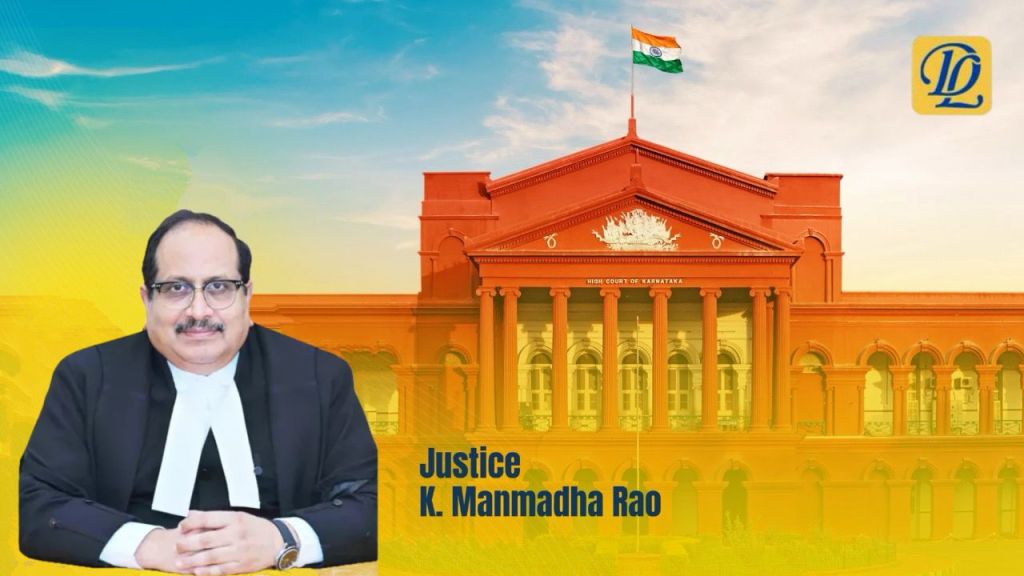
Hon’ble Mr. Justice K. Manmadha Rao celebrates his 59th birthday today.
Honble Dr. Justice K Manmadha Rao: His Lordship was born on 13.02.1967 (recorded date of birth is 13.06.1966) at Mypadu Village in Nellore District. His father Sri K.J.Rama Murthy was a retired Engineer in Irrigation Department and his mother Smt. K. Jhansi Lakshmi is a house wife. His Lordship did his schooling in Guntur, Prakasam and Nellore Districts on account of his father’s employment; Intermediate from Jawahar Bharathi College, Kavali of Nellore Dist; Graduation in Commerce from CSR Sarma College affiliated to Nagarjuna University; completed Law course from Nyaya Vidya Parishad Law College affiliated to Andhra University and was Students’ Union General Secretary of NVP Law College during 1989-90; PG Diploma in Cyber Laws from Hyderabad Central University; Master’s Degree from PG College of Law, Hyderabad, Osmania University and Ph.D. in Law from Andhra University. Enrolled as a Member of the Bar Council of the State of Andhra Pradesh on 25.06.1991 and commenced his practice by joining as a junior advocate to Sri Nagisetty Mohan Das, Advocate in the Sri Nagisetty Ranga Rao’s office at Ongole of Prakasam District and continued as such till May 1993, and thereafter, started independent practice in the Magistrate Courts, Subordinate Judge Court in Kandukur of Prakasam District till May, 1999 and also served as Secretary of the Bar Association, Kandukur. Thereafter, shifted practice to the High Court of Andhra Pradesh at Hyderabad and joined as a Golden member of the High Court Bar Association. His Lordship served as Counsel for various Central Government Undertakings i.e. BSNL, UTI , UTI TSL, Corporation Bank, State Bank of India, Andhra Bank, A.P. Mahesh Cooperative Bank and Life Insurance Corporation India, and Standing Counsel for HDFC-ERGO General Insurance Company handled hundreds of cases as their Counsel. Handled number of cases on behalf of poor & vulnerable persons while doing private practice and served as a counsel for Chit Fund Companies. His Lordship served as Senior Standing Counsel, Central Excise Board in the High Court from 2008 to 2016 and also served as Special Public Prosecutor/Standing Counsel for Enforcement Directorate for Hyderabad Zone, specially for PMLA cases, before the designated Courts and other Courts including Common High Court at Hyderabad for the period from 2016 to 2020 and also served as Special Public Prosecutor/Standing Counsel for Directorate Revenue Intelligence, specially for NDPS cases before the designated Courts and other Courts including High Court of Andhra Pradesh at Amravati.
His Lordship was empanelled as a member of the Senior Panel Counsel for the Union of India in the High Court of Telangana and the High Court of Andhra Pradesh. Lordship received Awards i.e., Ph.D (Doctorate in Law) from Andhra University and Dr.B.R.Ambedkar Gyan Vigyan Ratna Award -2014 presented by the Hon’ble Sri Justice Jasti Chalameswar, Judge, Supreme Court of India, New Delhi and organized by Resident Commissioner, Government of AP & AP Bhawan SC/ST /Employees’ Welfare Association, New Delhi on the eve of 123rd Birthday Ceremony celebrations of Dr. BR Ambedkar.
Lordship did academic Projects: Intellectual Property Rights and Dispute Settlement Mechanism- a Critical Study, Banking Transactions through Net services, Legal Changes on Net Banking Services, Computer Crimes and frauds in Banking Transactions, Disciplinary Proceedings and Domestic Enquiry in A.P.S.R.T.C, consumer privileges under the Consumer Protection Act or Consumer Justice. Lordship gave lectures on Central Excise laws in National Academy of Customs, Indirect Taxes and Narcotics (NACIN), Zonal Campus, Visakhapatnam on some occasions. His Lordship actively practised in Civil, Criminal, Services, Constitutional and almost all other branches of Law. Had developed his independent practice within a short span of time and extensively dealt with number of cases, covering all branches of Law.
Married to Ms. K.Suneeta and blessed with two Sons, namely, K.Kaushik and K.Subhash who are practicing as Advocates. His Lordship sworn in as a Judge of the High Court of Andhra Pradesh on 08.12.2021 and His Lordship transferred to Karnataka High Court and assumed the office as the Judge of the Karnataka High Court on 02.06.2025.
Important Judgements delivered by Hon’ble Mr. Justice K. Manmadha Rao.
Arbitration and Conciliation Act. An order refusing an application under Section 8, is an appealable order under Section 37 of the Act. Review of the said order under the Code of Civil Procedure is not permissible. Karnataka High Court.
Hindu Succession Act. Any property possessed by a female Hindu regardless of whether it was acquired before or after the Act’s commencement is held by her as an absolute owner. Unless the property was acquired via an instrument, decree, or award that explicitly prescribes a restricted or limited estate under Section 14(2), the property remains her absolute property and is not liable for partition as joint family property. Karnataka High Court.
Motor Vehicles Act. Where a motor vehicle is operated in blatant violation of statutory requirements specifically lacking a valid permit and registration, such breaches constitute fundamental policy violations. In such instances, the Insurance Company is not liable to indemnify the owner or satisfy the award. Karnataka High Court.
Land acquisition. Though a pragmatic approach may be adopted, courts cannot bypass the mandatory requirements of Section 5 of the Limitation Act. An inordinate, unexplained delay cannot be condoned on vague pleas of poverty or displacement, as it would revive settled rights, undermine finality, and erode legal certainty. Karnataka High Court.
Motor Vehicles Act. A person who borrows a motor vehicle and meets with an accident steps into the shoes of the owner and cannot be treated as a ‘third party’. A claim under Section 163-A of the Act by the borrower’s legal heirs against the insurer is not maintainable. The insurer’s liability is limited only to the Personal Accident cover under the insurance policy. Karnataka High Court.
Limitation Act. Administrative delay or laxity can never be treated as a sufficient cause for condoning delay. When the State chooses to litigate, it is bound by the same law of limitation as any other litigant. Delay cannot be condoned on vague or casual grounds unless the State clearly establishes bona fide conduct and due diligence. Karnataka High Court.
Motor Vehicles Act. Role of a women in a family and contribution in terms of service should not be under-estimated. Housewives have to be granted compensation on the basis of the multifarious service rendered by them for managing the entire family. Karnataka High Court.
Motor Vehicles Act. Insurer must specifically plead the contributory negligence in support of plea. Insurer cannot directly lead evidence without specific plea regarding contributory negligence. Karnataka High Court.
Civil Procedure Code. A judgment passed by the First Appellate Court must strictly adhere to the mandatory provisions of Order XLI Rule 31 and Order XX Rules 6 and 7. Failure to do so such as not drawing a decree corresponding to the findings, or failing to record independent reasons on each point after considering the evidence in detail renders the judgment incomplete and suffering from serious infirmity, warranting it to be set aside. Karnataka High Court.
Commercial Courts Act. Order XI Rule 5(1). Strict requirement for a plaintiff to establish a ‘reasonable cause for non-disclosure along with the plaint’ does not apply to an application for production of documents filed by any party during the pendency of the suit in direct response to issues or questions raised by the opposing party during the course of the evidence. Karnataka High Court.
Indian Evidence Act. Power conferred upon the court by Section 73 to direct a person present in court to write words or figures for comparison is limited to the court’s own necessity in determining the truth of a disputed writing. This provision cannot be used by a party to compel an opposing party or witness to provide sample writings for the advancement of the moving party’s case or defence, as such an action amounts to an unauthorized attempt to collect evidence. Karnataka High Court.
An application to amend the plaint, even if filed after the commencement of trial or conclusion of arguments, may be allowed when it merely adds an alternative prayer without altering the nature of the suit or the original cause of action, so as to prevent multiplicity of proceedings. Karnataka High Court.
A party bearing the burden of proof cannot, as a general rule—and particularly after the closure of evidence—compel or summon the opposite party to testify as his own witness. Such a course is legally disfavoured and regarded as an abuse of process or a dilatory tactic. The appropriate remedy when the opposing party refrains from entering the witness box is to seek an adverse inference against him. Karnataka High Court.
When the court finds that sufficient oral and documentary evidence already exists for the adjudication of the issues, Court Commissioner cannot be appointed only to resolve any ambiguity or aid in the appreciation of existing material. Karnataka High Court.
In a suit for specific performance, a third party who demonstrates a direct interest in the suit property on the basis of a prior agreement of sale and an irrevocable power of attorney from the original owners is a necessary party, as their presence is essential for the complete and effective adjudication of the dispute. Karnataka High Court.
When a decree passed against dead respondent in the first appeal is declared as nullity by the High Court in the second appeal, the first Appellate Court retains jurisdiction to entertain applications for bringing the legal representatives of the deceased respondent on record. Karnataka High Court.
Arbitration and Conciliation Act. When a suit involves a dispute governed by an arbitration clause in an agreement between the parties, the Civil Court’s jurisdiction is ousted. The court must return the plaint even if the suit includes prayers like declaration and injunction or redemption of mortgage. Karnataka High Court.
An application for amendment of pleadings may be permitted even after the commencement of trial if facts have come to light during the trial and the amendment is necessary for effectively determining the real issues in controversy between the parties. Karnataka High Court.
Karnataka Court Fee and Suit Valuation Act. Unless the plaintiff himself admits ouster, a suit for partition by a co-parcener must be valued under Section 35(2), based on the statutory presumption of joint possession regardless of any contrary claims or assertion of exclusive title/possession raised by the defendants in their written statement. Karnataka High Court.
Arbitration and Conciliation Act. Statutory bar against specific performance of a contract of personal service under Section 14(1)(b) of the Specific Relief Act is a substantive legal principle that equally binds Arbitral Tribunals, thereby precluding them from granting the relief of reinstatement. Karnataka High Court.
Hindu Law. Daughter’s right to an equal share in ancestral joint family property under the Hindu Succession Act is established by birth and is not conditional upon the father-coparcener being alive on the date of the amendment. Any prior judgment or preliminary decree restricting the daughter’s share based on the father’s death date must be modified to grant the daughter an equal share as a son. Karnataka High Court.
Arbitration and Conciliation Act. The non-joinder of a necessary party constitutes a fundamental error of law, striking at the root of the proceedings and rendering the adjudication and award legally unsustainable. Karnataka High Court.
Unregistered power of attorney is admissible as evidence if it explicitly states that no consideration was paid for it and is therefore not required to be registered. Court is not permitted to go beyond the recitals of the document to determine its admissibility. Karnataka High Court.
‘’Procedural enactment should not be construed in any manner, which would leave the Court helpless to meet extra-ordinary situations in the ends of justice’’. Order VIII Rule 1 of CPC providing for upper limit of 90 days to file written statement is directory not mandatory. Karnataka High Court.
A civil court, including a Commercial Court, lacks jurisdiction to entertain a suit challenging the actions of a secured creditor under the SARFAESI Act when the dispute falls within the exclusive domain of the Debt Recovery Tribunal. Karnataka High Court.
In a partition suit involving a Christian family, succession must be determined under the Indian Succession Act, and the coparcenary principles under the Hindu Succession Act have no application. Where an intestate dies leaving only children, the property is to be divided equally among all surviving children. Karnataka High Court.
Indian Succession Act. A sole beneficiary of a Will can be considered an executor by necessary implication. His application for probate is maintainable even if he is not explicitly named as the executor in the Will. Karnataka High Court.
Preventive detention is advised to assert/afford protection to society. Courts cannot sit as an Appellate Court on the subjective satisfaction of the detaining authority. Karnataka High Court.
 Daksha Legal