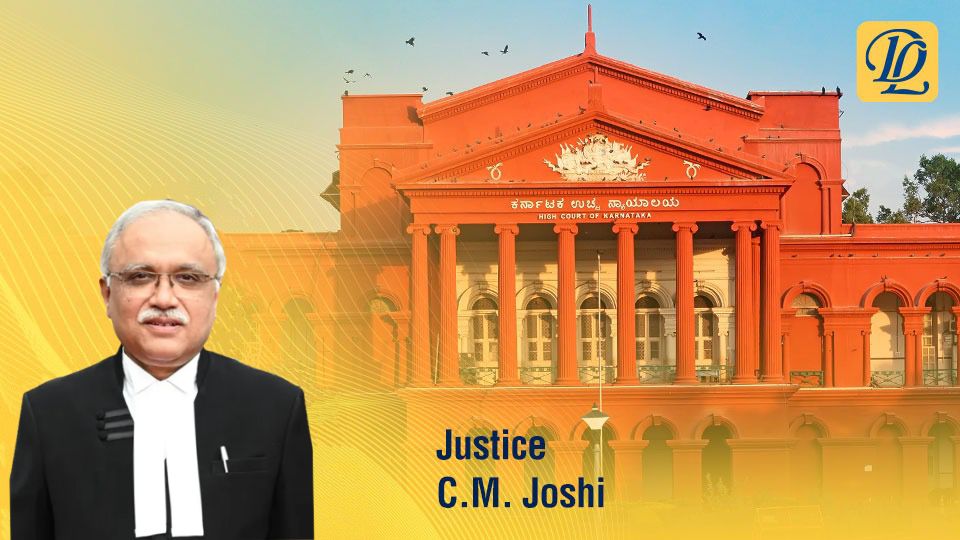
Hon’ble Mr. Justice C.M. Joshi celebrates his 62nd birthday today.
Hon’ble Mr. Justice Chandarashekar Mrutyunjaya Joshi: Born on 24.01.1964. Native of Hubballi. Enrolled as Advocate and practiced at Hubballi. Appointed as Munsiff on 08.02.1995. Appointed as District Judge on 06.07.2009. Served as Deputy Secretary, Karnataka State Legal Services Authority, Central Project Co-ordinator (Computers), Registrar (Computers) at High Court of Karnataka and as Prl. District & Sessions Judge, Udupi, Belagavi & Prl. City Civil & Sessions Judge, Bengaluru. Sworn-in as Additional Judge of the High Court of Karnataka on 16.08.2022.
Important judgments delivered by Hon’ble Mr. Justice C M Joshi.
Criminal law. Call records regarding conversation between accused and deceased are inadmissible in evidence unless the Certificate required under Section 65B of the Evidence Act is produced. Karnataka High Court.
Motor Vehicle Act. When a claim petition is filed under Section 163A and the evidence on record shows the income is above Rs.40,000/- p.a, the claim petition is liable to be rejected, unless it is converted to one under Section 166. Karnataka High Court.
Disciplinary proceedings against daily wage employee can be initiated under the Karnataka Daily Wage Employees Welfare Act, 2012 only if his name is notified by the State Government as daily wage employee. Karnataka High Court.
An order of acquittal adds up to the presumption of innocence in favour of the accused and hence the Appellate Court has to be relatively slow in reversing the order. Karnataka High Court.
Property allotted to a female in family partition between herself and her father is her absolute property and does not revert to heirs of her father under Section 15 (2) of the Hindu Succession Act. Karnataka High Court.
Service benefits do not form bequeathable estate of Government Servant. Family pension does not form part of the estate of the deceased and as such it cannot be disposed off during lifetime by testamentary disposition. Karnataka High Court.
Grant of Succession Certificate will not determine rights of parties since it merely identifies the hands in which death benefits be given and it does not entitle such person to appropriate such benefits to himself. Karnataka High Court.
Adopted son becomes a coparcener in the adoptor’s family and cannot claim right in his genitive family properties. Karnataka High Court.
In case of ‘Act Only Policy’ which does not cover pillion rider with extra premium, liability cannot be fastened on the insurance company. Even the principle of ‘pay and recover‘ does not apply in such cases. Karnataka High Court.
When ‘package/comprehensive’ policy is issued, it covers all including the occupant, driver, pillion rider and the owner. Premium paid is irrelevant. Karnataka High Court.
Karnataka Excise (General Conditions) Rules. Profit sharing ratio change in a partnership firm by 50% and above amounts to ‘’change of control and management of a firm’’ and attracts payment of transfer fee under the Rules. Karnataka High Court.
The limitation period for instituting probate proceedings for a Will is three years, as per the residuary provision of the Limitation Act, subject to specified exceptions. Karnataka High Court.
Service Law. Deemed suspension of an employee would continue even after his detention comes to an end by virtue of enlargement on bail or otherwise till after the competent authority issues a formal order revoking the suspension. Karnataka High Court.
Hindu Succession Act. Partition of ancestral properties prior to 2004 amendment does not affect rights of daughters in the ancestral property notionally allotted to the father. Karnataka High Court.
When brothers partition ancestral property, it continues as ancestral property. Son/daughter born after the partition will automatically acquire rights by birth. Karnataka High Court.
Service Law. ‘’It is the prerogative of the employer to deploy his staff suitable to the requirement of work/place unless the conditions of service otherwise provide’’. Employees cannot sit in self-judgment as to the validity of transfer order and disobey the same with impunity. Karnataka High Court.
Bombay Pargana and Kulkarni Watan Abolition Act. Watan property belongs to the entire family, with all family members having hereditary interests eligible for a share. Karnataka High Court.
Service Law. When a person is placed in independent charge of a post, albeit being eligible for promotion to that post, and later receives retrospective promotion, he is entitled to salary arrears corresponding to the pay scale of the said post. Karnataka High Court.
Karnataka Excise (General Conditions) Rules. Profit sharing ratio change in a partnership firm by 50% and above amounts to ‘’change of control and management of a firm’’ and attracts payment of transfer fee under the Rules. Karnataka High Court.
Urban Development Authority’s imposition of a penalty for non-construction on the allotted site by the allottee within the stipulated period cannot be held to be unreasonable. Karnataka High Court.
POCSO Act. Document relating to date of birth of a student issued by School on the basis of entry of the date of birth made in the admission register can be relied for the purpose of age determination. Karnataka High Court.
A person who acquires an interest in the suit property during the pendency of the suit can seek to be impleaded at the appeal stage by invoking Section 146 of the CPC which provision should be interpreted broadly and liberally to promote justice. Karnataka High Court.
Order on determination of question as to legal representatives of the deceased plaintiff or a deceased defendant, under Order 22 Rule 5 Civil Procedure Code, does not operate as resjudicata. Karnataka High Court.
Cause of action in a partition suit is recurring one. Dismissal of earlier suit for partition for default is not a bar for the second suit. Karnataka High Court.
Property allotted to a female in family partition between herself and her father is her absolute property and does not revert to heirs of her father under Section 15 (2) of the Hindu Succession Act. Karnataka High Court.
Arbitration and Conciliation Act. Disputes involving allegations of fraud can be referred to arbitration unless the allegations of fraud are so serious that they render the arbitration agreement itself void. Karnataka High Court.
Karnataka Stamp Act. The maximum stamp duty of Rs. 25 crores on amalgamation of companies specified in the Schedule does not include the additional duty. The duty chargeable under the Act would include not only the stamp duty as imposed under Section 3, but also the additional duty as levied under Section 3B of the Act. Karnataka High Court.
Arbitration and Conciliation Act. Arbitral Tribunal is the final arbiter of the disputes and an Arbitrator’s interpretation of the contractual terms are not liable to be interfered with, unless the court finds that no reasonable person could possibly hold the said view. Karnataka High Court.
Commercial Courts Act. Disputes arising from the failure of a lessee to vacate premises used for commercial purposes, after the expiry of the lease term and despite service of notice under Section 106 of the Transfer of Property Act, fall within the jurisdiction of the commercial courts. Karnataka High Court.
Right to Fair Compensation and Transparency in Land Acquisition, Rehabilitation and Re-Settlement Act does not provide a fresh cause of action in respect of the acquisitions of land that stand vested with the State. Any person in possession of the land after the same is vested with the State, is required to be treated as a trespasser. Karnataka High Court.
An employer cannot initiate departmental proceedings for incidents that occurred beyond the prescribed limitation period. Once this period has lapsed, an employee’s retirement benefits cannot be withheld indefinitely on the pretext of contemplated disciplinary action. Karnataka High Court.
Income Tax Act. A completed or unabated assessment cannot be reopened under Section 153A unless incriminating material revealing undisclosed income is discovered during the search. The object of Section 153A is to tax such undisclosed income detected in the search, not to arbitrarily reassess concluded matters. Karnataka High Court.
Income Tax Act. Disallowance of deductions on enhanced income under the proviso to Section 92C (4) is not applicable when an assessee voluntarily declares a higher income based on an Advance Pricing Agreement. An Assessing Officer cannot deny a deduction under Section 10AA on such income. Karnataka High Court.
Arbitration and Conciliation Act. A civil suit for an injunction to restrain arbitration proceedings is barred under Section 5, as all issues concerning the Arbitral Tribunal’s jurisdiction—including the existence, validity, or limitation of the arbitration agreement—fall exclusively within the Tribunal’s competence under Section 16. Karnataka High Court.
General Clauses Act. When the last date for filing a quarry lease renewal application falls on a Sunday or any public holiday, the statutory period for submission automatically extends to the next working day. Rejection of an application filed on the next working day is unsustainable. Karnataka High Court.
A superior court exercising jurisdiction under Article 226 can refuse a successive remand to a statutory tribunal that has repeatedly failed to discharge its basic adjudicatory duty, such as examining evidence, despite earlier directions. Karnataka High Court.
Karnataka Land Revenue Act. Revenue authorities are authorized to correct or alter mutation entries in the Record of Rights based on undisputed source-of-title documents even when a civil suit on title is pending. Karnataka High Court.
SARFAESI Act. The borrower’s right of redemption stands extinguished once the secured creditor publishes the auction notice. Any subsequent offer to pay dues or match the auction price after publication and confirmation of sale is invalid, as the SARFAESI Act overrides the general right of redemption under Section 60 of the Transfer of Property Act. Karnataka High Court.
Wildlife (Protection) Act. Where land within a National Park’s notified limits is voluntarily surrendered under a Resettlement and Rehabilitation scheme, compensation must be determined under the land acquisition law in force when the scheme was framed, and not under the 2013 Act, even if the surrender occurred after the 2013 Act came into force. Karnataka High Court.
Arbitration & Conciliation Act, 1996. An Arbitral Tribunal’s award of interest higher than the rate expressly stipulated in the contract on contractual amounts constitutes a patent error and is liable to be set aside under Section 34/37 to the extent of the excess interest awarded. Karnataka High Court.
An oral gift (Hiba) under Mohammedan Law does not require compulsory registration or payment of stamp duty based on market value, and a written record of such a gift does not alter its fundamental nature or requirements. Karnataka High Court.
An interlocutory order which is a step in the procedure that leads to final decree, if had not been appealed against, can be a ground in the appeal arising out of the decree. Karnataka High Court.
Employees Compensation Act. Wages specified in the Central Government’s notification under Section 4(1B) must be mandatorily applied and a lesser amount cannot be considered. In cases arising from a vehicular accident where a motor vehicle package policy is involved, the Insurance Company is liable for the interest on the compensation amount. Karnataka High Court.
The compensation for injuries to minors in motor vehicle accidents should be calculated based on the minimum wages of a skilled workman and include future prospects, rather than relying on fixed notional income or disability percentages. Karnataka High Court.
http://dakshalegal.com/judgements/actionView/6629c3c45d7cc0d6948fa28c
Courts should refrain from interfering with or halting an election process once it has commenced, even in the face of allegations of illegality or procedural non-compliance. The preparation of the electoral roll is merely an intermediate stage, and once the process is underway, it must be allowed to run its course without judicial interruption. Karnataka High Court.
Pre-emption under Mohammedan Law. A valid claim must be asserted through two mandatory demands—Talab-e-Muwathaba, made immediately upon sale, and Talab-e-Ishhad, declared before two witnesses and communicated to the seller or purchaser. Issuing a legal notice, even if attested, does not fulfill or replace this customary requirement. Karnataka High Court.
Town Planning. The validity of a building plan sanction is governed by the law in force on the date of its approval, not the date of application. Mere submission of an application does not confer any vested right or legitimate expectation for consideration under the earlier regulations, particularly when a later statutory amendment introduces restrictions in the public interest. Karnataka High Court.
Eviction suit by co-landlord is maintainable even if one co-landlord transfers his interest during the suit’s pendency. The failure to formally record the assignment under Order XXII Rule 10 of the CPC does not automatically render the suit non-maintainable, especially when the assignee continues to prosecute the case on behalf of the surviving co-landlord. Karnataka High Court.
Suit for specific performance. A court exercising its equitable discretion may impose a condition that the purchaser pay an enhanced sale consideration significantly higher than the agreed price to the vendor, in order to balance the equities arising from the escalation of property value due to the efflux of time during litigation. Karnataka High Court.
 Daksha Legal