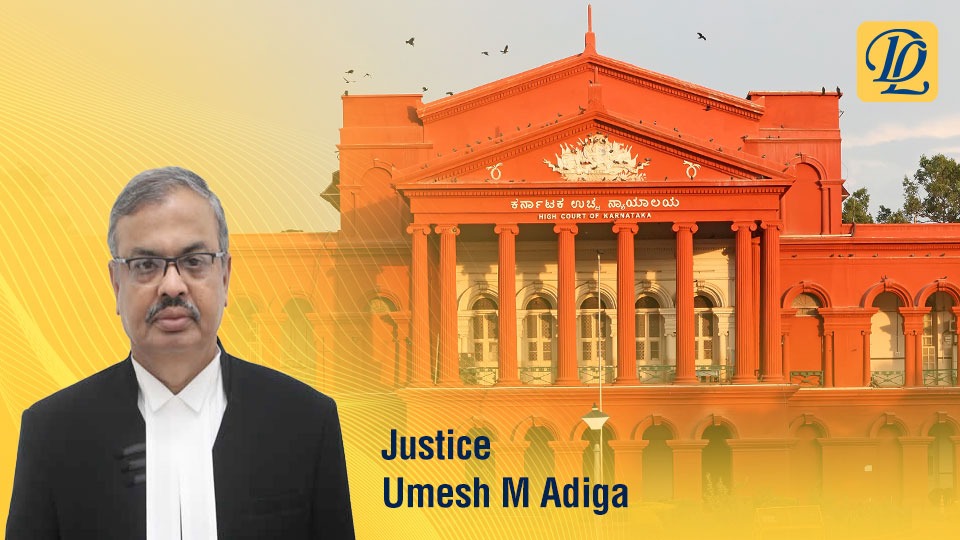
Hon’ble Mr. Justice Umesh M. Adiga celebrates his 62nd birthday today.
Hon’ble Mr. Justice Umesh Manjunath Bhat Adiga: Born on 09.01.1964. Native of Gadag. Enrolled as Advocate and practiced at Gadag. Appointed as Munsiff on 08.02.1995. Appointed as District Judge on 06.07.2009. Served as Registrar (Vigilance) High Court of Karnataka, Prl. District & Sessions Judge, Chikkamagaluru, Dharwad and as Presiding Officer, Industrial Tribunal, Bengaluru. Sworn-in as Additional Judge of the High Court of Karnataka on 16.08.2022.
Important Judgments delivered by Hon’ble Mr. Justice Umesh M Adiga.
Service Law. Person ineligible for the post cannot question the appointment of another person to the post since Public Interest Litigation is impermissible in Service matters. Karnataka High Court.
When proceedings are initiated under the Karnataka SC/ST (PTCL) Act, the authorities are bound to examine whether the grant comes within the purview of the Act. Karnataka High Court.
Employees’ Provident Funds and Miscellaneous Provisions Act. Competent authority has discretion to reduce the percentage of damages under Section 14B and the same is justiciable. Karnataka High Court.
Mere payment of premium amount before occurrence of accident will not cover liability if the insurance policy is issued with effect from the time after the accident. Karnataka High Court.
Mere existence of Arbitration Clause does not bar jurisdiction of the Civil Court unless the party exercises his right under Section 8 of the A & C Act. Karnataka High Court.
Where driver of vehicle had no valid and effective driving licence, the insurance company shall pay the compensation to the claimant and recover the same from owner of the vehicle. Karnataka High Court reiterates.
MVC Act. Amputation of leg need not always result in 100% disability for the purpose of awarding compensation when the claimant can do the work which is not strenuous in nature. Karnataka High Court.
Borrower of motor vehicle steps into the shoes of the owner of the vehicle and hence the borrower of the vehicle or his legal heirs are not entitled for compensation. Karnataka High Court.
“Coparcenary system continues even after the 2005 amendment to the Hindu Succession Act.” Karnataka High Court explains the principles behind succession and survivorship.
Income Tax Act. Exemption from restriction on cash transaction can be claimed only for special exigencies the burden of proving is on the assessee. Karnataka High Court.
Hindu Succession Act. When a person with a living daughter is adopted into another family, the daughter remains a part of her natural family and retains her right to inherit a share of her natural family’s ancestral property. Karnataka High Court.
Motor Vehicles Act. Assessment of the notional income for a minor must be based on the minimum wages payable to a skilled worker. Burden of furnishing the applicable minimum wage data rests on the insurance company if the claimant fails to produce it. Karnataka High Court.
Labour Law. When a reinstatement award is passed in favor of a workman, and the implementation of that award is subsequently stayed by an appellate court upon the employer’s challenge, the principle of ‘no work no pay’ will not apply for the period the stay order was in operation, as the workman was prevented from working due to the employer’s legal challenge. Karnataka High Court.
Mohammedan Law. The mere registration of a gift deed does not, by itself, establish compliance with all legal requirements. A valid gift must be supported by three essential elements: a clear declaration by the donor, acceptance by the donee, and contemporaneous as well as continuous delivery of possession to the donee. Unless these elements are proved, the donor remains entitled to subsequently alienate the property, and the donee cannot rely on an earlier, unproven gift to challenge the validity of later transactions. Karnataka High Court.
Motor Vehicles Act (unamended). The Insurer is liable to indemnify the owner for an accident that occurs within the 30 days grace period after expiry of the license period as the driver is deemed to possess a valid licence. Absence of a driving licence does not per se establish contributory negligence unless a direct link is proved between the lack of the licence and the occurrence of the accident. Karnataka High Court.
 Daksha Legal