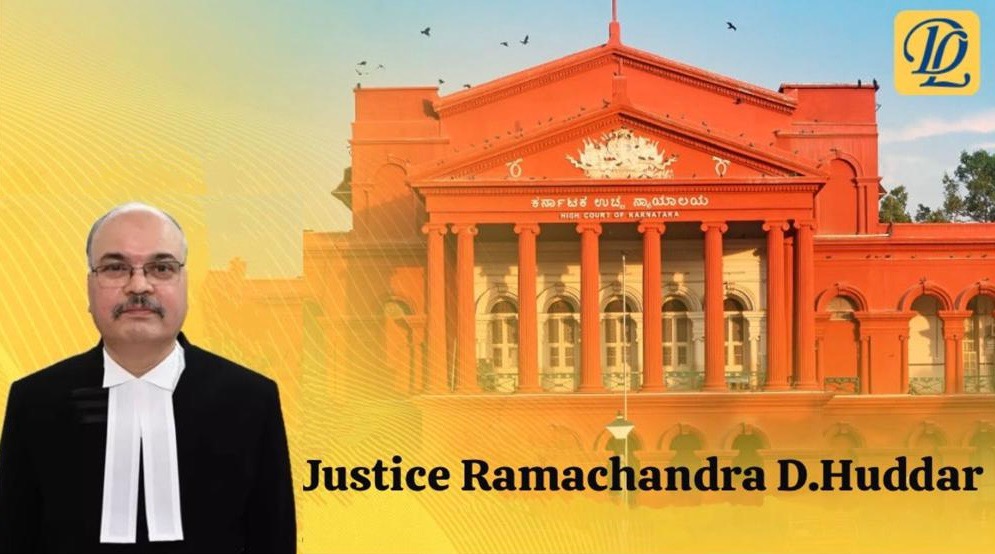
Hon’ble Mr. Justice Ramachandra D. Huddar celebrates his 62nd birthday today.
Honble Mr. Justice Ramachandra Dattatray Huddar: Born on 13.08.1963. Native of Gokak, Belgaum District. Graduated in Law from R.L. Law College, Belagavi. Enrolled as Advocate and practiced at Gokak. Appointed as Munsiff on 08.02.1995. Appointed as District Judge on 02.07.2009. Served as Registrar (Review & Statistics), Registrar (Administration), Addl. Registrar General, Dharwad Bench, Registrar (Infrastructure & Maintenance) & Registrar (Computers). Served as Prl. District & Sessions Judge, Dharwad, Mysuru. Worked as Director, Karnataka Judicial Academy, Bengaluru. Served also as Prl. City Civil & Sessions Judge, Bengaluru and Sworn-in as Additional Judge of the High Court of Karnataka on 24.01.2023.
Important Judgments delivered by Hon’ble Mr. Justice Ramachandra D Huddar.
Money belonging to a citizen is his property. If that is retained by the State, that amounts to temporary acquisition of property for which compensation has to be paid going by Article 300A of the Constitution of India. Karnataka High Court.
Banking Regulation Act. Bank can discontinue employment of a person who is convicted for an offence involving moral turpitude, whether he is sentenced or not. Karnataka High Court.
‘’Judges cannot act like Mughals of bygone era’’. High Court cannot issue writ in derogation of law or transcend the barriers of law. Karnataka High Court.
Negotiable Instruments Act. When cheque is returned with the endorsement ‘’payment stopped by drawer’’, the penal provisions of the Act are attracted. Karnataka High Court.
Land acquisition. Denotification and rescinding the denotification has to be gazetted so that the stakeholders challenge it; and the unscrupulous landowners would not prey the potential buyers on the basis of Denotification. Karnataka High Court.
UAP Act. Informal body of individuals ‘concerned’ with the terrorist act, though not actually involved in terrorist act, is also covered under the definition of ‘terrorist gang’. Karnataka High Court.
Mere usage of the words ‘Khayam’ or ‘Nirantara’ in a collateral document does not make lease of immovable property a ‘permanent lease’. Karnataka High Court.
Relief of declaration in a title suit to property benefits even those who are not impleaded as plaintiffs. Karnataka High Court.
When the appellate Court receives additional evidence such as expert opinion which requires to be analysed by the trial Court, the matter can be remanded to the trial Court. Karnataka High Court.
Not every application under Order 21 Rule 97 of CPC requires detailed enquiry. Courts must reject frivolous application at the threshold to enable the decree holder to reap the benefits of the decree. Karnataka High Court.
Hindu Succession Act. Failure on the part of daughters to claim share in house property in a family partition does not amount to abandonment of claim under the unamended Section 23. Karnataka High Court.
Criminal Law. Circumstantial evidence. Proved circumstances must be consistent only with hypothesis of guilt of accused and totally inconsistent with his innocence. Karnataka High Court.
Industry showing payment of overtime wages as conveyance charges to evade the ESI contribution. Karnataka High Court imposes exemplary cost on the appellant industry.
Though earlier suit for injunction does not operate as resjudicata, specific issues framed in the earlier suit and the decision rendered therein would certainly operate as resjudicata. Karnataka High Court.
Plaintiff is bound by law of limitation when he files a fresh suit under Order 23 Rule (1) CPC. If liberty is granted at the appellate stage, the cause action for fresh suit must be different than the earlier one. Karnataka High Court.
Specific performance. Subsequent escalation in market value is not a ground to refuse specific performance of the agreement when all other factors are proved. Karnataka High Court.
“Once the forest, always forest”. Karnataka High Court orders preservation and protection of Chamundibetta State Reserve Forest.
While an unpaid vendor’s usual remedy is to sue for the sale consideration, if the validity of the instrument is challenged and the transaction is alleged to be voidable on grounds of fraud or misrepresentation, a suit for declaration and cancellation is a recognized course. The existence of such a triable issue justifies the grant of a temporary injunction. Karnataka High Court.
A civil court shall return a plaint under Order VII Rule 10 of the CPC instead of rejecting it when a related commercial suit between the same parties is pending before a Commercial Court, as this avoids conflicting judgments and multiplicity of proceedings. Karnataka High Court.
Employees State Insurance Act. Labourers engaged through contractors for construction and repair works undertaken within the factory premises are to be treated as `employees’ within the meaning of Section 2(9). Karnataka High Court.
Children born from a second void marriage are not entitled to seek an injunction against the children of the first marriage to prevent them from alienating joint family properties that have already been partitioned. Their rights, if any, are confined solely to the share of the property allotted exclusively to the father. Karnataka High Court.
Principle that a suit for bare injunction does not lie when title is seriously disputed is not an inflexible rule. A temporary injunction can be granted to protect established and lawful possession, even when title is disputed, if the possession is clearly evidenced and its disruption would cause irreparable harm. Karnataka High Court.
Abetment to commit suicide. A criminal conviction cannot be sustained based solely on the uncorroborated and inconsistent testimony of a single interested eyewitness, particularly when contradicted by other evidence, as it fails to meet the standard of proof beyond reasonable doubt, entitling the accused to the benefit of doubt. Karnataka High Court.
Posthumous registration of a Will is legally permissible and does not, in itself, invalidate the Will or render it suspicious. Courts cannot prejudge the genuineness of a Will at the interlocutory stage based solely on such registration, as its validity must be determined through evidence at trial. Karnataka High Court.
Foreign Marriage Act. A marriage conducted in accordance with the customs or religious practices of a foreign country, and supported by evidence such as cohabitation, joint finances, and social recognition, holds legal validity in India, regardless of whether it is registered under the Act. Karnataka High Court.
Karnataka Protection of Interest of Depositors in Financial Establishments Act. Proceedings for attachment of property does not require a prior criminal case or naming as accused in a charge sheet. Special Court has jurisdiction to examine whether a property transfer was made in good faith or for proper consideration irrespective of the status of any related criminal proceedings. Karnataka High Court.
A person from the ‘Veerashaiva Lingayat’ community cannot claim the benefits of the ‘Beda Jangama’ Scheduled Caste. Mere grant of ‘Beda Jangama’ Certificate to a member of the family would not permit issuance of certificate to other claimant if they belong to ‘Veerashaiva Lingayat’ Community. Karnataka High Court.
Prevention of Corruption Act. Conviction is justified when complainant’s evidence, if consistent and corroborated by material particulars e.g., shadow witness, forensic evidence, and accused’s conduct, can establish the demand, particularly when the defence’s explanation is unconvincing. Karnataka High Court.
Prevention of Corruption Act. Presumption under Section 20 of the Act arises only after the prosecution proves the demand and acceptance. The appellate Courts should not lightly interfere in acquittals unless findings are perverse. Karnataka High Court.
Service Law. Candidates who join service late, even with authorized extensions, will have their seniority determined by their actual date of joining, rather than their position in the select list. However, once the seniority lists are finalized and have been in effect for a long period of time, they cannot be retroactively revised to unsettle established rights. Karnataka High Court.
Children from a second marriage are entitled to a share in their father’s share in ancestral property, even if their mother had relinquished her rights. Any sale of joint family property without the consent of all co-owners does not affect the inheritance rights of non-consenting legal heirs. Karnataka High Court.
A service provider is entitled to reimbursement of additional tax liability arising due to statutory changes. An arbitration clause does not bar writ jurisdiction when public law principles or contractual fairness are involved. Karnataka High Court.
Service Law. Courts and tribunals can intervene with an order imposing penalty or punishment when the order is issued by an authority lacking jurisdiction; when the decision is unsupported by evidence and when there is a gross violation of the principles of natural justice. Karnataka High Court.
Contract Act. When fixed deposits are offered as collateral security towards loan, Bank can exercise its general lien over the fixed deposits. Karnataka High Court.
Freedom Fighters pension. Care has to be taken to see that real freedom fighters do not suffer, at the same time, fictitious claims have to be sternly dealt with on merits. Karnataka High Court.
Demonetisation. Confiscation of specified Bank notes by the investigating agencies. Person can seek exchange of the notes from the Union of India only on production of direction of the Court to that effect. Karnataka High Court.
 Daksha Legal