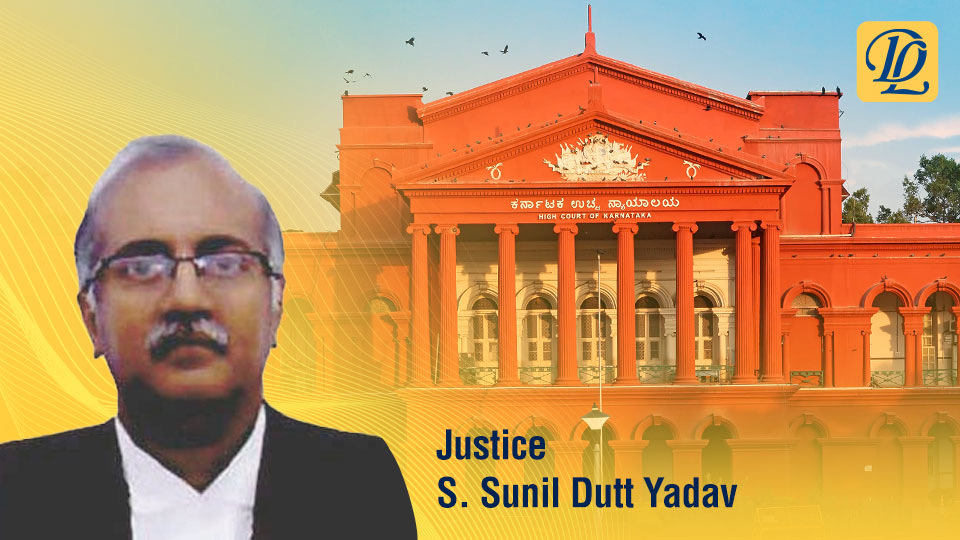
Hon’ble Mr. Justice S. Sunil Dutt Yadav celebrates his 53rd birthday today.
Hon’ble Mr. Justice Siddappa Sunil Dutt Yadav: Born on 3rd August 1972. Appointed as Additional Judge of the High Court of Karnataka and took oath on 14.02.2018 and Permanent Judge on 07.01.2020.
Important judgments delivered by Hon’ble Mr. Justice Sunil Dutt Yadav.
Compensation towards tortious acts of State entities. Concurrent remedy no bar to exercise writ jurisdiction. Karnataka High Court awards compensation of Rs. 1.19 Crore for death and injury due to electrocution.
Vehicle plying outside permit area. Violation does not absolve insurer of liability. Pay and recover principle applied.
Judgments cannot be swayed by emotions. Cases should be proved beyond reasonable doubt.
Claim to property based on adverse possession. Period starts from the time of giving up the claim based on title. Plea of title and adverse possession are mutually inconsistent. Karnataka High Court.
Unlike access to justice, forum convenience is not a fundamental right. Only the Chief Justice of High Court has power to allocate work to puisne judges of respective benches of High Court. Karnataka High Court clarifies.
Service Law. Stigmatic termination of an employee cannot be done by following termination simplicotor Rule abandoning disciplinary proceedings. Karnataka High Court.
Ineligible candidate cannot plead his innocence in the selection process. Permitting ineligibility to triumph would have the effect of perpetuation of illegality which cannot be allowed. Karnataka High Court.
Speedy conclusion of investigation in criminal cases. Karnataka High Court lays down detailed guidelines.
False allegation of impotency by wife would cause mental disharmony to husband and amounts to mental cruelty, which would enable the husband to seek divorce on the ground of cruelty. Karnataka High Court.
Proceedings before the mediator are confidential and cannot be relied on by Courts in deciding cases on merits. Karnataka High Court.
Assessee is entitled for ‘Nil Tax Deduction at Source’ for payments made towards reimbursement of salaries of deputed expatriate employees. Karnataka High Court.
Service Law. Wherever horizontal reservation of eligible candidates are not found, it is the duty of the authorities concerned to then have a vertical reservation. Karnataka High Court.
Service Law. Transfer order, after the period of general transfers without showing place of posting, is not permissible. Place of transfer must be to a vacant post. Karnataka High Court.
Prevention of Corruption Act. Previous sanction is not required before passing an order for investigation under Section 156(3) of Cr.P.C. Authoritative pronouncement of the Karnataka High Court.
Karnataka Grama Swaraj and Panchayat Raj Act. Chief Executive Officer cannot terminate employees of the Grama Panchayat since the competent authority is the Gram Panchayat. Karnataka High Court.
There must be a specific allegation that the action complained of amounts to interference or attempt to interfere with the free exercise of electoral right by undue influence at an election to constitute offence under Section 171C, IPC. Karnataka High Court.
Where driver of vehicle had no valid and effective driving licence, the insurance company shall pay the compensation to the claimant and recover the same from owner of the vehicle. Karnataka High Court reiterates.
MVC Act. Amputation of leg need not always result in 100% disability for the purpose of awarding compensation when the claimant can do the work which is not strenuous in nature. Karnataka High Court.
Borrower of motor vehicle steps into the shoes of the owner of the vehicle and hence the borrower of the vehicle or his legal heirs are not entitled for compensation. Karnataka High Court.
Reservation in promotion. Evaluation of inadequacy of representation need not be made at every stage of making fresh promotion. Karnataka High Court.
Arbitration and Conciliation Act, 1996. Even non-signatories will be bound by the arbitration agreement, if there is implied consent to be bound and a direct relationship with the signatory. Karnataka High Court.
‘Karnataka High Court rejects the plea of teachers for enhancing age of superannuation.’ Karnataka High Court.
Karnataka Stamp Act. Where possession is not handed over under agreement of sale, levy of stamp duty cannot exceed Rs. 20,000/- Karnataka High Court.
Election Law. Purchase of Medi Assist Policies by a candidate prior to nomination but distribution of the same after the nomination would amount to bribery in terms of Section 123 of the R.P. Act. Karnataka High Court.
Escaped assessment under the IT Act. ‘Income chargeable to tax’ is income as arising out of the capital gains and not the entire sale consideration. Karnataka High Court.
Service Law. Person ineligible for the post cannot question the appointment of another person to the post since Public Interest Litigation is impermissible in Service matters. Karnataka High Court.
Re-assessment under Section 148A (d) of the Income Tax Act against a Company already merged with another Company is a substantive illegality and without jurisdiction. Karnataka High Court.
Reopening assessment under Section 148 IT Act. Reasons for issuing notice once communicated and objections received, the officer is duty bound to adjudicate upon the same before reassessment order is passed. Karnataka High Court.
“Disputes between the governmental bodies cannot be dragged before the constitutional courts”. Karnataka High Court sets up committee to resolve the dispute between APMC and BMRCL regarding compensation.
Grant of sanction u/s 197 Cr.P.C. is an administrative function and the presumption under Section 114(e) of the Indian Evidence Act that official acts have been performed regularly can be applied. Karnataka High Court.
Grant of NOC from the Ministry of Defence for construction within the vicinity of Defence Establishment can only be as per the provisions of the Works of Defence Act, 1903. Executive instructions cannot be relied on. Karnataka High Court.
Determination of market value under Section 26 of 2013 Land acquisition Act shall be as per the guidelines in Section 26 of 2013 Act and not based on earlier Gazette Notification. Karnataka High Court.
Amendment of pleading cannot be rejected on the ground of delay when the Court exercises power under Section 26 (4) of the Specific Relief Act. Karnataka High Court.
Alternate appellate remedy. If exercise of jurisdiction by a Tribunal ex-facie appears to be an exercise of jurisdiction in futility, it will be permissible for the High Court to interfere in exercise of its writ jurisdiction. Karnataka High Court.
Judicial proceedings initiated by a third party other than the employer cannot be a reason to withhold pension payable to public servant. Karnataka High Court.
Right to privacy of Aadhaar number holder has to be protected. Marriage does not eclipse the right to privacy which is protected by the procedure of hearing under Section 33 of the Aadhaar Act. Karnataka High Court.
Employees Compensation Act. Commissioner is bound to consider the aspect of penalty in accordance with statutory provision when there is delay in payment of even the partial liability. Karnataka High Court.
Re-assessment under the Income Tax Act. Assessee duty to disclose does not extend beyond full and truthful disclosure of all primary facts and does not include inferences. Karnataka High Court.
Income Tax Act. Re-assessment under Section 148. Mere change of opinion cannot be a ground for re-opening concluded assessments. Karnataka High Court.
Whether BBMP can demand full property tax from the Educational Institutions? High Court of Karnataka takes up the issue and grants stay of the demand notice.
Procedure to be followed by BBMP in cases of reopening self-assessment where returns are not filed and in cases of random scrutiny. Karnataka High Court lays down guidelines.
Indian Succession Act. While granting Letters of Administration to the sole legal heir of the deceased, Court has no power to impose condition of non-alienation of the property on the petitioner. Karnataka High Court.
Disqualification to hold Office in local bodies. Work done for the Gram Panchayat at an earlier point of time would not operate as a disqualification. Karnataka High Court.
Karnataka Co-operative Societies Act. Disqualification for not clearing loan due to the Society as on the date of election. Subsequent clearing of dues will not wipe out the disqualification. Karnataka High Court.
Demonetisation. Confiscation of specified Bank notes by the investigating agencies. Person can seek exchange of the notes from the Union of India only on production of direction of the Court to that effect. Karnataka High Court.
Suit for specific performance. Purchaser of the property from the owner is a necessary party in the proceedings and hence requires to be arrayed as a party defendant. Karnataka High Court.
Sexual Harassment of Women at Workplace (Prevention, Prohibition and Redressal) Act. Appellate authority has powers to pass interim orders in appeals under Section 18 of the Act. Karnataka High Court.
Memo for withdrawal of a case does not require signature of the litigant since the Advocate is fully authorised to take action on behalf of the clients in the vakalat itself. Nevertheless, it is prudent for advocates to obtain written instructions from their clients prior to withdrawing the case. Karnataka High Court.
Karnataka SC/ST (PTCL) Act. The initiation of suo moto proceedings for resumption within five years from the date of commencement of the Act cannot be considered illegal or vitiated by delay. Karnataka High Court.
Legitimate expectation. An order which has the effect of reversing a pay hike has the consequence of upsetting financial planning of employee visiting civil consequences which cannot be resorted to without affording an opportunity of hearing. Karnataka High Court.
A suit seeking a declaration regarding matrimonial status, whether affirmative or negative, falls within the exclusive jurisdiction of the Family Court under Section 7(1)(b) of the Family Courts Act, 1984. The nature of relief sought does not affect maintainability, and Civil Courts are barred from entertaining such suits. Karnataka High Court.
Criminal Law. A conviction under Section 302 IPC can be upheld without an independent eyewitness if res gestae witnesses, forensic evidence, and motive prove guilt beyond a reasonable doubt. Testimony from the deceased’s family cannot be dismissed for bias, and minor contradictions or hostile witnesses do not weaken a well-supported prosecution case. Karnataka High Court.
Temporary employees performing the same duties as regular employees are entitled to equal pay. Prolonged engagement at exploitative wages violates Article 23, and courts can mandate compensation equivalent to the minimum prescribed salary. Karnataka High Court.
Grama Panchayat property tax. The determination of tax liability and entitlement to exemptions must be in accordance with the applicable rules at the time the tax is levied. Karnataka High Court.
Claim to property based on adverse possession. Period starts from the time of giving up the claim based on title. Plea of title and adverse possession are mutually inconsistent. Karnataka High Court.
Where a principal employer utilizes contract labor for essential, permanent, and perennial work, especially to bypass recruitment bans and in violation of the Contract Labour (Regulation and Abolition) Act, such employees are entitled for regularization. Karnataka High Court.
A person from the ‘Veerashaiva Lingayat’ community cannot claim the benefits of the ‘Beda Jangama’ Scheduled Caste. Mere grant of ‘Beda Jangama’ Certificate to a member of the family would not permit issuance of certificate to other claimant if they belong to ‘Veerashaiva Lingayat’ Community. Karnataka High Court.
Postal Department, as a public utility, cannot deny or suspend services or agreement renewals to an entity based on mere allegations of criminal or fraudulent activities or pending investigations without a conclusive judicial finding. Karnataka High Court.
 Daksha Legal