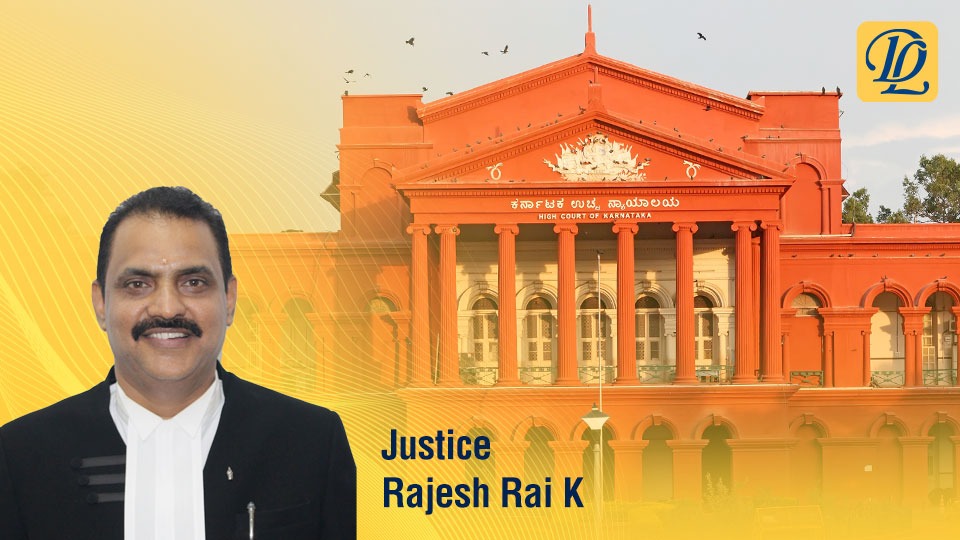
Hon’ble Mr. Justice Rajesh Rai K celebrates his 51st birthday today.
Hon’ble Mr. Justice Rajesh Rai Kallangala: Born on 01.06.1974. Completed primary education at Kepu & secondary education & PUC at Vitla. Completed Degree from St. Philomina’s College. Completed LL.B., from Vivekananda Law College, Puttur. Enrolled as Advocate in 1999 and practiced in the office of Sri G. Balakrishna Shastri and Sri Younus Ali Khan. Later joined the office of Hon’ble shri Justice John Michael D’Cunha. Worked as Government Pleader for 2 years. Served as Central Government Senior Panel Counsel for 6 years. Functioned as Special Public Prosecutor for Enforcement Directorate, and Narcotics Control Bureau. Served as Panel Advocate for BDA. Practiced mainly on criminal side.
Sworn-in as Additional Judge of the High Court of Karnataka on 09.02.2023.
Important Judgments delivered by Hon’ble Mr. Justice Rajesh Rai.
IPC. Section 306. To constitute the offence under Section 306, IPC, the accused must have played an active role by act of instigation or doing certain act to facilitate the commission of suicide. Karnataka High Court.
Application under Order 41 Rule 27 CPC can be considered only at the time of hearing of appeal on merits so as to find out whether the additional evidence has any relevance/bearing on the issues involved. Karnataka High Court.
Criminal trial. Denying cross-examination violates a person’s life and liberty which are not only fundamental rights but also basic human rights. Karnataka High Court.
Detention order cannot be challenged by seeking a writ of habeas corpus when the order is already confirmed by the Government. Karnataka High Court.
Service law. In the absence of clear proof based on the evidence of witnesses in the enquiry, an adverse presumption cannot be drawn on the guilt of the accused. Karnataka High Court sets aside compulsory retirement on corruption charges.
Standalone distilleries established for manufacturing ethanol are not governed by the provisions of the Sugarcane Control Order, 1966. Karnataka High Court.
”Purpose of acquisition is relevant factor in determining the compensation’’. Karnataka High Court enhances compensation from Rs. 750 to Rs. 2000 for the land acquired for Court complex.
Conviction for the offence under Section 366A Procuration of minor girl for illicit sexual intercourse must be fortified by sufficient evidence and reasons when the offence of rape not proved. Karnataka High Court.
When the prosecution fails to prove its case, benefit of the acquittal can be extended by the appellate court even to the accused who has not preferred appeal challenging the order of conviction. Karnataka High Court.
Criminal Law. Though due to passage of time and memory loss, witnesses deviate from their Police Statements, but when such discrepancies make the foundation of the prosecution case shaky, the Court has to take strict note thereof. Karnataka High Court.
If deposition of the child witness inspires confidence in the mind of the Court and there is no improvement or tutoring, the Court may rely upon the same. Karnataka High Court.
In determining culpable homicide under Section 299 of IPC, mentality of the accused, nature of the act and its effect upon the victim have to be analysed. Karnataka High Court.
When accused are acquitted for the offences under Sections 498A, 304B IPC and Sections 3 and 4 of the Dowry Prohibition Act, conviction for the murder cannot be sustained. Karnataka High Court.
Lack of intention on the part of the accused and commission of the act in the heat of passion upon sudden quarrel are the mitigating circumstances. Karnataka High Court reduces sentence from Section 302 IPC to Section 304.
Criminal Law. When trial Court misreads the evidence and arrives at a conclusion erroneously to convict the accused, the appellate Court must intervene to prevent miscarriage of justice. Karnataka High Court.
Reference Court while awarding compensation in respect of the sub-soil/minerals underneath the soil of the acquired properties shall take into consideration the provisions of the Karnataka Minor Minerals Concession Rules. Karnataka High Court.
Freedom fighters’ pension. The proof required must be as provided in the pension scheme itself. As long as such proof was not available, the benefit cannot be granted. Karnataka High Court, while following the Supreme Court Judgment.
Criminal law. To impose the extreme punishment, all the three tests; Crime test, Criminal test and Rarest rare test must be satisfied. Karnataka High Court converts imprisonment till last breath of life to life imprisonment.
Criminal Law. Subsequent voluntary statement of the accused cannot be admissible in evidence and recovery to that effect amounts to “rediscovery of a fact already disclosed and capable of discovery.” Karnataka High Court.
Cheque issued by vendor to purchaser of property as security towards pending litigation on the property is not ‘legally enforceable debt’. Karnataka High Court.
Presumption of innocence is a human right. Mere recovery of the tainted money, dehorse the circumstances under which it was found, is not sufficient for conviction under the PC Act when the substantive evidence is not proved. Karnataka High Court.
Preventive detention under the Goonda Act. Failure to furnish translated copies of the documents to the detenue renders the detention unsustainable. Karnataka High Court.
MVC Act. Contributory negligence cannot be attributed to victim riding vehicle simply because he did not have driving license and insurance, especially when he was riding on the correct side of the road. Karnataka High Court.
MVC Act,1988. Tribunal or Court should not apply the split multiplier in routine course and multiplier should be applied. An injured or the legal representatives of the deceased should not be deprived from getting a just compensation. Karnataka High Court.
MVC Act. Tribble riding on a two-wheeler itself is not a ground to avoid insurance liability unless it is established that the tribble riding was the cause for the accident to attribute contributory negligence. Karnataka High Court.
Service Law. Court cannot sit on perceptivity of the State Government in posting a person to a particular post except considering the eligibility of the person to occupy the post. Karnataka High Court.
Failure to furnish legible and translated copies of the documents supporting the preventive detention to the detune vitiates the detention order. Karnataka High Court.
Income Tax Act. Proceedings regarding escaped assessment and notices under Section 153C solely based on loose sheets and documents which are termed as ‘diaries’ found during the search are unsustainable. Karnataka High Court.
It is not always mandatory for the State Government to script the reasons for transfer of public servant when the reasonings are reflected in the records for obtaining prior-approval from the Chief Minister. Karnataka High Court.
A suit seeking a declaration regarding matrimonial status, whether affirmative or negative, falls within the exclusive jurisdiction of the Family Court under Section 7(1)(b) of the Family Courts Act, 1984. The nature of relief sought does not affect maintainability, and Civil Courts are barred from entertaining such suits. Karnataka High Court.
Criminal Law. A conviction under Section 302 IPC can be upheld without an independent eyewitness if res gestae witnesses, forensic evidence, and motive prove guilt beyond a reasonable doubt. Testimony from the deceased’s family cannot be dismissed for bias, and minor contradictions or hostile witnesses do not weaken a well-supported prosecution case. Karnataka High Court.
State Financial Corporation Act. In proceedings under Sections 31 and 32, where the enforcement of a surety’s liability is sought, the court’s investigation is primarily limited to determining the validity of the financial corporation’s claim. Karnataka High Court.
 Daksha Legal