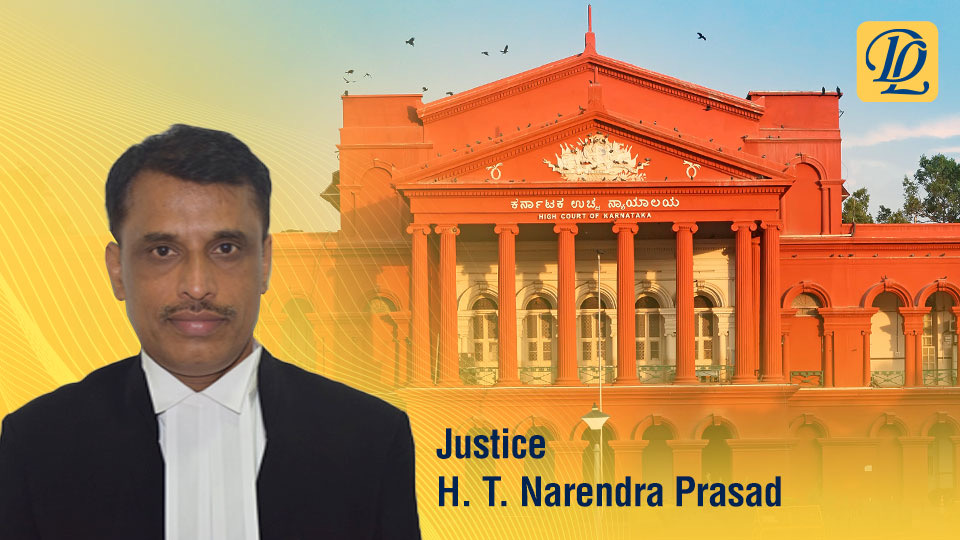
Hon’ble Mr. Justice H.T. Narendra Prasad celebrates his 59th birthday today.
Hon’ble Mr. Justice Harekoppa Thimmana Gowda Narendra Prasad: Born on 1st June 1966. Studied B.Sc., from D.V.S.College, Shivamoga in the year 1990 and LL.B., from Vidyavardhaka Law College, Mysuru in the year 1993.
Enrolled as an Advocate in the High Court of Karnataka in the year 1993. Started Practice in the Chambers of Prof. Ravivarma Kumar.
Initially for a period of two years practiced in Trial Courts, Bengaluru.
Practiced in the field of Constitutional Law, Service Law, administrative Law, Public Law, Property Law, Arbitration and Conciliation mattes, Environmental Law, Revenue Matters, Company matters, Banking Laws, Civil and Criminal matters before the High Court of Karnataka, Karnataka State Administrative Tribunal and Central Administrative Tribunal.
Appointed as High Court Government Pleader in the year 2006 till 2013 and as Additional Government Advocate from 2013 till the date of elevation, i.e., 2018.
Appointed as an Additional Judge, High Court of Karnataka on 02.06.2018 and as Permanent Judge on 26.02.2020.
Important Judgments delivered by Hon’ble Mr. Justice H.T. Narendra Prasad.
Issuance of fifteen days notice for moving no confidence motion under the Karnataka Panchayat Raj Act and the Rules is mandatory. Karnataka High Court.
Election petition cannot be dismissed for making the Returning Officer also a party to the petition. Karnataka High Court.
Maintenance and Welfare of Parents and Senior Citizens Act, 2002. Right of appeal under Section 16 (1) is conferred on both sides and not confined only to senior citizen and parents. Karnataka High Court.
Protection of Women from Domestic Violence Act, 2005. Order passed under Section 12 can be enforced in the same manner as laid down under Section 125, Criminal Procedure Code. Karnataka High Court.
Motor Vehicles Act, 1988. Section 147. Person travelling on mud-guard of a tractor is NOT an authorized passenger. Persons working on ploughing/crushing machines attached to tractor are NOT employees. Karnataka High Court.
Law of precedent. Observations made by the court must be read in context in which they appear to have been stated. The judgments of the courts are not to be construed as statutes. Karnataka High Court.
Tax laws. Interpretation. There is no equity about tax. No presumption as to tax. Nothing to be read in. Nothing to be implied except the actual language used. Karnataka High Court.
Technical objection which defeats justice should be discouraged. If infraction of procedural provision does not provide for any consequences such a provision has to be construed as directory and not mandatory.
Preventive detention. Order of detention can be passed even if detenue is in custody.
“Removing minor girl from the lawful custody of parents is clear case of kidnap”. Karnataka High Court convicts the accused while confirming his acquittal for the offence under the POCSO Act.
“Interest of the child is paramount in cases under the POCSO Act and the Court cannot appreciate the evidence on sentimental values.” Karnataka High Court sets aside the acquittal of the sexual offender.
Motor Vehicles Act. Compensation can be claimed for the death of brother having regard to Section 8 of the Hindu Succession Act. Karnataka High Court.
Acquisition of land granted under the Land Grant Rules. The grantee is entitled to compensation. Karnataka High Court.
Civil suit barred by limitation touches the very jurisdiction of the court. Even a compromise decree cannot be passed by the original or appellate court in such a proceeding. Karnataka High Court.
MV Act. When the income declared by a person engaged in a profession or business is not stable, in order to assess the income, the average of the income of the years considered would be appropriate. Karnataka High Court.
Hindu Law. Widow who is remarried after the succession opened due to the death of her husband is entitled to a share in her late husband’s properties. Karnataka High Court.
Purchaser cannot maintain a civil suit against the land acquisition body (BDA) for declaration and injunction when the acquisition proceedings are already completed. Karnataka High Court.
Civil suit for injunction against acquiring body in respect of property acquired under a statute is not maintainable and is barred under Section 9 of CPC. Karnataka High Court.
Unauthorized occupant cannot claim adverse possession in respect of property which belongs to statutory body. Karnataka High Court.
Karnataka SC/ST (PTCL) Act does not apply to lands granted to SC/ST persons under the Karnataka Village Offices Abolition Act. Karnataka High Court.
Karnataka SC/ST (PTCL) Act. Even the suo motu proceedings for resumption of alienated lands can be initiated only within the reasonable time. Karnataka High Court.
Karnataka Panchayat Act. Adhyaksha of Zilla Panchayats can interfere with an order or resolution of the Grama Panchayat only when the Adhyaksha of the Panchayat makes a reference to him. Karnataka High Court.
Municipal Corporation cannot insist on probate of a Hindu Will for change of khata since the Will executed by Hindus are not covered by Clauses (a) and (b) of Section 57 of the Indian Succession Act. Karnataka High Court.
To enforce right of pre-emption, the suit has to be filed within one year from the date of registration of the instrument. Suit for specific performance cannot be filed to avoid limitation issue. Karnataka High Court.
Court can pass an exparte order appointing a court commissioner under Order XXVI Rules 1 and 9 of the Civil Procedure Code in an intellectual property rights case. Karnataka High Court.
A dispute arising out of a Share Purchase Agreement does not amount to a commercial dispute under the Commercial Courts Act, 2015. Such matters should be adjudicated by a regular civil court and not by a Commercial Court. Karnataka High Court.
Trial court has no power to determine stamp duty and penalty on insufficiently stamped documents. Such matters must be referred to the District Registrar, who alone has the power to assess and certify compliance. Karnataka High Court.
Objections regarding pecuniary jurisdiction of trial court can be raised in an appeal against an interlocutory order when the suit is still pending. Bar under Section 21 of CPC applies only to appeals against final judgment and decree. Karnataka High Court.
 Daksha Legal