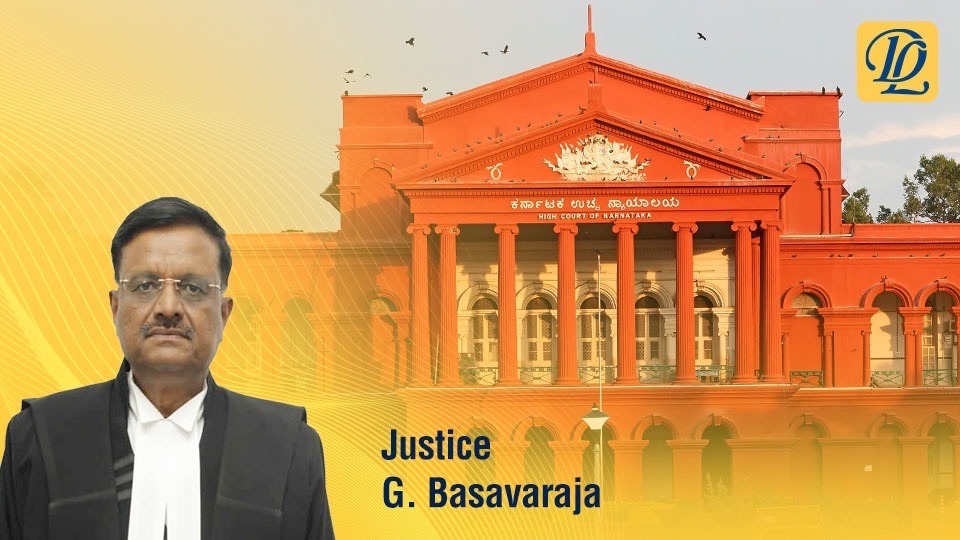
Hon’ble Mr. Justice G. Basavaraja celebrates his 60th birthday today.
Hon’ble Mr. Justice Gurusiddaiah Basavaraja: Born on 03.05.1965. Native of Methikurika Hiriyur Taluk, Chitradurga District. Enrolled as Advocate and practiced at Chitradurga. Appointed as Munsiff on 18.10.1993. Appointed as District Judge on 27.06.2009. Served as Prl. District & Sessions Judge, Chamarajanagar, Member Secretary, Karnataka State Legal Services Authority and as Prl. Judge, Family Court, Bengaluru. Sworn-in as Additional Judge of the High Court of Karnataka on 16.08.2022 and Sworn-in as Additional Judge of the High Court of Karnataka on 16.04.2024.
Important Judgments delivered by Hon’ble Mr. Justice G. Basavaraja.
Violation of the Income Tax Act in monetary transaction cannot be a defence in proceedings under Section 138 of the Negotiable Instruments Act.
Property derived by a female Hindu post the amendment to Section 6 of the Hindu Succession Act would become her absolute property and a coparcenary or joint family cannot be created by or under her.
Service Law. Premature transfer cannot be ordered simply because of the complaints against the public servant.
When the prosecution fails to prove major offence, the minor and related offence falls into insignificance and the accused will be entitled to acquittal. Karnataka High Court.
Digitalize the criminal investigation by videographing dying declaration and recording statements electronically with digital signatures. Karnataka High Court issues guidelines.
POCSO Act. Increasing cases of minor girls above the age of 16 years having love/sexual relationship resulting in criminal prosecutions. Karnataka High Court asks Law Commission of India to rethink on the age criteria.
Digitization of Criminal Investigation. Karnataka High Court issues comprehensive directions.
Service Law. Premature transfer cannot be ordered simply because of the complaints against the public servant. Karnataka High Court.
”Award of death sentence must be preceded by psychological and physiological evaluation, examination of early and present family background, history of violence and criminal antecedent of the accused”. Karnataka High Court lays down guidelines.
Motor Vehicles Act. Non-registration of police case regarding the accident or failure of the Medical Officer to report medico-legal case to the Police is not a ground to deny claim of the victim. Karnataka High Court.
Hindu Marriage Act. Wife not honouring decree for restitution of conjugal rights and refusing to join her husband is sufficient ground for divorce. Karnataka High Court.
Supari killing of Sulya KVG Medical College administrator. Karnataka High Court convicts six accused including the Director of the college.
Expenditure incurred by assessee towards construction of houses for flood victims as per of the Government directions is liable for deduction under Section 37(1) of the Income Tax Act. Karnataka High Court.
“When the murder is in broad daylight, evidence of the eyewitnesses cannot be brushed aside.” Karnataka High Court reverses acquittal of four persons and convicts them for murder.
Karnataka Education Act. Mere change in the composition of the Governing Council or its members from time to time would not tantamount to change in the Governing Council. Karnataka High Court.
‘Persons in public employment are not slaves of the Government, nor of their higher ups in the echelon of administration’. Karnataka High Court quashes dismissal order against public servant honorably acquitted in the criminal case.
Hindu Law. Doctrine of blending of individual’s property into joint family can be inferred by the words and if there are no words, then from his conduct. Karnataka High Court.
When counsel for appellant is absent and counsel for the respondent is present, the only course open to the appellate Court is to dismiss the appeal for non-prosecution. The appeal cannot be decided on merits. Karnataka High Court.
Residual provision of Article 137 of the Limitation Act, 1963 cannot be applied to prefer Revision Petition against the order passed by the Karnataka Waqf Tribunal. Karnataka High Court.
Plaintiff furnishing fictitious/false address of defendant and then seeking substituted service is a serious issue. Courts must verify the facts before ordering substituted service. Karnataka High Court.
Service Law. Disciplinary authority cannot go on holding enquiry after enquiry against an employee till the desired report is given by the enquiry officer. Karnataka High Court.
When a case relies heavily on a dying declaration, the court must meticulously examine its veracity, consistency, and the surrounding circumstances. If the dying declaration is inconsistent, appears doubtful, or is not adequately corroborated by other reliable evidence, and if the prosecution’s case is marred by significant inconsistencies and procedural lapses, the accused is entitled to acquittal. Karnataka High Court.
In a suit for partition of joint Hindu family property, the wife and children of a coparcener have an independent right to challenge a compromise decree that adversely affects their pre-existing rights in the ancestral property. Order VII Rule 11(d) of the CPC should not be used to reject a plaint in a partition suit at a preliminary stage when there are substantive rights of the parties that need to be adjudicated through a full trial. Karnataka High Court.
Mere utterance of the words ‘go and die’ does not, by itself, fulfill the ingredients of abetment to suicide. Statements made during a quarrel or in the heat of the moment cannot be presumed to have been made with the requisite mens rea. Karnataka High Court.
When there are two agreements to sell with different price components, the court must examine the intent of the parties and the circumstances surrounding the agreements to determine the actual terms of the transaction. A mere change in price alone may not constitute novation unless the new contract completely substitutes, rescinds, or alters the original contract. Karnataka High Court.
Appeal under Section 372 of Code of Criminal Procedure against acquittal. The appellate court should not disturb a trial court’s acquittal unless the trial court’s appreciation of evidence is capricious or its conclusions are without evidence. Karnataka High Court.
Land acquisition. Compensation for acquired land must reflect its market potential and proximity to developed areas. Comparable sale transactions serve as reliable indicators of fair valuation, with reasonable deductions for development costs. Karnataka High Court.
Resjudicata applies only when a former suit has been decided on the same cause of action, involving identical parties and issues. An ex-parte decree without substantive findings does not bar a subsequent suit where ownership and possession claims are distinct from prior proceedings. Karnataka High Court.
The 45-day limitation period under Section 17(1) of the SARFAESI Act is mandatory and cannot be extended. The DRT lacks the power to condone delay, and courts cannot intervene to relax statutory time limits based on equitable considerations. Karnataka High Court.
Set Top Boxes qualify as ‘goods’ under the KVAT Act, and their transfer to subscribers for a fee constitutes a ‘sale’. The Karnataka GST Act, 2017, does not nullify past VAT liabilities, and retrospective taxation through government notification is legally valid. Karnataka High Court.
Parliament can levy service tax on restaurants and accommodations under Entry 97 of List I. Service tax and sales tax target different aspects of the same transaction, allowing states to impose sales tax on food sales while the Union taxes the service component. Karnataka High Court.
Income Tax Act. A bonafide belief based on legal opinion from tax experts and legal professionals can constitute a reasonable cause under Section 273B, thereby exempting the assessee from penalty under Section 271C for non-deduction of TDS. Karnataka High Court.
When the scheme formulated under the Karnataka Urban Development Authorities Act to form residential layout is lapsed, the Authority cannot refuse sanction of residential layout plan submitted by the landowners. Karnataka High Court.
Family Courts Act. Suit for declaration regarding marital status between two ladies claiming to be the legally wedded wife of a certain person falls within the jurisdiction of the family court and not the civil court. Karnataka High Court.
Dismissal of the complaint under Section 138 N.I.Act for default amounts to acquittal Section 256(1) of Cr.P.C. Appeal is maintainable under Section 378(4) Cr.P.C. Karnataka High Court.
Disposal of corner sites. ‘Power of the BDA to accept or reject auction bid without explanation is traceable to a Rule which is not under challenge.’ Karnataka High Court upholds rejection of the auction bid.
 Daksha Legal