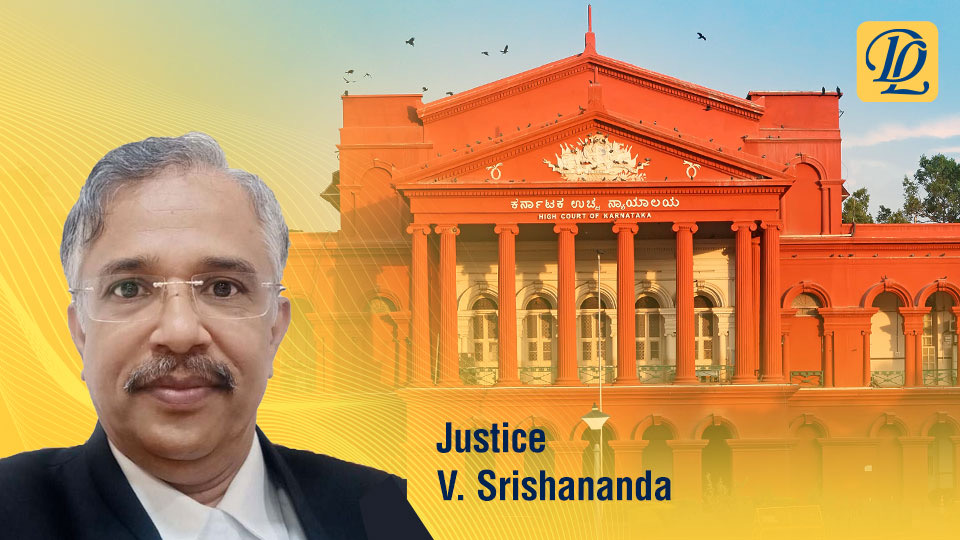
Hon’ble Mr. Justice V Srishananda celebrates his 59th birthday today.
Hon’ble Mr. Justice Vedavyasachar Srishananda: Born on 29.03.1966. Appointed as Additional Judge of the High Court of Karnataka and taken oath on 04.05.2020 and Permanent Judge on 25.09.2021.
Important Judgments delivered by Hon’ble Mr. Justice Srishananda.
Provisions of Order 41 Rule 27, production of additional evidence in Appellate Court, cannot be used to plug loopholes in the case of a party especially when such evidence was available earlier. Karnataka High Court.
Copyright Act. When once positive action is taken by the copyright holder of infringement, action under Section 60 challenging groundless threat of legal proceedings would no longer survive. Karnataka High Court.
Suit challenging a compromise decree passed before the Lok Adalath on the ground of fraud is not maintainable since the only remedy is to question the same under Article 226 and 227 of the Constitution of India. Karnataka High Court.
Daughter-in-law cannot claim maintenance against her parents-in-law under Section 125 of the Criminal Procedure Code. Karnataka High Court.
Plea of prior partition in a suit for partition is available only if all the necessary parties were included in the earlier partition. Karnataka High Court.
Income Tax Act 1961. Company ceasing to exist on the day of passing assessment order as a result of its merger under the approved scheme of amalgamation. Assessment order against such non-existent company is invalid. Karnataka High Court.
‘Acid attack is not only a crime against victim, but a crime against the entire civilized society. It is high time to deal with the acid attackers with iron hand.’ Karnataka High Court upholds life sentence to acid attacker.
Criminal Procedure Code. Section 267. Accused can NOT be detained by the jail authorities only on the basis of ”body warrant” without there being any detention order or judicial order. Karnataka High Court.
Public nuisance. Executive Magistrate must afford sufficient opportunities to the parties and record evidence and arrive at a legal finding that the action complained has resulted in nuisance to the general public at large. Karnataka High Court.
Bulk allotment of lands in favour of house building co-operative societies by BDA is valid and the society can seek permanent injunction on the basis of such bulk allotment. Karnataka High Court.
Statutory body using public money to indulge in frivolous litigation. Karnataka High Court imposes cost of Rs. 5 lakhs on the Bangalore Development Authority.
POCSO Act. Special Judge has no power to reduce minimum sentence of seven years for the penetrative sexual assault punishable under Section 4. Karnataka High Court.
Acceptance of ‘B’ report by the Magistrate cannot be reversed by the District Judge in revision without issuing notice to the defacto complainant. Karnataka High Court.
Protection of Women from Domestic Violence Act. Husband cannot be forced to keep both first and second wives in the same house. Karnataka High Court modifies trial court order.
Wills. Attesting witness is not just a ritualistic signer of a document. He is a key player in putting the plan of action of the testator into reality after the death of testator. Karnataka High Court.
Being physically handicapped by itself is not a favourable factor in considering the bail application of the accused when the gravity of the offence is serious in nature. Karnataka High Court.
POCSO Act. Undertaking by the accused that he would marry the victim girl if released on bail cannot be countenanced either to grant bail or to quash the proceedings. Karnataka High Court.
Initiation of criminal proceedings under the Karnataka Protection of Interest of Deposits in Financial Establishment Act against director of a company without preliminary enquiry is illegal. Karnataka High Court.
Insecticide Act. Non impleading the company who manufactured the pesticides vitiates criminal prosecution. Karnataka High Court.
Anticipatory bail. Though Court can’t hold a mini trial on merits, usage of deadly weapon and attack on vital part of the body are factors to be considered to reject the petition. Karnataka High Court.
Violation of privacy. There is no requirement for the Police to take permission of the Magistrate to register the case under Section 66E of the Information Technology Act. Karnataka High Court.
Second marriage by Muslim woman without divorcing the first husband is ‘Batil’ and void-ab-initio. Children born out of such marriage are illegitimate with no right of succession. Karnataka High Court.
Summons to produce document or other thing under Section 91 of Cr.P.C. The power is not limited to the enquiry or investigation but it would also extend for trial. Karnataka High Court.
Motor vehicle accident. Criminal prosecution against subsequent purchaser cannot be launched unless the erstwhile owner gets his name removed from the RTO register and enters the name of the subsequent purchaser. Karnataka High Court.
Provisions of Order 41 Rule 27, production of additional evidence in Appellate Court, cannot be used to plug loopholes in the case of a party especially when such evidence was available earlier. Karnataka High Court.
A charge sheet is deemed to be filed within the statutory period if it bears the judicial endorsement of receipt within the prescribed timeframe, even if it is later processed by the court registry. The right to default bail is extinguished once the charge sheet is filed within the mandatory period. Karnataka High Court.
Negotiable Instruments Act. Once the issuance of a cheque is admitted, the presumption under Section 139 applies, and the burden shifts to the accused to prove the absence of liability. A legal notice sent to the correct address, if returned unclaimed, is deemed served under Section 27 of the General Clauses Act. Karnataka High Court.
Accused in prosecutions under Section 138 of the Negotiable Instruments Act should not be treated similarly to those convicted under other penal statutes. If the accused pays the entire cheque amount and fine, courts have the discretion to reduce or set aside the imprisonment sentence. Karnataka High Court.
Karnataka Rent Act. Cout has no power to extend the statutory five-year period granted to the legal representatives of an original tenant to vacate rented premises. Karnataka High Court.
When a tenant denies ownership of landlord, such tenant must vacate the premises and then establish his right or the contra title over the suit property and then take back possession of the property. Karnataka High Court.
Criminal appeal. When appellant’s counsel is absent, the appeal cannot be dismissed for default. The court must reassess the judgment on merits or provide legal assistance to the appellant. Karnataka High Court.
Karnataka Rent Act. There is a presumption in favour of landlord regarding his bonafide requirement, which needs to be rebutted by the tenant by cogent evidence. Karnataka High Court.
In the absence of rival claims the Magistrate shall release seized properties ensuring that the material objects would be available for identification during the trial. Karnataka High Court.
“Do not allow expensive and sophisticated goods to be damaged/ruined”. Karnataka High Court lays down guidelines for release of seized materials by the Police.
Want of money lending license cannot be pleaded in proceedings under NI Act when issuance of cheque is admitted. Karnataka High Court.
Drawing up of high-tension electricity lines on private lands. Writ Court cannot go into the technical aspects especially when the experts have drawn the route to cause as little damage as possible. Karnataka High Court.
https://www.dakshalegal.com/judgements/actionView/87MB6ynZEvsSYNcXTuvJJXZyL
Provisions of the Karnataka SC/ST (PTCL) Act does not apply to lands which are granted by the Land Tribunal under the Karnataka Land Reforms Act. Karnataka High Court.
Police cannot file FIR based on report of a private organisation or correspondence between government officers without there being independent evidence showing cognizable offence. Karnataka High Court.
A person who purchases the property in a Court auction would be purchasing such property free from all encumbrances including the tenancy claims. Karnataka High Court.
Karnataka Land Reforms Act. Person claiming tenancy cannot plead adverse possession. Karnataka High Court.
Proceedings before the Lok–Adalat are not judicial proceedings. Lok-Adalat cannot entertain applications where Judicial orders are required to be passed. Karnataka High Court.
 Daksha Legal