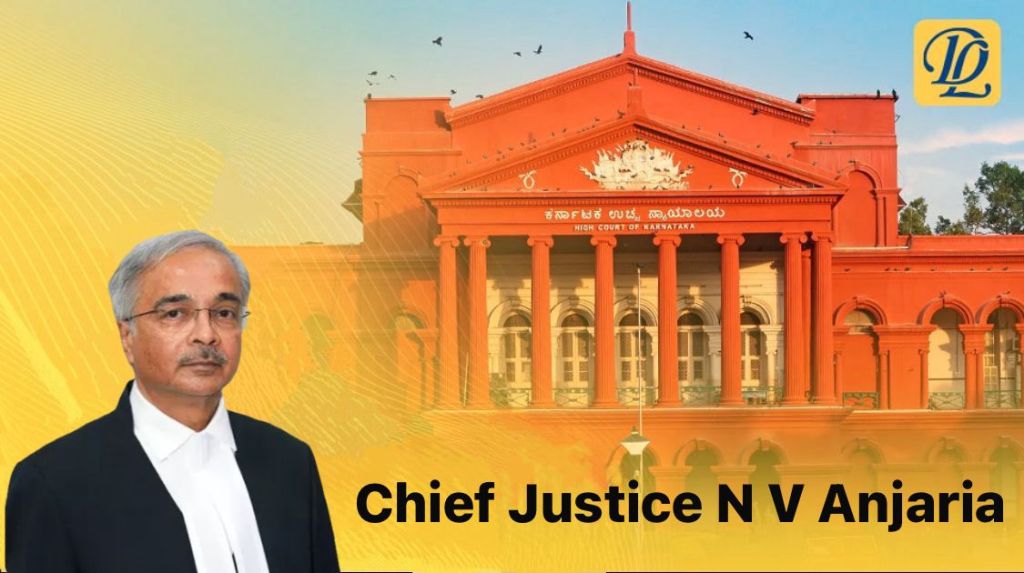
Hon’ble Mr. Chief Justice N V Anjaria celebrates his 60th birthday today.
Hon’ble Mr. Chief Justice N V Anjaria: Born on 23rd March, 1965 at Ahmedabad, Native Mandvi-Kachchh, From family of lawyers, Father was also in judiciary. Graduated from H.L.College of Commerce, Ahmedabad. LL.B from Sir L.A. Shah Law College in 1988. Obtained Masters Degree in Law in 1989 from University School of Law, Ahmedabad.
Started practice in the High Court of Gujarat from August 1988 by joining chamber of Shri S.N. Shelat, Senior Advocate. Conducted matters involving constitutional issue and all categories of civil cases, labour and service. Had been Standing Counsel / Panel Advocate for High Court and subordinate Courts, State Election Commission, Gujarat Information Commission, Gujarat Industrial Development Corporation, Municipalities, etc.
He has served as a Senior Panel Counsel for Central Bureau of Investigation (CBI), Senior Standing Counsel for BSNL, Union Public Service Commission (UPSC), University Grants Commission (UGC), All India Counsel for Technical Education (AICTE), National Counsel for Teacher Education (NCTE).
Was awarded Research Fellowship in 1992 by Late Shri Navinchandra Desai Foundation, Ahmedabad on ‘Freedom of Speech and Expression – With Reference to Media’. Rendered service as Hon. Associate Editor, Gujarat Law Herald, also as Trained Mediator in the High Court Mediation Centre. Articles, write-ups etc. on Constitutional and legal subjects published in books, Law Journals etc., privileged to contribute write-up ‘High Court of Gujarat: Advent and Ascent’ in the Souvenir published under the aegis of High Court of Gujarat on the occasion of its Golden Jubilee Celebrations in April 2010.
His Lordship was elevated as Additional Judge, High Court of Gujarat on 21st November 2011 and confirmed as permanent Judge on 06.09.2013.
His Lordship took oath as The Chief Justice of High Court of Karnataka on 25.02.2024.
Important Judgements delivered by Hon’ble Mr. Chief Justice N V Anjaria.
SARFAESI Act and Rules. When bidder fails to deposit balance amount within the statutory period, forfeiture of the earnest money deposit is a statutory consequence which cannot be avoided by approaching the writ court. Karnataka High Court.
Registering petition under Section 95 of the IBC before the NCLT is purely administrative/ministerial act which cannot be questioned through a writ petition. Karnataka High Court.
Minimum one kilometre distance from the notified National Parks and Wildlife Sanctuary has to be maintained in establishing, running and operating the quarry units. Karnataka High Court upholds ban on quarrying near Kappathagudda.
High Court in writ jurisdiction cannot enter into the arena of interpretation of contractual term, its enforcement and the questions regarding breach or otherwise thereof since they are questions to be subjected to evidence. Karnataka High Court.
Karnataka Gram Swaraj and Panchayat Raj Act. Minor procedural flaws do not invalidate a no-confidence motion if the essential legal requirements are met. A distinction exists between illegality, which violates a fundamental principle of law, and irregularity, which involves a deviation from established procedures that can be remedied. Karnataka High Court.
MMDR Act, 1957 and the Forest (Conservation) Act, 1980. Mining operations in forest land require a valid Forest Clearance which vests in the new lessee only for two years post-auction. Upon expiry, fresh clearance is mandatory, and failure to obtain it justifies cessation of mining operations by the authorities. Karnataka High Court.
When parties enter into a new agreement that replaces or novates a prior contract, the arbitration clause in the original agreement ceases to exist. Karnataka High Court.
”The right to health, including protection from preventable diseases, is part of the fundamental right to life under Article 21. The State and municipal authorities must take proactive measures to prevent outbreaks, and judicial intervention may be necessary if they fail to do so”. Karnataka High Court in suo motu PIL.
PTCL Act. A claim for restitution of granted lands must be pursued within a reasonable time. Although the PTCL Act does not prescribe a limitation period, claims made after an unreasonably long delay are barred by the doctrine of laches. Karnataka High Court.
Natural Justice. Penalty order must not travel beyond the bounds of the show cause notice. Any additional grounds or allegations included in the final order that were not part of the notice render the action unlawful. Karnataka High Court.
An appointee appointed with condition that he would hold the office at the pleasure of the government would remain on the post at such pleasure. Nominated member of a government body cannot claim vested right to continue. Karnataka High Court.
Karnataka Municipal Corporations Act. Time limit for reopening the assessment by the Commissioner, which is otherwise not provided or in respect of which the statute is silent, to be one year. Karnataka High Court.
Maintenance and Welfare of Parents and Senior Citizens Act. Appeal under Section 16 of the Act can be filed solely by senior citizens or parents, excluding all others, including children and transferee. Karnataka High Court.
Minimum Wages Act. Notification under Section 5(1) though a subordinate legislative piece, precedes the statutory process and must be informed by compliance of principles of natural justice by giving the party interested a hearing. Karnataka High Court.
Minimum Wages Act. Employers and Employers Association have interest in the matter of fixation of minimum wages. Notification under the Act cannot be challenged without making employers/association as parties to the writ petition. Karnataka High Court.
National Green Tribunal cannot impose environment compensation without following the principles of natural justice and without affording an opportunity to the persons/entity to defend. Karnataka High Court.
‘’The function of the court ends where the realm of legislature starts’’. Writ Court cannot issue mandamus mandating investigating officer in criminal case to sign on each page of the Court Diary. Karnataka High Court.
 Daksha Legal