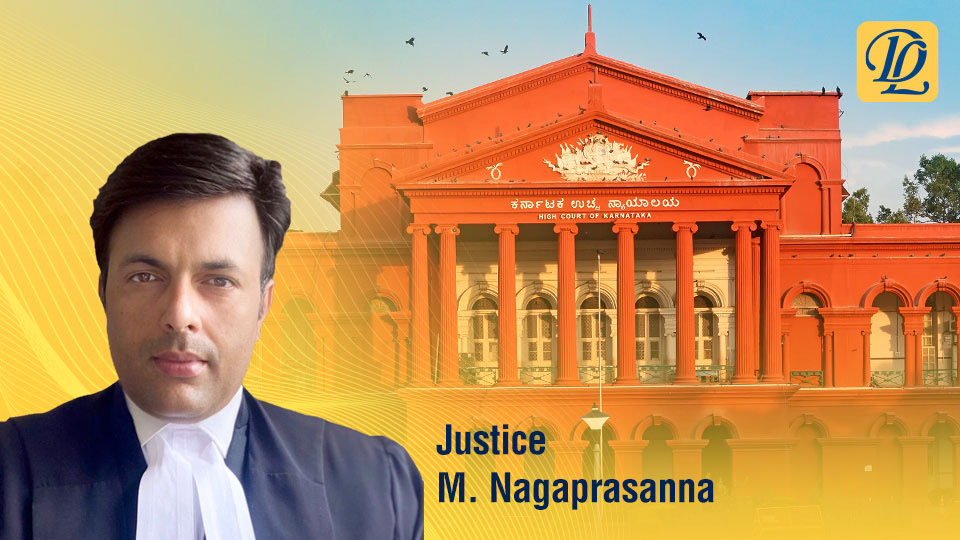
Hon’ble Mr. Justice M. Nagaprasanna celebrates his 54th birthday today.
Hon’ble Mr. Justice M. Nagaprasanna: Born on 23.03.1971. Appointed as Additional Judge of the High Court of Karnataka and taken oath on 26.11.2019 and Permanent Judge on 08.09.2021.
Important Judgments delivered by Hon’ble Mr. Justice M. Nagaprasanna.
Service Law. Employee of a Gram Panchayat cannot be removed on acts of misconduct without enquiry. Karnataka High Court.
https://www.dakshalegal.com/judgements/actionView/VzbBse4PKDTviqTPTzoIM7DGk
Karnataka SC/ST Commission has No powers to deal with matters under Karnataka SC/ST (Prohibition of Certain Lands) Act, 1978. Karnataka High Court.
“It is better to wear out; than rust out’. Gender neutral provision i.e. Section 24 of the Hindu Marriage Act cannot be used by lethargic husband to seek maintenance from wife. Karnataka High Court.
Karnataka SC ST PTCL Act. Conversion and sale of granted land by original grantee after prohibition period. Conversion amounts to deemed permission. Sale is valid. Karnataka High Court.
Public procurement cannot be frustrated due to delay in disposing the appeals by the Appellate Authority. Karnataka High Court stresses the need for speedy disposal.
Industrial Disputes Act 1947. Section 17B. Payment of full wages to workman pending proceedings in higher Courts is not absolute especially when relation of employer and employee is in serious dispute. Karnataka High Court.
Payment of Gratuity Act 1972. Payment of gratuity would NOT depend upon an application being made by the employee. Employer is duty bound to dispense gratuity immediately after cessation of service of an employee. Karnataka High Court.
‘’Pension is trite, not a bounty’’. In genuine cases where pensioners are unable to visit up to the Bank, it is the duty of the Bank officers to visit those persons and take Life Certificate and update them on the system. Karnataka High Court.
‘To err is human. Infallibility is unknown to humanity.’ Mistake in mentioning caste status shall not result in loss of employment. Karnataka High Court.
Karnataka High Court quashes imposition of Ground rent, License fee, Scrutiny fee and Lake Rejuvenation fee by Bruhat Bangalore Mahanagara Palike as without jurisdiction and ultravires.
Karnataka Cooperative Societies Act. Person seeking employment, who has not yet become employee of the Co-operative Society, need not raise dispute under Section 70. Writ Petition is maintainable. Karnataka High Court.
‘It’s high time the haves stop despoiling the rights of have-nots; the haves, I mean, those who have power.’ Karnataka High Court restores property to the widow of the manual scavenger, which was illegally snatched by the statutory authority.
“Law abhors Statelessness of children”. Karnataka High Court comes to the rescue of minor child who lost Indian citizenship after the mother renounced Indian citizenship. Directs issuance of passport till the child attains majority.
“Section 12 is the salt of the statute; if by delay the salt would lose its savour; the statute would lose its flavour”. Karnataka High Court issues directions for speedy disposal of applications under the Protection of Women from Domestic Violence Act.
Criminal Procedure Code. Court trying criminal case has no power to impound passport of accused since impounding of passport can be done only under the Passports Act, 1967. Karnataka High Court.
Period spent by an accused pursuant to a body warrant must be counted for the purpose of default bail under Section 167(2) Cr.P.C. Karnataka High Court.
Indian Penal Code. Section 376. No exemption is absolute. Husband using wife as sex slave can be booked for rape. Karnataka High Court.
Externment under the Karnataka Police Act. Authorities must remember that what is being taken away from the citizen is a fundamental right. Reasonable opportunity mandated under the Act must be followed. Karnataka High Court.
“Disqualification of a tenderer or termination of contract can happen only in tune with clauses of the tender”. Karnataka High Court orders restoration of tender which was recalled arbitrarily.
There can be no criminal liability against landlord if the tenanted premises is used for immoral trafficking without his knowledge. Karnataka High Court.
Merely because charge sheet did not accompany FSL report, accused cannot contend that he is entitled for bail especially when Police report with necessary details is filed within time. Karnataka High Court.
Period spent by an accused pursuant to a body warrant must be counted for the purpose of default bail under Section 167(2) Cr.P.C. Karnataka High Court.
Criminal proceedings against public servant for defamation cannot be initiated without prior sanction under Section 197 of the Cr.P.C. Karnataka High Court.
A woman accused is entitled to bail even in a murder case under the first proviso to Section 437(1)(ii) Cr.P.C, when the accused has no grave criminal antecedents. Karnataka High Court.
”Bald and imaginary allegations do not constitute foundation for criminal offences”. Karnataka High Court quashes criminal proceedings by wife against the entire family of the husband.
Wife filing complaint under Section 498A, IPC simultaneously or immediately after husband issuing a notice for divorce will not and can by no stretch of imagination result in the complaint rendering itself insignificant. Karnataka High Court.
Annulment of marriage does not give right to husband to retain articles of the wife carried by her to the matrimonial house. Karnataka High Court.
Second petition under Section 482 Cr.P.C to quash criminal proceedings is maintainable only in exceptional cases where there are changed circumstances. Karnataka High Court.
Power of attorney holder of an accused in a criminal case cannot maintain a Petition be it under Article 226 or 227 of the Constitution of India or Criminal Petition under Section 482 Cr.P.C. Karnataka High Court.
Criminal Procedure Code. Charges can be altered anytime during trial and even after the matter is reserved for judgment. Karnataka High Court.
Pure official communication between two people does not amount to ‘publication’ within the meaning of Section 499 IPC to constitute the offence of defamation. Karnataka High Court.
To constitute offence under the SC /ST (Prevention of Atrocities) Act, hurling of abuse must be in in a public place or in a place of public view. Karnataka High Court.
Causing death by negligence. Section 304A, IPC. Architect who designed the house cannot be prosecuted for death of construction worker in on-site accident. Karnataka High Court.
Interim compensation in cheque bounce cases. Magistrate can award compensation ranging from 1% to 20% in a cautious manner and after recording the reasons. Karnataka High Court.
Criminal Law. Doctrine of sameness does not apply when the complainants are different and there is no certainty of time and period. Karnataka High Court.
Cheque bounce case. Directors/Chairman of a company cannot claim that they are not privy to the transaction between the accused and the complainant when the complaint clearly narrates their role in the transaction. Karnataka High Court.
Mere breach of a development agreement cannot be made use of by the prospective purchaser to set criminal law in motion alleging criminal breach of trust. Karnataka High Court.
Cheque bounce case. Taking sworn statement first then taking cognizance and issuing summons would not vitiate the proceedings. Karnataka High Court.
Special Power of Attorney holder who is aware of the transaction can initiate proceedings under Section 138 of the Negotiable Instruments Act. Karnataka High Court.
IPC. Section 304B. Wife committing suicide even after two years of leaving the matrimonial house can in certain circumstances come within the meaning of ‘soon before death’ since it would be a matter of evidence. Karnataka High Court.
Criminal Law. If the complainant himself is not in possession of the property, question of criminal trespass does not arise. Karnataka High Court.
Setting the criminal law in motion for recovery of disputed money is not what criminal law should be used for as it would amount to misuse of criminal law as a shortcut to seek recovery of money. Karnataka High Court.
“ACB blissfully ignored the ABC of procedure’’. Karnataka High Court quashes criminal proceedings initiated pursuant to casual act of drawing up source information report, registering FIR and conducting the search by the Anti-Corruption Bureau.
Employee of Karnataka Milk Federation is ‘public servant’ under the Prevention of Corruption Act, 1998. Karnataka High Court upholds criminal prosecution against General Manager of Nandini Milk Products.
Second petition under Section 482 Cr.P.C. is maintainable after the Magistrate takes cognizance and issues summons on the final report/charge sheet.
Bank cannot initiate criminal proceedings alleging loan fraud when borrower’s declaration as ‘willful defaulter’ is stayed by Court. Karnataka High Court.
Service Law. Rejection of claim for regularisation on an earlier occasion will not be an impediment for fresh consideration. Karnataka High Court.
A teacher is the lamp of knowledge who moulds the life of children. State must stop appointing teachers on contract basis through outsourced agencies by process of inviting tender. Karnataka High Court.
Look Out Notice. An accused who is enlarged on bail should be made known as to why his travel is being interrupted. He must be served with copy of Look Out Notice. Karnataka High Court.
“Fair trial includes fair investigation which is part of Article 20 and 21 of the Constitution of India.’’ Taking note of utter failure of the Police to deal with powerful accused, Karnataka High Court refers murder case to CBI for further investigation.
If a document having direct nexus with Court proceeding is fabricated outside Court and produced later in Court proceeding, inquiry under Section 340 Cr.P.C can be initiated for the offence punishable under Section 195 IPC. Karnataka High Court.
Maximum period seized gold bullion/gold ornaments could be held is 15 days or one month and later interim custody should be handed over to the victim/complainant/applicant. Karnataka High Court.
Public procurement cannot be frustrated due to delay in disposing the appeals by the Appellate Authority. Karnataka High Court stresses the need for speedy disposal.
Collision in high seas. Provisions of the IPC apply even when the ship is flagged outside India and the flag ship does not come within the territory of India so long as the accident takes place within Exclusive Economic Zone. Karnataka High Court.
Offence of criminal conspiracy can be a standalone offence in certain circumstances particularly in financial transaction cases. Karnataka High Court.
Invocation of SARFAESI is not a bar for Bank to initiate criminal action if account is declared fraud. Karnataka High Court.
Standing Counsel of a statutory body cannot be booked for cheating for the adverse Court orders. Karnataka High Court admonishes the Registrar of RGUHS.
Cheating in the name of online wellness therapy. Karnataka High Court refuses to quash criminal proceedings against ‘Tinder Lurer’.
DNA test result is only a corroborative evidence and cannot be conclusive in crimes involving sexual assault on children. Karnataka High Court.
Karnataka Societies Registration Act. Pre-registration acts cannot be considered for the purpose of invoking Section 27 since the Act makes acts to be unlawful activity only after the registration of the Society. Karnataka High Court.
N.I.Act. Where there are clear averments in statutory notice and complaint about the role of the directors and their responsibility, proceedings cannot be quashed merely on the plea that they had no direct role in the transaction. Karnataka High Court.
District Registrar has no power under Section 25 of the Karnataka Societies Registration Act to decide the validity of elections held in a Society. Karnataka High Court.
Notification declaring the organisation to be unlawful with immediate effect contains sufficient reasons. Karnataka High Court rejects the challenge to the ban of Popular Front of India.
Increasing litigation in public distribution system. “Stop indiscriminate allotment of fair price shops or discriminate distribution of cards”. Karnataka High Court.
Administrative Law. If a show cause notice is for a particular purpose and the party replies for that particular purpose, the authorities cannot pass order on something more to which the party had no notice. Karnataka High Court.
Real Estate (Regulation and Development) Act does not apply to completed projects or to which completion certificate is issued and hence the Authority has no power to deal with complaints in respect of such projects. Karnataka High Court.
Karnataka SC ST PTCL Act. Repeated sale by grantee constitutes offence of cheating under Section 420 IPC. Such person is not entitled to seek restoration of the granted land and also to retain the consideration received by him. Karnataka High Court.
“Registration of an FIR on a cognizable offence on a reference being made by the Magistrate under Section 156(3) of the Cr.P.C. is imperative.” Karnataka High Court orders enquiry against the delinquent Police Officer.
Cancellation of tender after tender process got concluded, award being notified, and contract being signed amounts to arbitrary exercise of power and violative of tenets of Article 14 of the Constitution of India. Karnataka High Court.
“When the State or its agents fear the people there is LIBERTY; when the people fear the State or its agents, there is TYRANNY”. Karnataka High Court awards Rs. 3 lakhs compensation to Advocate who was illegally arrested and tortured by the Police.
Allegation of corruption charges against officers of the Tender Scrutiny Committee cannot result in cancellation of a valid tender. Karnataka High Court.
Public employment. Caste and income of the parents of the applicant and not that of her husband should be taken into consideration. Karnataka High Court.
Appointing authority has no power to go beyond the caste certificate issued by the competent authority. Karnataka High Court.
“Right to claim maintenance shall not be rendered illusory.” Karnataka High Court issues guidelines for early disposal of maintenance petitions.
Architects Act, 1972. Karnataka High Court directs Union of India to notify criteria for nomination of Members of the Council qua the qualification and experience which would become binding on every State Government.
Cheque bounce cases. While considering application for grant of interim compensation, conduct of the accused is relevant. Karnataka High Court.
‘Proliferation of mobile loan apps haunts gullible customers’. Karnataka High Court rejects the challenge against freezing of the Chinese company account under the Prevention of Money Laundering Act, 2002.
Grant of conversion from agriculture to non-agricultural purposes under the KLR Act does NOT amount to change of land use under Section 14A of the KTCP Act. Karnataka High Court.
Execution Court cannot mechanically issue notice on application of third party claiming right over the property in execution. Karnataka High Court dismisses frivolous claim by imposing cost of Rs. 2 lakhs. Karnataka High Court.
Agency of the Life Insurance Corporation cannot be terminated without strictly following the Regulations. Karnataka High Court restores the agency with consequential benefits.
Consensual and longtime sexual relationship cannot be given the colour of rape simply because the promise of marriage could not be fulfilled by the accused. Karnataka High Court.
Criminal law. When court directs life sentence to start first, the term sentence would run concurrently with the life sentence. Karnataka High Court.
Foreign citizen pretending to be Indian citizen to avail educational benefits is reprehensible. Karnataka High Court orders issuance of exit permit subject to payment fee payable by NRI for the entire course.
Arbitration and Conciliation Act, 1996. Writ petition challenging interlocutory order of the Arbitrator is not maintainable. The Act defers the remedy till the stage of section 34. Karnataka High Court.
“Consider & dispose applications for premature release of life convicts without any loss of time. Committee meetings to be held once in two months.” Karnataka High Court orders grant of parole to the convict till his application is disposed.
“If Government wants to curb corruption, such intention should be reflected in swift action.” Competent Authority must pass orders on the requisitions for sanction to prosecute public servant within the outer limit of six months. Karnataka High Court.
If a person has no role to play in the entire loan transaction with the bank, issuance of Look Out Circular against him cannot be justified. Karnataka High Court.
Order XVIII Rule 17 of CPC. To recall the witness, there should be demonstrable bonafides in filing applications and the application should be filed without any delay. Karnataka High Court.
E-Auction. Court cannot telescope its imagination into the intricate details of conduct of e-auction since it does not possess expertise to sit in the armchair of experts. Karnataka High Court.
Grant of Indian citizenship under the Citizenship Act, 1955. Mere surrender of foreign passport does not amount to renunciation of foreign citizenship. Karnataka High Court rejects the plea of minor children of Indian citizen holding Pakistan citizenship.
“Keep your house in order so that common man does not bear the brunt of unnecessary litigation.” Karnataka High Court orders grant of interest to HUF in the Post Office Public Provident Fund Scheme deposit.
“Don’t reduce the fundamental right of children under Article 21-A of the Constitution of India, to a “mere rope of sand”. Karnataka High Court directs the Govt to identify land and rebuild Government School.
Insolvency and Bankruptcy Code, 2016. Tribunal has no jurisdiction to entertain any issue arising out of any statutory requirement and it cannot exercise jurisdiction over matters de hors insolvency proceedings. Karnataka High Court.
“Facilitating Woman who plays the God”. Karnataka High Court evolves Genetic Test, Physical Test and Economic Test while directing Surrogacy Board to consider application of man who crossed 55 years age bar.
“In our criminal justice system, it is not the end result of the proceedings, that is agonizing, it is the rigmarole of proceedings which by itself can become a punishment.”. Karnataka High Court quashes proceedings against person dragged in POCSO case.
Child custody. Karnataka High Court approves denial of female child custody to father who failed to take care of her privacy and security.
Karnataka High Court repels the challenge to constitutional validity of Section 37A of the Foreign Exchange Management Act based on manifest arbitrariness.
Prevention of Corruption Act. Sanction for prosecution is necessary in respect of retired public servant when the allegations levelled him are the ones in discharge of his official duties while he was in service since. Karnataka High Court.
Lands earmarked in the Master Plan for minor or major roads, State or National highways would not lapse if they are not acquired within five years. Planning Authority has a right to hold on to the lands in terms of KTCP Act. Karnataka High Court.
POCSO Act. Reporting of offences under the Act, particularly by doctors, requires strict compliance failing which the very object of the Act would be defeated. Karnataka High Court.
Disputes arising out of contract of employment do not fall within the jurisdiction of the commercial court under the Commercial Courts Act, 2015. Karnataka High Court.
‘’Breach of contract between the protagonists in the agreements cannot be the subject matter to set the criminal law into motion’’. Karnataka High Court quashes criminal proceedings initiated by partner alleging breach of the partnership.
‘Unless the offences are found prima facie, criminal proceedings in matrimonial cases should not be permitted to continue’. Karnataka High Court quashes proceedings against husband who refused to consummate marriage following Bramhakumari preaching.
To constitute the offence of abetment to commit suicide, the instigation should be of the kind that it drives a person to commit suicide. Instigation should be proximate to the occurrence of death. Karnataka High Court.
Courts exercising power under Section 482, Cr.P.C. should not interfere if the case involves disputed questions of fact as the Court won’t become a fact-finding authority at the stage of crime or analysis of the charge sheet. Karnataka High Court.
KathaSangam of Corruption. “It is high time the menace of corruption is nipped in the bud by making the bribe giver susceptible for prosecution like the bribe taker”. Karnataka High Court rejects plea of accused in Madal Virupakshappa case.
Cheque bounce case. An independent non-executive director, who is not aware of day-to-day affairs of the company, cannot be held liable under the N.I. Act. Karnataka High Court.
Advocates have a right to appear before the Deputy Commissioner in the proceedings under the Maintenance and Welfare of Parents and Senior Citizens Act, 2007. Karnataka High Court.
“Sexual harassment of law intern has a chilling effect on the entire legal profession”. Karnataka High Court refuses to quash criminal proceedings against Advocate.
“Proceeding under the IPC is the flesh and the proceeding under the PMLA is the blood.” Provisional attachment under the PMLA shall be suspended when the predicate offence proceedings under the IPC are stayed by the Court. Karnataka High Court.
Disaster Management Act, 2005. No prosecution can be launched for the offence under Section 51, (Punishment for obstruction, etc), without first issuing notice to the person against whom complaint is said to be made. Karnataka High Court.https://www.dakshalegal.com/judgements/actionView/cRfqTqPHeoZPgT7Y3wZWsVYOa
Section 319 Cr.P.C. Power to proceed against other persons appearing to be guilty of offence. Karnataka High Court upholds summoning of the Senior Sub-Registrar for the alleged fraud in the registration of gift deeds.
Cheque Dishonor. When the signatory to the cheque was a sole proprietor of a firm, on his death, the liability would not move upon the legal heirs of such sole proprietor. Karnataka High Court.
Collection of Statistics Act, 2008. Conviction for neglect or refusal to supply particulars under Section 15 (1) will not absolve furnishing data. Second complaint under Section 15 (2) does not amount to double jeopardy. Karnataka High Court.
When company was not made party to the criminal proceedings and there is material to proceed against the company, summoning of the company under Section 319 of the CrPC. cannot be questioned. Karnataka High Court.
Woman seeking relationships with people on social media platforms and after prolonged consensual sexual relationship, registering crimes alleging rape; such conduct amounts to abuse of process of law. Karnataka High Court.
Karnataka Police Act. Externment takes away fundamental right and shall not to be passed as a matter of course but to be resorted in extraordinary circumstances and meet Article 19 (5) of the Constitution of India. Karnataka High Court.
Where the allegations in the FIR are absurd, inherently improbable, manifestly attended with mala fides or is maliciously instituted with a view to spite the accused, such proceedings should be quashed. Karnataka High Court.
“Set your house in order’’. Karnataka High Court lambasts at the lackadaisical attitude on the part of the Karnataka Lokayukta in completing investigations under the Prevention of Corruption Act in time.
‘’Even on a money claim, the Writ would be maintainable, if the action of the State smacks arbitrariness’’. Karnataka High Court directs Bank to refund sale consideration arising out of a fraudulent auction sale.
No Court can take cognizance of the offence against a public servant without a valid sanction from the hands of the competent authority placed before the concerned Court, by the Investigating Officer. Karnataka High Court.
“If husband is leading a good life, wife cannot be asked to lead a deprived life”. Karnataka High Court while enhancing wife’s maintenance.
”It has become a habit to lay Sections 504 and 506, IPC in every offence merely because they are non-cognizable and the criminal cases are filed on glorified trivialities between husband and wife”. Karnataka High Court while quashing criminal proceeding.
When earlier suit is dismissed for default, the same acts as resjudicata for the subsequent suit on the same cause of action. Plaintiff cannot contend that he has no duty to disclose dismissal of the earlier suit. Karnataka High Court.
After taking cognizance, it is impermissible for the Magistrate to take cognizance again for the offence that had already been taken cognizance. Karnataka High Court quashes proceedings under the Protection of Wildlife Act.
Negotiable Instruments Act. Death of the drawer of the cheque cannot and will not efface the offence when the cheque is issued on behalf of the Company. Karnataka High Court.
Traffic Police accepting bribe to let vehicles ply against the regulation amounts to demand and acceptance. Such cases would not require approval under Section 17A of the Prevention of Corruption Act. Karnataka High Court.
Police officers causing traffic congestion in the city of Bangalore by accepting bribe and letting vehicles to ply against regulation is a serious crime. Government shall deal with iron hand. Karnataka High Court.
Surrogacy. Couple having a medical condition that becomes impossible for the woman to conceive can opt for surrogacy by a gamete which is that of the woman not genetically related to the intending couple. Karnataka High Court.
‘’Temples are symbols of unity and inclusivity’’. Karnataka High Court condemns denial of rights of temple entry and worship to persons belonging to scheduled castes and scheduled tribes. Karnataka High Court.
Railway Services Pension Rules. Second wife of deceased employee is also entitled for equal pension along with the legally wedded first wife. Karnataka High Court.
Prevention of Corruption Act. Alleged demand and acceptance of bribe by son on behalf of his father does not render the father culpable. Karnataka High Court quashes proceedings against ex MLA Madal Virupakshappa.
Karnataka Hindu Religious Institutions and Charitable Endowments Act. Term of the Managing Committee commences from the date of its constitution and not from the first meeting to elect the Chairman. Karnataka High Court.
SARFAESI Act as amended. Once the sale notice is issued, right to redeem mortgaged property by the borrower is lost and the right of enforcement of security interest by the Bank is absolute. Karnataka High Court.
‘Policies which are in the realm of regulatory, economic and quality cannot be interfered by a Writ Court’. Karnataka High Court upholds quality control policy on import of plastic into the shores of the nation.
Karnataka Industrial Areas Development Act. Allottee of an industrial plot who fails to make full payment as per terms of the allotment cannot insist on issuance of show cause notice before cancellation of the allotment. Karnataka High Court.
“Governments may come and Governments may go, the Writ of Constitutional Courts would run and run for all times to come.’’ Karnataka High Court while quashing Govt notification de-notifying committee members of Ramachandrapura Math.
Arms Act. Deputy Commissioner cannot sit over application of Arms license holder to add or delete Arms. Karnataka High Court allows plea of licensee under the ‘Renowned Shooter’ category to possess 10 arms and 1 lakh ammunition.
https://www.dakshalegal.com/judgements/actionView/pdx8FEwobO56fZBbONyGQJ4QP
Test. The Commissioner of Police has the authority to transfer an investigation within the same jurisdiction under Section 36 Cr.P.C. A petition under Section 482 Cr.P.C. for quashing a criminal case involving serious charges like Section 302 IPC should not be entertained when prima facie evidence exists. Statements recorded under Section 164 Cr.P.C. carry evidentiary value and must be tested in trial. Mere absence of dowry demand does not negate cruelty under Section 498A IPC. Karnataka High Court.
An FIR cannot be quashed at the investigation stage merely on the ground of political vendetta if the allegations disclose a cognizable offense. Karnataka High Court.
The Karnataka Victim Compensation Scheme applies only to victims of crimes requiring rehabilitation and explicitly excludes compensation for road accident victims covered under the Motor Vehicles Act. Karnataka High Court.
Cruelty under Section 498A IPC is not confined to dowry-related demands but includes any form of harassment or abuse that causes physical or mental harm to the woman. Criminal proceedings cannot be quashed merely because the dowry charges were dropped. Karnataka High Court.
Power to record additional evidence under Section 391 of the Cr.P.C. should be exercised only when the party making such request was prevented from presenting the said evidence in the trial, despite due diligence. Once a request for additional evidence is rejected at the trial stage, the same relief cannot be sought at the appellate stage. Karnataka High Court.
State Tax Officers under the KGST Act are cross-empowered under the IGST Act to act as proper officers without the need for a separate notification unless explicitly excluded by the Government of India. In GST-related disputes, alternative remedy under Section 107 of the KGST Act must be exhausted unless there is a jurisdictional challenge. Karnataka High Court.
A Disciplinary Authority cannot withhold 100% of pension and gratuity unless legally justified. Arbitrary withholding of pensionary benefits violates fundamental rights and entitles the petitioner to full restoration with interest. Karnataka High Court.
The State Government cannot unilaterally transfer staff in aided institutions without consultation. Section 133 of the Karnataka Education Act does not override this requirement. Withholding salaries to enforce compliance violates Article 23 of the Constitution and constitutes forced labor. Karnataka High Court.
A long-serving temporary employee working in a sanctioned vacant post cannot be denied regularization based on procedural technicalities, especially when barred from direct recruitment due to age restrictions. Arbitrary denial of regularization violates Articles 14 and 16 of the Constitution, and courts can issue mandamus to ensure fair employment practices. Karnataka High Court.
‘’State practising exploitation of human labour should by judicial orders, be curbed’’. Karnataka High Court orders regularisation of employees who worked for three decades without being regularised.
Disciplinary proceeding initiated after inordinate and unexplained delay stands vitiated due to prejudice caused to the employee. Further, when multiple employees are involved in the same misconduct, the penalty imposed must be proportionate and maintain parity. Karnataka High Court.
Dowry harassment leading to suicide. Even if the deceased’s note does not explicitly blame anyone, if the circumstances surrounding the death suggest prima facie evidence of guilt, the criminal case cannot be quashed. Karnataka High Court.
“Just because a man and woman have had consensual sex, it doesn’t give the man a free pass to assault the woman’’. Karnataka High Court refuses to quash criminal proceedings terming the case as ‘gross misogynist brutality’.
Whether the legislators are immune from criminal prosecution for the alleged offences committed inside the House? Karnataka High Court to consider the issue.
Service Law. Administrative exigency may justify employee transfers, as it’s an inherent aspect of service. However, such transfers must comply with the statute and guidelines. Any violation is unacceptable and unsustainable. Karnataka High Court.
“You spend crores of rupees elsewhere and take preposterous plea of financial constraints when it comes to education of the poor”. Karnataka High Court quashes Government notification that reduced education assistance to children of construction workers.
Merely designating private land as a forest under forest legislation does not automatically convert it into government land or a reserved forest. Karnataka High Court.
Pardon. Application under Section 306 of the Cr.P.C. is akin to seeking enlargement on bail, where a second application would be maintainable, but only on changed circumstances. Karnataka High Court.
When an offence is punishable up to ten years, the threshold punishment being less than ten years, the police custody can only be for forty days. Section 187 of BNSS in comparison to Section 167 of the Cr.P.C. has not brought any changes. Karnataka High Court.
Pardon. Co-accused has a right to question the order granting pardon under Section 306 of the Cr.P.C., only insofar as it pertains to procedural aberration and not on its merits. Karnataka High Court.
Application for pardon under Section 306 Cr.P.C cannot be considered once the trial has commenced and the matter is committed to the Court of Sessions/Special Court. Karnataka High Court.
“Complainant projects a huge hocus-pocus, but alas, he has no locus’’. Karnataka High Court quashes criminal proceedings against Naleen Kumar Kateel in the alleged ‘’Extortion by Electoral Bonds’’ case.
Cybercrimes and online frauds have completely changed the conventional acts of robbery and dacoity. Courts should exercise caution when considering the quashing of such criminal cases and should allow a proper trial to take place. Karnataka High Court.
Information of grounds of arrest under Section 50 of the Cr.P.C., must be followed and must be indicated to every accused who is to be arrested even for the offences under the Indian Penal Code. Karnataka High Court.
“You played with lives of poor home buyers.’’. Karnataka High Court rejects challenge to criminal proceedings against developers who received huge advance amounts and failed to honor the commitment.
Negotiable Instruments Act. Partners who have retired from the partnership firm before the issuance of the cheque cannot be prosecuted for an offence punishable under Section 138 unless their involvement even after the retirement is shown. Karnataka High Court.
“Application of mind that is necessary in law and not application of ink’’. Order sanctioning prosecution in non-cognizable offence must be preceded by application of mind by the Magistrate. Karnataka High Court reiterates.
Pension is a property under Article 300-A of the Constitution and it constitutes a fundamental right to livelihood under Article 21. Karnataka High Court.
Mere breach of promise to marry is different from false promise to marry. Consensual sex in the first case cannot be called rape. Sexual relation with false promise, given in bad faith and with no intention of being adhered to at the time it was given amounts to rape. Karnataka High Court.
Banking Companies (Acquisition and Transfer of Undertakings) Act. Power of the Reserve Bank of India to give directions does not empower banks to seek entrustment of investigation in any crime, to the hands of any particular agency like CBI. Karnataka High Court.
Exemption of nursery from acquisition. ‘Make believe’ nursery without registration with Indian Horticulture Board cannot be considered for exemption. Karnataka High Court.
N.I.Act. Filing a civil suit for recovery of cheque amount will not bar complaint for the offence under Section 138, though both spring from the same cause of action. Karnataka High Court.
Authorities cannot keep application for renewal of registration of the medical establishment in cold storage and then initiate criminal prosecution for non-registration. Karnataka High Court prescribes time-limit.
Mere change of counsel is not a ground to recall the witness under Section 311 Cr.P.C. Recalling of witnesses should not be permitted at the fag end of the trial. Karnataka High Court.
“Alleged acts of the petitioner depict wanton lust, depravity of senses, and has a chilling effect down the spine of the society”. Karnataka High Court rejects bail plea of Prajwal Revenna, ex MP in rape case.
Shifting of under-trial prisoners from one jail to another cannot be at the whim and fancy of the prosecution and such orders when sought, the learned Magistrates ought to apply their mind. Karnataka High Court.
Raising religious slogans near a place of worship belonging to another faith does not constitute ‘outraging religious feelings’ under Section 295-A of the Indian Penal Code. Karnataka High Court.
‘’Sloganeering Bharath Matha Ki Jai would only lead to harmony and never a discord.’’ Karnataka High Court quashes criminal proceedings initiated under Section 153 IPC for shouting pro-India slogans and taking the name of PM Narendra Modi.
’Withholding of evidence in defence would undoubtedly defeat the voyage towards discovery of truth in a criminal trial.’’. Karnataka High Court permits playing video footage in criminal trial as ‘previous statement’ on the day of the crime.
Accused who breaches settlement agreement in a cheque dishonour case cannot be allowed to go scot-free on hyper-technical grounds without adhering to the conditions of the settlement. Karnataka High Court.
Negotiable Instruments Act. Accused who breaches settlement agreement to pay cheque amount cannot later take the contention that the original complaint was defective for not making company a party. Karnataka High Court.
”The Writing Is On The Wall – that acts of sexual violence against women must be dealt with sternly”. Karnataka High Court rejects plea of man booked for writing a woman’s phone number on the toilet wall with the prefix ‘Call Girl’.
”Consensual relationship is not a license for a man to cause bodily injury to a woman”. Karnataka High Court rejects the plea challenging criminal proceedings under Section 323 IPC while quashing rape charges.
‘Breach of marriage engagement’ cannot be construed as ‘false promise to marry’. Sexual intercourse after engagement cannot be termed as rape when the engagement is breached. Karnataka High Court.
Maintenance and Welfare of Parents and Senior Citizens Act. Assistant Commissioner has no jurisdiction to annul gift deed if there are no recitals in the gift deed to maintain the donor. Karnataka High Court.
Coram Non-Judice. If Caste Certificate is cancelled by Tahsildar on the direction of Deputy Commissioner, appeal against such order to the Assistant Commissioner is not maintainable on the principle of coram non-judice. Karnataka High Court.
‘’Compulsory rural service from medical graduates cannot be enforced without publishing the notification in the Gazette’’. Karnataka High Court declares pre-notification bonds from the doctors unenforceable.
Medical graduates who are the beneficiaries of the welfare of the State like Government seat etc have obligation of rural service to make the Society ‘’Egalitarian’’ resulting in an ‘’Utopian Land’’. Karnataka High Court.
Sub-Registrar cannot refuse registration of Sale Certificate issued pursuant to public auction on the ground that Income Tax dues are pending against the borrower. Karnataka High Court.
NCLT cannot entertain petition under Section 95 IBC when personal guarantee of the corporate guarantor is already waived. High Court can entertain plea challenging the proceedings. Karnataka High Court.
Guardian and Ward’s Act. Residence of father or mother does not determine jurisdiction of Courts. ‘’Ordinarily resides’’ under Section 9 has to be construed accordingly. Karnataka High Court.
Insolvency and Bankruptcy Code. Resolution Professional has to be independent and his action should be just and fair. Karnataka High Court castigates Resolution Professional for his biased actions.
Insolvency and Bankruptcy Code. Suspended directors have right to participate in the resolution proceedings denial of which results in annulment of the entire resolution process. Karnataka High Court.
”A session of hookah is more harmful than a pack of cigarettes”. Karnataka High Court upholds Govt ban on sale of Hookah in public place.
Water Supply and Sewerage Board cannot levy impost fee/charge as a condition to issue ‘No Objection Certificate’ to a proposed residential building in the absence of ‘quid pro quo’. Karnataka High Court.
Petition against a partnership firm or its directors is not maintainable under Section 95 of the Insolvency and Bankruptcy Code. Karnataka High Court quashes registration of the petition before the NCLT.
Disputes arising out of a joint development agreement or sharing agreement cannot be converted into criminal proceedings invoking Section 420 IPC. Karnataka High Court.
Municipal Corporation cannot demand arrears of property tax as a condition for transfer of khata since property tax can be demanded only after entry of name of the owner in the Tax Payment Register. Karnataka High Court.
‘’Procedural safeguards are the life blood of liberty’’. Order of externment under the Karnataka Police Act should be passed only when there is minimum proximity or necessity for passing such order. Karnataka High Court.
Stigma of divorce cannot haunt widow forever. Grant of Identity Card to widow of an ex-serviceman cannot be denied merely on the ground of exparte divorce decree obtained by husband. Karnataka High Court.
Government Tender. Constitutional Court cannot sit in the seat of Tender Scrutiny Committee and go on interfering at every stage of tender. Karnataka High Court.
“Indian parents adopting child in Uganda which is not a signatory to Hague Convention or under the Hindu Adoptions and Maintenance Act cannot be rendered remediless’’. Karnataka High Court directs issuance of No Objection Certificate.
Cross border adoption of foreign child by Indian parents. Authoritative judgement from the Karnataka High Court.
“Provide video-conferencing facility for the undertrial prisoners to interact with their counsel and family members’’. Karnataka High Court directs establishment of robust video conferencing facility in the prisons.
Power of the Courts to order a person to undergo medical test can be exercised only if there is a strong prima facie case and sufficient material. Karnataka High Court rejects husband’s plea to subject his wife to medical test, with exemplary costs.
Criminal Law. Charge sheet filed by prosecution alleging several charges need not form a part of framing of charge in every case. Karnataka High Court orders redrawing of chargesheet in Murugha Mutt case.
“Public authority withholding pension by imposing penalty after penalty without holding enquiry shocks the conscience of the Court’’. Karnataka High Court directs payment of costs and pension to the retired employee.
Doctors who do not possess post-graduation or super-specialty degree cannot perform surgery. Karnataka High Court.
“Job of wife also as a mother is indefatigably round the clock.’’ Karnataka High Court awards higher maintenance to wife who was forced by husband to quit her job to take care of the children.
Negotiable Instruments Act. When conviction is set aside based on compromise, Court must impose condition that the deviation from the compromise will automatically result in restoration of the proceedings. Karnataka High Court.
“High Court cannot sit in the armchair of experts to scrutinize or monitor commercial decisions of the State’’. Karnataka High Court, while upholding Railway Catering Policy.
“Economic offences have become a real threat to the functioning of the financial system of the country’’. Karnataka High Court approves entrustment of investigation under Section 210, Companies Act to the Serious Fraud Investigation Office.
Pendency of investigation into affairs of company under Section 210, Companies Act 2013 will not prevent the Central Government from handing over investigation to the Serious Fraud Investigation Office. Karnataka High Court.
Pendente lite purchaser has no right to intervene or seek impleadment as objector in the execution proceedings taking shelter under Order 21 Rule 97 of the CPC. Karnataka High Court.
RERA. Issuance of Occupancy Certificate shall be preceded by due inspection of the property. Officers issuing illegal occupancy shall be made responsible and accountable. Karnataka High Court issues directions to Govt.
Representation of Peoples Act. Election petition without attestation by the petitioner suffers from an incurable defect and the same is liable to be dismissed. Karnataka High Court.
Clear case of ‘malicious parent syndrome’. Karnataka High Court laments at fighting parents using girl child as false victim of sexual harassment. Quashes proceedings against stepfather of girl child.
Tender. Experience gained by holding company can be taken into consideration for the purpose of experience or eligibility of a subsidiary company. Karnataka High Court.
Question of jurisdiction is always a ‘yes’ or a ‘no’ and can never be a ‘may be’. Challenge to jurisdiction cannot be rejected on the ground of delay or acquiescence. Karnataka High Court.
Company not registered as Micro, Small or Medium Enterprise under the MSMED Act cannot approach the Council to conciliate or to refer the matter to arbitral tribunal. Karnataka High Court.
Tender. Blacklisting or termination of contract of holding company cannot be a ground to disqualify the subsidiary company. Karnataka High Court.
‘Doors of the Court to such Rip Van Winkles are not ajar but closed’. Karnataka High Court rejects highly belated challenge to SARFAESI proceedings.
 Daksha Legal