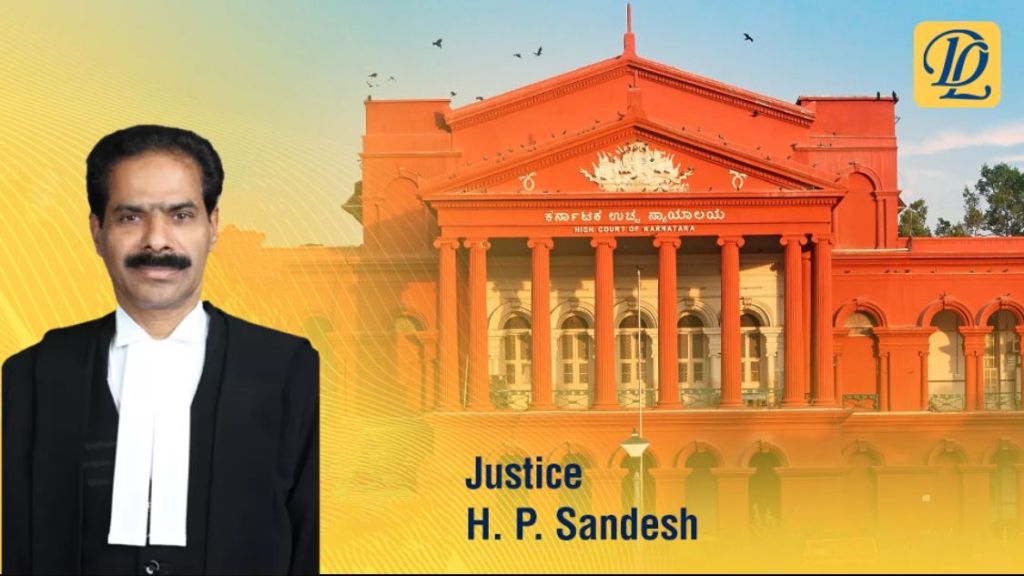
Hon’ble Mr. Justice H.P. Sandesh celebrates his 60h birthday today.
Hon’ble Mr. Justice Hethur Puttaswamygowda Sandesh: Born on December 2nd 1964, at Hethur in Sakaleshpur Taluk, Hassan District to Late Sri. Puttaswamy Gowda and Late Smt. Kaveramma as a second son. He had his Primary Education at Hethur and Sakaleshpur. Secondary Education at Pre-University Government College, Sakaleshpur.
Thereafter, obtained 5 years Law Degree from M. Krishna Law College, Mysuru University from 1987 to 1992 and started practice with Sri.K. Anantharamaiah, Senior Advocate on both Civil and Criminal Law at Hassan. Thereafter, shifted his practice to Bengaluru in 1994. He has practiced both on Civil and Criminal side in High Court and District Judiciary in Bengaluru.
Thereafter, directly selected as District & Sessions Judge in 2002 and worked as I Additional District & Sessions Judge, Mandya and Mangaluru, Principal Secretary to Hon’ble The Chief Justice, Registrar (Administration) in High Court of Karnataka, Principal District & Sessions Judge, Mysuru and Haveri, Registrar (Infrastructure), Registrar (Administration), Secretary to Hon’ble The Chief Justice, High Court of Karnataka, Chief Judge, Court of Small Causes, Registrar (Vigilance), High Court of Karnataka and elevated as Additional Judge, High Court of Karnataka on 03.11.2018 and permanent Judge on 26.02.2020.
Got married to Smt. Hemavathi and has two daughters by name Kum. Sahana Sandesh, who is an Engineering graduate and Kum. Sneha Sandesh, who is pursuing her MBBS., and now doing her internship in M.S.Ramaiah Medical College, Bengaluru.
Hobbies: Reading and playing Cricket.
Important judgments delivered by Hon’ble Justice H.P. Sandesh.
Criminal Procedure Code. Section 482. Mere pendency of civil suit on the issue is not a ground to quash criminal proceedings when serious allegations are made in chargesheet. Karnataka High Court.
Negotiable Instruments Act. Whether a cheque is issued in respect of a time barred debt is a matter for trial. Proceedings cannot be quashed on this ground. Karnataka High Court.
Criminal Procedure Code. Section 482. When prosecution prima facie establishes receipt of huge money by son relatable to crime of corruption by the father defence of private transaction cannot be accepted to quash proceedings. Karnataka High Court.
Negotiable Instruments Act. Section 138. Non mentioning of transaction date in the complaint is not fatal to the case when evidence is led to corroborate the transaction details. Karnataka High Court.
Negotiable Instruments Act. Imprisonment ordered in default of fine in different and independent transactions. Sentence will run consecutively and NOT concurrently. Karnataka High Court.
Cr.P.C. Section 482. Though a transaction is civil in nature, if the complaint specifically avers dishonest and fraudulent acts inducing complainant to part with money, the criminal proceedings can NOT be quashed. Karnataka High Court.
Rape. Alleged bad character of a woman does not justify sexual assault on her. Karnataka High Court condemns the police machinery which tried to protect the rapist police officer.
Motor Vehicles Act. Insurance Company is liable to pay compensation under personal accident claim benefit even when the borrower of the vehicle met with personal accident. Karnataka High Court.
Motor Vehicles Act. After 1994 amendment, in case of goods vehicle, owner or his authorised representative are covered and entitled for compensation even though policy was issued earlier to 1994. Karnataka High Court.
Motor Vehicles Act. Vehicle covered under valid insurance policy driven by person without a driving licence at the time of accident. Insurance company has to pay compensation and recover the same from the owner. Karnataka High Court.
Motor Vehicles Act. Comprehensive policy covers employee of owner of vehicle involved in accident. Insurance company is liable to pay compensation for death of such employee. Karnataka High Court.
Negotiable Instruments Act. Against the order of acquittal passed by the first appellate court, appeal to High Court under Section 378(4) Cr.P.C is maintainable. Karnataka High Court.
Forgery of document produced before the Court. If the document was already tampered before its production before the Court, bar under Section 195(1)(b)(ii) for prosecution will not apply. Karnataka High Court.
Complaint u/s 138 N.I. Act filed without application to condone delay. Limitation issue raised for the first time in appeal. Appellate Court can send matter back to trial court by permitting complainant to file necessary application. Karnataka High Court.
Review. An error, which is not self-evident and to be detected by the process of reasoning, can not be said to be an error apparent on the face of the record, justifying the Court to exercise the power of review. Karnataka High Court.
Suit for specific performance. When entire sale consideration is paid and possession of the property is also delivered to the agreement holder, the readiness and willingness issue becomes illusory. Karnataka High Court.
Defamation. Onus of proving two ingredients; truth of the imputation and the publication of the imputation for the public good, is on the accused. Karnataka High Court reiterates.
Food Adulteration Act, 1954. Court cannot frame charge for ‘adulteration’ when prosecution case is ‘misbranding’. Judgement based on such charge liable to be set aside. Karnataka High Court.
Make sure that men of integrity are posted to Anti Corruption Bureau which is established to prevent corruption. Karnataka High Court directs the Chief Secretary to Government.
”Financial dependency is not the Ark of The Covenant”. Even the married sons and daughters are also entitled to compensation under the MVC Act. Karnataka High Court.
Workmen’s Compensation Act. There is no bar to enhance compensation invoking Order XLI Rule 33 of the CPC even in the absence of an appeal by the claimants. Karnataka High Court.
Death of driver due to heart attack while taking rest in parked vehicle shall also be construed as death during the course of employment. Karnataka High Court.
Motor Vehicle Act. Karnataka High Court exercises power under Order 41 Rule 33 CPC to enhance compensation from 11 lakhs to 44 lakhs in the appeal filed by the Insurance Company.
MVC Act. Insurance Company cannot escape its liability by merely branding driving license as fake without actually proving the same. Karnataka High Court.
After collecting premium for one year, Insurance Company cannot disown its liability on the ground that the registration of the vehicle expired in the meanwhile. Karnataka High Court.
Workmen Compensation Act. When the employer has not maintained the register, the salary claim of the claimant has to be accepted. Karnataka High Court.
After issuing the policy, Insurance Company cannot avoid liability if the cheque towards premium is dishonoured unless the Insurer cancels the policy and intimates the insured. Karnataka High Court.
Failure to conclude criminal trial expeditiously cannot be a ground to grant bail when the involvement in serious offences is made out. Karnataka High Court.
Rejection of earlier bail petition does not bar the Court from considering further developments on different considerations in a successive bail petition subject to gravity of the offence. Karnataka High Court.
Even the illegitimate children of the deceased are entitled to compensation under the Motor Vehicles Act. Karnataka High Court.
Order rejecting bail petition does not preclude another petition on a later occasion giving more materials, further developments and different considerations. Karnataka High Court reiterates.
Order 41 Rule 33 CPC can be invoked to enhance compensation even in an appeal filed by the insured as well as Insurance Company in the absence of appeal filed by the claimant. Karnataka High Court.
Bail. Merely because another accused who was granted bail was armed with similar weapon is not sufficient to determine whether bail can be granted on the basis of parity. Karnataka High Court.
NDPS. Possession could mean physical possession with animus; exercise of dominion and control as a result of concealment; or personal knowledge as to the existence of the contraband and the intention based on such knowledge. Karnataka High Court.
Petition for anticipatory bail is NOT maintainable once accused appears through his Advocate and gets exemption from appearance. He can seek only regular bail. Karnataka High Court.
Hindu Succession Act. Grant of occupancy rights in favour of a woman member of the joint family under the Karnataka Land Reforms Act cannot be considered as her absolute property under Section 14. Karnataka High Court.
Permissive possession cannot be claimed as adverse possession unless the possession is adequate in continuity, adequate in publicity and adverse to a competitor. Karnataka High Court.
Limitation for suit for comprehensive relief of declaration and possession is 12 years under Article 65 and not 3 years under Article 58 of the Limitation Act. Karnataka High Court.
Suit for specific performance. When suit is filed after non-alienation period is over, the suit cannot be said to be barred by time especially when entire sale consideration is paid under the agreement of sale. Karnataka High Court.
Disposition property in unnatural, improbable or unfair manner and exclusion of or absence of adequate provisions for the natural heirs without any reason is a ground to doubt the execution of a Will. Karnataka High Court.
Though sale in violation of non-alienation clause is voidable, if no action is taken against the purchaser or the sale for long time, by virtue of Section 27 of the Limitation Act, the purchaser gets his title perfected. Karnataka High Court.
Arbitration and Conciliation Act. Limitation under Section 34(3) commences only from the date a signed copy of the award is delivered to the party applying for setting it aside. Mere knowledge of the award is not enough. Karnataka High Court.
Suit for partition filed several years after the property was sold by the karta or the mother is hit by the doctrine of acquiescence and the same is liable to be dismissed. Karnataka High Court.
Suit seeking direction to conduct prayers/mass prayers in Church in a particular language invoking fundamental right under Article 25 does not involve Canon Law. Plaint cannot be rejected on this ground. Karnataka High Court.
Suit or proceeding in relation to the guardianship of the person or the custody of, or access to, any minor, can be filed only before the Family Court and the District Court has no jurisdiction. Karnataka High Court.
Suit for partition filed three years after the minor coparcener attaining majority merely pleading that alienation of ancestral properties by karta is not binding on him is barred by law of limitation. Karnataka High Court.
Counter claim need not be within the pecuniary jurisdiction of a Court. When counter claim exceeds pecuniary jurisdiction, the Court shall return the plaint under Order 7 Rule 10 CPC to be presented before the proper Court. Karnataka High Court.
When the rent and the leased area are within the prescribed limit under the Rent Act, the Court must reject the plaint for ejection filed under the Transfer of Property Act. Karnataka High Court.
If the premises used for commercial purpose is more than fourteen square meters, it is excluded from the applicability of the Karnataka Rent Act. This can’t be defeated on the ground that its rent is less than the amount stipulated. Karnataka High Court.
Indian Succession Act. Jurisdiction of the court to grant Succession Certificate is based on the ordinary residence of the deceased at the time of death with an intention to stay at that place for a considerable length. Karnataka High Court.
Mere pendency of second appeal against dismissal of suit for specific performance of sale agreement between landlord and tenant is not a ground to postpone the eviction proceedings. Karnataka High Court.
Suit by purchaser of property during pendency of civil suit, seeking declaration that the decree passed in the suit is not binding on him, is not maintainable and the plaint is liable to be rejected. Karnataka High Court.
Plaintiff not signing every page of the plaint is not a ground to reject the plaint when the verification column is duly signed by the plaintiff. Karnataka High Court.
Cheque Bounce cases. Moratorium contained in Section 14 of the Insolvency and Bankruptcy Code applies only to Corporate Debtors. Directors are liable under Chapter XVII of the Negotiable Instruments Act. Karnataka High Court.
Constructive resjudicata under Order 2, Rule 2 of CPC does not apply when the later suit is based on fresh cause of action. Karnataka High Court.
When specific averments are made in the plaint, the defence is immaterial while considering application under Order 7, Rule 11. Karnataka High Court.
Resjudicata is a mixed question of fact and law. Plaint cannot be rejected under Order 7, Rule 11(d) of C.P.C. without holding full fledged trial. Karnataka High Court.
Attachment under Order 38 Rule 5 of CPC. Even where the defendant is removing or disposing his assets, attachment before judgment will not be issued if the plaintiff is not able establish prima facie case. Karnataka High Court.
Appeal against grant/refusal to grant temporary injunction. Appellate Court can mould the relief taking note of the relief sought in the Trial Court as on the date of suit. Karnataka High Court.
Sale cannot be set aside under Order XXI Rule 90 CPC unless there is material irregularity which has resulted substantial injury to the judgment-debtor. Karnataka High Court.
Grant of temporary injunction in suit based on defamation. Issue regarding territorial jurisdiction goes to the root of the matter and the Court must consider this issue before considering other aspects. Karnataka High Court.
Judgment of the foreign Court is not executable in India if the same is not on merits. Even when the defendant is placed exparte, the judgment ought to be the one based on evidence led by the plaintiff. Karnataka High Court.
Karnataka Public Premises (Eviction of unauthorized occupants) Act is not a bar for the public authority to file for eviction against a dismissed employee seeking possession of the service quarters. Karnataka High Court.
Karnataka Rent Act, 1999. Second revision petition under Section 115 of CPC is maintainable as against the revisional order passed by the District Court under Section 46. Karnataka High Court.
An independent suit questioning the compromise decree is not maintainable. Parties must approach the very same Court if any fraud or misrepresentation is alleged while obtaining the compromise decree. Karnataka High Court.
Second wife is not entitled to retirement benefits of her deceased husband. Karnataka High Court.
Section 5 of the Limitation Act can be invoked in an appeal filed under Section 37 of the Arbitration and Conciliation Act. Karnataka High Court.
Bar of Civil Court jurisdiction in a statute. Before considering the application for temporary injunction, the court must first consider the issue regarding jurisdiction. Karnataka High Court.
Judgment on admissions. It is not permissible for the Court to make roving enquiry for disposal of the application filed under Order XII Rule 6 of CPC. Karnataka High Court.
Karnataka Rent Act. Date of filing eviction petition governs the jurisdiction of the Court. Subsequent conduct of the parties will not oust the jurisdiction. Karnataka High Court.
When appeal against dismissal of suit for injunction is pending, the same does not give right to the defendant to seek injunction by way of fresh suit on same the cause of action pleaded by him. Karnataka High Court.
Successive anticipatory bail applications ought not to be entertained when the case diary and the status report clearly indicates that the accused is absconding and not cooperating with the investigation. Karnataka High Court.
Preventing bank from exercising its right under the SARFAESI Act in the guise of partition suit among family members with prayer for injunction is hit by Sections 35 and 36. Karnataka High Court.
Second suit for partition, instead of enforcing the earlier decree for partition within the period of limitation, is not maintainable. Plaint is liable to be rejected. Karnataka High Court.
Revocation of probate under the Indian Succession Act. Delay in applying for revocation cannot be considered when the service of notice and publication of citation was defective. Karnataka High Court.
Hindu Succession Act. Mother as class-I heir is entitled to a share in her deceased son’s property. Her death during the suit/appeal will not alter the situation since Section 15 gets attracted. Karnataka High Court.
Counter claim for possession based on dispossession/trespass. Trial Court is bound to raise the issue of limitation even in the absence of any pleadings with regard to limitation. Karnataka High Court.
Sale deed registered outside the State in respect of property situated within the State of Karnataka is a void document and does not confer any right. Karnataka High Court.
When a registered sale agreement is admitted by the vendor, it is not necessary to examine the witnesses to prove the agreement. Karnataka High Court.
Plaintiff cannot file rejoinder, pursuant to the written statement, as a matter of right without obtaining leave of the Court. Karnataka High Court.
When one party seriously disputes biological relationship with another in a civil suit, the court shall allow the application for DNA test at the instance of the person claiming such a relation. Karnataka High Court.
Order XXI Rule 97 CPC. Only person with independent right has the right to record resistance and not a party who is tracing his right through judgment debtor. Karnataka High Court.
Public or ex-servicemen cannot claim right of way through Class A1 land exclusively belonging to military invoking Article 19 (1) (d) of the Constitution of India. Karnataka High Court.
Land acquired and vested with the Government cannot be withdrawn from acquisition taking recourse to the General Clauses Act. Karnataka High Court.
Suit for partition without including all the joint family properties and without impleading all the co-sharers is not maintainable. Karnataka High Court.
A third party can institute separate suit challenging compromise award passed by the Lok-Adalat on the ground of fraud and undue influence. Karnataka High Court.
Suit for declaration cannot be decreed only on the basis of admission unless there is title deed showing the ownership. Karnataka High Court.
Indian Railways Act. Death or injury in the course of boarding or de-boarding train falls within the meaning of ‘’untoward incident’’. Victim is entitled to compensation. Karnataka High Court.
Specific Relief Act. A registered sale deed cannot be cancelled by another deed of cancellation even by the consent of the parties. The only mode is to re-transfer the property. Karnataka High Court.
Kartha/father can gift ancestral property in favour of his daughter within reasonable limits for pious purposes. Karnataka High Court.
Violation of Principles of Natural Justice itself is an independent ground for review of Judgment/order under Order 47 Rule 1 of the Civil Procedure Code. Karnataka High Court.
Compact Disk containing telephonically recorded conversation with Certificate under Section 65B of the Evidence Act is admissible as secondary evidence. Karnataka High Court.
Incidental finding on title in earlier suit for injunction will not act as resjudicata in a later suit unless the relief for injunction was founded or based on the finding on title. Karnataka High Court.
In a suit for injunction, valuation need not be split separately for Court fee and jurisdiction. It shall be valued only under Section 26(c) of the Karnataka Court Fees and Suits Valuation Act. Karnataka High Court.
Even in the absence of declaratory relief, Court can grant the relief of perpetual injunction with regard to the exercise of easementary right over the property. Karnataka High Court.
Order releasing the amount deposited under Section 148(3) N.I. Act does not amount to intermediate order since it is an interlocutory order. Revision before the High Court under Section 397 Cr.P.C. is not maintainable. Karnataka High Court.
Purchase of land and constructions put up subsequent to acquisition proceedings do not confer any right over the purchaser. Such person cannot maintain a suit for injunction against the acquiring body. Karnataka High Court.
When plaintiff’s suit for specific performance is barred by time, the defendant’s counter claim for possession can be granted by the Court. Karnataka High Court.
Purchaser of undivided share from a coparcener cannot insist on allotment of a particular developed portion in the partition when the construction was without the consent of the other coparceners. Karnataka High Court.
Hindu Women’s Rights Act. In the absence of an express prohibition in writing by the husband his widow had authority to make an adoption and such authority need not be proclaimed to anyone. Karnataka High Court.
Hindu Succession Act. Succession under Section 15 (2) is intended only to change the order of succession specified in sub-section (1) and not to completely eliminate other categories of heirs set out in sub-section (1). Karnataka High Court.
Arbitration agreement entered into after the 1996 Act came into force but making a reference to Indian Arbitration Act or the 1940 Act shall be governed only under the provisions of the 1996 Act. Karnataka High Court.
Indian Succession Act. Apart from the executor named in the Will, even other persons can seek for a probate under Section 276 depending on the circumstances. Karnataka High Court.
Statements in autobiography. Unless a full-fledged trial establishes defamatory nature of the statements, which are allegedly based on true facts, injunction cannot be granted restraining circulation of the book. Karnataka High Court.
Where title to property is not disputed, suit for possession and consequential injunction is maintainable without seeking declaration of title. Karnataka High Court.
Though a comprehensive suit for declaration is pending, fresh suit for injunction in respect of the same property is maintainable when additional parties are added and fresh cause of action is pleaded. Karnataka High Court.
In order to invoke Section 420 of IPC, there must be dishonest intention from the very beginning which is sine qua non to hold that accused is guilty for commission of the said offence. Karnataka High Court.
While considering the application for temporary injunction, trial court cannot go into merits of the case or validity of a compromise decree between the parties. Karnataka High Court.
Criminal Law. Circumstantial evidence. Proved circumstances must be consistent only with hypothesis of guilt of accused and totally inconsistent with his innocence. Karnataka High Court.
 Daksha Legal